From Surf Wiki (app.surf) — the open knowledge base
Bay Area Rapid Transit
Rapid transit system serving the San Francisco Bay Area

Rapid transit system serving the San Francisco Bay Area
| Field | Value | ||||
|---|---|---|---|---|---|
| box_width | 300px | ||||
| name | Bay Area Rapid Transit (BART) | ||||
| image | Bart-logo.svg | ||||
| imagesize | 100px | ||||
| image2 | BART train from Farallones Street footbridge (1), July 2023.JPG | ||||
| imagesize2 | 300px | ||||
| caption2 | BART train in southern San Francisco | ||||
| locale | San Francisco Bay Area (Alameda, Contra Costa, San Francisco, San Mateo, and Santa Clara counties) | ||||
| transit_type | {{plainlist | ||||
| lines | |||||
| stations | 50 (7 planned/proposed) | ||||
| daily_ridership | () | ||||
| annual_ridership | () | ||||
| chief_executive | Robert Powers | ||||
| headquarters | 2150 Webster Street | ||||
| Oakland, California | |||||
| website | |||||
| began_operation | |||||
| character | Fully grade separated with at-grade, elevated and underground sections | ||||
| train_length | {{plainlist | ||||
| * 6–9 cars<ref name | "Train Size Change 2023" / (10 cars, 710 ft max) | ||||
| vehicles | 805 total, with 700+ available for service; with 8 DMU vehicle sets (eBART); and 4 AGT vehicle sets | ||||
| operator | San Francisco Bay Area Rapid Transit District | ||||
| headway | 20 minutes (4 of 5 service lines), 10 minutes (1 service line) | ||||
| system_length | 131.4 mi | ||||
| track_gauge | {{plainlist | ||||
| * Main system: {{track gauge | 5ft6in | lk | on}} | ||
| * eBART: {{track gauge | ussg | lk | on}} | ||
| minimum_radius_of_curvature | 120 m | ||||
| el | Third rail, 1 kV DC | ||||
| average_speed | 35 mph | ||||
| top_speed | {{plainlist | ||||
| * {{convert | 80 | mph | km/h | abbr | on}} (maximum) |
| * {{convert | 70 | mph | km/h | abbr | on}} (typical) |
| map | {{switcher | ||||
| {{maplink-road | from | Bay Area Rapid Transit.map}} | |||
| {{Bay Area Rapid Transit lines | inline | yes}} | |||
| map_state | show |
- Rapid transit (main system)
- Hybrid rail (eBART)
- AGT (Oakland Airport Connector) Oakland, California
- 6–9 cars (10 cars, 710 ft max)
- 2-car married pair (DMUs)
- 3 cars (AGT)
- Main system:
- eBART:
- 80 mph (maximum)
- 70 mph (typical) | | Show interactive map | [[File:BART system map.png|275px]] | Show static map | [[File:BART evening map.png|275px]] | Show static map (evenings) | | Show route diagram
Bay Area Rapid Transit (BART) is a rapid transit system serving the San Francisco Bay Area in California. BART serves 50 stations along six routes and 131 mi of track, including eBART, a 9 mi spur line running to Antioch, and Oakland Airport Connector, a 3 mi automated guideway transit line serving Oakland San Francisco Bay Airport. With an average of weekday passenger trips as of and annual passenger trips in , BART is the seventh-busiest rapid transit system in the United States.
BART is operated by the San Francisco Bay Area Rapid Transit District which formed in 1957. The initial system opened in stages from 1972 to 1974. The system has been extended several times, most recently in 2020, when Milpitas and Berryessa/North San José stations opened as part of the under construction Silicon Valley BART extension in partnership with the Santa Clara Valley Transportation Authority (VTA).
Services
BART serves large portions of its three member counties – San Francisco, Alameda, and Contra Costa – as well as smaller portions of San Mateo County and Santa Clara counties. The system has 50 stations: 22 in Alameda County, 12 in Contra Costa County, 8 in San Francisco, 6 in San Mateo County, and 2 in Santa Clara County. BART operates five named heavy rail services plus one separate automated guideway line. All of the heavy rail services run through Oakland, and all but the Orange Line cross the bay through the Transbay Tube to San Francisco. All five services run every day until 9 pm; only three services operate evenings after 9 pm. All stations are served during all service hours. The eastern segment of the (between Antioch and the transfer platform east of Pittsburg/Bay Point) uses different rolling stock and is separated from the rest of the line.
| Route name | First | ||||||
|---|---|---|---|---|---|---|---|
| service | Length | ||||||
| (mi) | Termini | Lines used | date=February 14, 2022 | title=BART Schedules (PDF) | url=https://www.bart.gov/schedules/pdfs | access-date=August 3, 2022 | publisher=San Francisco Bay Area Rapid Transit District}} |
| 1972 | 51 | Berryessa/ | |||||
| North San José | Richmond | R, K, A, S | |||||
| 1973 | 62.2 | SFO (until 9pm) | Antioch | C, K, M, W, Y, E | |||
| Millbrae (after 9pm) | |||||||
| 1974 | 53 | Daly City | Berryessa/ | ||||
| North San José | S, A, M | ||||||
| 1976 | 38.2 | Millbrae | Richmond | R, K, M, W, Y | |||
| 1997 | 35.7 | Daly City | Dublin/ | ||||
| Pleasanton | L, A, M | ||||||
| 2014 | 3.2 | OAK | Coliseum | H |
Hours and frequencies
BART's network topology, which mixes densely-packed urban stations served at high frequencies by multiple interlined services along a central trunk (West Oakland to Daly City, served by all lines but the Orange) with branching suburban lines with widely-spaced stations and lower frequencies, is similar to European S-Bahn systems. Trains on each primary service run every 20 minutes, except the busy Yellow Line, which operates every 10 minutes on weekdays. However, many stations are served by multiple lines; the trunk between West Oakland and Daly City receives 15 trains per hour (average four-minute headways) in peak hours. The Oakland Airport Connector runs "on demand", typically on headways of 10 minutes or less.
Timed cross-platform transfers are available between the Orange Line, which runs north-south through the East Bay, and the Yellow Line, which operates through the Transbay Tube to serve the San Francisco Peninsula. This service complements the Red Line during daytime hours and replaces that line when it stops operating after 9:00 p.m.
The first inbound trains leave outer terminals around 5:00 am on weekdays, 6:00 am on Saturdays, and 8:00 am on Sundays and most holidays. The last trains of the service day leave their terminals around midnight; the final Yellow and Orange Line trains in both directions meet at MacArthur station, and the final Orange and Blue Line trains in the southbound direction meet at Bay Fair station, for guaranteed transfers.
Bus services
Two different bus networks are operated by regional transit agencies as a rail replacement bus service when BART is not operating due to regularly scheduled maintenance during the overnight hours.
The All Nighter network provides basic bus service to San Francisco, the East Bay, and Peninsula, replicating rail transit services in those regions, including BART, Caltrain, and Muni Metro. All Nighter buses serve most BART stations (directly or within several blocks), replicating 3-Line late night BART service with abbreviated routes:
- Buses replicating Yellow Line service terminate at Rockridge (stations east of Rockridge to the regular terminus at Antioch are not served)
- Buses replicating Blue Line service terminate at Bay Fair (stations east to Dublin/Pleasanton are not served)
- Buses replicating Orange Line service terminate at Fremont (stations south to Berryessa/North San José are not served) The All Nighter-branded bus service started in 2006, although late night bus service had been provided as an alternative to BART prior to then.
The network is another bus alternative which provides service to major BART stations in the early morning between 3:50 am and 5:30 am. Early Bird Express buses are operated by local transit agencies, including AC Transit, Golden Gate Transit, Muni, and SamTrans, running between a limited number of major BART stations on San Francisco/Peninsula and Transbay routes which all meet at the Salesforce Transit Center. Early Bird Express routes are identified by three-digit route numbers starting with 7xx. , there are six Early Bird Express routes, replicating 3-Line service:
- Yellow Line bus substitute operating to and from Millbrae (Peninsula)
- Blue Line bus operating to and from Daly City (San Francisco)
- Yellow Line buses operating from Pittsburg/Bay Point and Pleasant Hill (Transbay)
- Blue Line bus operating from Dublin/Pleasanton (Transbay)
- Orange Line bus operating from El Cerrito del Norte (Transbay) The original Early Bird Express network was introduced in February 2019 when the start of rail service was shifted from 4 a.m. to 5 a.m. to accommodate seismic upgrades in the Transbay Tube; at its debut, it featured fifteen routes, but some were eliminated later that year due to low ridership. Additional routes were eliminated in 2024, including an inbound bus from Fremont replicating Orange Line service.
Historically, BART operated bus service between 1974 and 1997, extending transit coverage to central and eastern Alameda and Contra Costa counties; these routes were discontinued following the completion of rail line extensions starting in the late 1990s. BART Express was operated for BART under contracts to AC Transit (1974–1989) and Laidlaw (1989–1997). Since then, some services similar to the legacy BART Express routes which were not replaced by rail service have been taken over by local bus operators, including WestCAT and Tri Delta Transit.
To accommodate those with conditions and disabilities that prevent from boarding a train, BART has entered a joint venture with AC Transit to establish East Bay Paratransit to provide paratransit bus services.
Connecting services
Intermodal connections to local, regional, and intercity transit – including bus, light rail, commuter rail, and intercity rail – are available across the BART system. Three Amtrak intercity rail services – the California Zephyr, Capitol Corridor, and Gold Runner – stop at Richmond station; the Capitol Corridor also stops at Oakland Coliseum station. Transfer between BART and the Caltrain commuter rail service is available at Millbrae station.
BART and most lines of San Francisco's Muni Metro light rail system share four stations (Embarcadero, Montgomery Street, Powell Street, and Civic Center/UN Plaza) in the Market Street subway; connections are also available to three lines at Balboa Park station and one line at Glen Park station. A tunnel at the Powell Street station connects to the Union Square/Market Street station on the Muni Metro T Third Street line. In the South Bay, Milpitas station provides a connection to the Orange Line of VTA light rail.
BART is served by bus connections from regional and local transit agencies at all stations, most of which have dedicated off-street bus transfer areas. Many connecting routes (particularly in suburban areas) serve primarily as feeder routes to BART. Larger bus systems connecting to BART include Muni in San Francisco, AC Transit in the East Bay, SamTrans in San Mateo County, County Connection and Tri Delta Transit in eastern Contra Costa County, WestCAT in western Contra Costa County, WHEELS in the Tri-Valley, VTA in the Santa Clara Valley, and Golden Gate Transit. Smaller systems include Emery Go-Round in Emeryville, Commute.org on the Peninsula, San Leandro LINKS, Dumbarton Express, and Union City Transit. The Salesforce Transit Center regional bus hub is located one block from Embarcadero and Montgomery stations.
Several transit agencies offer limited commuter-oriented bus service from more distant cities to outlying BART stations; these include VINE from Napa County, Solano Express from Solano County, Rio Vista Delta Breeze, Stanislaus Regional Transit Authority from Stanislaus County, and San Joaquin RTD from Stockton. Many BART stations are also served by privately run employer and hospital shuttles, and privately run intercity buses stop at several stations.
Airport connections
Main article: Oakland International Airport station, San Francisco International Airport station
BART also runs directly to two of the three major Bay Area airports (San Francisco International Airport and Oakland International Airport) with service to San Jose International Airport provided by a VTA bus route available at Milpitas station.
History
Origins, planning, and geographical coverage
Some of the Bay Area Rapid Transit system's current coverage area was once served by an electrified streetcar and suburban train system called the Key System. This early 20th-century system once had regular transbay traffic across the lower deck of the Bay Bridge, but the system was dismantled in the 1950s, with its last transbay crossing in 1958, and was superseded by highway travel. A 1950s study of traffic problems in the Bay Area concluded the most cost-effective solution for the Bay Area's traffic woes would be to form a transit district charged with the construction and operation of a new, high-speed rapid transit system linking the cities and suburbs. Marvin E. Lewis, a San Francisco trial attorney and member of the city's board of supervisors, spearheaded a grassroots movement to advance the idea of an alternative bay crossing and the possibility of regional transit network.
Formal planning for BART began with the setting up in 1957 of the San Francisco Bay Area Rapid Transit District, a county-based special-purpose district body that governs the BART system. The district initially began with five members, all of which were projected to receive BART lines: Alameda County, Contra Costa County, the City and County of San Francisco, San Mateo County, and Marin County. Although invited to participate, Santa Clara County supervisors elected not to join BART due to their dissatisfaction that the peninsula line only stopped at Palo Alto initially, and that it interfered with suburban development in San Jose, preferring instead to concentrate on constructing freeways and expressways. Though the system expanded into Santa Clara County in 2020, as of June 2024 it is still not a district member.
In 1962, San Mateo County supervisors voted to leave BART, saying their voters would be paying taxes to carry mainly Santa Clara County residents (presumably along I-280, SR 92, and SR 85). The district-wide tax base was weakened by San Mateo's departure, forcing Marin County to withdraw a month later. Despite the fact that Marin had originally voted in favor of BART participation at the 88% level, its marginal tax base could not adequately absorb its share of BART's projected cost. Another important factor in Marin's withdrawal was an engineering controversy over the feasibility of running trains on the lower deck of the Golden Gate Bridge, an extension forecast as late as three decades after the rest of the BART system. The withdrawals of Marin and San Mateo resulted in a downsizing of the original system plans, which would have had lines as far south as Palo Alto and northward past San Rafael. Voters in the three remaining participating counties approved the truncated system, with termini in Fremont, Richmond, Concord, and Daly City, in 1962.
Construction of the system began in 1964, and included a number of major engineering challenges, including excavating subway tunnels in San Francisco, Oakland, and Berkeley; constructing aerial structures throughout the Bay Area, particularly in Alameda and Contra Costa counties; tunneling through the Berkeley Hills on the Concord line; and lowering the system's centerpiece, the Transbay Tube connecting Oakland and San Francisco, into a trench dredged onto the floor of San Francisco Bay. Like other transit systems of the same era, BART endeavored to connect outlying suburbs with job centers in Oakland and San Francisco by building lines that paralleled established commuting routes of the region's freeway system. BART envisioned frequent local service, with headways as short as two minutes between trains through the Transbay Tube and six minutes on each individual line.
Early years and train control problems
Passenger service began on September 11, 1972, initially just between MacArthur and Fremont. The rest of the system opened in stages, with the entire system opening in 1974 when the transbay service through the Transbay Tube began. The new BART system was hailed as a major step forward in subway technology, although questions were asked concerning the safety of the system and the huge expenditures necessary for the construction of the network. Ridership remained well below projected levels throughout the 1970s, and direct service from Daly City to Richmond and Fremont was not phased in until several years after the system opened.
Some of the early safety concerns appeared to be well founded when the system experienced a number of train-control failures in its first few years of operation. As early as 1969, before revenue service began, several BART engineers identified safety problems with the Automatic Train Control (ATC) system. The BART Board of Directors was dismissive of their concerns and retaliated by firing them. Less than a month after the system's opening, on October 2, 1972, an ATC failure caused a train to run off the end of the elevated track at the terminal Fremont station and crash to the ground, injuring four people. The "Fremont Flyer" led to a comprehensive redesign of the train controls and also resulted in multiple investigations being opened by the California State Senate, California Public Utilities Commission, and National Transportation Safety Board. Hearings by the state legislature in 1974 into financial mismanagement at BART forced the General Manager to resign in May 1974, and the entire Board of Directors was replaced the same year when the legislature passed legislation leading to the election of a new Board and the end of appointed members.
Extensions
Main article: Bay Area Rapid Transit expansion
Even before the BART system opened, planners projected several possible extensions. Although Marin County was left out of the original system, the 1970 Golden Gate Transportation Facilities Plan considered a tunnel under the Golden Gate or second deck on the bridge, but neither of these plans was pursued. Over twenty years would pass before the first extensions to the BART system were completed to North Concord/Martinez in 1995, Colma and Pittsburg/Bay Point in 1996. An extension to Dublin/Pleasanton in 1997 added a fifth line to the system for the first time in BART's history. The system was expanded to San Francisco International Airport in 2003 and to Oakland International Airport via an automated guideway transit spur line in 2014. eBART, an extension using diesel multiple units along conventional railroad infrastructure between Pittsburg/Bay Point and Antioch on the Yellow Line, opened on May 26, 2018. BART's most significant current extension project is the Silicon Valley BART extension on the Green and Orange Lines. The first phase extended the Fremont line to Warm Springs/South Fremont in early 2017, and the second phase to Berryessa/North San José began service on June 13, 2020. The third phase to Santa Clara is contingent upon the allocation of funding , but is planned to be completed by 2036.
Plans had long been floated for an extension from Dublin to Livermore, but the most recent proposal was rejected by the BART board in 2018. Other plans have included an extension to Hercules, a line along the Interstate Highway 680 corridor, and a fourth set of rail tracks through Oakland. At least four infill stations such as Irvington and Calaveras on existing lines have been proposed. With the Transbay Tube nearing capacity, long-range plans included a new four-bore Transbay Tube beneath San Francisco Bay that would run parallel and south of the existing tunnel and emerge at the Transbay Transit Terminal to connect to Caltrain and the future California High-Speed Rail system. The four-bore tunnel would provide two tunnels for BART and two tunnels for conventional/high-speed rail. The BART system and conventional U.S. rail use different and incompatible rail gauges and different loading gauges. In 2018, BART announced that a feasibility study for installing a second transbay crossing would commence the following year. By 2019, the Capitol Corridor Joint Powers Authority (CCJPA) had joined with BART to study a multi-modal crossing, which could also allow Capitol Corridor and San Joaquins routes to serve San Francisco directly.
System modernization
In 2007, BART stated its intention to improve non-peak (night and weekend) headways for each line to 15 minutes. The 20-minute headways at these times is a barrier to ridership. In mid-2007, BART temporarily reversed its position, stating that the shortened wait times would likely not happen due to a $900,000 state revenue budget shortfall. Nevertheless, BART eventually confirmed the implementation of the plan by January 2008. Continued budgetary problems halted the expanded non-peak service and returned off-peak headways to 20 minutes in 2009.
In 2008, BART announced that it would install solar panels at two yards, maintenance facilities, and Orinda station (the only station that receives sufficient sunlight to justify installation cost).
In 2012, the California Transportation Commission announced that they would provide funding for expanding BART facilities, through the Santa Clara Valley Transportation Authority, in anticipation of the opening of the Silicon Valley Berryessa Extension. $50 million would go in part to improvements to the Hayward Maintenance Complex.
In March 2019, BART announced that they would begin updating ticket add-fare machines inside the paid area to accept debit and credit cards for payment (for Clipper cards only). In December 2020, BART completed the changeover to Clipper and stopped issuing magstripe paper tickets. Existing paper tickets remained valid. In April 2021, BART began accepting Clipper cards on Apple Pay, Google Pay, and the Clipper app at all BART stations. By December 2023, the fare system was entirely Clipper-only. Beginning August 20, 2025, riders no longer need a Clipper card, and can pay using physical contactless credit or debit cards, or mobile payment methods, such as Apple Pay and Google Pay.
During the 1989 Loma Prieta earthquake, the BART equipment was mostly undamaged. A 2010 study concluded that along with some Bay Area freeways, some of BART's overhead structures could collapse in a major earthquake, which has a significant probability of occurring within three decades. Seismic retrofitting has been carried out since 2004 upon voter approval to address these deficiencies, especially in the Transbay Tube. BART projects that Transbay Tube retrofits were completed by 2024.
Rolling stock
Main article: Bay Area Rapid Transit rolling stock
Car types


The mainline BART network operates with electric powered, self-propelled railcars. For most lines, six cars are coupled together in a train, except the Yellow Line, which uses nine-car trains. BART trains have gangway connections, and passengers can move freely between cars. The cars have three doors on each side, bike racks, 54 seats per car, and interior and exterior displays giving information. The new cars, branded by BART as its "Fleet of the Future", were unveiled in April 2016. The first cars were expected to be in service in December 2016, however, glitches and a failed CPUC inspection delayed introduction to January 19, 2018. A total of 775 cars were ordered from Bombardier (which merged with Alstom during production): 310 cab cars (D-cars) and 465 non-cab cars (E-cars). , BART has received all 775 D and E cars, of which 769 have been certified for service. To run its peak service, BART requires 400 cars. Of those, 384 are scheduled to be in active service; the others are used to build up spare trains (used to maintain on-time service).
The previous BART fleet, consisting of A, B, and C cars, was built between 1968 and 1996. It was retired from regular service on September 11, 2023, with the final revenue runs on April 20, 2024.
The Oakland Airport Connector uses a completely separate and independently operated fleet of cable car-based automated guideway transit vehicles. It uses four Cable Liner trains built by DCC Doppelmayr Cable Car, arranged as three-car sets, but the system can accommodate four-car trains in the future.
The eBART extension uses eight Stadler GTW diesel railcars. The Stadler GTW vehicles are diesel multiple units, which operate over standard gauge tracks (as opposed to BART's broad gauge).
| Lines | Manufacturer | Class | Image | Car | |||
|---|---|---|---|---|---|---|---|
| numbers | Qty. | Built | |||||
| Main system | Bombardier/ | ||||||
| Alstom | D | [[File:Future Fleet Open House at El Cerrito Del Norte Station (cropped).jpg | 100px]] | 3001–3310 | 310 | 2012–2024 | |
| E | [[File:BART E cars at 19th Street Oakland station, March 2018.jpg | 100px]] | 4001–4465 | 465 | |||
| Oakland Airport Connector | Doppelmayr | Cable Liner | [[File:OAK-Coliseum Airport Mover.jpg | 100px]] | 1.3–4.3 | 4 sets | 2014 |
| eBART | Stadler | GTW | [[File:Westbound eBART train approaching Pittsburg Center station, May 2018.JPG | 100px]] | 101–108 | 8 | 2016 |
| Lines | Manufacturer | Class | Image | Car | ||||
|---|---|---|---|---|---|---|---|---|
| numbers | Qty. | Built | Retired | |||||
| Main system | Rohr | A | [[File:Bart A car Oakland Coliseum Station.jpg | 100px]] | 1164–1276 | 59 | 1968–1975 | April 20, 2024 |
| B | [[File:BART train at Fruitvale station 2.JPG | 100px]] | 1501–1913 | 380 | 1971–1975 | |||
| Alstom | C1 | [[File:BART C1 car at Fruitvale station, March 2018.JPG | 100px]] | 301–450 | 150 | 1987–1990 | May 15, 2023 | |
| Morrison–Knudsen | C2 | 2501–2580 | 80 | 1994–1996 | August 2021 |
Depots
The initial BART system included car storage and maintenance yards in Concord, Hayward, and Richmond, with an additional maintenance only (no car storage) yard in Oakland. The Daly City car storage and maintenance yard opened in December 1988. The Oakland Airport Connector uses the Doolittle Maintenance and Storage Facility. eBART vehicles use a facility in Antioch.
Fares

Fare schedule
BART has distance-based fares, which requires riders to use fare gates to both enter and exit, with a flat fare of $2.15 for trips under 6 miles. A surcharge is added for trips traveling through the Transbay Tube ($1.40), to/from Oakland International Airport ($6.70) or San Francisco International Airport ($4.95), and to/from San Mateo County ($1.45, except $1.25 for Daly City). The maximum fare, including both airport surcharges and the Transbay surcharge, is $17.60; the maximum without surcharges (–) is $10.30. , the average fare paid is $3.93.
Because of the varied fares, it is possible to enter the system with enough stored value for a shorter trip, but not a longer trip. Passengers without sufficient fare to complete their journey must use an add-fare machine to add value in order to exit the station.
Before August 20, 2025, entering and exiting at the same station within 30 minutes incurred an "excursion fare" of $6.40 – significantly higher than many station-to-station fares. This was originally introduced to allow people to tour the then-futuristic system; it was kept to discourage undesired behaviors such as tech bus riders using BART parking lots. The excursion fare has been criticized for negatively impacting riders who leave stations during service disruptions (although station agents can allow riders to exit without fare payment). As of August 20, 2025, riders paying using the contactless Tap and Ride system have a 30-minute grace period to avoid the BART excursion fare; Clipper card users still need to see an agent to avoid it.
As of December 2022, BART is working to implement a 30-minute "grace period" before the fare is charged.
Unlike many other rapid transit systems, BART does not have weekly or monthly passes with unlimited rides. The only discount provided to the general public is a 6.25% reduction when "high value tickets" (only available on Clipper cards with autoload) are purchased with fare values of $48 and $64. 50% discount is available to youth aged 5–18 (children age 4 and under ride free), and a 62.5% discount is provided to seniors and the disabled. The Clipper START program for low-income adults provides a 50% discount. The San Francisco Muni and BART offer a combined monthly "A" Fast Pass, which allows unlimited rides on Muni services plus BART service within San Francisco.
In August 2022, BART launched Clipper BayPass, a two-year pilot program to examine the viability of a transit pass that is compatible with all the public transit agencies in the Bay Area. The program was initially made available to around 50,000 college students and affordable housing residents.
Fare media
The primary fare media for BART is the Clipper card, which is used by most Bay Area transit agencies. Clipper is a contactless smart card; passengers tap in and out at card readers on fare gates. Clipper cards in Apple Pay and Google Wallet electronic wallets can also be used. As of August 20, 2025, riders can also pay using physical contactless credit or debit cards, or mobile payment methods, such as Apple Pay and Google Pay.
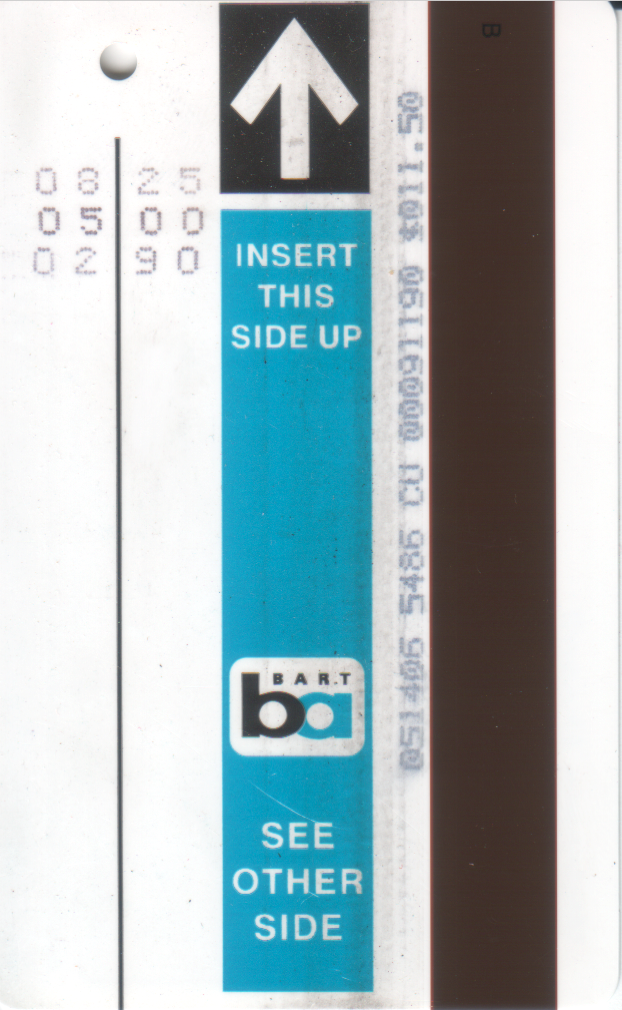
BART's original fare system used tickets made of a paper-plastic composite with a magnetic stripe. The tickets were sold by fare vending machines. When exiting, fare gates read the magnetically stored value on the card, encoded the new value with the fare subtracted, and printed the new value on the card. Tickets with no remaining value were retained by the machine rather than being returned. The entire fare system was designed and built by IBM under a $7 million contract (equivalent to $ million in ). It was the third system in the US to use encoded-value magnetic stripe tickets, following the Illinois Central Gulf commuter line (now the Metra Electric District) in 1964 and the PATCO Speedline in 1968.
Although tickets could be refilled at fare machines, riders often discarded tickets with small values remaining. BART formerly relied on unused ticket values on such discarded cards for additional revenue – as much as $9.9 million annually in 1999 (equivalent to $ million in ). Tickets stopped being sold in December 2020 in favor of Clipper cards, and can no longer be used. A 50-cent surcharge per trip (25 cents for discounted fares) is applied to all journeys made on paper tickets. However, due to supply chain shortages resulting in a lack of plastic Clipper cards, BART started issuing tickets again at the SFO station in October 2022. Sales of paper tickets again ended on September 30, 2023, and they were no longer usable after November 30.
BART first piloted a smart card for fare payment called EZ Rider in 2006; this program was abandoned in 2010 in favor of a regional farecard. In 2009, BART became one of the first five transit agencies to accept TransLink (later renamed Clipper) cards for fare payment and began phasing out tickets. By December 2020, all BART ticket machines, except for add-fare machines inside of paid areas, were converted to Clipper use only. Tickets were no longer accepted starting in December 2023.
Ridership levels
Ridership by year
For most of its history, BART's ridership has reflected the U.S. economy, growing modestly during periods of economic expansion and dropping slightly during recessions. A major exception occurred in 1989 in the aftermath of the Loma Prieta earthquake, which severely damaged the San Francisco–Oakland Bay Bridge, causing its closure for a month. BART became the only direct route between the East Bay and San Francisco, resulting in a nearly 17% ridership jump for the 1990 fiscal year. Ridership would not drop back to previous levels after the repair of the bridge until the COVID-19 pandemic began to affect the Bay Area in March 2020.
Between 2010 and 2015, BART ridership grew rapidly, mirroring strong economic growth in the Bay Area. In 2015, the system was carrying approximately 100,000 more passengers each day than it had five years earlier. High gasoline prices also contributed to growth, pushing ridership to record levels during 2012, with the system recording five record ridership days in September and October 2012.
After six straight years of expansion, ridership growth began to slow in late 2016, dropping by 1.7% in October 2016 from the prior year. Although the fiscal year ending June 30, 2017, showed an average weekday ridership of 423,395, the second-highest in BART's history, this was a 2.3% drop from FY 2016. Ridership continued to decline by approximately 3% per year between 2016 and 2019, mirroring a nationwide decline in mass transit ridership in the second half of the decade. The Washington Post and LA Streetsblog attributed the national decline in ridership to changes in commute patterns, the fall in gasoline prices since 2014, and competition from the private sector in the form of ride-hailing services such as Uber and Lyft. Ride-hailing has especially affected ridership on the lines to the San Francisco International Airport and the Oakland International Airport. At SFO, ride-hailing services grew by a factor of almost six or nearly 500% at the airport between 2014 and 2016. BART planners believe that competition from Uber and Lyft is reducing overall ridership growth and BART's share of airport transit.
Stations in the urban cores of San Francisco, Oakland, and Berkeley have the highest ridership, while suburban stations record lower rider numbers. During fiscal year 2017, the busiest station was Embarcadero with 48,526 average weekday exits, followed by Montgomery Street with 45,386. The busiest station outside of San Francisco was 12th Street Oakland City Center with 13,965 riders, followed by 19th Street Oakland with 13,456. The least busy station was Oakland International Airport with 1,517 riders, while the least busy standard BART station was North Concord / Martinez with 2,702 weekday exits.
BART's one-day ridership record was set on Halloween of 2012 with 568,061 passengers attending the San Francisco Giants' victory parade for their World Series championship. This surpassed the record set two years earlier of 522,198 riders in 2010 for the Giants' 2010 World Series victory parade. Before that, the record was 442,100 riders in October 2009, following an emergency closure of the Bay Bridge. During a planned closure of the Bay Bridge, there were 475,015 daily riders on August 30, 2013, making that the third highest ridership. On June 19, 2015, BART recorded 548,078 riders for the Golden State Warriors championship parade, placing second on the all-time ridership list.
BART set a Saturday record of 419,162 riders on February 6, 2016, coinciding with Super Bowl 50 events and a Golden State Warriors game. That easily surpassed the previous Saturday record of 319,484 riders, which occurred in October 2012, coinciding with several sporting events and Fleet Week. BART set a Sunday ridership record of 292,957 riders in June 2013, in connection with the San Francisco Gay Pride Parade, surpassing Sunday records set the previous two years when the Pride Parade was held.
Ridership dropped sharply during the COVID-19 pandemic and associated lockdowns beginning in March 2020, during which BART was forced to drastically cut service. Ridership in the weeks immediately following the start of the Bay Area's lockdown (on March 17, 2020) fell by as much as 93%. If ridership does not recover and additional revenue is not obtained, in the worst case the agency projected it would only be able to sustain trains on three lines running once an hour from 5am to 9pm weekdays, and would have to close nine stations. , weekday ridership is at 41% of pre-pandemic levels, Saturday ridership is at 63%, and Sunday ridership is at 75%.
In a 2022 survey, 31% of riders report household income below $50,000 (up from 26% in 2018), and 44% did not own a vehicle (up from 31% in 2018). Compared to the region, BART riders are more likely to be Black or Latino, and less likely to be White or Asian.
Infrastructure

The entirety of the system runs in exclusive, grade-separated right-of-way. BART's rapid transit revenue routes cover about 131 mi with 50 stations. On the main lines, approximately 28 mi of lines run through underground sections with 32 mi on elevated tracks. 1,000 volts DC is delivered to the trains over a third rail. An automated guideway transit line and an additional station were opened in 2014, using off-the-shelf cable car technology developed by DCC Doppelmayr Cable Car: the Cable Liner. The section of the Antioch-SFO/Millbrae line east of the Pittsburg/Bay Point station, known as eBART, runs on conventional unelectrified rail.
BART trains are so unpleasantly noisy that a recording while inside the Transbay Tube, described as "the worst sound in the history of man", was used in the 2008 horror video game Dead Space. The main system uses an unusual broad gauge (mostly seen in India and Pakistan) and mostly ballastless track. Originally using flat-edge rail and wheelsets with cylindrical treads, in 2016 BART started switching to conical treads to reduce the noise caused by flange/rail contact and loss of adhesion of one of the wheels on curves.
Schedules call for trains to operate at up to 70 mph, but certain segments (in particular, the Transbay Tube) are designed for 80 mph operation when making up delays.
, rapid transit trains are typically six cars long, except on the Yellow Line, which uses eight-car trains. The minimum train length is four cars, and the maximum length is ten cars. A ten-car train is 710 ft, the longest of any metro system in the United States, and extending slightly beyond the 700 ft platforms. Cars are 10.5 ft wide, the maximum gradient is four percent, and the minimum curve radius is 394 ft. The combination of unique loading gauges and unusual rail technologies has complicated maintenance and increased cost of the system, as rolling stock requires custom wheelsets, brake systems, and power systems.
Many of the original 1970s-era stations, especially the aerial stations, feature simple Brutalist architecture, but newer stations are a mix of Neomodern and Postmodern architecture. The additional double-tracked 4 mi upper deck of the Market Street subway and its four underground stations were built by BART for Muni Metro.
Lines
lettered linesThe routes run on track segments ("lines"), which are internally, but not commonly, known by letters.
| Line | Endpoints | Opened | Right of way | Heavy rail | Light rail | Automated guideway transit (AGT) |
|---|---|---|---|---|---|---|
| A-Line | Oakland Wye – Fremont | September 11, 1972 | Former Western Pacific Railroad right-of-way (UP Oakland Subdivision), tunnel near the Oakland Wye | |||
| C-Line | Rockridge – Pittsburg/Bay Point | May 21, 1973 (to Concord) | ||||
| December 16, 1995 (to North Concord/Martinez) | ||||||
| December 7, 1996 (to Pittsburg/Bay Point) | SR 24 median, Berkeley Hills Tunnel, former Sacramento Northern Railway right-of-way, SR 4 median | |||||
| K-Line | Oakland Wye – Rockridge | September 11, 1972 (to MacArthur) | ||||
| May 21, 1973 (to Rockridge) | Tunnel under Broadway, SR 24 median | |||||
| L-Line | Bay Fair – Dublin/Pleasanton | May 10, 1997 | Median of I-238, median of I-580 | |||
| M-Line | Oakland Wye – Daly City Yard (north of Colma) | November 5, 1973 (Daly City – Montgomery Street) | ||||
| September 16, 1974 (Montgomery Street – Oakland Wye) | ||||||
| December 9, 1988 (to Daly City Yard) | Elevated above 5th and 7th streets, Transbay Tube, tunnel under Market Street and Mission Street, former Southern Pacific Railroad right-of-way (Ocean View Branch) | |||||
| R-Line | MacArthur – Richmond | January 29, 1973 | Elevated above Martin Luther King Jr. Way, tunnel under Adeline St and Shattuck Ave, former Santa Fe right-of-way | |||
| S-Line | Fremont – Berryessa/North San José | March 25, 2017 (to Warm Springs/South Fremont) | ||||
| June 13, 2020 (to Berryessa/North San José) | Tunnel under Fremont Central Park, former Western Pacific Railroad right-of-way (San Jose Branch) | |||||
| W-Line | Daly City Yard – Millbrae | February 24, 1996 (to Colma) | ||||
| June 22, 2003 (to Millbrae) | Former Southern Pacific Railroad right-of-way (Ocean View Branch), shared Caltrain right-of-way | |||||
| Y-Line | W-Line – San Francisco International Airport | June 22, 2003 | Elevated wye into San Francisco International Airport | |||
| E-Line | Pittsburg/Bay Point – Antioch | May 26, 2018 | SR 4 median | |||
| H-Line | Coliseum – Oakland International Airport | November 22, 2014 | Mostly elevated above Hegenberger Road, depressed section below Doolittle Drive |
| frame-lat = 37.80 | frame-long = -122.27 | frame-width = 750 | frame-height = 470
Automation
BART was one of the first U.S. rail transit systems of any size to be substantially automated. Routing and dispatching of trains, and adjustments for schedule recovery are controlled by a combination of computer and human supervision at BART's Operations Control Center (OCC) and headquarters at the Kaiser Center in Downtown Oakland. Station-to-station train movement, including speed control and maintenance of separation between successive trains, is entirely automatic under normal operation, the operator's routine responsibilities being issuing announcements, closing the doors after station stops, and monitoring the track ahead for hazards. In unusual circumstances the operator controls the train manually at reduced speed.
Parking
Many BART stations offer parking; however, underpricing causes station parking lots to overflow in the morning. Pervasive congestion and underpricing forces some to drive to distant stations in search of parking. BART operates Parking Lots at 36 stations and offers parking passes for designated spots at many stations.
BART offers long-term airport parking through a third-party vendor at most East Bay stations. Travelers must make an online reservation in advance and pay the daily fee of $5 before they can leave their cars at the BART parking lot.
Parking at stations in Santa Clara County (Milpitas and Berryessa/North San José) is managed by Santa Clara Valley Transportation Authority rather than BART.
Accessibility
All BART trains have dedicated spaces for wheelchair users and every station has accessible elevators. Estimated train arrival times and service announcements are both displayed on platform-level screens and announced audibly over the public address system. Station platforms are equipped with tactile paving to aid those with visual impairments, and Braille/tactile signs are present throughout stations.
Platform elevators

At some stations, the elevator to the platform (which is inside the paid area) is accessed from an unpaid area of the station. To enter the BART system at one of these stations, passengers using the elevator must first pass through a faregate into the paid area and then exit back through the swing gate adjacent to the station agent booth before taking the elevator to the platform. To exit the system from one of these stations, passengers must do the reverse: take the elevator from the platform to the concourse level, enter the paid area through the swing gate, and then process their ticket at a faregate to exit the paid area once again. Station agents may be able to assist upon request. The configuration of these stations enables fare evasion and causes confusion for passengers.
As of 2020, eighteen stations had a platform elevator outside of the paid area. Of these, three stations had ticket processing machines near the elevators that allowed elevator users to avoid having to enter, then exit, then re-enter the paid area; however, these did nothing to deter fare evasion. BART has begun to correct this issue at stations either by expanding the paid area on the concourse level or by installing a single accessible faregate in front of the elevator doors. By December 2021, the number of stations with elevators outside the paid area had been reduced to eight. Five of these stations had elevator faregates installed by January 2023, while the paid area on the concourse level at was expanded to include a new elevator as part of a larger renovation. As of March 2023, only Orinda and Powell Street stations have a platform elevator outside the paid area. New elevator faregates are expected to be installed at these two remaining stations by April 2023.
Cell phone and Wi-Fi
In 2004, BART became the first transit system in the United States to offer cellular telephone communication to passengers of all major wireless carriers on its trains underground. Service was made available for customers of Verizon Wireless, Sprint/Nextel, AT&T Mobility, and T-Mobile in and between the four San Francisco Market Street stations from Civic Center to Embarcadero. In 2009, service was expanded to include the Transbay Tube, thus providing continuous cellular coverage between West Oakland and Balboa Park. In 2010, service was expanded to all underground stations in Oakland (19th Street, 12th Street/Oakland City Center, and Lake Merritt).
In 2007, BART ran a beta test of Wi-Fi Internet access for travelers. It initially included the four San Francisco downtown stations: Embarcadero, Montgomery, Powell, and Civic Center. It included above ground testing to trains at BART's Hayward Test Track. The testing and deployment were extended into the underground interconnecting tubes between the four downtown stations and further. The successful demonstration provided for a ten-year contract with WiFi Rail, Inc. for the services throughout the BART right of way. In 2008, the Wi-Fi service was expanded to include the Transbay Tube. BART terminated the relationship with Wi-Fi Rail in December 2014, citing that WiFi Rail had not submitted an adequate financial or technical plan for completing the network throughout the BART system.
In 2011, during the Charles Hill killing and aftermath BART disabled cell phone service to hamper demonstrators. The ensuing controversy drew widespread coverage that raised legal questions about free speech rights of protesters and the federal telecommunications laws that relate to passengers. In response, BART released an official policy on cutting off cell phone service.
Organization and management
| 2012 statistics |
|---|
| Number of vehicles |
| Initial system cost |
| Equivalent cost in 2004 dollars (replacement cost) |
| Hourly passenger capacity |
| Maximum daily capacity |
| Average weekday ridership |
| Annual operating revenue |
| Annual expenses |
| Annual profits (losses) |
| Rail cost/passenger mile (excluding capital costs) |
Governance
The San Francisco Bay Area Rapid Transit District is a special district consisting of Alameda County, Contra Costa County, and the City and County of San Francisco. San Mateo County, which hosts six BART stations, and Santa Clara County, which hosts two, are not part of the BART District. A nine-member elected Board of Directors represents nine districts. BART has its own police force.
While the district includes all of the cities and communities in its jurisdiction, some of these cities do not have stations on the BART system. This has caused tensions among property owners in cities like Livermore who pay BART taxes but must travel outside the city to receive BART service. In areas like Fremont, the majority of commuters do not commute in the direction that BART would take them (many Fremonters commute to San Jose). This would be remedied with the completion of the Silicon Valley BART extension. Phase I of the extension opened on June 13, 2020, giving San Jose its first BART station, Berryessa/North San José station.
BART Board of Directors
| District | Stations Included | Counties Included | Board Member |
|---|---|---|---|
| 1 | Concord, Lafayette, Pleasant Hill/Contra Costa Centre, Walnut Creek | Contra Costa | Matt Rinn |
| 2 | Antioch, Concord (partial), North Concord/Martinez, Pittsburg/Bay Point, Pittsburg Center | Contra Costa | Mark Foley |
| 3 | Bay Fair, Downtown Berkeley, El Cerrito del Norte (partial), El Cerrito Plaza (partial), North Berkeley, Orinda, Rockridge, San Leandro | Alameda/Contra Costa | Barnali Ghosh |
| 4 | Bay Fair, Coliseum, Fruitvale, Hayward (partial), Oakland International Airport, San Leandro, and South Hayward (partial) | Alameda | Robert Raburn |
| 5 | Castro Valley, Dublin/Pleasanton, Hayward, West Dublin/Pleasanton | Alameda | Melissa Hernandez |
| 6 | Fremont, South Hayward (partial), Union City, Warm Springs/South Fremont | Alameda | Liz Ames |
| 7 | Ashby, El Cerrito del Norte (partial), El Cerrito Plaza (partial), MacArthur (partial), Montgomery (partial), Richmond, West Oakland, Embarcadero (partial) | Alameda/Contra Costa/San Francisco | Victor Flores |
| 8 | Balboa Park, Embarcadero (partial), Glen Park (partial), Montgomery (partial), Powell Street (partial) | San Francisco | Janice Li |
| 9 | 16th Street Mission, 24th Street Mission, Glen Park, Civic Center, Powell Street, Balboa Park (partial) | San Francisco | Edward Wright |
BART General Managers
- B. R. Stokes (1963–1974)
- Larry Dahms (Acting)
- Frank Herringer
- Keith Bernard
- Frank Wilson (1989–1994)
- Richard A. White (1994–1996)
- Thomas Margro (1996–2007)
- Dorothy Dugger (2007–2011)
- Grace Crunican (2011–2019)
- Bob Powers (2019–present)
Budget
In 2005, BART required nearly $300 million in funds after fares. About 37% of the costs went to maintenance, 29% to actual transportation operations, 24% to general administration, 8% to police services, and 4% to construction and engineering. In 2005, 53% of the budget was derived from fares, 32% from taxes, and 15% from other sources, including advertising, station retail space leasing, and parking fees. BART reported a farebox recovery ratio of 75.67% in February 2016, up from 2012's 68.2%. BART train operators and station agents have a maximum salary of $62,000 per year with an average of $17,000 in overtime pay. (BART management claimed that in 2013, union train operators and station agents averaged about $71,000 in base salary and $11,000 in overtime, and pay a $92 monthly fee from that for health insurance.)
Incidents and controversies
BART Police shootings
Oscar Grant III
Main article: Shooting of Oscar Grant
On January 1, 2009, a BART Police officer, Johannes Mehserle, fatally shot Oscar Grant III. Eyewitnesses gathered direct evidence of the shooting with video cameras, which were later submitted to and disseminated by media outlets and watched hundreds of thousands of times in the days following the shooting. Both peaceful and violent demonstrations occurred protesting the shooting.
BART held multiple public meetings to ease tensions led by BART Director Carole Ward Allen who called on the BART Board to hire two independent auditors to investigate the shooting, and to provide recommendations to the board regarding BART Police misconduct. Director Ward Allen established BART's first Police Department Review Committee and worked with Assemblyman Sandre Swanson to pass AB 1586 in the California State Legislature, which enforced civilian oversight of the BART Police Department. BART Director Lynette Sweet said that "BART has not handled this [situation] correctly," and called for the BART police chief and general manager to step down, but only one other BART Director, Tom Radulovich, supported such action.
Mehserle was arrested and charged with murder, to which he pleaded not guilty. Oakland civil rights attorney John Burris filed a US$25 million wrongful death claim against the district on behalf of Grant's daughter and girlfriend. Mehserle's trial was subsequently moved to Los Angeles following concerns that he would be unable to get a fair trial in Alameda County. On July 8, 2010, Mehserle was found guilty on a lesser charge of involuntary manslaughter. He was released on parole on June 13, 2011.
Charles Hill
On July 3, 2011, an officer of the BART Police shot and killed Charles Hill at Civic Center Station in San Francisco. Hill had thrown a bottle at the officers and was in the process of throwing a knife at them from a distance of about 15 feet when the first shot was fired.
On August 12, 2011, BART shut down cellphone services on the network for three hours in an effort to hamper possible protests against the shooting and to keep communications away from protesters at the Civic Center station in San Francisco. The shutdown caught the attention of state senator Leland Yee and international media, as well as drawing comparisons to the internet shutdowns during the Egyptian revolution earlier that year. Antonette Bryant, the union president for BART, stated that "BART have lost our confidence and are putting rider and employee safety at risk."
Members of Anonymous broke into BART's website and posted names, phone numbers, addresses, and e-mail information on the Anonymous website.
On August 15, 2011, there was more disruption in service at BART stations in downtown San Francisco. The San Francisco Examiner reported that the protests were a result of the shootings, including that of Oscar Grant.
On August 29, 2011, a coalition of nine public interest groups led by Public Knowledge filed an Emergency Petition asking the U.S. Federal Communications Commission (FCC) to declare "that the actions taken by the Bay Area Rapid Transit District ("BART") on August 11, 2011, violated the Communications Act of 1934, as amended, when it deliberately interfered with access to Commercial Mobile Radio Service ("CMRS") by the public" and "that local law enforcement has no authority to suspend or deny CMRS, or to order CMRS providers to suspend or deny service, absent a properly obtained order from the Commission, a state commission of appropriate jurisdiction, or a court of law with appropriate jurisdiction".
In December 2011 BART adopted a new "Cell Service Interruption Policy" that only allows shutdowns of cell phone services within BART facilities "in the most extraordinary circumstances that threaten the safety of District passengers, employees and other members of public, the destruction of District property, or the substantial disruption of public transit service". According to a spokesperson for BART, under the new policy the wireless phone system would not be turned off under circumstances similar to those in August 2011. Instead police officers would arrest individuals who break the law.
In February 2012, the San Francisco District Attorney concluded that the BART Police Officer that shot and killed Charles Hill at the Civic Center BART station the previous July "acted lawfully in self defense" and would not face charges for the incident.
In March 2012, the FCC requested public comment on the question of whether or when the police and other government officials can intentionally interrupt cellphone and Internet service to protect public safety.
A federal lawsuit filed against BART by Charles Hill's brother was dismissed in 2013. The federal judge concluded that "a reasonable officer in that situation could believe that he was in danger of being hit by a knife after having had a bottle thrown at him." The lawyers of Hill's family did not dispute that he had thrown a knife at the officer, but argued that both officers should have done more to deescalate the situation.
Worker fatalities
1979 fatal electrical fire
In January 1979, an electrical fire occurred on a train as it was passing through the Transbay Tube. One firefighter (Lt. William Elliott, 50, of the Oakland Fire Department) was killed in the effort to extinguish the blaze. Since then, safety regulations have been updated.
James Strickland
On October 14, 2008, track inspector James Strickland was struck and killed by a train as he was walking along a section of track between the Concord and Pleasant Hill BART stations. Strickland's death started an investigation into BART's safety alert procedures. At the time of the accident, BART had assigned trains headed in opposite directions to a shared track for routine maintenance. BART came under further fire in February 2009 for allegedly delaying payment of death benefits to Strickland's family.
October 2013 incident
On October 19, 2013, a BART engineering manager and contractor were struck and killed by a train near Walnut Creek while inspecting a track defect. Due to an ongoing labor strike, both the track workers and the train operators were working outside their usual roles. The train was carrying management employees being trained as substitute operators and maintenance workers. The track workers were working under a safety protocol known as "simple approval" which required the workers to be aware of train movements and provide their own protection. The National Transportation Safety Board found that the "simple approval" practice was the probable cause of the incident. BART was fined $600,000 for the incident.
Crime
Fare Evasion
In 2019, BART estimated that 5% of riders evade fares, costing an estimated $15 to $25 million annually. In March 2023, BART announced plans to install new gates resistant to fare evasion. The project, which was projected to cost $90 million, began with a pilot program at West Oakland station and was completed system-wide in August 2025.
Violent Crime
In mid-2017, BART came under criticism for refusing to publicly release video evidence of crimes committed at Oakland stations. That year, in at least three incidents, groups of young people had boarded stopped trains and attacked and robbed train riders. In response to the criticism, a BART manager argued that "to release these videos would create a high level of racially insensitive commentary toward the district [...] and in addition it would create a racial bias in the riders against minorities on the trains." According to an internal memo, the agency decided to not issue a press release about one of the cases (where a woman had her phone stolen by one of a group of teenagers) in order to avoid having BART look "crime ridden" and because it would "unfairly affect and characterize riders of color, leading to sweeping generalizations in media reports." A spokesman also stated that state laws about "juvenile police records" prohibited BART from releasing surveillance video.
In 2018, BART released surveillance video from one of the 2017 incidents, showing (as summarized by KRON4) "the moments leading up to a mob-style attack on a BART train [... with] about 40 teens jumping the fare gates and pushing through the emergency gates at the station as an overwhelmed station agent calls for help." BART stated that two juveniles and an 18-year-old had been arrested for the incident, with the 18-year-old ending up serving one year in jail. In September 2017, six victims of the robberies/assaults filed suit against BART for gross negligence, claiming BART did not provide adequate security for its riders. In January 2020, two passengers affected by the same incident lost their lawsuits, one of them on the grounds that she had been attacked on the platform rather than on the train, outside of BART's common carrier duties.
On July 22, 2018, a man fatally stabbed 18-year-old Nia Wilson with a knife as she exited a train car at the MacArthur station. This was the third homicide at a BART station within five days. In June 2019, the Alameda County Civil Grand Jury released a report documenting a 128% increase in thefts on BART between 2014 and 2018, and an 83% increase in aggravated assault during the same time period.
Racially biased design
In the 1960s, BART was designed to speed white suburban commuters past minority urban neighborhoods. For example, it has stop spacing of 2.75 mi in the racially diverse and dense urban neighborhood of San Antonio, Oakland, but 1.75 mi in majority-white suburban Walnut Creek and Pleasant Hill. --
References
Notes
References
- (July 25, 2019). "BART selects Robert Powers as new general manager". San Francisco Chronicle.
- (December 29, 2020). "New Train Car Project".
- (August 14, 2023). "BART unveils reimagined schedule starting in September aimed at increasing ridership". Bay Area Rapid Transit.
- "BART – Car Types". Bay Area Rapid Transit.
- Glover, Julian. (May 19, 2020). "BART announces service start date for long-awaited Milpitas, San Jose Berryessa stations". ABC7 News.
- (January 10, 2022). "BART schedule change begins 2/14/22, extending service to midnight on Sundays". Bay Area Rapid Transit District.
- (2022). "Every day until 9pm: 5-Line Service". Bay Area Rapid Transit District.
- (February 14, 2022). "BART Schedules (PDF)". San Francisco Bay Area Rapid Transit District.
- Cano, Ricardo. (April 27, 2023). "This BART line's trains will run more frequently under new schedule changes". San Francisco Chronicle.
- (May 16, 2024). "Transit Information: Late Night Bus Services". Metropolitan Transportation Commission.
- (May 19, 2006). "Now transit stays up as late as you! Catch the "All Nighter" bus service". San Francisco Bay Area Rapid Transit District.
- "Early Bird Express". San Francisco Bay Area Rapid Transit District.
- (November 5, 2018). "BART to open at 5am starting 2-11-2019 with alternative bus service provided". San Francisco Bay Area Rapid Transit District.
- (January 30, 2019). "Early Bird Express (flyer)". San Francisco Bay Area Rapid Transit District.
- (2019). "Early Bird Express". San Francisco Bay Area Rapid Transit District.
- (June 4, 2019). "EBX June 2019 Service Improvements". San Francisco Bay Area Rapid Transit District.
- (December 10, 2019). "Early Bird Express service changes coming 12/16". San Francisco Bay Area Rapid Transit District.
- (August 4, 2024). "BART to reduce some Early Bird Express Bus trips starting August 12, 2024". San Francisco Bay Area Rapid Transit District.
- "BART Express".
- (2016). "Short-Range Transit Plan". Western Contra Costa Transit Authority.
- (2020). "Short Range Transit Plan". Eastern Contra Costa Transit Authority.
- "Who Provides East Bay Paratransit".
- "Transit Center Maps and Information". Alameda Contra Costa Transit District.
- "A History of BART: The Concept is Born". Bay Area Rapid Transit.
- Healy, Michael C.. (2016). "BART: The Dramatic History of the Bay Area Rapid Transit System". Heyday.
- (March 12, 2013). "History of BART to the South Bay". [[San Jose Mercury News]].
- "A History of BART: The Concept is Born". Bart.gov.
- {{BART History
- See BART Composite Report, prepared by Parsons Brinkerhof Tutor Bechtel, 1962
- "A History of BART: the Concept is Born".
- "A History of BART: The Project Begins".
- W. S. Homburger. "The impact of a new rapid transit system on traffic on parallel highway facilities". Transportation Planning and Technology.
- (May 1, 1976). "Automatic Train Control in Rail Rapid Transit". United States Congress Office of Technology Assessment.
- (September 13, 1972). "BART– Not a Moment Too Soon". Los Angeles Times.
- (August 2025). "BART First in Operation: 2nd great subway boom under way in many cities".
- Gillam, Jerry. (November 15, 1972). "Safe Automated BART Train Controls Doubted". Los Angeles Times.
- Lembke, Daryl. (November 16, 1972). "BART Manager Denies System Was Overcharged by Designers". Los Angeles Times.
- Stephen Unger. (April 29, 2010). "The BART Case". The Online Ethics Center for engineering and science.
- (December 9, 1972). "Troubles Beset Transit System in San Francisco Bay Area". The New York Times.
- Bill Northwood. (November 29, 1972). "What is BART, and why are we saying such terrible things about it?". KPFA Pacifica Radio.
- (May 1, 1976). "Automatic Train Control in Rail Rapid Transit". United States Congress Office of Technology Assessment.
- Peter Sheerin. (October 1, 1990). "Bill Wattenburg's Background: BART—Bay Area Rapid Transit System".
- (March 1, 1973). "Bigger bugs in BART?". IEEE Spectrum Magazine.
- (May 25, 2013). "Legislative Analyst's Office 75th anniversary". Legislative Analyst's Office (LAO) of the State of California.
- (May 25, 2013). "B.R. Stokes, ex-BART general manager, dies". San Francisco Chronicle.
- Bill Wattenburg. (February 15, 1974). "BART: Countdown to San Francisco". Commonwealth Club of California.
- "BART historical timeline". BART.
- "Golden Gate Bridge, Highway and Transportation District 1970–71 Annual Report". Golden Gate Bridge, Highway and Transportation District.
- (November 21, 2014). "New BART service to Oakland International Airport now open". Bay Area Rapid Transit (BART).
- (2012). "Celebrating 40 Years of Service 1972 • 2012 Forty BART Achievements Over the Years". Bay Area Rapid Transit (BART).
- (October 4, 2023). "San Jose BART extension will be further delayed and cost more". San Jose Mercury News.
- Cabanatuan, Michael. (May 24, 2018). "BART board votes down extension to Livermore". San Francisco Chronicle.
- Cabanatuan, Michael. (June 22, 2007). "BART'S New Vision: More, Bigger, Faster". San Francisco Chronicle.
- (April 25, 2013). "BART Metro Vision Update". Bay Area Rapid Transit (BART).
- Fortson, Jobina. (November 15, 2018). "BART considering 2nd Transbay Tube, 24 hour service".
- Bizjak, Tony. (February 20, 2019). "How trains under the bay – not high-speed rail – may connect Sacramento and San Francisco". Sacramento Bee.
- Cuff, Denis. (May 29, 2007). "BART board wants to lessen waits".
- (October 1, 2007). "Good move by BART".
- Bay Area Rapid Transit. "Off-peak service reductions began Monday, September 14th".
- Dennis, Cuff. (July 10, 2008). "BART goes solar at Orinda station". [[Contra Costa Times]].
- (December 7, 2012). "Santa Clara VTA receives state funding to expand BART facilities". RT&S.
- (March 15, 2019). "BART add-fare machines inside fare zones will finally start accepting credit cards". [[San Francisco Examiner]].
- (December 14, 2020). "BART completes systemwide conversion to Clipper-only sales". San Francisco Bay Area Rapid Transit District.
- "Clipper card now supported on iPhone and Apple Watch".
- (August 20, 2025). "Tap and Ride: Contactless Payment".
- (August 13, 2025). "BART is (finally) rolling out contactless payment". SF Standard.
- "Earthquake Safety Program Technical Information". Bay Area Rapid Transit District.
- (February 11, 2013). "Earthquake Safety Program". Bay Area Rapid Transit District.
- "Digging Deeper: Crews Rework Deep Welds on BART's Seismic Retrofit {{!}} 2021-03-22 {{!}} Engineering News-Record".
- "Transbay Tube Retrofit {{!}} bart.gov".
- "U.S. Subway Car Design Behind the Curve".
- (April 6, 2016). "Onsite testing begins for BART's first new train car".
- Rodriguez, Joe Fitzgerald. (November 7, 2017). "BART's new train cars fail regulatory test, possibly delaying rollout". San Francisco Examiner.
- Cabanatuan, Michael. (January 18, 2018). "New BART rail cars approved for service". San Francisco Chronicle.
- Brinklow, Adam. (January 19, 2018). "New BART cars go into service today". Curbed SF.
- Richman, Josh. (May 10, 2012). "BART board approves contract for 410 new train cars". [[San Jose Mercury News]].
- Bowen, Douglas John. (May 11, 2012). "BART taps Bombardier; U.S. content at issue".
- (November 21, 2013). "Board Meeting Agenda". San Francisco Bay Area Rapid Transit District.
- "New Train Car Project". Bay Area Rapid Transit District.
- (2013). "New Train Car Project".
- Chinn, Jerold. (January 29, 2015). "Long wait ahead for longer BART trains".
- Cabanatuan, Michael. (April 10, 2010). "BART can't keep pace with rising 'crush loads'". SFGate.
- (August 24, 2023). "Sizing Trains for Safety and Efficiency".
- (April 16, 2024). "BART invites the public to "ride through history" at a legacy car retirement ceremony and final ride on 4/20/24". San Francisco Bay Area Rapid Transit District.
- (May 19, 2015). "East Contra Costa BART Extension (eBART) Implementation". Bay Area Rapid Transit (BART).
- (April 26, 2014). "Stadler Rail delivers trains to Oakland". [[Stadler Rail]].
- (October 2018). "FY19 Short Range Transit Plan and Capital Improvement Program". San Francisco Bay Area Rapid Transit District.
- (July 1, 2022). "Clipper Fares". San Francisco Bay Area Rapid Transit District.
- (June 9, 2022). "BART Board approves two-year budget focused on rider experience". San Francisco Bay Area Rapid Transit District.
- (August 2021). "BART Basics Guide". San Francisco Bay Area Rapid Transit District.
- Cabanatuan, Michael. (August 5, 2022). "This little-known BART fare can cost you $6.70, even if you don't step foot on a train". San Francisco Chronicle.
- "Tap and Ride: Contactless Payment".
- Bartlett, Amanda. (December 6, 2022). "A new policy change will eliminate this annoying BART fee". San Francisco Chronicle.
- "Discounts". San Francisco Bay Area Rapid Transit District.
- Walsh, Eli. (August 19, 2022). "Pilot program launches for transit pass compatible with all Bay Area transit agencies". [[KTVU]].
- (August 17, 2022). "Clipper BayPass pilot program launched; transit pass to be used on all Bay Area public transit agencies". [[CBS News]].
- (August 20, 2025). "Tap and Ride: Contactless Payment".
- (August 13, 2025). "BART is (finally) rolling out contactless payment". SF Standard.
- Rodda, R. Scott. (July 1993). "Evolving Fare Technologies". Transportation Research Board.
- (September 10, 1972). "Ticket Machines Treat You Farely". Oakland Tribune.
- Healy, Michael C.. (2016). "BART: The Dramatic History of the Bay Area Rapid Transit System". Heyday.
- (1996). "TCRP Report 10: Fare Policies, Structures, and Technologies". Transportation Research Board.
- Carroll, Jon. (December 6, 2000). "Tiny Tickets Ha Ha Ha Ha". The San Francisco Chronicle.
- "BART will no longer accept paper/magstripe tickets beginning Nov 30 {{!}} Bay Area Rapid Transit".
- Baldassari, Erin. (June 22, 2017). "BART: 50-cent surcharge for paper tickets, expanded discount for youth". The Mercury News.
- (October 19, 2022). "Supply chain woes: MTC, BART encourage adding Clipper card on mobile phones".
- (September 11, 2023). "BART to end sale of paper tickets, including at SFO, beginning September 30, 2023". San Francisco Bay Area Rapid Transit District.
- "BART enhances "EZ Rider" card with parking payment option {{!}} bart.gov".
- (November 10, 2010). "BART Phasing Out EZ Rider Passes in Switch to Clipper".
- Gordon, Rachel. (August 4, 2009). "BART starts accepting TransLink fare cards".
- (2025-02-19). "2024 Q4 Ridership report". [[American Public Transportation Association.
- (2017). "Total Annual Exits FY1973 – FY2017". San Francisco Bay Area Rapid Transit District.
- "BART can't keep pace with rising 'crush loads'". SFGate.
- "October BART ridership soaring". BART.
- (December 5, 2016). "Uber and Lyft use at SFO increases six-fold in two years, BART loses ridership".
- "Nationwide Transit Ridership Falls 2.9% in June".
- (February 20, 2016). "Ripple effect of Metro's troubles: plummeting bus ridership across the region".
- (January 29, 2016). "What Factors Are Causing Metro's Declining Ridership? What Next?".
- (December 5, 2016). "Uber and Lyft use at SFO increases six-fold in two years, BART loses ridership".
- (December 5, 2016). "Uber and Lyft use at SFO increases six-fold in two years, BART loses ridership".
- (December 17, 2018). "Ride-hailing companies fly off with BART's airport riders". San Francisco Chronicle.
- "Average Weekday Exits by Station". BART.
- (October 31, 2012). "BART marks all-time highest ridership day in 40 years of service". BART.
- (November 4, 2010). "World Series parade boosts BART ridership to highest day ever – past half-million". BART.
- "11.01.2009 BART customers continue to set ridership records". Bart.gov.
- (August 30, 2013). "BART ridership soars during Bay Bridge closure". KTVU.
- (June 20, 2015). "Warriors parade BART's second highest ridership day". BART.
- Alexander, Kurtis. (February 7, 2016). "Super Bowl helps BART crush weekend-day ridership record". San Francisco Chronicle.
- (February 8, 2016). "BART ends milestone week with a record; next challenge: playing catch-up". BART.
- (October 7, 2012). "BART shatters Saturday ridership record, adds capacity for Sunday". BART.
- (June 30, 2013). "Pride Parade Service Breaks Sunday Ridership Record". BART.
- SFGATE, Silas Valentino. (November 22, 2022). "'A death spiral': BART considers cutting weekend service".
- "Ridership Watch: daily updates related to riders returning to BART".
- (2023-04-04). "2022 BART Customer Satisfaction Study". BART Marketing & Research Dept..
- Dowd, Katie. (2019-01-13). "'The worst sound in the history of man': How BART trains turned terror in 'Dead Space'".
- (March 24, 2013). "Why does BART use wider, non-standard gauge rails? – BayRail Alliance".
- Shivy, Gregory. (May 2016 }}{{Dead link). "BART Wheel Profile Change".
- (September 2, 2016). "The Four-Year Fight to Make San Francisco's Subway Stop Screaming".
- "BART System Facts". San Francisco Bay Area Rapid Transit District.
- (July 24, 2006). "BART reduces trains speeds, station lighting, to help PG&E and state power grid").
- (June 2013). "BART Sustainable Communities Operations Analysis". San Francisco Bay Area Rapid Transit District.
- (July 3, 2000). "BART Train length". Google Groups: ba.transportation.
- Paul Garbutt. (1997). "World Metro Systems". Capital Transport.
- Gafni, Matthias. (March 25, 2016). "Has BART's cutting-edge 1972 technology design come back to haunt it?". San Jose Mercury News.
- (October 2012). "Rail Capacity Improvement Study for Heavy Rail Transit Operations". Federal Transit Administration.
- Bay Area Rapid Transit. "Geospatial Data".
- Orenstein, Natalie. (March 19, 2019). "'Troubleshooting on the fly': Riding in the cab with a BART operator".
- "BART parking overview". BART.
- Richards, Gary. (October 7, 2015). "Opening of BART Warm Springs station pushed back to next year". San Jose Mercury News.
- "BART parking".
- "Long-Term Parking for Travelers". BART.
- "Wheelchair or Limited Mobility". San Francisco Bay Area Rapid Transit District.
- "Low Vision or Blind {{!}} bart.gov".
- Moench, Mallory. (December 7, 2020). "BART's new gate stopped some fare cheats this year. How will the agency pay for more?".
- (December 3, 2020). "Next Generation Fare Gates Update".
- (February 9, 2022). "New Embarcadero platform fare gate speeds up transfer to Muni, improves accessibility, reduces fare evasion". San Francisco Bay Area Rapid Transit District.
- (2016). "GO Uptown Gateway to Oakland Uptown: 2016 TIGER Grant Project Summary". San Francisco Bay Area Rapid Transit District.
- (March 24, 2022). "Next Generation Fare Gates Update".
- "New Fare Gates & Station Hardening {{!}} bart.gov".
- Michael Cabanatuan. (November 19, 2005). "Underground, but not unconnected – BART offers wireless service to riders". San Francisco Chronicle.
- "BART expands wireless access to Transbay Tube | bart.gov".
- "BART expands wireless network to underground stations in downtown Oakland | bart.gov".
- (February 2009). "WiFi Rail Inc. to provide wifi access on BART system". BART.
- (June 2009). "WiFi Rail Tube Access". KRON 4.
- (December 30, 2014). "BART scraps Wi-Fi contract, prompting threats of legal action". Sfgate.
- Elinson, Zusha. (August 11, 2011). "BART Cuts Cell Service to Foil Protest". The Bay Citizen.
- (March 2, 2012). "US regulators seek input on cell phone interruptions".
- Rachel Lackert. (May 1, 2012). "BART Cell Phone Service Shutdown: Time for a Virtual Forum?".
- (August 12, 2012). "BART's Cell Phone Shutdown, One Year Later".
- "BART Police". BART.
- (July 17, 2003). "BART's Livermore role reviewed". Contra Costa Times.
- (2005). "BART 2005 Annual Report".
- "BART 2016 Factsheet". Bay Area Rapid Transit.
- (December 6, 2012). "Sustainable BART".
- Griffin, Melissa. (June 13, 2013). "BART labor seeking more money for not laboring". [[The San Francisco Examiner]].
- (July 3, 2013). "San Francisco rail strike continues as commuters face third day of chaos". [[The Guardian]].
- (January 2, 2009). "Deadly BART brawl – officer shoots rider, 22". San Francisco Chronicle.
- (2009). "Spokesman: Officer in subway shooting has resigned". CNN.
- Elinor Mills. (2009). "Web videos of Oakland shooting fuel emotions, protests". [[CNET Networks]].
- (January 8, 2009). "Protests over BART shooting turn violent". San Francisco Chronicle.
- Terry Collins. (January 11, 2009). "Transit board gets another earful on Oakland death". Associated Press.
- Maria L. La Ganga. (January 13, 2009). "BART board creates commission to oversee transit police". [[Los Angeles Times]].
- (July 16, 2020). "Governor signs bill into law authorizing citizen oversight of BART Police". bart.gov.
- (January 9, 2009). "BART directors apologize to slain man's family". San Francisco Chronicle.
- Cuff, Denis. (January 27, 2009). "Second BART director wants new general manager". Contra Costa Times.
- (2009). "BART Shooting: Family Suing BART For $25 Million". [[KTVU]].
- (July 8, 2010). "Jury Finds Mehserle Guilty Of Involuntary Manslaughter". [[KTVU]].
- Bulwa, Demian. (June 14, 2011). "Johannes Mehserle, ex-BART officer, leaves jail". San Francisco Chronicle.
- (2014-09-13). "Judge Dismisses Suit Over 2011 Fatal Shooting By BART Officer".
- Murphy, David. (August 13, 2011). "To Prevent Protests, San Francisco Subway Turns Off Cell Signals, August 13, 2011".
- "S.F. subway muzzles cell service during protest". CNET.
- "Questions, Complaints Arise Over BART Cutting Cell Phone Service". [[KTVU]].
- "Leland Yee scolds BART over cell phone blackout". KGO-TV.
- "BART Under Fire From Hackers, Critics, Employees". KTVU.
- "Hackers Escalate Attack On BART; User IDs Stolen". [[KTVU]].
- "Shadowy Internet group Anonymous attacks BART website". San Francisco Examiner.
- "BART runs without problems despite protest threats". [[KGO-TV]].
- "BART Warns Commuters Of Potential Protest Disruptions". [[KTVU]].
- "BART Warns Commuters Of Potential Protest Disruptions". NBC Bay Area.
- "Protesters storm BART, slow commute out of San Francisco". San Francisco Examiner.
- "BART warns passengers of possible protests at San Francisco stations Thursday". San Francisco Examiner.
- [http://www.cdt.org/files/pdfs/Emergency%20Petition%20for%20Declaratory%20Ruling_0.pdf "In the Matter of the Petition of Public Knowledge et al. for Declaratory Ruling that Disconnection of Telecommunications Services Violates the Communications Act"], Harold Feld, Legal Director, and Sherwin Siy, Deputy Legal Director, of Public Knowledge before the Federal Communications Commission, August 29, 2011.
- Crawford, Susan. (September 25, 2011). "Phone, Web Clampdowns in Crises Are Intolerable". Bloomberg News.
- (December 2011). "Cell Service Interruption Policy". Bay Area Rapid Transit District.
- Wyatt, Edward. (March 2, 2012). "F.C.C. Asks for Guidance on Whether, and When, to Cut Off Cellphone Service". [[The New York Times]].
- Crowell, James. (February 22, 2012). "BART Officer Who Shot Charles Hill, 'Acted Lawfully' According To District Attorney". Huffington Post.
- Geoffrey Hunter. (2005). "Oakland Fire Department". Arcadia Publishing.
- (October 15, 2008). "BART train kills worker on tracks in Concord". San Francisco Chronicle.
- Eskenazi, Joe. (February 2, 2009). "BART Accused of Being Late – in Paying Out to Survivors of Track Inspector Killed by Train". San Francisco News – The Snitch. Blogs.sfweekly.com.
- (2015-04-13). "Railroad Accident Brief: Bay Area Rapid Transit Train 963 Struck Roadway Workers".
- (April 13, 2017). "Video of 2013 Fatal BART Accident Reveals Safety Lapses: Regulators". NBC Bay Area.
- Swan, Rachel. (2019-06-25). "BART chief: 5% of riders cheat fares, not 15% as reported by grand jury". [[San Francisco Chronicle]].
- Zada, Gilare. (August 7, 2023). "BART awards contract for new anti-fare-evasion gates".
- (26 January 2024). "BART's new 'hardened' fare gates get mixed reactions from West Oakland riders". The Oaklandside.
- Young, Pete. (2025-09-29). "BART's new 'Next Generation' gates cut fare evasion by more than half, officials say".
- Caen, Melissa. (July 9, 2017). "BART Withholding Surveillance Videos of Crime to Avoid 'Stereotypes'". CBS San Francisco.
- (2018-09-25). "WATCH: Video shows moments before BART mob attack in Oakland".
- Ruggiero, Angela. (September 14, 2017). "BART mob robbery: Six victims sue transit agency over brazen attacks". The East Bay Times.
- Egelko, Bob. (2020-01-18). "BART not responsible for safety of passenger on platform, court rules".
- Lee, Henry. (2020-01-20). "TV news report on KTVU".
- (July 23, 2018). "BART Investigating 3 Homicides in Less Than a Week". CBS San Francisco.
- Sweeney, Don. (July 23, 2018). "3 killed in 5 days at BART stations. Official calls it an 'anomaly'". The Sacramento Bee.
- Swan, Rachel. (June 25, 2019). "Violent crime on BART more than doubles in four years". San Francisco Chronicle.
- "Racism has shaped public transit, and it's riddled with inequities".
- (1975). "Racial discrimination in the United States". Harper & Row.
This article was imported from Wikipedia and is available under the Creative Commons Attribution-ShareAlike 4.0 License. Content has been adapted to SurfDoc format. Original contributors can be found on the article history page.
Ask Mako anything about Bay Area Rapid Transit — get instant answers, deeper analysis, and related topics.
Research with MakoFree with your Surf account
Create a free account to save articles, ask Mako questions, and organize your research.
Sign up freeThis content may have been generated or modified by AI. CloudSurf Software LLC is not responsible for the accuracy, completeness, or reliability of AI-generated content. Always verify important information from primary sources.
Report