From Surf Wiki (app.surf) — the open knowledge base
Bautzen
| Field | Value | |
|---|---|---|
| name | Bautzen | |
| Budyšin | ||
| type | Stadt | |
| image_photo | {{Photomontage | position=center |
| photo1a | Bautzen Altstadt 57.jpg | |
| photo2a | Bautzen - Hauptmarkt 03 ies.jpg | |
| photo2b | Budyšin Radnica 2.jpg | |
| photo3a | Fußgängerzone in Bautzen.JPG | |
| photo3b | Image-Sorbisch-deutsches Straßenschild in Bautzen 2.JPG | |
| photo4a | Bautzen-pano-night-gp.jpg | |
| size | 280 | |
| spacing | 2 | |
| border | 0 | |
| foot_montage | Clockwise from top: view of Bautzen, view over the city hall to the Czorneboh (Lusatian Highlands), historicizing bilingual Bautzen street signage, view of the city at dusk, Reichenturm, Main Market Square with town hall | |
| image_coa | Coat of arm Bautzen.svg | |
| state | Sachsen | |
| district | Bautzen | |
| coordinates | ||
| image_plan | Bautzen in BZ.svg | |
| elevation | 204 | |
| area | 66.67 | |
| postal_code | 02625 | |
| area_code | 03591 | |
| licence | BZ, BIW, HY, KM | |
| Gemeindeschlüssel | 14625020 | |
| divisions | 15 | |
| website | ||
| mayor | Karsten Vogt | |
| leader_term | 2022–29 | |
| party | CDU |
Budyšin
Bautzen () or Budyšin (), until 1868 Budissin in German, is a town in eastern Saxony, Germany, and the administrative centre of the district of Bautzen. It is located on the Spree river, is the eighth most populous town in Saxony, and is the seat of Saxony's largest district. Bautzen lies in the bilingual Sorbian settlement area (Serbski sydlenski rum) of Lusatia, and is Lusatia's third-largest town after Cottbus and Görlitz, as well as the second-largest town in Upper Lusatia.
The town lies in the hilly Upper Lusatian Gefilde (Hornjołužiske hona), a part of the northwesternmost foothills of the Sudetes, just north of the Lusatian Highlands. Bautzen is the first larger town on the Spree River (), and the Bautzen Reservoir (Budyska rěčna zawěra) lies in the north of the town. In 2021, Bautzen had a population of around 38,000.
Although Görlitz is larger, it is Bautzen that is regarded as the historical capital of Upper Lusatia. Bautzen is the political and cultural center of the entirety of the Slavic minority of the Sorbs (Upper and Lower), although Lower Lusatia and the Lower Sorbian-speaking Sorbs have an own, second center, which is Cottbus. About 10 percent of Bautzen's population is Upper Sorbian-speaking. The use of the language is more widespread in the countryside surrounding the town than in the town itself. Bautzen is the seat of several Sorbian institutions like the Domowina, the German-Sorbian People's Theater (Němsko-Serbske ludowe dźiwadło), and Sorbian Broadcasting (Sorbischer Rundfunk, Serbski rozhłós).
From 1346 until 1815, the town was a member of the Lusatian League. The Bautzen Wenceslaus' Market (Bautzener Wenzelsmarkt, Upper Sorbian: Budyske Wjacławske wiki) is "Germany's oldest Christmas market mentioned in a chronicle". Asteroid 11580 Bautzen is named in honour of the city.
Names
Like other cities and places in Lusatia, Bautzen has several different names across languages. Its German name was also officially changed in 1868.
Besides Bautzen (German) and Budyšin (Upper Sorbian), the town has had the following names:
- German: Budissin (variants used from onwards; Saxon government changed to Bautzen on 3 June 1868)
- Lower Sorbian: Budyšyn
Geography
Geographical situation
The town on the River Spree is situated about 50 km east of Dresden between the Lusatian highland and the lowlands in the north, amidst the region of Upper Lusatia. To the north stretches the Bautzen Reservoir, which was flooded in 1974. This is the former location of the villages of Malsitz (Małšecy) and Nimschütz (Hněwsecy).
Expansion of the urban area
The old part of Bautzen is located on the plateau above the Spree, whose top is marked by the castle. It is bordered by the city walls. The later-built more recent quarters in the east were enclosed by the city ramparts. After their removal, the city expanded further east and to the left bank of the river. However, there has only been a small urban area west of the Spree until today. In the 1970s, the development areas of "Gesundbrunnen" and "Allendeviertel" were erected. After 1990, several neighbouring villages were incorporated.
Bordering municipalities
The city is bordered by Radibor, Großdubrau and Malschwitz in the North, Kubschütz in the East, Großpostwitz, Obergurig and Doberschau-Gaußig in the South, as well as Göda in the West. All of these belong to the Bautzen district.
Subdivisions
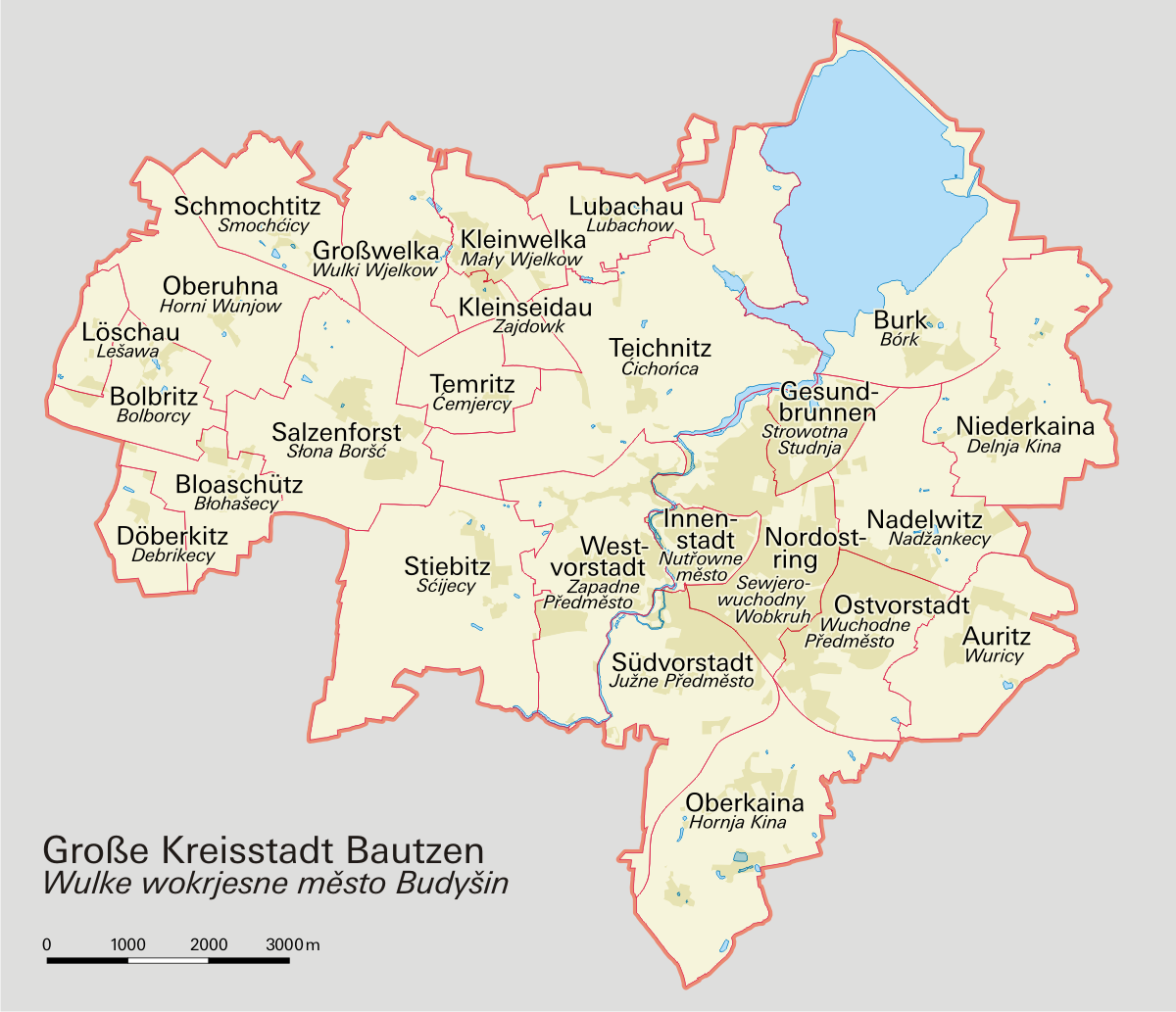
The 15 city districts are:
| Name | Population | |||
|---|---|---|---|---|
| (as of 1 January 2009) | German | Upper Sorbian | English translation | |
| Innenstadt | Nutřkowne město | City centre | 5,278 | |
| Südvorstadt | Južne Předměsto | Southern outskirts | 1,738 | |
| Westvorstadt | Zapadne Předměsto | Western outskirts | 3,505 | |
| Gesundbrunnen | Strowotna studnja | – | 8,178 | |
| Nordostring | Sewjerowuchodny Wobkruh | North-eastern ring | 10,727 | |
| Ostvorstadt | Wuchodne Předměsto | Eastern outskirts | 6,360 | |
| Teichnitz | Ćichońca | – | 377 | |
| Nadelwitz | Nadźankecy | – | 268 | |
| Burk | Bórk | – | 325 | |
| Oberkaina | Hornja Kina | – | 832 | |
| Niederkaina | Delnja Kina | – | 522 | |
| Stiebitz | Sćijecy | – | 510 | |
| Kleinwelka | Mały Wjelkow | – | 1,314 | |
| Salzenforst-Bolbritz | Słona Boršć-Bolborcy | – | 839 | |
| Auritz | Wuricy | – | 458 |
History

Alex K Kingdom of Poland-flag.svg Kingdom of Poland 1025–1032
K.S.Wappenbanner Meißner Löwe.svg Margraviate of Meissen 1032-1075
Přemyslovci erb.svg Duchy of Bohemia 1075–1198 Kingdom of Bohemia 1198–1253
Wappen Mark Brandenburg.png Margraviate of Brandenburg 1253-1319
Kingdom of Bohemia 1319-1469
Flag of Matthias I of Hungary.svg Kingdom of Hungary 1469-1490
Kingdom of Bohemia 1490-1635
Electorate of Saxony 1635–1806
Kingdom of Saxony 1806-1871
German Empire 1871-1918
Weimar Republic 1918-1933
Nazi Germany 1933-1945
Allied-occupied Germany 1945-1949
East Germany 1949–1990
Germany 1990–present
In the 3rd century AD an eastern Germanic settlement existed here, but excavations have proved that the region was already inhabited as early as the late Stone Age. Sorbs arrived in the area during the migration period in the 6th century AD.
The first written evidence of the city is from 1002 under the name Budusin (, ). In 1018 the Peace of Bautzen was signed between the German king Henry II and the Polish ruler Bolesław I the Brave. The treaty left the town under Polish rule. In 1032 it passed to the Margraviate of Meissen within the Holy Roman Empire, in 1075 to the Duchy of Bohemia, elevated to a kingdom in 1198 (with short periods of Brandenburgian and Hungarian rule), in 1635 to Saxony, whose electors were also Polish kings in personal union from 1697 to 1763. One of two main routes connecting Warsaw and Dresden ran through the town at that time.
From 1346 to 1815, it was a member of the Six Cities' Alliance of the Upper Lusatian cities of Görlitz, Zittau, Löbau, Kamenz, Lubań, and Bautzen.
In 1429 and 1431 the town was unsuccessfully besieged by the Hussites. In 1634, it was destroyed by the Swedes during the Thirty Years' War. It was the site of one of the battlefields of the Napoleonic War Battle of Bautzen in 1813. In 1868, the name was officially changed from Budissin to the more Germanized form Bautzen.
In 1839, the Sorbian student organization Societas Slavica Budissenensis was founded in the city. In 1845, the Sorbian national anthem was publicly performed for the first time in the city. The Sorbian House (), a Sorbian cultural centre, was opened in the city in 1904.
After the Nazi Party came to power in Germany in 1933, many political prisoners were held in the Bautzen I and Bautzen II prisons, built in 1904 and 1906, respectively. The AL Bautzen subcamp of the Groß-Rosen concentration camp operated in Bautzen. At least 600 men, mostly Poles, but also of other nationalities, were imprisoned there, about 310 of whom died. This meant Bautzen and its surroundings stayed in German hands until Germany's capitulation.
From 1952 to 1990, Bautzen was part of the Bezirk Dresden of East Germany. Bautzen was infamous throughout East Germany for its two penitentiaries. "Bautzen I" was used as an official prison, soon to be nicknamed Gelbes Elend ("Yellow Misery") due to its outer colour, whereas the more secretive "Bautzen II" was used as a facility to hold political prisoners, dissidents and prisoners of conscience. Today, Bautzen I is known as the Bautzen Correctional Institution and is used to hold prisoners who are awaiting trial. Bautzen II which was also operated by the GDR's Ministry for State Security, has served as an open memorial since 1993, operated by the Saxon Memorials Foundation. It is accessible to the public. Guided tours are provided and occasionally, films are screened. A permanent exhibition depicts the misery suffered by occupants; visitors may tour detention cells, the isolation area and the yards where prisoners were allowed to exercise.
In 2002 the city commemorated its 1000th birthday. In 2010 it was hit by a flood.
Population development
During the Early Middle Ages, Bautzen was one of the largest cities in Central Germany. However, from around the 15th century, its population growth began to stagnate. The relatively late onset of industrialization in Bautzen brought new momentum, leading to population growth even during the era of East Germany. Following the Peaceful Revolution of 1990, however, the city’s population declined significantly, dropping from 52,000 in 1989 to around 38,000, largely due to emigration and low birth rates. Since the early 2000s, this decline has slowed considerably. Today, Bautzen ranks as the 10th largest city in Saxony by population.
As of December 31, 2011, 98.3% of Bautzen's residents were of German origin, with 6.1% having a migration background.
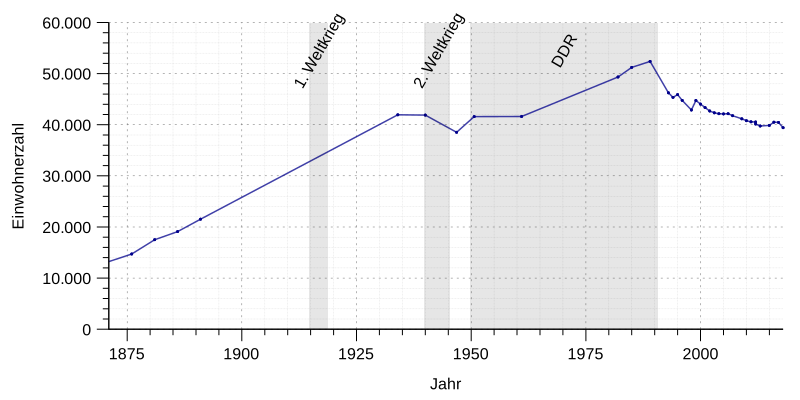
(as of December 31 unless otherwise stated)
- 1849 – 10,518
- 1868 – 12,623
- 1875 – 14,709
- 1890 – 21,516
- 1933 – 41,951
- 1950 – 41,592 (as of August 31)
- 1960 – 41,613
- 1984 – 51,208
- 1995 – 44,763
- 2000 – 43,353
- 2005 – 42,150
- 2010 – 40,573
- 2015 – 40,501
- 2020 – 38,006
- 2021 - 38,360
- 2022 - 38,682
Politics
The Bautzen City Council consists of 34 members. It meets either in the or in the . There are also four local councils (Niederkaina, Stiebitz, Kleinwelka, and Salzenforst-Bolbritz), whose honorary members are elected for five years.
Mayors
- Konrad Johannes Kaeubler, Lord Mayor (1890–1918)
- Gottfried Franz Hermann Niedner, (1872–1945), Lord Mayor 1918–1933
- Christian Schramm (born 1952), (CDU), (Lord) Mayor 1990–2015
- Alexander Ahrens (born 1966), (independent), Lord Mayor 2015–2022
Main sights

Bautzen has a very compact and well-preserved medieval town centre with numerous churches and towers and a city wall on the steep embankment to the river Spree, with one of the oldest preserved waterworks in central Europe (built 1558).
Sites of interest include:
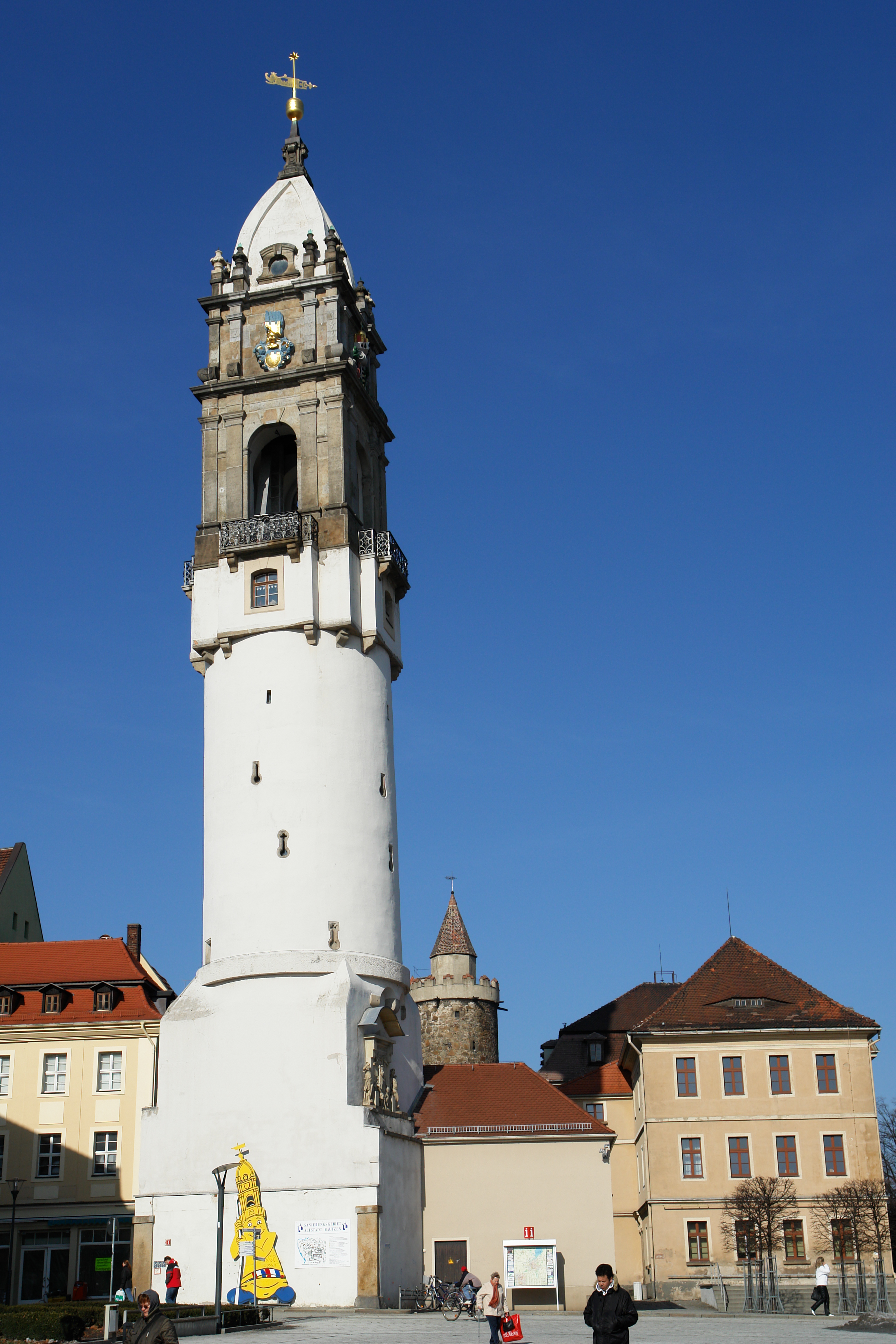
- The Reichenturm, one of the steepest leaning and still passable towers north of the Alps
- Ortenburg Castle
- The Old Waterworks, an architectural monument and museum
- Saint Peter's Cathedral, Eastern Germany's only historic interdenominational church edifice
- Hexenhaus (Witch's House), oldest preserved residential building (built in 1604)
There are six museums in Bautzen, including the Stadtmuseum Bautzen ("Bautzen city Museum"), the Sorbisches Museum ("Sorbian Museum", Sorbian: Serbski muzej) and the Senfmuseum (Mustard Museum).
Sorbian institutions
Bautzen is the seat of several institutions of the cultural self-administration of the Sorbian people:
- Foundation for the Sorbian People (Stiftung für das sorbische Volk, Załožba za serbski lud)
- Domowina (poet. Sorbian for „Homeland“, actually: Zwjazk Łužiskich Serbow z. t., Bund Lausitzer Sorben e. V.) – the umbrella organization of Sorbian cultural associations and institutions
- Sorbian Institute (Serbski institut)
- Sorbian Radio (Serbski rozhłós)
- Sorbian National Ensemble and the German-Sorbian People's Theater (Němsko-serbske ludowe dźiwadło)
- Bautzen Sorbian Boarding School
Economy

Alstom Transportation operates a large factory on Fabrikstraße making railway locomotives, carriages and trams. It was built by the former VEB Waggonbau Bautzen, which was acquired by Bombardier Transportation in 1998 via Deutsche Waggonbau and acquired by Alstom when Bombardier Transportation was sold by parent Bombardier Inc. in 2021.
The mustard Bautz'ner Senf is produced in Bautzen. It is the market leader in the new states of Germany with a market share of 65 percent.
Notable people


- Walter von Boetticher (1853–1945), historian and physician
- Karl Gustav Brescius (1824–1864), railway engineer
- Rudolf Buchheim (1820–1879), German pharmacologist
- Wilhelm Buck (1869–1945), Prime Minister of the Free State of Saxony
- Friedrich August Carus (1770–1807), psychologist and philosopher
- Kurt Dinter (1868–1945), botanist and explorer in South West Africa
- Werner von Erdmannsdorff (1891–1945), General of Infantry in World War II
- Will Grohmann (1887–1968), art historian and art critic
- Erhard Heinz (1924–2017), mathematician
- Hermann Hunger (born 1942), Austrian assyriologist
- Stefanie Kloß (born 1984), lead singer of pop rock band Silbermond
- Hermann Lotze (1817–1881), German philosopher and logician
- August Gottlieb Meißner (1753–1807), writer, founder of the German crime novel
- Harald Metzkes (born 1929), painter and graphic artist
- Juro Mětšk (1954–2022), composer
- Ferdinand Neuling (1885–1960), General of Infantry in World War II
- Caspar Peucer (1525–1602), German-Sorbian reformer, physician and scholar
- Charles Gottlieb Raue (1820–1896), American homeopathic physician
- Georg-Hans Reinhardt (1887–1963), Colonel-General of the German Wehrmacht
- Simone Ritscher (born 1959), actress
- Friedrich Wilhelm Ehrenfried Rost (1768–1835), theologian and philosopher
- Hans von Tettau (1888–1956), infantry General
- Hans Unger (1872–1936), painter
- Karl Friedrich Gottlob Wetzel (1779–1819), writer
- Handrij Zejler (1804–1872), born in the district Salzenforst, founder of modern Sorbian poetry
Twin towns – sister cities
Bautzen is twinned with:
- GER Worms, Germany (1990)
- GER Heidelberg, Germany (1991)
- FRA Dreux, France (1992)
- CZE Jablonec nad Nisou, Czech Republic (1993)
- POL Jelenia Góra, Poland (1993)
References
References
- [https://wahlen.sachsen.de/download/Buergermeister/statistik-sachsen_wahlen_buergermeister_uebersicht_aktuell.xlsx Gewählte Bürgermeisterinnen und Bürgermeister im Freistaat Sachsen, Stand: 17. Juli 2022], Statistisches Landesamt des Freistaates Sachsen.
- (2021). "SmartGuide — audio guide to Bautzen – Budyšin".
- (2017). "Upper Sorbian". Cambridge University Press.
- (12 August 2021). "Federal German labour minister, Hubertus Heil, is open for talks on the rights of the Sorbs/Wends".
- "2 + 2=1".
- (10 December 2016). "ÄLTESTER WEIHNACHTSMARKT | REKORD-INSTITUT für DEUTSCHLAND".
- ONLINE, RP. (9 December 2015). "Rekord-Institut für Deutschland: Welcher Weihnachtsmarkt ist der älteste?".
- "IAU Minor Planet Center".
- Malala
- "The History of Bautzen".
- "Informacja historyczna".
- (2015). "The Smallest Slavonic Nation: The Sorbs of Lusatia". Bloomsbury Publishing.
- Sack, Birgit. (2015). "Plac Monachijski w Dreźnie i jego znaczenie w kontaktach gostyńsko-drezdeńskich". Muzeum w Gostyniu.
- "Subcamps of KL Gross- Rosen".
- (1995). "Kriegsschauplatz Sachsen 1945; Die Kämpfe um Bautzen 18. bis 27. April 1945 (Battleground Saxony 1945; The battles around Bautzen 18-27 August)".
- "Bautzen I, 'Yellow Misery' | Gedenkstätte Bautzen | Stiftung Sächsische Gedenkstätten".
- "The Bautzen Prison Memorials".
- "Bautzen Memorial | Gedenkstätte Bautzen | Stiftung Sächsische Gedenkstätten".
- ''Geschichte der Stadt Bautzen'', [[Richard Reymann]], Druck und Verlag: Gebrüder Müller, 1902, S. 720. Die Angaben stammen ursprünglich aus einem Zeitdokument, das am 10. September 1868 in die Turmkugel des [[Reichenturm. Reichenturms]] gelegt wurde. Demnach waren unter den 12.623 Einwohnern 2579 [[Wends. Wenden]]. Zudem waren darunter ''[...] 11.419 Lutheraner, 1153 Katholiken, 29 Reformierte, 5 Angelikaner, 7 Deutschkatholiken, 1 Griechisch-Katholik und 9 Juden''.
- "Serbski rozhłós - Sorbisches Programm | MDR.DE".
- (January 2026). "Bautz'ner Senf wird 60".
- "Partnerstädte". Bautzen.
This article was imported from Wikipedia and is available under the Creative Commons Attribution-ShareAlike 4.0 License. Content has been adapted to SurfDoc format. Original contributors can be found on the article history page.
Ask Mako anything about Bautzen — get instant answers, deeper analysis, and related topics.
Research with MakoFree with your Surf account
Create a free account to save articles, ask Mako questions, and organize your research.
Sign up freeThis content may have been generated or modified by AI. CloudSurf Software LLC is not responsible for the accuracy, completeness, or reliability of AI-generated content. Always verify important information from primary sources.
Report