From Surf Wiki (app.surf) — the open knowledge base
Batumi
City in Georgia and the capital of Adjara

City in Georgia and the capital of Adjara
| Field | Value |
|---|---|
| official_name | Batumi |
| native_name | ბათუმი |
| settlement_type | City |
| image_skyline | {{multiple image |
| border | infobox |
| perrow | 1/2/2/1 |
| caption_align | center |
| total_width | 290 |
| image1 | View of Batumi skyline from the Botanical Garden (cropped).jpg |
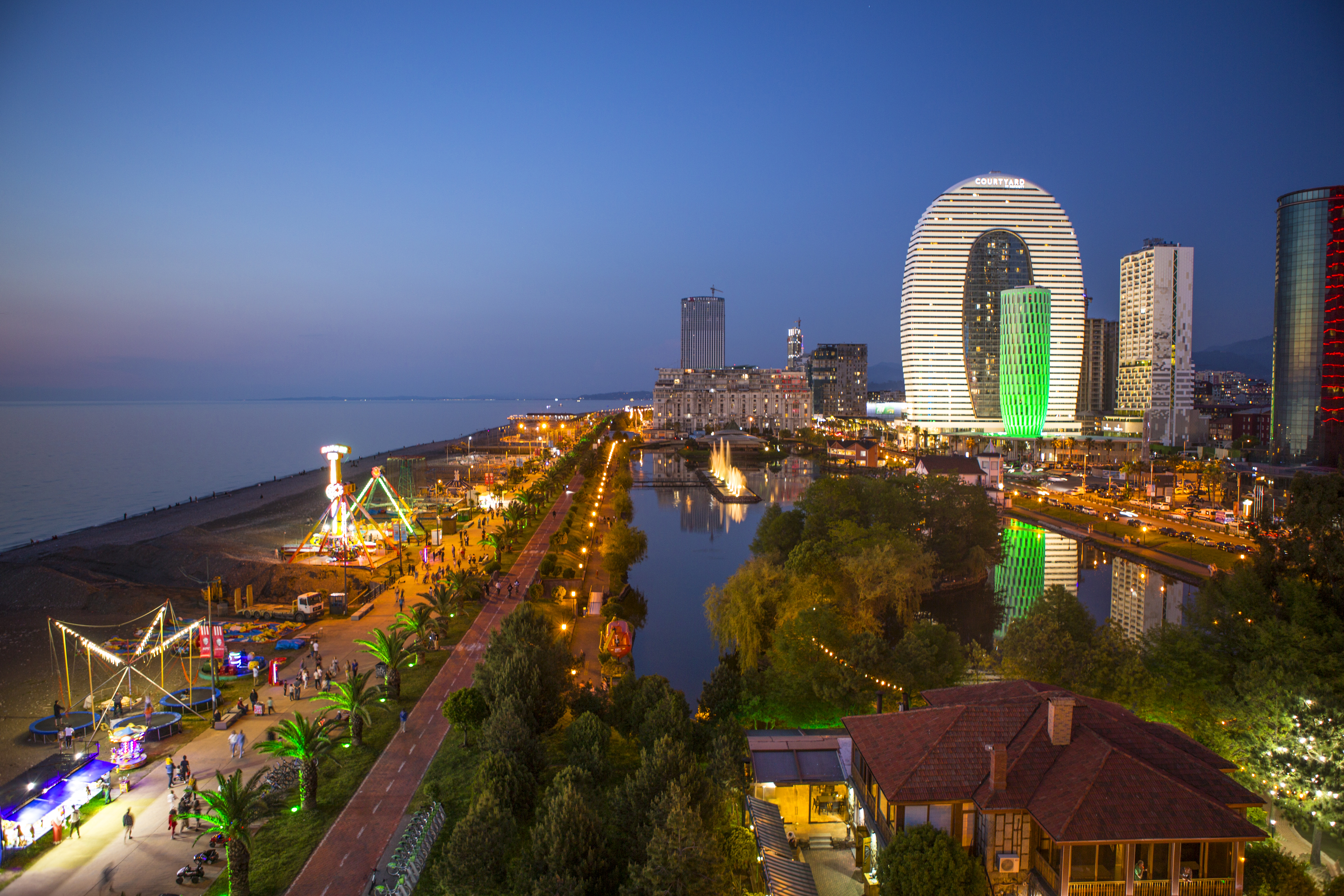
| caption1 | Batumi Bay seen from Botanical Garden |
| image2 | USS Oak Hill, 26th MEU Marines Visit Batumi, Georgia (40817303032).jpg |
| caption2 | City skyline and Lesser Caucasus mountains |
| image3 | Batumi Boulevard Colonnades (cropped).jpg |
| caption3 | Colonnades of the seaside boulevard |
| image4 | Batumi Port.jpg |
| caption4 | Batumi Seaport |
| image5 | Nino and Ali Statues in Batumi, 2016.jpg |
| caption5 | Ali and Nino |
| image_flag | Flag of Batumi.svg |
| image_shield | COA of Batumi.png |
| pushpin_map | Georgia#Georgia Adjara#Caucasus mountains |
| pushpin_relief | 1 |
| pushpin_mapsize | 270 |
| pushpin_map_caption | Location within Georgia##Location within Adjara##Location within Caucasus |
| subdivision_type | Country |
| subdivision_name | Flag_of_Georgia.svg Georgia |
| subdivision_type1 | Autonomous republic |
| subdivision_name1 | Flag_of_Adjara.svg Adjara |
| established_title | Founded |
| established_date | 8th century |
| established_title2 | City status |
| established_date2 | 1866 |
| government_type | Mayor–Council |
| governing_body | Batumi City Assembly |
| leader_title | Mayor |
| leader_name | Archil Chikovani (GD) |
| area_total_km2 | 64.9 |
| population_as_of | 2025 |
| population_footnotes | |
| population_total | 234,949 |
| population_density_km2 | 2,823 |
| population_rank | 2nd in Georgia |
| timezone | Georgian Time |
| utc_offset | +4 |
| timezone_DST | |
| coordinates | |
| elevation_m | 3 |
| area_code | (+995) 422 |
| postal_code_type | Postal code |
| postal_code | 6000-6010 |
| website |
Region Batumi (; ბათუმი ), historically Batum or Batoum, is the second-largest city of Georgia and the capital of the Autonomous Republic of Adjara. Located on the eastern shore of the Black Sea, about 20 km north of the Georgia–Turkey border, Batumi lies at the foot of the Caucasus Mountains in a humid subtropical zone. As one of the country’s principal urban centers, it serves as a major seaport, commercial hub, and cultural gateway between Europe and Asia.
The city has played a significant role in the history of the south-eastern Black Sea region due to its deep-water harbor and strategic position along regional trade routes. Over the centuries, Batumi has been ruled by the Kingdom of Georgia, the Ottoman Empire, the Russian Empire, and the Soviet Union, each leaving distinct cultural and architectural imprints. Its economy historically relied on maritime trade and oil transit, particularly following the construction of the Baku–Batumi pipeline in the early 20th century. Today, it remains a key transit point for Caspian energy exports and regional commerce.
Since the early 2000s, Batumi has undergone rapid modernization, with large-scale investments in tourism, high-rise development, and transport infrastructure. It is often referred to as the “Las Vegas of the Black Sea” for its gambling industry, modern hotels, and nightlife, while also being known for restored 19th-century architecture and public spaces. As of 2025, the city has a population of about 187,000 and hosts major cultural events, educational institutions, and one of Georgia’s busiest ports, making it both a leading tourist destination and a vital economic center in the South Caucasus.
History
Historical affiliations
Flag of the Kingdom of Egris-Abkhazia v2.svg Kingdom of Abkhazia, 780–1010
Flag of Kingdom of Georgia.svg Kingdom of Georgia, 1010–1455
Flag of the_Ottoman_Empire.svg Ottoman Empire, 1703–1878
Flag of Russia.svg Russian Empire, 1878–1918
Flag of the Republic of Batumi.png British Empire, 1918–1920
Flag of Georgia (1918-1921).svg Dem. Rep. of Georgia, 1920–1921
Flag of USSR.svg USSR (Adj. ASSR in G.SSR) 1921–1991
Adjara (de facto independent, de jure part of Georgia) 1991–2004
Georgia (AR of Adjara), 1991 (2004)–present Main article: History of Batumi, Timeline of Batumi
Early settlement and antiquity
Batumi’s strategic location on the Black Sea coast near mountain passes into the Caucasus interior made it an important trade and military point from antiquity. Archaeological excavations at Pichvnari conducted by the Batumi Archaeological Museum alongside the University of Oxford indicate that the Adjara region was inhabited as early as the 5th century BC, with imported amphorae and other evidence of Greek maritime presence. The ancient settlement is commonly identified with the Greek trading post known as Bathus or Bathys (Greek: βαθύς λιμήν, bathys limēn, “deep harbor”), a toponym recorded in classical sources. During the reign of Hadrian (c. 117–138 AD), the area featured a Roman fortification. In the 6th century, the Byzantine Empire redirected its regional military focus to the fortress of Petra (modern Tsikhisdziri), reducing Batumi’s strategic importance.
Medieval Georgian principalities
After the fragmentation of the Kingdom of Georgia, the area came under the rule of the Princes of Guria. In the 15th–16th centuries, Batumi was intermittently occupied by the Ottoman Empire. Following the Battle of Sokhoista (1545), it fell under Ottoman control.
Ottoman rule (15th–19th centuries)
In the 15th century, during the reign of Prince Kakhaber Gurieli, the Ottoman Empire briefly seized Batumi and its surrounding district but failed to maintain control. A century later, the Ottomans returned with a stronger military presence, inflicting a decisive defeat on Georgian forces at the Battle of Sokhoista in 1545. Batumi subsequently changed hands several times: it was retaken in 1546 by Prince Rostom Gurieli, lost soon afterwards, and again reclaimed in 1609 by Mamia II Gurieli.
In 1703, Batumi was permanently incorporated into the Ottoman Empire as part of the Sanjak of Lazistan. Over the next century and a half, it developed into a small but active provincial port serving the empire’s eastern Black Sea hinterland, facilitating trade in timber, tobacco, and other regional products.
Following the Ottoman conquest, a sustained campaign of Islamization began among the predominantly Christian Georgian population of the region. While conversion rates varied by community, this process significantly altered Adjara's demographic and cultural profile. The Islamization trend was halted and in part reversed after Batumi and Adjara were annexed by the Russian Empire following the Russo-Turkish War (1877–1878).
Russian Imperial era (1878–1918)
Batumi was the last major Black Sea port to be annexed by the Russian Empire during its conquest of the Caucasian Black Sea coast. Under the terms of the Treaty of San Stefano (ratified 23 March 1878), signed between Russia and the Ottoman Empire following the Russo-Turkish War (1877–1878), Batumi was ceded to Russia and formally occupied on 28 August 1878. It was declared a free port (porto franco) until 1886 to encourage trade and foreign investment. Initially functioning as the center of a special military district, it was incorporated into the Kutaisi Governorate on 12 June 1883. On 1 June 1903, together with the Artvin Okrug, Batumi was reorganized as the Batum Oblast under the direct administration of the Viceroy of the Caucasus.
Batumi’s expansion accelerated with major infrastructure projects: the completion of the Batumi–Tiflis–Baku railway in 1883 and the opening of the Baku–Batumi pipeline in 1907. These developments turned Batumi into the chief Russian oil port on the Black Sea. The city’s population doubled within two decades, rising from 8,671 in 1882 to 12,000 in 1889, and by 1902 reached around 16,000, including about 1,000 employed in the oil refinery of Baron Rothschild’s Caspian and Black Sea Oil Company.
In the late 1880s and 1890s, Batumi became the departure point for over 7,400 Doukhobor emigrants bound for Canada, following an agreement with the imperial government allowing their resettlement abroad. The Doukhobors, a pacifist religious minority opposed to military service, received financial and logistical assistance from Quaker and Tolstoyan supporters for the transatlantic journey. Most were eventually settled in Manitoba and Saskatchewan.
British occupation and the Democratic Republic of Georgia (1918–1921)
Following the Treaty of Brest-Litovsk in March 1918, the Ottoman Empire advanced into southwestern Georgia, occupying Batumi in April 1918. The short-lived Treaty of Batum (4 June 1918) formalized Ottoman control over the city and surrounding district, though the Armistice of Mudros in October 1918 forced Ottoman withdrawal.
In December 1918, British Army forces under General William M. Thomson occupied Batumi as part of the Allied intervention in the Caucasus, citing the need to secure the port and the Baku–Batumi pipeline in the aftermath of the Russian Civil War. The British administered the city as a strategic base for regional operations, maintaining a garrison of several thousand troops.
Facing growing Georgian nationalist pressure and changing strategic priorities, Britain transferred control of Batumi to the Democratic Republic of Georgia on 7 July 1920, under an agreement recognizing Georgian sovereignty while allowing temporary Allied access to port facilities. The handover was part of a broader British withdrawal from the Caucasus as post-war demobilization took effect.
Soviet era (1921–1991)
In March 1921, during the final stages of the Red Army invasion of Georgia, Turkish troops briefly occupied Batumi under the pretext of protecting the local Muslim population. Following a short period of Georgian control, the city was transferred to the Soviet Union in accordance with the Treaty of Kars (October 1921), which confirmed Turkish recognition of Soviet sovereignty over Batumi and the surrounding Adjara region in exchange for border adjustments in northeastern Turkey.
To address the distinct religious and cultural composition of the local population, the Soviets established the Adjarian Autonomous Soviet Socialist Republic on 16 July 1921, granting nominal autonomy within the Georgian SSR to Adjara’s predominantly Muslim community.
Throughout the Soviet period, Batumi underwent significant transformation. The port was expanded and modernized, becoming a key hub for Black Sea trade, particularly for oil exports from the Baku–Batumi pipeline. Industrialization brought new factories, ship-repair facilities, and food-processing plants, while Soviet urban planning introduced wide boulevards, parks, and standardized residential districts.
In addition to its industrial role, Batumi developed as a resort destination for Soviet citizens, with new hotels, sanatoriums, and a revitalized seaside promenade attracting tourists from across the USSR. The city’s population steadily grew due to internal migration, reflecting its dual role as both a working port and a leisure center on the Black Sea coast.
Post-independence (1991–present)

Tensions with the Georgian government escalated in early 2004, following the Rose Revolution, as President Mikheil Saakashvili sought to reassert central authority over Adjara. Mass protests in Batumi and surrounding towns in May 2004 combined with the defection of key security officials forced Abashidze to resign and flee to Russia on 6 May 2004. The region was then reintegrated into Georgia’s political and administrative framework.
Since 2004, Batumi has undergone significant transformation, driven by foreign investment, large-scale urban redevelopment, and government-backed infrastructure projects. The city has emerged as a major tourism hub on the Black Sea, with the construction of modern hotels, a renovated seaside boulevard, and cultural venues aimed at attracting international visitors.[[File:Changing skyline of Batumi, Georgia.jpg|thumb|As Georgia's Black Sea coast continues to develop, high-rises are being built amongst Batumi's traditionally [[classical architecture|classical]] cityscapes.]]Parallel to the tourism boom, the Port of Batumi has been modernized to handle increased cargo traffic, reinforcing its role as a strategic transit point for Caspian oil and regional trade. Ongoing projects include port deepening, new ferry terminals, and expanded logistics facilities, positioning Batumi as both a leisure destination and a commercial gateway in the South Caucasus.
Geography
Climate
Batumi has a humid subtropical climate (Cfa) according to Köppen's classification. The city's climate is heavily influenced by the onshore flow from the Black Sea and is subject to the orographic effect of the nearby hills and mountains, resulting in significant rainfall throughout most of the year, making Batumi the wettest city in both Georgia and the entire Caucasus Region.
The average annual temperature in Batumi is approximately 14 °C. January is the coldest month with an average temperature of 5 °C. August is the hottest month, with an average temperature of 22 °C. The absolute minimum recorded temperature is -6 °C, and the absolute maximum is 40 °C. The number of days with daily temperatures above 10 °C is 239. The city receives 1958 hours of sunshine per year.
Batumi's average annual precipitation is 2435 mm. November is the wettest month with an average of 312 mm of precipitation, while May is the driest, averaging 84 mm. Batumi receives snow most years, but it is often limited in amount (accumulating snowfall of more than 30 cm is rare), and the number of days with snow cover for the year is 12. The average level of relative humidity ranges from 70 to 80%.
|Jan record high C = 25.3 |Feb record high C = 27.4 |Mar record high C = 33.0 |Apr record high C = 38.3 |May record high C = 37.2 |Jun record high C = 39.9 |Jul record high C = 40.8 |Aug record high C = 39.5 |Sep record high C = 38.1 |Oct record high C = 35.4 |Nov record high C = 30.1 |Dec record high C = 28.3 |year record high C = 40.8 |Jan record low C = -7.7 |Feb record low C = -8.2 |Mar record low C = -6.7 |Apr record low C = -2.5 |May record low C = 3.4 |Jun record low C = 8.1 |Jul record low C = 12.9 |Aug record low C = 12.6 |Sep record low C = 7.5 |Oct record low C = 2.0 |Nov record low C = -3.9 |Dec record low C = -4.2 |year record low C = -8.2 | access-date= 27 September 2012 | archive-date= 19 May 2019 | archive-url= https://web.archive.org/web/20190519215650/http://meteoweb.ru/cl006.php | url-status= live
Subdivisions
According to the 31 March 2008, decision of the Batumi City Council, Batumi is divided into seven boroughs, those of:
- Old Batumi (ძველი ბათუმის უბანი)
- Rustaveli (რუსთაველის უბანი)
- Khimshiashvili (ხიმშიაშვილის უბანი)
- Bagrationi (ბაგრატიონის უბანი)
- Aghmashenebeli (აღმაშენებლის უბანი)
- Javakhishvili (ჯავახიშვილის უბანი)
- Tamar (თამარის უბანი)
- Boni-Gorodok (ბონი-გოროდოკის უბანი)
- Airport (აეროპორტის უბანი)
- Gonio-Kvariati (გონიო-კვარიათის უბანი)
- Kakhaberi (კახაბრის უბანი)
- Batumi Industrial (ბათუმის სამრეწველო უბანი)
- Green Cape (მწვანე კონცხის უბანი)
Cityscape

Contemporary architecture

.jpg)

.jpg)
Batumi's skyline has been transformed since 2007 with remarkable buildings and monuments of contemporary architecture,
- Marriott Hotel
- Radisson Blu hotel
- Public Service Hall
- Hilton Batumi
- Leogrand
A large Kempinski hotel and casino is to open in 2013, a Hilton Hotel as well as a 47-storey Trump Tower is also planned. Alliance Privilege, a building compromising Marriott Hotel, Casino and serviced apartments is one of the contemporary buildings with unique architecture by the beach.
Novelty architecture
Novelty architecture in Batumi includes:
- Sheraton Hotel, designed in the style of the Great Lighthouse at Alexandria, Egypt
- Alphabetic Tower (145 m high), celebrating Georgian script and writing
- Batumi Piazza, a mixed-used development in the form of an Italian piazza
- Buildings designed in the style of a lighthouse, the Acropolis, and an upside-down White House
Sites of interest
Main sights
Attractions include
- Adjara State Museum
- Batumi Botanical Garden
- Circus
- Former resort area along the Black Sea coast.
Tourist attractions
.jpg)
- Batumi Boulevard
- The statue of "Man and Woman" AKA "Ali and Nino" by Georgian artist, Tamara Kvesitadze
- Batumi Botanical Gardens
- Cafe Fantasy
- Dancing Fountains, Batumi
- Dolphinarium
- Piazza Square
- Panoramic Wheel
- Astronomical clock
- Argo Cable Car
- 6 May Park
- Europe Square
- Alphabetic Tower
- Batumi Sea Port
- Miracle Park
- Fountain of Neptune
- Batumi Archeological Museum
- Monument of Ilia Chavchavadze
Demographics

| Year | Georgians | Armenians | Russians | Greeks | Others | Total |
|---|---|---|---|---|---|---|
| 1886 | 2,518 | 17% | 3,458 | 23.4% | 2,982 | 20.1% |
| 1897 | 6,087 | 21.4% | 6,839 | 24% | 6,224 | 21.8% |
| 1916 | 6,481 | 32.4% | 5,524 | 27.6% | 4,825 | 24.1% |
| 1926 | 17,804 | 36.7% | 10,233 | 21.1% | 8,760 | 18.1% |
| 1959 | 40,181 | 48.8% | 12,743 | 15.5% | 20,857 | 25.3% |
| 2002 | 104,313 | 85.6% | 7,517 | 6.2% | 6,300 | 5.2% |
| 2014 | 142,691 | 93.4% | 4,636 | 3.0% | 2,889 | 1.9% |
Religion
Of the 4,970 inhabitants in 1872, about 4,500 were Muslim (Adjarians, Turks, Circassians, and Abkhazians). In the 1897 census, the Orthodox Christian population was 15,495 (mostly Slavs) while Muslims numbered 3,156, including some of whom were citizens of Turkey.
As of 2014, out of 152,839 inhabitants of Batumi, 68,7% is Eastern Orthodox Christian, and they primarily adhere to the national Georgian Orthodox Church. Muslims make up 25,3% of population, while there are also Catholic, Armenian Apostolic, Jehovah's Witness, Seventh-day Adventist, and Jewish communities.
The main places of worship in the city are:
- Georgian Orthodox Cathedral of the Mother of God, and Saint Barbara Church
- Catholic Church of the Holy Spirit
- Saint Nicholas Church
- Batumi Mosque
- Batumi Synagogue
Culture

Batumi has 18 various museums, including State Art Museum of Adjara. Rugby Union club Batumi RC competes in the Georgian Didi 10 and previously competed in the Pan-European Rugby Europe Super Cup. Football club FC Dinamo Batumi play at the Batumi stadium.
A sculpture by Tamara Kvesitadze of two standing figures on the seashore shows the story first told in the 1937 Austrian novel, Ali and Nino, of lovers who are parted after World War I. Each day, the two figures move toward each other but never stay together. Ali, an Azerbaijani Muslim, falls in love with Georgian princess, Nino, but sadly, after they are finally able to get together, the war hits home and Ali is killed. It was installed in 2010.
Notable people
Notable people who are from or have resided in Batumi:
- Irakli Alasania (*1973), Georgian politician, Minister of Defense
- Herbert Backe (1896–1947), Reich Minister of Food in Nazi Germany
- Ioseb Bardanashvili (*1948), composer
- Khatia Buniatishvili (*1987), concert pianist
- Odysseas Dimitriadis (1908–2005), Greek-Soviet music conductor
- Roman Dolidze (*1988), mixed martial artist
- Mary, Princess Eristavi (1888–1986), Georgian princess and model
- Fadiko Gogitidze (1916-1940), Adjara's first woman pilot
- , (1887–1978), writer
- Devi Khajishvili (*1991), actor
- Sopho Khalvashi (*1986), first Georgian entrant to the Eurovision Song Contest 2007
- Mindia Khitarishvili (*1973), composer
- Konstantin Meladze (*1963), composer and producer
- Valery Meladze (*1965), singer
- Katie Melua, singer
- Aramashot Papayan, Armenian playwright, screenwriter, actor and director
- Lado Seidishvili (1931–2010), Georgian painter and poet
- Arkady and Boris Strugatsky (1925–1991 ; 1933–2012), science fiction authors
- William Horwood Stuart (1857–1906), British diplomat who was murdered there in 1906
- Sergei Yesenin (1895–1925), Russian lyrical poet
- Fyodor Yurchikhin (*1959), astronaut
- Lamara Chkonia (1930–2024), Georgian soprano
Economy and infrastructure

Transport
The city is served by Batumi Airport, one of three international airports in the country. . ]] -- . ]] --
The main types of public transport are buses, minibusses, and taxis. Batumi has modern electric buses. Using the service is possible by BATUMICARD, transit card, or debit/credit cards. Buses connect almost everywhere in the city. A bike-sharing system named BatumVelo allows you to rent a bicycle on the street with a smart card.
The port of Batumi is on one of the routes of China's proposed Eurasian Land Bridge (part of the "New Silk Road"), which would see an eastern freight link to China via Azerbaijan and the Caspian Sea, and a western link by ferry to Ukraine and on to Europe.
Education
Batumi has become an emerging centre for medical education in the Caucasus region, attracting international students due to its affordable tuition and English-language programs. Institutions such as Batumi Shota Rustaveli State University, BAU International University offer accredited medical degrees recognized across America, Europe and Asia.
The city’s growth in medical education is supported by modern infrastructure and increasing foreign enrollment. According to The Times of India, many Indian students choose Batumi for MBBS studies due to simplified admission processes and NMC-recognized curriculum.
Postage stamps==
Main article: Postage stamps of Batum under British occupation
Twin towns – sister cities
Batumi is twinned with:
- ITA Bari, Italy (1987)
- USA Savannah, United States (1992)
- TUR Trabzon, Turkey (2000)
- ARM Vanadzor, Armenia (2006)
- GRE Volos, Greece (2007)
- UKR Yalta, Ukraine (2008)
- BUL Burgas, Bulgaria (2009)
- ESP Marbella, Spain (2010)
- TUR Kuşadası, Turkey (2010)
- TUR Ordu, Turkey (2011)
- UKR Ternopil, Ukraine (2011)
- ISR Ashdod, Israel (2011)
- USA New Orleans, United States (2012)
- TUR Yalova, Turkey (2012)
- AZE Nakhchivan, Azerbaijan (2012)
- LVA Daugavpils, Latvia (2012)
- UKR Donetsk, Ukraine (2013)
- CZE Prague 1, Czech Republic (2013)
- EGY Sharm El Sheikh, Egypt (2014)
- CHN Ürümqi, China (2015)
- BLR Brest, Belarus (2015)
- CYP Paphos, Cyprus (2016)
- POL Nysa, Poland (2017)
- BLR Mogilev, Belarus (2017)
- ISR Netanya, Israel (2018)
- POL Wrocław, Poland (2019)
- ROM Constanța, Romania (2020)
Gallery
Cityscapes & Sea
File:Panoramic view of Batumi at night.jpg|Batumi at night File:Seaside of Batumi (02).jpg|Seaside boulevard and beach File:Warhammer 819 batumi port.jpg|Batumi Seaport File:20241123 Batumi 6.jpg|Night skyline with stadium (2024)
Modern architecture & landmarks
File:Europe square in Batumi.jpg|Europe square in Batumi File:Square in Batumi.jpg|Neptun Square File:Батуми - panoramio (5).jpg|Radisson Blu Hotel File:20241123 Batumi 7a.jpg|Marriott Hotel, Batumi File:Batumi, summer 2018 11.jpg|Alphabetic Tower File:Plac piazza batumi.jpg|Batumi Piazza File:Batumi2025building-public-service-hall-and-courtyard.jpg|Public Service Hall
Heritage & history
File:Batum.jpg|Port of Batumi, 1881 File:Batumi Boulevard Colonnades.jpg|Colonnades on the boulevard File:Cathedral of the Blessed Virgin Mary at night, Batumi 2007.jpg|Cathedral of the Mother of God File:Batumi Synagogue, 2016.jpg|Batumi Synagogue
References
- Georgian Soviet Encyclopedia. Georgian SSR (Supplementary Edition). 1981. pp. 16–18.
References
- "Population – National Statistics Office of Georgia".
- Rose, John D.. (April 1980). "Batum as Domino, 1919–1920: The Defence of India in Transcaucasia". The International History Review.
- (1907). "The Standard History of the World". University Society Inc..
- Spritzer, Dinah. (9 September 2010). "Glamour revives port of Batumi". The New York Times.
- Curly Tales. (2024-09-11). "Exploring The Las Vegas Of Black Sea {{!}} Beaches, Mountains & Casinos {{!}} One World Ep 05 {{!}} Curly Tales".
- (1999). "Pichvnari and Its Environs: 6th Century BC – 4th Century AD". Université de Franche-Comté.
- "Contextual Research of the Market Potential of Historical Sites in Georgia". Black Sea CBC.
- "Batumi – Medieval Harbors". Olkas.net.
- Peeters, Jeroen. (2017). "Ottoman Port Cities of the Eastern Black Sea". Brill.
- Lang, David Marshall. (1957). "Last Years of the Georgian Monarchy, 1658–1832". Columbia University Press.
- Faroqhi, Suraiya. (2002). "Ottoman Ports and Trade in the Black Sea". International Journal of Turkish Studies.
- Zürcher, Erik-Jan. (2004). "Turkey: A Modern History". I.B. Tauris.
- Allen, W.E.D.. (2024). "A History of the Georgian People". Routledge.
- Kozlov, Sergei. (2017). "Batumi as a Free Port in the Russian Empire". Journal of Eurasian Studies.
- Gammer, Moshe. (2003). "Muslim Resistance to the Tsar: Shamil and the Conquest of Chechnia and Daghestan". Routledge.
- Patmore, J.A.. (1969). "Railways, Geography and Economic Growth". Macmillan.
- А.Э. Котов (A.E. Kotov). (17 July 2009). ""Из истории Южно-Кавказской железной дороги" ("From the History of the South Caucasus Railway")".
- "Каспийско-Черноморское нефтепромышленное и торговое общество (Баку) - Ротшильды и Баку". Our Baku.
- Mir-Babayev, Mir-Yusif. (February 2015). "Baku-Batumi – The World's Longest Pipeline". Visions of Azerbaijan.
- Yergin, Daniel. (1991). "The Prize: The Epic Quest for Oil, Money, and Power". Simon & Schuster.
- Woodcock, George. (1968). "The Doukhobors". Oxford University Press.
- (1962). "A Modern History of Georgia". Weidenfeld and Nicolson.
- Suny, Ronald Grigor. (1994). "The Making of the Georgian Nation". Indiana University Press.
- Reynolds, Michael. (2006). "Britain and the Caucasus, 1918–1920". Middle Eastern Studies.
- Allen, W.E.D.. (2017). "A History of the Georgian People". Routledge.
- Harris, George S.. (1953). "The Origins of the Soviet-Georgian Dispute". Stanford University Press.
- Walker, Christopher J.. (1990). "Armenia: The Survival of a Nation". Palgrave Macmillan.
- Suny, Ronald Grigor. (1994). "The Making of the Georgian Nation". Indiana University Press.
- Gachechiladze, Revaz. (1992). "The New Role of Tbilisi and Batumi in Soviet and Post-Soviet Economic Geography". Eurasian Geography and Economics.
- Fowkes, Ben. (1997). "The Disintegration of the Soviet Union: A Study in the Rise and Triumph of Nationalism". Macmillan.
- Mitchell, Lincoln A.. (2008). "Uncertain Democracy: U.S. Foreign Policy and Georgia's Rose Revolution". University of Pennsylvania Press.
- (6 May 2004). "Adjaran Leader Resigns, Leaves Georgia". Radio Free Europe/Radio Liberty.
- Kakulia, Marine. (2016). "Tourism Development in Adjara: Trends and Prospects". Journal of Tourism Studies.
- "საქართველოს საკონსტიტუციო სასამართლო".
- (2020). "Batumi Port Development Strategy 2030". Asian Development Bank.
- (13 November 2007). "Russia Hands Over Batumi Military Base to Georgia". Civil Georgia, Tbilisi.
- "WMO Climate Normals for 1981-2010: Batumi Airport-37496". National Centers for Environmental Information.
- (14 January 2021). "37496: Batumi (Georgia)". OGIMET.
- {{in lang. (October 2016)
- (1 April 2012). "Lonely Planet Georgia, Armenia & Azerbaijan". Lonely Planet.
- [http://www.utsandiego.com/news/2012/nov/11/tp-tourism-is-flourishing-in-black-sea-resort/ "TOURISM IS FLOURISHING IN BLACK SEA RESORT", AP, November 11, 2012] {{webarchive. link. (17 August 2014)
- "News & Events".
- "باتومی – گرجستان".
- "население грузии".
- "Демоскоп Weekly – Приложение. Справочник статистических показателей.".
- "Батумский округ 1897".
- (1917). "Кавказский календарь на 1917 год". Tipografiya kantselyarii Ye.I.V. na Kavkaze, kazenny dom.
- "Ethnic groups by major administrative-territorial units".
- "georgia-ethnic-2014".
- Sichinava, V. (1958). "Batumis ist'oriidan".
- [http://pop-stat.mashke.org/georgia-religion2014b.htm georgia-religion 2014]
- National Statistics Office of Georgia. [http://www.geostat.ge/cms/site_images/_files/english/census/2014/22_Population%20by%20regions%20and%20religion.xls Population Census 2014: Population by Regions and Religion] {{Webarchive. link. (14 September 2016 , Retrieved: 6 May 2016)
- "Batumi: sights". Official website of Batumi.
- (October 23, 2015). "Ali and Nino, Batumi, Georgia".
- "Batumi Airport".
- "BatumVelo".
- (21 January 2016). "Silk Road Renewed With Launch of New Commercial Transit Route". The Astana Times.
- "School Detail".
- (2023-08-21). "Georgia continues to attract Indian medical students". The Times of India.
- "ჩვენი ქალაქი – დამეგობრებული ქალაქები". Batumi.
- "Ბათუმი და ბალარუსის ქალაქი მოგილიოვი დამეგობრდნენ – TV25".
- (2019-07-17). "Batumi miastem partnerskim Wrocławia". Wrocław.
- "Კონსტანცასა და ბათუმს შორის თანამშრომლობის მემორანდუმი გაფორმდა".
This article was imported from Wikipedia and is available under the Creative Commons Attribution-ShareAlike 4.0 License. Content has been adapted to SurfDoc format. Original contributors can be found on the article history page.
Ask Mako anything about Batumi — get instant answers, deeper analysis, and related topics.
Research with MakoFree with your Surf account
Create a free account to save articles, ask Mako questions, and organize your research.
Sign up freeThis content may have been generated or modified by AI. CloudSurf Software LLC is not responsible for the accuracy, completeness, or reliability of AI-generated content. Always verify important information from primary sources.
Report