From Surf Wiki (app.surf) — the open knowledge base
Battle of Uhud
625 battle of the Muslim–Quraysh War
625 battle of the Muslim–Quraysh War
| Field | Value | |||||||||
|---|---|---|---|---|---|---|---|---|---|---|
| conflict | Battle of Uhud | |||||||||
| coordinates | ||||||||||
| map_type | Saudi Arabia | |||||||||
| map_relief | 1 | |||||||||
| partof | the Muslim–Quraysh War | |||||||||
| image | The Prophet Muhammad and the Muslim Army at the Battle of Uhud, from the Siyer-i Nebi, 1595.jpg | |||||||||
| caption | Muhammad and the Muslim Army at the Battle of Uhud, from the Siyer-i Nebi, 1595 | |||||||||
| date | 23 March 625 (7 Shawwal, AH 3 (in the ancient (intercalated) Arabic calendar) | |||||||||
| place | Valley by Mount Uhud, north of Medina, Arabia | |||||||||
| result | Quraysh victory | |||||||||
| combatant1 | First Islamic State | |||||||||
| combatant2 | Quraysh Flag.svg Quraysh | |||||||||
| commander1 | {{plainlist | |||||||||
| *Abu Bakr<ref name | "auto" | |||||||||
| *Umar<ref name | "auto"/ | |||||||||
| *Abdullah ibn Jubayr<ref name | "Najeebabadi 171" | |||||||||
| *Mundhir ibn Amr<ref name | "Najeebabadi 171"/ | |||||||||
| *Abd Allah ibn Ubayy (defected) <ref name | "Najeebabadi 171"/ | |||||||||
| *'Ubadah ibn al-Samit<ref>{{cite book | last1 | Gil | first1=Moshe | title=Ibn Sa'd, 1(1), 147 VII(2), 113f, Baladhuri, Tarikh Tabari, 1 2960, Muqaddasi, Muthir, 25f; Ibn Hisham, 311 | publisher=Cambridge University press | isbn=0521599849 | page=119 | url=https://books.google.com/books?id=M0wUKoMJeccC&q=ubada+samit+&pg=PA40 | access-date=26 January 2020 | date=1997-02-27 }} |
| commander2 | {{plainlist | |||||||||
| *Safwan ibn Umayya{{citation needed | date | July 2024}} | ||||||||
| strength1 | 754 total{{ubl | |||||||||
| strength2 | 3,000 total{{ubl | |||||||||
| casualties1 | 62–75 killed | |||||||||
| casualties2 | 22–35 killed |
- Muhammad
- Ali ibn Abi Talib
- Hamza ibn Abd al-Muttalib
- Abu Bakr
- Umar
- Abu Dujana
- Abdullah ibn Jubayr
- Mundhir ibn Amr
- Al-Zubayr ibn al-Awwam
- Abd Allah ibn Ubayy (defected)
- 'Ubadah ibn al-Samit
- Talha ibn Ubayd Allah
- Abu Sufyan
- Hind bint Utba
- Ikrima ibn Amr
- Amr ibn al-As
- Khalid ibn al-Walid
- Safwan ibn Umayya
- Ali ibn Umayya
- Jabala ibn al-Hanbal
- Abu Azza al-Jumahi
- Ubayy ibn Khalaf |700 Infantry |50 archers |4 cavalry}} |1,450 infantry |1,450 camels |100 cavalry}} The Battle of Uhud () was fought between the early Muslims and the Quraysh during the Muslim–Quraysh wars in a valley north of Mount Uhud near Medina on Saturday, 23 March 625 AD (7 Shawwal, 3 AH).
Following the Muslim emigration to Medina, hostilities with the Quraysh intensified, largely due to Muslim raids on Meccan trade caravans. In 624, the Quraysh suffered a major defeat at the Battle of Badr, during which several of their leaders were killed. The following year, Abu Sufyan ibn Harb led a force of approximately 3,000 men toward Medina to avenge the loss. The two sides met near Mount Uhud, just north of the city. At the outset of the engagement, the Muslims gained the upper hand and forced the Meccan lines to retreat. A group of Muslim archers had been stationed by Muhammad on a nearby hill in order to protect the army’s rear and guard against a cavalry attack. However, believing the battle was won, many of them left their positions to collect spoils from the Meccan camp. This lapse allowed the Meccan cavalry, led by Khalid ibn al-Walid, to launch a counterattack from the rear, reversing the momentum of the battle, and disrupting the Muslim lines. The resulting chaos led to heavy losses on the Muslim side, including the death of Hamza ibn Abd al-Muttalib.
The battle was seen as a significant setback for the Muslims and a minor victory for the Quraysh as they would return with an even larger force in the Battle of the Trench.
Background
Muhammad initially spread his new religion in Mecca, where he found no opposition from the local people until he attacked their polytheistic beliefs.{{efn|... that is, when he[Muhammad] openly attacked the polytheism of his native town.}} As tensions with the Meccans increased, Muhammad brought his followers to migrate to Medina after his successful negotiations with Banu Aws and Khazraj to mediate their tribal conflicts. Francis Peters proposes that these raids were probably a quick remedy by Muhammad for the poverty of his people in the new land, who lacked agricultural skills and capital for trade. Tariq Ramadan agrees with this reasoning, but also adds that The Battle of Badr in particular was initiated to impress the Meccans, who were becoming increasingly hostile towards Medina.
In March 624, after gaining rich plunder from attacking a caravan at Nakhla, Muhammad received information about a large Quraysh trade caravan containing about 1,000 camels and 50,000 dinars was on its way from Gaza to Mecca, and he ordered his followers to ambush it. The very cautious Abu Sufyan, who led the caravan, got wind of his plan and sent messengers on a quick trip to Mecca for help, with the caravan diverted to another route. The reinforcements then camped at Badr, where they later met up with the Muslims. A battle ensued, and with great charisma and powers of suggestion, Muhammad managed to get his troops to defeat the Quraysh reinforcements, which were larger in number.
This defeat was a major catastrophe for the people of Mecca. A number of its influential and experienced men were killed, including Amr ibn Hisham. Their prestige was shaken. Their old enemies, such as the Hawazin, began to set their sights on them again. On Muhammad's part, this victory drew all eyes to him. He used this victory as proof of his prophethood. Those who supported and participated in his raids were becoming more numerous. Abu Sufyan, who was chosen as the successor of the leader of the Quraysh, vowed vengeance. Several months later, he accompanied a party of 200 men to Medina. There, he met his old friend, the Banu Nadir chief, who then provided him with a meal and some background information about the area, but nothing more. He and his party then left Medina, burning two houses and laying waste to some fields in fulfillment of his vow.
Further skirmishes between the Meccans and the Muslims would occur thereafter. A few months later, Abu Sufyan mobilized an invasion force of over 3,000 men to retaliate against the Muslims for the losses at Badr.
Battle

Meccan march to Medina

At the head of a 3,000-strong army, Abu Sufyan ibn Harb ( one of the head generals) set forth toward Madinah to avenge the Meccans' defeat at Badr. They encamped on the pastures north of the city, hoping that the Muslims would come out to meet them. According to the early Muslim historian Ibn Ishaq, a number of Meccan women are said to have accompanied Abu Sufyan's army to boost their morale, including Hind bint 'Utbah, Abu Sufyan's wife.
Muslim encampment at Uhud
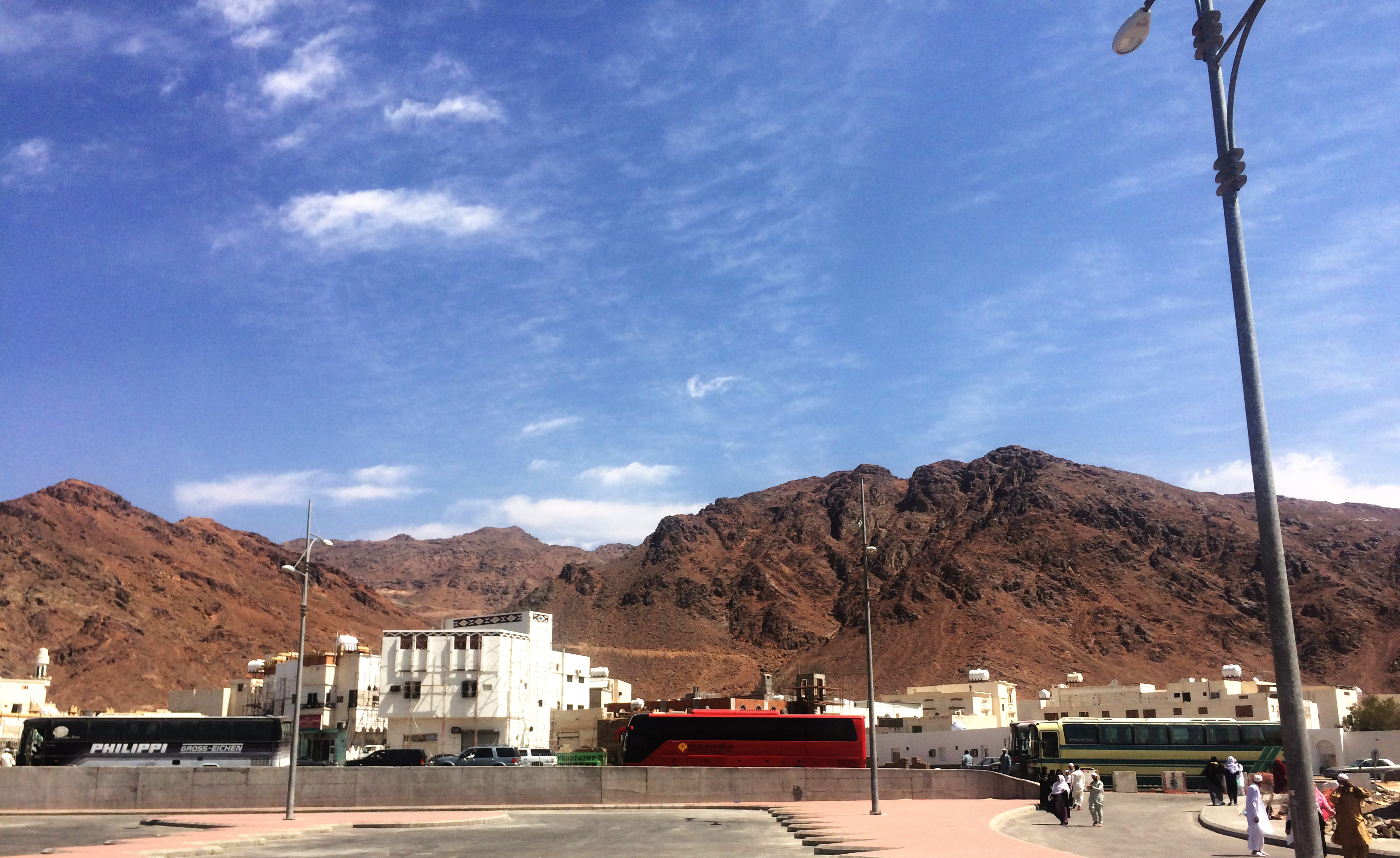
A group of approximately 1,000 Muslim men set out northward from Madinah toward Mount Uhud late on Friday, 21 December 624. Early the next morning, they took a position on the lower slopes of the hill of Uhud. Shortly before the battle commenced, 'Abdallah ibn Ubayy, chief of the Khazraj, along with 300 other men, withdrew their support for Muhammad and returned to Medina, with reports suggesting Ibn Ubayy's discontent with the plan to march out from Medina to meet the Meccans. Ibn Ubayy and his followers would later receive censure in the Qur'an for this act.
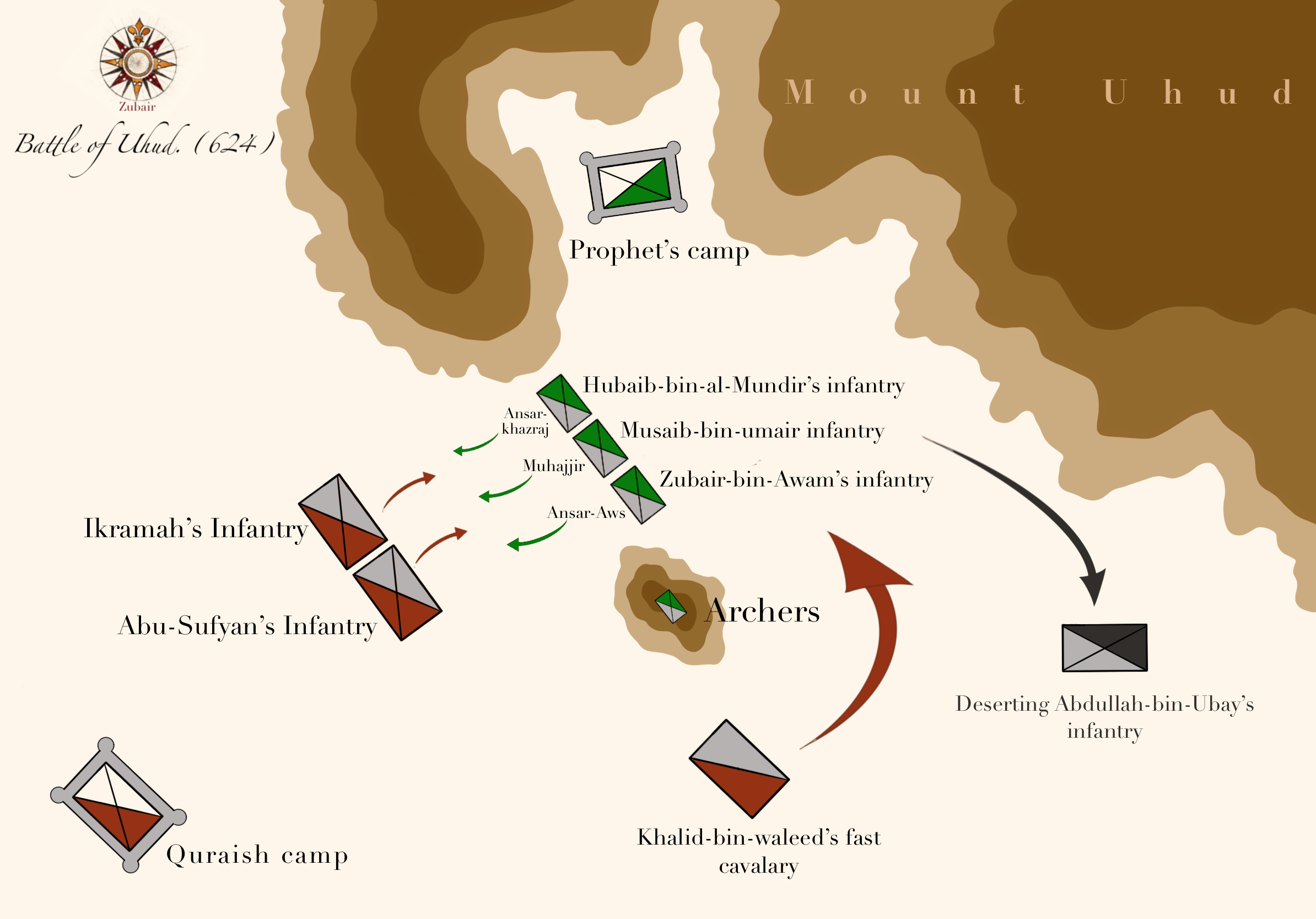
The Muslim force, now numbering around 700 encamped on the slopes of Uhud, facing Madinah, with their back protected by the mountain. Before the battle, Muhammad had assigned 50 archers on a nearby rocky hill at the west side of the Muslim camp. This was a strategic decision in order to shield the vulnerable flanks of the outnumbered Muslim army; the archers on the hill were to protect the left flank, while the right flank was to be protected by the Mount of Uhud situated on the east side of the Muslim camp. Protecting the flanks of the Muslim army meant that the Meccan army would not be able to turn around the Muslim camp, and thus the Muslim army would not be surrounded or encircled by the Meccan cavalry, keeping in mind that the Meccan cavalry outnumbered the Muslim cavalry with 50-to-1. Muhammad ordered the Muslim archers to not leave their positions on the hill unless ordered to do so by him, making it clear by uttering these words to the archers, "If you see us prevail and start to take spoils, do not come to assist us. And if you see us get vanquished and birds eat from our heads, do not come to assist us."
Duels
The Meccan army positioned itself facing the Muslim lines, with the main body led by Abu Sufyan, and the left and right flanks commanded by Ikrimah ibn Abu Jahl, son of Amr ibn Hishām and Khalid ibn al-Walid, respectively. 'Amr ibn al-'As was commander of the cavalry and his task was to coordinate the attack between the cavalry wings. They attacked with their initial charge led by the Medinan exile Abu ‘Amir. Thwarted by a shower of stones from the Muslims, Abu ‘Amir and his men were forced to retreat to the camps behind the Meccan lines. The Meccan standard-bearer Talhah ibn Abi Talhah al-‘Abdari, advanced and challenged the enemy to a duel. Ali ibn Abi Talib, the cousin of Muhammad, rushed forth and struck Talhah down in a single blow. Talhah's brother, Uthman, ran forward to pick up the fallen banner — the Meccan women willing him on with songs and the loud beating of timbrels. Hamza ibn ‘Abd al-Muttalib emerged from the Muslim ranks, bringing him to a similar fate as Talhah. It was their family that was responsible for the Meccan army's standard-bearing, and thus one by one, Talhah's brothers and sons went to retrieve the Meccan banner and fight unsuccessfully until they all eventually perished. Following the duels, general engagement between the two armies commenced. Meccan confidence quickly began to dissolve as the Muslims swept through their ranks.
Meccan retreat and counter-attack
The Meccan army was pushed back, and repeated attempts by its cavalry to overrun the left Muslim flank were negated by the Muslim archers. Enjoying the best of these early encounters, the Muslims pierced through the Meccan lines, with victory appearing certain. However, it was the detachment of the Muslim archers, disobeying Muhammad's strict orders to remain stationary, that would shift the outcome of the battle, as most of them ran downhill to join in the advance and despoil the Meccan camp, leaving the flank vulnerable.
At this critical juncture, the Meccan cavalry, led by Khalid ibn al-Walid, exploited this move and attacked the remaining minority of Muslim archers who refused to disobey Muhammad's orders and were still positioned on the hill. From there, the Meccans were then able to target and overrun the Muslim flank and rear. Confusion ensued, and numerous Muslims were killed. The most notable of the killed Muslims was Hamza, Muhammad's uncle, who had been thrown down in a surprise attack by the javelin of the Ethiopian slave of Jubayr ibn Mut'im, Wahshi ibn Harb. While the Meccan riposte strengthened, rumors circulated that Muhammad too had perished. It emerged, however, that Muhammad had only been wounded—due to missiles of stone which resulted in a gash on his forehead and lip. It is sometimes reported that 'Ali ibn Abi Talib alone remained, fending off the assaults of Khalid's cavalrymen. According to Ibn al-Atheer, "The Prophet became the object of the attack of various units of the army of Quraish from all sides. Ali attacked, in compliance with Muhammad's orders, every unit that made an attack upon him and dispersed them or killed some of them, and this thing took place a number of times in Uhud." After fierce hand-to-hand combat, many of the Muslims managed to flee and regroup higher up on the slopes of Uhud. Hakim al-Nishaburi, a well known Sunni scholar, in his famous book Al-Mustadrak Alal Saheehayn (Volume 3, Page 37) writes that one of the most notable individuals among those who had run away from the battlefield was Abu Bakr. A small faction was cut off and tried to make its way back to Medina, though many of these were killed. The Meccans' chief offensive arm, its cavalry, was unable to ascend the slopes of Uhud in pursuit of the Muslims, and so the fighting ceased. Hind bint Utba and her companions are said to have mutilated the Muslim corpses, cutting off their ears and noses and feeding them to Muslims; making them into anklets. Hind bint Utba is reported to have cut open the corpse of Hamza, taking out his liver which she then attempted to eat. Abu Sufyan, after some brief verbal exchanges with Muhammad's companion, Ibn Ishaq records this exchange as follows:
Abu Sufyan then decided to return to Mecca without pressing his advantage of re-attacking the wounded Muslims of Madinah.
The battle is believed by some scholars to be a defeat for the Muslims, as they had incurred much more losses than the Meccans. Chase F. Robinson, writing in the Encyclopaedia of Islam, states the notion that "the Muslims suffered a disheartening defeat is clear enough." Other scholars such as William Montgomery Watt disagree, noting that while the Muslims did not win, the Meccans had failed to achieve their strategic aim of destroying Muhammad and his followers; and that the Meccans' untimely withdrawal indicated weakness on their part.See:
- Cambridge History of Islam 1A (1977) pp. 47—48
- Firestone (1999) p.132 The battle is also noted for the emergence of the military leadership and stratagem of Khalid ibn al-Walid, who would later become one of the most famous of all Arab generals during the Islamic expansion era, in conquering the Sassanid Empire and Byzantine-held Syria.See:
- Andrae; Menzel (1960) p. 150;
- Nafziger; Walton (2000) pp. 16–18;
- Watt (1974) p. 200
Aftermath

Muhammad and the Muslims buried the dead on the battlefield, returning home that evening. The Meccans retired for the evening at a place called Hamra al-Asad, a few miles away from Medina. The next morning, Muhammad sent out a small force to scout the Meccan army on their way home. According to Watt, this was because Muhammad realized that a show of force was required to speed the Meccans away from the Medinan territory. The Meccans, not wanting to be perceived as being chased away, remained nearby for a few days before leaving.See:
- Watt (1981) p. 432;
- An early Muslim historian, al-Waqidi, records 'Amr ibn al-'As (a Meccan commander) as saying:
Muslim reaction
For the Muslims, the battle held a religious dimension as well as a military one. They had expected another victory like at Badr, which was considered a sign of God's favor upon them. At Uhud, however, they had barely held off the invaders and had lost a great many men. A verse of the Qur'an revealed soon after the battle cited the Muslims' disobedience and desire for loot as the cause for this setback:
According to the Qur'an, then, the misfortunes at Uhud — largely the result of the rear guard abandoning their position in order to seek booty — were partly a punishment and partly a test for steadfastness. Firestone observes that such verses provided inspiration and hope to the Muslims, sacralizing future battles that they would experience. He adds that rather than demoralizing the Muslims, the battle seemed to reinforce the solidarity between them.
Further conflict
Abu Sufyan, whose position as leader was no longer disputed, set about forging alliances with surrounding nomadic tribes in order to build up strength for another advance on Medina. The success of the Meccans' rousing of tribes against Muhammad reaped disastrous consequences for him and the Muslims with two main losses: one was where a Muslim party had been invited by a chieftain of the Ma'unah tribe, who were then killed as they approached by the tribe of Sulaym; while the other was when the Muslims had sent out instructors to a tribe which stated it wanted to convert to Islam — the instructors had been led into an ambush by the guides of the would-be Muslim tribe, and were subsequently killed. Soon thereafter, Muhammad became convinced that the Jewish tribe Banu Nadir harbored enmity towards him and were plotting to kill him. The Banu Nadir were expelled from Medina after a fifteen-day siege, with some relocating to the oasis of Khaybar and others to Syria. Abu Sufyan, along with the allied confederate tribes, would attack Medina in the Battle of the Trench, two years after the events at Uhud (in 627).
Islamic primary sources
Quran
The event is mentioned in the Quranic verse according to the Muslim scholar Safiur Rahman Mubarakpuri, as well as , .
The Muslim Mufassir Ibn Kathir's commentary on this verse in his book Tafsir ibn Kathir is as follows:
(Verily, those who disbelieve spend their wealth...) until
(they who are the losers.)
Mujahid, Said bin Jubayr, Al-Hakam bin Uyaynah, Qatadah, As-Suddi, and Ibn Abza said that this Ayah was revealed about Abu Sufyan and his spending money in Uhud to fight the Messenger of Allah. Ad-Dahhak said that this Ayah was revealed about the idolators of Badr. In any case, the Ayah is general, even though there was a specific incident that accompanied its revelation. Allah states here that the disbelievers spend their wealth to hinder from the path of truth. However, by doing that, their money will be spent and then will become a source of grief and anguish for them, availing them nothing in the least. They seek to extinguish the Light of Allah and make their word higher than the word of truth. However, Allah will complete His Light, even though the disbelievers hate it. He will give aid to His religion, make His Word dominant, and His religion will prevail above all religions. This is the disgrace that the disbelievers will taste in this life; and in the Hereafter, they will taste the torment of the Fire. Whoever among them lives long, will witness with his eyes and hear with his ears what causes grief to him. Those among them who are killed or die will be returned to eternal disgrace and everlasting punishment.|Ibn Kathir on Quran 8:36
Hadith
Safiur Rahman Mubarakpuri mentions that this incident is also mentioned in the Sunni hadith collection Sahih al-Bukhari. mentions: It is also mentioned in that Quran verse was revealed about this event: The event is also mentioned in
Biographical literature
This event is mentioned in Ibn Ishaq's biography of Muhammad. Most of the information available about the events is derived from the sira—maghazi traditions (biographical narratives and documentation of military campaigns) of the early centuries of Islam. The general sequence of the events gained consensus early on, as demonstrated in the text of Ibn Ishaq, an early biographer of Muhammad. Accounts of the battle are derived mainly from descendants of the participants. Much of the basic narrative and chronology, according to Robinson, is reasonably authentic, although some of the more elaborate details — such as the exact scale of the Muslim defeat — may be doubtful or difficult to ascertain.
Muslim casualties
Ibn al-Athir gives the names of 85 Muslims killed in the battle of Uhud. Of these, 75 were Medinans (43 from the Banu Khazraj and 32 from the Banu Aws) and 10 were Muhajirun (Emigrants) from Mecca. Moreover, 46 of the 85 martyrs of Uhud had also participated in the earlier battle of Badr. Some the martyrs of Uhud include:
- ‘AbdAllāh bin Jahsh al-Badrī al-Muhājirī
- ‘Amr bin al-Jamūh al-Badrī al-Khazrajī
- Anas bin an-Nadr al-Khazrajī
- Hamza ibn Abdul-Muttalib
- Hanzala bin Abī ‘Āmir al-Awsī
- Mus‘ab bin ‘Umayr al-Badrī al-Muhājirī
Importance in warfare
Muhammad showed his ability as a general by choosing the battlefield of Uhud. He decided according to the will of Muslims to fight in an open country but was aware of the superior mobility of the Meccans. He knew that an encounter in the open country would expose the infantry wings to envelopment and neutralize the Meccan mobility factor
Thus, he decided to hold high ground with Mount Uhud in their rear, which provided security from any attack from the rear. Moreover, as the front was of approximately of 800 to and on one flank, he rested Mount Einein and on other flank were the defiles of Mount Uhud and so, in military language, he refused both wings to the Meccan cavalry. The only approach from which they could be taken from the rear was protected by the deployment of archers.
Modern references
The battle of Uhud is the second of the two main battles featured in Moustapha Akkad's 1976 film centering on the life of Muhammad, Mohammad, Messenger of God. The other battle featured is the battle of Badr. The battle of Uhud is also depicted in the 2004 animated film, Muhammad: The Last Prophet, directed by Richard Rich, and in the 2012 TV series Farouk Omar. The cave in Mount Uhud where Muhammad rested temporarily during the battle has also received recent media attention in the light of proposals by some Salafi scholars for it to be destroyed.
Notes
References
Books and journals
- Watt, W. Montgomery (1974). Muhammad: Prophet and Statesman, Oxford University Press
Encyclopedias
References
- [http://www.davidmus.dk/en/collections/islamic/dynasties/muhammad/art/13-2001 Miniature from volume 4 of a copy of Mustafa al-Darir’s Siyar-i Nabi (Life of the Prophet). "The Prophet Muhammad and the Muslim Army at the Battle of Uhud", Turkey, Istanbul; c. 1594 Leaf: 37.3 × 27 cm] {{Webarchive. link. (2018-06-12 David Collection.)
- (11 October 2023). "The Battle of Uhud - Islamestic".
- Najeebabadi, Akbar Shah. "History of Islam, Vol.1".
- (1997-02-27). "Ibn Sa'd, 1(1), 147 VII(2), 113f, Baladhuri, Tarikh Tabari, 1 2960, Muqaddasi, Muthir, 25f; Ibn Hisham, 311". Cambridge University press.
- Karen Armstrong. (2001). "Muhammad: A Biography of the Prophet". Phoenix.
- Lesley Hazleton. "The First Muslim".
- Karen Armstrong. (2001). "Muhammad: A Biography of the Prophet". Phoenix.
- Karen Armstrong. (2001). "Muhammad: A Biography of the Prophet". Phoenix.
- Watt, William Montgomery. (1956). "Muhammad at Medina". Caldron Press.
- "Aws and Khazraj".
- Peters, Francis E.. (1994-01-01). "Muhammad and the Origins of Islam". SUNY Press.
- Ramadan, Tariq. (2007). "In The Footsteps of the Prophet". Oxford University Press.
- Watt, William Montgomery. (1961). "Muhammad: Prophet and Statesman". Oxford University Press.
- Watt (1974], pp. 133
- Watt (1974) pp. 124—127
- Mubarakpuri, The Sealed Nectar, p. 181. ([https://web.archive.org/web/20110623154128/http://www.witness-pioneer.org/vil/Books/SM_tsn/ch4s7.html online])
- "Uhud", ''Encyclopedia of Islam Online''.
- Watt (1974) p. 135.
- Guillaume 813.
- Watt (1974) p. 137.
- {{Cite quran. 3. 166
- (August 2025). "Review: The lesson of Uhud defeat (in Arabic)}}{{Dead link".
- Jones, J. M. B.. (1957). "The Chronology of the "Mag̱ẖāzī"-- A Textual Survey". Bulletin of the School of Oriental and African Studies, University of London.
- Safi-ur Rahman Mubarakpuri. (1996). "The sealed nectar: biography of the Noble Prophet".
- Muir; Weir (1912) p. 258.
- Watt (1974) pp. 138—139.
- Muir; Weir (1912) p. 259.
- Muir; Weir (1912) p. 260.
- Syed, Akramulla. (14 December 2017). "History of Islam and Muslims, The second battle of Islam at Uhud, Battle of Ohod".
- Ibn Ishaq (1955) 380—388, cited in Peters (1994) p. 218.
- Cambridge History of Islam 1A (1977) pp. 47–48.
- Watt (1974) p. 144.
- {{cite quran. 3. 152
- Firestone (1999) p. 132.
- Watt (1974) pp. 147—148.
- Nadir, Banu-l. ''Encyclopedia of Islam Online''.
- Safi-ur Rahman al-Mubarakpuri. (1996). "The sealed nectar: biography of the Noble Prophet".
- Safi-ur Rahman al-Mubarakpuri. (1996). "The sealed nectar: biography of the Noble Prophet".
- Muhammad Saed Abdul-Rahman, [https://books.google.com/books?id=c71ASjReLUkC&pg=PA226 Tafsir Ibn Kathir Juz' 9 (Part 9): Al-A'Raf 88 to Al-Anfal 40], p. 226, MSA Publication Limited, 2009, {{ISBN|1861795750}}. ([https://web.archive.org/web/20141231003439/http://www.qtafsir.com/index.php?option=com_content&task=view&id=1545&Itemid=63 online])
- Mubarakpuri, The sealed nectar: biography of the Noble Prophet, p. 296 (footnote 2).
- Noormuhammad, Siddiq Osman. (December 2003). "Muslim Martyrs of the Battle of Uhud".
- [[Agha Ibrahim Akram. Akram, Agha Ibrahim]] (2004), Khalid bin al-Waleed – His Life and Campaigns, Oxford University Press: Pakistan, {{ISBN. 0-19-597714-9
- JustIslam. "The Battle of Uhud".
- [http://www.dvdtimes.co.uk/content.php?contentid=5335 Review: The Message]. Mark Campbell, 24 April 2004.
- [http://www.islamonline.net/English/News/2002-10/10/article28.shtml "Muhammad The Last Prophet": A Movie Below Expectations] {{webarchive. link. (September 26, 2007 . ''[[IslamOnline]]''.)
- (23 January 2006). "Call to destroy Uhud cave rejected". [[ArabNews]].
This article was imported from Wikipedia and is available under the Creative Commons Attribution-ShareAlike 4.0 License. Content has been adapted to SurfDoc format. Original contributors can be found on the article history page.
Ask Mako anything about Battle of Uhud — get instant answers, deeper analysis, and related topics.
Research with MakoFree with your Surf account
Create a free account to save articles, ask Mako questions, and organize your research.
Sign up freeThis content may have been generated or modified by AI. CloudSurf Software LLC is not responsible for the accuracy, completeness, or reliability of AI-generated content. Always verify important information from primary sources.
Report