From Surf Wiki (app.surf) — the open knowledge base
Battle of the Ch'ongch'on River
Part of the Korean War

Part of the Korean War
| Field | Value | |||
|---|---|---|---|---|
| conflict | Battle of the Ch'ongch'on River | |||
| partof | the Korean War | |||
| image | [[File:Second Phase Campaign.jpg | 300px | border | alt=A snow covered hill with the hill top on fire and the slopes filled with charging soldiers]] |
| caption | Chinese forces overrun a UN position. | |||
| date | November 25 – December 2, 1950 | |||
| place | Ch'ongch'on River, North Korea | |||
| coordinates | ||||
| map_type | North Korea | |||
| map_relief | 1 | |||
| territory | South Korean and UN forces withdraw/retreat to Seoul and Inchon, KPA regains control of all areas north of the 38th Parallel | |||
| result | Chinese victory | |||
| combatant2 | China | |||
| combatant1 | United Nations United Nations | |||
| {{flagcountry | First Republic of Korea | 1949 | size | 23px}} |
| commander2 | China Mao Zedong | |||
| China Peng Dehuai | ||||
| China Han Xianchu | ||||
| commander1 | United Nations Douglas MacArthur | |||
| United States Walton H. Walker | ||||
| United States John B. Coulter | ||||
| United States Laurence B. Keiser | ||||
| First Republic of Korea Yu Jae-hung | ||||
| First Republic of Korea Paik Sun-yup | ||||
| Turkey Tahsin Yazıcı | ||||
| United Kingdom Basil Aubrey Coad | ||||
| units2 | ;38th Corps | |||
| * 112th Division<ref name | cmsa110. | |||
| * 113th Division<ref name | cmsa110. | |||
| * 114th Division<ref name | cmsa110. | |||
| ;39th Corps<ref name | cmsa110. | |||
| * 115th Division<ref name | cmsa110. | |||
| * 116th Division<ref name | cmsa110. | |||
| * 117th Division<ref name | cmsa110. | |||
| ;40th Corps<ref name | cmsa110. | |||
| * 118th Division<ref name | cmsa110. | |||
| * 119th Division<ref name | cmsa110. | |||
| * 120th Division<ref name | cmsa110. | |||
| ;42nd Corps<ref name | cmsa110. | |||
| * 124th Division<ref name | cmsa110. | |||
| * 125th Division<ref name | cmsa110. | |||
| * 126th Division<ref name | cmsa110. | |||
| ;50th Corps<ref name | cmsa110. | |||
| * 148th Division<ref name | cmsa110. | |||
| * 149th Division<ref name | cmsa110. | |||
| * 150th Division<ref name | cmsa110. | |||
| ;66th Corps<ref name | cmsa110. | |||
| * 196th Division<ref name | cmsa110. | |||
| * 197th Division<ref name | cmsa110. | |||
| * 198th Division<ref name | cmsa110. | |||
| strength2 | 230,000 | |||
| units1 | ;United States I Corps | |||
| ;{{flagicon | First Republic of Korea | 1949 | size | 23px}} II Corps |
| ; US Fifth Air Force<ref name | cmsa110. | |||
| strength1 | 254,571 | |||
| casualties2 | Total:China 45,000 | |||
| Chinese estimation: | ||||
| 20,000 battle casualties | ||||
| casualties1 | Total: | |||
| 11,000+ | ||||
| Chinese estimation: | ||||
| 23,000 | ||||
| 676 killed<br>3,034 wounded<br>2,055 captured<ref name | ecker62.This is the total US army casualty number between November 25 to December 15, 1950, minus the numbers from the 3rd and the 7th Infantry Division at the Chosin Reservoir. See Ecker 2005, p. 62. | |||
| 743 missing | ||||
| Turkey 218 killed | ||||
| 455 wounded | ||||
| 94 missing | ||||
| campaignbox |
- United States
- Turkey
- United Kingdom First Republic of Korea China Peng Dehuai China Han Xianchu United States Walton H. Walker United States John B. Coulter United States Laurence B. Keiser First Republic of Korea Yu Jae-hung First Republic of Korea Paik Sun-yup Turkey Tahsin Yazıcı United Kingdom Basil Aubrey Coad
- 112th Division
- 113th Division
- 114th Division ;39th Corps
- 115th Division
- 116th Division
- 117th Division ;40th Corps
- 118th Division
- 119th Division
- 120th Division ;42nd Corps
- 124th Division
- 125th Division
- 126th Division ;50th Corps
- 148th Division
- 149th Division
- 150th Division ;66th Corps
- 196th Division
- 197th Division
- 198th Division
- 1st Cavalry Division
- 1st ROK Infantry Division
- 24th Infantry Division ;United States IX Corps
- 2nd Infantry Division
- 25th Infantry Division
- United Kingdom 27th Commonwealth Brigade
- Turkey Turkish Brigade ;First Republic of Korea II Corps
- 6th ROK Infantry Division
- 7th ROK Infantry Division
- 8th ROK Infantry Division ;United States US Fifth Air Force Chinese estimation: 20,000 battle casualties 11,000+ Chinese estimation: 23,000 United States 676 killed 3,034 wounded 2,055 capturedThis is the total US army casualty number between November 25 to December 15, 1950, minus the numbers from the 3rd and the 7th Infantry Division at the Chosin Reservoir. See Ecker 2005, p. 62. 743 missing Turkey 218 killed 455 wounded 94 missing
The Battle of the Ch'ongch'on River (), also known as the Battle of the Ch'ongch'on, was a battle in the Korean War that took place from November 25 to December 2, 1950, along the Ch'ongch'on River Valley in the northwestern part of North Korea. In response to the successful Chinese First Phase Campaign against the United Nations (UN) forces, General Douglas MacArthur launched the Home-by-Christmas Offensive to expel the Chinese forces from Korea and to end the war. Anticipating this reaction, the Chinese People's Volunteer Army (PVA) Commander Peng Dehuai planned a counteroffensive, dubbed the "Second Phase Campaign", against the advancing UN forces.
Hoping to repeat the success of the earlier First Phase Campaign, the PVA 13th ArmyIn Chinese military nomenclature, the term "Army" (军) means Corps, while the term "Army Group" (集团军) means Army. first launched a series of surprise attacks along the Ch'ongch'on River Valley on the night of November 25, 1950, at the western half of the Second Phase CampaignThe eastern half of the offensive was the Battle of Chosin Reservoir. (), effectively destroying the Eighth United States Army's right flank, while allowing PVA forces to move rapidly into UN rear areas. In the subsequent battles and withdrawals from November 26 to December 2, 1950, although the Eighth Army managed to avoid being surrounded by PVA forces, the PVA 8th Army were still able to inflict heavy losses onto the retreating UN forces, which had lost all cohesion. In the aftermath of the battle, the Eighth Army's heavy losses forced all UN forces to retreat from North Korea to the 38th Parallel.
Background
In the wake of the UN forces' successful landing at Inchon, the breakout from the Pusan Perimeter and the subsequent destruction of the Korean People's Army (KPA) during September 1950, the Eighth United States Army crossed the 38th Parallel and advanced rapidly towards the Sino-Korean border. Alarmed by this development, Chinese Communist Party chairman Mao Zedong ordered the PVA to intervene in Korea and to launch the First Phase Campaign against the UN forces.
Between October 25 and November 4, 1950, the PVA 13th Army Group surprised and defeated the Republic of Korea Army (ROK) II Corps and the US 1st Cavalry Division in a series of battles around Onjong and Unsan, destroying the right flank of the US Eighth Army while forcing the UN forces to retreat back to the Ch'ongch'on River. Although PVA forces were able to break through the UN line, logistics difficulties forced the PVA to withdraw on November 5, 1950.
Despite the success of the PVA First Phase Campaign, the UN planners still believed that China had not intervened in Korea on a large scale. The suddenness of the PVA withdrawal in the face of a victory further reinforced this belief. Working on the assumption that only 30,000 PVA troops could remain hidden in the hills, General Douglas MacArthur ordered the bombing of the bridges over the Yalu River in an effort to cut off PVA reinforcements. Confident that the UN air forces could detect and disrupt any troop movements across the Yalu River, MacArthur launched the Home-by-Christmas Offensive on November 24 to rout the remaining PVA and KPA forces and to end the Korean War.
Unknown to the UN planners, however, there were already 180,000 PVA troops stationed in Korea, with more reinforcements infiltrating across the border. Although the PVA was ordered to maintain a defensive posture in North Korea until Soviet weapons could arrive in the spring of 1951, its earlier successes convinced the Chinese leadership that the PVA was capable of turning the tide of UN advance. Encouraged by the fact that the UN did not know their true numbers, PVA Commander Peng Dehuai outlined the Second Phase Campaign, a counteroffensive aimed at pushing the UN forces back to a line halfway between Ch'ongch'on River and Pyongyang. As a part of a deception plan to further reinforce the weak appearance of PVA forces, Peng ordered all units to rapidly retreat north while releasing POWs along the way. With 230,000 troops at his disposal and another 150,000 heading to the Chosin Reservoir,
Prelude
Location, terrain and weather
The battle was fought along the UN front line around the Ch'ongch'on River and its tributaries, which is located 50 mi south of the Sino-Korean border. The UN front line stretched from the Korean west coast to the Taebaek Mountains in central Korea, while the Ch'ongch'on River crosses into the north of the UN line at the town of Kujang-dong. From west to east, a series of towns, such as Chongju, Yongsan-dong, Ipsok, Kujang-dong, Tokchon, and Yongwon dot the front line, and connecting those towns are a series of road junctions located at Sinanju, Anju, Kunu-ri and Pukchang-ni. A road runs south from Kunu-ri into Sunchon and eventually into Pyongyang, and it would later become the main retreat route for the UN forces stationed at the center of the front line. The hilly terrain on the northern bank of the Ch'ongch'on River formed a defensive barrier that allowed the Chinese to hide their presence while dispersing the advancing UN forces. The battle was also fought during one of the coldest Korean winters in 100 years, with temperatures dropping to as low as -30 °F.
Forces and strategies

Acting on MacArthur's instructions, General Walton Walker of the Eighth Army started the Home-by-Christmas Offensive at 10:00 on November 24, 1950. With a reconstituted ROK II Corps placed on the Eighth Army's right flank, the advance was led by US I Corps to the west, US IX Corps in the center and ROK II Corps to the east. The three UN Corps advanced cautiously in a continuous front line in order to prevent more ambushes similar to the PVA First Phase Campaign,
Despite the lack of manpower, the US Eighth Army had three and half times the firepower of the opposing PVA/KPA forces. The US Fifth Air Force, which was responsible for the air support, also had little opposition due to the lack of anti-aircraft weapons by the PVA/KPA. Boosted by a Thanksgiving feast with roasted turkeys on the eve of the advance, the morale was high among the UN ranks, and home by Christmas and Germany by spring was in everyone's mind. The high morale, however, caused a degradation of troop discipline, and most of the soldiers had discarded their equipment and ammunition supply before the battle. A rifle company from the US IX Corps, for example, started its advance with most of the helmets and bayonets thrown away, and there were on average less than one grenade and 50 rounds of ammunition carried per man. Because the UN planners did not foresee that the war would be dragged into a winter campaign, all elements of the Eighth Army started the offensive with a shortage of winter clothing.
While the Eighth Army was advancing, the PVA 13th Army was hiding in the mountains with the 50th and 66th Corps to the west, the 39th and the 40th Corps in the center and the 38th and 42nd Corps to the east. Anticipating the UN advances, the PVA planned a series of counterattacks to catch the Eighth Army off guard. Hoping to repeat the success of the earlier First Phase Campaign, the 38th and 42nd Corps would first attack ROK II Corps and destroy the UN right flank, then cut behind the UN lines. At the same time, the 39th and 40th Corps would hold US IX Corps in place while preventing any reinforcements to ROK II Corps. The 50th and 66th Corps would stay behind and check the advances of the US I Corps.
Although the PVA 13th Army had a nominal strength of 230,000 men, as opposed to the expected 10,000 men per division. There was also only one firearm available for every three soldiers, and the rest were employed as grenade throwers. Because most of the Chinese howitzers and guns were left behind in Manchuria, mortars were the only artillery support available for the PVA. For the counteroffensive, the average soldier was issued with only five days worth of rations and ammunition, and resupply could only be obtained by scavenging on the battlefield. To compensate for its shortcomings, the PVA relied extensively on night attacks and infiltrations in order to avoid the UN firepower. The primitive logistics system had also allowed the PVA to maneuver over the rough hilly terrains, thus enabled them to by-pass the UN defenses and to surround the isolated UN positions. Because the Chinese had captured large numbers of Nationalist weapons during the Chinese Civil War, most of the PVA men used US-made small arms such as the Thompson submachine gun, the M1 Garand rifle, the M1918 Browning Automatic Rifle, the bazooka and the M2 mortar.
Battle
As the US Eighth Army stopped its advance on the afternoon of November 25, 1950, the PVA 13th Army commenced the Second Phase Campaign. A massive frontal attack was launched against the entire UN line from Yongsan-dong to Yongdong-ni. To the west, the ROK 1st Infantry Division of US I Corps was attacked by the PVA 66th Corps at Yongsan-dong. In the center, strong probing actions by the PVA 39th and 40th Corps were carried out against US IX Corps at Ipsok and Kujang-dong. In the east, the PVA 38th and 42nd Corps broke through ROK II Corps' line at Tokchon and Yongdong-ni. The Home-by-Christmas Offensive was completely stalled on the morning of November 26.
Actions at Tokchon and Yongdong-ni

In the aftermath of the Battle of Onjong, the Chinese recognized ROK II Corps as the most vulnerable unit of the Eighth Army. Besides lacking the firepower of their US counterpart, the Corps also held the most difficult terrain on the UN right flank. At the same time, the ROK 8th Infantry Division on the II Corps' right flank advanced north from Yongdong-ni, but their advance was halted by the PVA 38th and 42nd Corps' stubborn resistance. The continuous fighting for the next two days failed to create any gains for the ROK. During the advances, the PVA defenses managed to create a wedge in the center of the ROK 7th Infantry Division, forcing the division to commit most of its reserves on the front line. Meanwhile, the ROK 6th Infantry Division in the II Corps' rear could only offer its 2nd Infantry Regiment as the Corps' reserve due to the earlier losses at Onjong.
As the ROK were preparing their defensive positions on the dusk of November 25, the two PVA corps were mobilizing for a decisive counterattack against the Eighth Army's right flank. The PVA 38th Corps planned to attack in full force against the ROK 7th Infantry Division's center and right flank, while two divisions from the 42nd Corps started to march through the hills in order to bypass the ROK 8th Infantry Division's right flank. Given the importance of this assault, Han Xianchu, one of Peng's deputies, personally commanded the 38th and 42nd Corps for the rest of the battle.
The PVA 38th Corps landed the first blow against ROK II Corps at 17:00 on November 25. Aided by total surprise, the PVA 113th Division, 38th Corps first shattered the ROK 7th Infantry Division's Reconnaissance Company on the division's right flank, creating a 0.5 mi gap between the ROK 7th and 8th Infantry Division. When the ROK 7th Infantry Division's center and right were in complete chaos, the PVA 112th and the 113th Division, 38th Corps slipped past the UN lines and advanced towards Tokchon. Under heavy pressures from the PVA 114th Division, the ROK 5th and 8th Infantry Regiment tried to fall back to Tokchon, but PVA ambushes in the rear scattered the unsuspecting ROK troops. and the ROK 3rd Infantry Regiment on the ROK 7th Infantry Division's left flank drifted westward and joined the US 2nd Infantry Division.
While the ROK 7th Infantry Division was being annihilated at Tokchon by the PVA 38th Corps, the ROK 8th Infantry Division was also being routed, at Yongdong-ni by the PVA 42nd Corps. With the PVA 125th Division tying down the ROK 10th and 21st Infantry Regiment at Yongdong-ni, the 124th and the 126th Division tried to infiltrate the ROK 8th Infantry Division's rear by marching through the hills east of Yongdong-ni. At 13:00 on November 25, the ROK 16th Infantry Regiment to the ROK 8th Infantry Division's rear spotted the two PVA divisions at Maengsan, 20 km south of Yongdong-ni. Surprised by this development, the ROK 8th Infantry Division ordered the 16th Infantry Regiment to block the PVA advance while the ROK 10th and 21st Infantry Regiment were retreating from Yongdong-ni. But before the order could be carried out, the PVA struck first after learning their trap had been discovered. Meanwhile, following the bonfires made by the Koreans for the cold weather, the PVA 124th Division overran a battalion from the ROK 16th Infantry Regiment and attacked the ROK 8th Infantry Division's command post at Maengsan. With the entire division dispersed, the ROK 8th Infantry Division headquarters and the ROK 16th Infantry Regiment broke out of Maengsan on November 27 and retreated from the battlefield.
During the chaos of the battle, Major General Yu Jae-hung of ROK II Corps did not receive news from the front line until midnight of November 25 — five hours after the Chinese had entered the ROK rear. Responding to the crisis, Yu committed the ROK 2nd Infantry Regiment, 6th Infantry Division to block the PVA divisions. With most of the ROK II Corps' units destroyed by November 27, the UN right flank had fallen to the PVA.
Although UN aerial reconnaissance observed on November 27 that the PVA forces on the UN right flank were moving rapidly into the Eighth Army's rear, Walker still ordered the rest of the Eighth Army to continue the offensive north. Convinced that the collapse of ROK II Corps was merely a small counterattack by the PVA, By that time, however, US I and IX Corps had already suffered heavy losses from the Chinese counteroffensive at Kujang-dong, Ipsok and Yongsan-dong.
Actions at Kujang-dong
.jpg)
On the left of the ROK 7th Infantry Division of ROK II Corps, the US 2nd Infantry Division of IX Corps was placed in the path of a major PVA supply line. During the Home-by-Christmas Offensive, US 9th Infantry Regiment led the division's advance northward along the Ch'ongch'on River, while the US 38th Infantry Regiment was placed on the division's right flank. The offensive started with little resistance, although the 9th Infantry Regiment was stalled by PVA defenses at Hill 219, north of Kujang-dong on November 25. When the aerial reconnaissance detected an increase in PVA activities, the 38th Infantry Regiment's A Company was sent on a patrol into Chinese territory.
To ensure the success of the counterattack against ROK II Corps, PVA 40th Corps was assigned the mission of protecting the PVA 38th Corps' flank against the US 2nd Infantry Division. The 120th Division would then fight its way across the Ch'ongch'on River and tie down the bulk of the US 2nd Infantry Division. Finally, the 118th Division would flank the Americans from the west and capture Kujang-dong from the rear.
On the night of the counteroffensive, the PVA 120th Division first accidentally stumbled upon the US 9th Infantry Regiment on the northern bank of the Ch'ongch'on River. The surprise encounter between the two sides soon left the 9th Infantry Regiment with only three rifle companies combat effective. Unaware that the 1st Battalion of the US 23rd Infantry Regiment had pulled up behind the US 61st Field Artillery Battalion, four Sharp Sword Companies from the PVA 359th Regiment, 120th Division proceeded to cross the river and attacked the US artillery positions. The surviving PVA troops drifted eastward and occupied a hill named Chinaman's Hat,
While the PVA 120th Division commenced its attack on the US 2nd Infantry Division's center, the PVA 119th Division was also trying to drive a wedge between Kujang-dong and Tokchon. Adding to the confusion, Chinese reconnaissance teams lured the US forces into exposing their positions, and the resulting PVA counter-fire caused the loss of the G Company on the 38th Infantry Regiment's center. The PVA had also penetrated the 38th Infantry Regiment's left flank, blocking the regiment's retreat route in the process. By the morning of November 26, PVA troops were observed all around the 38th Infantry Regiment.
The PVA promptly withdrew as the morning came on November 26, and a counterattack by the 38th Infantry Regiment later reopened the road to the rear. Under orders from Major General Laurence B. Keiser, commander of the US 2nd Infantry Division, Colonel Peploe immediately took command of the ROK 3rd Infantry Regiment while trying to refuse his right flank.
The PVA renewed their attacks on the night of November 26. A counterattack from Chinaman's Hat soon captured the 23rd Infantry Regiment's command post. On the 23rd Infantry Regiment's left, the 9th Infantry Regiment's G Company was also overrun by the attacking PVA forces, forcing Colonel Charles C. Sloane Jr. to withdraw the remnants of his regiment across the river. PVA ambushes in the rear then decimated the rest of the 9th Infantry Regiment. To the US 2nd Infantry Division's right, Commander Wen Yuchen of PVA 40th Corps ordered the 119th Division to destroy the 38th Infantry Regiment in order to protect the PVA breakthrough on the UN right flank. The ferocious fighting soon forced the 38th Infantry Regiment to fight its way back to Kujang-dong in order to rejoin the division.
Although Walker did not cancel the Home-by-Christmas Offensive on November 27, Keiser ordered his division to withdraw to Kujang-dong. Before Keiser's order was complete on November 28, Walker instructed Major General John B. Coulter of IX Corps to set up a new defensive line at Kunu-ri — 20 mi south of the US 2nd Infantry Division. Full scale retreat of the Division started on the night of November 27, with the PVA attacking everywhere. As the division's convoy tried to move south, they were met with machine gun and mortar fire from numerous PVA roadblocks in the rear. PVA bazooka teams had also knocked out several vehicles while others were trying to swarm the tanks and to lob grenades into their hatches. With some losses, the US 2nd Infantry Division broke through the PVA 118th Division's blockade and arrived at Kunu-ri on the night of November 28.
Actions at Ipsok

For the Home-by-Christmas Offensive, US 25th Infantry Division of IX Corps advanced on the left of the US 2nd Infantry Division along the Kuryong River, one of the northern tributaries of the Ch'ongch'on River. On November 24, the 25th Infantry Division started its offensive at the city of Yongbyon, south of Ipsok. To lead the offensive, five companies of infantry, armor and artillery were drawn from the 25th Infantry Division to form a special task force named Task Force Dolvin. With Task Force Dolvin leading the offensive on the eastern bank of the Kuryong River, the US 24th Infantry Regiment, 25th Infantry Division was placed on the division's right to maintain contact with the 2nd Division, The 27th Infantry Regiment, 25th Infantry Division was located in the division's rear as a reserve.
Because of the earlier UN defeat at the Battle of Unsan, the US 25th Infantry Division expected to encounter heavy PVA resistance during its advance. Aside from harassing fire, the US 25th Infantry Division did not encounter strong resistance along the way. Ipsok was captured by Task Force Dolvin on November 24, and several American POWs from the Unsan battle were also recovered at the town. PVA resistance started to stiffen. During the hill battles on the afternoon of November 25, the Eighth Army Ranger Company of Task Force Dolvin suffered heavy losses against the Chinese defenses, and the task force stopped its advance at dusk.
While the US 25th Infantry Division was advancing, the opposing PVA 39th Corps was waiting for instructions from the PVA High Command. But the PVA still conducted a series of probing actions against the American positions on the night of November 25. The PVA patrols soon destroyed the rest of the Ranger Company, while numerous PVA reconnaissance teams disguised as US forces infiltrated *Task Force Dolvin'''s positions. On the right of Task Force Dolvin, the mountainous terrains scattered US 24th Infantry Regiment while blocking most of its radio transmissions. Upon learning of the destruction of the Ranger Company, Major General William B. Kean of the US 25th Infantry Division sent the 2nd Battalion of the 27th Infantry Regiment to reinforce Task Force Dolvin. He also sent the assistant division commander Brigadier General Vennard Wilson to command of the task force, renaming the task force *Task Force Wilson''.
After the successful attack against the Eighth Army's right flank, the PVA High Command gave the go ahead for the 39th Corps to attack the US 25th Infantry Division on November 26. The crushing attack soon left the task force decimated and reeling. The PVA 347th Regiment of the 115th Division first met the C Company on the task force's center,Official Chinese history claimed that 115 black soldiers from Task Force Wilson's C Company were captured intact as a unit, but military historian Roy Appleman believed that those soldiers were from the missing C Company of the US 24th Infantry Regiment. See Appleman 1989, p. 139. On the right flank, the 115th Division attacked the task force's B Company. As the entire task force's line collapsing, the E Company sleeping at the task force's rear was pushed to the front line. the company was reduced to just one platoon after the battle. PVA forces in the rear had also attacked the task force's artillery at Ipsok, preventing fire support during the night. In the aftermath of the night battle, the task force found itself surrounded, and the PVA troops were chanting in all directions against the US forces. When Wilson tried to evacuate the wounded, PVA roadblocks ambushed the medical convoy just south of the 2nd Battalion's perimeter.
With only the 2nd Battalion of Task Force Wilson remaining combat effective on the morning of November 27, Wilson ordered the task force to withdraw to Ipsok. Under heavy air cover, the 2nd Battalion broke through PVA 348th Regiment's roadblock and reached Ipsok on the afternoon. On November 28, Walker shifted US I Corps eastward by attaching the US 25th Infantry Division to US I Corps, while ordering the 25th Infantry Division to withdraw to the Ch'ongch'on River. With the US 35th Infantry Regiment rejoining the 25th Infantry Division after the battle at Yongsan-dong, the 25th Infantry Division withdrew south and Task Force Wilson was dissolved by Kean on November 28.
Actions at Yongsan-dong
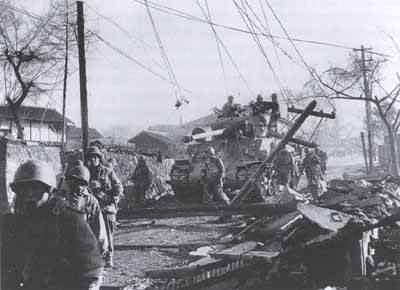
After an extensive refit in the aftermath of the Unsan battle, the ROK 1st Infantry Division was placed on the US I Corps right flank at Yongsan-dong on November 20. As part of the Home-by-Christmas Offensive, the Division was to advance north and to capture the town of Taechon while the US 35th Infantry Regiment, 25th Infantry Division was advancing north from Yongsan-dong on the Korean right flank. At the same time, the US 24th Infantry Division of US I Corps would advance towards Chongju on the ROK 1st Infantry Division's left flank.
On the morning of November 24, the ROK 1st Infantry Division advanced towards the town of Taechon with its 11th and 12th Infantry Regiment on point. On the night of November 24, the defending PVA 66th Corps counterattacked the ROK forces with infantry and cavalry charges, and the PVA and ROK troops were soon locked in a seesaw battle from November 25 to 26.
As the battle around Taechon dragged into the night of November 26, the ROK 11th Infantry Regiment on the division's right became disorganized. Upon noticing their flank was buckling, the US 24th Infantry Division and the US 35th Infantry Regiment started the retreat southward to the Ch'ongch'on River.
At 1 p.m. on November 27, Peng ordered the PVA 66th Corps to destroy the ROK 1st Infantry Division before they could retreat to the Ch'ongch'on River. On the evening of November 27, the PVA 66th Corps launched a massive attack against the ROK 1st Infantry Division, the US 5th Regimental Combat Team of the 24th Infantry Division and the US 35th Infantry Regiment. After midnight, the PVA attacks broke through the ROK lines and captured Yongsan-dong, resulting in the loss of the ROK 11th, 15th and US 35th Infantry Regiment's command posts. The ROK 11th and 15th Infantry Regiment were soon scattered while the retreating US 35th Infantry Regiment was blocked at Yongsan-dong with PVA forces attacking from behind. Under heavy pressure, the US 35th Infantry Regiment fought its way through the town and rejoined the US 25th Division on the afternoon of November 28.
Actions at Kunu-ri

Kunu-ri is a crossroad village on the northern bank of the Kaechon River, one of Ch'ongch'on River's southern tributaries. The importance of Kunu-ri was also noted by the Chinese, and on November 27, Peng instructed the PVA 38th Corps to cut the US IX Corps retreat route. The PVA 114th Division of 38th Corps would capture Kunu-ri by marching westward on the road from Tokchon, while the PVA 112th Division would follow on a parallel route through the hills north of the road.
With the US 2nd Infantry Division still engaged at Kujang-dong, Coulter ordered the Turkish Brigade in the IX Corps reserve to block the PVA advance. On the night of November 27, the Turks took up defensive position at Wawon to the east of Kunu-ri. They were soon met with the PVA 342nd Regiment, 114th Division. The ensuing battle between the Chinese regiment and the brigade's advance battalion continued for much of the November 28, resulting in 400 Turkish casualties. As dusk came on November 28, the Turkish Brigade tried to retreat 5 km west to Sinim-ri to set up stronger defensive positions, but the PVA 342nd Regiment caught up with the brigade and attacked its rear, completely surrounding the brigade. With communications cut between the brigade and the Turkish headquarters, The trapped Turks broke out of the PVA encirclement on the morning of November 29 and the brigade was attached to the US 2nd Infantry Division.
Although the Turkish Brigade was crippled by the PVA, its delaying action allowed the US 2nd Infantry Division to secure Kunu-ri on the night of November 28. With the US 23rd Infantry Regiment setting up defensive positions to the north of Kunu-ri on the morning of November 29, the US 38th Infantry Regiment tried to occupy the hills to the northeast of Kunu-ri. But the American soon found the PVA 112th Division had already occupied the hills. The 38th Infantry Regiment was then forced to occupy a lower position at 1 mi away from the Chinese.
Both historian Clay Blair and Colonel Paul Freeman believed that the Turkish Brigade was "overrated, poorly led green troops" who "broke and bugged out", and blamed them for not protecting on the right flank of the US Eighth Army. However historian Bevin Alexander noted that given the Turkish Brigade was the only UN force present between Wawon and Kunu-ri, the Chinese inability to capture Kunu-ri before the US 2nd Infantry Division meant the Turks had fulfilled their original mission and covered the withdrawal of the US IX Corps.

On the afternoon of November 28, MacArthur started to recognize that a crisis was growing in Korea. With the start of the Battle of Chosin Reservoir on November 27, MacArthur gathered his field commanders, including Walker, for a conference in Tokyo. During the conference, MacArthur learned about the situation on the Eighth Army's right flank and judged that the Eighth Army was in great danger. He instructed Walker to withdraw from the battle before the Chinese could surround the Eighth Army. After the conference at November 29, Walker ordered all Eighth Army units to retreat to a new line around Sunchon, 30 mi south of Kunu-ri.
Following Walker's orders, most of the Eighth Army's major units promptly broke contact with the Chinese and withdrew, but the US 2nd Infantry Division was forced to stay at Kunu-ri in order to hold off the Chinese forces on the Eighth Army's right flank. By the time the 2nd Infantry Division tried to withdraw on the night of November 29, the two PVA divisions attacked the US 38th Infantry Regiment. The PVA 112th Division first struck the 38th Infantry Regiment on the left flank, but the American defenses held firm, Upon noticing this development, Brigadier General Tahsin Yazıcı of the Turkish Brigade ordered a withdrawal, and the Americans had to retreat by infiltrating the PVA lines. At 04:00 on November 30, the 38th Infantry Regiment crossed the Kaechon River under the cover of the 23rd Infantry Regiment and Kunu-ri was under PVA control.
The Gauntlet
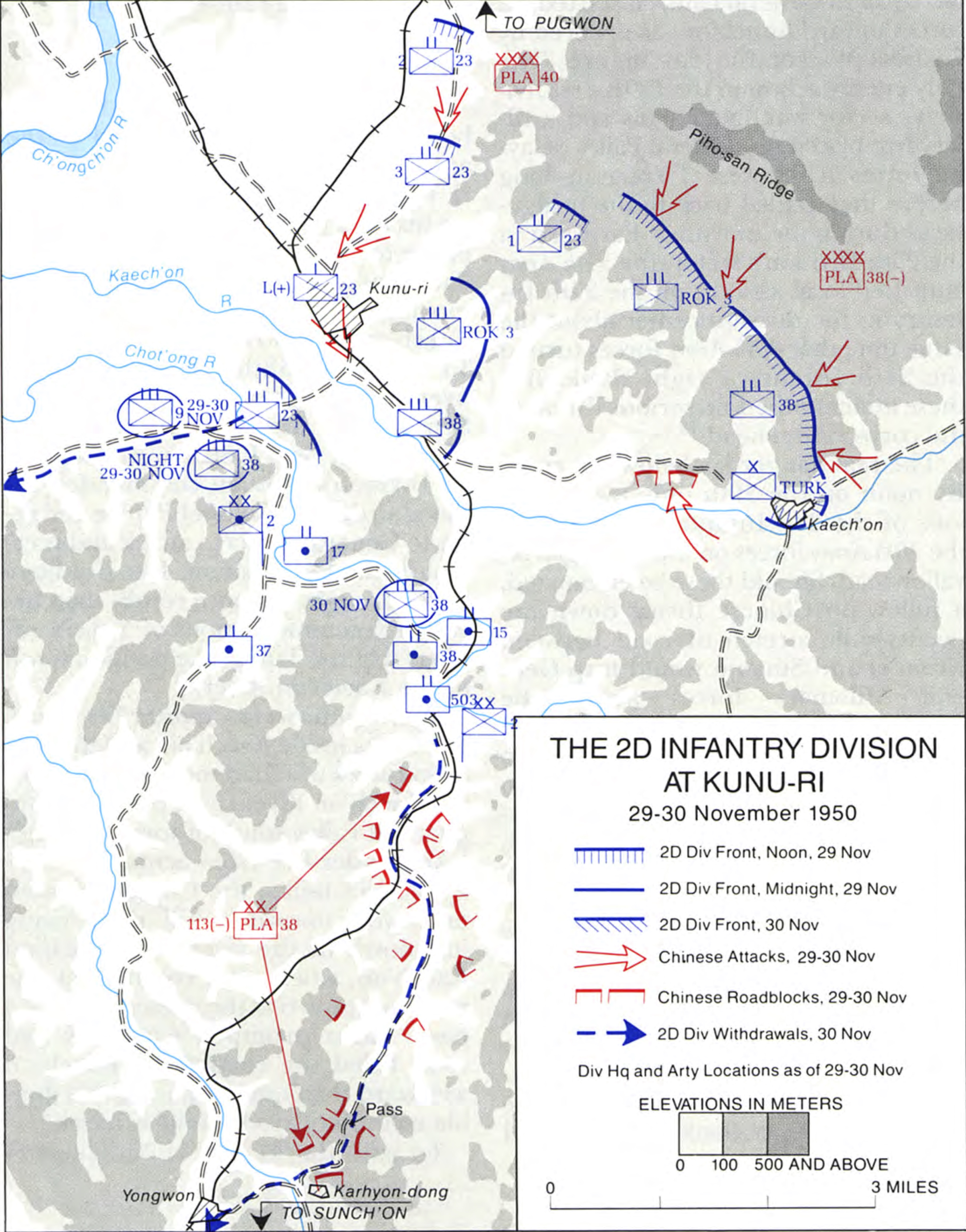
In the aftermath of ROK II Corps' collapse on November 27, Peng immediately ordered the PVA 38th Corps to cut the road between Kunu-ri and Sunchon in the US IX Corps rear, while the PVA 42nd Corps would surround the entire Eighth Army by rushing south through Pukchang-ni and capture Sunchon.
With the new orders on November 28, the US 5th Cavalry Regiment, 1st Cavalry Division left Kunu-ri to rejoin the division to the northeast of Sunchon. With the US 5th Cavalry Regiment absent and the 8th Cavalry Regiment still recovering from devastating losses from the battle at Unsan, Major General Hobart Gay of the US 1st Cavalry Division placed the US 7th Cavalry Regiment to the south of Pukchang-ni, behind the remnants of the ROK 6th Infantry Division. Lacking reinforcements, the ROK 6th Infantry Division was quickly routed by the PVA 42nd Corps on the night of November 28. PVA forces then attacked the 7th Cavalry Regiment under the cover of the fleeing Korean soldiers and refugees pouring into the American front. Under Gay's order, the 7th Cavalry Regiment withdrew southwest to the town of Sinchang-ni on the morning of November 29, and the PVA resumed the drive southward. A fierce battle between the PVA 125th Division and the 7th Cavalry Regiment broke out during the night of November 29, but by the morning of November 30 the PVA 42nd Corps' advance was halted.
The PVA 38th Corps, on the other hand, was marching towards the Kunu-ri—Sunchon road virtually unopposed. An hour and half later, the advance platoon from the 5th Cavalry Regiment was ambushed and destroyed. With its advance blocked, the 5th Cavalry Regiment tried to dislodge the PVA garrison, but it was forced to turn back by the afternoon.
The 113th Division then occupied the valley containing the Kunu-ri—Sunchon road at that night and blocked the retreat route of the US 2nd Infantry Division.
One of the first victims of the new PVA roadblock was a convoy from the Turkish Brigade, and it was ambushed on the night of November 28. A military police patrol was sent to investigate, but most of its members were killed by the morning. With the battle still raging at Kunu-ri, the news of the PVA roadblock reached the US 2nd Infantry Division on November 29. and the roadblock grew to 6 mi in depth.
The 2nd Infantry Division, however, did not know the strength of the roadblock on the night of November 29. At the same time, the US 25th Infantry Division Military Police mistakenly reported that the alternative retreat route from Kunu-ri to Anju was also blocked by PVA. Later, Coulter ordered Keiser to withdraw by breaking the roadblock with the 27th Commonwealth Brigade. On the early morning of November 30, Keiser made the decision to withdraw through the valley.
On the morning of November 30, the 9th Infantry Regiment led the withdrawal by attacking the roadblock. Four tanks were first sent down the road and the PVA held their fire. Encouraged by this development, Colonel Sloane ordered the 9th Infantry Regiment to press forward, but PVA machine gun and mortar fire immediately stopped the advance at 9 a.m. With no contacts between the American commands and the British units, the Middlesex Regiment advanced to the south end of the valley without attacking the roadblock. Believing that the roadblock was short and the British were attacking up the road, Keiser ordered the 2nd Infantry Division to run through the blockade at 10:00.
As the 2nd Infantry Division entered the valley, later known as the "Gauntlet", the PVA machine guns delivered punishing fire while mortar shells saturated the road. The length of the roadblock caught the 2nd Infantry Division by surprise, and the road was soon filled with wrecked vehicles and wounded and dead soldiers. Those who tried to take cover in the ditches were promptly left behind by the convoy rushing south, and unit cohesion instantly evaporated. and the immobilized artillery pieces forced the rest of the division to abandon all vehicles and to retreat by hiking through the hills. In one of the last acts of the battle, the 23rd Infantry Regiment fired off its stock of 3,206 artillery shells within 20 minutes, The last stragglers from the US 2nd Infantry Division finally arrived at Sunchon on December 1, and by December 2 the Eighth Army had completely lost contact with the Chinese.
Aftermath

In the aftermath of the battle, US Eighth Army's casualty number exceeded 11,000 in the first count. However, it was later approximated that the US 2nd Infantry Division had suffered 4,037 casualties, and most of its artillery pieces, 40 percent of its signal equipment, 45 percent of its crew-served weapons, and 30 percent of its vehicles were lost during the battle. Another figure even demonstrated a much worse situation for the 2nd Infantry Division; a count rendered on 1 December listed 2nd Division battle casualties at 4,940 for the last half of November; of these, 90 percent had been incurred since November 25. When reconciled with non-battle casualties, replacements, and returnees, the battle losses left the division 8,662 men short of authorized strength, or 4,731 men short of the Division's actual strength on 15 November. The 1st Cavalry took over the line originally assigned to the 2nd Division. Thus, the US 2nd Infantry Division was deemed to be crippled, and Keiser was relieved from command by the end of the battle. The other US unit that had reported significant losses was the US 25th Infantry Division with 1,313 casualties. The Turkish Brigade had also reported 936 casualties with 90 percent equipment, 90 percent vehicle and 50 percent artillery losses, and the brigade was rendered combat ineffective. The ROK casualties could not be estimated due to the complete absence of South Korean records during the first half of the Korean War, but according to Paik, the ROK II Corps' headquarters was forced to disband in the aftermath of the battle. As for PVA losses, Peng estimated 45,000 casualties by the end of the battle, and the official Chinese history attributed approximately 20,000 casualties to combat, while the rest were attributed to the lack of adequate winter clothing and the lack of food. For its role in setting up the Gauntlet against the US 2nd Infantry Division, the PVA 38th Corps was awarded the title "Ten Thousand Years Corps" by Peng on December 1, 1950.
With the US 2nd Infantry Division, the Turkish Brigade and ROK II Corps out of action, the US Eighth Army was reduced to just two corps, composed of four divisions and two brigades. Meanwhile, the over-extended Chinese logistics system had also left the victorious PVA 13th Army Group half-starved and incapable of any further offensive operations. But during the chaotic UN retreats, no reconnaissance was conducted to determine the state of the Chinese forces. much to the surprise of the PVA commanders. The following 120 mi withdrawal to the 38th Parallel is often referred to as "the longest retreat in US military history." Aside from extremely low morale after the battle, the entire Eighth Army was also gripped with "bug out fever" during the retreat, and a song called the "Bug-Out Boogie" was composed to commemorate the Eighth Army's defeat. Walker died two days before the Christmas of 1950 when a truck driven by a ROK soldier collided with his jeep, and Lieutenant General Matthew B. Ridgway assumed the command of the US Eighth Army. At the UN, all hopes for a unified Korea were abandoned, and a ceasefire at the 38th Parallel was proposed to China on December 11, 1950.
Having decisively won the battle and once again turned the tide of the war in favor of the Communists, the Battle of the Ch'ongch'on River represented the peak of the Chinese military's performance in Korea. However, Mao interpreted the UN ceasefire as a weakness that China should further exploit. Mao ordered the PVA to invade South Korea—a mission that was beyond the Chinese military's abilities while breaking the fragile Chinese supply lines. Recognizing the Chinese difficulties, Ridgway then led the Eighth Army to inflict severe losses on the PVA during the Chinese offensives of 1951.
Notes
;Footnotes ;Citations
References
References
- {{harvnb. Chinese Military Science Academy. 2000
- {{harvnb. Appleman. 1989
- {{harvnb. Appleman. 1989
- {{harvnb. Appleman. 1989
- Chinese Military Science Academy. 2000
- {{harvnb. Appleman. 1989
- {{harvnb. Chae. Chung. Yang. 2001
- {{harvnb. Ecker. 2005
- "Korean War (Kore Savaşi)". Turkish War Veterans Association.
- {{harvnb. Appleman. 1989
- Millett, Allan R.. (2009). "Korean War". [[Encyclopædia Britannica]].
- {{harvnb. Roe. 2000
- {{harvnb. Roe. 2000
- {{harvnb. Roe. 2000
- {{harvnb. Alexander. 1986
- {{harvnb. Roe. 2000
- {{harvnb. Roe. 2000
- {{harvnb. Appleman. 1989
- {{harvnb. Appleman. 1989
- {{harvnb. Roe. 2000
- {{harvnb. Zhang. 1995
- {{harvnb. Zhang. 1995
- {{harvnb. Roe. 2000
- {{harvnb. Roe. 2000
- {{harvnb. Appleman. 1989
- {{harvnb. Appleman. 1989
- {{harvnb. Appleman. 1989
- {{harvnb. Appleman. 1989
- {{harvnb. Appleman. 1989
- {{harvnb. Appleman. 1989
- {{harvnb. Appleman. 1989
- {{harvnb. Appleman. 1989
- {{harvnb. Halberstam. 2007
- {{harvnb. Roe. 2000
- {{harvnb. Appleman. 1989
- {{harvnb. Roe. 2000
- Appleman. 1989
- {{harvnb. Appleman. 1989
- {{harvnb. Appleman. 1989
- {{harvnb. Appleman. 1989
- {{harvnb. Appleman. 1989
- {{harvnb. Appleman. 1992
- {{harvnb. Appleman. 1989
- {{harvnb. Roe. 2000
- {{harvnb. Chinese Military Science Academy. 2000
- Appleman. 1989
- {{harvnb. Alexander. 1986
- {{harvnb. Shrader. 1995
- {{harvnb. Appleman. 1989
- {{harvnb. Alexander. 1986
- {{harvnb. Shrader. 1995
- {{harvnb. Appleman. 1989
- {{harvnb. Roe. 2000
- {{harvnb. Appleman. 1989
- {{harvnb. Roe. 2000
- At 10:00 on November 24, the ROK [[7th Infantry Division (South Korea). Chae. Chung. Yang. 2001
- {{harvnb. Chae. Chung. Yang. 2001
- {{harvnb. Chae. Chung. Yang. 2001
- {{harvnb. Chae. Chung. Yang. 2001
- {{harvnb. Chae. Chung. Yang. 2001
- {{harvnb. Chinese Military Science Academy. 2000
- {{harvnb. Chinese Military Science Academy. 2000
- {{harvnb. Appleman. 1989
- {{harvnb. Chae. Chung. Yang. 2001
- {{harvnb. Chinese Military Science Academy. 2000
- Chae. Chung. Yang. 2001
- Chae. Chung. Yang. 2001
- Appleman. 1989
- {{harvnb. Chae. Chung. Yang. 2001
- {{harvnb. Chinese Military Science Academy. 2000
- {{harvnb. Chae. Chung. Yang. 2001
- Chae. Chung. Yang. 2001
- {{harvnb. Appleman. 1989
- {{harvnb. Chae. Chung. Yang. 2001
- {{harvnb. Chae. Chung. Yang. 2001
- {{harvnb. Appleman. 1989
- Chae. Chung. Yang. 2001
- {{harvnb. Appleman. 1989
- {{harvnb. Appleman. 1989
- {{harvnb. Roe. 2000
- Roe. 2000
- {{harvnb. Appleman. 1989
- {{harvnb. Appleman. 1989
- In order to renew the offensive on the next day, the [[23rd Infantry Regiment (United States). Appleman. 1989
- Appleman. 1989
- {{harvnb. Appleman. 1989
- {{harvnb. Appleman. 1989
- {{harvnb. Mahoney. 2001
- {{harvnb. Appleman. 1989
- {{harvnb. Appleman. 1989
- {{harvnb. Appleman. 1989
- Appleman. 1989
- Appleman. 1989
- {{harvnb. Appleman. 1989
- {{harvnb. Appleman. 1989
- {{harvnb. Chinese Military Science Academy. 2000
- {{harvnb. Appleman. 1989
- {{harvnb. Mossman. 1990
- {{harvnb. Appleman. 1989
- {{harvnb. Appleman. 1989
- {{harvnb. Appleman. 1989
- {{harvnb. Appleman. 1989
- {{harvnb. Appleman. 1989
- {{harvnb. Appleman. 1989
- while the US [[35th Infantry Regiment (United States). Appleman. 1989
- {{harvnb. Appleman. 1989
- {{harvnb. Appleman. 1989
- Appleman. 1989
- {{harvnb. Appleman. 1989
- {{harvnb. Appleman. 1989
- {{harvnb. Chinese Military Science Academy. 2000
- {{harvnb. Appleman. 1989
- {{harvnb. Appleman. 1989
- {{harvnb. Appleman. 1989
- {{harvnb. Appleman. 1989
- {{harvnb. Appleman. 1989
- Chinese Military Science Academy. 2000
- {{harvnb. Appleman. 1989
- Appleman. 1989
- Appleman. 1989
- {{harvnb. Appleman. 1989
- {{harvnb. Appleman. 1989
- {{harvnb. Appleman. 1989
- {{harvnb. Appleman. 1989
- {{harvnb. Appleman. 1989
- Appleman. 1989
- {{harvnb. Appleman. 1989
- {{harvnb. Chae. Chung. Yang. 2001
- {{harvnb. Chae. Chung. Yang. 2001
- {{harvnb. Appleman. 1989
- Appleman. 1989
- Appleman. 1989
- {{harvnb. Appleman. 1989
- {{harvnb. Chinese Military Science Academy. 2000
- {{harvnb. Appleman. 1989
- {{harvnb. Appleman. 1989
- {{harvnb. Appleman. 1989
- {{harvnb. Appleman. 1989
- Appleman. 1989
- Mossman. 1990
- {{harvnb. Appleman. 1989
- {{harvnb. Chae. Chung. Yang. 2001
- {{harvnb. Chinese Military Science Academy. 2000
- {{harvnb. Chae. Chung. Yang. 2001
- {{harvnb. Appleman. 1989
- Chinese Military Science Academy. 2000
- {{harvnb. Appleman. 1989
- {{harvnb. Appleman. 1989
- {{harvnb. Appleman. 1989
- Chinese Military Science Academy. 2000
- {{harvnb. Appleman. 1989
- {{harvnb. Appleman. 1989
- {{harvnb. Mossman. 1990
- {{harvnb. Mossman. 1990
- {{harvnb. Appleman. 1989
- {{harvnb. Appleman. 1989
- {{harvnb. Appleman. 1989
- Mossman. 1990
- Mossman. 1990
- {{harvnb. Roe. 2000
- {{harvnb. Appleman. 1989
- At the same day, Walker shifted the Eighth Army's line eastward by attaching the US [[1st Cavalry Division (United States). 1st Cavalry Division]] and the Anglo-Australian [[27th Infantry Brigade (United Kingdom). Farrar-Hockley. 1990
- {{harvnb. Mossman. 1990
- {{harvnb. Roe. 2000
- Chae. Chung. Yang. 2001
- {{harvnb. Appleman. 1989
- {{harvnb. Appleman. 1989
- {{harvnb. Roe. 2000
- Appleman. 1989
- {{harvnb. Appleman. 1989
- {{harvnb. Appleman. 1989
- {{harvnb. Appleman. 1989
- {{harvnb. Appleman. 1989
- Chinese Military Science Academy. 2000
- {{harvnb. Appleman. 1989
- {{harvnb. Appleman. 1989
- {{harvnb. Appleman. 1989
- {{harvnb. Appleman. 1989
- {{harvnb. Appleman. 1989
- Appleman. 1989
- {{harvnb. Chae. Chung. Yang. 2001
- {{harvnb. Appleman. 1989
- {{harvnb. Farrar-Hockley. 1990
- {{harvnb. Mossman. 1990
- {{harvnb. Appleman. 1989
- {{harvnb. Mossman. 1990
- {{harvnb. Roe. 2000
- {{harvnb. Roe. 2000
- Appleman. 1989
- Appleman. 1989
- {{harvnb. Appleman. 1989
- Appleman. 1989
- {{harvnb. Appleman. 1989
- {{harvnb. Appleman. 1989
- {{harvnb. Appleman. 1989
- {{harvnb. Appleman. 1989
- {{harvnb. Appleman. 1989
- {{harvnb. Appleman. 1989
- {{harvnb. Paik. 1992
- {{harvnb. Zhang. 1995
- {{harvnb. Xue. 1990
- {{harvnb. Chinese Military Science Academy. 2000
- {{harvnb. Mossman. 1990
- {{harvnb. Roe. 2000
- {{harvnb. Shrader. 1995
- Appleman. 1989
- {{harvnb. Roe. 2000
- {{harvnb. Alexander. 1986
- {{harvnb. Malkasian. 2001
- {{harvnb. Varhola. 2000
- {{harvnb. Appleman. 1989
- {{harvnb. Dickson. 2004
- {{harvnb. Appleman. 1989
- {{harvnb. Alexander. 1986
- {{harvnb. Ryan. Finkelstein. McDevitt. 2003
- Ryan. Finkelstein. McDevitt. 2003
This article was imported from Wikipedia and is available under the Creative Commons Attribution-ShareAlike 4.0 License. Content has been adapted to SurfDoc format. Original contributors can be found on the article history page.
Ask Mako anything about Battle of the Ch'ongch'on River — get instant answers, deeper analysis, and related topics.
Research with MakoFree with your Surf account
Create a free account to save articles, ask Mako questions, and organize your research.
Sign up freeThis content may have been generated or modified by AI. CloudSurf Software LLC is not responsible for the accuracy, completeness, or reliability of AI-generated content. Always verify important information from primary sources.
Report