From Surf Wiki (app.surf) — the open knowledge base
Battle of Poltava
1709 battle of the Great Northern War
1709 battle of the Great Northern War
| Field | Value | |||
|---|---|---|---|---|
| conflict | Battle of Poltava | |||
| partof | the Swedish invasion of Russia during the Great Northern War | |||
| image | File:Marten's Poltava.jpg | |||
| image_size | 300px | |||
| map_relief | 1 | |||
| map_type | Ukraine#European Russia | |||
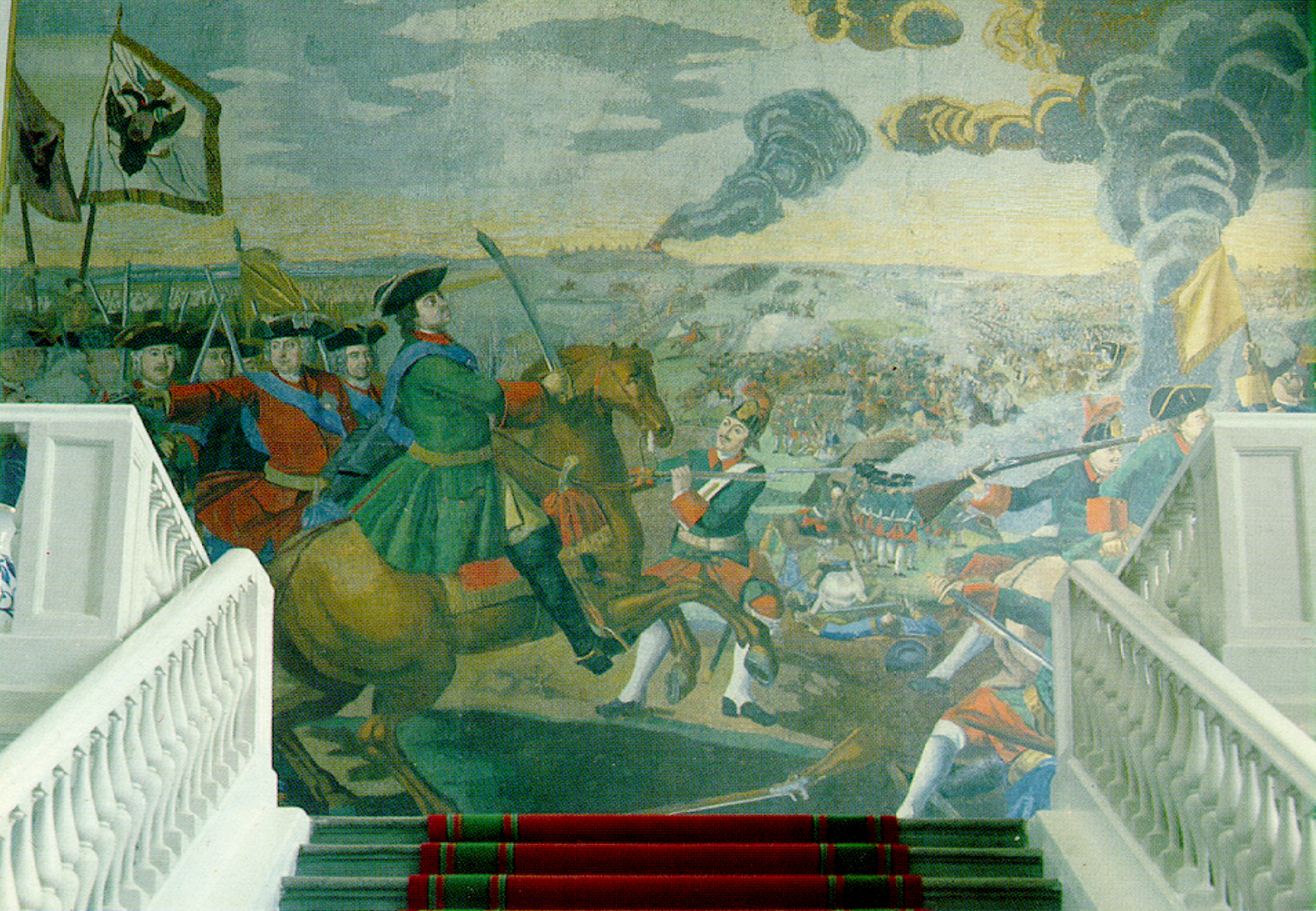
| caption | The Battle of Poltava by Pierre-Denis Martin | |||
| date | 8 July 1709 | |||
| place | Poltava, Cossack Hetmanate, Tsardom of Russia (present-day Ukraine) | |||
| coordinates | ||||
| result | Russian coalition victory | |||
| territory | Decline of the Swedish Empire | |||
| combatant1 | Swedish Empire | |||
| Flag of the Cossack Hetmanate.svg Cossack Hetmanate | ||||
| combatant2 | Tsardom of Russia Tsardom of Russia | |||
| Flag of the Cossack Hetmanate.svg Cossack Hetmanate | ||||
| Kalmyk Khanate | ||||
| commander1 | Swedish Empire Charles XII | |||
| Swedish Empire Carl Gustav Rehnskiöld | ||||
| Swedish Empire Carl Gustaf Creutz | ||||
| Swedish Empire Adam Ludwig Lewenhaupt | ||||
| Swedish Empire | ||||
| Swedish Empire Wolmar Anton von Schlippenbach | ||||
| Swedish Empire Carl Gustaf Roos | ||||
| Flag of the Cossack Hetmanate.svg Ivan Mazepa | ||||
| commander2 | Tsardom of Russia Peter I | |||
| Tsardom of Russia Boris Sheremetev | ||||
| Tsardom of Russia Alexander Menshikov | ||||
| Tsardom of Russia Jacob Bruce | ||||
| Flag of the Cossack Hetmanate.svg Ivan Skoropadsky | ||||
| Flag of the Cossack Hetmanate.svg Semyon Paliy | ||||
| strength1 | 31,392 | |||
| 34 artillery pieces | ||||
| * 16,500 in battle{{efn | 8,700 infantry<ref name | "Poltava 1709"/ | ||
| 7,800 cavalry}} | ||||
| 4 cannonsBesieging Poltava: 1,100 to 3,000 infantry | ||||
| 200 cavalry | ||||
| strength2 | 75,000 to 80,000 | |||
| 102 artillery pieces | ||||
| * 42,660 in battle{{sfn | Krotov | 2014 | p | 273}} |
| 86 cannonsGarrison of Poltava: | ||||
| 4,200 infantry | ||||
| 2,000 Cossacks and 28 cannons | ||||
| casualties1 | 9,700 to 12,211{{efn | |||
| * Swedish accounts: 6,900 killed and wounded, 2,800 captured.{{sfn | Glaeser | 2020 | p | 117}} |
| author | Derek Wilson | |||
| date | March 9, 2009 | |||
| title | Poltava: the Battle that Changed the World | |||
| journal | History Today | |||
| volume | 59 | |||
| issue | 3 | |||
| pages | 23–29 | |||
| location | London | |||
| * Russian accounts: 9,234 killed, 2,864–2,977 captured.<ref> [http://battles.h1.ru/poltava.shtml Битва под Полтавой] {{webarchive | url | https://web.archive.org/web/20050225001544/http://battles.h1.ru/poltava.shtml | date=2005-02-25 }} | |
| * Others accounts: 7,800 killed and 2,977 captured{{sfn | Krotov | 2014 | p | 432}} |
| casualties2 | 4,635 to 5,953{{efn | |||
| * Official accounts: 1,345 killed, 3,290 wounded.{{sfn | Glaeser | 2020 | p | 117}} |
| campaignbox |
Flag of the Cossack Hetmanate.svg Cossack Hetmanate Flag of the Cossack Hetmanate.svg Cossack Hetmanate Kalmyk Khanate Swedish Empire Carl Gustav Rehnskiöld Swedish Empire Carl Gustaf Creutz Swedish Empire Adam Ludwig Lewenhaupt Swedish Empire Swedish Empire Wolmar Anton von Schlippenbach Swedish Empire Carl Gustaf Roos Flag of the Cossack Hetmanate.svg Ivan Mazepa Tsardom of Russia Boris Sheremetev Tsardom of Russia Alexander Menshikov Tsardom of Russia Jacob Bruce Flag of the Cossack Hetmanate.svg Ivan Skoropadsky Flag of the Cossack Hetmanate.svg Semyon Paliy 34 artillery pieces
- 16,500 in battle 4 cannonsBesieging Poltava: 1,100 to 3,000 infantry 200 cavalry 102 artillery pieces
- 42,660 in battle 86 cannonsGarrison of Poltava: 4,200 infantry 2,000 Cossacks and 28 cannons
- Swedish accounts: 6,900 killed and wounded, 2,800 captured.
- Russian accounts: 9,234 killed, 2,864–2,977 captured.
- Others accounts: 7,800 killed and 2,977 captured
- Official accounts: 1,345 killed, 3,290 wounded.
- Other accounts: 5,953 killed and wounded.
The Battle of Poltava fought on 8 July 1709, was the decisive and largest battle of the Great Northern War. The Russian army under the command of Tsar Peter I defeated the Swedish army commanded by Carl Gustaf Rehnskiöld. The battle would lead to the Swedish Empire losing its status as a European great power and also marked the beginning of Russian supremacy in eastern Europe.
During the course of six years in the initial stages of the war, King Charles XII and the Swedish Empire had defeated almost all participants in the anti-Swedish coalition, which initially consisted of the Polish-Lithuanian Commonwealth, Denmark-Norway and the Tsardom of Russia. The latter, under Tsar Peter I, was the only one still fighting. Charles therefore chose to invade Russia in the autumn of 1707 and march towards Moscow with a large Swedish army. However, the campaign was complicated by harsh weather conditions and by Russian scorched earth tactics and surprise attacks, which forced Charles to interrupt his march on Moscow and instead march south to establish winter quarters with the help of Ivan Mazepa, hetman of the Cossack Hetmanate Zaporizhian Host.
After the extremely harsh Great Frost of 1708–1709, which was the coldest recorded winter in Europe, the weakened Swedish army resumed operations in the spring of 1709 and besieged the fortress of Poltava, an important trading center and military depot on the Vorskla. Meanwhile, a numerically superior Russian army of 75,000–80,000 men commanded by Peter, advanced to Poltava to relieve the siege. The two armies clashed, and the Swedes were defeated and fled the battlefield. Charles and Mazepa retreated with 1,500 men south to the river Dnieper, which they crossed, thus managing to escape the Russians and established themselves in the Ottoman Empire.
The Battle of Poltava, as well as the subsequent capitulation, ended in a decisive victory for Peter I and became the greatest military catastrophe in Swedish history. It marked a turning point in the continuation of the war in favour of the anti-Swedish coalition, which as a result of the battle was revived and with renewed vigor attacked the weakened Swedish Empire on several fronts. Poltava thus marked the end of Sweden's time as the dominant power in the Baltic region, a position which after the war was taken over by the Russian Empire. The battle is therefore of crucial importance in the history of Sweden as well as Russia and Ukraine.
Background
Charles XII had led Swedish forces to early victories in North Zealand (summer 1700) and in the Battle of Narva in November 1700. However, it took six years for him to defeat Augustus II of Saxony-Poland. Peter I withdrew from Poland in the spring of 1706, and offered to return the Baltic provinces of Sweden that Russia had occupied since 1703 - except for Ingria, where Peter had already started to build his intended new capital of St. Petersburg - but Charles refused. Peter subsequently adopted a scorched-earth policy in order to deprive the Swedish forces of supplies.
Charles ordered a final attack on the Russian heartland with a possible assault on Moscow from his campaign base in Poland. The Swedish army of almost 44,000 men left Saxony on 22 August 1707 and marched slowly eastwards. Charles took the field in November after waiting for reinforcements to arrive.
Poor weather and road conditions kept the Swedish troops in winter quarters until June 1708. In July the Swedes defeated Marshal Boris Sheremetyev's forces at the Battle of Holowczyn and advanced to the Dnieper River.
Rather than winter in Livonia or wait for Lewenhaupt, Charles decided to move southwards into Ukraine and join Mazepa, who had decided to rebel against Peter. Lewenhaupt followed south and was attacked while crossing a river near a small village that gave its name to the Battle of Lesnaya, losing the supply train and half of his force. In need of resupply, Charles moved towards Baturyn, Mazepa's headquarters, but Russian troops under Aleksandr Menshikov reached the city first. Anticipating the Swedish arrival, Menshikov ordered the merciless massacre of the population, razing the city and destroying or looting arms, ammunition and food.
Prelude
By the spring of 1709, Charles' force had shrunk to half of its original size. After the coldest winter in Europe in over 500 years, Charles was left with 20,000 soldiers and 34 cannons. Short of supplies, he laid siege to the Russian fortress at Poltava on the Vorskla River on 2 May 1709. Peter's force of 80,000 marched to relieve the siege. Upon his arrival, Peter built a fortified camp on the Vorskla, 4 km north of Poltava. While observing the Russian position on 20 June, Charles was struck in the foot by a stray bullet that wounded him so severely that he could not stand. In addition, Charles' last hope of reinforcement expired, as the Swedish forces under von Krassow had turned aside to deal with the anti-Swedish Sandomierz Confederation in Poland.
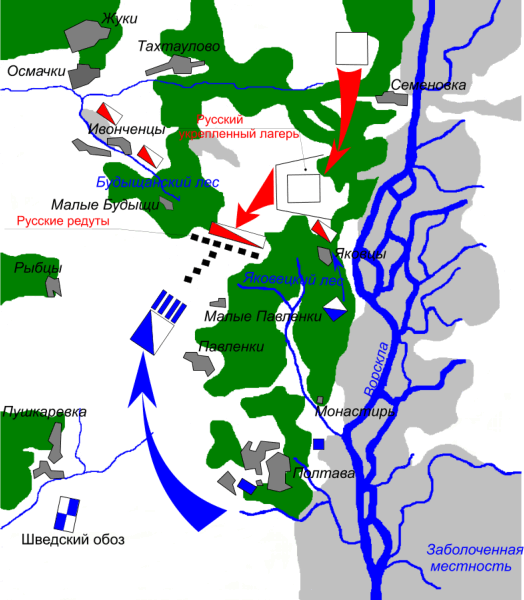
Between the Russian and Swedish forces the Yakovetski and Budyschenski woods formed a corridor, which the Russians defended by building six forts across the gap. Peter, in addition, ordered four more redoubts built so the entire system of ten forts would have a T shape, providing flanking fire to a Swedish advance. Two of the redoubts were still being constructed on the morning of the battle, but 4,000 Russians manned the remaining eight, with 10,000 cavalry under General Aleksandr Danilovich Menshikov stationed behind them.
Battle
Because of his wound, Charles turned over operational command to Field Marshal Carl Gustav Rehnskiöld. Four columns of infantry and six columns of cavalry were to form during the night, 600 meters south of the redoubts, intending to attack before dawn in order to swiftly bypass the redoubt system and hit the Russian fort. The infantry was in place by 2:30 a.m. but the cavalry arrived late, having lost their way. Riding forward, Axel Gyllenkrok observed the Russians at work on the two nearest redoubts and rode back to inform Rehnskiöld. A reconnoitre by Major General Wolmar Anton von Schlippenbach was discovered by the Russians and the alarm was sounded by the firing of a pistol. Having lost the element of surprise, and without sufficient cannon to breach the fortifications, Rehnskiöld consulted with Charles, Carl Piper and Lewenhaupt on whether or not to proceed with the assault. By the time Rehnskiöld decided to proceed with the attack by quoting, "In the name of God then, let us go forward", it was nearly 4:00 a.m. on 28 June (Swedish calendar) and dawn was already approaching. The Swedes in Carl Gustaf Roos' column quickly overran the first two redoubts, killing every Russian soldier inside them, but by 4:30 a.m. the attempts to take the third redoubt stalled.
Lewenhaupt's ten battalions on the right bypassed the first four redoubts entirely, advancing to the back line and, with the aid of cavalry, took some redoubts while bypassing others. Two of Roos' rear battalions joined them, indicating that issued orders lacked clarity as to whether to avoid the redoubts or attack them in series. The cavalry on the left wing, commanded by Major General Hamilton and an infantry regiment, advanced by passing the redoubts on the left and charged the Russian cavalry, forcing them to retreat. It was 5:00 a.m. when the left and right wings of the Swedish army made it past the back line of redoubts, sending the Russian cavalry in retreat. However, Rehnskiöld ordered his cavalry to stop their pursuit and Lewenhaupt, already advancing towards the fort, to withdraw to the west. There they awaited Roos' battalions for two hours, while the Russian cavalry and Ivan Skoropadsky's Cossacks waited to the north, with 13 Russian battalions deployed north of their camp and ten to the south, anticipating a Swedish advance.
General Roos and six battalions (one-third of the Swedish infantry) became isolated while attempting to take the third Russian redoubt. After suffering severe casualties from several assault attempts, Roos led the remaining 1,500 of his original 2,600 men into the Yakovetski woods to the east at 6:00 a.m. The Russians reoccupied the first two redoubts and launched a two-pronged attack by ten regiments around 7:00 a.m., forcing Roos to retreat towards Poltava and take refuge in an abandoned fort by 9:00 a.m. when he could not make it to the Swedish siege works. Roos was forced to surrender at 9:30 a.m.
The Swedes continued to wait for Roos' troops to return, unaware of their surrender. Peter led the 42 battalions of Russian infantry—22,000 soldiers—into an advance out of the fortified camp, supported by 55 three-pounder cannons and 32 guns on the ramparts of the fort. Ten regiments of dragoons formed under Lieutenant General Adolf Fredrik Bauer on the Russian right and six regiments under Menshikov on the left. Just west of the camp the Russians were faced by 4,000 Swedish infantry, formed into ten battalions with four three-pounders, and the cavalry under Major General Carl Gustaf Creutz in the rear. The Russians slowly moved forward to engage. According to Charles and reports from other Swedish officers, the weather at that time was already very hot and humid, with the sun obscured by smoke from the Russian cannons in the fort.
At 09:45, Rehnskiöld ordered Lewenhaupt and the Swedish line to move forward, advancing towards the Russian line, which started firing its cannons at 500 meters. When the Swedes were 50 meters from the Russian line, the Russians opened fire with their muskets from all four ranks. Advancing to within 30 meters of the Russian line, the Swedes fired a volley of their own and charged with their muskets and pikemen, and the Russian first line retreated towards their second line. The Swedes seemed to be on the verge of a breakthrough and needed the cavalry under Creutz to break the Russian lines. Unfortunately for the Swedes, Creutz's and the other cavalry units were unable to reform completely in time. With the Russian line longer than the Swedish line, the Swedish infantry on the left flank lagged behind the right and finally threw down their weapons and fled. As the Swedish right flank was still advancing, a gap began to open in the Swedish line which the Russians filled and the battle turned into a Cannae variation. Barely able to gather his cavalry squadrons, Creutz tried to advance on the right flank, but the Russian battalions were able to form into hollow squares, while Menshikov's cavalry outflanked the Swedes and attacked them from the rear. At this point the Swedish assault had disintegrated and no longer had organized bodies of troops to oppose the Russian infantry or cavalry. Small groups of soldiers managed to break through and escape to the south through the Budyschenski woods, while many of the rest were overwhelmed, ridden down or captured.
.png)
Realizing they were the last Swedes on the battlefield, Charles ordered a retreat to the woods, gathering what remaining forces he could for protection, including the remnants of Creutz's detachment. The Russians halted at the edge of the woods and their artillery fire stopped; only the Cossacks and Kalmyks roamed the plains south of the woods. Emerging from the woods at around noon, Charles—on horseback after his litter was destroyed, and protected by a square of a couple of thousand men—headed to Pushkaryovka and his baggage train 5 km to the south, reaching it after 1:00 p.m., by which time the battle was over.
Charles gathered the remainder of his troops and baggage train and retreated to the south later that same day—at about 7:00 p.m., abandoning the siege of Poltava.
Aftermath
Main article: Surrender at Perevolochna

High-ranking Swedes captured during the battle included Field Marshal Rehnskiöld, Major Generals Schlippenbach, Stackelberg, Hamilton and Prince Maximilian Emanuel, as well as Piper. Two mass graves contained the Russian dead, 500 meters southwest of their camp. Previously when defeating Peter, Charles had gone so far as to pay the Russian troops. Peter instead took many Swedes, with great pride, and sent them to Siberia.
Charles and Mazepa escaped with about 1,500 men to Bendery, Moldavia, then controlled by the Ottoman Empire.
Since 3 September 2009, the battlefield has been listed by Ukraine as a monument of national historical significance.
Notes
References
Sources
- Brown, Peter B. "Gazing Anew at Poltava: Perspectives from the Military Revolution Controversy, Comparative History, and Decision-Making Doctrines." Harvard Ukrainian Studies 31.1/4 (2009): 107–133. online
- Frost, Robert I. "' Everyone understood what it meant': The Impact of the Battle of Poltava on the Polish-Lithuanian Commonwealth." Harvard Ukrainian Studies 31.1/4 (2009): 159–176 online.
- Gerner, Kristian. "The Battle of Poltava as a Realm of Memory and a Bone of Contention." Harvard Ukrainian Studies 31.1/4 (2009): 679–693 online.
- Kamenskii, Alexander. "The Battle of Poltava in Russian Historical Memory." Harvard Ukrainian Studies 31.1/4 (2009): 195–204 online.
- LeDonne, John. "Poltava and the geopolitics of Western Eurasia." Harvard Ukrainian Studies 31.1/4 (2009): 177–191 online.
- .
- online
Secondary notes
References
- (2008). "Poltava, Battle of". Canadian Institute of Ukrainian Studies..
- Д. Ю. Степанов. link
- Ericson, p. 297.
- {{in lang
- {{in lang. ru [http://war1960.narod.ru/nwtime/Poltava_sostav.html О составе русской и шведской армий в Полтавском сражении] {{Webarchive. link. (2019-10-06)
- Englund (1988), p. 215.
- {{in lang. sv Christer Kuvaja: ''Karolinska krigare 1660–1721'', p. 192. [[Schildts Förlags Ab]] 2008. {{ISBN. 978-9515018236.
- {{in lang. ru [http://battles.h1.ru/poltava.shtml Битва под Полтавой] {{webarchive. link. (2005-02-25)
- "Poltava, Battle of".
- {{in lang
- Krotov. 2014
- Gordon, A. The History of Peter the Great, Emperor of Russia: To which is Prefixed a Short General History of the Country from the Rise of that Monarchy: and an Account of the Author's Life, Volume 1. Aberdeen. 1755. pp. 301–02.
- Field, J. F.. (2022-07-01). "Battle of Poltava".
- Moltusov, Valerij Aleksejevitj. (2009). "Poltava 1709: Vändpunkten". SMB.
- {{rp. 710 The rest of the army was forced to [[Surrender at Perevolochna. surrender to the Russians]] at the village of [[Perevolochna]] on 11 July 1709.Massie.
- Field, J. F.. (2022-07-01). "Battle of Poltava".
- (2015). "Poltava, Battle of". [[Oxford University Press.
- Schnakenbourg, Eric. (2018). "Great Northern War (1700–21)". John Wiley & Sons, Ltd.
- Tucker, S.C., 2010, A Global Chronology of Conflict, Vol. Two, Santa Barbara: ABC-CLIO, LLC, {{ISBN. 978-1-85109-667-1
- Englund, P., 1992, The Battle that Shook Europe, London: I.B. Tauris & Co. Ltd., {{ISBN. 978-1-78076-476-4
- {{rp. 197, 210 Lewenhaupt led the surviving Swedes and some of the Cossack forces to the Dnieper River, but was doggedly pursued by the Russian regular cavalry and 3,000 Kalmyk auxiliaries and forced to [[surrender at Perevolochna. surrender three days later at Perevolochna]] on 11 July.Massie.
- "". link
This article was imported from Wikipedia and is available under the Creative Commons Attribution-ShareAlike 4.0 License. Content has been adapted to SurfDoc format. Original contributors can be found on the article history page.
Ask Mako anything about Battle of Poltava — get instant answers, deeper analysis, and related topics.
Research with MakoFree with your Surf account
Create a free account to save articles, ask Mako questions, and organize your research.
Sign up freeThis content may have been generated or modified by AI. CloudSurf Software LLC is not responsible for the accuracy, completeness, or reliability of AI-generated content. Always verify important information from primary sources.
Report