From Surf Wiki (app.surf) — the open knowledge base
Battle of Okinawa
Major 1945 battle of the Pacific War

Major 1945 battle of the Pacific War
| Field | Value | |||
|---|---|---|---|---|
| conflict | Battle of Okinawa | |||
| partof | the Volcano and Ryukyu Islands campaign of the Pacific War (World War II) | |||
| image | File:Ww2 158.jpg | |||
| image_size | 300 | |||
| caption | 1st Marine Regiment during fighting at Wana Ridge during the Battle of Okinawa, May 1945 | |||
| date | 1 April – 22 June 1945 | |||
| () | ||||
| place | Okinawa Island and Prefecture, Ryukyu Islands, Japan | |||
| coordinates | ||||
| map_type | Japan#Pacific Ocean | |||
| map_size | 300 | |||
| result | Allied victory | |||
| combatant1 | Ground forces: | |||
| United States | ||||
| Naval forces: | ||||
| United States | ||||
| United Kingdom | ||||
| Australia | ||||
| Dominion of New Zealand | ||||
| Canada | ||||
| combatant2 | Empire of Japan Japan | |||
| commander1 | {{ubl | |||
| commander2 | {{ubl | |||
| units1 | Ground units: | |||
| United States *Tenth Army* | ||||
| units2 | Ground units: | |||
| Empire of Japan *32nd Army* | ||||
| strength1 | Naval_jack_of_the_United_States_(1912–1959).svg United States Navy | |||
| <ref name | Blumberg | |||
| ~541,000 in Tenth Army <br />~183,000 combat troops<ref>{{harvnb | Sloan | 2007 | p | 18}} rising to ~250,000 |
| strength2 | Empire of Japan Imperial Japanese Navy | |||
| <ref name | "USNIok" / | |||
| <ref name | "USNIok" | |||
| * ~40,000+ Okinawan conscripts and boeitai<ref>{{harvnb | Hastings | 2008 | p | 370}} |
| casualties1 | United States American personnel: | |||
| *Battle casualties:* | ||||
| ~50,000, including ~12,500 dead | ||||
| Army: 19,929 | ||||
| Navy: 10,007 at Okinawa, 1,294 on USS Franklin | ||||
| Marines: 19,460 | ||||
| *Non-battle casualties*: 26,211 to 33,096 (all causes) | ||||
| British personnel:<br />Battle casualties:<br>119 killed<br>83 wounded<br>228 aircraft lost<br>4 fleet carriers damaged in kamikaze strikes<ref name | Blumberg/ | |||
| Total casualties: ~76,000 to 84,000<br />Materiel:<br />375 tanks damaged, disabled, or destroyed<ref>[http://cdm16635.contentdm.oclc.org/cdm/ref/collection/p16635coll14/id/56035 "Survey of Allied tank casualties in World War II"] {{Webarchive | url | https://web.archive.org/web/20190717223049/http://cdm16635.contentdm.oclc.org/cdm/ref/collection/p16635coll14/id/56035 | date=17 July 2019 }}, Technical Memorandum ORO-T-117, Department of the Army, Washington D.C.,Table 1. | |
| 13 destroyers sunk | ||||
| 15 amphibious ships sunk | ||||
| 8 other ships sunk | ||||
| 386 ships damaged | ||||
| 763 aircraft lost | ||||
| casualties2 | Empire of Japan Japanese personnel: | |||
| *Battle & non-battle casualties:* | ||||
| 94,136 soldiers and sailors dead (all causes) | ||||
| 4,037 dead from Yamato task force | ||||
| 7,401 captured (by 30 June)〜16,346 captured(by the end of November) | ||||
| Total casualties: ~105,000 to 110,000 | ||||
| Materiel: | ||||
| 1 battleship sunk | ||||
| 1 light cruiser sunk | ||||
| 5 destroyers sunk | ||||
| 9 other warships sunk | ||||
| 1,430 aircraft lost | ||||
| 27 tanks destroyed | ||||
| 743–1,712 artillery pieces, anti-tank guns, mortars and anti-aircraft guns lost | ||||
| casualties3 | 40,000–150,000 civilians dead | |||
| campaignbox |
() United States Naval forces: United States United Kingdom Australia Dominion of New Zealand Canada |COMPACFLT: |United States Chester W. Nimitz |Tenth Army: |United States Simon Bolivar Buckner Jr. |United States Roy Geiger |United States John R. Hodge |Fifth Fleet: ||United States Raymond A. Spruance |United States Richmond K. Turner |United Kingdom Bernard Rawlings |United States Marc Mitscher |Western District Army: |Empire of Japan Isamu Yokoyama |Combined Fleet: |Empire of Japan Soemu Toyoda |Empire of Japan Minoru Ōta |32nd Army: |Empire of Japan Mitsuru Ushijima |Empire of Japan Isamu Chō |Empire of Japan Hiromichi Yahara |Special Attack Force: |Empire of Japan Saachi Itō United States Tenth Army
- III Amphibious Corps
- XXIV Corps
- 7th Infantry Division
- 27th Infantry Division
- 77th Infantry Division
- 96th Infantry Division Naval units: United States Fifth Fleet
- Task Force 50
- Task Force 58
- United Kingdom Task Force 57
- Joint Exp. Force Empire of Japan 32nd Army
- 24th Infantry Division
- 28th Infantry Division
- 62nd Infantry Division
- 44th Mixed Brigade
- 45th Mixed Brigade
- 59th Mixed Brigade
- 60th Mixed Brigade
- 27th Tank Regiment Naval units:
Empire of Japan Combined Fleet
- 2nd Fleet
- 7 fleet carriers,
- 6 light carriers,
- 18 escort carriers,
- 8 fast battleships,
- 10 old battleships,
- 14 heavy cruisers,
- 17 light cruisers,
- 132 destroyers,
- 45 destroyer escorts
United Kingdom Royal Navy
- 5 fleet carriers
- 6 escort carriers
- 2 fast battleships
- 4 light cruisers
- 12 destroyers
- 251 carrier based aircraft United Kingdom Royal Australian Navy
- 4 destroyers United Kingdom Royal New Zealand Navy
- 2 light cruisers United Kingdom Royal Canadian Navy
- 1 light cruiser
United States of America Ground forces ~541,000 in Tenth Army ~183,000 combat troops rising to ~250,000
- 1 battleship
- 1 light cruiser
- 8 destroyers
- 1815 aircraft (of which 1050 were kamikazes)
Empire of Japan Imperial Japanese Army Air Service
- 850 kamikazes
Empire of Japan Ground forces
- ~76,000+ Japanese soldiers
- ~40,000+ Okinawan conscripts and boeitai Battle casualties: ~50,000, including ~12,500 dead Army: 19,929 Navy: 10,007 at Okinawa, 1,294 on USS Franklin Marines: 19,460 Non-battle casualties: 26,211 to 33,096 (all causes)
United Kingdom British personnel: Battle casualties: 119 killed 83 wounded 228 aircraft lost 4 fleet carriers damaged in kamikaze strikes Total casualties: ~76,000 to 84,000 Materiel: 375 tanks damaged, disabled, or destroyed 13 destroyers sunk 15 amphibious ships sunk 8 other ships sunk 386 ships damaged 763 aircraft lost Battle & non-battle casualties: 94,136 soldiers and sailors dead (all causes) 4,037 dead from Yamato task force 7,401 captured (by 30 June)〜16,346 captured(by the end of November) Total casualties: ~105,000 to 110,000 Materiel: 1 battleship sunk 1 light cruiser sunk 5 destroyers sunk 9 other warships sunk 1,430 aircraft lost 27 tanks destroyed 743–1,712 artillery pieces, anti-tank guns, mortars and anti-aircraft guns lost
The Battle of Okinawa, codenamed Operation Iceberg, was a major battle of the Pacific War fought on the island of Okinawa by the United States Army and United States Marine Corps forces against the Imperial Japanese Army. The initial invasion of Okinawa on 1 April 1945 was the largest amphibious assault in the Pacific Theater of World War II. The Kerama Islands surrounding Okinawa were preemptively captured on 26 March 1945 by the U.S. Army 77th Infantry Division. The 82-day battle on Okinawa lasted from 1 April 1945 until 22 June 1945. After a long campaign of island hopping, the Allies were planning to use Kadena Air Base on the island as a staging point for Operation Downfall, the planned invasion of the Japanese home islands, 340 mi away.
The United States created the Tenth Army, a cross-branch force consisting of the U.S. Army 7th, 27th, 77th and 96th Infantry Divisions with the 1st, 2nd, and 6th Marine Divisions, to seize the island. The Tenth Army was unique because it had its own Tactical Air Force (joint Army-Marine command) and was supported by combined naval and amphibious forces. Opposing the Allied forces on the ground was the Japanese Lieutenant General Mitsuru Ushijima's Thirty-Second Army, a mixed force consisting of regular army troops, naval infantry and conscripted local Okinawans. There were about 100,000 Japanese troops on Okinawa at the onset of the invasion. The battle was the longest sustained carrier campaign of the Second World War.
The battle has been referred to as the "typhoon of steel" in English, known in Japanese as "tetsu no bōfū". The nicknames refer to the ferocity of the fighting, the intensity of Japanese kamikaze attacks and the sheer numbers of Allied ships and armored vehicles that assaulted the island. The battle was the bloodiest and fiercest in the Pacific Ocean Theatre, with some 50,000 Allied and around 100,000 Japanese casualties, also including local Okinawans conscripted into the Japanese Army. According to local authorities, at least 149,425 Okinawan people were killed, died by coerced suicide or went missing.
In the naval operations surrounding the battle, both sides lost considerable numbers of ships and aircraft, including the Japanese battleship . After the battle, Okinawa provided the victorious Allies with a fleet anchorage, troop staging areas, and airfields in close proximity to Japan as they planned to invade the Japanese home islands.
Order of battle
Main article: Okinawa ground order of battle
Allied
In all, the US Army had over 103,000 soldiers (of these, 38,000+ were non-divisional artillery, combat support and HQ troops, with another 9,000 service troops), over 88,000 Marines and 18,000 Navy personnel (mostly Seabees and medical personnel).
The British naval contingent accompanied 251 British naval aircraft and included a British Commonwealth fleet with Australian, New Zealand and Canadian ships and personnel.
Japanese
The Japanese land campaign (mainly defensive) was conducted by the 67,000-strong (77,000 according to some sources) regular 32nd Army and some 9,000 Imperial Japanese Navy troops at Oroku Naval Base (only a few hundred of whom had been trained and equipped for ground combat), supported by 39,000 drafted local Ryukyuan people (including 24,000 hastily drafted rear militia called Boeitai and 15,000 non-uniformed laborers). The Japanese had used kamikaze tactics since the Battle of Leyte Gulf, but now for the first time they became a major institutionalized aspect of the Japanese defensive strategy. Between the American landing on 1 April and 25 May, seven major kamikaze attacks were attempted, involving more than 1,500 planes.
The 32nd Army initially consisted of the 9th, 24th and 62nd Divisions and the 44th Independent Mixed Brigade. The 9th Division was moved to Taiwan before the invasion, resulting in shuffling of Japanese defensive plans. Primary resistance was to be led in the south by Lieutenant General Mitsuru Ushijima, his chief of staff, Lieutenant General Isamu Chō and his chief of operations, Colonel Hiromichi Yahara. Yahara advocated a defensive strategy, whilst Chō advocated an offensive one.
In the north, Colonel Takehiko Udo was in command. The naval troops were led by Rear Admiral Minoru Ōta. They expected the Americans to land 6–10 divisions against the Japanese garrison of two and a half divisions. The staff calculated that superior quality and numbers of weapons gave each US division five or six times the firepower of a Japanese division. To this, would be added the Americans' abundant naval and air firepower.
Japanese use of children
On Okinawa, the Imperial Japanese Army mobilized 1,780 schoolboys aged 14–17 years into front line service as an Iron and Blood Imperial Corps (), while female Himeyuri students were organized into a nursing unit. This mobilization was conducted by an ordinance of the Ministry of the Army, not by law. The ordinances mobilized the students as volunteer soldiers for form's sake; in reality, the military authorities ordered schools to force almost all students to "volunteer" as soldiers; sometimes they counterfeited the necessary documents. About half of the Tekketsu Kinnōtai were killed, including in suicide bomb attacks against tanks and in guerrilla operations.
Among the 21 male and female secondary schools that made up these student corps, 2,000 students died on the battlefield. Even with the female students acting mainly as nurses to Japanese soldiers, they were still exposed to the harsh conditions of war.
Land battle

On 31 March, Marines of the Amphibious Reconnaissance Battalion landed without opposition on Keise Shima, four islets just 8 mi west of the Okinawan capital of Naha. A group of 155 mm "Long Tom" artillery pieces went ashore on the islets to cover operations on Okinawa.
Northern Okinawa

The main landing was made by the XXIV Corps and the III Amphibious Corps on the Hagushi beaches on the western coast of Okinawa on 1 April. The 2nd Marine Division conducted a demonstration off the Minatoga beaches on the southeastern coast to deceive the Japanese about American intentions and delay movement of reserves from there.
Tenth Army swept across the south-central part of the island with relative ease, capturing the Kadena and the Yomitan airbases within hours of the landing. In light of the weak opposition, General Buckner decided to proceed immediately with Phase II of his plan, the seizure of northern Okinawa. The 6th Marine Division headed up the Ishikawa Isthmus and by 7 April had sealed off the Motobu Peninsula.
Six days later on 13 April, the 2nd Battalion, 22nd Marine Regiment, reached Hedo Point at the northernmost tip of the island. By this point, the bulk of the Japanese forces in the north (codenamed Udo Force) were cornered on the Motobu Peninsula. The terrain was mountainous and wooded, with the Japanese defenses concentrated on Mount Yaedake, a twisted mass of rocky ridges and ravines on the center of the peninsula. There was heavy fighting before the Marines finally cleared Yaedake on 18 April. However, this was not the end of ground combat in northern Okinawa. On 24 May, the Japanese mounted Operation Gi-gou: a company of Giretsu Kuteitai commandos were airlifted in a suicide attack on Yomitan. They destroyed 70000 USgal of fuel and nine planes before being killed by the defenders, who lost two men.
Meanwhile, the 77th Infantry Division assaulted Ie Shima, a small island off the western end of the peninsula, on 16 April. In addition to conventional hazards, the 77th Infantry Division encountered kamikaze attacks and even local women armed with spears. There was heavy fighting before the area was declared secured on 21 April and became another airbase for operations against Japan.
Southern Okinawa

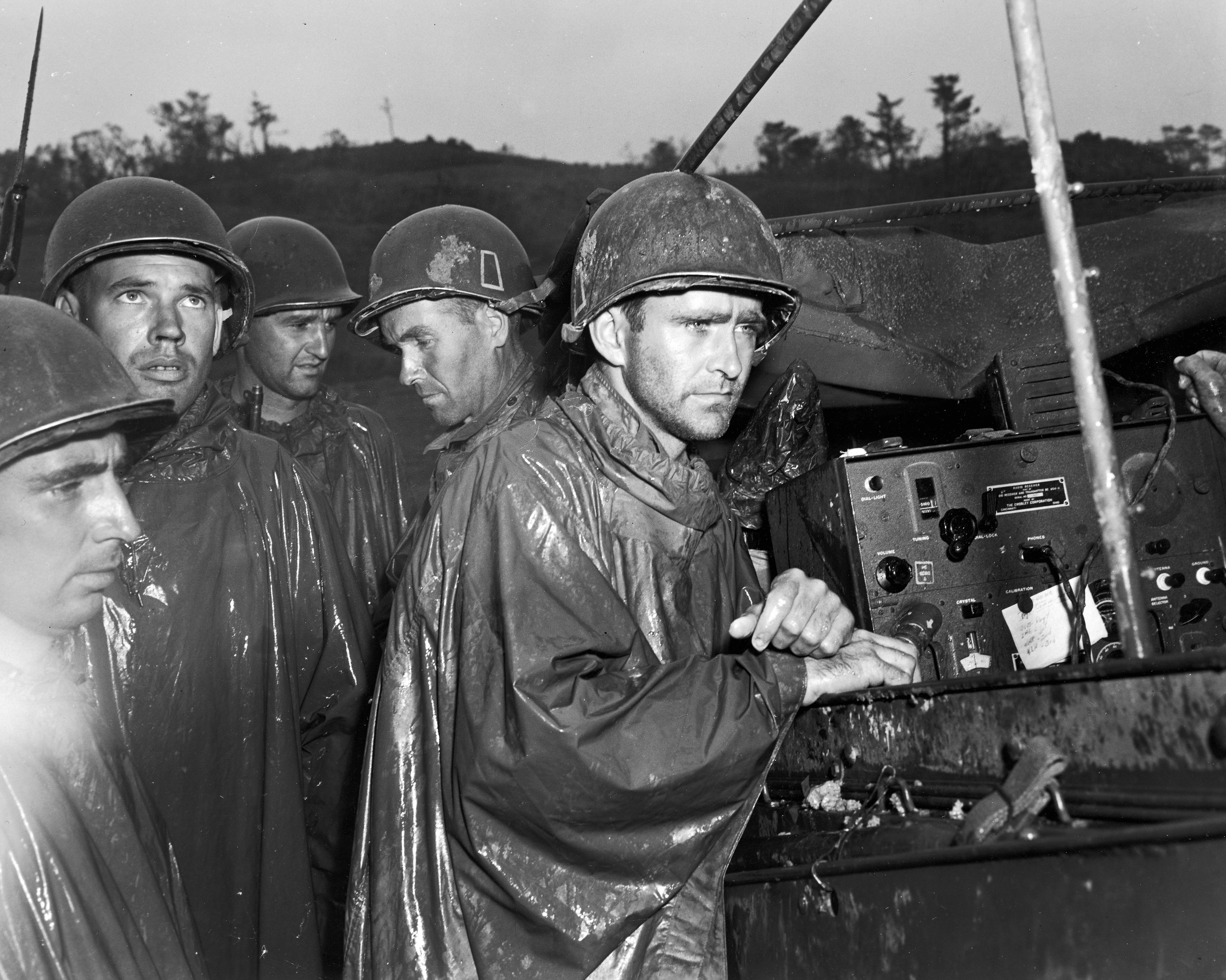


While the 6th Marine Division cleared northern Okinawa, the US Army 96th and 7th Infantry Divisions wheeled south across the narrow isthmus of Okinawa. The 96th Infantry Division began to encounter fierce resistance in west-central Okinawa from Japanese troops holding fortified positions east of Highway No. 1 and about 5 mi northwest of Shuri, from what came to be known as Cactus Ridge. The 7th Infantry Division encountered similarly fierce Japanese opposition from a rocky pinnacle located about 1000 yd southwest of Arakachi (later dubbed "The Pinnacle"). By the night of 8 April, American troops had cleared these and several other strongly fortified positions. They suffered over 1,500 battle casualties in the process while killing or capturing about 4,500 Japanese. Yet the battle had only begun, for it was realized that "these were merely outposts," guarding the Shuri Line.
The next American objective was Kakazu Ridge ()(see :ja:嘉数の戦い), two hills with a connecting saddle that formed part of Shuri's outer defenses. The Japanese had prepared their positions well and fought tenaciously. The Japanese soldiers hid in fortified caves. American forces often lost personnel before clearing the Japanese out from each cave or other hiding place. The Japanese sent out Okinawans at gunpoint to obtain water and supplies for them, which led to civilian casualties. The American advance was inexorable but resulted in a high number of casualties on both sides. Meanwhile, American forces also faced heavy resistance at the Maeda Ridge, also known as Hacksaw Ridge (see :ja:前田の戦い).
As the American assault against Kakazu Ridge stalled, Lieutenant General Ushijima—influenced by General Chō—decided to take the offensive. On the evening of 12 April, the 32nd Army attacked American positions across the entire front. The Japanese attack was heavy, sustained, and well organized. After fierce close combat, the attackers retreated, only to repeat their offensive the following night. A final assault on 14 April was again repulsed. The effort led the 32nd Army's staff to conclude that the Americans were vulnerable to night infiltration tactics but that their superior firepower made any offensive Japanese troop concentrations extremely dangerous, and they reverted to their defensive strategy.
The 27th Infantry Division, which had landed on 9 April, took over on the right, along the west coast of Okinawa. General John R. Hodge now had three divisions in the line, with the 96th in the middle and the 7th to the east, with each division holding a front of only about 1.5 mi. Hodge launched a new offensive on 19 April with a barrage of 324 guns, the largest ever in the Pacific Ocean Theater. Battleships, cruisers, and destroyers joined the bombardment, which was followed by 650 Navy and Marine planes attacking the Japanese positions with napalm, rockets, bombs, and machine guns. The Japanese defenses were sited on reverse slopes, where the defenders waited out the artillery barrage and aerial attack in relative safety, emerging from the caves to rain mortar rounds and grenades upon the Americans advancing up the forward slope.
A tank assault to achieve breakthrough by outflanking Kakazu Ridge failed to link up with its infantry support attempting to cross the ridge and therefore failed with the loss of 22 tanks. Although flame tanks cleared many cave defenses, there was no breakthrough, and the XXIV Corps suffered 720 casualties. The losses might have been greater except for the fact that the Japanese had practically all of their infantry reserves tied up farther south, held there by another feint off the Minatoga beaches by the 2nd Marine Division that coincided with the attack.
At the end of April, after Army forces had pushed through the Machinato defensive line, the 1st Marine Division relieved the 27th Infantry Division and the 77th Infantry Division relieved the 96th. When the 6th Marine Division arrived, the III Amphibious Corps took over the right flank and Tenth Army assumed control of the battle.


On 4 May, the 32nd Army launched another counter-offensive. This time, Ushijima attempted to make amphibious assaults on the coasts behind American lines. To support his offensive, the Japanese artillery moved into the open. By doing so, they were able to fire 13,000 rounds in support, but effective American counter-battery fire destroyed dozens of Japanese artillery pieces. The attack failed.
Buckner launched another American attack on 11 May. Ten days of fierce fighting followed. On 13 May, troops of the 96th Infantry Division and 763rd Tank Battalion captured Conical Hill (). Rising 476 ft above the Yonabaru coastal plain, this feature was the eastern anchor of the main Japanese defenses and was defended by about 1,000 Japanese. Meanwhile, on the opposite coast, the 1st and 6th Marine Divisions fought for "Sugar Loaf Hill" (). The capture of these two key positions exposed the Japanese around Shuri on both sides. Buckner hoped to envelop Shuri and trap the main Japanese defending force.
By the end of May, monsoon rains which had turned contested hills and roads into a morass exacerbated both the tactical and medical situations. The ground advance began to resemble a World War I battlefield, as troops became mired in mud, and flooded roads greatly inhibited evacuation of wounded to the rear. Troops lived on a field sodden by rain, part garbage dump and part graveyard. Unburied Japanese and American bodies decayed, sank in the mud and became part of a noxious stew. Anyone sliding down the greasy slopes could easily find their pockets full of maggots at the end of the journey.
From 24 to 27 May the 6th Marine Division cautiously occupied the ruins of Naha, the largest city on the island, finding it largely deserted.
On 26 May aerial observers saw large troop movements just below Shuri. On 28 May Marine patrols found recently abandoned positions west of Shuri. By 30 May the consensus among Army and Marine intelligence was that the majority of Japanese forces had withdrawn from the Shuri Line. On 29 May the 1st Battalion, 5th Marines (1/5 Marines) occupied high ground 700 yd east of Shuri Castle and reported that the castle appeared undefended. At 10:15 Company A, 1/5 Marines occupied the castle.
Shuri Castle had been shelled by the battleship for three days before this advance. The 32nd Army withdrew to the south and thus the Marines had an easy task of securing Shuri Castle. The castle, however, was outside the 1st Marine Division's assigned zone, and only frantic efforts by the commander and staff of the 77th Infantry Division prevented an American airstrike and artillery bombardment which would have resulted in many friendly fire casualties.
On 29 May a Confederate flag was raised over Shuri Castle, before being removed and replaced by a US flag three days later on orders of General Buckner, himself the son of a Confederate General.
The Japanese retreat, although harassed by artillery fire, was conducted with great skill at night and aided by the monsoon storms. The 32nd Army was able to move nearly 30,000 personnel into its last defense line on the Kiyan Peninsula, which ultimately led to the greatest slaughter on Okinawa in the latter stages of the battle, including the deaths of thousands of civilians. In addition, there were 9,000 IJN troops supported by 1,100 militia, with approximately 4,000 holed up at the underground headquarters on the hillside overlooking the Okinawa Naval Base in the Oroku Peninsula, east of the airfield.
On 4 June, elements of the 6th Marine Division launched an amphibious assault on the peninsula. The 4,000 Japanese sailors, including Admiral Ōta, all committed suicide within the hand-built tunnels of the underground naval headquarters on 13 June. By 17 June, the remnants of Ushijima's shattered 32nd Army were pushed into a small pocket in the far south of the island to the southeast of Itoman.
On 18 June, General Buckner was killed by Japanese artillery fire while monitoring the progress of his troops from a forward observation post. Buckner was replaced by Major General Roy Geiger. Upon assuming command, Geiger became the only US Marine to command a numbered army of the US Army in combat; he was relieved five days later by General Joseph Stilwell. On 19 June, Brigadier General Claudius Miller Easley, the commander of the 96th Infantry Division, was killed by Japanese machine-gun fire, also while checking on the progress of his troops at the front.
The last remnants of Japanese resistance ended on 21 June, although some Japanese continued hiding, including the future governor of Okinawa Prefecture, Masahide Ōta. Ushijima and Chō committed suicide by seppuku in their command headquarters on Hill 89 in the closing hours of the battle. Colonel Yahara had asked Ushijima for permission to commit suicide, but the general refused his request, saying: "If you die there will be no one left who knows the truth about the battle of Okinawa. Bear the temporary shame but endure it. This is an order from your army commander." Yahara was the most senior officer to have survived the battle on the island, and he later authored a book titled The Battle for Okinawa. On 22 June Tenth Army held a flag-raising ceremony to mark the end of organized resistance on Okinawa. On 23 June a mopping-up operation commenced, which concluded on 30 June.
On 15 August 1945, Admiral Matome Ugaki was killed while part of a kamikaze raid on Iheyajima island. The official surrender ceremony was held on 7 September, near the Kadena Airfield.
Casualties
The Battle of Okinawa was the bloodiest battle of the Pacific War. The most complete tally of deaths during the battle is at the Cornerstone of Peace monument at the Okinawa Prefectural Peace Memorial Museum, which identifies the names of each individual who died at Okinawa in World War II. As of 2023, the monument lists 242,046 names, including 149,634 Okinawans, 77,823 Imperial Japanese soldiers, 14,010 Americans, and smaller numbers of people from South Korea (381), the United Kingdom (82), North Korea (82) and Taiwan (34).
The numbers correspond to recorded deaths during the Battle of Okinawa from the time of the American landings in the Kerama Islands on 26 March 1945 to the signing of the Japanese surrender on 2 September 1945, in addition to all Okinawan casualties in the Pacific War in the 15 years from the Manchurian Incident, along with those who died in Okinawa from war-related events in the year before the battle and the year after the surrender. 234,183 names were inscribed by the time of unveiling, and new names are added as necessary. 40,000 of the Okinawan civilians killed had been drafted or impressed by the Japanese army and are often counted as combat deaths.
Military losses
American


The Americans suffered some 48,000 casualties, not including some 33,000 non-battle casualties (psychiatric, injuries, illnesses), of whom over 12,000 were killed or missing. Killed in action were 4,907 Navy, 4,675 Army, and 2,938 Marine Corps personnel; while 13,708 marines were wounded. when excluding naval losses at sea and losses on the surrounding islands (such as Ie Shima), 6,316 killed and over 30,000 wounded occurred on Okinawa proper. Other authors such as John Keegan have come up with higher numbers. The battle caused more than twice the number of American casualties than both the Guadalcanal Campaign and Battle of Iwo Jima combined, with the Japanese kamikaze effort causing the American Navy to suffer more casualties than any previous engagement in the Atlantic or Pacific.
The most famous American casualty was Lieutenant General Buckner, whose decision to attack the Japanese defenses head-on, although extremely costly in American lives, was ultimately successful. Four days from the closing of the campaign, Buckner was killed by Japanese artillery fire, which blew lethal slivers of coral into his body, while inspecting his troops at the front line. He was the highest-ranking US officer to be killed by enemy fire during the Second World War. The day after Buckner was killed, Brigadier General Easley was killed by Japanese machine-gun fire. War correspondent Ernie Pyle was also killed by Japanese machine-gun fire on Ie Shima, a small island just off of northwestern Okinawa.
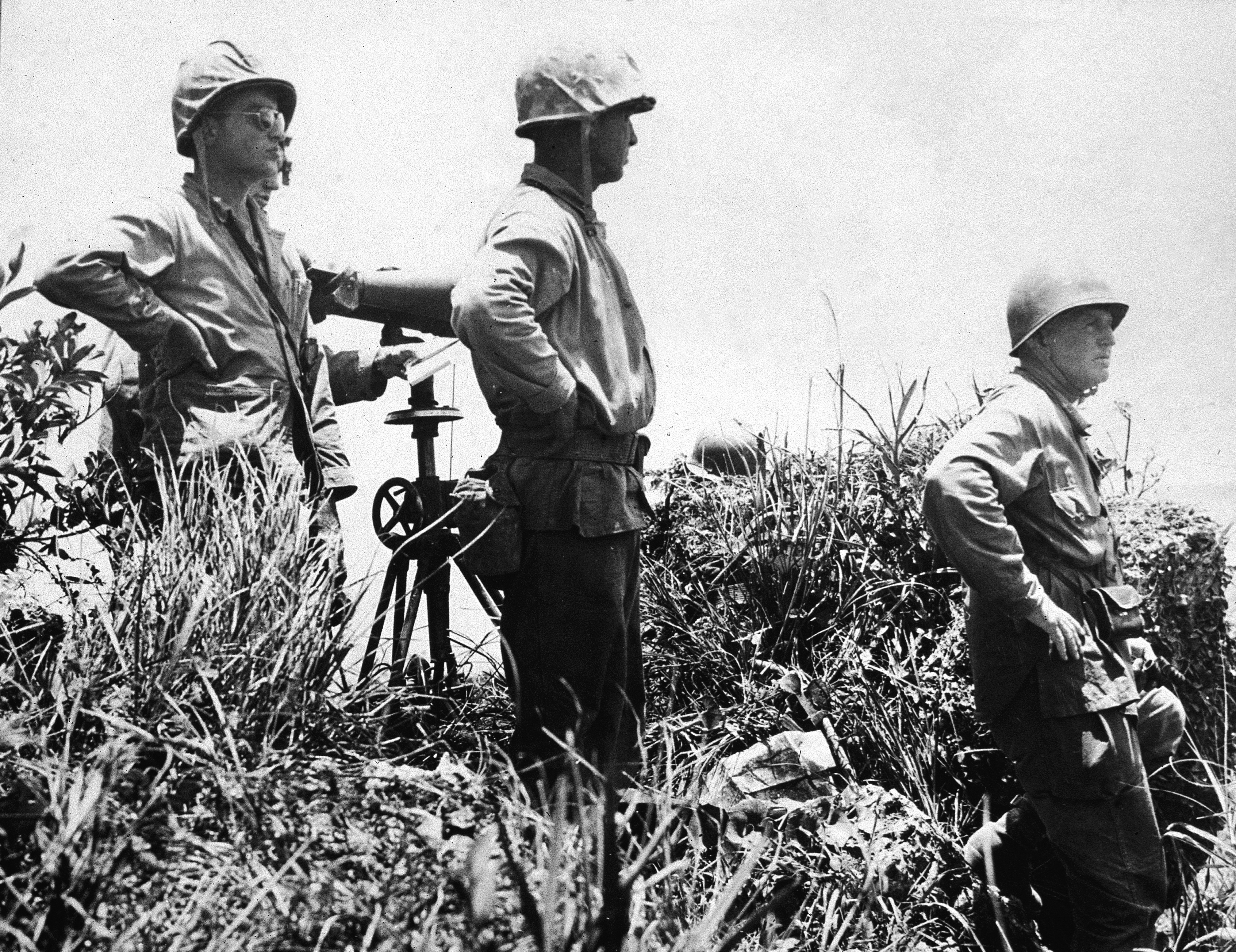

Aircraft losses over the three-month period were 768 US planes, including those bombing the Kyushu airfields launching kamikazes. Combat losses were 458, and the other 310 were operational accidents. At sea, 368 Allied ships—including 120 amphibious craft—were damaged while another 36—including 15 amphibious ships and 12 destroyers—were sunk during the Okinawa campaign. The US Navy's dead exceeded its wounded, with 4,907 killed and 4,874 wounded, primarily from kamikaze attacks.
American personnel casualties included thousands of cases of mental breakdown. According to the account of the battle presented in Marine Corps Gazette:
Medal of Honor recipients from Okinawa are: Marine Corps
- Richard E. Bush – 16 April
- Henry A. Courtney Jr. – 14–15 May ()
- James L. Day – 14–17 May
- John P. Fardy – 7 May (posth.)
- William A. Foster – 2 May (posth.)
- Harold Gonsalves – 15 April (posth.)
- Dale M. Hansen – 7 May (posth.)
- Louis J. Hauge Jr. – 14 May (posth.)
- Elbert L. Kinser – 4 May (posth.)
- Robert M. McTureous Jr. – 7 June (posth.)
- Albert E. Schwab – 7 May (posth.) Army
- Beauford T. Anderson – 13 April
- Clarence B. Craft – 31 May
- Desmond Doss – 29 April – 21 May
- Martin O. May – 19–21 April (posth.)
- Seymour W. Terry – 11 May (posth.)
- John W. Meagher – 19 June
- Edward J. Moskala – 9 April (posth.)
- Joseph E. Muller – 15–16 May (posth.)
- Alejandro R. Ruiz – 28 April Navy
- Robert Eugene Bush – 2 May
- William D. Halyburton Jr. – 10 May (posth.)
- Fred F. Lester – 8 June (posth.)
- Richard M. McCool Jr. – 10–11 June
Allied naval vessels sunk or damaged at Okinawa
The following table lists the Allied naval vessels that received damage or were sunk in the Battle of Okinawa between 19 March – 30 July 1945. The table lists a total of 147 damaged ships, five of which were damaged by enemy suicide boats and another five by mines. During the naval battle, which started before the amphibious landings on Okinawa on 1 April, suffered over 800 killed and missing and suffered 396 killed and missing. These were the first and third largest loss of life on damaged or sunken American aircraft carriers during World War II. USS Franklin (hit by two bombs in a level bombing attack by a D4Y Suisei (Judy) on 19 March 1945) and USS Bunker Hill were the only two aircraft carriers that sustained very severe damage from Japanese attacks and as a result were the only aircraft carriers in the that did not experience any active service after the end of World War II. One source estimated that total Japanese sorties during the entire Okinawa campaign exceeded 3,700, with a large percentage being kamikaze attacks, and that the attackers damaged slightly more than 200 Allied vessels, with 4,900 naval officers and seamen killed and roughly 4,824 wounded or missing. USS Thorton was damaged as the result of a collision with another US ship.
The Japanese air attacks were so intense that Fifth Fleet commander Admiral Spruance's flagships were struck two separate times ( was hit in March and had to retire for repairs which forced him to transfer to which was also hit in May). Fast Carrier Task Force commander Vice Admiral Marc Mitscher and his chief of staff Commodore Arleigh Burke were yards away from getting killed or wounded by kamikazes on his flagship USS Bunker Hill, which killed three of Mitscher's staff officers and eleven of his enlisted staff members and also destroyed his flag cabin along with all of his uniforms, personal papers, and possessions. Just three days later Mitscher's new flagship was also struck by a kamikaze forcing him to have to change his flagship yet again. Both fleet carriers were knocked out for the rest of the war.
sunk or had to be scuttled due to irreparable damage. Of those sunk, the majority were relatively smaller ships; these included destroyers of around 300–450 feet. A few small cargo ships were also sunk, several containing munitions which caught fire.
scrapped or decommissioned as a result of damage.
| Day | Ship | Type | Cause | Killed | Wounded | Total | |
|---|---|---|---|---|---|---|---|
| 19 Mar 45 | USS Wasp | Carrier | Air attack, bomb through flight, & hangar decks | 102 | 269 | ||
| 19 Mar 45 | USS Franklin | Carrier | Air attack | 807 | 487 | ||
| 20 Mar 45 | USS Enterprise | Carrier | Air attack, two near misses from bombs, at the same time of near misses immediately hit by two 5-inch AA shells from U.S. ships | 9 | 28 | ||
| 20 Mar 45 | USS Hasley Powell | Destroyer | Air attack, kamikaze | 12 | 29 | ||
| 24 Mar 45 | USS Nevada | Battleship | Air attack, kamikaze hit and knocked out 14-inch guns in turret number 3 | 11 | 49 | ||
| 26 Mar 45 | USS Haligan* | Destroyer | Mine, 3 miles SE of Maye Shima, exploded two forward magazines, bow blown off | 153 | 39 | ||
| 26 Mar 45 | USS Kimberly | Destroyer | Air attack, kamikaze | 4 | 57 | ||
| 27 Mar 45 | USS Murray | Destroyer | Air attack, bomb | 1 | 116 | ||
| 27 Mar 45 | USS O'Brian | Destroyer | Air attack, Val kamikaze with bomb | 50 | 76 | ||
| 28 Mar 45 | USS Skylark* | Small Minesweeper | Mine, struck mines twice off Hagushi beaches | 5 | 25 | ||
| 28 Mar 45 | USS LSM(R)-188 | Landing Ship | Air attack, kamikaze | 15 | 32 | ||
| 29 Mar 45 | USS Wyandot | Attack Cargo Ship | Mine, possibly bomb | 0 | 1 | ||
| 31 Mar 45 | USS Indianapolis | Cruiser | Air attack, kamikaze with bomb through fuel tanks and propeller shafts | 9 | 20 | ||
| 1 Apr 45 | USS Adams | Destroyer Minelayer | Air attack, kamikaze with bombs to fantail | 0 | 0 | ||
| 1 Apr 45 | USS Alpine | Attack Transport | Air attack, bomb and kamikaze | 16 | 27 | ||
| 1 Apr 45 | USS Hinsdale | Attack Transport | Air attack, kamikaze with bombs at waterline | 16 | 39 | ||
| 1 Apr 45 | # USS LST-884 | Tank Landing Ship | Air attack, kamikaze, scuttled 6 May | 24 | 21 | ||
| 1 Apr 45 | HMS Ulster | Destroyer | Air attack, near miss bomb, badly damaged | 2 | 1 | ||
| 1 Apr 45 | USS West Virginia | Battleship | Air attack, kamikaze | 4 | 23 | ||
| 2 Apr 45 | USS New York | Battleship | Air attack, kamikaze destroyed search plane on catapult | 0 | 2 | ||
| 2 Apr 45 | USS Dickerson* | Destroyer Transport | Air attack, kamikaze Nick crashed bridge, towed, scuttled | 54 | 23 | ||
| 2 Apr 45 | USS Goodhue | Attack Transport | Air attack, kamikaze aimed at bridge glanced mainmast, hit cargo boom, gun tubs, over side | 24 | 119 | ||
| 2 Apr 45 | USS Henrico | Attack Transport | Air attack, kamikaze w/bombs hit bridge | 49 | 125 | ||
| 2 Apr 45 | USS Achernar | Attack Cargo Ship | Air attack, kamikaze w/bomb hit starboard | 5 | 41 | ||
| 3 Apr 45 | USS Wake Island | Escort Carrier | Air attack, kamikaze blew below waterline | 0 | 0 | ||
| 3 Apr 45 | USS Pritchett | Destroyer | Air attack, 500 lb bomb | 0 | 0 | ||
| 3 Apr 45 | USS Foreman | Destroyer | Air attack, bomb passed through her bottom, exploded below | 0 | 3 | ||
| 3 Apr 45 | USS LST-599 | Tank Landing Ship | Air attack, kamikaze through main deck, fires | 0 | 21 | ||
| 3 Apr 45 | # USS LCT-876 | Landing Craft Tank | Air attack | 0 | 2 | ||
| 4 Apr 45 | USS LCI(G)-82* | Landing Craft, Infantry | Suicide boat | 8 | 11 | ||
| 5 Apr 45 | USS Nevada | Battleship | Air attack 25 Mar and 5 April coastal battery | 2 | 16 | ||
| 6 Apr 45 | USS Bush* | Destroyer | Air attack, three kamikaze hits, two between stacks, blew forward engine room, broke in half | 94 | 32 | ||
| 6 Apr 45 | USS Colhoun* | Destroyer | Air attack, four kamikaze hits, bombs blew forward, & aft fire rooms at waterline | 35 | 21 | ||
| 6 Apr 45 | USS Howorth | Destroyer | Air attack, kamikaze struck superstructure, fires put out | 9 | 14 | ||
| 6 Apr 45 | USS Hyman | Destroyer | Air attack, kamikaze Hampton hit torpedo tubes twixt stacks | 10 | 40 | ||
| 6 Apr 45 | # USS Leutze | Destroyer | Air attack, kamikaze blew at fantail, bad flooding | 7 | 34 | ||
| 6 Apr 45 | # USS Morris | Destroyer | Air attack, kate kamikaze portside | 0 | 5 | ||
| 6 Apr 45 | USS Mullany | Destroyer | Air attack, kamikaze hit depth charges | 13 | 45 | ||
| 6 Apr 45 | # USS Newcomb | Destroyer | Air attack, multiple kamikazes | 40 | 24 | ||
| 6 Apr 45 | USS Haynsworth | Destroyer | Air attack, kamikaze | 7 | 25 | ||
| 6 Apr 45 | # USS Witter | Destroyer Escort | Starboard waterline kamikaze | 0 | 5 | ||
| 6 Apr 45 | USS Fieberling | Destroyer | Air attack, kamikaze near miss | 6 | 6 | ||
| 6 Apr 45 | USS Emmons* | Destroyer Minesweeper | Air attack, five kamikaze hits, scuttled 7 April | 64 | 71 | ||
| 6 Apr 45 | USS Rodman | Destroyer Minesweeper | Air attack, four kamikaze hits | 16 | 20 | ||
| 6 Apr 45 | USS Defense | Small Minesweeper | Air attack, two kamikaze strikes | 0 | 9 | ||
| 6 Apr 45 | USS LST-447* | Landing Ship | Air attack, kamikaze hit close above waterline, bomb blew | 5 | 17 | ||
| 6 Apr 45 | SS Hobbs Victory* | Cargo | Air attack, kamikaze struck port, flames ignited ammunition | 15 | 3 | ||
| 6 Apr 45 | SS Logan Victory* | Cargo | Air attack, kamikaze struck superstructure, flames ignited ammunition | 16 | 11 | ||
| 7 Apr 45 | USS Hancock | Carrier | Air attack, cartwheeling kamikaze | 72 | 82 | ||
| 7 Apr 45 | USS Maryland | Battleship | Air attack, kamikaze hit starboard | 16 | 37 | ||
| 7 Apr 45 | USS Bennett | Destroyer | Air attack, kamikaze hit engine room | 3 | 18 | ||
| 7 Apr 45 | USS Wesson | Destroyer | Air attack, kamikaze starboard | 8 | 23 | ||
| 7 Apr 45 | USS PGM-18* | Small Gunboat | Mine, powerful explosion | 14 | 14 | ||
| 7 Apr 45 | YMS-103* | Small Minesweeper | Mine, struck two mines, blowing off her bow and stem rescuing PGM-18 | 5 | 0 | ||
| 8 Apr 45 | USS Gregory | Destroyer | Air attack, port kamikaze amidships near waterline | 0 | 2 | ||
| 8 Apr 45 | USS YMS-92 | Small Sweeper | Air attack | 0 | 0 | ||
| 9 Apr 45 | USS Charles J. Badger | Destroyer | Suicide boat threw depth charge or mine | 0 | 0 | ||
| 9 Apr 45 | USS Sterett | Destroyer | Air attack, kamikaze hit starboard at waterline | 0 | 9 | ||
| 9 Apr 45 | USS Hopping | Destroyer Transport | Coastal Battery, damaging hits off Buckner Bay | 2 | 18 | ||
| 11 Apr 45 | USS Enterprise | Carrier | Air attack, two kamikazes hit at the waterline near her hull | 1 | 18 | ||
| 11 Apr 45 | USS Kidd | Destroyer | Air attack, kamikaze | 38 | 55 | ||
| 11 Apr 45 | USS Missouri | Battleship | Air attack, kamikaze | 0 | 0 | ||
| 12 Apr 45 | USS Idaho | Battleship | Air attack, kamikaze hit port side anti-torpedo bulge | 0 | 0 | ||
| 12 Apr 45 | USS Tennessee | Battleship | Air attack, kamikaze hit signal bridge | 25 | 104 | ||
| 12 Apr 45 | USS Mannert L. Abele* | Destroyer | Air attack, kamikaze | 79 | 35 | ||
| 12 Apr 45 | USS Purdy | Destroyer | Air attack, splashed kamikaze bomb skidded in | 13 | 27 | ||
| 12 Apr 45 | USS Cassin Young | Destroyer | Air attack, kamikaze hit foremast | 1 | 59 | ||
| 12 Apr 45 | USS Zellars | Destroyer | Air attack, kamikaze crashed port, bomb blew | 29 | 37 | ||
| 12 Apr 45 | USS Rall | Destroyer | Air attack, kamikaze starboard aft, bomb blew | 21 | 38 | ||
| 12 Apr 45 | USS Whitehurst | Destroyer Escort | Air attack, kamikaze with bomb crashed into pilot house | 37 | 37 | ||
| 12 Apr 45 | USS Lindsey | Destroyer Minelayer | Air attack, two kamikaze Val strikes | 56 | 51 | ||
| 12 Apr 45 | USS LSM(R)-189 | Landing Ship | Air attack, kamikaze | 0 | 4 | ||
| 12 Apr 45 | USS LCS(L)-33* | Landing Craft | Air attack, kamikaze Val amidships | 4 | 29 | ||
| 12 Apr 45 | USS LCS(L)-57 | Landing Craft | Air attack, three kamikaze strikes | 2 | 6 | ||
| 14 Apr 45 | USS Sigsbee | Destroyer | Air attack, kamikaze damaged port engine | 4 | 74 | ||
| 16 Apr 45 | USS Intrepid | Carrier | Air attack, kamikaze crashed deck, fires put out | 10 | 87 | ||
| 16 Apr 45 | USS Bryant | Destroyer | Air attack, kamikaze to bridge, with explosion | 34 | 33 | ||
| 16 Apr 45 | USS Laffey | Destroyer | Air attack, multiple kamikaze hits | 31 | 72 | ||
| 16 Apr 45 | USS Pringle* | Destroyer | Air attack, kamikaze Val hit abaft stack No. 1, explosion, broke in half | 65 | 110 | ||
| 16 Apr 45 | USS Bowers | Destroyer Escort | Air attack, kamikaze to bridge, bomb hit pilot house | 48 | 56 | ||
| 16 Apr 45 | # USS Harding | Destroyer Minesweeper | Air attack, kamikaze struck side near bridge | 22 | 10 | ||
| 16 Apr 45 | USS Hobson | Destroyer Minesweeper | Air attack, near miss kamikaze's bomb veered in | 4 | 8 | ||
| 16 Apr 45 | USS LCS(L)-116 | Landing Craft | Air attack, kamikaze hit aft gun mount | 12 | 12 | ||
| 16 Apr 45 | USS Missouri | Battleship | Air attack, kamikaze hit stern crane | 0 | 2 | ||
| 18 Apr 45 | USS LSM-28 | Landing Ship | Air attack | 0 | 0 | ||
| 22 Apr 45 | USS Isherwood | Destroyer | Air attack, kamikaze w/bomb crashed gun mount | 42 | 41 | ||
| 22 Apr 45 | USS Swallow* | Small Sweeper | Air attack, bad kamikaze hit flooded her, 3 mins sunk | 2 | 9 | ||
| 22 Apr 45 | USS LCS(L)-15* | Landing Craft | Air attack | 15 | 11 | ||
| 27 Apr 45 | # USS Hutchins | Destroyer | Suicide boat explosive blew close | 0 | 0 | ||
| 27 Apr 45 | # USS Rathburne | Destroyer | Air attack, kamikaze hit port bow waterline | 0 | 0 | ||
| 27 Apr 45 | SS Canada Victory* | Cargo | Air attack, kamikaze hit stern, lit ammo, sunk in ten minutes | 12 | 27 | ||
| 28 Apr 45 | USS Pinkney | Destroyer | Air attack, kamikaze hit aft of superstructure, lit ammo | 35 | 12 | ||
| 28 Apr 45 | USS Comfort | Hospital Ship | Air attack, kamikaze through three decks to surgery | 30 | 48 | ||
| 29 Apr 45 | # USS Haggard | Destroyer | Air attack, kamikaze went through hull, blew engine room | 11 | 40 | ||
| 29 Apr 45 | USS Hazelwood | Destroyer | Air attack, kamikaze zero hit port bridge | 46 | 26 | ||
| 29 Apr 45 | # USS LCS(L)-37 | Landing Craft | Suicide boat | 0 | 4 | ||
| 30 Apr 45 | USS Terror | Minelayer | Air attack, kamikaze blew through main deck | 48 | 123 | ||
| 3 May 45 | USS Little* | Destroyer | Air attack, five kamikaze strikes | 30 | 79 | ||
| 3 May 45 | # USS Aaron Ward | Destroyer Minelayer | Air attack; three kamikaze hits and bomb frags | 45 | 49 | ||
| 3 May 45 | USS Macomb | Destroyer Minelayer | Air attack, kamikaze | 7 | 14 | ||
| 3 May 45 | USS LSM(R)-195* | Landing Ship | Air attack, kamikaze hit rockets, sunk | 8 | 16 | ||
| 4 May 45 | # USS Sangamon | Escort Carrier | Air attack, kamikaze & bomb blew through flight deck | 46 | 116 | ||
| 4 May 45 | USS Birmingham | Light Cruiser | Air attack, kamikaze hit forward | 51 | 81 | ||
| 4 May 45 | USS Ingraham | Destroyer | Air attack, kamikaze above port waterline, bomb blew | 14 | 37 | ||
| 4 May 45 | HMS Formidable | Carrier | Air attack, kamikaze & bomb blew through flight deck | 8 | 55 | ||
| 4 May 45 | USS Hopkins | Destroyer Minesweeper | Air attack, glancing blow by burning kamikaze | 0 | 1 | ||
| 4 May 45 | USS Luce* | Destroyer | Air attack, first kamikaze bomb hit, second kamikaze struck aft | 149 | 94 | ||
| 4 May 45 | USS Morrison* | Destroyer | Air attack, first kamikaze hit bridge, then three more hits | 159 | 102 | ||
| 4 May 45 | USS Shea | Destroyer | Air attack, Ohka kamikaze through starboard bridge | 27 | 91 | ||
| 4 May 45 | USS Carina | Cargo Ship | Suicide boat ramming caused explosion | 0 | 6 | ||
| 4 May 45 | USS LSM(R)-190* | Landing Ship | Air attack, kamikaze set off her rockets | 13 | 18 | ||
| 4 May 45 | USS LSM(R)-194* | Landing Ship | Air attack | 13 | 23 | ||
| 9 May 45 | # USS England | Destroyer | Air attack, kamikaze dive bomber | 35 | 27 | ||
| 9 May 45 | HMS Formidable | Carrier | Air attack, kamikaze | 1 | 4 | ||
| 9 May 45 | # USS Oberrender | Destroyer Escort | Air attack, kamikaze hit starboard gun mount, bomb through main deck | 8 | 53 | ||
| 11 May 45 | USS Bunker Hill{{Efn | flagship of Vice Admiral | Carrier | Air attack, three kamikaze hits with bombs through flight deck | 396 | 264 | |
| 11 May 45 | # USS Hugh W. Hadley | Destroyer | Air attack, aft bomb, an Ohka, and two more kamikazes struck | 28 | 67 | ||
| 11 May 45 | # USS Evans | Destroyer | Air attack, struck by four kamikazes, fires put out | 30 | 29 | ||
| 11 May 45 | USS LCS(L)-88 | Landing Craft | Air attack | 7 | 9 | ||
| 12 May 45 | USS New Mexico | Battleship | Air attack, kamikaze hit, bomb | 54 | 119 | ||
| 13 May 45 | USS Bache | Destroyer | Air attack, kamikaze hit, bomb exploded amidships just above main deck | 41 | 32 | ||
| 13 May 45 | USS Bright | Destroyer Escort | Air attack, kamikaze zero hit fantail, bomb exploded | 0 | 2 | ||
| 14 May 45 | USS Enterprise{{Efn | flagship of Vice Admiral | Carrier | Air attack, two kamikazes, struck port, & under starboard bow | 14 | 68 | |
| 17 May 45 | USS Douglas H. Fox | Destroyer | Two kamikaze strikes, one to forward gun mounts, one to fantail | 9 | 35 | ||
| 18 May 45 | USS Longshaw* | Destroyer | Coastal Battery, four hits, one ignited magazine, blew off bow back to bridge | 86 | 97 | ||
| 18 May 45 | USS LST-808* | Landing Ship Tank | Air attack | 11 | 11 | ||
| 20 May 45 | # USS Chase | Destroyer Escort | Air attack, splashed kamikaze skidded in, bombs opened hull, with flooding | 0 | 35 | ||
| 20 May 45 | # USS Thatcher | Destroyer | Air attack, kamikaze Oscar struck aft of bridge, large hole | 14 | 53 | ||
| 20 May 45 | # USS John C. Butler | Destroyer Escort | Air attack, kamikaze hit to mast and antennas | 0 | 0 | ||
| 25 May 45 | USS Stormes | Destroyer | Air attack, crashed aft torpedo mount, bomb blew large hole, flooded aft | 21 | 6 | ||
| 25 May 45 | USS O'Neill | Destroyer Escort | Air attack, kamikaze | 0 | 16 | ||
| 25 May 45 | USS Butler | Destroyer Minesweeper | Air attack, kamikaze bombs exploded under keel | 0 | 15 | ||
| 25 May 45 | # USS Spectacle | Small Minesweeper | Air attack, kamikaze crashed port gun tub causing fires | 29 | 6 | ||
| 25 May 45 | USS Barry* | Destroyer Transport | Air attack, kamikaze badly crashed starboard side, fires, abandoned | 0 | 30 | ||
| 25 May 45 | USS Bates* | Destroyer Escort | Air attack, two kamikaze hits, fires, abandoned, towed, later sank | 21 | 35 | ||
| 25 May 45 | USS Roper | Destroyer | Air attack, kamikaze hit off Hanagushi, Okinawa | 1 | 10 | ||
| 25 May 45 | LSM-135* | Landing Ship | Air attack, kamikaze caused fires, beached, abandoned | 11 | 10 | ||
| 25 May 45 | SS William B. Allison (aka USS Inca) | Cargo Ship, Liberty Ship | Air attack, Aerial Torpedo off Nakagusuku Wan | 8 | 2 | ||
| 27 May 45 | USS Braine | Destroyer | Air attack, two kamikazes, first hit bridge, and second hit amidships | 66 | 78 | ||
| 27 May 45 | # USS Forrest | Destroyer Minesweeper | Air attack, kamikaze crashed starboard side waterline | 5 | 13 | ||
| 27 May 45 | USS Rednour | Transport | Air attack, two kamikazes hits, one made ten foot hole in main deck | 3 | 13 | ||
| 27 May 45 | USS Loy | Destroyer Escort | Air attack, kamikaze near miss sprayed fragments | 3 | 15 | ||
| 27 May 45 | LCS(L)-119 | Landing Craft | Air attack | 12 | 6 | ||
| 28 May 45 | USS Drexler* | Destroyer | Air attack, first kamikaze Frances hit topside, second Francis with bombs crashed into superstructure | 158 | 51 | ||
| 28 May 45 | USS Sandoval | Attack Transport | Air attack, kamikaze hit portside of wheelhouse | 8 | 26 | ||
| 28 May 45 | SS Brown Victory | Cargo | Air attack, kamikaze hit | 4 | 16 | ||
| 28 May 45 | SS Josiah Snelling | Cargo | Air attack, kamikaze hit | 0 | 11 | ||
| 28 May 45 | SS Mary A. Livermore | Cargo | Air attack, kamikaze hit on starboard | 10 | 4 | ||
| 29 May 45 | USS Shubrick | Destroyer | Air attack, kamikaze bomb hit starboard causing hole, exploding depth charge | 32 | 28 | ||
| 3 June 45 | # USS LCI-90 | Landing Craft Infantry | Air attack, kamikaze | 1 | 7 | ||
| 5 Jun 45 | USS Louisville | Cruiser | Air attack, kamikaze hit quad 40mm AA gun mount and number 1 smoke stack | 8 | 45 | ||
| 5 Jun 45 | USS Mississippi | Battleship | Air attack, kamikaze hit | 1 | 2 | ||
| 6 June 45 | # USS J. William Ditter | Destroyer Minelayer | Air attack, first kamikaze glanced, second hit port near main deck | 10 | 27 | ||
| 6 Jun 45 | USS Harry F. Bauer | Destroyer Minelayer | Air attack, kamikaze hit superstructure | 0 | 0 | ||
| 7 June 45 | USS Natoma Bay | Escort carrier | Air attack, kamikaze hit flight deck | 1 | 4 | ||
| 10 Jun 45 | USS William D. Porter* | Destroyer | Air attack, splashed kamikaze Val's bomb exploded close underwater | 0 | 61 | ||
| 11 Jun 45 | USS LCS(L)-122 | Landing Craft | Air attack kamikaze hit conning tower base, bomb fragments caused fires | 11 | 29 | ||
| 16 Jun 45 | USS Twiggs* | Destroyer | Air attack, splashed kamikaze and bomb blew in hull plating, with structural damage | 126 | 34 | ||
| 21 Jun 45 | USS Halloran | Destroyer Escort | Air attack, splashed kamikaze's bomb struck | 3 | 24 | ||
| 21 Jun 45 | USS Curtiss | Seaplane Tender | Air attack, kamikaze and bomb ripped two holes in hull and blew | 41 | 28 | ||
| 21 Jun 45 | USS LSM-59* | Landing Ship | Air attack, kamikaze strike while towing USS Barry, sank in four minutes | 2 | 8 | ||
| 22 Jun 45 | USS LSM-213 | Landing Ship | Air attack, kamikaze strike at Kimmu Wan, hull damage | 3 | 10 | ||
| 22 Jun 45 | USS LST-534 | Landing Ship Tank | Air attack, while offloading on Nagagusuku Wan, kamikaze hit bow doors, tank deck | 3 | 35 | ||
| 29 Jul 45 | USS Callaghan* | Destroyer | Air attack, bi-plane kamikaze hit, its bomb blew aft engine room, sunk | 47 | 73 | ||
| 30 Jul 45 | USS Cassin Young | Destroyer | Air attack, kamikaze hit forward, earlier hit 12 April | 22 | 45 | ||
| 4582 | 6043 |
Japanese losses
The US military estimates that 110,071 Japanese soldiers were killed during the battle. This total includes conscripted Okinawan civilians.

A total of 7,401 Japanese regulars and 3,400 Okinawan conscripts surrendered or were captured during the battle of Okinawa. Additional Japanese and renegade Okinawans were captured or surrendered over the next few months, bringing the total to 16,346. This was the first battle in the Pacific War in which thousands of Japanese soldiers surrendered or were captured. Many of the prisoners were native Okinawans who had been pressed into service shortly before the battle and were less imbued with the Imperial Japanese Army's no-surrender doctrine. When the American forces occupied the island, many Japanese soldiers put on Okinawan clothing to avoid capture, and some Okinawans would come to the Americans' aid by offering to identify these mainland Japanese.
The Japanese lost 16 combat vessels, including the super battleship Yamato. Early claims of Japanese aircraft losses put the total at 7,800, however later examination of Japanese records revealed that Japanese aircraft losses at Okinawa were far below often-repeated US estimates for the campaign. The number of conventional and kamikaze aircraft actually lost or expended by the 3rd, 5th, and 10th Air Fleets, combined with about 500 lost or expended by the Imperial Army at Okinawa, was roughly 1,430. The Allies destroyed 27 Japanese tanks and 743 artillery pieces (including mortars, anti-tank and anti-aircraft guns), some of them eliminated by the naval and air bombardments but most knocked out by American counter-battery fire.
Civilian losses, suicides, and atrocities

Main article: Minoru Ōta#Telegraph to the Navy Vice Admiral
Some of the other islands that saw major battles in World War II, such as Iwo Jima, were uninhabited or had been evacuated. Okinawa, by contrast, had a large indigenous civilian population; US Army records from the planning phase of the operation made the assumption that Okinawa was home to about 300,000 civilians. The official US Tenth Army count for the 82-day campaign is a total of 142,058 recovered enemy bodies (including those civilians pressed into service by the Imperial Japanese Army), with the deduction made that about 42,000 were non-uniformed civilians who had been killed in the crossfire. Okinawa Prefecture's estimate is over 100,000 losses.
During the battle, American forces found it difficult to distinguish civilians from soldiers. It became common for them to shoot at Okinawan houses, as one infantryman wrote:
There was some return fire from a few of the houses, but the others were probably occupied by civilians—and we didn't care. It was a terrible thing not to distinguish between the enemy and women and children. Americans always had great compassion, especially for children. Now we fired indiscriminately.
In its history of the war, the Okinawa Prefectural Peace Memorial Museum presents Okinawa as being caught between Japan and the United States. During the battle, the Imperial Japanese Army showed indifference to Okinawans' safety, and its soldiers used civilians as human shields or outright killed them. The Japanese military also confiscated food from the Okinawans and executed those who hid it, leading to mass starvation, and forced civilians out of their shelters. Japanese soldiers also killed about 1,000 people who spoke in the Okinawan language to suppress spying. The museum writes that "some were blown apart by [artillery] shells, some finding themselves in a hopeless situation were driven to suicide, some died of starvation, some succumbed to malaria, while others fell victim to the retreating Japanese troops."
With the impending Japanese defeat, civilians often committed mass suicide, urged on by the Japanese soldiers who told locals that victorious American soldiers would go on a rampage of killing and raping. Ryūkyū Shimpō, one of the two major Okinawan newspapers, wrote in 2007: "There are many Okinawans who have testified that the Japanese Army directed them to commit suicide. There are also people who have testified that they were handed grenades by Japanese soldiers" to blow themselves up. Thousands of civilians, having been induced by Japanese propaganda to believe that American soldiers were barbarians who committed horrible atrocities, killed their families and themselves to avoid capture at the hands of the Americans. Some of them threw themselves and their family members from the southern cliffs where the Peace Museum now resides.
Okinawans "were often surprised at the comparatively humane treatment they received from the American enemy". Islands of Discontent: Okinawan Responses to Japanese and American Power by Mark Selden states that the Americans "did not pursue a policy of torture, rape, and murder of civilians as Japanese military officials had warned". American Military Intelligence Corps combat translators such as Teruto Tsubota managed to convince many civilians not to kill themselves. Survivors of the mass suicides blamed also the indoctrination of their education system of the time, in which the Okinawans were taught to become "more Japanese than the Japanese" and were expected to prove it.

Witnesses and historians claim that American and Japanese soldiers raped Okinawan women during the battle. Rape by Japanese troops reportedly "became common" in June, after it became clear that the Imperial Japanese Army had been defeated. Marine Corps officials in Okinawa and Washington have said that they knew of no rapes by American personnel in Okinawa at the end of the war. There are, however, numerous credible testimony accounts which note that a large number of rapes were committed by American forces during the battle. This includes stories of rape after trading sexual favors or even marrying Americans, such as the alleged incident in the village of Katsuyama, where civilians said they had formed a vigilante group to ambush and kill three black American soldiers whom they claimed would frequently rape the local girls there.
MEXT textbook controversy
There is ongoing disagreement between Okinawa's local government and Japan's national government over the role of the Japanese military in civilian mass suicides during the battle. In March 2007, the national Ministry of Education, Culture, Sports, Science and Technology (MEXT) advised textbook publishers to reword descriptions that the embattled Imperial Japanese Army forced civilians to kill themselves in the war to avoid being taken prisoner. MEXT preferred descriptions that just say that civilians received hand grenades from the Japanese military. This move sparked widespread protests among Okinawans. In June 2007, the Okinawa Prefectural Assembly adopted a resolution stating, "We strongly call on the (national) government to retract the instruction and to immediately restore the description in the textbooks so the truth of the Battle of Okinawa will be handed down correctly and a tragic war will never happen again."
On 29 September 2007, about 110,000 people held the biggest political rally in the history of Okinawa to demand that MEXT retract its order to textbook publishers regarding revising the account of the civilian suicides. The resolution states, "It is an undeniable fact that the 'multiple suicides' would not have occurred without the involvement of the Japanese military and any deletion of or revision to (the descriptions) is a denial and distortion of the many testimonies by those people who survived the incidents." In December 2007, MEXT partially admitted the role of the Japanese military in civilian mass suicides. The ministry's Textbook Authorization Council allowed the publishers to reinstate the reference that civilians "were forced into mass suicides by the Japanese military", on condition it is placed in sufficient context. The council report states, "It can be said that from the viewpoint of the Okinawa residents, they were forced into the mass suicides." That was not enough for the survivors who said it is important for children today to know what really happened.
The Nobel Prize-winning author Kenzaburō Ōe wrote a booklet that states that the mass suicide order was given by the military during the battle. He was sued by revisionists, including a wartime commander during the battle, who disputed this and wanted to stop publication of the booklet. At a court hearing, Ōe testified "Mass suicides were forced on Okinawa islanders under Japan's hierarchical social structure that ran through the state of Japan, the Japanese armed forces and local garrisons." In March 2008, the Osaka Prefecture Court ruled in favor of Ōe, stating, "It can be said the military was deeply involved in the mass suicides." The court recognized the military's involvement in the mass suicides and murder-suicides, citing the testimony about the distribution of grenades for suicide by soldiers and the fact that mass suicides were not recorded on islands where the military was not stationed.
In 2012, Korean-Japanese director Pak Su-nam announced her work on the documentary Nuchigafu (Okinawan for "only if one is alive") collecting living survivors' accounts to show "the truth of history to many people", alleging that "there were two types of orders for 'honorable deaths'—one for residents to kill each other and the other for the military to kill all residents". In March 2013, Japanese textbook publisher Shimizu Shoin was permitted by MEXT to publish the statements that "Orders from Japanese soldiers led to Okinawans committing group suicide" and "The [Japanese] army caused many tragedies in Okinawa, killing local civilians and forcing them to commit mass suicide."
Aftermath

.jpg)
Military historian and journalist Hanson W. Baldwin stated about scale and ferocity of the battle, especially for American forces, that:According to historian George Feifer, Okinawa was the "site of the largest land-sea-air battle in history" and that the battle was the "last major one before the start of the atomic age". At least 90% of the buildings on the island were destroyed, along with countless historical documents, artifacts, and cultural treasures, and the tropical landscape was turned into "a vast field of mud, lead, decay and maggots". The military value of Okinawa was significant, as Okinawa provided a fleet anchorage, troop staging areas, and airfields in proximity to Japan. The US cleared the surrounding waters of mines in Operation Zebra, occupied Okinawa, and set up the United States Civil Administration of the Ryukyu Islands, a form of military government, after the battle. In 2011, one official of the prefectural government told David Hearst of The Guardian:
Effect on the wider war
Because the next major event following the Battle of Okinawa was the total surrender of Japan, the effect of this battle is more difficult to consider. Because Japan surrendered when it did, the anticipated series of battles and the invasion of the Japanese homeland never occurred, and all military strategies on both sides which presupposed this apparently-inevitable next development were immediately rendered moot.
Some military historians believe that the Okinawa campaign led directly to the atomic bombings of Hiroshima and Nagasaki, as a means of avoiding the planned ground invasion of the Japanese mainland. This view is explained by Victor Davis Hanson in his book Ripples of Battle:
Meanwhile, many parties continue to debate the broader question of "why Japan surrendered", attributing the surrender to a number of possible reasons including: the atomic bombings, the Soviet invasion of Manchuria, and Japan's depleted resources.
Memorial
In 1995, the Okinawa government erected a memorial monument named the Cornerstone of Peace in Mabuni, the site of the last fighting in southeastern Okinawa. The memorial lists all the known names of those who died in the battle, civilian and military, Japanese and foreign. As of 2024, the monument lists 242,225 names.
Modern US base
Significant US forces remain garrisoned on Okinawa as the United States Forces Japan, which the Japanese government sees as an important guarantee of regional stability, and Kadena remains the largest US air base in Asia. Local residents have long protested against the size and presence of the base.
Notes
References
Citations
Sources
:
- , famous Marine memoir
- – Firsthand account of the battle by a surviving Japanese officer.
References
- "Ryukus". US Army Center of Military History.
- 26 March marked the first landing on the Kerama Islands around Okinawa in the Ryukus by the 77th Division.
- (2017). "The Forgotten Fleet – Warfare History Network".
- {{harvnb. Sloan. 2007
- Keegan, John. (2005). "The Second World War". Penguin.
- (May 1954). "Kamikazes and Okinawa Campaign".
- {{harvnb. Hastings. 2008
- "The Second World Wars: How the First Global Conflict Was Fought and Won" p. 302
- (7 July 2022). "Okinawa: The Costs of Victory in the Last Battle".
- [https://cgsc.contentdm.oclc.org/digital/collection/p4013coll8/id/126/rec/9 Army Battle Casualties and Nonbattle Deaths in World War II. Final Report, 7 December 1941-31 December 1946] p. 95 Retrieved 2/1/2024
- [https://cgsc.contentdm.oclc.org/digital/collection/p4013coll8/id/598 Tenth Army After Action Report, Ryukyus, vol. 1] 9-IV-1. Retrieved 2/1/2024
- [https://archive.org/details/HistoryOfTheMedicalDeptInWWIIV3 History of the Medical Department in World War II, vol. III] Appendix Table 14, see "Bombing and Landing on Okinawa." Retrieved 2/1/2024
- [https://archive.org/details/infernoepiclifed0000spri/page/316/mode/2up?q=killed Springer, "Inferno: The Epic Life and Death Struggle of the USS Franklin in World War II] p. 317. Retrieved 2/1/2024
- Frank, "Downfall" p. 402
- [https://www.ibiblio.org/hyperwar/USMC/V/USMC-V-M.html#fn1 Frank and Shaw, "History of U.S. Marine Corps Operations in World War II, Appendix M]. Retrieved 2/1/2024
- [http://cdm16635.contentdm.oclc.org/cdm/ref/collection/p16635coll14/id/56035 "Survey of Allied tank casualties in World War II"] {{Webarchive. link. (17 July 2019 , Technical Memorandum ORO-T-117, Department of the Army, Washington D.C.,Table 1.)
- (1948). "Okinawa: The Last Battle". [[United States Army Center of Military History]].
- [https://books.google.com/books?id=iG5MAAAAMAAJ&q=65%2C908 Hirofumi Hayashi, "Okinawa-sen to minshu" (Japanese).] p. 5. Retrieved 2/1/2024
- Abe 1995, ''Tokko Yamato Kantai.''
- Appleman p. 489
- Giangreco, D.. (2009). "Hell to Pay Operation Downfall and the Invasion of Japan, 1945–47". Naval Institute Press.
- (1 April 1945). "11: Battle of Okinawa". Nisei.hawaii.edu.
- [https://www.ulethbridge.ca/lib/ematerials/bitstream/handle/123456789/488/IL%20unspoken%20memory.pdf?sequence=1 Kyle Ikeda, "Unspoken Memory and Vicarious Trauma" p. 12] Retrieved 2/1/2024
- (1955). "Okinawa: Victory in the Pacific". Government Printing Office.
- Feifer 2001 pp. xi, 99–106
- (2022-07-07). "Okinawa: The Costs of Victory in the Last Battle".
- "The United States Navy assembled an unprecedented armada in March and April 1945". Militaryhistoryonline.com.
- "The American invasion of Okinawa was the largest amphibious invasion of all time". Historynet.com.
- Wheelan, Joseph. (2020). "Bloody Okinawa: The Last Great Battle of World War II". Hachette Books.
- (1 April 1945). "Okinawa: The Typhoon of Steel". American Veterans Center.
- [http://www.stripes.com/news/at-60th-anniversary-battle-of-okinawa-survivors-recall-typhoon-of-steel-1.31175 At 60th anniversary, Battle of Okinawa survivors recall 'Typhoon of Steel' – News – Stripes] {{Webarchive. link. (5 April 2020 , Allen, David; ''Stars and Stripes''; 1 April 2005.)
- Huber, Thomas. (May 1990). "Japan's battle of Okinawa, April–June 1945".
- Rottman, Gordon. (2002). "Okinawa 1945: The Last Battle". Osprey Publishing.
- {{rp. 40 It was planned that [[Simon Bolivar Buckner Jr.. Lieutenant General Simon Bolivar Buckner Jr.]] would report to [[Richmond K. Turner. Vice Admiral Richmond K. Turner]] until the amphibious phase was completed, after which he would report directly to [[Raymond A. Spruance. Admiral Raymond A. Spruance]]. Total aircraft provided by the US Navy, Marine and Army Air Force exceeded 3,000 over the course of the battle, including fighters, attack aircraft, scout planes, bombers and dive-bombers. The invasion was supported by a fleet consisting of 18 [[battleship]]s, 27 [[cruiser]]s, 177 [[destroyer]]s/[[destroyer escort]]s, 39 [[aircraft carrier]]s (11 [[fleet carrier]]s, 6 [[Light aircraft carrier. light carriers]] and 22 [[escort carrier]]s) and various support and troop [[transport ship]]s.The Great Courses. ''World War II: The Pacific Theater''. Lecture 21. Professor Craig Symonds
- (January 2013). "The Royal Navy's Pacific Strike Force".
- "[Official] Himeyuri Peace Museum".
- Toland, John. (1970). "The Rising Sun: The Decline and Fall of the Japanese Empire 1936–1945". Random House.
- . (February 3, 1953). ["Japanese Air Sorties and Bomb Tonnage Against Okinawa"](https://archive.org/details/afhra-reel-k1023). *[[Air Force Historical Research Agency]]*.
- Baldwin, Hanson W. ''Sea Fights and Shipwrecks'' Hanover House 1956 p. 309
- Christopher Chant, "The Encyclopedia of Codenames of World War II (Routledge Revivals)", p. 87
- Navy, corporateName=Royal Australian. "The British Pacific Fleet".
- {{harvnb. Hastings. 2008
- {{harvnb. Hobbs. 2012
- Shigeaki, Kinjo. (13 June 2014). "The Most Haunting Interview You'll Ever Read: When Japanese Islanders Were Ordered to Commit Mass Suicide". History News Network.
- {{harvnb. Hastings. 2008
- West Point Atlas of American Wars
- (15 August 1945). "The Ordeals of Shuri Castle". Wonder-okinawa.jp.
- "The Final Campaign: Marines in the Victory on Okinawa (Assault on Shuri)". Nps.gov.
- (6 April 2018). "Okinawa Confederate Flag". Abbeville Institute Press.
- {{harvnb. Coski. 2005
- "'The World is beginning to know Okinawa': Ota Masahide reflects on his life from the Battle of Okinawa to the Struggle for Okinawa". Japanfocus.org.
- (12 June 2006). "Battle of Okinawa: The Bloodiest Battle of the Pacific War". HistoryNet.
- Manchester, William. (14 June 1987). "The Bloodiest Battle Of All". The New York Times.
- "Number of names Inscribed/沖縄県". [[Okinawa Prefecture]].
- "The Cornerstone of Peace – names to be inscribed". [[Okinawa Prefecture]].
- (1997). "Japan's minorities: the illusion of homogeneity". Routledge.
- "Recollecting the War in Okinawa". [[Japan Policy Research Institute]].
- (24 June 2007). "Okinawa marks 62nd anniversary of WWII battle". [[Japan Times]].
- https://www.med.navy.mil/Media/News/Article/3728759/april-1-1945-remembered-battle-for-okinawa-a-lasting-memory/#:~:text=The%20Battle%20of%20Okinawa%20lasted,12%2C520%20were%20killed%20or%20missing
- Keegan, John. (1989). "The Times Atlas of the Second World War". Times Books.
- Feifer 2001 p. xi
- Reid, Chip. [http://www.nbcnews.com/id/5130777 "Ernie Pyle, trail-blazing war correspondent{{sndBrought home the tragedy of D-Day and the rest of WWII"] {{Webarchive. link. (17 August 2018 , NBC News, 7 June 2004. Retrieved 26 April 2006.)
- "The Amphibians Came to Conquer". Ibiblio.org.
- Frame, SSgt Rudy R. Jr.. "Okinawa: The Final Great Battle of World War II | Marine Corps Gazette". Mca-marines.org.
- Toll, Ian, ''Twilight of the Gods'', (2020) Norton and Co., New York, New York, p. 593
- "H-048-1: Kamikaze Attacks on U.S. Flagships off Okinawa".
- United States Navy, with casualties taken from individual action reports Morison, Samuel, Eliot, ''Victory in the Pacific, 1945'', (Copyright 1960), Naval Institute Press, Annapolis, Maryland, Appendix II pp. 390–392
- http://www.cv6.org/ship/logs/pod19450321.htm . Retrieved 14 March 2024.
- http://www.cv6.org/1945/1945.htm . Retrieved 14 March 2024.
- Morison, ''Victory'', pp. 115–116
- https://www.usswestvirginia.org/stories/story.php?id=57 . Retrieved 14 March 2024.
- Morison, ''Victory'', p. 176
- Morison, ''Victory'', p. 177
- Morison, ''Victory'', p. 218
- Morison, ''Victory'', pp. 186–191
- "Destroyer History, USS ''Howorth''". Destroyer History Foundation.
- Morison, ''Victory'', p. 192
- Morison, ''Victory'', p. 184
- "Loss report of PGM-18". www.fold3.com.
- "Loss report of YMS-103". www.fold3.com.
- Toll, Ian, ''Twilight'', p. 597
- Morison, ''Victory'', p. 147
- "Daily Event for May 24, 2008, William B. Allison". Maritime Quest.
- https://www.history.navy.mil/research/library/online-reading-room/title-list-alphabetically/n/naval-armed-guard-service-in-world-war-ii/action-at-okinawa.html . Retrieved 11 March 2024.
- https://www.newspapers.com/article/clarion-ledger-blow-by-blow-account-of/22619240/ . Retrieved 14 March 2024.
- Morison, ''Victory'', p. 275
- Morrison, ''Victory'', p. 279
- Feifer 2001 p. 374
- (1 April 2000). "The Basic Concept of the Okinawa Prefectural Peace Memorial Museum". Peace-museum.pref.okinawa.jp.
- Brooke, James. "1945 suicide order still a trauma on Okinawa".
- Onishi, Norimitsu. (1 April 2007). "Japan's Textbooks Reflect Revised History". The New York Times.
- (24 June 1995). "Editorial – Cornerstone of Peace: A Legacy of Bloodshed". San Francisco Chronicle.
- Molasky, Michael S.. (1999). "The American Occupation of Japan and Okinawa: Literature and Memory". Routledge.
- (2000). "Southern Exposure: Modern Japanese Literature from Okinawa". University of Hawaii Press.
- (9 April 2003). "Islands of Discontent: Okinawan Responses to Japanese and American Power". Rowman & Littlefield Publishers.
- "Military Intelligence Service Research Center: Okinawa". Njahs.org.
- [http://www.stripes.com/news/defiant-soldier-saved-lives-of-hundreds-of-civilians-during-okinawa-battle-1.31173 Defiant soldier saved lives of hundreds of civilians during Okinawa battle] {{Webarchive. link. (27 January 2012 , ''[[Stars and Stripes (newspaper)). Stars and Stripes]]'', 1 April 2005.
- Saito, Toru. "Pressure to prove loyalty paved way for mass suicides in Battle of Okinawa – AJW by The Asahi Shimbun". Asahi Shimbun.
- Sims, Calvin. (1 June 2000). "3 Dead Marines and a Secret of Wartime Okinawa". The New York Times.
- (2003). "Japan's Comfort Women: Sexual Slavery and Prostitution During World War II". Routledge.
- Lisa Takeuchi Cullen. (13 August 2001). "Okinawa Nights".
- [http://search.japantimes.co.jp/cgi-bin/nn20070623a1.html Okinawa slams history text rewrite] {{Webarchive. link. (4 June 2012 , ''Japan Times'', 23 June 2007.)
- Gheddo, Piero. "Japan: Okinawa against Tokyo's attempts to rewrite history – Asia News". Asianews.it.
- (30 September 2007). "110,000 protest history text revision order". Search.japantimes.co.jp.
- [http://www.iht.com/articles/2007/12/26/asia/japan.php Japan to amend textbook accounts of Okinawa suicides] {{Webarchive. link. (19 December 2008 ''[[International Herald Tribune). Herald Tribune]]'', 26 December 2007.
- [http://search.japantimes.co.jp/cgi-bin/nn20071227a1.html Texts reinstate army's role in mass suicides: Okinawa prevails in history row] {{Webarchive. link. (29 June 2012 ''[[Japan Times]]'', 27 December 2007.)
- [https://news.bbc.co.uk/2/hi/asia-pacific/7098876.stm Okinawa's war time wounds reopened] BBC News, 17 November 2007.
- [http://search.japantimes.co.jp/cgi-bin/nn20070912a3.html Witness: Military ordered mass suicides] {{Webarchive. link. (29 June 2012 , ''Japan Times'', 12 September 2007.)
- [http://search.japantimes.co.jp/cgi-bin/nn20071110a3.html Oe testifies military behind Okinawa mass suicides] {{webarchive. link. (12 November 2007, ''Japan Times'', 10 November 2007.)
- [http://search.japantimes.co.jp/cgi-bin/nn20080329a1.html Court sides with Oe over mass suicides] {{Webarchive. link. (29 June 2012 , ''Japan Times'', 29 March 2008.)
- Nayoki Himeno, [http://ajw.asahi.com/article/behind_news/social_affairs/AJ201205240011 Director humanizes tragedy of Okinawan mass suicides] {{webarchive. link. (28 May 2013, ''The Asashi Shimbun'', 24 May 2012.)
- [https://archive.today/20130413130816/http://mainichi.jp/english/english/newsselect/news/20130327p2a00m0na014000c.html New high school texts say Japanese Imperial Army ordered WWII Okinawa suicides], ''The Mainichi'', 29 March 2013.
- Feifer 2001 p. vii
- Feifer 2001 pp. xi
- "Okinawan History and Karate-do".
- (2004). "Military Government in the Ryukyu Islands, 1945–1950". University Press of the Pacific.
- David Hearst in Okinawa. (7 March 2011). "Second battle of Okinawa looms as China's naval ambition grows". The Guardian.
- Maddox, Robert James. (2004). "Weapons for Victory: The Hiroshima Decision". University of Missouri Press.
- Gaddis, John Lewis. (2005). "The Cold War". Allen Lane.
- [http://www.history.com/this-day-in-history/soviets-declare-war-on-japan-invade-manchuria "Soviets declare war on Japan; invade Manchuria".] {{Webarchive. link. (3 September 2020 History.com. A&E Television Networks, n.d. Web. 6 July 2014.)
- link. (24 September 2021 [[Ward Wilson). Wilson, Ward]]. YouTube. Carnegie Council for Ethics in International Affairs, 16 January 2013. Web. 6 July 2014.
- Hasegawa, Tsuyoshi. (2005). "Racing the Enemy: Stalin, Truman, and the Surrender of Japan". Belknap Press of Harvard University Press.
- [http://archive.boston.com/bostonglobe/ideas/articles/2011/08/07/why_did_japan_surrender/ "Why did Japan surrender?"] {{Webarchive. link. (26 July 2020 . ''Boston Globe''. 7 August 2011.)
- "The Cornerstone of Peace". Pref.okinawa.jp.
- "Activists in Tokyo call for 'liberation of Ryukyu' on the Okinawa anniversary".
- (23 June 2024). "Okinawa marks 79 years since end of fierce ground battle".
- (9 February 2017). "Press rewind: Trump, Tokyo and a welcome back to the 1980s". BBC News.
- Fackler, Martin. (5 July 2013). "In Okinawa, Talk of Break From Japan Turns Serious". The New York Times.
This article was imported from Wikipedia and is available under the Creative Commons Attribution-ShareAlike 4.0 License. Content has been adapted to SurfDoc format. Original contributors can be found on the article history page.
Ask Mako anything about Battle of Okinawa — get instant answers, deeper analysis, and related topics.
Research with MakoFree with your Surf account
Create a free account to save articles, ask Mako questions, and organize your research.
Sign up freeThis content may have been generated or modified by AI. CloudSurf Software LLC is not responsible for the accuracy, completeness, or reliability of AI-generated content. Always verify important information from primary sources.
Report