From Surf Wiki (app.surf) — the open knowledge base
Battle of Fort Bisland
Battle of the American Civil War
Battle of the American Civil War
| Field | Value |
|---|---|
| conflict | Battle of Fort Bisland |
| partof | the American Civil War |
| date | – |
| place | St. Mary Parish, Louisiana |
| result | Union victory |
| combatant1 | USA United States (Union) |
| combatant2 | CSA CSA (Confederacy) |
| commander1 | Nathaniel P. Banks |
| commander2 | Richard Taylor |
| units1 | Department of the Gulf |
| XIX Corps | |
| units2 | Army of Western Louisiana |
| casualties1 | 234 |
| casualties2 | 450 |
XIX Corps
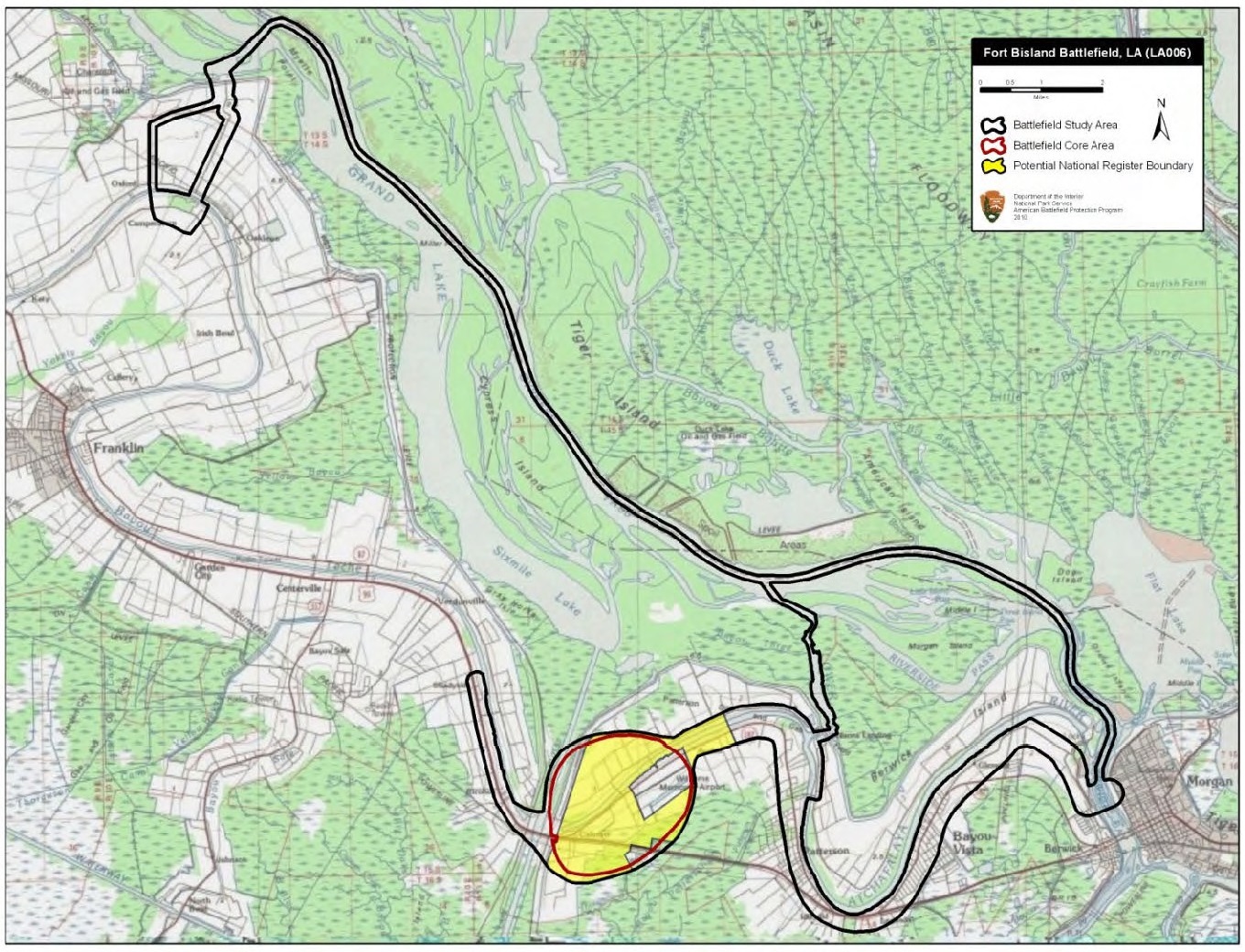
The Battle of Fort Bisland was fought in the American Civil War between Union Major General Nathaniel P. Banks against Confederate Major General Richard Taylor during Banks' operations against the Bayou Teche region in southern Louisiana.
Prelude
When Banks was made commander of the XIX Army Corps, Department of the Gulf, on December 16, 1862, he was ordered to coordinate an attack against the Confederate bastion of Port Hudson while General Ulysses S. Grant moved against Vicksburg. Banks made preparations for this campaign, but he knew the difficulties he would face on the march there. First, the area from New Orleans, was marshy, full of swamps, and disease would be rampant. There was also another obstacle in Bank's path — General Richard Taylor's small Army of Western Louisiana.
Banks formulated a plan that would take the XIX Corps to Alexandria, securing the Bayou Teche region that was laden with natural forage and unused supplies. He would establish supply depots along the way and then would move from Alexandria against Port Hudson. However, the quick movement he hoped for was slowed by Taylor's small army in a series of attacks, beginning with Fort Bisland, located in St. Mary Parish, Louisiana.
Battle
When Banks departed New Orleans, he planned to capture Taylor's army in its entirety. On April 9, two divisions from the XIX Corps crossed Berwick Bay from Brashear City (present day Morgan City, Louisiana) to the west side at Berwick. On April 11, Banks began his advance in earnest. Taylor was well aware of Banks' advance because of successful scouting by his cavalry under Brig. Gen. Thomas Green. Green shadowed Banks' army and reported back to Taylor every detail of the maneuvers of the Union army.
On April 12, Banks sent a third division, under Brig. Gen. Cuvier Grover, up the Atchafalaya River to land in the rear of Franklin, intending to intercept a Confederate retreat from Fort Bisland or turn the enemy's position. General Taylor sent some of Green's cavalry to the front to ascertain the enemy's strength and slow his advance. He also sent troops under Brig. Gen. Alfred Mouton to impede the advance of Grover's division. Late in the day, Union troops of Brig. Gen. William H. Emory's division arrived and formed a battle line outside the Fort Bisland's defenses. An artillery barrage ensued from both sides until dark when the Federal troops fell back to camp for the night.
About 9:00 a.m. on April 13, Union forces again advanced on Fort Bisland. Banks had three brigades under in position south of the Bayou Teche. The brigades were deployed with Godfrey Weitzel on the left, Halbert E. Paine on the right (anchored on Bayou Teche) with Timothy Ingraham in support. Opposing the Union forces south of the Teche was the Texas cavalry brigade commanded by Brig. Gen. Henry Hopkins Sibley. North of Bayou Teche was the Union brigade of Oliver P. Gooding who faced off against Mouton's Confederate brigade.
Combat did not begin until after 11:00 a.m. and continued until dusk. In addition to Confederate forces in the earthworks, the gunboat Diana, which had been captured and was now in Confederate hands, shelled the Union troops. U.S. gunboats joined the fray in late afternoon.
By early evening, fire had halted. Later that night, Taylor learned that the Union division that went up the Atchafalaya and landed in his rear was now in a position to cut off a Confederate retreat. Taylor began evacuating supplies, men, and weapons, leaving a small force to slow any enemy movement. The next morning, Banks and his men found the fort abandoned.
Aftermath
Fort Bisland was the only fortification that could have impeded this Union offensive, and it had fallen. Banks continued his march up Bayou Teche after this initial battle onward to his ultimate objective of Alexandria, Louisiana.
Taylor would slow Banks again a few days later at the Battle of Irish Bend.
Opposing Forces
Union
Army of the Gulf – Major General Nathaniel P. Banks
19th Corps – Major General Nathaniel P. Banks
- 1st Division -
- 2nd Brigade - BG Godfrey Weitzel
- 3rd Division - BG William H. Emory
- 1st Brigade - Col T. Ingraham
- 2nd Brigade - Col Halbert E. Paine
- 3rd Brigade - Col Oliver Paul Gooding
- Divisional Artillery
- 19th Corps Artillery - BG Richard Arnold
Confederate
District of West Louisiana - Major General Richard Taylor
- Mouton's Brigade - Brig. Gen. Jean Jacques Alfred Alexander Mouton
- 18th Louisiana Infantry Regiment - Colonel Armand
- 28th Louisiana Infantry Regiment - Colonel Henry Gray
- 24th Louisiana Infantry Regiment (Crescent Regiment) - Colonel Bosworth
- 10th Louisiana Infantry Bataillon (Yellow Jacket Bataillon) - Lieutenant Colonel Fournet
- 12th Louisiana Infantry Bataillon (Clack's Bataillon / Confederate Guard Response Bataillon)
- Pelican Battery - Captain Faries
- Cornay's Battery - Lieutenant Gordy
- Semmes' Battery - Lieutenant Barnes
- Sibley's Brigade - Brig. Gen. Henry Hopkins Sibley
- 4th Texas Cavalry Regiment - Colonel James Reily
- 5th Texas Cavalry Regiment - Colonel Thomas Green
- 7th Texas Cavalry Regiment - Colonel Arthur Bagby
- 13th Texas Cavalry Bataillon (Waller's Bataillon)
- Val Verde Texas Battery - Captain Joseph D. Sayers
- Unattached
- 2nd Louisiana Cavalry Regiment - Colonel Vincent
References
Sources
- Ayres, Thomas, Dark and Bloody Ground : The Battle of Mansfield and the Forgotten Civil War in Louisiana, Cooper Square Press, 2001.
- Parrish, T. Michael, Richard Taylor, Soldier Prince of Dixie, University of North Carolina Press, 1992.
- Taylor, Richard, Destruction and Reconstruction : Personal experiences of the late war, Time-Life Books, 1983.
References
- Dyer, p. 745
- Dyre, (pages relevant to individual regiments).
- Scott, p. 319
- [https://www.nps.gov/history/hps/abpp/battles/la006.htm Battle Summary: Fort Bisland] {{webarchive. link. (November 12, 2012)
This article was imported from Wikipedia and is available under the Creative Commons Attribution-ShareAlike 4.0 License. Content has been adapted to SurfDoc format. Original contributors can be found on the article history page.
Ask Mako anything about Battle of Fort Bisland — get instant answers, deeper analysis, and related topics.
Research with MakoFree with your Surf account
Create a free account to save articles, ask Mako questions, and organize your research.
Sign up freeThis content may have been generated or modified by AI. CloudSurf Software LLC is not responsible for the accuracy, completeness, or reliability of AI-generated content. Always verify important information from primary sources.
Report