From Surf Wiki (app.surf) — the open knowledge base
Battle of Ancona
1944 battle of World War II
1944 battle of World War II
| Field | Value |
|---|---|
| conflict | Battle of Ancona |
| image | File:WWII51 Gothic Line.jpg |
| image_size | 300 |
| caption | German defensive positions in Northern Italy 1944. Polish II Corps advance and taking on Ancona showed on the map. |
| partof | the Italian campaign of World War II |
| date | 16 June–18 July 1944 |
| place | Ancona, Italy |
| coordinates | |
| result | Allied victory |
| combatant1 | Poland Poland |
| United Kingdom | |
| Kingdom of Italy | |
| Flag of Italian Committee of National Liberation.svg Italian Resistance | |
| combatant2 | Nazi Germany |
| commander1 | Poland Władysław Anders |
| Poland Klemens Rudnicki | |
| commander2 | Nazi Germany Harry Hoppe |
| strength1 | ~50,000 |
| strength2 | Unknown |
| casualties1 | 496 killed |
| 1,789 wounded | |
| 139 missing | |
| casualties2 | 800 killed |
| 2,500 captured |
United Kingdom Kingdom of Italy Flag of Italian Committee of National Liberation.svg Italian Resistance Poland Klemens Rudnicki 1,789 wounded 139 missing 2,500 captured
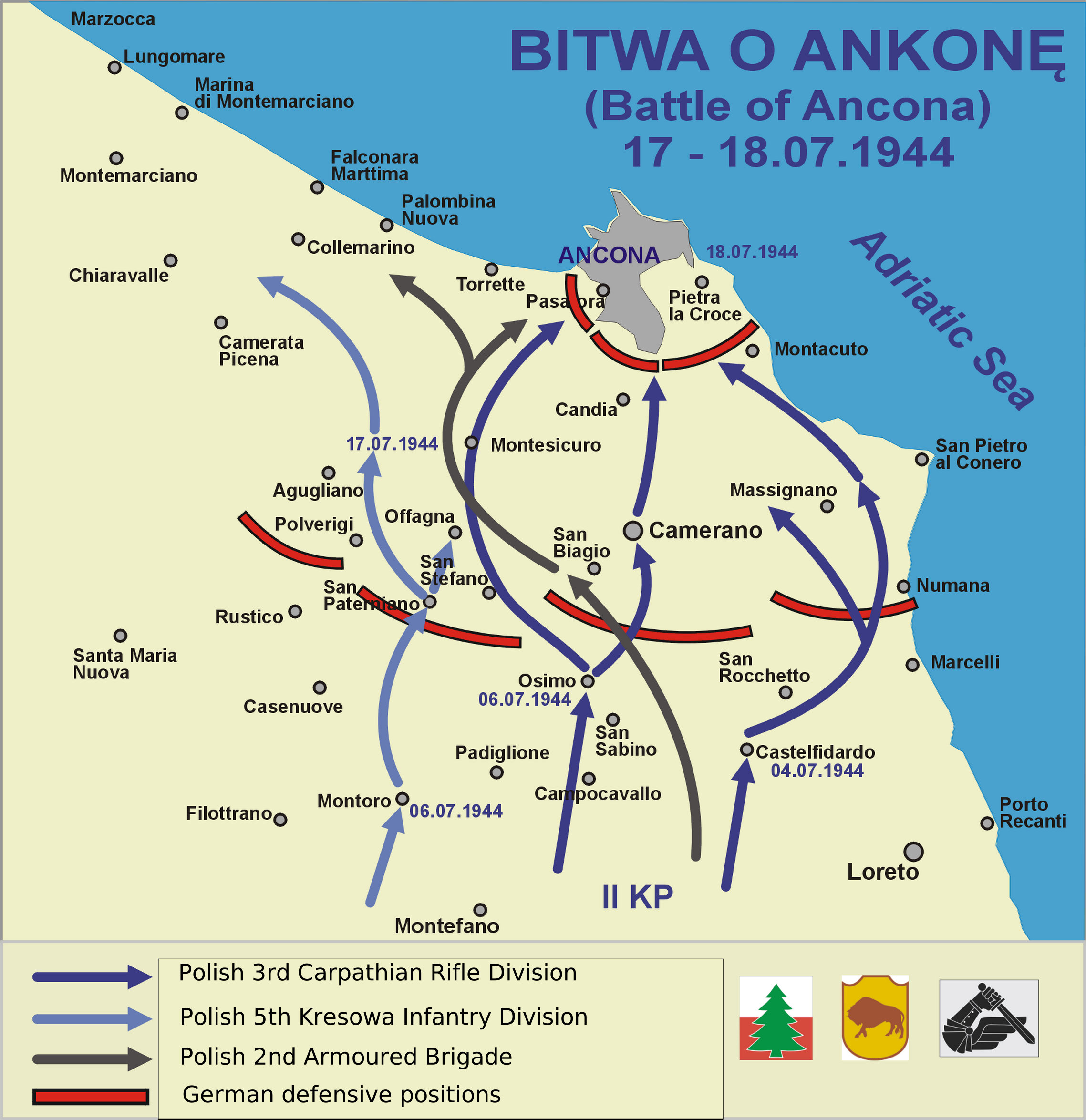
The Battle of Ancona was fought between forces from Poland serving as part of the British Army and German forces that took place from 16 June–18 July 1944 during the Italian campaign in World War II. The battle was the result of an Allied plan to capture the city of Ancona in Italy in order to gain possession of a seaport closer to the fighting so that they could shorten their lines of communication. The Polish 2nd Corps, tasked with capture of the city on 16 June 1944, accomplished the objective a month later on 18 July 1944. The Battle of Ancona was the only battle of the Western Front that was carried out entirely by the Polish military.
Background
The Allied advance north meant that the logistics line was in need of a port closer to the front lines than the ports of Pescara and Anzio. As such, two new targets were designated: Ancona on the Adriatic coast, and Livorno on the Tyrrhenian Sea. On 16 June, Polish II Corps under Lieutenant-General Władysław Anders—which had been taken into British Eighth Army, commanded by Lieutenant-General Sir Oliver Leese, reserve after its efforts in the Battle of Monte Cassino—was brought forward once more to relieve British V Corps and tasked with the capture of Ancona. On 17 June, Anders was given command of the Adriatic sector of the Italian theatre.
Battle
The first obstacle to cross was the Chienti river. Polish troops reached it on 21 June, and heavy fighting lasted in that region until 30 June. The main offensive on Ancona began on 17 July. Polish armored troops took Monte della Crescia and outflanked German troops defending Ancona. Next, the Italian Co-belligerent Army's IX Assault Unit secured Casenuove, and neighbouring British and Canadian troops took Montecchio and Croce di San Vincenzo. By the evening of 17 July, Polish troops were near Agugliano, and the following morning they took Offagna. Later that day, Polish troops took Chiaravalle, and armored troops reached the sea, cutting the German defenders of Ancona from the north-west. The Germans were falling back towards the sea, and Polish troops encountered little resistance entering Ancona at 14:30 on 18 July.
Aftermath
Taking Ancona was the only independent operation of the Polish II Corps. Afterward, the Corps took part in the breaking of the Gothic Line and the Allied spring 1945 offensive which resulted in the surrender of the Axis forces in Italy.
For their action in the battle while seconded to the Polish corps, the British 7th Queen's Own Hussars received the battle honour "Ancona".
Notes
References
- Zbigniew Wawer, Zdobycie Bolonii [Capture of Bologna], Chwała Oręża Polskiego 32 (53), Rzeczpospolita, 3 March 2007.
References
- Olgierd Terlecki, Beryl Arct, ''Poles in the Italian campaign, 1943-1945'', Interpress for the Council for Protection of Monuments of Struggle and Martyrdom, 1972, p. 101
- Marino, James I. (8 September 2021). "The Polish II Corps in Italy". Warfare History Network.
- Zbigniew Wawer, ''Zdobycie Bolonii'', p.4
- "Maid of Warsaw".
This article was imported from Wikipedia and is available under the Creative Commons Attribution-ShareAlike 4.0 License. Content has been adapted to SurfDoc format. Original contributors can be found on the article history page.
Ask Mako anything about Battle of Ancona — get instant answers, deeper analysis, and related topics.
Research with MakoFree with your Surf account
Create a free account to save articles, ask Mako questions, and organize your research.
Sign up freeThis content may have been generated or modified by AI. CloudSurf Software LLC is not responsible for the accuracy, completeness, or reliability of AI-generated content. Always verify important information from primary sources.
Report