From Surf Wiki (app.surf) — the open knowledge base
Bat
Order of flying mammals

Order of flying mammals
- Yinpterochiroptera
- Yangochiroptera (traditional):
- Megachiroptera
- Microchiroptera
Bats (order Chiroptera ) are winged mammals; the only mammals capable of true and sustained flight. Bats are more agile in flight than most birds, flying with their long spread-out digits covered with a thin membrane or patagium. The smallest bat, and one of the smallest extant mammals, is Kitti's hog-nosed bat, which is 29 - in length, 150 mm across the forearm and 2 g in mass. The largest bats are the flying foxes, with the giant golden-crowned flying fox (Acerodon jubatus) reaching a weight of 1.5 kg and having a wingspan of 1.6 m.
The second largest order of mammals after rodents, bats account for about 20% of all classified mammal species worldwide, with at least 1,500 known species. These were traditionally divided into two suborders: the largely fruit-eating megabats and the echolocating microbats. But more recent evidence has supported dividing the order into Yinpterochiroptera and Yangochiroptera, with megabats as members of the former along with several species of microbats. Many bats are insectivores, and most of the rest are frugivores (fruit-eaters) or nectarivores (nectar-eaters). A few species feed on animals other than insects; for example, the vampire bats are haematophagous (feeding on blood). Most bats are nocturnal, and many roost in caves or other refuges; it is uncertain whether bats have these behaviours to escape predators. Bats are distributed globally in almost all regions. They are important in their ecosystems for pollinating flowers and dispersing seeds as well as controlling insect populations.
Bats provide humans with some direct benefits, at the cost of some disadvantages. Bat dung has been mined as guano from caves and used as fertiliser. Bats consume insect pests, reducing the need for pesticides and other insect management measures. Bats are sometimes numerous enough and close enough to human settlements to serve as tourist attractions, and they are used as food in Africa, Asia, the Pacific and the Caribbean. Due to their physiology, bats are one type of animal that acts as a natural reservoir of many pathogens, such as rabies, and since they are highly mobile, social, and long-lived, they can readily spread disease among themselves. If humans interact with bats, these traits become potentially dangerous to humans.
Depending on the culture, bats may be symbolically associated with positive traits, such as protection from certain diseases or risks, rebirth, or long life, but in the West, bats are popularly associated with darkness, malevolence, witchcraft, vampires, and death.
Etymology
A dialectal English name for bats is "flittermouse", which matches their name in other Germanic languages (for example, German Fledermaus and Swedish fladdermus), related to the fluttering of wings. Middle English had bakke, most likely cognate with Old Swedish natbakka (), which may have undergone a shift from -k- to -t- (to Modern English bat) influenced by Latin blatta, . The word bat was probably first used in the early 1570s. The order name Chiroptera derives from the Ancient Greek χείρ (kheír), meaning "hand", and πτερόν (pterón), meaning "wing".
Phylogeny and taxonomy
Evolution
The delicate skeletons of bats do not fossilise well; it is estimated that only 12% of bat genera that lived have been found in the fossil record. The oldest known bat fossils include Archaeonycteris praecursor and Altaynycteris aurora (55–56 million years ago), both known only from isolated teeth. The oldest complete bat skeletons are Icaronycteris gunnelli and Onychonycteris finneyi (52 million years ago), known from two skeletons discovered in Wyoming. The extinct bats Palaeochiropteryx tupaiodon and Hassianycteris kumari, both of which lived 48 million years ago, are the first fossil mammals whose colouration has been discovered: both were reddish-brown.
Bats were formerly grouped in the superorder Archonta, along with the treeshrews (Scandentia), colugos (Dermoptera), and primates. Modern genetic evidence now places bats in the superorder Laurasiatheria, with its sister taxon as Ferungulata, which includes carnivorans, pangolins, odd-toed ungulates, and even-toed ungulates. One study places Chiroptera as a sister taxon to odd-toed ungulates (Perissodactyla).
The flying primate hypothesis proposed that when adaptations to flight are removed, megabats are allied to primates and colugos by anatomical features not shared with microbats, and thus flight evolved twice in mammals. Genetic studies have strongly supported the common ancestry of all bats and the single origin of mammal flight.
Co-evolutionary evidence
An independent molecular analysis trying to establish the dates when bat ectoparasites (bedbugs) evolved came to the conclusion that bedbugs similar to those known today (all major extant lineages, all of which feed primarily on bats) had already diversified and become established over 100 million years ago, suggesting that they initially all evolved on non-bat hosts and "bats were colonized several times independently, unless the evolutionary origin of bats has been grossly underestimated". No analysis has provided estimates for the age of the flea lineages associated with bats. The oldest known members of a different lineage of bat ectoparasites (bat flies), however, are from roughly 20 million years ago, well after the origin of bats. The bat-ectoparasitic earwig family Arixeniidae has no fossil record but is not believed to originate more than 23 million years ago.
Inner systematics
A 2011 study supported separating megabats and microbats. A 2013 phylogenomic study supported the two new proposed suborders.
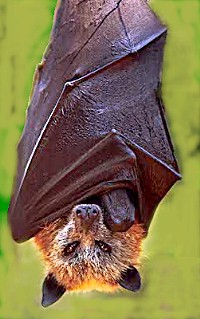
The 2003 discovery of an early fossil bat from the 52-million-year-old Green River Formation, Onychonycteris finneyi, indicates that flight evolved before echolocative abilities. Unlike modern bats, Onychonycteris had claws on all five of its fingers. It also had longer hind legs and shorter forearms, possible adaptations for climbing. This palm-sized bat had short, broad wings, suggesting that it could not fly as fast or as far as later bat species. Instead of flapping its wings continuously while flying, Onychonycteris probably switched between flaps and glides in the air. Hence flight in bats likely developed from gliding and in arboreal locomotors, rather than terrestrial runners. This model of flight development, commonly known as the "trees-down" theory, holds that bats first flew by taking advantage of height and gravity to drop down on to prey, rather than running fast enough for a ground-level take-off.
The molecular phylogeny was controversial, as it pointed to microbats not having a unique common ancestry, which implied that some seemingly unlikely transformations occurred. The first is that laryngeal echolocation evolved twice in bats, once in Yangochiroptera and once in the rhinolophoids. The second is that laryngeal echolocation had a single origin in Chiroptera, was lost in the family Pteropodidae (all megabats), and later evolved as a system of tongue-clicking in the genus Rousettus. Analyses of the sequence of the vocalisation gene FoxP2 were inconclusive on whether laryngeal echolocation was lost in the pteropodids or gained in the echolocating lineages. Echolocation probably first derived in bats from communicative calls. The Eocene bats Icaronycteris (52 million years ago) and Palaeochiropteryx had cranial adaptations suggesting an ability to produce ultrasound. This may have been used at first mainly to forage on the ground for insects and map out their surroundings in their gliding phase or for communicative purposes. After the adaptation of flight was established, it may have been refined to target flying prey. but ontogenic analysis of the cochlea supports that laryngeal echolocation evolved only once.
Classification
Bats are placental mammals. After rodents, they are the largest order, making up about 20% of known mammal species. In 1758, Carl Linnaeus classified the seven bat species he knew of in the genus Vespertilio in the order Primates. Around twenty years later, the German naturalist Johann Friedrich Blumenbach gave them their own order, Chiroptera. Since then, the number of described species has risen to over 1,500, traditionally classified as two suborders: Megachiroptera (megabats) and Microchiroptera (microbats/echolocating bats). Not all megabats are larger than microbats. Several characteristics distinguish the two groups. Microbats use echolocation for navigation and finding prey, but megabats, apart from those in the genus Rousettus, do not. Accordingly, megabats have well-developed eyesight. They only feed on plant material like fruit and nectar.

Below is a table chart following the bat classification of families recognised by various authors of the ninth volume of Handbook of the Mammals of the World published in 2019:
| Family | English name | Number of Species | Image Figure | Family | English name | Number of Species | Image Figure | Family | English name | Number of Species | Image Figure | Family | English name | Number of Species | Image Figure | Family | English name | Number of Species | Image Figure | |
|---|---|---|---|---|---|---|---|---|---|---|---|---|---|---|---|---|---|---|---|---|
| Pteropodidae J. E. Gray, 1821 | Old World fruit bats | 191 | [[File:Pteropus niger three.jpeg | 100px]] | ||||||||||||||||
| Rhinolophoidea J. E. Gray, 1825 | ||||||||||||||||||||
| Rhinopomatidae Bonaparte, 1838 | Mouse-tailed bats | 6 | [[File:Mouse-Tailed Bat.jpg | 100px]] | ||||||||||||||||
| Craseonycteridae Hill, 1974 | Hog-nosed bat | 1 | [[File:Craseonycteris thonglongyai.png | 100px]] | ||||||||||||||||
| Megadermatidae H. Allen, 1864 | False-vampires | 6 | [[File:Greater False Vampire Bat (Megaderma lyra).jpg | 100px]] | ||||||||||||||||
| Rhinonycteridae J. E. Gray, 1866 | Trident bats | 9 | [[File:Rhinonicteris aurantia.jpg | 100px]] | ||||||||||||||||
| Hipposideridae Lydekker, 1891 | Old World leaf-nosed bats | 88 | [[File:Bat in a Cave.jpg | 100px]] | ||||||||||||||||
| Rhinolophidae J. E. Gray, 1825 | Horseshoe bats | 109 | [[File:Bat(20070605).jpg | 100px]] | ||||||||||||||||
| Yangochiroptera Koopman, 1984 | ||||||||||||||||||||
| Emballonuroidea Gervais in de Castelnau, 1855 | ||||||||||||||||||||
| Nycteridae Van der Hoeven, 1855 | Slit-faced bats | 15 | [[File:Common Slit-faced Bat (Nycteris thebaica) (7027172215).jpg | 100px]] | ||||||||||||||||
| Emballonuridae Gervais in de Castelnau, 1855 | Sheath-tailed bats | 54 | [[File:Emballonura semicaudata.jpg | 100px]] | ||||||||||||||||
| Noctilionoidea J. E. Gray, 1821 | ||||||||||||||||||||
| Myzopodidae Thomas, 1904 | Madagascar and western sucker-footed bats | 2 | [[File:Myzopoda Myzopodidae.jpg | 100px]] | ||||||||||||||||
| Mystacinidae Dobson, 1875 | New Zealand short-tailed bats | 2 | [[File:Southern short-tailed bats, Mystacina tuberculata.jpg | 100px]] | ||||||||||||||||
| Thyropteridae Miller, 1907 | Disk-winged bats | 5 | [[File:Thyroptera discifera.jpg | 100px]] | ||||||||||||||||
| Furipteridae J. E. Gray, 1866 | Smoky bat and thumbless bat | 2 | [[File:Furipterus horrens.jpg | 100px]] | ||||||||||||||||
| Noctilionidae J. E. Gray, 1821 | Bulldog bats | 2 | [[File:Captive Noctilio leporinus.jpg | 100px]] | ||||||||||||||||
| Mormoopidae Saussure, 1860 | Ghost-faced, naked-backed and mustached bats | 18 | [[File:Mormoops megalophylla.JPG | 100px]] | ||||||||||||||||
| Phyllostomidae J. E. Gray, 1825 | New World leaf-nosed bats | 217 | [[File:Phyllostomus discolor b.jpg | 100px]] | ||||||||||||||||
| Vespertilionoidea J. E. Gray, 1821 | ||||||||||||||||||||
| Natalidae J. E. Gray, 1825 | Funnel-eared bats | 10 | [[File:Natalus stramineus.jpg | 100px]] | ||||||||||||||||
| Molossidae Gervais in de Castelnau, 1855 | Free-tailed bats | 126 | [[File:Mormopterus beccarii astrolabiensis 1.jpg | 100px]] | ||||||||||||||||
| Miniopteridae Dobson, 1875 | Long-fingered and bent-wing bats | 38 | [[File:Southern bentwing bat.jpg | 100px]] | ||||||||||||||||
| Cistugidae Lack et al., 2010 | Wing-gland bats | 2 | [[File: Cistugo lesueuri.jpg | 100px]] | ||||||||||||||||
| Vespertilionidae J. E. Gray, 1821 | Vesper bats | 496 | [[File:Vespertilio murinus 2.jpg | 100px]] |
Anatomy and physiology
Skull and dentition

The head and teeth shape of bats can vary by species. In general, megabats have a fox-like appearance with long snouts and ears, hence their nickname of "flying foxes". The number of teeth in bats can vary between 38 teeth in small, insect-eating species and as low as 20 in vampire bats. A diet of hard-shelled insects requires fewer but larger teeth along with longer canines and more robust lower jaws. In nectar-feeding bats, the canines are long, while the cheek teeth are reduced. In fruit-eating microbats, the cusps of the cheek teeth are adapted for crushing. The upper incisors of vampire bats lack enamel, which keeps them razor-sharp.
Wings, skin, and flight
Main article: Bat flight, Bat wing development
Bats are the only mammals capable of sustained flight, as opposed to the gliding of flying squirrels, colugos and sugar gliders. The fastest bat, the Mexican free-tailed bat (Tadarida brasiliensis), can achieve a ground speed of 160 km/h.
The flexible finger bones of bats have a flattened cross-section and become less mineralised towards the tips. During flight, the bones undergo bending and shearing stress; the former being less than in terrestrial mammals, and the latter being greater. The wing bones of bats are less resistant to breaking than those of birds.
As in other mammals, and unlike in birds, the radius is the main component of the forearm. Bats have five elongated digits, which all radiate around the wrist. The thumb points forward and supports the leading edge of the wing, and the other digits support the tension held in the wing membrane. The second and third digits go along the wingtip, allowing the wing to be pulled forward against aerodynamic drag without having to be thick, as in pterosaur wings. The fourth and fifth digits go from the wrist to the trailing edge and repel the bending force caused by air pushing up against the stiff membrane. The knees point upwards and outwards during flight due to the attachment of the femurs, while the ankle joint can bend the trailing edge downwards.

Due to their flexible joints, bats are more manoeuvrable and more dexterous than gliding mammals, and their thin, articulated wings allow them to manoeuvre more accurately than birds and fly with more lift and less drag. By folding the wings in toward their bodies on the upstroke, they save 35 percent energy during flight. Flight muscles used for the upstroke are located on the back, while those for the downstroke are at the chest. This is in contrast to birds, where both muscle types are at the chest. Nectar- and pollen-eating bats can hover in a similar way to hummingbirds. The sharp leading edges of the wings can create vortices, which provide lift. The vortex may be stabilised by the animal changing its wing curvature.
Skin The patagium is the wing membrane, which reaches from the arm and finger bones to the side of the body and the hindlimbs.
While the skin on the body of the bat is covered in hair and sweat glands with an epidermis, a dermis, and a fatty subcutaneous layer, the patagium is an extremely thin double layer of epidermis separated by a connective tissue centre rich with collagen and elastic fibres. The surface of the wings is equipped with touch-sensitive receptors on small bumps called Merkel cells. Each bump has a tiny hair in the centre, allowing the bat to detect and adapt to changing airflow; the primary use is to judge the most efficient speed at which to fly, and possibly also to avoid stalls. Insectivorous bats may also use tactile hairs when manoeuvring to capture flying insects.
Photoluminescence has been reported in at least six North American species based on 60 museum specimens. The wings, uropatagium (around the tail), and hind limbs of these bats glowed green when exposed to UV light. The explanation for this is uncertain, and some have suggested the phenomenon is an artefact of the techniques used to dry specimens for museum storage.
Roosting and gaits

When not flying, bats hang upside down from their feet, a posture known as roosting. Most megabats roost with the head tucked towards the belly, whereas most microbats roost with the neck curled towards the back. This difference is due to the structure of the cervical or neck vertebrae in the two groups, which are clearly distinct. Tendons allow bats to hang from a roost with no effort, which is needed to release.
Bats are more awkward when crawling on the ground, though a few species, such as the New Zealand lesser short-tailed bat (Mystacina tuberculata) and the common vampire bat (Desmodus rotundus), are quite agile. These species move their limbs one after the other, but vampire bats accelerate by bounding, the folded-up wings being used to propel them forward. Vampire bats likely evolved these gaits to stalk their hosts, while short-tailed bats took to the ground due to a lack of competition from other mammals. Terrestrial locomotion does not appear to affect their ability to fly.
Internal systems
Bats have an efficient circulatory system. They seem to make use of particularly strong venomotion, a rhythmic contraction of venous wall muscles. In most mammals, the walls of the veins provide mainly passive resistance, maintaining their shape as deoxygenated blood flows through them, but in bats, they appear to actively support blood flow back to the heart with this pumping action. Because of their small, lightweight bodies, bats are not at risk of blood rushing to their heads when roosting. Compared to a terrestrial mammal of similar size, the bat's heart can be up to three times larger and pump more blood, while blood oxygen levels are twice as much. An active microbat can reach a heart rate of 1000 beats per minute.

Bats possess a highly adapted respiratory system to cope with the demands of powered flight. They have relatively large lungs, and many species have proportionally larger alveolar surface areas and pulmonary capillary blood volumes than other mammals. During flight, the respiratory cycle has a one-to-one relationship with the wing-beat cycle. Their mammalian lungs prevent them from flying at high altitudes. Bats can also meet oxygen demands by exchanging gas through the patagium of the wing. When the bat has its wings spread, it allows for an increase in surface area to volume ratio, 85% of the surface area being the wing. The subcutaneous vessels in the membrane lie near the surface and allow for the diffusion of oxygen and carbon dioxide.
The digestive system of bats varies depending on the species of bat and its diet. Digestion is relatively quick to meet the energy demands of flight. Insectivorous bats may have certain digestive enzymes to better process insects, such as chitinase to break down their chitin exoskeleton. Vampire bats, probably due to their diet of blood, are unique among vertebrates in that they do not have the enzyme maltase, which breaks down malt sugar, in their intestinal tract. Nectivorous and frugivorous bats have more maltase and sucrase enzymes than insectivores, to cope with the higher sugar contents of their diet.
The adaptations of the kidneys of bats vary with their diets. Carnivorous and vampire bats consume large amounts of protein and can output concentrated urine; their kidneys have a thin cortex and long renal papillae. Frugivorous bats lack that ability and have kidneys adapted for electrolyte retention due to their low-electrolyte diet; their kidneys accordingly have a thick cortex and very short conical papillae. Flying gives bats relatively high metabolism, which increases respiratory water loss. Lipids known as cerebrosides retain water in cold temperatures but allow for evaporation through the skin in hot temperatures to cool them. Water helps maintain the ionic balance in their blood, thermoregulation system and urinary and waste system. They are also susceptible to blood urea poisoning if they do not receive enough fluid.
The structure of the uterine system in female bats can vary by species, with some having two uterine horns while others have a single mainline chamber.
Senses
Echolocation and hearing
Main article: Animal echolocation#Bats
Microbats and a few megabats emit ultrasonic sounds to produce echoes. The sound intensity of these echoes is dependent on subglottic pressure. The bats' cricothyroid muscle, located inside the larynx, controls the orientation pulse frequency, which is an important function. By comparing the outgoing pulse with the returning echoes, bats can learn about their environment and detect prey in darkness. Some bat calls can reach over 140 decibels. Microbats use their larynx to emit echolocation signals through the mouth or the nose. Bat call frequencies range from as low as 11 kHz to as high as 212 kHz. The noses of various groups of bats have fleshy extensions, known as nose-leaves, which play a role in sound transmission.
In low-duty cycle echolocation, bats can separate their calls and returning echoes by time. They have to time their short calls to finish before echoes return. In high-duty cycle echolocation, bats emit a continuous call and separate pulse and echo in frequency using the Doppler effect of their motion in flight. The shift of the returning echoes yields information relating to the motion and location of the bat's prey. These bats must deal with changes in the Doppler shift due to changes in their flight speed. They have adapted to change their pulse emission frequency in relation to their flight speed so echoes still return in the optimal hearing range.
In addition to echolocating prey, bat ears are sensitive to sounds made by their prey, such as the fluttering of moth wings. The complex geometry of ridges on the inner surface of bat ears helps to sharply focus echolocation signals and to passively listen for any other sound produced by the prey. These ridges can be regarded as the acoustic equivalent of a Fresnel lens. Bats can estimate the elevation of their target using the interference patterns from the echoes reflecting from the tragus, a flap of skin in the external ear.
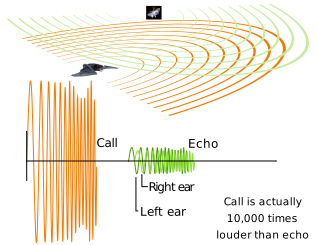
By repeated scanning, bats can mentally construct an accurate image of the environment in which they are moving and of their prey. Many species of moth have exploited this, such as many tiger moths, which produce aposematic ultrasound signals to warn bats that they are chemically protected and therefore distasteful. Some tiger moths can produce signals to jam bat echolocation. In some moth species, the tympanum hearing organ causes the insect to move in random evasive manoeuvres when detecting a bat call.
Vision
Microbats tend to have small eyes but are still sensitive to light, and no species is truly blind. Most microbats have mesopic vision, meaning that they can detect light only in low levels, whereas other mammals have photopic vision, which allows colour vision. Microbats may use their vision for orientation and while travelling between their roosting grounds and feeding grounds, as echolocation is effective only over short distances. Megabat species generally have good eyesight and may have some colour vision to help them distinguish ripe fruits. Some species can detect ultraviolet (UV). As the bodies of some microbats have distinct colouration, they may be able to discriminate colours.
Smell
Among bat species, megabats tend to have a more developed sense of smell, being particularly sensitive to esters, which are found in ripe fruits. Insectivorous bats have less use for smell during foraging, as they rely on echolocation to search for prey.
Magnetoreception and infrared sensing
Like birds, microbats' sensitivity to the Earth's magnetic field gives them great magnetoreception. Microbats use a polarity-based compass, which means they can distinguish north from south, unlike birds, which use the strength of the magnetic field to differentiate latitudes, which may be used in long-distance travel. The mechanism possibly involves magnetite particles. Vampire bats are the only mammals that use infrared sensing; heat sensors around the nose allow them to detect blood vessels near the surface of the skin of their target.
Thermoregulation

Tropical bats tend to be homoeothermic (having a stable body temperature), while temperate and subtropical species which enter hibernation or torpor are more heterothermic (where body temperature can vary). Compared to other mammals, bats have a high thermal conductivity. They lose heat via the wings when they are spread, so resting bats wrap their wings around themselves to keep warm. Smaller bats generally have a higher metabolic rate than larger bats and so need to consume more food in order to maintain homoeothermy.
Bats may avoid flying during the day to prevent overheating in the sun, since they would absorb sun radiation via their dark wing membranes. Bats may not be able to release heat if the ambient temperature is too high; they use saliva to cool themselves in extreme conditions. Among megabats, the flying fox Pteropus hypomelanus uses saliva and wing-fanning to cool itself while roosting during the hottest part of the day. Among microbats, the Yuma myotis (Myotis yumanensis), the Mexican free-tailed bat (Tadarida brasiliensis), and the pallid bat (Antrozous pallidus) cope with temperatures up to 45 C by panting, salivating, and licking their fur to promote evaporative cooling; this is sufficient to release twice their metabolic heat production.

During torpor, bats drop their body temperature to 6 –, while their energy usage diminishes by 50 to 99%. Tropical bats may use it to reduce the chance of being caught by a predator during foraging. Megabats were generally believed to be homoeothermic, but three species of small megabats, with a mass of about 50 g, have been known to use torpor: the common blossom bat (Syconycteris australis), the long-tongued nectar bat (Macroglossus minimus), and the eastern tube-nosed bat (Nyctimene robinsoni). Torpid states last longer in the summer for megabats than in the winter.
During hibernation, bats enter a torpid state and decrease their body temperature for 99.6% of their hibernation period; even during periods of arousal, when their body temperature returns to normal, they sometimes enter a shallow torpid state, known as "heterothermic arousal". Some bats become dormant during higher temperatures to keep cool in the summer months (aestivation).
Heterothermic bats during long migrations may fly at night and go into a torpid state roosting in the daytime. Unlike migratory birds, which fly during the day and feed during the night, nocturnal bats have a conflict between travelling and eating. The energy saved reduces their food requirements and also decreases the duration of migration, which may prevent them from spending too much time in unfamiliar places and decrease predation. In some species, pregnant individuals use a more moderate state of torpor to maintain foetal development, while still saving energy.
Size
The smallest bat, and one of the smallest mammals, is Kitti's hog-nosed bat (Craseonycteris thonglongyai), which is 29 – long with a 150 mm forearm and weighs 2 oz. The largest species is the giant golden-crowned flying fox (Acerodon jubatus), which can weigh 1.5 kg with a wingspan of 1.6 m. Larger bats tend to use lower frequencies and smaller bats higher for echolocation; high-frequency echolocation is better at detecting smaller prey. Small prey may be absent in the diets of large bats as they are unable to detect them.
Ecology
.jpg)
Flight has enabled bats to become one of the most widespread groups of mammals, being found nearly everywhere apart from polar regions, some remote islands and the very tops of mountains. Different species select different habitats during different seasons, including ocean coasts, mountains, rainforests and deserts, but they require suitable roosts. Bat roosts can be found in hollows, crevices, foliage, and even human-made structures and include "tents" the bats construct with leaves; megabats generally roost in trees. Bats are usually nocturnal but are known to exhibit diurnal behaviour in temperate regions during summer to make up for insufficient nighttime feeding and where there is little predatory threat from birds.
In temperate areas, some bats migrate to winter hibernation dens, usually caves and mines, where they pass into torpor during the cold weather, never waking and relying on their stored fat. Similarly, tropical bats go through aestivation during periods of prolonged heat and dryness. Bats rarely fly in rain, possibly because being wet costs them more energy and raindrops interfere with their echolocation. They do appear to surf storm fronts when travelling to give birth in warmer temperatures.
Food and feeding
Different bat species have different diets, including insects, nectar, pollen, fruit and even vertebrates. Megabats are mostly fruit, nectar and pollen eaters. Due to their small size, high metabolism and rapid burning of energy through flight, bats must consume large amounts of food for their size. Insectivorous bats may eat over 120 percent of their body weight per day, while frugivorous bats may eat over twice their weight. They can travel significant distances each night, exceptionally as much as 38.5 km in the spotted bat (Euderma maculatum), in search of food. Bats may acquire water from the food they eat or drink from sources like lakes and streams, flying over the surface and dipping their tongues into the water.
Bats as a group appear to be losing vitamin C synthesis. Such a loss was recorded in 34 bat species from six major families, both insect- and fruit-eating, with the cause being a single mutation inherited from a common ancestor. Vitamin C synthesis has been recorded in at least two species of bat, Leschenault's rousette (Rousettus leschenaultii) and the great roundleaf bat (Hipposideros armiger).
Insects and invertebrates
Most bats, especially in temperate areas, prey on insects. The diet of an insectivorous bat may span many species, including flies, mosquitos, beetles, moths, grasshoppers, crickets, termites, bees, wasps, mayflies and caddisflies. They will also eat other arthropods such as spiders, scorpions, centipedes, lobsters and shrimp. Large numbers of Mexican free-tailed bats (Tadarida brasiliensis) fly hundreds of metres above the ground in central Texas to feed on migrating moths. Species that hunt insects in flight, like the little brown bat (Myotis lucifugus) and the eastern red bat (Lasiurus borealis), may catch an insect in mid-air directly with the mouth or use their tail membranes or wings. The slow-moving brown long-eared bat (Plecotus auritus) plucks insects from vegetation, while many horseshoe bat species wait for them from their perches. Some bats may take the insect to their roost and eat it there. Arthropod-eating bats living at high latitudes have to consume prey with higher energetic value than tropical bats.
Plant material
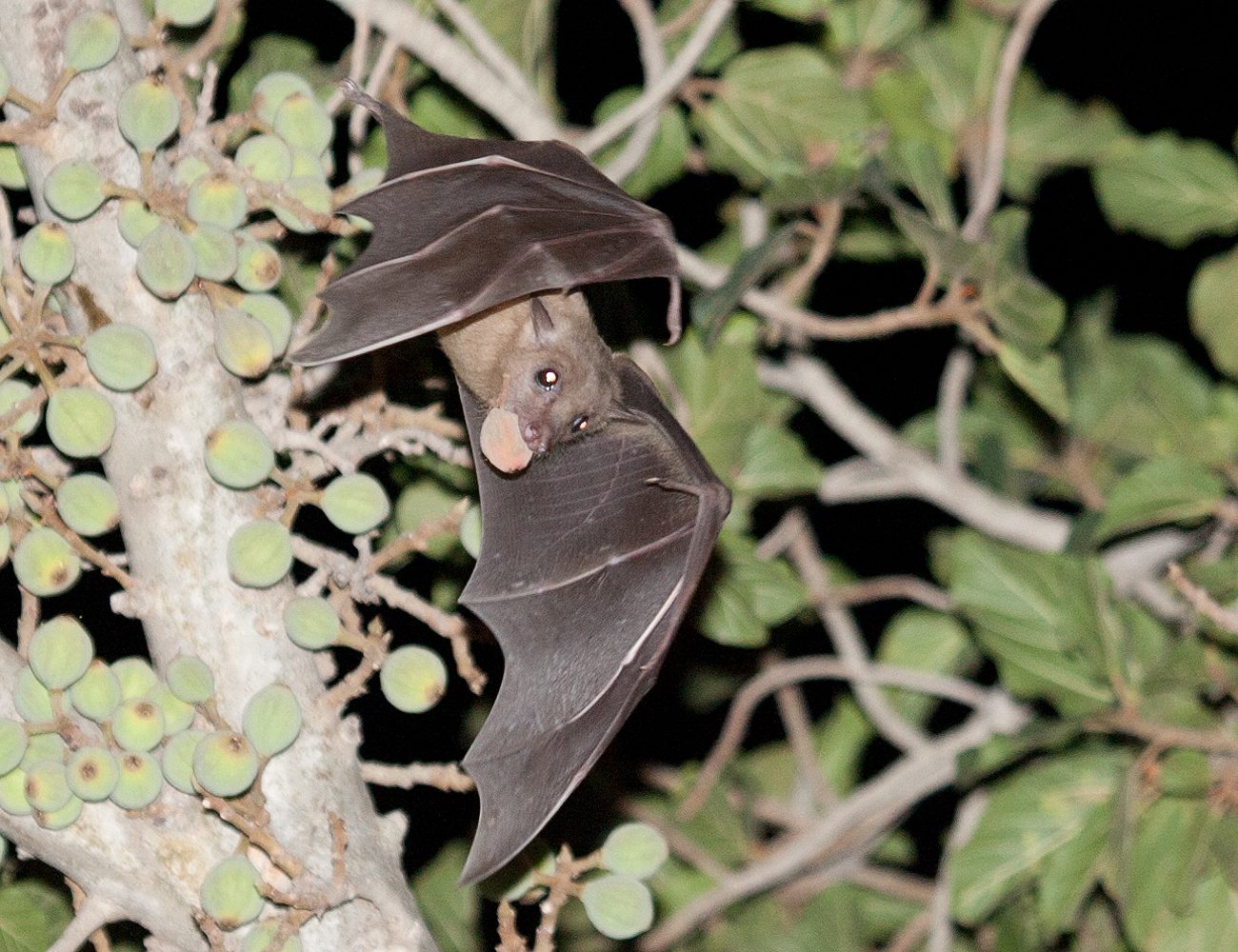
Consumption of fruit, nectar, pollen and other plant material occurs in megabats and New World leaf-nosed bats. Bats prefer ripe fruit and typically pull it from a tree and travel somewhere else to feed, possibly to avoid predators, though larger megabats may eat on site at the fruiting tree. The Jamaican fruit bat (Artibeus jamaicensis) has been recorded carrying fruit weighing as much as 50 g. Many species of plants depend on bats for seed dispersal. Fruit-eating bats sometimes chew leaves to suck up the moisture and then spit them out. Bats apparently cannot digest cellulose.
Nectar-eating bats have acquired specialised adaptations. These bats possess long muzzles and long, extensible tongues covered in fine bristles that aid them in feeding on particular flowers and plants. The tube-lipped nectar bat (Anoura fistulata) has a proportionally longer tongue than any mammal and is the only species capable of reaching deep into the flowers of Centropogon nigri. When the tongue retracts, it is pulled inside the rib cage. Because of these features, nectar-feeding bats cannot easily turn to other food sources in times of scarcity, making them more at risk of extinction than other species. Nectar feeding also aids a variety of plants, since these bats serve as pollinators, as pollen attaches to their fur while they feed. Around 500 species of flowering plant rely on bat pollination and thus tend to open their flowers at night. Many rainforest and Mediterranean plants depend on bat pollination.
Vertebrates
.jpg)
Some bats prey on other vertebrates, such as fish, frogs, lizards, birds and mammals. The fringe-lipped bat (Trachops cirrhosus), for example, is skilled at catching frogs, locating them by tracking their mating calls. The greater noctule bat (Nyctalus lasiopterus) will hunt and catch birds in flight. Some species, like the greater bulldog bat (Noctilio leporinus), hunt fish, flying over the water and grabbing them with their clawed feet. They use echolocation and may be alerted by ripples on the surface or a jumping fish. Some species feed on other bats, including the spectral bat (Vampyrum spectrum) and the ghost bat (Macroderma gigas).
Blood
The three species of vampire bat strictly feed on animal blood (hematophagy); the common vampire bat feeds on mammals, while the hairy-legged (Diphylla ecaudata) and white-winged vampire bats (Diaemus youngi) feed on birds. Vampire bats target sleeping prey and can sense deep breathing. They cut through and peel the animal's skin with their teeth and lap up the blood with their tongues, which have grooves on the underside adapted to this purpose. Certain substances in the saliva keep the blood flowing.
Predators, parasites, and diseases
Bats are subject to predation from birds of prey, such as owls, hawks, and falcons. J. Rydell and J. R. Speakman argue that bats evolved nocturnality during the early Eocene period to avoid predators. Other zoologists find the evidence to be unclear and contradictory. Twenty species of tropical New World snakes are known to eat bats; they may wait for them at the entrances of their refuges or attack them inside. As are most mammals, bats are hosts to a number of internal and external parasites. Among ectoparasites, bats carry fleas and mites, as well as specific parasites such as bat bugs and bat flies (Nycteribiidae and Streblidae). Bats generally do not host lice, possibly due to high competition from other parasites, including the more specialised ones. Internal parasites of bats include tapeworms, roundworms and flukes.
.jpg)
White nose syndrome is a condition associated with the deaths of millions of bats in North America. The disease is named after a white fungus, Pseudogymnoascus destructans, found growing on the muzzles, ears, and wings of affected bats. The fungus is mostly spread from bat to bat and cause weight loss, dehydration and electrolyte imbalances. The fungus was first discovered in central New York State in 2006 and spread to 30 US states and five Canadian provinces; mortality rates as high as 99% have occurred for affected bat wintering caves.
Bats are natural reservoirs for a large number of zoonotic pathogens, including rabies, endemic in many bat populations; histoplasmosis, both directly and in guano; Nipah and Hendra viruses; and possibly the Ebola virus. Their high mobility, broad distribution, long life spans, substantial sympatry (range overlap) of species, and social behaviour make bats favourable hosts and vectors of disease. Reviews have found different answers as to whether bats have more zoonotic viruses (transferable to humans) than other mammal groups. One 2015 review found that among mammals, bats, rodents, and primates harboured the most zoonotic viruses by a significant margin, though bats had about as many zoonotic viruses as rodents and primates. Another 2020 review of mammals and birds found that the taxon of the reservoir was not a factor in whether a virus was zoonotic. Instead, more diverse groups had greater viral diversity.
Bats seem to be highly resistant to many of the pathogens they carry, suggesting a degree of adaptation to their immune systems. Their interactions with livestock and pets, including predation by vampire bats, compound the risk of zoonotic transmission. Bats have been connected to the emergence of severe acute respiratory syndrome (SARS) in China, since they serve as natural hosts for coronaviruses, several from a cave in Yunnan, one of which developed into the SARS virus. However, there is no evidence that bats cause or spread COVID-19.
Behaviour and life history
Social structure
Bats may roost solitarily or in colonies; Mexican free-tailed bats roost in the millions, while the hoary bat (Lasiurus cinereus) is mostly solitary, aside from mothers with young. Living in large colonies lessens the risk to an individual of predation. Temperate bat species may swarm at hibernation sites as autumn approaches. This may serve to guide young to these sites, signal reproduction in adults and allow adults to breed with those from other groups.
Several species have a fission-fusion social structure, where large numbers of bats congregate in one roosting area, along with the breaking up and mixing of subgroups. Within these societies, long-term relationships form despite the fluidity of grouping. Some of these relationships consist of matrilineally related females and their dependent offspring. Food sharing and mutual grooming are known to occur in species like the common vampire bat (Desmodus rotundus). Homosexual fellatio has been observed in the Bonin flying fox (Pteropus pselaphon) and the Indian flying fox (Pteropus medius), though the function and purpose of this behaviour are not clear.
Communication

Bats produce calls to attract mates, find roost partners and defend resources. These calls are typically low-frequency and wide-travelling. Species like Daubenton's bat (Myotis daubentonii) are capable of lowering their vocal range in a manner similar to a death growl, which they use in conflict with other individuals. Mexican free-tailed bats are one of the few species to "sing" like birds. Males sing to attract females, and their songs consist of chirps, trills and buzzes, the first of which has distinct "A" and "B" syllables. Bat songs are highly stereotypical but differ in syllable number, phrase order, and phrase repetitions between individuals. Among greater spear-nosed bats (Phyllostomus hastatus), females produce loud, broadband calls among their roost mates to form group cohesion. Roosting groups have their own distinct calls, and these may arise from vocal learning.
In a study on captive Egyptian fruit bats, 70% of the directed calls could be identified by the researchers as to which individual bat made it, and 60% could occur in four contexts: fights over food, quarrelling for a sleeping position, female aggression toward amorous males, and arguing between perched neighbours. The animals made slightly different sounds when communicating with different individual bats, especially those of the opposite sex. In the highly sexually dimorphic hammer-headed bat (Hypsignathus monstrosus), males display to females with a "deep, resonating, monotonous call". Bats in flight make vocal signals for traffic control. Greater bulldog bats honk when on a collision course with each other.
Bats also communicate by other means. Male little yellow-shouldered bats (Sturnira lilium) use a spicy odour secreted from their shoulder glands during the breeding season, retained and spread by specialised hairs. These hairs exist in other species, which are noticeable as collars around the necks in some Old World megabat males. Male greater sac-winged bats (Saccopteryx bilineata) have sacs in their wings in which they mix body secretions like saliva and urine to create a perfume that they sprinkle on roost sites, a behaviour known as "salting". The bats may sing while salting.
Reproduction and life cycle
Most bat species are polygynous, where males mate with multiple females. Male pipistrelle, noctule, and vampire bats may claim and defend resources that attract females, such as roost sites, and mate with those females. Males unable to claim a site are forced to live on the periphery, where they have less reproductive success. Promiscuity, where both sexes mate with multiple partners, exists in species like the Mexican free-tailed bat and the little brown bat. There appears to be bias towards certain males among females in these bats. In a few species, such as the yellow-winged bat (Lavia frons) and spectral bat, adult males and females form monogamous pairs. Lek mating, where males aggregate and compete for female choice through display, is rare in bats but occurs in the hammerheaded bat.
Temperate-living bats typically mate during late summer and autumn, while tropical bats may mate multiple times a year. In hibernating species, males will copulate with females in torpor. Female bats use a variety of strategies to control the timing of pregnancy and the birth of young, to make delivery coincide with maximum food availability and other ecological factors. Females of some species have delayed fertilisation, in which sperm is stored in the reproductive tract for several months after mating. Mating occurs in late summer to early autumn, but fertilisation is delayed until the following late winter to early spring. Other species exhibit delayed implantation, in which the egg is fertilised after mating but does not experience all its cell divisions until external conditions become favourable. In another strategy, fertilisation and implantation both occur, but development of the foetus is delayed until good conditions prevail. During the delayed development, the mother keeps the fertilised egg alive with nutrients. This process can go on for a long period because of the advanced gas exchange system.

Gestation in bats ranges from around 40 days to eight months, correlating with the size of the species. In most bat species, females carry and give birth to a single pup per litter. A newborn bat pup can be up to 40 percent of the mother's weight, and the pelvic girdle of the female can expand during birth as the two halves are connected by a flexible ligament. Females typically give birth upright or horizontally, using gravity to make the process easier. The young emerges rear-first, possibly to prevent the wings from becoming tangled, and the female holds it in her wing and tail membranes. In many species, females give birth and raise their young in maternity colonies and may assist each other in birthing.
Most of the care for a young bat comes from the mother, though in monogamous species, the father plays a role. Allo-suckling, where a female suckles another mother's young, occurs in several species. This may serve to increase colony size in species where females breed in their birth colonies. Young bats can fly after they develop their adult body dimensions and forelimb length. For the little brown bat, this occurs when they are eighteen days old. Weaning of young for most species takes place in under 80 days. The common vampire bat nurses its offspring beyond that, and young vampire bats achieve independence later in life than other species. This is probably due to the species's blood-based diet, as the female may not be able to feed on a nightly basis.
Life expectancy
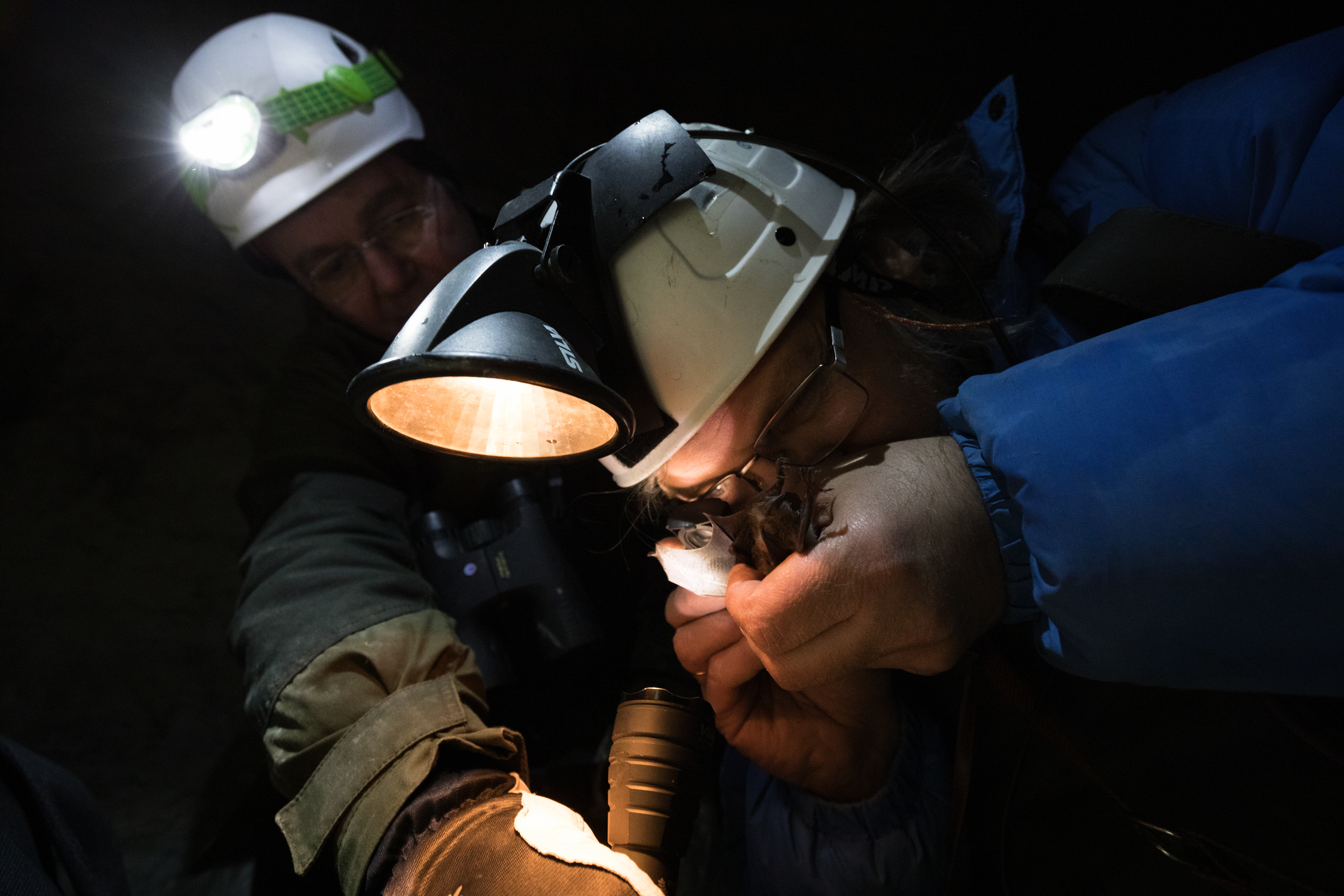
The maximum lifespan of bats is three-and-a-half times that of other mammals of similar size; a Siberian bat (Myotis sibiricus) was recaptured in the wild after 41 years, making it the oldest known bat.
Conservation
Groups such as the Bat Conservation International aim to increase awareness of bats' ecological roles and the environmental threats they face. This group called for Bat Appreciation Week from October 24–31 every year to promote awareness of the ecological importance of bats. In the United Kingdom, all bats are protected under the Wildlife and Countryside Acts, and disturbing a bat or its roost can be punished with a heavy fine. In Sarawak, Malaysia, "all bats" but species such as the hairless bat (Cheiromeles torquatus) are still eaten by the local communities. Humans have caused the extinction of several species of bat in modern history, the most recent being the Christmas Island pipistrelle (Pipistrellus murrayi), which was declared extinct in 2009.
Many people put up bat houses to attract bats. The 1991 University of Florida bat house is the largest occupied artificial roost in the world, with around 450,000–500,000 residents. In Britain, thick-walled and partly underground World War II pillboxes have been converted to make roosts for bats, and purpose-built 'bat bridges' are occasionally built to mitigate damage to habitat from roads or other developments. Cave gates are sometimes installed to limit human entry into caves with sensitive or endangered bat species. The gates are designed not to limit the airflow and thus to maintain the cave's micro-ecosystem. In the United States, 35 of the 47 bat species roost on human-made structures, while 14 of them use bat houses.
There is evidence that suggests that wind turbines might create sufficient barotrauma (pressure damage) to kill bats. Bats have typical mammalian lungs, which are thought to be more sensitive to sudden air pressure changes than the lungs of birds, making them more liable to fatal rupture. Bats may approach turbines to roost on them, increasing the death rate. Ultrasonic signals may help to deter bats from approaching wind farms, thus reducing deaths. The diagnosis and contribution of barotrauma to bat deaths near wind turbine blades have been disputed by other research comparing dead bats found near wind turbines with bats killed by impact with buildings in areas with no turbines.
The effects of climate change on bats are debated; a 2022 literature review concluded that, "Several biological and ecological traits of bats may make them sensitive to climate change, yet there is surprisingly little evidence on how these mammals respond to this anthropogenic environmental pressure." A 2025 study of European species found that bat populations may be shifting their ranges further north. Specifically, range suitability declined markedly in southern Europe while increasing at higher northern latitudes.
Interactions with humans
Cultural significance
,_from_Los_Caprichos_-_Google_Art_Project.jpg)
Since bats are mammals yet can fly, they are considered to be liminal beings in various traditions. In many cultures, including in Europe, bats are associated with darkness, death, witchcraft, and malevolence. Among Native Americans such as the Creek, Cherokee and Apache, the bat is identified as a trickster. An East Nigerian tale tells that the bat developed its nocturnal habits after causing the death of his partner, the bush rat, and now hides by day to avoid arrest.
More positive depictions of bats exist in some cultures. In China, bats have been associated with happiness, joy and good fortune and symbolise the "Five Blessings": longevity, riches, health, love of virtue and a peaceful passing away. The bat is sacred in Tonga and is often considered the physical manifestation of a separable soul. Mayan people associated bats with the gateway to the realm of the gods since they live in caves. In the Zapotec civilisation, the bat god presided over corn and fertility.

The Weird Sisters in Shakespeare's Macbeth used the fur of a bat in their brew. In Western culture, the bat is often a symbol of the night and its foreboding nature. The bat is a primary animal associated with fictional characters of the night, both villainous vampires, such as Count Dracula and, before him, Varney the Vampire, and heroes, such as the DC Comics character Batman.
The bat is sometimes used as a heraldic symbol in many European countries, including France, Belgium, Germany, Spain and the UK. They have also been used as symbols in the militaries of the UK, US and Israel. Three US states have an official state bat. Texas and Oklahoma are represented by the Mexican free-tailed bat, while Virginia is represented by the Virginia big-eared bat (Corynorhinus townsendii virginianus).
Uses and benefits
Main article: Human uses of bats, Bat as food
Consumption of bats has occurred globally, particularly in parts of Africa and Asia and on some islands in the Pacific and Caribbean. The animals may be eaten for their perceived medical benefits or as a delicacy. Western cookbooks have mentioned grilled bats and fruit bat soup. Bat dung, a type of guano, is rich in nitrates and is mined from caves for use as fertiliser.
Insectivorous bats in particular are especially helpful to farmers, as they control populations of agricultural pests and reduce the need to use pesticides. It has been estimated that bats save the agricultural industry of the United States anywhere from $3.7billion to $53billion per year in pesticides and damage to crops. This also prevents the overuse of pesticides, which can pollute the surrounding environment and may lead to resistance in future generations of insects. Some bats are predators of mosquitoes, suppressing the transmission of mosquito-borne diseases. Bats have also been tourist attractions, including the Congress Avenue Bridge in Austin, Texas, where over a million Mexican free-tailed bats roost.
Explanatory notes
References
Sources
References
- "Bat". Dictionary.com.
- "Bat, noun 2". Online Etymology Dictionary.
- "χείρ". A Greek-English Lexicon.
- {{cite EB1911
- "πτερόν". A Greek-English Lexicon.
- (2009). "Global completeness of the bat fossil record". Journal of Mammalian Evolution.
- (2009). "A new primitive bat from the earliest Eocene of Europe". Journal of Vertebrate Paleontology.
- (2021). "The earliest Asian bats (Mammalia: Chiroptera) address major gaps in bat evolution". Biology Letters.
- (2023). "The oldest known bat skeletons and their implications for Eocene chiropteran diversification". PLOS ONE.
- (2015). "Chemical, experimental, and morphological evidence for diagenetically altered melanin in exceptionally preserved fossils". Proceedings of the National Academy of Sciences of the United States of America.
- (2004). "Phylogenetic relationships among recent chiropteran families and the importance of choosing appropriate out-group taxa". Journal of Mammalogy.
- Smith, D.. "Chiroptera: Systematics". University of California Museum of Paleontology.
- Eick, G. N.. (2005). "A Nuclear DNA Phylogenetic Perspective on the Evolution of Echolocation and Historical Biogeography of Extant Bats (Chiroptera)". Molecular Biology and Evolution.
- Pumo, D. E.. (1998). "Complete Mitochondrial Genome of a Neotropical Fruit Bat, ''Artibeus jamaicensis'', and a New Hypothesis of the Relationships of Bats to Other Eutherian Mammals". Journal of Molecular Evolution.
- Zhou, X.. (2011). "Phylogenomic Analysis Resolves the Interordinal Relationships and Rapid Diversification of the Laurasiatherian Mammals". Systematic Biology.
- Zhang, G.. (2012). "Comparative Analysis of Bat Genomes Provides Insight into the Evolution of Flight and Immunity". Science.
- (1992). "Rejection of the "Flying Primate" Hypothesis by Phylogenetic Evidence from the ε-globin Gene". Science.
- (2019). "Bedbugs Evolved before Their Bat Hosts and Did Not Co-speciate with Ancient Humans". Current Biology.
- (2012). "The first fossil streblid bat fly, ''Enischnomyia stegosoma'' n. g., n. sp. (Diptera: Hippoboscoidea: Streblidae)". Systematic Parasitology.
- Grimaldi, D.. (May 2005). "Evolution of the Insects". Cambridge University Press.
- (2011). "A time-calibrated species-level phylogeny of bats (Chiroptera, Mammalia)". PLOS Currents.
- Teeling, E.C.. (2005). "A Molecular Phylogeny for Bats Illuminates Biogeography and the Fossil Record". Science.
- (2013). "Phylogenomic analyses elucidate the evolutionary relationships of bats (Chiroptera)". Current Biology.
- (2008). "Primitive Early Eocene bat from Wyoming and the evolution of flight and echolocation". Nature.
- Norberg, U. M.. (1994). ["Ecological Morphology: Integrative Organismal Biology"]({{google books). University of Chicago Press.
- Bishop, K. L.. (2008). "The Evolution of Flight in Bats: Narrowing the Field of Plausible Hypotheses". The Quarterly Review of Biology.
- (2011). "Ancient bats got in a flap over food". Nature.
- (18 October 2023). "A molecular phylogeny for all 21 families within Chiroptera (bats)". Integrative Zoology.
- Teeling. (2000). "Molecular evidence regarding the origin of echolocation and flight in bats". Nature.
- (2001). "Integrated fossil and molecular data reconstruct bat echolocation". Proceedings of the National Academy of Sciences.
- (2007). "Accelerated FoxP2 evolution in echolocating bats". PLOS ONE.
- (2008). "The hearing gene Prestin reunites the echolocating bats". Proceedings of the National Academy of Sciences of the United States of America.
- (2017). "Prenatal development supports a single origin of laryngeal echolocation in bats". Nature Ecology & Evolution.
- (2016). "Phylogenomic analyses of bat subordinal relationships based on transcriptome data". Scientific Reports.
- (8 November 2025). "Search=Chiroptera".
- Prothero, D. R.. (2017). "The Princeton Field Guide to Prehistoric Mammals". Princeton University Press.
- (2004). "Are Megabats Big?". Journal of Mammalian Evolution.
- Holland, R. A.. (2004). "Echolocation signal structure in the Megachiropteran bat Rousettus aegyptiacus Geoffroy 1810". Journal of Experimental Biology.
- Stephen, J.. (1994). "Creative Conservation: Interactive Management of Wild and Captive Animals". Springer.
- (2019). "Handbook of the Mammals of the World – Volume 9". Lynx Ediciones.
- (2015). "Beyond size – morphological predictors of bite force in a diverse insectivorous bat assemblage from Malaysia". Functional Ecology.
- Hunter, P.. (2007). "The nature of flight: The molecules and mechanics of flight in animals". Science and Society.
- (2016). "Airplane tracking documents the fastest flight speeds recorded for bats". Royal Society Open Science.
- Norberg, Ulla M.. (1972). "Bat wing structures important for aerodynamics and rigidity (Mammalia, Chiroptera)". Zeitschrift für Morphologie der Tiere.
- Sears, K. E.. (2006). "Development of bat flight: Morphologic and molecular evolution of bat wing digits". Proceedings of the National Academy of Sciences.
- Kirkpatrick, S. J.. (1994). "Scale effects on the stresses and safety factors in the wing bones of birds and bats". Journal of Experimental Biology.
- (2015). "Somatosensory substrates of flight control in bats". Cell Reports.
- Brown University. (2007). "Bats in Flight Reveal Unexpected Aerodynamics". ScienceDaily.
- (2012). "Upstroke wing flexion and the inertial cost of bat flight". Proceedings of the Royal Society B: Biological Sciences.
- (29 February 2008). "Leading Edge Vortex Allows Bats to Stay Aloft, Aerospace Professor Reports". USC Viterbi School of Engineering.
- Mehlhorn, H.. (2013). "Bats (Chiroptera) as Vectors of Diseases and Parasites: Facts and Myths". Springer.
- (2018-05-16). "Wound healing in wing membranes of the Egyptian fruit bat (Rousettus aegyptiacus) and big brown bat (Eptesicus fuscus)". Journal of Mammalogy.
- (December 2007). "The structural design of the bat wing web and its possible role in gas exchange". Journal of Anatomy.
- (2011). "Bat wing sensors support flight control". Proceedings of the National Academy of Sciences of the United States of America.
- Roberts, W. C.. (2006). "Facts and ideas from anywhere". Proceedings (Baylor University. Medical Center).
- Irwin, N.. (1997). "Wanted DNA samples from ''Nyctimene'' or ''Paranyctimene Bats''". The New Guinea Tropical Ecology and Biodiversity Digest.
- (2025). "Glowing Green: A quantitative analysis of photoluminescence in six North American bat species". Ecology and Evolution.
- (2024). "Ultraviolet-induced photoluminescent bristles on the feet of the Mexican free-tailed bat (''Tadarida brasiliensis'')". Mammalian Biology.
- (2023). "Photoluminescence in mammal fur: 111 years of research". Journal of Mammalogy.
- (1984). "Cervical Vertebrae in Relation to Roosting Posture in Bats". Journal of Mammalogy.
- (2006). "Terrestrial locomotion of the New Zealand short-tailed bat ''Mystacina tuberculata'' and the common vampire bat ''Desmodus rotundus''". Journal of Experimental Biology.
- Jones, T. W.. (1852). "Discovery That the Veins of the Bat's Wing (Which are Furnished with Valves) are Endowed with Rythmical {{sic}} Contractility, and That the Onward Flow of Blood is Accelerated by Each Contraction". Philosophical Transactions of the Royal Society of London.
- (15 June 2012). "Blood flow augmentation by intrinsic venular contraction in vivo". American Journal of Physiology. Regulatory, Integrative and Comparative Physiology.
- Langley, L.. (29 August 2015). "Bats and Sloths Don't Get Dizzy Hanging Upside Down – Here's Why". National Geographic.
- (1981). "Blood oxygen transport and organ weights of small bats and small non-flying mammals". Respiration Physiology.
- Kunz, Thomas. (1982). "Ecology of Bats". Plenum.
- (2009). "Molecular cloning and evolutionary analysis of the GJA1 (connexin43) gene from bats (Chiroptera)". Genetics Research.
- Maina, J. N.. (2000). "What it takes to fly: the structural and functional respiratory refinements in birds and bats". Journal of Experimental Biology.
- (1972). "Respiration, Wing-Beat and Ultrasonic Pulse Emission in an Echo-Locating Bat". Journal of Experimental Biology.
- Pennycuick, C. J.. (2008). "Modelling the Flying Bird". Elsevier.
- (2007). "The structural design of the bat wing web and its possible role in gas exchange". Journal of Anatomy.
- (1978). "A collagen and elastic network in the wing of the bat". Journal of Anatomy.
- (2013). "Insectivorous Bats Digest Chitin in the Stomach Using Acidic Mammalian Chitinase". PLOS ONE.
- (2001). "Diet and the evolution of digestion and renal function in phyllostomid bats". Zoology.
- (2016-06-29). "The cutaneous lipid composition of bat wing and tail membranes: a case of convergent evolution with birds". Proceedings of the Royal Society B: Biological Sciences.
- (March 2014). "Introduction to the Care and Rehabilitation of Microbats". Wildcare Australia.
- (1973). "Mechanisms of Sound Production by Echolocating Bats". American Zoologist.
- (2008). "Echolocating bats Cry Out Loud to Detect Their Prey". PLOS ONE.
- (2002). "Microbat paraphyly and the convergent evolution of a key innovation in Old World rhinolophoid microbats". PNAS.
- (2007). "Bat echolocation calls: adaptation and convergent evolution". Proceedings of the Royal Society B: Biological Sciences.
- (2012). "Evolution of high duty cycle echolocation in bats". The Journal of Experimental Biology.
- (2009). "Model predicts bat pinna ridges focus high frequencies to form narrow sensitivity beams". The Journal of the Acoustical Society of America.
- Muller, R.. (2004). "A numerical study of the role of the tragus in the big brown bat". The Journal of the Acoustical Society of America.
- (2009). "Acoustic scanning of natural scenes by echolocation in the big brown bat, ''Eptesicus fuscus''". Journal of Experimental Biology.
- (2005). "Sound strategy: acoustic aposematism in the bat–tiger moth arms race". Naturwissenschaften.
- (2009). "Tiger moth jams bat sonar". Science.
- Jia, T. (2024). "Weapons of Moths against Bats and Their Bionic Applications". BIO Web of Conferences.
- (2009). "Bat Eyes Have Ultraviolet-Sensitive Cone Photoreceptors". PLOS ONE.
- (2010). "Parallel and Convergent Evolution of the Dim-Light Vision Gene ''RH1'' in Bats (Order: Chiroptera)". PLOS ONE.
- (2004). "Molecular evolution of bat color vision genes". Molecular Biology and Evolution.
- (2007). "Use of Olfaction During Prey Location by the Common Vampire Bat (''Desmodus rotundus'')". Biotropica.
- (2024). "Evolution of olfactory receptor superfamily in bats based on high throughput molecular modelling". Molecular Ecology Resources.
- (2007). "Bats Respond to Polarity of a Magnetic Field". Proceedings of the Royal Society B: Biological Sciences.
- (2015). "Bats Respond to Very Weak Magnetic Fields". PLOS ONE.
- (2011). "Ganglion-specific splicing of TRPV1 underlies infrared sensation in vampire bats". Nature.
- (2024). "The upper limit of thermoneutrality is not indicative of thermotolerance in bats". Journal of Thermal Biology.
- (2014). "The importance of temporal heterothermy in bats". J Zool.
- (2011). "Trapped in the darkness of the night: thermal and energetic constraints of daylight flight in bats". Proceedings of the Royal Society B: Biological Sciences.
- (1999). "Thermoregulatory behavior in the small island flying fox, ''Pteropus hypomelanus'' (Chiroptera: Pteropodidae)". Journal of Thermal Biology.
- (1967). "Physiological responses to high environmental temperatures in three species of microchiropteran bats". Comparative Biochemistry and Physiology.
- (2011). "Hibernation and Torpor in Tropical and Subtropical Bats in Relation to Energetics, Extinctions, and the Evolution of Endothermy". Integrative and Comparative Biology.
- (2010). "Fat and Fed: Frequent Use of Summer Torpor in a Subtropical Bat". Naturwissenschaften.
- (2006). ["Functional and Evolutionary Ecology of Bats"]({{google books). Oxford University Press.
- Knight, K.. (2012). "Bats Use Torpor to Minimise Costs". Journal of Experimental Biology.
- (2016). "How to Keep Cool in a Hot Desert: Torpor in Two Species of Free-Ranging Bats in Summer". Temperature.
- (2014). "Bats on a Budget: Torpor-Assisted Migration Saves Time and Energy". PLOS ONE.
- (1994). "Patterns of daily torpor and day-roost selection by male and female big brown bats (''Eptesicus fuscus'')". Canadian Journal of Zoology.
- Nowak, Robert M. (1994). "Walker's Bats of the World". Johns Hopkins University Press.
- Yovel, Yossi. (2025). "The Genius Bat: The Secret Life of the Only Flying Mammal". St. Martin's Publishing Group.
- (2013). "Mosquito Consumption by Insectivorous Bats: Does Size Matter?". PLOS ONE.
- (1972). "Physiology and energetics of bat flight". Journal of Experimental Biology.
- (2023). "The global biomass of wild mammals". Proceedings of the National Academy of Sciences.
- (2003). "Grzimek's Animal Life Encyclopedia: Vol 13 Mammals II".
- (1990). "The function of daylight flying in British bats". Journal of Zoology.
- (2000). "Activity patterns of insectivorous bats and birds in northern Scandinavia (69° N), during continuous midsummer daylight". Oikos.
- (19 December 2018). "Into the light: atypical diurnal foraging activity of Blyth's horseshoe bat, Rhinolophus lepidus (Chiroptera: Rhinolophidae) on Tioman Island, Malaysia". Mammalia.
- (1975). "The diurnal flight of the Azorean bat (Nyctalus azoreum) and the avifauna of the Azores". Journal of Zoology.
- (2011). "Rain increases the energy cost of bat flight". Biology Letters.
- (2025-01-03). "Bats surf storm fronts during spring migration". Science.
- (2005). "A choroidal sleight of hand". British Journal of Ophthalmology.
- (June 1998). "Long Foraging Distance for a Spotted Bat (Euderma Maculatum) in Northern Arizona". The Southwestern Naturalist.
- (2011). "Recent loss of vitamin C biosynthesis ability in bats". PLOS ONE.
- (1980). "Variation of L-gulonolactone oxidase activity in placental mammals". Comparative Biochemistry and Physiology B.
- (2011). "Progressive pseudogenization: vitamin C synthesis and its loss in bats". Mol. Biol. Evol..
- Jones, G.. (2001). "The Encyclopedia of Mammals". Oxford University Press.
- (2018). "Incidence and taxonomic richness of mosquitoes in the diets of little brown and big brown bats". Journal of Mammalogy.
- (1 January 2019). "Male and female bats differ in their use of a large urban park". Journal of Urban Ecology.
- (2008). "Brazilian free-tailed bats (Tadarida brasiliensis: Molossidae, Chiroptera) at high altitude: Links to migratory insect populations". Integrative and Comparative Biology.
- (1962). "The role of the flight membranes in insect capture by bats". Animal Behaviour.
- (2016). "Physiological and behavioral adaptations in bats living at high latitudes". Physiology and Behavior.
- (2001). "''Artibeus jamaicensis''". Mammalian Species.
- (2011). "Feeding habits of the Egyptian fruit bat ''Rousettus aegyptiacus'' on Cyprus island: a first assessment". Hystrix: The Italian Journal of Mammalogy.
- "Bats as Dispersers of Plants in the Lowland Forests of Central French Guiana". New York Botanical Garden.
- (2013). "Specialized bat tongue is a hemodynamic nectar mop". Proceedings of the National Academy of Sciences.
- Muchhala, N. (2006). "Nectar bat stows huge tongue in its rib cage". Nature.
- (1999). "Conservation biology of nectar-feeding bats in Mexico". Journal of Mammalogy.
- (2001). "The role of fruits and insects in the nutrition of frugivorous bats: Evaluating the use of stable isotope models". Biotropica.
- (2003). "Fruit Bats (Chiroptera: Pteropodidae) as Seed Dispersers and Pollinators in a Lowland Malaysian Rain Forest". Biotropica.
- (2001). "''Trachops cirrhosus''". Mammalian Species.
- (2007). "Bats' Conquest of a Formidable Foraging Niche: The Myriads of Nocturnally Migrating Songbirds". PLOS ONE.
- (2025-10-09). "Greater noctule bats prey on and consume passerines in flight". Science.
- (1994). "Fishing and Echolocation Behavior of the Greater Bulldog Bat, ''Noctilio leporinus'', in the Field". Behavioral Ecology and Sociobiology.
- (1995). "Evolution of nocturnality in bats: Potential competitors and predators during their early history". Biological Journal of the Linnean Society.
- (2007). "Snakes preying on bats: new records from Brazil and a review of recorded cases in the Neotropical Region". Revista Brasileira de Zoologia.
- (2020). "Bat parasites (Acari, Anoplura, Cestoda, Diptera, Hemiptera, Nematoda, Siphonaptera, Trematoda) in France (1762–2018): a literature review and contribution to a checklist". Parasite.
- (2013). "Bats (Chiroptera) as Vectors of Diseases and Parasites: Facts and Myths". Springer.
- (2015). "Coevolution of Life on Hosts: Integrating Ecology and History". University of Chicago Press.
- "White-Nose Syndrome (WNS)". National Wildlife Health Center, U.S. Geological Survey.
- (2011). "Experimental infection of bats with Geomyces destructans causes white-nose syndrome". Nature.
- "White-Nose Syndrome – Regional Outlook". Canadian Cooperative Wildlife Health Centre.
- (2022). "Early treatment of white-nose syndrome is necessary to stop population decline". Journal of Applied Ecology.
- Wong, S.. (October 2006). "Bats as a continuing source of emerging infections in humans". [[John Wiley & Sons]].
- McColl, K. A.. (2000). "Bat lyssavirus infections". Revue Scientifique et Technique.
- (2006). "Bats: Important Reservoir Hosts of Emerging Viruses". Clinical Microbiology Reviews.
- (2012). "Viruses: Essential Agents of Life".
- (2006). "Hendra and Nipah viruses: different and dangerous". Nature Reviews Microbiology.
- (2000). "Isolation of Hendra virus from pteropid bats: a natural reservoir of Hendra virus". [[Journal of General Virology]].
- Leroy, E. M.. (2005). "Fruit bats as reservoirs of Ebola virus". [[Nature (journal).
- Choi, C. Q.. (2006). "Going to Bat". [[Scientific American]].
- (2015). "Bats and Viruses".
- (2020). "Viral zoonotic risk is homogenous among taxonomic orders of mammalian and avian reservoir hosts". Proceedings of the National Academy of Sciences.
- Castro, J.. (6 February 2013). "Bats Host More Than 60 Human-Infecting Viruses". Live Science.
- Dobson, A. P.. (2005). "What Links Bats to Emerging Infectious Diseases?". Science.
- (6 August 2014). "Why Do Bats Transmit So Many Diseases?". IFL Science.
- (14 April 2014). "CDC Features – Take Caution When Bats Are Near". Centers for Disease Control and Prevention.
- Li, W.. (28 October 2005). "Bats are natural reservoirs of SARS-like coronaviruses". [[Science (journal).
- (2017). "Discovery of a rich gene pool of bat SARS-related coronaviruses provides new insights into the origin of SARS coronavirus". PLOS Pathogens.
- (2020). "Bats don't cause or spread Covid-19". Zoo's Print.
- "Bracken Cave Preserve". Bat Conservation International.
- (2011). "Bats are able to maintain long-term social relationships despite the high fission–fusion dynamics of their groups". Proceedings of the Royal Society B: Biological Sciences.
- (2014). "Strong matrilineal structure in common pipistrelle bats (''Pipistrellus pipistrellus'') is associated with variability in echolocation calls". Biological Journal of the Linnean Society.
- (2013). "Does food sharing in vampire bats demonstrate reciprocity?". Communicative & Integrative Biology.
- Wilkinson, G. S.. (1986). "Social Grooming in the Common Vampire Bat, ''Desmodus rotundus''". Anim. Behav..
- Sugita, Norimasa. (2016). "Homosexual fellatio: erect penis licking between male Bonin Flying Foxes ''Pteropus pselaphon''". PLOS ONE.
- (2020). "An observation of homosexual fellatio in the Indian Flying Fox ''Pteropus medius'' (Temminck, 1825) (Mammalia: Chiroptera: Pteropodidae)". Journal of Threatened Taxa.
- (2022). "Bats expand their vocal range by recruiting different laryngeal structures for echolocation and social communication". PLOS Biology.
- (2009). "Versatility and Stereotypy of Free-Tailed Bat Songs". PLOS ONE.
- Boughman, J. W.. (1998). "Vocal learning by greater spear-nosed bats". Proceedings of the Royal Society B: Biological Sciences.
- (22 December 2016). "Everyday bat vocalizations contain information about emitter, addressee, context, and behavior". Scientific Reports.
- Wilkinson, G. S.. (1985). "The Social Organization of the Common Vampire Bat II: Mating system, genetic structure, and relatedness". Behavioral Ecology and Sociobiology.
- (1979). "Social Behavior of the Little Brown Bat, ''Myotis lucifugus'': I. Mating Behavior". Behavioral Ecology and Sociobiology.
- (2004). "The Mating System of ''Tadarida brasiliensis'' (Chiroptera: Molossidae) in a Large Highway Bridge Colony". Journal of Mammalogy.
- (2013). "Is lek breeding rare in bats?". Journal of Zoology.
- Bradbury, J. W.. (1977). "Lek Mating Behavior in the Hammer-headed Bat". Zeitschrift für Tierpsychologie.
- (1994). "Allomaternal care: helper-assisted birth in the Rodrigues fruit bat, ''Pteropus rodricensis'' (Chiroptera: Pteropodidae)". Journal of Zoology.
- (2011). "Hibernation is associated with increased survival and the evolution of slow life histories among mammals". Proceedings of the Royal Society B.
- (2002). "Life history, ecology and longevity in bats". Aging Cell.
- (2016). "Group size, survival and surprisingly short lifespan in socially foraging bats". BMC Ecology.
- "Taxonomy: Chiroptera".
- "Mission & Vision". Bat Conservation International.
- "Bat Appreciation Week".
- "Bats and the Law". Bat Conservation Trust.
- "Wildlife Protection Ordinance 1998". FAO.
- (2009). "The Naked Bulldog Bat, ''Cheiromeles torquatus'' in Singapore – past and present records, with highlights on its unique morphology (Microchiroptera: Molossidae)". Nature in Singapore.
- (2015). "The Annihilation of Nature: Human Extinction of Birds and Mammals". Johns Hopkins University Press.
- "Bat Houses". Bat Conservation International.
- "Welcome to the World's Largest Occupied Bat Houses". Florida Museum of Natural History.
- "Protecting and managing underground sites for bats, see section 6.4.". Eurobats.
- (6 April 2006). "Pillbox converted to bat retreat". BBC.
- (4 April 2008). "Bypass wings it with bat bridges". BBC.
- "Agency Guide to Cave and Mine Gates 2009".
- (February 2019). "Bats, People, and Buildings: Issues and Opportunities". United States Department of Agriculture, Forest Service, Forest Products Laboratory.
- (23 September 2008). "B.C. study to help bats survive wind farms". National Wind Watch.
- "[https://www.newscientist.com/article/dn11834 Bats take a battering at wind farms]", ''[[New Scientist]]'', 12 May 2007
- (4 January 2005). "Caution Regarding Placement of Wind Turbines on Wooded Ridge Tops". Bat Conservation International.
- Arnett, E. B.. (12 June 2005). "Relationships between Bats and Wind Turbines in Pennsylvania and West Virginia: An Assessment of Fatality Search Protocols, Patterns of Fatality, and Behavioral Interactions with Wind Turbines". Bat Conservation International.
- Baerwald, E. F.. (26 August 2008). "Barotrauma is a significant cause of bat fatalities at wind turbines". [[Current Biology]].
- (2012). "Effects of Acoustic Deterrents on Foraging Bats". U.S. Department of Agriculture, U.S. Forest Service, Northern Research Station.
- (January 2012). "A Forensic Investigation Into the Etiology of Bat Mortality at a Wind Farm: Barotrauma or Traumatic Injury?". Veterinary Pathology.
- (2022). "Bat responses to climate change: a systematic review". Biological Reviews of the Cambridge Philosophical Society.
- (2025). "Changes in community composition and functional diversity of European bats under climate change". Conservation Biology.
- McCracken, G. F.. (1993). "Folklore and the Origin of Bats". BATS Magazine.
- Chwalkowski, F.. (2016). "Symbols in Arts, Religion and Culture: The Soul of Nature". Cambridge Scholars Publishing.
- Arnott, K.. (1962). "African Myths and Legends". Oxford University Press.
- "Chinese symbols". British Museum.
- Grant, G. S.. "Kingdom of Tonga: Safe Haven for Flying Foxes". Batcon.org.
- (28 October 2013). "Zapotec Civilization". [[World History Encyclopedia]].
- de Vries, A.. (1976). "Dictionary of Symbols and Imagery". North-Holland.
- (1998). "Bats, Vampires & Dracula". Newsletter of the Florida Bat Conservation Centre.
- "Official state bats". Netstate.
- Weaver, H. D.. (2008). "Missouri Caves in History and Legend". University of Missouri Press.
- (2011). "Economic Importance of Bats in Agriculture". Science.
- (2020). "Bats actively prey on mosquitoes and other deleterious insects in rice paddies: Potential impact on human health and agriculture". Pest Management Science.
- Christensen, RaeAnn. "Best time to see the bat colony emerge from Congress Bridge in Downtown Austin". Fox7.
This article was imported from Wikipedia and is available under the Creative Commons Attribution-ShareAlike 4.0 License. Content has been adapted to SurfDoc format. Original contributors can be found on the article history page.
Ask Mako anything about Bat — get instant answers, deeper analysis, and related topics.
Research with MakoFree with your Surf account
Create a free account to save articles, ask Mako questions, and organize your research.
Sign up freeThis content may have been generated or modified by AI. CloudSurf Software LLC is not responsible for the accuracy, completeness, or reliability of AI-generated content. Always verify important information from primary sources.
Report