From Surf Wiki (app.surf) — the open knowledge base
Basilica of Maxentius
Ancient building in the Roman Forum, Rome

Ancient building in the Roman Forum, Rome
| Field | Value |
|---|---|
| name | Basilica of Maxentius |
| image | File:Largest Arches 02.jpg |
| caption | Remains of the Basilica of Maxentius and Constantine. The building's northern aisle is all that remains. |
| location | Regio IV Templum Pacis |
| built | AD 312 |
| builder | Maxentius, Constantine I |
| type | Basilica |
| coordinates | |
| map_dot_label | Basilica of Maxentius |
| map_label_position | bottom |
| map_type | Italy Rome Antiquity |
| map_overlay | Roma Plan.jpg |
| map_caption | Shown within Augustan Rome |
| map_size | 270 |
| image_size | 270 |
| mapframe-frame-width | 270 |
| mapframe | yes |
| mapframe-caption | Click on the map for a fullscreen view |
| mapframe-zoom | 12 |
| mapframe-marker | monument |
| mapframe-wikidata | yes |
|mapframe-frame-width=270 |mapframe-caption=Click on the map for a fullscreen view |mapframe-zoom=12 |mapframe-marker=monument |mapframe-wikidata=yes
The Basilica of Maxentius (), sometimes known by its original Latin name, Basilica Nova or, less commonly, the Basilica of Constantine (Italian: Basilica Constantini), was a civic basilica in the Roman Forum. At the time of its construction, it was the largest building in the Forum, and the last Roman basilica built in the city.
History
In ancient Rome, a basilica was a rectangular building with a large central open space, and often a raised apse at the far end from the entrance. Basilicas served a variety of functions, including a combination of a court-house, council chamber and meeting hall. There might be, however, numerous statues of the gods displayed in niches set into the walls. Under Constantine and his successors this type of building was chosen as the basis for the design of the larger places of Christian worship, presumably as the basilica form had fewer pagan associations than those of the designs of traditional Greco-Roman temples, and allowed large congregations. As a result of the building programmes of the Christian Roman emperors the term basilica later became largely synonymous with a large church or cathedral.
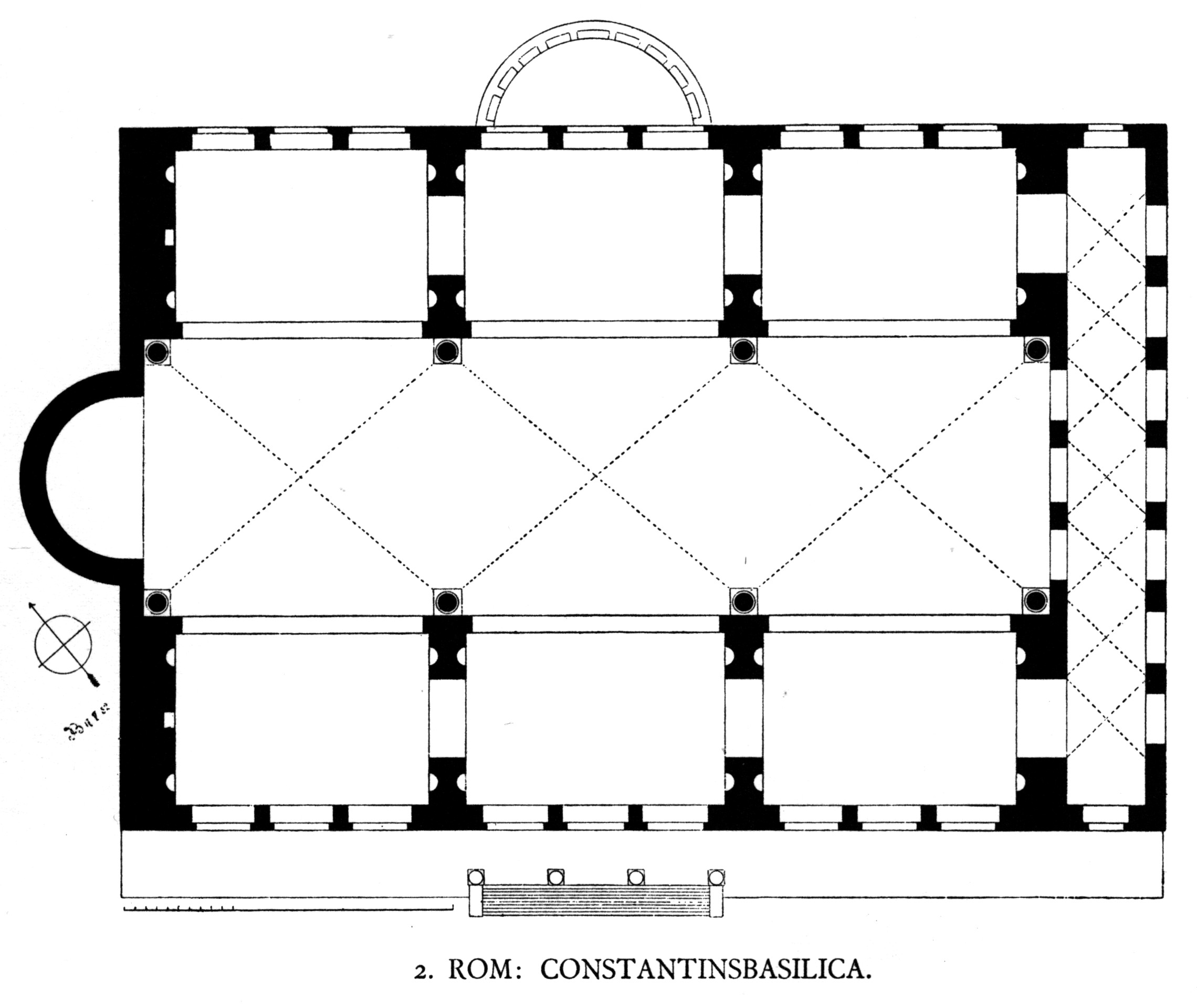
Construction began on the northern side of the forum under the emperor Maxentius in 308 AD, and was completed in 312 by Constantine I after his defeat of Maxentius at the Battle of the Milvian Bridge. The building rose on the north side of the Via Sacra, close to the Temple of Peace, at that time probably neglected, and the Temple of Venus and Rome, whose reconstruction was part of Maxentius' interventions.
During the 6th century, the building was called "templum Romae".
Architecture
The colour of the building before it was destroyed was white. The basilica stood on a 100 x concrete and rectangular platform. The thickness of the platform is not known/communicated. The central nave was 80 m long, 25 m wide, 35 m high, with side aisles 16 m wide and 24.5 m high. Eight massive marble columns 14.5 m high and 5.4 m in circumference stood at the corners of the nave. They were all destroyed except one that was removed by Paul V in 1613 to the Santa Maria Maggiore where it still stands.
The building consisted of a central nave covered by three groin vaults suspended 39 m above the floor on four large piers, ending in an apse at the western end containing a colossal statue of Constantine (remnants of which are now in a courtyard of the Palazzo dei Conservatori of the Musei Capitolini). The lateral forces of the groin vaults were held by flanking aisles measuring 23 x. The aisles were spanned by three semi-circular barrel vaults perpendicular to the nave, and narrow arcades ran parallel to the nave beneath the barrel vaults. The nave itself measured 25 x creating a 2000 sqm floor. Like the great imperial baths, the basilica made use of vast interior space with its emotional effect. Running the length of the eastern face of the building was a projecting arcade. On the south face was a projecting (prostyle) porch with four columns (tetrastyle).

The south and central sections were probably destroyed by the earthquake of 847. In 1349 the vault of the nave collapsed in another earthquake. The only one of the eight 20 m high columns that survived the earthquake was brought by Pope Paul V to Piazza Santa Maria Maggiore in 1614. All that remains of the basilica today is the north aisle with its three concrete barrel vaults. The ceilings of the barrel vaults show advanced weight-saving structural skill with octagonal ceiling coffers.
On the outside wall of the basilica, facing onto the via dei Fori Imperiali, are contemporary maps showing the various stages of the rise of the Roman Empire which were added during the Fascist regime of Benito Mussolini. A map depicting Mussolini's "New Roman Empire" was removed from the wall after the war. The wrestling events were held here during the 1960 Summer Olympic Games.
Engineering


The basilica Maxentius took aspects from Roman baths as well as typical Roman basilicas. At that time, it used the most advanced engineering techniques known including innovations taken from the Markets of Trajan and the Baths of Diocletian.
Similar to many basilicas at the time such as the Basilica Ulpia, the Basilica of Maxentius featured a huge open space in the central nave. However, instead of having columns support the ceiling like other basilicas, it was built using arches, a much more common appearance in Roman baths than basilicas. Another difference from traditional basilicas is the roof of the structure. While the former were built with a flat roof, the Basilica of Maxentius featured a folded roof, decreasing the overall weight of the structure and decreasing the horizontal forces exerted on the outer arches.
.jpg)
Legacy
The artist Giovanni Battista Piranesi (1720–1778) drew many etchings of the basilica.
The building became an inspiration for many buildings built afterwards, including New York City's former Penn Station.
References
Sources
- 1960 Summer Olympics official report. Volume 1. pp. 76, 79.
- The Roman Empire: From the Etruscans to the Decline of the Roman Empire, Henri Stierlin, TASCHEN, 2002, Edited by Silvia Kinkle, Cologne,
References
- Samuel Ball Platner, [https://penelope.uchicago.edu/Thayer/E/Gazetteer/Places/Europe/Italy/Lazio/Roma/Rome/_Texts/PLATOP*/Basilica_Constantini.html Basilica Constantini], ''Uchicago.edu'', 1929
- Fazio, Michael. (2009). "Buildings across time : an introduction to world architecture". McGraw-Hill Higher Education.
- Roth, Leland M.. (1993). "Understanding Architecture: Its Elements, History and Meaning". Westview Press.
- [http://www.mmdtkw.org/VBasCons.html Basilica of Maxentius/Constantine], ''Mmdtkw.org''
- link. (2016-03-04 The Huntington. Retrieved 12 July 2015.)
- René Seindal [http://sights.seindal.dk/sight/177_Basilica_of_Maxentius.html "Basilica of Maxentius - the last and largest basilica in the Roman Forum"] {{Webarchive. link. (2016-10-21 , ''Photo Archive'', 2003-08-06, accessed November 7, 2010.)
- Giavarini, Carlo, ''The Basilica of Maxentius: the Monument, its Materials, Construction, and Stability'', Rome: L'Erma di Bretschneider, 2005.
- [http://omeka.wellesley.edu/piranesi-rome/exhibits/show/basilica-of-maxentius-and-cons/piranesi Basilica of Maxentius and Constantine: Piranesi], ''Wellesley.edu''
- [http://omeka.wellesley.edu/piranesi-rome/exhibits/show/basilica-of-maxentius-and-cons/architecture Basilica of Maxentius and Constantine: Architecture], ''Wellesley.edu''
This article was imported from Wikipedia and is available under the Creative Commons Attribution-ShareAlike 4.0 License. Content has been adapted to SurfDoc format. Original contributors can be found on the article history page.
Ask Mako anything about Basilica of Maxentius — get instant answers, deeper analysis, and related topics.
Research with MakoFree with your Surf account
Create a free account to save articles, ask Mako questions, and organize your research.
Sign up freeThis content may have been generated or modified by AI. CloudSurf Software LLC is not responsible for the accuracy, completeness, or reliability of AI-generated content. Always verify important information from primary sources.
Report