From Surf Wiki (app.surf) — the open knowledge base
Barringtonia asiatica
Species of plant
Species of plant
|Agasta asiatica (L.) Miers |Agasta indica Miers |Agasta splendida Miers |Barringtonia butonica J.R.Forst. & G.Forst. |Barringtonia levequii Jard. nom. nud. |Barringtonia littorea Oken nom. illeg. |Barringtonia senequei Jard. |Barringtonia speciosa J.R.Forst. & G.Forst. |Butonica speciosa (J.R.Forst. & G.Forst.) Lam. |Huttum speciosum (J.R.Forst. & G.Forst.) Britten |Mammea asiatica L. |Michelia asiatica (L.) Kuntze |Mitraria commersonia J.F.Gmel.
Barringtonia asiatica, known variously as fish poison tree, putat and beach Barringtonia among other names, is a species of plants in the brazil nut family Lecythidaceae. It is native to coastal habitats from Tanzania and Madagascar in the west to tropical Asia, northern Australia, and islands of the western Pacific Ocean. It was described by Wilhelm Sulpiz Kurz in 1875 and has a conservation status of least concern. It has been used by a number of traditional cultures as a fish poison.
Description
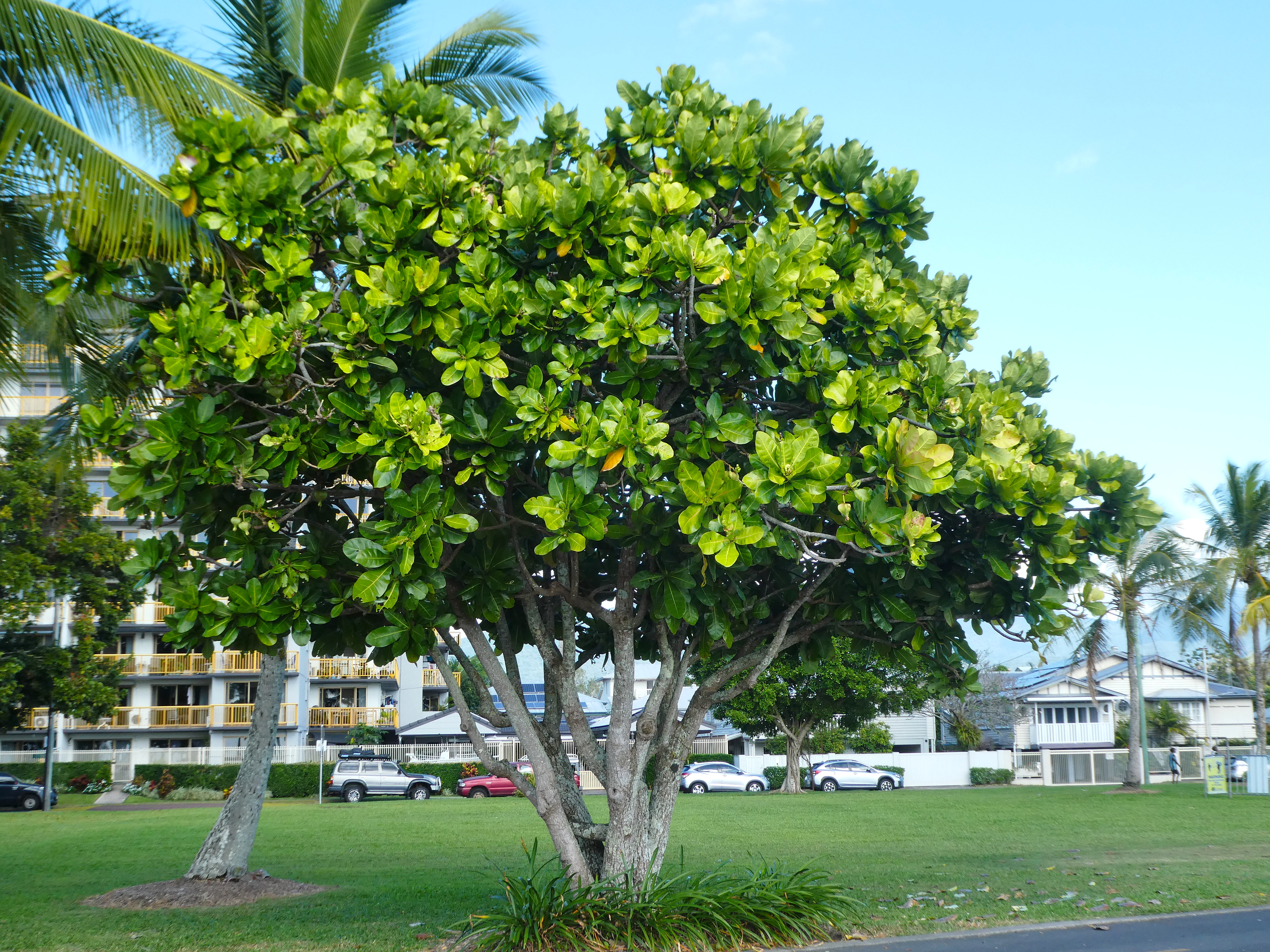
This is a tree which will usually grow to a height of about 20 m, occasionally to 30 m, and a trunk diameter of up to 30 cm diameter. The trunk is irregularly shaped and often leaning, the bark is dark and coarse. The leaves are , or pear-shaped, being widest at the tip and narrowest at the base. They are glossy green and somewhat waxy, and may reach up to about 40 cm long and 20 cm wide. The margin is without lobes and the petiole (leaf stalk) is very short or absent.
Flowers are produced in erect racemes at the ends of the branches, each carrying up to 20 flowers. The calyx is completely fused while the bud forms, and splits into two uneven parts when the flower opens. It remains attached even after the fruit has matured. The flowers are large, showy and fragrant, with numerous long stamens which are white at the base and pink/purple at the tip. There are four white petals and the entire flower is about 15 cm in diameter.
The fruit is large and somewhat pyramid-shaped. In cross section it is more or less square; in longitudinal section it is roughly (heart-shaped) or triangular, with the broadest part at the base attached to the petiole. They measure about 11 cm long and 9 cm wide, and they contain one or (rarely) two seeds.
Taxonomy
This species was first described in 1753 as Mammea asiatica by Carl Linnaeus, based on material collected from Java by Pehr Osbeck, a Swedish naturalist and one of Linnaeus' apostles. It was transferred to the genus Barringtonia (which at the time was variously placed in either Myrtaceae, Lecythidaceae or Barringtoniaceae) by the German botanist Wilhelm Sulpiz Kurz in 1875. A number of other botanists have collected specimens of this plant and described them under different names, all of which are now recognised as synonyms (see synonyms list).
Etymology
The genus name was created to honour the English lawyer, antiquary and naturalist, Daines Barrington, while the species epithet asiatica refers to the region where this species is found.
Vernacular names
Due to its wide distribution, this species is known by many different names in different regions. In Australia it is called beach Barringtonia, mango pine, mango bark and box fruit. In Malaya and Singapore it is called Putat laut; in Indonesia and Borneo it is known as Butun, Butun alas and other variations; in the Andaman Islands it is referred to as Kyee-bin; it is called bonnet d'évêque (bishop's hat) in New Caledonia; in the Cook Islands it is 'Utu, and may be called hutu, wutu or futu in other Polynesian cultures.
Distribution and habitat
.jpg)
Barringtonia asiatica is native to tropical coastlines from Tanzania and Madagascar to India, Southeast Asia, Australia, the Solomon Islands, New Caledonia, Fiji and many other islands of the western Pacific Ocean, and it has been introduced to the Cayman Islands, Cuba, Dominican Republic, Haiti, the Leeward Islands, Puerto Rico, Trinidad-Tobago and the Windward Islands. It inhabits beaches and coastal forests at altitudes up to 100 m.
Conservation
The International Union for Conservation of Nature has given this species a conservation rating of least concern globally, however in Singapore it is locally classified as critically endangered.
Ecology
The night-opening flowers of this tree are pollinated by bats and moths. The fruit have a thick spongy layer around the seed, making them very buoyant and allowing them to be dispersed by ocean currents. In testing it has been shown that they can remain afloat for up to fifteen years, although in the ocean most will only survive for up to two years. They have been found on beaches as far away as Ireland and the Netherlands, and it was one of the first plants to colonise the island of Anak Krakatau after the massive eruption in 1883.
Toxicity
The plant is highly toxic to humans.
Uses
Many traditional cultures have used the bark and seeds as a fish poison – they are crushed or pounded to release the saponins contained within, and then placed in slow moving freshwater streams or coral lagoons. The fish are quickly killed or stunned, but the mechanism is not fully understood.
The fruit have been used as floats for fishing nets. The timber is not very hardy and thus has limited use.
The bark, leaves and fruit have been used for medical complaints such as headaches, backaches, sores, and bad dreams.
Cultivation
This tree has ornamental flowers and foliage and provides good shade, and it has been widely planted in tropical parks and gardens. In the city of Cairns, Australia, close to 100 have planted in the streets and parks.
Gallery
|File:BarringtoniaAsiatica.jpg|Foliage and flower buds |File:Barringtonia asiatica - twin flower.JPG|Flowers |File:Fish-killer tree (439413766).jpg|Developing fruit |File:Barringtonia-asiatica-SF25151-06.jpg|Leaf and fruit |File:Barringtonia-asiatica-SF25155-01.jpg|Fresh seed
References
References
- (2024). "''Barringtonia asiatica'' (L.) Kurz". [[Royal Botanic Gardens, Kew]].
- (2024). "''Barringtonia asiatica'' Kurz". World Flora Online Consortium.
- (1776). "Characteres generum plantarum, quas in itinere ad insulas maris Australis,: collegerunt, descripserunt, delinearunt, annis".
- (2022). "''Barringtonia asiatica''". [[Australian Biological Resources Study]], Department of Climate Change, Energy, the Environment and Water: Canberra.
- (1753). "Species plantarum".
- "Name - ''Mammea asiatica'' L.". Missouri Botanical Garden.
- (1873). "Preliminary report on the forest and other vegetation of Pegu". C.B. Lewis, Baptist Mission Press.
- "''Barringtonia asiatica'' (Linnaeus) Kurz". Missouri Botanical Garden, St. Louis, MO & Harvard University Herbaria, Cambridge, MA..
- "''Barringtonia asiatica'' (L.) Kurtz". [[Singapore Government]].
- Razafiniary, V.. (2021). "''Barringtonia asiatica''".
- (2020). "''Barringtonia asiatica''". Centre for Australian National Biodiversity Research (CANBR), [[Australian Government]].
- "''Barringtonia asiatica'' (L.) Kurz".
- (1967). "A monograph of the genus ''Barringtonia'' (Lecythidaceae)". Blumea.
- (2014). "First records of ''Barringtonia asiatica'' (Lecythidaceae) from UK waters and a review of north-western European records". New Journal of Botany.
- (January 2013). "Lecythidaceae". Flora Malesiana - Series 1, Spermatophyta.
- "Barringtonia asiatica". Cook Islands Natural Heritage Trust, Rarotonga.
- (2002). "Tree Flora of Sabah and Sarawak: Volume 4". Sabah Forestry Department, Malaysia; Forest Research Institute, Malaysia; Sarawak Forestry Department, Malaysia.
- (1990). "Australian Medicinal Plants". Mandarin.
- (2025). "''Barringtonia asiatica'' (L.) Kurz".
- (1997). "Handbook of the Vascular Plants of Ashmore and Cartier Islands". Parks Australia.
- "TreePlotter".
- (2001). "Barringtonia asiatica (L.) Kurz". PROSEA Foundation.
This article was imported from Wikipedia and is available under the Creative Commons Attribution-ShareAlike 4.0 License. Content has been adapted to SurfDoc format. Original contributors can be found on the article history page.
Ask Mako anything about Barringtonia asiatica — get instant answers, deeper analysis, and related topics.
Research with MakoFree with your Surf account
Create a free account to save articles, ask Mako questions, and organize your research.
Sign up freeThis content may have been generated or modified by AI. CloudSurf Software LLC is not responsible for the accuracy, completeness, or reliability of AI-generated content. Always verify important information from primary sources.
Report