From Surf Wiki (app.surf) — the open knowledge base
Barrel (horology)
Part of the clockwork
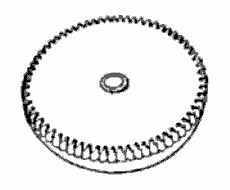
Part of the clockwork
Used in mechanical watches and clocks, a barrel is a cylindrical metal box closed by a cover, with a ring of gear teeth around it, containing a spiral spring called the mainspring, which provides power to run the timepiece. The barrel turns on an arbor (axle). The spring is hooked to the barrel at its outer end and to the arbor at its inner end. The barrel teeth engage the first pinion of the wheel train of the watch, usually the center wheel. Barrels rotate slowly: for a watch mainspring barrel, the rate is usually one rotation every 8 hours. This construction allows the mainspring to be wound (by turning the arbour) without interrupting the tension of the spring driving the timepiece.
Types
; Plain barrel: I.e. without teeth, used in fusee watches and clocks. A chain, or cord, was wound around the plain barrel, connecting it to the fusee. ; Going barrel: The form used in modern watches, is wound by turning the arbor and drives the watch movement by a ring of teeth around the barrel. This enables the mainspring to continue running the watch while it is being wound. Invented by Jean-Antoine Lépine. ; Hanging barrel: A version of the going barrel that to save space is supported by the movement only at its upper end. ; Motor, or safety, barrel: Used in pocket watches around 1900, a reverse variant of the going barrel in which the spring is wound by turning the barrel, and turns the watch movement by the central arbor. The purpose of this arrangement was that if the spring breaks, destructive recoil forces would not be applied to the vulnerable gear train.
References
References
- Hebert, Luke. (1856). "The Engineer's and Mechanic's Encyclopædia, Comprehending Practical Illustrations of the Machinery and Processes Employed in Every Description of Manufacture of the British Empire, Etc".
- Hood, Grant. (1904). "Modern Methods in Horology". Kansas City Jeweler and Optician.
This article was imported from Wikipedia and is available under the Creative Commons Attribution-ShareAlike 4.0 License. Content has been adapted to SurfDoc format. Original contributors can be found on the article history page.
Ask Mako anything about Barrel (horology) — get instant answers, deeper analysis, and related topics.
Research with MakoFree with your Surf account
Create a free account to save articles, ask Mako questions, and organize your research.
Sign up freeThis content may have been generated or modified by AI. CloudSurf Software LLC is not responsible for the accuracy, completeness, or reliability of AI-generated content. Always verify important information from primary sources.
Report