From Surf Wiki (app.surf) — the open knowledge base
Barnes maze
Set-up
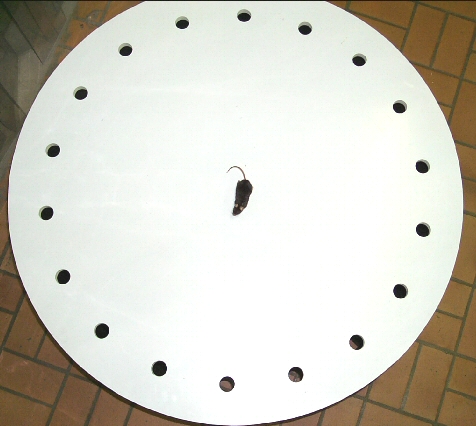
The Barnes maze consists of a circular surface with up to 20 circular holes around its circumference. Visual cues, such as colored shapes or patterns, are placed around the table in plain sight of the animal. The table surface is brightly lit by overhead lighting. Under one of the holes is an "escape box" which can be reached by the rodent through the corresponding hole on the table top. The model is based on rodents' aversion of open spaces, which motivates the test subject to seek shelter in the escape box. A normal rodent will learn to find the escape box within four to five trials and will head directly toward the escape box without attempting to escape via incorrect holes. Various parameters are measured including latency to escape, path length, number of errors, and velocity. The selection of a background strain and the choice of behavioural tasks are significant in determining the outcome of an experiment. These variables help to verify that innate anxiety and cognitive ability differ considerably among mouse strains.
Performance
Due to the spatial nature of the Barnes maze, damage to the hippocampus leads to deficits in performance of the task. An experiment done on degu, a specific rodent species, showed that there can be sex differences in performance on the Barnes maze. During the task training where encoding would occur, females used more frequently a spatial strategy, while males preferably applied either serial, random or opposite strategies. In addition, it was noted that the spatial retention ability of female rats was largely dependent on the phase of their estrus cycle. The differences between males and females are found during the encoding period but not during the storage, indicating that acquisition and consolidation are differently influenced by sex in degu.
Comparison to other mazes
The Barnes maze is similar to the Morris water navigation task and to the radial arm maze task, but does not utilize a strong aversive stimulus (stress induced by swimming such as in the Morris water maze) or deprivation (food or water deprivation such as in the radial arm maze) as reinforcement. Behavioral tasks involving high levels of stress can influence the animal's performance on the task, making the Barnes maze ideal for eliminating stress-induced confounds. However, due to the lack of a strong aversive stimuli, some rodents may lack motivation to complete the task. Once acclimated to the maze, subjects may prefer to explore instead of complete the task. Using different parameters to analyze the data is important for avoiding this issue. Latency, path length to escape box, and number of errors to the first nose poke at the escape hole have been used as measures previously. Another drawback to the Barnes maze is that when testing multiple animals, scent cues left on the maze by the previous animal could alter the performance of subsequent subjects. This can be easily corrected by cleaning the maze after each trial.
References
References
- Barnes, CA (1979). "Memory deficits associated with senescence: a neurophysiological and behavioral study in the rat." J Comp Physiol Psychol. 1979 Feb;93(1):74-104.
- Harrison F.E, Hosseini A.H, MacDonald M.P.(2009). "Endogenous anxiety and stress responses in water maze and Barnes maze spatial memory tasks." Behavioural Brain Research 198 (2009) 247–251.
- Reiserer, RS., Harrison F>E., Syverud, DC., McDonald, MP. Impaired spatial learning in the APPSwe + PSEN1DeltaE9 bigenic mouse model of Alzheimer’s disease. Genes Brain Behav. 6:54-65 (2007).
- Mouzon, B. (December 2012). "Repetitive Mild Traumatic Brain Injury in a Mouse Model Produces Learning and Memory Deficits Accompanied by Histological Changes.". J Neurotrauma.
- Mouzon, B. (February 2014). "Chronic neuropathological and neurobehavioral changes in a repetitive mild traumatic brain injury model.". Ann. Neurol..
- Harrison FE, Hosseini AH, McDonald MP. 2009. Endogenous anxiety and stress responses in water maze and barnes maze spatial memory tasks. Behav Brain Res 198(1):247-51.
- Harrison, FE., Hosseini, AH., McDonald, MP. (2009) "Endogenous anxiety and stress responses in water maze and Barnes maze spatial memory tasks". Behavioural Brain Research. 198(1):247-251.
- Fox, GB., Fan, L., LeVasseur, RA., Faden, AI. Effect of traumatic brain injury on mouse spatial and nonspatial learning in the Barnes circular maze. J Neurotrauma 15:1037-1046 (1998).
- Popovic, N, Madrid, J.A, Rol, M.A, Caballero-Bleda, M, Popvic M. (2010) "Barnes maze performance of Octodon degus is gender dependent". Behavioural Brain Research. Volume:212(2)
- Holscher C. Stress impairs performance in spatial water maze learning tasks. Behav Brain Res. 100:225-235 (1999).
- Harrison, FE., Reiserer, RS., Tomarken, AJ., McDonald, MP. Spatial and nonspatial escape strategies in the Barnes maze. Learn Mem. 13:809-819 (2006).
This article was imported from Wikipedia and is available under the Creative Commons Attribution-ShareAlike 4.0 License. Content has been adapted to SurfDoc format. Original contributors can be found on the article history page.
Ask Mako anything about Barnes maze — get instant answers, deeper analysis, and related topics.
Research with MakoFree with your Surf account
Create a free account to save articles, ask Mako questions, and organize your research.
Sign up freeThis content may have been generated or modified by AI. CloudSurf Software LLC is not responsible for the accuracy, completeness, or reliability of AI-generated content. Always verify important information from primary sources.
Report