From Surf Wiki (app.surf) — the open knowledge base
Barabbas
Figure mentioned in the New Testament
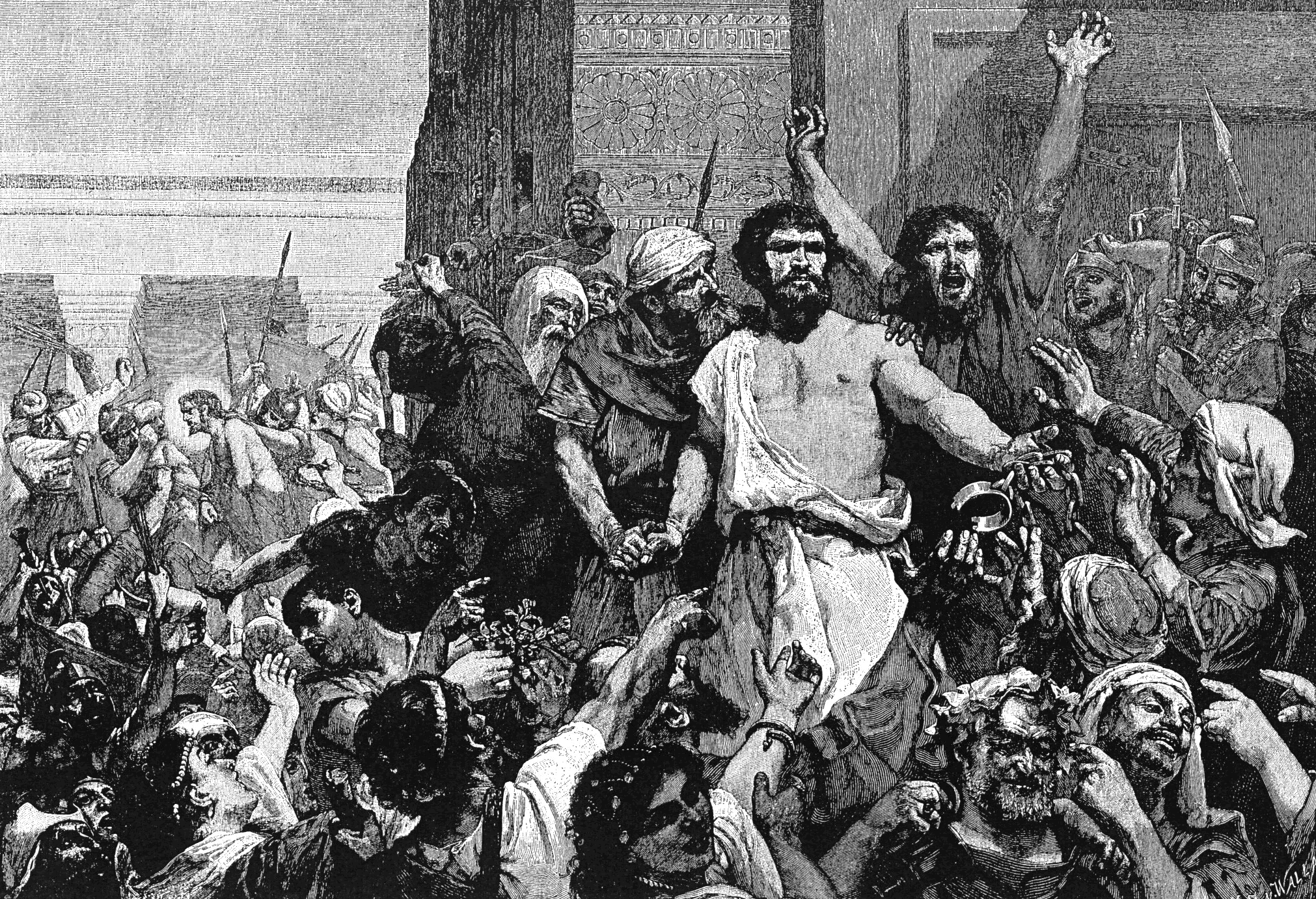
Figure mentioned in the New Testament
| Field | Value |
|---|---|
| image | Barabbas (James Tissot).jpg |
| caption | Painting by James Tissot, btwn 18861894 |
| occupation | Bandit |
| known_for | Pardoned by Pontius Pilate instead of Jesus |
the biblical figure Barabbas
According to the New Testament, Barabbas () was a Jewish bandit and rabble-rouser who was imprisoned by the Roman occupation in Jerusalem, only to be chosen over Jesus by a crowd to be pardoned by Roman governor Pontius Pilate at the Passover feast.
Biblical account
According to all four canonical gospels, there was a prevailing Passover custom in Jerusalem that allowed Pontius Pilate, the praefectus or governor of Judea, to commute one prisoner's death sentence by popular acclaim. In one such instance, the "crowd" (ὄχλος : óchlos), "the Jews" and "the multitude" in some sources, are offered the choice to have either Barabbas or Jesus released from Roman custody. According to the Synoptic Gospels of Matthew, Mark, and Luke, and the account in John, the crowd chooses Barabbas to be released and Jesus of Nazareth to be crucified. Pilate reluctantly yields to the insistence of the crowd. One passage, found in the Gospel of Matthew, has the crowd saying (of Jesus), "Let his blood be upon us and upon our children."
Matthew refers to Barabbas only as a "notorious prisoner". Mark and Luke further refer to Barabbas as one involved in a στάσις (stásis, a riot), probably "one of the numerous insurrections against the Roman power" who had committed murder. Robert Eisenman states that John 18:40 refers to Barabbas as a λῃστής (lēistēs, "bandit"), "the word Josephus always employs when talking about Revolutionaries".
Three gospels state that there was a custom that at Passover the Roman governor would release a prisoner of the crowd's choice; , , and . Later copies of Luke contain a corresponding verse (), although this is not present in the earliest manuscripts, and may be a later gloss to bring Luke into conformity.
The custom of releasing prisoners in Jerusalem at Passover is known to theologians as the Paschal Pardon, but this custom, whether at Passover or any other time, is not recorded in any historical document other than the gospels, leading some to question its historicity and make further claims that such a custom was a mere narrative invention of the Bible's writers.
Name
There exist several versions of this figure's name in gospel manuscripts, most commonly simply without a first name. However the variations (, , ) found in different manuscripts of the Matthew 27:16–17 give this figure the first name "Jesus", making his full name "Jesus Barabbas" or "Jesus Bar-rhabban", and giving him the same first, given name as Jesus.
The Codex Koridethi seems to emphasise Bar-rhabban as composed of two elements in line with a patronymic Aramaic name. These versions, featuring the first name "Jesus" are considered original by a number of modern scholars.
Origen seems to refer to this passage of Matthew in claiming that it must be a corruption, as no sinful man ever bore the name "Jesus" and argues for its exclusion from the text. He however does not account for the high priest Jason () from 2 Maccabees 4:13, whose name seems to transliterate the same Aramaic name into Greek, as well as other bearers of the name Jesus mentioned by Josephus. It is possible that scribes when copying the passage, driven by a reasoning similar to that of Origen, removed this first name "Jesus" from the text to avoid dishonor to the name of the Jesus whom they considered the Messiah.
Etymology
Of the two larger categories in which transmitted versions of this name fall , seems to represent Jewish Palestinian Aramaic: בּר רַבָּן, romanized: Bar Rabbān, lit. 'Son of our Rabbi/Master', while appears to derive ultimately from Jewish Palestinian Aramaic: בּר אַבָּא, romanized: *Bar ʾAbbā lit. 'Son of ʾAbbā/[the] father''', a patronymic Aramaic name. However, *ʾAbbā'' has been found as a personal name in a 1st-century burial at Giv'at ha-Mivtar. Additionally it appears fairly often as a personal name in the Gemara section of the Talmud, a Jewish text dating from AD 200–400.
Historicity
The majority of scholars such as Craig A. Evans and N. T. Wright accept the historicity of the Passover pardon narrative, quoting evidence of such pardons from Livy's Books from the Foundation of the City, Josephus's Antiquities of the Jews, Papyrus Florence, Pliny the Younger's Epistles and the Mishnah.
The similarities of the name () in some manuscripts and the name of Jesus have led some modern scholars to argue that the counter-intuitive similarity of the two men's names is evidence of its historicity. They doubt a Christian writer would invent a similar name for a criminal, practically equating Christ with a criminal, if he were fictionalizing the story for a polemical or theological purpose.
Contrarian beliefs include Max Dimont's opinion the story of Barabbas as related in the Gospels lacks credibility from both the Roman and Jewish standpoint. Dimont argues against the believability of the Barabbas story by noting that the alleged custom of privilegium Paschale, "the privilege of Passover", where a criminal is set free, is only found in the Gospels. Alternatively, Raymond E. Brown argues that the Gospels' narratives about Barabbas cannot be considered historical, but that it is probable that a prisoner referred to as Barabbas (bar abba, "son of the father") was freed around the period Jesus was crucified, and this gave birth to the story.
Bart D. Ehrman notes the story is not in Pontius Pilate's character and comments that the name Barabbas "son of the father" is interestingly similar to Jesus's role as the son of God.
Another minority of scholars, including Benjamin Urrutia, Stevan Davies, Hyam Maccoby and Horace Abram Rigg, have contended that Barabbas and Jesus were the same person.
Levitical atonement allegory
Robert L. Merritt, Raymond E. Brown, Pope Benedict XVI, and Hyam Maccoby describe or register readings that compare the Barabbas pericope with the Day of Atonement rite in Leviticus 16, sometimes as deliberate narrative typology and sometimes as thematic echo. Origen already noted the force of the variant name "Jesus Barabbas," which sharpens a two figure juxtaposition in Matthew and which later scribes may have muted.
| Leviticus 16 (Day of Atonement) | Gospel Narrative |
|---|---|
| Two goats are set before the community, lots distinguish the goat for the Lord from the goat for Azazel, and the people witness the assignment | Two prisoners are set before the crowd, Jesus of Nazareth and Barabbas, and the people determine the outcome by acclamation rather than by lots |
| The goat for the Lord is killed as the sin offering | Gospel Jesus is condemned and executed, which early Christian texts interpret as a once for all sacrificial offering that fulfills and supersedes temple sacrifice |
| The scapegoat bears the iniquities of the community and is sent out alive to the wilderness | Barabbas the ληιστης is released alive back into the social body, which typological readers construe as the bearer of communal transgression displaced from the innocent one |
| The priestly rite involves confession over the scapegoat | The crowd's shouted choice and the Matthean cry "Let his blood be on us and on our children" function as the narrative moment of transfer in the typology, though Brown and others caution that the legal setting and absence of lots mark a transformation rather than replication |
On this reading the retelling encodes faith development from Judaism to Christianity. The cultic system of atonement is recast into a judicial narrative in which Jesus replaces the sin offering, temple sacrifice becomes Christological once for all atonement, and the released figure carries the narrative role of the living scapegoat into the world rather than into the sanctuary precincts. Merritt argues that the Barabbas option at Passover functions as a civic ritual that could be read by early Christians in light of Yom Kippur patterns, while Benedict XVI acknowledges the connection yet restricts its scope to typology rather than direct dependence. Maccoby underscores the naming and insurgent context, which increases the rhetorical contrast between the one killed and the one released, and so strengthens the two goat frame.
Antisemitism
The story of Barabbas has played a role in historical antisemitism, because it has historically been used to lay the blame for the crucifixion of Jesus on the Jews, and thereby to justify antisemitism – an interpretation known as Jewish deicide.
Pope Benedict XVI, in his 2011 book Jesus of Nazareth, dismisses this reading, since the Greek word ὄχλος (óchlos) in means "crowd", rather than "Jewish people".
In literature
Barabbas appears in Mikhail Bulgakov's The Master and Margarita (1967), rendered as Bar-Rabban, a rebel insurgent. In Chapter 2, "Pontius Pilate," the devil Woland recounts Yeshua Ha-Nozri's trial to Soviet atheists in 1930s Moscow. Amid Passover tumult, the crowd demands Bar-Rabban's release over Yeshua's, dooming the latter to crucifixion with thieves. This episode mirrors biblical events while amplifying Bulgakov's motifs of arbitrary authority, crowd frenzy, and Pilate's gnawing remorse, echoed later as the procurator's eternal curse, weaving ancient injustice into the novel's satire on Soviet repression.
Samuel Crossman's English hymn "My Song Is Love Unknown" (published 1684) contains this verse alluding anonymously to Barabbas as "a murderer"
:They rise, and needs will have :my dear Lord made away; :a murderer they save, :the Prince of Life they slay. :Yet cheerful He :to suffering goes, :that He His foes :from thence might free.
Barabbas is the main character in the novel Barabbas (1950) by Pär Lagerkvist.
References
Notes
Citations
Sources
References
- "Barabbas {{!}} Facts & Significance {{!}} Britannica".
- {{bibleverse. Mark. 15:6–15. TNIV
- {{bibleverse. Luke. 23:13–25. TNIV
- {{bibleverse. John. 18:38–19:16. TNIV
- {{bibleverse. Mark. 15:6–15. TNIV
- {{bibleverse. Matthew. 27:25
- {{bibleverse. Matthew. 27:16
- {{bibleverse. Mark. 15:7, {{bibleverse. Luke. 23:19
- Cunningham, Paul A.. "The Death of Jesus: Four Gospel Accounts". Center for Christian–Jewish Learning at Boston College.
- Paul, Winter. (1961). "On the Trial of Jesus". De Gruyter.
- Paul, Winter. (1961). "On the Trial of Jesus". De Gruyter.
- Lagrange, Marie-Joseph. (1923). "ÉVANGILE SELON SAINT MATTHIEU". V. Lecoffre.
- Dahl, N. A.. (September 1955). "Die Passionsgeschichte bei Mattheus". New Testament Studies.
- Origen, ''Commentary on Matthew'', Chapter 27, paragraph 17
- Origen, ''Commentary on Matthew'', Chapter 27
- Bulgakov, Mikhail. (1967). "The Master and Margarita". Collins / Harvill Press.
- "History of Hymns: 'My Song Is Love Unknown'". [[United Methodist Church]].
- "My Song Is Love Unknown".
- "Barabbas : Facts & Significance".
- "Mark 15". Cambridge Bible for Schools and Colleges.
- "[[Diccionario de la Real Academia]]".
- "[[Diccionario de la Real Academia]]".
This article was imported from Wikipedia and is available under the Creative Commons Attribution-ShareAlike 4.0 License. Content has been adapted to SurfDoc format. Original contributors can be found on the article history page.
Ask Mako anything about Barabbas — get instant answers, deeper analysis, and related topics.
Research with MakoFree with your Surf account
Create a free account to save articles, ask Mako questions, and organize your research.
Sign up freeThis content may have been generated or modified by AI. CloudSurf Software LLC is not responsible for the accuracy, completeness, or reliability of AI-generated content. Always verify important information from primary sources.
Report