From Surf Wiki (app.surf) — the open knowledge base
Bar (unit)
Unit of pressure equal to 100,000 Pa
Unit of pressure equal to 100,000 Pa
| Field | Value |
|---|---|
| name | bar |
| image | Aluminium cylinder.jpg |
| caption | An aluminium cylinder of wall thickness 5 mm after an external pressure of 700 bar was applied to it |
| standard | metric system |
| quantity | pressure |
| symbol | bar |
| units1 | SI units |
| inunits1 | 1 bar |
| units2 | CGS units |
| inunits2 | |
| units3 | US customary units |
| inunits3 | 1.000000 bar |
| units4 | Atmospheres |
| inunits4 | 1.000000 bar |
The bar is a metric unit of pressure defined as (100 kPa or 1000 hPa), though not part of the International System of Units (SI). A pressure of 1 bar is slightly less than the current average atmospheric pressure on Earth at sea level (approximately 1.013 bar). By the barometric formula, 1 bar is roughly the atmospheric pressure on Earth at an altitude of 111 metres at 15 °C.
The bar and the millibar were introduced by the Norwegian meteorologist Vilhelm Bjerknes, who was a founder of the modern practice of weather forecasting, with the bar defined as one megadyne per square centimetre.
The SI brochure, despite previously mentioning the bar, now omits any mention of it. The bar has been legally recognised in countries of the European Union since 2004. The US National Institute of Standards and Technology (NIST) deprecates its use except for "limited use in meteorology" and lists it as one of several units that "must not be introduced in fields where they are not presently used".NIST Special Publication 1038 , Sec. 4.3.2; NIST Special Publication 811, 2008 edition {{webarchive
Units derived from the bar include the megabar (symbol: Mbar), kilobar (symbol: kbar), decibar (symbol: dbar), centibar (symbol: cbar), and millibar (symbol: mbar).
Definition and conversion
The bar is defined using the SI derived unit, pascal: ≡ ≡ .
Thus, is equal to:
- (barye; in CGS units (this has also been called "bar"); and 1 bar is approximately equal to:
- 1 bar
- 1 bar
- 1 bar
- 1 bar
- 1 bar
- centimetres of water (cmH2O) (1 bar approximately corresponds to the gauge pressure of water at a depth of 10 metres)
1 millibar (mbar) is equal to:
- 1 mbar
Origin
The word bar has its origin in the Ancient Greek word βάρος (grc), meaning weight. The unit's official symbol is bar; the earlier symbol b is now deprecated and conflicts with the uses of b denoting the unit barn or bit, but it is still encountered, especially as mb (rather than the proper mbar) to denote the millibar. Between 1793 and 1795, the word bar was used for a unit of mass (equal to the modern tonne) in an early version of the metric system.
Usage

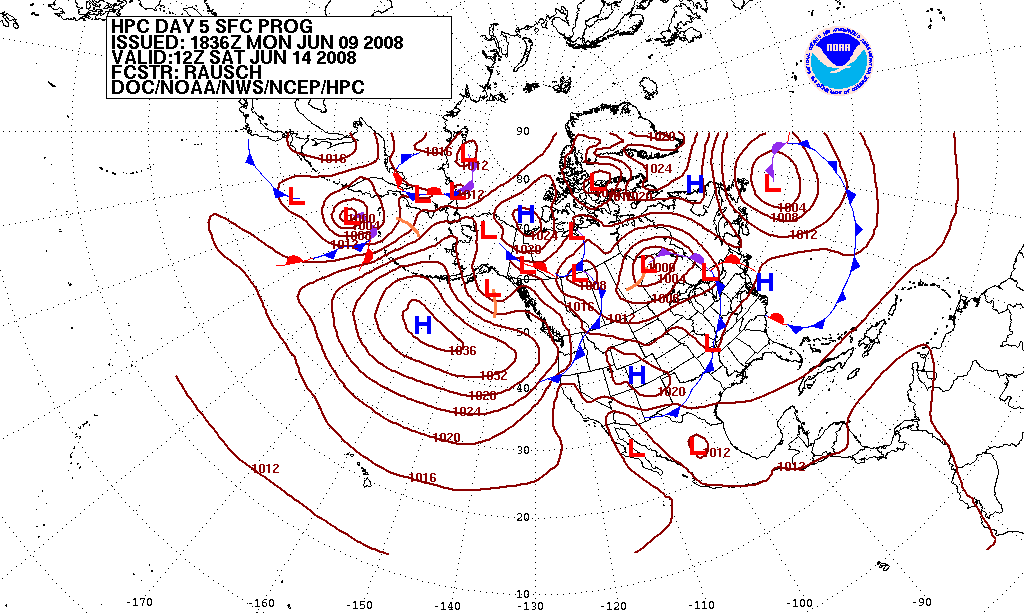
Atmospheric air pressure where standard atmospheric pressure is defined as 1013.25 mbar, 101.325 kPa, , which is about 1.00 atm. Despite the millibar not being an SI unit, meteorologists and weather reporters worldwide have long measured air pressure in millibar as the values are convenient. After the advent of SI units, some meteorologists began using hectopascals (symbol hPa) which are numerically equivalent to millibar; for the same reason, the hectopascal is now the standard unit used to express barometric pressures in aviation in most countries. For example, the Meteorological Service of Canada uses kilopascals and hectopascals on their weather maps. In contrast, Americans are familiar with the use of the millibar in US reports of hurricanes and other cyclonic storms.
In fresh water, there is an approximate numerical equivalence between the change in pressure in decibar and the change in depth from the water surface in metres. Specifically, an increase of 1 decibar occurs for an increase in depth of . In sea water with respect to the gravity variation, the latitude and the geopotential anomaly the pressure can be converted into metres' depth according to an empirical formula (UNESCO Tech. Paper 44, p. 25). As a result, decibar is commonly used in oceanography.
In scuba diving, bar is also the most widely used unit to express pressure, e.g. 200 bar being a full standard scuba tank, and depth increments of 10 metre of seawater being equivalent to 1 bar of pressure.
Many engineers worldwide use the bar as a unit of pressure because, in much of their work, using pascals would involve using very large numbers. In measurement of vacuum and in vacuum engineering, residual pressures are typically given in millibar, although torr or millimetre of mercury (mmHg) were historically common.
Pressures resulting from deflagrations are often expressed in units of bar.
In the automotive field, turbocharger boost is often described in bar outside the United States. Tire pressure is often specified in bar. In hydraulic machinery components are rated to the maximum system oil pressure, which is typically in hundreds of bar. For example, 300 bar is common for industrial fixed machinery.
In the maritime ship industries, pressures in piping systems, such as cooling water systems, is often measured in bar.
Unicode has characters for "mb" (), "bar" () and ミリバール (; "millibar" spelt in katakana), but they exist only for compatibility with legacy Asian encodings and are not intended to be used in new documents.
The kilobar, equivalent to 100 MPa, is commonly used in geological systems, particularly in experimental petrology.
The abbreviations "bar(a)" and "bara" are sometimes used to indicate absolute pressures, and "bar(g)" and "barg" for gauge pressures. The usage is deprecated but still prevails in the oil industry (often by capitalized "BarG" and "BarA"). As gauge pressure is relative to the current ambient pressure, which may vary in absolute terms by about 50 mbar, "BarG" and "BarA" are not interconvertible. Fuller descriptions such as "gauge pressure of 2 bars" or "2-bar gauge" are recommended.
References
:
References
- "Nomenclature of the unit of absolute pressure, Charles F. Marvin, 1918".
- Resolution 6 of the 9th CGPM, 1948, lists the bar (symbol bar) in a table illustrating writing and printing of unit symbols
- {{SIbrochure9th.
- [[British Standard]] BS 350:2004 ''Conversion Factors for Units''.
- International Astronomical Union Style Manual. Comm. 5 in IAU Transactions XXB, 1989, Table 6
- Allen, William H.. (1965-01-01). "Dictionary of Technical Terms for Aerospace Use". NASA Special Publication.
- Marvin, Charles F.. (1918-03-30). "Nomenclature of the Unit of Absolute Pressure". Monthly Weather Review.
- (1793). "Instructions abrégée sur les mesures déduites de la grandeur de la terre et sur les calculs relatifs à leur division décimale, 1793: gravet, bar".
- Canada, Environment. (2013-04-16). "Canadian Weather at a Glance - Environment Canada".
- Canada, Environment. (2013-04-16). "Canadian Weather - Environment Canada".
- [https://www.wpc.ncep.noaa.gov/sfc/90fwbg.gif US government atmospheric pressure map]
- [https://s.w-x.co/util/image/map/WEB_Current_Weather_Map_1280x720.jpg?v=ap&w=1280&h=720&api=7db9fe61-7414-47b5-9871-e17d87b8b6a0 The Weather Channel]
- Scientific Committee on Oceanic Research. (1983). "Algorithms for computation of fundamental properties of seawater".
- "NFPA 68 Standard on Explosion Protection by Deflagration Venting".
- "What do the letters 'g' and 'a' denote after a pressure unit? (FAQ - Pressure) : FAQs : Reference : National Physical Laboratory".
This article was imported from Wikipedia and is available under the Creative Commons Attribution-ShareAlike 4.0 License. Content has been adapted to SurfDoc format. Original contributors can be found on the article history page.
Ask Mako anything about Bar (unit) — get instant answers, deeper analysis, and related topics.
Research with MakoFree with your Surf account
Create a free account to save articles, ask Mako questions, and organize your research.
Sign up freeThis content may have been generated or modified by AI. CloudSurf Software LLC is not responsible for the accuracy, completeness, or reliability of AI-generated content. Always verify important information from primary sources.
Report