From Surf Wiki (app.surf) — the open knowledge base
Bangladesh Armed Forces
Combined military forces of Bangladesh

Combined military forces of Bangladesh
| Field | Value | |
|---|---|---|
| name | Bangladesh Armed Forces | |
| native_name | বাংলাদেশ সশস্ত্র বাহিনী | |
| image | [[File:বাংলাদেশ সামরিক বাহিনীর প্রতীক.svg | 160px]] |
| caption | Crest of Bangladesh Armed Forces | |
| image2 | [[File:Bangladesh Armed Forces Flag.svg | 180px]] |
| caption2 | Flag of Bangladesh Armed Forces | |
| motto | চির উন্নত মম শির (de facto) | |
| ("Ever High is My Head") | ||
| founded | ||
| current_form | ||
| branches | ||
| headquarters | Armed Forces Division Headquarters, Dhaka Cantonment | |
| website | - | |
| commander-in-chief | Flag of the President of Bangladesh.svg President Mohammed Shahabuddin | |
| commander-in-chief_title | Commander-in-Chief | |
| chief minister | Standard of the Chief Adviser of Bangladesh.svg Chief Adviser Muhammad Yunus | |
| chief minister_title | Minister of Defence | |
| chief_of_staff | Bangladesh Armed Forces Flag.svg Lieutenant General S. M. Kamrul Hassan | |
| chief_of_staff_title | Principal Staff Officer | |
| commander_title | ||
| age | 18 years | |
| conscription | No | |
| active | 204,000 (2025) | |
| deployed | 3,000 for United Nations peacekeeping | |
| amount | ৳ 408.51 billion ($3.34 billion) (2025) | |
| percent_GDP | 0.71% | |
| domestic_suppliers | {{hidden | |
| headerstyle | background:#b0c4de | |
| style | text-align:center; | |
| foreign_suppliers | Australia | |
| China | ||
| Russia | ||
| Turkey | ||
| United Kingdom | ||
| United States | ||
| France | ||
| Italy | ||
| Japan | ||
| imports | (2025) | |
| history | ||
| ranks | Military ranks of Bangladesh |
("Ever High is My Head")
| commander-in-chief = Flag of the President of Bangladesh.svg President Mohammed Shahabuddin | commander-in-chief_title = Commander-in-Chief |List
- Bangladesh Machine Tools Factory
- Bangladesh Ordnance Factories
- Bangladesh Aeronautical Centre
- Khulna Shipyard Limited
- Dockyard and Engineering Works
- Chittagong Dry Dock Limited China Russia Turkey United Kingdom United States France Italy Japan
South Korea India Pakistan Serbia Germany
The Bangladesh Armed Forces () is the combined military force of Bangladesh, responsible for national defense, safeguarding sovereignty, and supporting civil authorities during emergencies. It consists of three uniformed branches: the Bangladesh Army, the Bangladesh Navy, and the Bangladesh Air Force. The armed forces operate under the jurisdiction of the Ministry of Defence of the Government of Bangladesh and are directly administered by the Armed Forces Division of the Prime Minister's Office. The President of Bangladesh serves as the Commander-in-Chief of the Bangladesh Armed Forces.
Bangladesh has the third-largest defence budget in South Asia. The Bangladeshi military is also the 35th strongest in the world and the third most powerful military force in South Asia. Border Guard Bangladesh and Bangladesh Coast Guard is under the jurisdiction of the Ministry of Home Affairs during peacetime, but during wartime, they fall under the command of the Bangladesh Army and the Bangladesh Navy, respectively.
Military policy is formulated and executed by the Armed Forces Division (AFD), whereas the Ministry of Defence (MoD) does not exercise any operational or policy authority over the Armed Forces. Since independence, the AFD and MoD have been led by the Prime Minister. To coordinate military policy with foreign and intelligence policy, both the President and the Prime Minister are advised by a six-member advisory board, which consists of the three military services Chiefs of Staff, Principal Staff Officer of the Armed Forces Division, and Military secretaries to the President and the Prime Minister. The directors-general of the NSI, the DGFI, and the BGB also serve in an advisory capacity when invited.
Armed Forces Day is observed on 21 November and commemorates the founding of the three services of the Armed Forces, who subsequently initiated a joint military operation against the occupying Pakistani Armed Forces during the Bangladesh Liberation War. Official functions are held across the country, including at Bangabhaban, the Armed Forces Division Headquarters at Dhaka Cantonment, all military cantonments, and at every military installation throughout Bangladesh.
History
Main article: Military history of Bangladesh
East Pakistan
With the partitioning of India on 15 August 1947, the territory constituting modern Bangladesh was partitioned from the province of Bengal as East Bengal which joined Pakistan. Ethnic and sectional discrimination prevailed in various sectors of the state. Like other government sectors, Bengalis were under-represented in the Pakistani military too. Officers of Bengali origin in different wings of the armed forces made up just 5% of the entire military by 1965. West Pakistanis believed that Bengalis were not "martially inclined" unlike Pashtuns and Punjabis; the "Martial Races" notion was dismissed as ridiculous and humiliating by Bengalis. Moreover, despite huge defence spending, East Pakistan received none of the benefits, such as contracts, purchasing and military support jobs. The Indo-Pakistani War of 1965 over Kashmir also highlighted the sense of military insecurity among Bengalis as only an under-strength infantry division and 15 combat aircraft without tank support were in East Pakistan to repel any Indian attack during the conflict.
The East Bengal Regiment was formed on 15 February 1948 following Pakistan's independence and transition from post British rule, composed exclusively of men from the western part of the country. The first East Bengal Regiment was composed of Bengali members of the British Indian Army Pioneer Corps and Bihar Regiment of the abolished British-Indian army. Between 1948 and 1965, a total of eight battalions of EBR were raised.
Bangladesh War of Independence
Main article: Bangladesh War of Independence

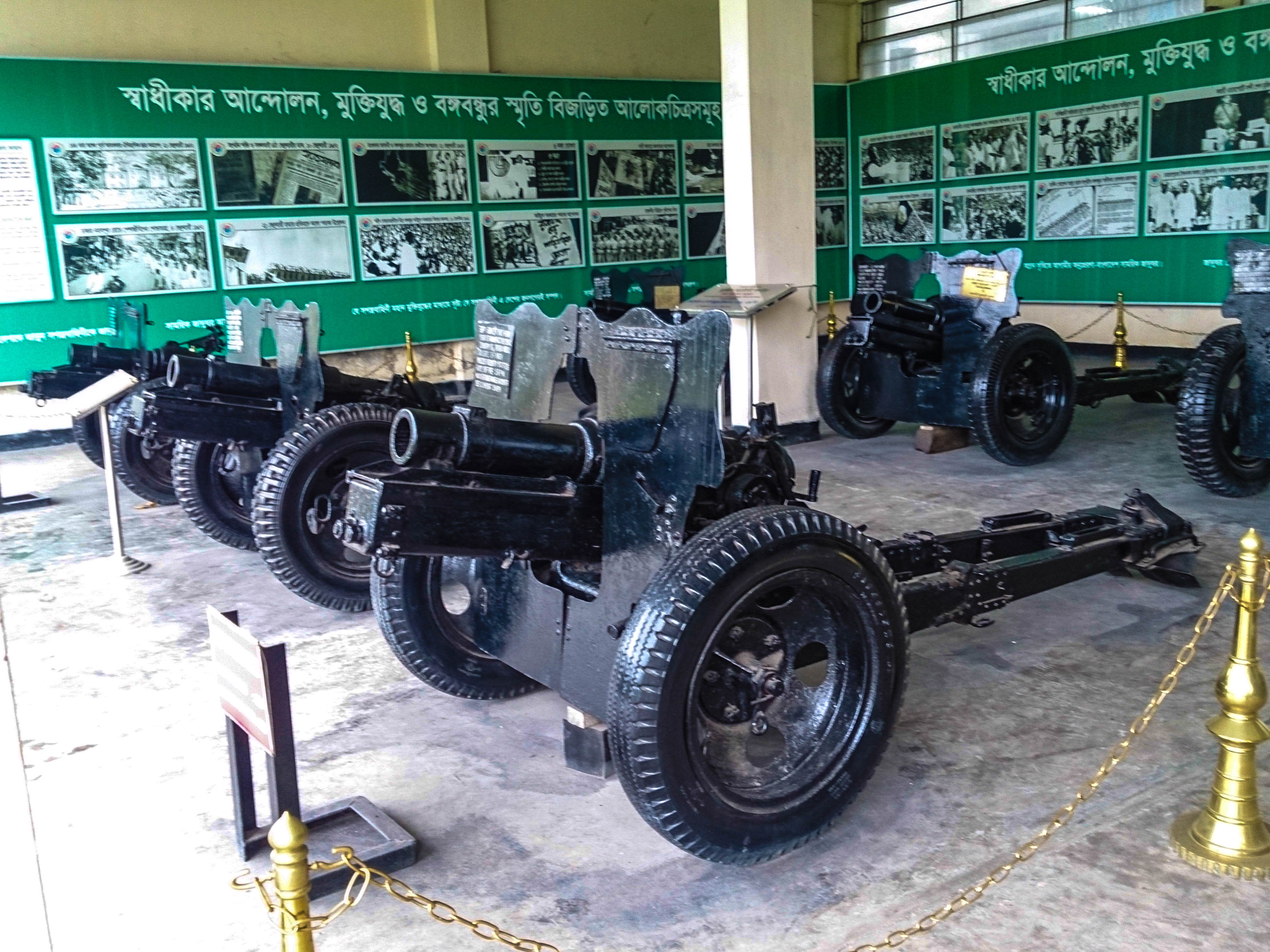
Following the victory of the Awami League in the 1970 elections, then-president General Yahya Khan refused to appoint its leader Sheikh Mujibur Rahman as the prime minister and launched a brutal attack named Operation Searchlight on the Bengali nationalists of the then East Pakistan, using the Pakistan Army to repress political movements. The number of people killed by Pakistani forces vary from a minimum of around 300,000 to a maximum of around 3 million. Responding to Mujib's call for rebellion, many students, workers and other civilians mutinied against Pakistan and raised the Mukti Bahini, a guerrilla force. Later on, many Bengali officers and units from the Pakistan Army and East Pakistan Rifles mutinied against their West Pakistani counterparts and joined the Mukti Bahini. On 17 April 1971, M. A. G Osmani took oath as the commander-in-chief of Mukti Bahini. While the war raged on, the necessity of a well-trained armed force was always felt. During the first Bangladesh Sector Commanders Conference, held from 11 to 17 July 1971, the Bangladesh Forces started its journey composed of the revolting Bengali members of the Pakistan Army and EPR. In this historic conference the field command structure, sector reorganization, reinforcement, appointment of field commanders and tactics of warfare were decided upon and carried out. On 21 November 1971, the Bangladesh Forces was divided into three separate services as Bangladesh Army, Bangladesh Navy and Bangladesh Air Force.
The Bangladesh Forces received modest assistance from the Indian Government soon after the start of the war, On 3 December 1971, the India-Pakistan war broke out and Indian troops entered Bangladesh allied with the Bangladesh Armed Forces. On 16 December 1971, the Pakistani military surrendered to the joint Indian and Bangladesh forces.
Post-independence
The newly formed Bangladeshi armed forces incorporated some of the units and guerrillas of the Mukti Bahini. Gen. Osmani, who had led the Mukti Bahini was appointed the General of the Bangladesh armed forces. For many years, there was active discrimination in favour of the inductees from the Mukti Bahini against those Bengali officers who had continued service in the Pakistani armed forces or had been detained in West Pakistan. A group of angered officers assassinated the president Sheikh Mujib on 15 August 1975 and established a regime with politician Khondaker Mostaq Ahmed as President of Bangladesh and new army chief Maj. Gen. Ziaur Rahman. The military itself was subject of divisions as Mujib's assassins were overthrown by the pro-Mujib Brig. Gen. Khaled Mosharraf on 3 November, who himself was soon overthrown by a socialist group of officers under Col. Abu Taher on 7 November who returned Ziaur Rahman to power—an event now called the Sipoy-Janata Biplob (Soldiers and People's Coup). Under the presidency of Ziaur Rahman, the military was reorganised to remove conflicts between rival factions and discontented cadre. However, Ziaur Rahman was himself overthrown in a 1981 coup attempt, and a year later, Lt. Gen. Hossain Mohammad Ershad took power from the elected government of president Abdus Sattar. The military remained the most important force in national politics under the regimes of Ziaur Rahman and later Hossain Mohammad Ershad until democracy was restored in 1991.
Modern period
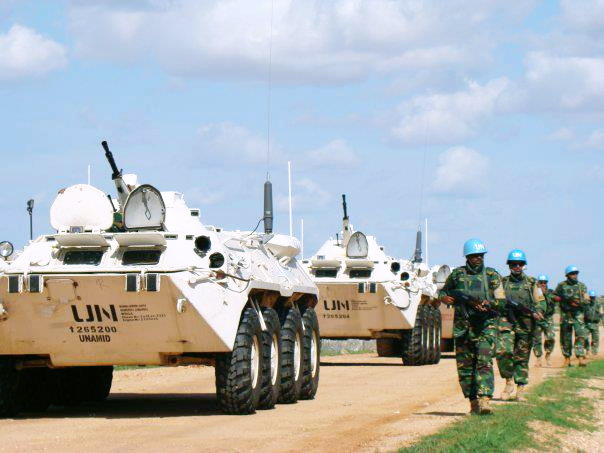
Having relied primarily on India and the Soviet Union for military aid, Bangladesh has also developed military ties with the People's Republic of China and the United States. The Bangladesh Army has been actively involved in United Nations Peace Support Operations (UNPSO). During the first Gulf War in 1991, the Bangladesh Army sent a 2,193 member team to monitor peace in Saudi Arabia and Kuwait. The Bangladesh Army also participated in peace keeping activities in Namibia, Cambodia, Somalia, Uganda, Rwanda, Mozambique, former Yugoslavia, Liberia, Haiti, Tajikistan, Western Sahara, Sierra Leone, Kosovo, Georgia, East Timor, Congo, Côte d'Ivoire and Ethiopia. As of October 2008, Bangladesh remained the second largest contributor with 9,800 troops in the UN Peacekeeping forces.
Until a peace accord was signed in 1997, the Bangladeshi military engaged in counterinsurgency operations in the Chittagong Hill Tracts fighting the Shanti Bahini separatist group. In 2001, Bangladeshi military units engaged in clashes with the Indian Border Security Force (BSF) along the northern border.
Several projects and schemes aiming to expand and modernize the Bangladeshi armed forces were launched by the government of former Prime Minister Begum Khaleda Zia.
Forces Goal 2030 was launched by the government of Prime Minister Sheikh Hasina to secure new equipment for the Bangladeshi military.
Bangladesh-Myanmar border
Standoffs have occasionally occurred at the Bangladesh-Myanmar border, including in 1991 and 2008. Most of the standoffs took place, when Myanmar attempted to force Rohingyas into Bangladesh. In 2008, the two countries deployed warships after Myanmar attempted to explore a disputed Bay of Bengal seabed for oil and gas. The dispute was resolved at an international tribunal in 2012. Bangladesh and Myanmar have also conducted counter-insurgency operations on the border.
Medals and decorations
Main article: Military awards and decorations of Bangladesh
The following are the various gallantry, service and war medals of the Bangladesh Armed Forces.
Gallantry awards
- [[File:Bir Sreshtho ribbon.svg|80px]] Bir Sreshtho-(; literally, "The Most Valiant Hero"), the highest gallantry award
- [[File:Bir Uttom ribbon.svg|80px]] Bir Uttom- (; literally, "Better among Braves"), the second highest gallantry award
- [[File:Bir Bikrom.svg|80px]] Bir Bikrom- (; literally, "Valiant hero"), the third highest gallantry award
- [[File:Bir Protik ribbon.svg|80px]] Bir Protik- (; literally, "Symbol of Bravery or Idol of Courage"), the fourth highest gallantry award
Service medals
- [[File:Bangladesh Order of Military Merit ribbon.svg|80px]] Order of Military Merit
- [[File:Jestha Padak I.svg|80px]] Jestha Padak I (10 years service)
- [[File:Jestha Padak II.svg|80px]] Jestha Padak II (20 years service)
- [[File:Jestha Padak III.svg|80px]] Jestha Padak III (30 years service)
Current deployments
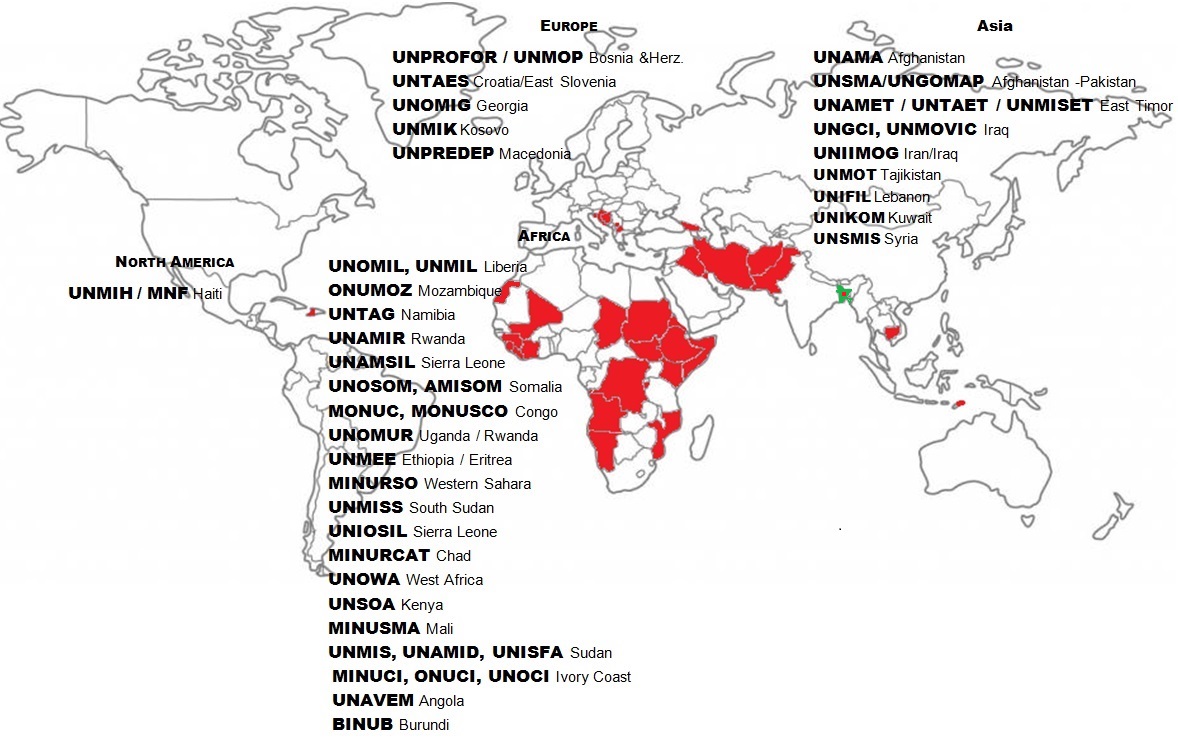
Bangladesh has consistently made large contributions to United Nations peacekeeping operations. As of May 2007, Bangladesh had major deployments in Democratic Republic of Congo, Liberia, Lebanon, Sudan, Timor-Leste and Côte d'Ivoire. With 10,736 troops deployed, it ranks first in personnel contributions to UN peacekeeping. The government declined to participate in Iraq on a request from the United States. The deployment to Liberia began in October 2003 and has remained at a level of about 3,200 who are participating in peacekeeping, charitable activities and infrastructure development.
Training
Officers are trained and educated for three years at the Bangladesh Military Academy, Bhatiary, Bangladesh Naval Academy at Patenga, both located in Chittagong and Bangladesh Air Force Academy located in Jessore. For advance training during their career, officers are sent to Bangladesh Defence Services Command and Staff College at Mirpur, while senior officers attend the National Defense University for Armed Forces War Course. Many attend the Military Institute of Science and Technology while serving. Officers of the Army Medical Corps are recruited after graduation from both military or civil medical colleges. They undergo basic military training at Bangladesh Military Academy followed by professional training in medical corps centre and Armed Forces Medical Institute. Recently cadets of Armed Forces Medical College also started joining the services directly.
Ranks
Main article: Military ranks of Bangladesh
Bangladeshi military ranks, essentially corresponds to those used by the armed forces of the commonwealth nations.
The rank insignia for commissioned officers for the Armed forces respectively.
Organization
| Name | Mission | Headquarters | Warfare | Bangladesh Army | Bangladesh Navy | Bangladesh Air Force | Paramilitary | Border Guard Bangladesh | Bangladesh Coast Guard | Civil and Reserve | Bangladesh Police | Bangladesh Ansar and Village Defence Party | Bangladesh National Cadet Corps | Specialized | President Guard Regiment | Special Security Force | Special Operational Combatants | Para-Commando Brigade | Special Warfare Diving And Salvage | 41 Squadron Airborne | Rapid Action Battalion | Armed Police Battalion | |
|---|---|---|---|---|---|---|---|---|---|---|---|---|---|---|---|---|---|---|---|---|---|---|---|
| [[File:Roundel of Bangladesh – Army Aviation.svg | 100px]] | Ground warfare | Dhaka Cantonment | ||||||||||||||||||||
| [[File:বাংলাদেশ নৌবাহিনীর মনোগ্রাম.svg | 100px]] | Naval warfare | |||||||||||||||||||||
| Aerial warfare | |||||||||||||||||||||||
| [[File:বর্ডার গার্ড বাংলাদেশের মনোগ্রাম.svg | 100px]] | Maintaining the security of the land border. | Pilkhana | ||||||||||||||||||||
| [[File:বাংলাদেশ কোস্ট গার্ডের প্রতীক.svg | 100px]] | Maintaining the security of the naval border. | Agargaon | ||||||||||||||||||||
| [[File:Bangladesh Police Emblem.svg | 100px]] | Enforcing and upholding laws nationwide. | Fulbari, Dhaka | ||||||||||||||||||||
| Preservation of internal security as auxiliary force. | Khilgaon | ||||||||||||||||||||||
| [[File:Bncc logo.png | 100px]] | Volunteer reserve and second line of defense for the Army, Navy, and Air Force. | Sector-6, Uttara | ||||||||||||||||||||
| [[File:Insignia of the President Guard Regiment (PGR).svg | 100px]] | Cavalry regiment for the security of the President. | Bangabhaban | ||||||||||||||||||||
| [[File:Insignia of the Special Security Force.svg | 100px]] | Provide physical security to anyone designated as VVIP by the government. | PMO | ||||||||||||||||||||
| [[File:Para Commando Brigade (Bangladesh) Formation Sign.svg | 100px]] | Counter-terrorism, hostage rescue, deep-penetration raids, and warfare both domestically and internationally. | Jalalabad Cantonment | ||||||||||||||||||||
| [[File:SWADS Naval Commando tab.svg | 100px]] | Anti-piracy and underwater demolition. | BNS Nirvik, Chittagong | ||||||||||||||||||||
| [[File:Bangladesh Army Para Commando sign.svg | 100px]] | Functions under the directive of PCB and the Air force. | |||||||||||||||||||||
| Conter-terrorism and crackdown of illegal substances. | Kurmitola | ||||||||||||||||||||||
| Form to create a reserve battalion of Bangladesh Police to assist Bangladesh Army in any operation and protecting "KPI" infrastuctures. | Uttara |
Military districts
- Savar Area Command
- Ghatail Area Command,Tangail
- Bogra Area Command
- Rangpur Area Command
- Comilla Area Command
- Chittagong Area Command
- Ramu Area Command
- Jessore Area Command
- Sylhet Area Command
- Barisal Area Command
- Army Training and Doctrine Command
- Army Logistics Area
Dhaka Cantonment
- HQ All Military Lands
- HQ Cantonment Boards
- HQ's of Bangladesh Army
- Armed Forces Division (AFD)
- 46 Independent Infantry Brigade
- 24 Independent Engineers Brigade
- 18 Engineers Brigade
- 6 Air Defence Brigade
- 14 Army Signal Brigade
- HQ, President's Guard Regiment
- Inter Services Selection Board (ISSB)
- HQ's Armed Forces Medical and Nursing Corps (AFMNC)
- Central Officer's Record Office (CORO)
- HQ's Armed Forces Recruiting Centre (AFRC)
- HQ's Cantonment Public Schools
- HQ's Armed Forces Library
- Armed Forces Institute of Pathology (AFIP)
- National Armed Forces Cemetery
Educational and training institutes
- Army Institute of Business Administration (Army IBA), Savar Cantonment, Dhaka
- Bangladesh University of Professionals (BUP), Mirpur Cantonment, Dhaka
- Bangladesh Military Academy (BMA), Bhatiari, Chittagong
- Bangladesh Army International University of Science & Technology (BAIUST), Cumilla Cantonment.
- School of Infantry and Tactics (SI&T), Jalalabad Cantonment, Sylhet.
- Defence Services Command and Staff College (DSC&SC), Mirpur Cantonment, Dhaka.
- National Defence College (NDC), Mirpur Cantonment, Dhaka.
- Military Institute of Science and Technology (MIST), Mirpur Cantonment, Dhaka.
- Armoured Corps Centre & School (ACC&S), Majira Cantonment, Bogra.
- Engineer Centre and School of Military Engineering, Qadirabad Cantonment, Natore.
- Signal Training Centre and School, Jessore Cantonment, Jessore.
- Army Service Corp Centre & School, Jahanabad Cantonment, Khulna.
- Army Medical Corps Centre & School, Shaheed Salahuddin Cantonment, Ghatail, Tangail.
- Ordnance Corps Centre & School, Rajendrapur Cantonment, Gazipur
- Bangladesh Institute of Peace Support Operation Training (BIPSOT), Rajendrapur Cantonment, Gazipur.
- Electrical and Mechanical Engineering Centre and School, Saidpur Cantonment, Nilphamari.
- Corps of Military Police Centre and School, Savar Cantonment, Savar, Dhaka.
- Army School of Education and Administration, Shahid Salahuddin Cantonment, Ghatail, Tangail.
- Army School of Physical Training and Sports (ASPTS), Dhaka Cantonment, Dhaka.
- Army School of Music, Chittagong Cantonment, Chittagong.
- Armed Forces Medical College (AFMC), Dhaka Cantonment, Dhaka.
- Army Medical College Chattogram (AMCC)
- Army Medical College Comilla (AMCCo)
- Army Medical College Bogra (AMCB)
- Army Medical College Jashore (AMCJ)
- Rangpur Army Medical College (RAMC)
- Artillery Centre and School, Halishahar, Chittagong.
- School of Military Intelligence, Moynamoti Cantonment, Comilla.
- East Bengal Regimental Centre, Chittagong Cantonment, Chittagong.
- Bangladesh Infantry Regimental Centre, Rajshahi Cantonment, Rajshahi.
- Non Commissioned Officers Academy, Majira Cantonment, Bogra.
Training institutes of Bangladesh Air Force
- Bangabandhu Sheikh Mujibur Rahman Aviation and Aerospace University
- Bangladesh Air Force Academy (BAFA), Jessore.
- Flying Instructors School (FIS), Bogra.
- Command and Staff Training Institute (CSTI), Dhaka.
- Flight Safety Institute (FSI), Dhaka.
- Officers' Training School (OTS), Jessore.
- Aero-Medical Institute (AMI), Dhaka.
- Fighter Controller Training Unit (FCTU), Dhaka.
- School of Physical Fitness (SOPF), Dhaka.
- Recruits Training School (RTS), Shamshernagar, Moulovibazar.
- Training Wing (TW), Chittagong.
- Mechanical Transport Driving School (MTDS), Shamsher Nagar.
- Helicopter Simulator Institute BAF(HSI), Dhaka
Training Institutes of Bangladesh Navy
- Bangladesh Naval Academy (BNA), Chittagong.
- BNS Shaheed Moazzem, Kaptai, Rangamati Hill District, Chittagong. (For Sailor's Advanced Training)
- BNS ISA KHAN, Chittagong (Home of 13 Different Training Schools)
- BNS TITUMIR, Khulna (Home of New Entry Training School (NETS) and School of Logistics and Management (SOLAM))
- School of Maritime Warfare & Tactics, Chittagong Port.
Army Cantonments
Cantonments are where Bangladesh Army personnel work, train, and live.
- Alikadam Cantonment (Bandarban)
- Bandarban Cantonment (Bandarban)
- Bangladesh Military Academy (Chittagong District)
- Bogra Cantonment (Bogra)
- Chittagong Cantonment (Chittagong)
- Comilla Cantonment (Comilla)
- Dhaka Cantonment (Dhaka)
- Dighinala Cantonment (Khagrachhari)
- Halishahar Cantonment (Chittagong)
- Jahanabad Cantonment (Khulna)
- Jahangirabad Cantonment (Bogra)
- Jalalabad Cantonment (Sylhet)
- Jamuna Cantonment (Bhuapur, Tangail)
- Jessore Cantonment (Jessore)
- Kaptai Cantonment (Kaptai)
- Khagrachhari Cantonment (Khagrachhari)
- Kholahati Cantonment (Parbatipur, Dinajpur)
- Mirpur Cantonment (Mirpur)
- Mithamain Cantonment (Kishoreganj)
- Mymensingh Cantonment (Mymensingh)
- Padma Cantonment (Munshiganj and Shariatpur)
- Postogola Cantonment (Dhaka)
- Qadirabad Cantonment (Natore)
- Rajendrapur Cantonment (Gazipur)
- Rajshahi Cantonment (Rajshahi)
- Ramu Cantonment (Ramu, Cox's Bazar)
- Rangamati Cantonment (Rangamati)
- Rangpur Cantonment (Rangpur)
- Saidpur Cantonment (Saidpur, nilphamary)
- Savar Cantonment (Savar)
- Shahid Salahuddin Cantonment (Ghatail, Tangail)
- Barisal Cantonment (Patuakhali)
Air Force bases
- BAF Base A.K. Khandokar (Kurmitola, Dhaka)
- BAF Base Sheikh Hasina (Cox's Bazar)
- BAF Base Khademul Bashar (Tejgaon,Dhaka)
- BAF Base Matiur Rahman (Jessore)
- BAF Base Paharkanchanpur (Tangail)
- BAF Base Zahurul Haq (Chittagong)
Navy bases
- BNS Haji Mohshin (Dhaka)
- BNS Dhaka (Dhaka)
- BNS Issa Khan (Chittagong)
- BNS Shaheed Moazzem (Rangamati)
- BNS Pekua (Cox's Bazar)
- BNS Sher-e-Bangla (Patuakhali)
- BNS Titumir (Khulna)
- BNS Ulka (Chittagong)
- BNS Bhatiary (Chittagong)
- BNS Nirvik (Chittagong)
- BNS Mongla (Bagerhat)
- BNS Patenga
- BNS Upasham (Khulna)
Future modernisation plans
Main article: Forces Goal 2030
Bangladesh has made a long term modernisation plan for its Armed Forces named Forces Goal 2030. The plan includes the modernization and expansion of all equipment and infrastructures and providing enhanced training.
Gallery
File:US Navy 071126-N-1831S-104 A member of the Bangladesh Army helps unload bags of purified water from a CH-46 Sea Knight assigned to the amphibious assault ship USS Kearsarge (LHD 3).jpg|Humanitarian operation after Cyclone Sidr File:US Navy 071123-M-7696M-099 Bangladeshi soldiers use a stretcher to unload a shipment of bottled water delivered by Marines of Marine Medium Helicopter Squadron (HMM) 261.jpg|Bangladesh Army soldiers unload a shipment of bottled water for cyclone victims. File:US Navy 071203-M-3095K-030 Bangladeshis help onload boxes of food to a waiting CH-46E Sea Knight helicopter from the 22nd Marine Expeditionary Unit (MEU) (Special Operations Capable) at Barisal Airfield.jpg|Bangladesh Army personnel unloading boxes of food for cyclone victims at Barisal File:Bdunmsn3.jpg|Bangladesh Army personnel and armoured personnel carrier in UN peacekeeping mission File:Army Vehicle waiting near Abahani ground.jpg|Army soldiers on active duty in Dhaka File:Victory Day Parade.jpg|Army personnel at Victory Day Parade 2012 File:Bangladesh Army MBT2000. (39072813711).jpg|Bangladesh Army's MBT-2000/VT-1A main battle tank at Victory Day Parade 2017 File:Type 69-IIMA tank.jpg|Bangladesh Army's Type-69 IIG main battle tank File:Bd army eurocopter.jpg|AS365 Dauphin helicopter of Bangladesh Army Aviation Group File:Bangladesh Army Aviation CN-295W.jpg|C-295 transport aircraft of Bangladesh Army File:BTR-80 of Bangladesh Army.png|BTR-80 armoured personnel carrier of Bangladesh Army File:Bangladesh navy frigate Somudro Joy (F-28) at Pearl Harbor in 2013.JPG|Bangladesh navy frigate BNS Somudra Joy (F-28) at Pearl Harbor in 2013 File:Bangladesh Navy Ship Bangabandhu (F-25).jpg|BNS Khalid Bin Walid (F-25) guided missile frigate at sea. File:BNS Somudra Avijan moored in Alameda, CA.jpg|Bangladesh navy frigate BNS Somudra Avijan (F-29) at Alameda, California, in 2015 File:Bangladesh Navy Ship Sangu (P-713).jpg|Bangladesh navy patrol ship BNS Sangu File:Bangladesh Navy Ships Bangabandhu (F-25), right, and Sangu (P-713).jpg|Bangladesh Navy frigate and OPV at Exercise CARAT 2012 conducted by US Pacific Fleet File:US Navy 110921-N-HA376-268 Lt. j.g. David Zicarelli, assigned to the guided-missile frigate USS Ford (FFG 54), debriefs Bangladesh Navy Special War.jpg|Bangladesh Navy SWADS personnel amid a joint military exercise with the US Navy in 2011 File:36100 Bangladesh Air Force MIG-29 Landing (8141565769).jpg|Bangladesh Air Force Mikoyan MiG-29 multirole fighter aircraft File:FT-7 BG Low Fly Pass over VGHS Runway (8124347638).jpg|Chengdu F-7 BG fighter aircraft of Bangladesh Air Force File:S3-AGE@PEK (20200417154352).jpg|Lockheed Martin C-130J Super Hercules military transport aircraft of Bangladesh Air Force File:Bangladesh Air Force Antonov An-32 S3-ACA (8042300010).jpg|Bangladesh Air Force Antonov An-32 (converted bomber) File:Mi-171Sh helicopter used by Bangladesh Air Force (29).png|Mil Mi-171Sh assault helicopter of Bangladesh Air Force File:Bangladesh Air Force Mil Mi-17 245 Flight Past (8219306335).jpg|Bangladesh Air Force Mil Mi-17 helicopter at UN Peacekeeping mission File:Bangladesh Air Force (BAF) paratroopers descend from a U.S. Air Force C-130 Hercules aircraft over Bangladesh during exercise Cope South 14 Nov. 12, 2013 131112-F-SI013-572.jpg|Bangladesh Air Force paratroopers descend from a C-130 aircraft
Notes
References
References
- "South Asia :: Bangladesh — The World Factbook". CIA.
- "Bangladesh Military".
- (4 June 2025). "Bangladesh increases defence budget but gains offset by inflation".
- "About AFD".
- (January 14, 2025). "Indian Army vs Bangladesh Army: Can Yunus's army beat India? How powerful is Bangladesh Army?".
- (16 December 1971). "Ministry of Home Affairs - Government of the People's Republic of Bangladesh".
- (15 January 2009). "Hasina attends office at Armed Forces Division". [[The Daily Star (Bangladesh)]].
- (3 February 2016). "Lt Gen Mahfuzur new principal staff officer of Armed Forces Division". [[The Daily Star (Bangladesh)]].
- (20 November 2002). "Govt will continue efforts to modernise armed forces: PM". [[Bangladesh Sangbad Sangstha]].
- (21 November 2015). "Armed Forces Day today". [[The Daily Star (Bangladesh)]].
- (22 November 2009). "Significance of Armed Forces Day". [[The Daily Star (Bangladesh)]].
- (1989). "Bangladesh: A Country Study". Federal Research Division, Library of Congress.
- "Demons of December — Road from East Pakistan to Bangladesh".
- Jahan, Rounaq. (1972). "Pakistan: Failure in National Integration". [[Columbia University Press]].
- (11 November 2014). "Maj Abdul Gani". [[The Daily Star (Bangladesh)]].
- "The 1965 War: A view from the east". Rediff.com.
- Bose, Sarmila. (8 October 2005). "Anatomy of Violence: Analysis of Civil War in East Pakistan in 1971". [[Economic and Political Weekly]].
- Matthew White's ''[http://users.erols.com/mwhite28/warstat2.htm#Bangladesh Death Tolls for the Major Wars and Atrocities of the Twentieth Century] {{Webarchive. link. (9 June 2007 '')
- [http://www.virtualbangladesh.com/history/holocaust.html Virtual Bangladesh : History : The Bangali Genocide, 1971] {{webarchive. link. (23 July 2011)
- (1989). "Bangladesh: A Country Study". Federal Research Division, Library of Congress.
- {{Cite Banglapedia
- {{Cite Banglapedia
- "Bangladesh War of Independence".
- (26 March 2015). "The Tangail Landings: A signal for victory". [[The Daily Star (Bangladesh)]].
- (16 December 2012). "Witnessing the surrender". [[The Daily Star (Bangladesh)]].
- (1989). "Bangladesh: A Country Study". Federal Research Division, Library of Congress.
- Khan, Muazzam Hussain. (2012). "Banglapedia: National Encyclopedia of Bangladesh". [[Asiatic Society of Bangladesh]].
- (1989). "Bangladesh: A Country Study". Federal Research Division, Library of Congress.
- Islam, Syed Serajul. (May 1984). "The State in Bangladesh under Zia (1975–81)". University of California Press.
- (1989). "Bangladesh: A Country Study". Federal Research Division, Library of Congress.
- (8 June 1981). "Bangladesh: Death at Night".
- (18 April 2001). "India-Bangladesh border conflict". [[BBC News]].
- "ODM of Bangladesh: Ribbon Chart".
- "Text List of Ribbons".
- "Orders, Decorations and Medals of Bangladesh".
- "Medals".
- "Asian Medals: Bangladesh".
- [https://www.un.org/Depts/dpko/dpko/contributors/2007/may07_3.pdf UN Mission's Summary detailed by Country] {{Webarchive. link. (27 March 2009 , Monthly Summary of Contributors of Military and Civilian Police Personnel, Department of Peacekeeping Operations, United Nations, 31 May 2007)
- [https://www.un.org/Depts/dpko/dpko/contributors/2007/may07_2.pdf Ranking of Military and Police Contributions to UN Operations] {{Webarchive. link. (27 March 2009 , Monthly Summary of Contributors of Military and Civilian Police Personnel, Department of Peacekeeping Operations, United Nations, 31 May 2007)
- "National Defence College". Bangladesharmy.org.
- "Armoured Corps Center & School". Bangladesh Army.
- Singh, Ravi Shekhar Narain. (2005). "Asian Strategic and Military Perspective". Lancer Publishers.
- "BSMR aviation and aerospace university bill passed". [[The Daily Star (Bangladesh)]].
- "Cantonment Locations". Bangladesh Army.
- "Bangladesh Navy Bases".
- (28 February 2013). "Forces Goal 2030 to be implemented in four phases: PM". [[New Age (Bangladesh).

This article was imported from Wikipedia and is available under the Creative Commons Attribution-ShareAlike 4.0 License. Content has been adapted to SurfDoc format. Original contributors can be found on the article history page.
Ask Mako anything about Bangladesh Armed Forces — get instant answers, deeper analysis, and related topics.
Research with MakoFree with your Surf account
Create a free account to save articles, ask Mako questions, and organize your research.
Sign up freeThis content may have been generated or modified by AI. CloudSurf Software LLC is not responsible for the accuracy, completeness, or reliability of AI-generated content. Always verify important information from primary sources.
Report