From Surf Wiki (app.surf) — the open knowledge base
Bald eagle
Bird of prey species of North America

Bird of prey species of North America
the bird of prey
- H. l. leucocephalus – Southern bald eagle
- H. l. washingtoniensis – Northern bald eagle Falco pygargus Daudin, 1800 (nec Linnaeus)
Falco ossifragus Shaw, 1809 (nec Linnaeus)
- Haliaeetus leucocephalus alascanus Townsend, 1897 (=H. l. washingtoniensis) Star: accidental records
The bald eagle (Haliaeetus leucocephalus) is a bird of prey found in North America. A sea eagle, it has two known subspecies and forms a species pair with the white-tailed eagle (Haliaeetus albicilla), which occupies the same niche as the bald eagle in the Palearctic. Its range includes most of Canada and Alaska, all of the contiguous United States, and northern Mexico. It is found near large bodies of open water with an abundant food supply and old-growth trees for nesting.
The bald eagle is an opportunistic feeder that subsists mainly on fish, upon which it swoops down and snatches from the water with its talons. It builds the largest nest of any North American bird and the largest tree nests ever recorded for any animal species, up to 4 m deep, 2.5 m wide, and 1 t in weight. Sexual maturity is attained at the age of four to five years.
Bald eagles are not bald; the name derives from an older meaning of the word, "white-headed". The adult is mainly brown with a white head and tail. The sexes are identical in plumage, but females are about 25% larger than males. The yellow beak is large and hooked. The plumage of the immature is brown.
The bald eagle is the national bird and national symbol of the United States and appears on its seal. In the late 20th century it was on the brink of extirpation in the contiguous United States, but measures such as banning the practice of hunting bald eagles and banning the use of the harmful pesticide DDT slowed the decline of their population. Populations have since recovered, and the species' status was downgraded from "endangered" to "threatened" in 1995 and removed from the list altogether in 2007.
Taxonomy
The bald eagle is placed in the genus Haliaeetus (sea eagles), and gets both its common and specific scientific names from the distinctive appearance of the adult's head. Bald in the English name is from an older usage meaning "having white on the face or head" rather than "hairless", referring to the white head feathers contrasting with the darker body.
The genus name is Neo-Latin: Haliaeetus (from the ), and the specific name, leucocephalus, is Latinized () and ().
The bald eagle was one of the many species originally described by Carl Linnaeus in his 18th-century work Systema Naturae, under the name Falco leucocephalus.
The bald eagle forms a species pair with the white-tailed eagle of Eurasia. This species pair consists of a white-headed and a tan-headed species of roughly equal size; the white-tailed eagle also has overall somewhat paler brown body plumage. The two species fill the same ecological niche in their respective ranges. The pair diverged from other sea eagles at the beginning of the Early Miocene (c. 10 Ma BP) at the latest, but possibly as early as the Early/Middle Oligocene, 28 Ma BP, if the most ancient fossil record is correctly assigned to this genus.
Subspecies
There are two historically recognized subspecies of bald eagle, although it is believed these may be the same species with size differences according to Bergmann's Rule.
- H. l. leucocephalus (Linnaeus, 1766) is the nominate subspecies. It is found in the southern United States and Baja California peninsula.
- H. l. washingtoniensis (Audubon, 1827), synonym H. l. alascanus (Townsend, 1897), the northern subspecies, is larger than southern nominate leucocephalus. It is found in the Northern United States, Canada and Alaska.
Description

The plumage of an adult bald eagle is evenly dark brown with a white head and tail. The tail is moderately long and slightly wedge shaped. Males and females are identical in plumage coloration, but sexual dimorphism is evident in the species, in that females are 25% larger than males. The beak, feet and irises are bright yellow. The legs are feather free, and the toes are short and powerful with large talons. The highly developed talon of the hind toe is used to pierce the vital areas of prey while it is held immobile by the front toes. The beak is large and hooked, with a yellow cere. The adult bald eagle is unmistakable in its native range. The African fish eagle (Ichthyophaga vocifer) (from far outside the bald eagle's range) also has a brown body (albeit of somewhat more rufous hue), white head and tail, but differs from the bald eagle in having a white chest and black tip to the bill.
.jpg)

The plumage of the immature is a dark brown overlaid with messy white streaking until the fifth (rarely fourth, very rarely third) year, when it reaches sexual maturity. Immature bald eagles are distinguishable from the golden eagle (Aquila chrysaetos), the only other very large, non-vulturine raptorial bird in North America, in that the former has a larger, more protruding head with a larger beak, straighter edged wings which are held flat (not slightly raised) and with a stiffer wing beat and feathers which do not completely cover the legs. When seen well, the golden eagle is distinctive in plumage with a more solid warm brown color than an immature bald eagle, with a reddish-golden patch to its nape and (in immature birds) a highly contrasting set of white squares on the wing.


The bald eagle has sometimes been considered the largest true raptor (accipitrid) in North America. The only larger species of raptor-like bird is the California condor (Gymnogyps californianus), a New World vulture that today is not generally considered a taxonomic ally of true accipitrids. However, the golden eagle, averaging 4.18 kg and 63 cm in wing chord length in its American race (Aquila chrysaetos canadensis), is merely 455 g lighter in mean body mass and exceeds the bald eagle in mean wing chord length by around 3 cm. Additionally, the bald eagle's close cousins, the relatively longer-winged but shorter-tailed white-tailed eagle and the overall larger Steller's sea eagle (Haliaeetus pelagicus), may, rarely, wander to coastal Alaska from Asia.
The bald eagle has a body length of 70 –. Typical wingspan is between 1.8 and and mass is normally between 3 and. Females are about 25% larger than males, averaging as much as 5.6 kg, and against the males' average weight of 4.1 kg.
The size of the bird varies by location and generally corresponds with Bergmann's rule: the species increases in size further away from the equator and the tropics. For example, eagles from South Carolina average 3.27 kg in mass and 1.88 m in wingspan, smaller than their northern counterparts. One field guide in Florida listed similarly small sizes for bald eagles there, at about 4.13 kg. Of intermediate size, 117 migrant bald eagles in Glacier National Park were found to average 4.22 kg but this was mostly (possibly post-dispersal) juvenile eagles, with six adults here averaging 4.3 kg. Wintering eagles in Arizona (winter weights are usually the highest of the year since, like many raptors, they spend the highest percentage of time foraging during winter) were found to average 4.74 kg.
The largest eagles are from Alaska, where large females may weigh more than 7 kg and span 2.44 m across the wings. An Alaskan adult female eagle that was considered outsized weighed some 7.4 kg. R.S. Palmer listed a record from 1876 in Wyoming County, New York of an enormous adult bald eagle that was shot and reportedly scaled 8.2 kg. The culmen reportedly ranges from 3 to, while the measurement from the gape to the tip of the bill is 7 -.
The call consists of weak staccato, chirping whistles, kleek kik ik ik ik, somewhat similar in cadence to a gull's call. The calls of young birds tend to be harsher and shriller than those of adults.
Range

The bald eagle's natural range covers most of North America, including most of Canada, all of the continental United States, and northern Mexico. It is the only sea eagle endemic to North America. Occupying varied habitats from the bayous of Louisiana to the Sonoran Desert and the eastern deciduous forests of Quebec and New England, northern birds are migratory, while southern birds are resident, remaining on their breeding territory all year. At minimum population, in the 1950s, it was largely restricted to Alaska, the Aleutian Islands, northern and eastern Canada, and Florida. From 1966 to 2015 bald eagle numbers increased substantially throughout its winter and breeding ranges, and as of 2018 the species nests in every continental state and province in the United States and Canada.
The majority of bald eagles in Canada are found along the British Columbia coast while large populations are found in the forests of Alberta, Saskatchewan, Manitoba and Ontario. Bald eagles also congregate in certain locations in winter. From November until February, one to two thousand birds winter in Squamish, British Columbia, about halfway between Vancouver and Whistler. In March 2024, bald eagles were found nesting in Toronto for the first time. The birds primarily gather along the Squamish and Cheakamus Rivers, attracted by the salmon spawning in the area. Similar congregations of wintering bald eagles at open lakes and rivers, wherein fish are readily available for hunting or scavenging, are observed in the Northern United States.
It has occurred as a vagrant twice in Ireland; a juvenile was shot illegally in County Fermanagh on January 11, 1973 (misidentified at first as a white-tailed eagle), and an exhausted juvenile was captured near Castleisland in County Kerry on November 15, 1987. There is also a record of it from Llyn Coron in Anglesey, United Kingdom, from October 17, 1978; the provenance of this individual eagle has remained in dispute.
Habitat


The bald eagle occurs during its breeding season in virtually any kind of American wetland habitat such as seacoasts, rivers, large lakes or marshes or other large bodies of open water with an abundance of fish. Studies have shown a preference for bodies of water with a circumference greater than 11 km, and lakes with an area greater than 10 km2 are optimal for breeding bald eagles.
The bald eagle typically requires old-growth and mature stands of coniferous or hardwood trees for perching, roosting, and nesting. Tree species reportedly is less important to the eagle pair than the tree's height, composition and location. Perhaps of paramount importance for this species is an abundance of comparatively large trees surrounding the body of water. Selected trees must have good visibility, be over 20 m tall, an open structure, and proximity to prey. If nesting trees are in standing water such as in a mangrove swamp, the nest can be located fairly low, at as low as 6 m above the ground. In a more typical tree standing on dry ground, nests may be located from 16 to in height. In Chesapeake Bay, nesting trees averaged 82 cm in diameter and 28 m in total height, while in Florida, the average nesting tree stands 23 m high and is 23 cm in diameter. Trees used for nesting in the Greater Yellowstone area average 27 m high. Trees or forest used for nesting should have a canopy cover of no more than 60%, and no less than 20%, and be in close proximity to water. Most nests have been found within 200 m of open water. The greatest distance from open water recorded for a bald eagle nest was over 3 km, in Florida.
Bald eagle nests are often very large in order to compensate for size of the birds. The largest recorded nest was found in Florida in 1963, and was measured at 2.9 m wide and 6.1 m deep.
In Florida, nesting habitats often consist of mangrove swamps, the shorelines of lakes and rivers, pinelands, seasonally flooded flatwoods, hardwood swamps, and open prairies and pastureland with scattered tall trees. Favored nesting trees in Florida are slash pines (Pinus elliottii), longleaf pines (P. palustris), loblolly pines (P. taeda) and cypress trees, but for the southern coastal areas where mangroves are usually used. In Wyoming, groves of mature cottonwoods or tall pines found along streams and rivers are typical bald eagle nesting habitats. Wyoming eagles may inhabit habitat types ranging from large, old-growth stands of ponderosa pines (Pinus ponderosa) to narrow strips of riparian trees surrounded by rangeland. In Southeast Alaska, Sitka spruce (Picea sitchensis) provided 78% of the nesting trees used by eagles, followed by hemlocks (Tsuga) at 20%. Increasingly, eagles nest near human-made reservoirs stocked with fish.

The bald eagle is usually quite sensitive to human activity while nesting, and is found most commonly in areas with minimal human disturbance. It chooses sites more than 1.2 km from low-density human disturbance and more than 1.8 km from medium- to high-density human disturbance. However, bald eagles will occasionally nest in large estuaries or secluded groves within major cities, such as Hardtack Island on the Willamette River in Portland, Oregon, or John Heinz National Wildlife Refuge at Tinicum in Philadelphia, Pennsylvania, which are surrounded by a great quantity of human activity. Even more contrary to the usual sensitivity to disturbance, a family of bald eagles moved to the Harlem neighborhood in New York City in 2010.
While wintering, bald eagles tend to be less habitat and disturbance sensitive. They will commonly congregate at spots with plentiful perches and waters with plentiful prey and (in northern climes) partially unfrozen waters. Alternately, non-breeding or wintering bald eagles, particularly in areas with a lack of human disturbance, spend their time in various upland, terrestrial habitats sometimes quite far away from waterways. In the northern half of North America (especially the interior portion), this terrestrial inhabitance by bald eagles tends to be especially prevalent because unfrozen water may not be accessible. Upland wintering habitats often consist of open habitats with concentrations of medium-sized mammals, such as prairies, meadows or tundra, or open forests with regular carrion access.
Behavior
The bald eagle is a powerful flier, and soars on thermal convection currents. It reaches speeds of 56 – when gliding and flapping, and about 48 km/h while carrying fish. Its dive speed is between 120 -, though it seldom dives vertically. Regarding their flying abilities, despite being morphologically less well adapted to faster flight than golden eagles (especially during dives), the bald eagle is considered surprisingly maneuverable in flight. Bald eagles have also been recorded catching up to and then swooping under geese in flight, turning over and thrusting their talons into the other bird's breast. It is partially migratory, depending on location. If its territory has access to open water, it remains there year-round, but if the body of water freezes during the winter, making it impossible to obtain food, it migrates to the south or to the coast. A number of populations are subject to post-breeding dispersal, mainly in juveniles; Florida eagles, for example, will disperse northwards in the summer. The bald eagle selects migration routes which take advantage of thermals, updrafts, and food resources. During migration, it may ascend in a thermal and then glide down, or may ascend in updrafts created by the wind against a cliff or other terrain. Migration generally takes place during the daytime, usually between the local hours of 8:00 a.m. and 6:00 p.m., when thermals are produced by the sun.
Diet and feeding
The bald eagle is an opportunistic carnivore with the capacity to consume a great variety of prey. Fish often comprise most of the eagle's diet throughout their range. In 20 food habit studies across the species' range, fish comprised 56% of the diet of nesting eagles, birds 28%, mammals 14% and other prey 2%. More than 400 species are known to be included in the bald eagle's prey spectrum, far more than its ecological equivalent in the Old World, the white-tailed eagle, is known to take. Despite its considerably lower population, the bald eagle may come in second amongst all North American accipitrids, slightly behind only the red-tailed hawk, in number of prey species recorded.
Behavior
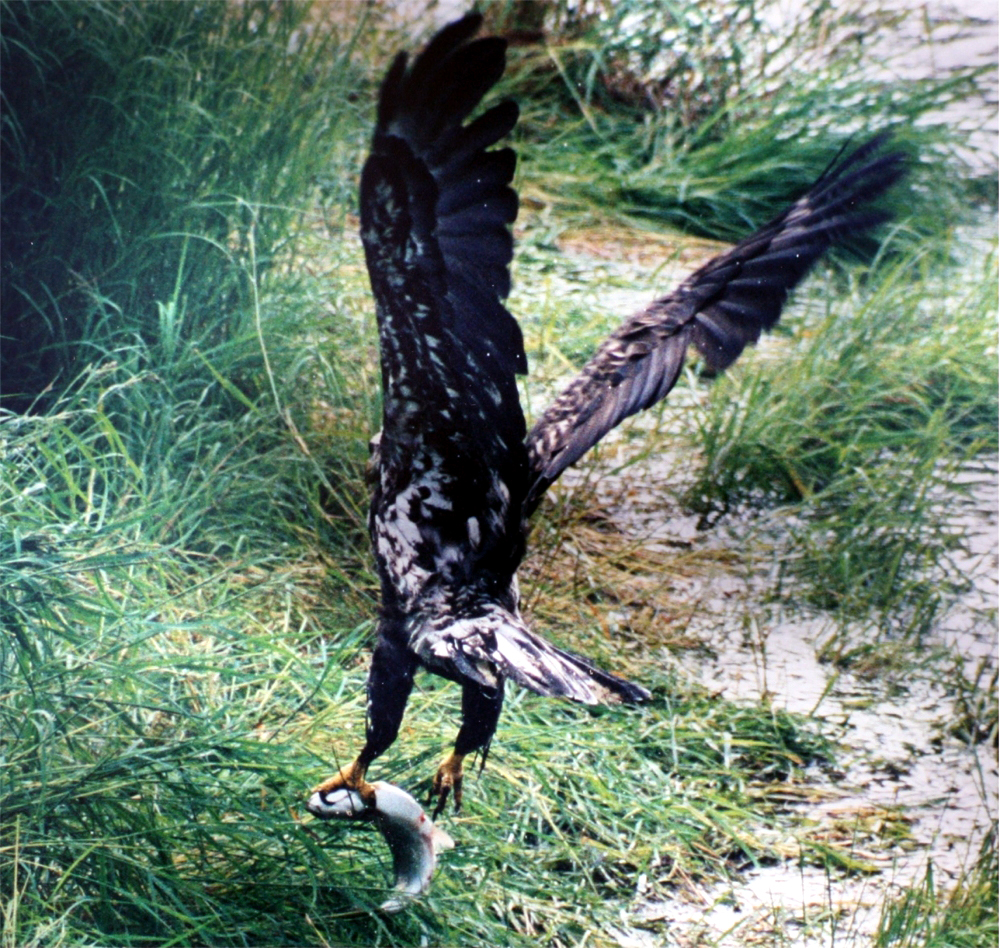
To hunt fish, the eagle swoops down over the water and snatches the fish out of the water with its talons. They eat by holding the fish in one claw and tearing the flesh with the other. Eagles have structures on their toes called spicules that allow them to grasp fish. Ospreys also have this adaptation. Bird prey may occasionally be attacked in flight, with prey up to the size of Canada geese attacked and killed in mid-air. Bald eagles can fly with fish at least equal to their own weight, but if the fish is too heavy to lift, the eagle may be dragged into the water. Bald eagles can swim, but in some cases, they drag their catch ashore with their talons. Still, some eagles drown or succumb to hypothermia. Many sources claim that bald eagles, like all large eagles, cannot normally take flight carrying prey more than half of their own weight unless aided by favorable wind conditions. On numerous occasions, when large prey such as large fish including mature salmon or geese are attacked, eagles have been seen to make contact and then drag the prey in a strenuously labored, low flight over the water to a bank, where they then finish off and dismember the prey. While hunting waterfowl, bald eagles repeatedly fly at a target and cause it to dive repeatedly, hoping to exhaust the victim so it can be caught (white-tailed eagles have been recorded hunting waterfowl in the same way). When hunting concentrated prey, a successful catch often results in the hunting eagle being pursued by other eagles and needing to find an isolated perch for consumption if it is able to carry it away successfully.
They obtain much of their food as carrion or via a practice known as kleptoparasitism, by which they steal prey away from other predators. Due to their dietary habits, bald eagles are frequently viewed in a negative light by humans. Thanks to their superior foraging ability and experience, adults are generally more likely to hunt live prey than immature eagles, which often obtain their food from scavenging. They are not very selective about the condition or origin, whether provided by humans, other animals, auto accidents or natural causes, of a carcass's presence, but will avoid eating carrion where disturbances from humans are a regular occurrence. They will scavenge carcasses up to the size of whales, though carcasses of ungulates and large fish are seemingly preferred. Congregated wintering waterfowl are frequently exploited for carcasses to scavenge by immature eagles in harsh winter weather. Bald eagles also may sometimes feed on material scavenged or stolen from campsites and picnics, as well as garbage dumps (dump usage is habitual mainly in Alaska) and fish-processing plants.
Fish


In Southeast Alaska, fish comprise approximately 66% of the year-round diet of bald eagles and 78% of the prey brought to the nest by the parents. Eagles living in the Columbia River Estuary in Oregon were found to rely on fish for 90% of their dietary intake. At least 100 species of fish have been recorded in the bald eagle's diet. From observation in the Columbia River, 58% of the fish were caught alive by the eagle, 24% were scavenged as carcasses and 18% were pirated away from other animals.
In the Pacific Northwest, spawning trout and salmon provide most of the bald eagles' diet from late summer throughout fall. Though bald eagles occasionally catch live salmon, they usually scavenge spawned salmon carcass. Southeast Alaskan eagles largely prey on pink salmon (Oncorhynchus gorbuscha), coho salmon (O. kisutch) and, more locally, sockeye salmon (O. nerka), with Chinook salmon (O. tshawytscha). Due to the Chinook salmon's large size (12 to average adult size), it is probably taken only as carrion and a single carcass can attract several eagles. Also important in the estuaries and shallow coastlines of southern Alaska are Pacific herring (Clupea pallasii), Pacific sand lance (Ammodytes hexapterus) and eulachon (Thaleichthys pacificus). In Oregon's Columbia River Estuary, the most significant prey species were largescale suckers (Catostomus macrocheilus) (17.3% of the prey selected there), American shad (Alosa sapidissima; 13%) and common carp (Cyprinus carpio; 10.8%). Eagles living at Chesapeake Bay in Maryland were found to subsist largely on American gizzard shad (Dorosoma cepedianum), threadfin shad (Dorosoma petenense) and white bass (Morone chrysops). Floridian eagles have been reported to prey on catfish, most prevalently the brown bullhead (Ameiurus nebulosus) and any species in the genus Ictalurus as well as mullet, trout, needlefish, and eels. Wintering eagles on the Platte River in Nebraska preyed mainly on American gizzard shads and common carp.
Fish taken by bald eagles varies in size, but bald eagles take larger fish than other piscivorous birds in North America, typically range from 20 to and prefer 36 cm fish. When experimenters offered fish of different sizes in the breeding season around Lake Britton in California, fish measuring 34 to were taken 71.8% of the time by parent eagles while fish measuring 23 to were chosen only 25% of the time. At nests around Lake Superior, the remains of fish (mostly suckers) were found to average 35.4 cm in total length. In the Columbia River Estuary, most preyed on by eagles were estimated to measure less than 30 cm, but larger fish between 30 and or even exceeding 60 cm in length also taken especially during the non-breeding seasons. They can take fish up to at least twice their own weight, such as large mature salmons, carps, or even muskellunge (Esox masquinongy), by dragging its catch with talons and pull toward ashore. Much larger marine fish such as Pacific halibut (Hippoglossus stenolepis) and lemon sharks (Negaprion brevirostris) have been recorded among bald eagle prey though probably are only taken as young, as small, newly mature fish, or as carrion.
Benthic fishes such as catfish are usually consumed after they die and float to the surface, though while temporarily swimming in the open may be more vulnerable to predation than most fish since their eyes focus downwards. Bald eagles also regularly exploit water turbines which produce battered, stunned or dead fish easily consumed. Predators who leave behind scraps of dead fish that they kill, such as brown bears (Ursus arctos), gray wolves (Canis lupus) and Red foxes (Vulpes vulpes), may be habitually followed in order to scavenge the kills secondarily. Once North Pacific salmon die off after spawning, usually local bald eagles eat salmon carcasses almost exclusively. Eagles in Washington need to consume 489 g of fish each day for survival, with adults generally consuming more than juveniles and thus reducing potential energy deficiency and increasing survival during winter.
Birds
_32.jpg)
Behind fish, the next most significant prey base for bald eagles are other waterbirds. The contribution of such birds to the eagle's diet is variable, depending on the quantity and availability of fish near the water's surface. Waterbirds can seasonally comprise from 7% to 80% of the prey selection for eagles in certain localities. Overall, birds are the most diverse group in the bald eagle's prey spectrum, with 200 prey species recorded.
Bird species most preferred as prey by eagles tend to be medium-sized, such as western grebes (Aechmophorus occidentalis), mallards (Anas platyrhynchos), and American coots (Fulica americana) as such prey is relatively easy for the much larger eagles to catch and fly with. American herring gull (Larus smithsonianus) are the favored avian prey species for eagles living around Lake Superior. Black ducks (Anas rubripes), common eiders (Somateria mollissima), and double-crested cormorants (Phalacrocorax auritus) are also frequently taken in coastal Maine and velvet scoter (Melanitta fusca) was dominant prey in San Miguel Island.
.jpg)
Due to easy accessibility and lack of formidable nest defense against eagles by such species, bald eagles are capable of preying on such seabirds at all ages, from eggs to mature adults, and they can effectively cull large portions of a colony. Along some portions of the North Pacific coastline, bald eagles which had historically preyed mainly kelp-dwelling fish and supplementally sea otter (Enhydra lutris) pups are now preying mainly on seabird colonies since both the fish (possibly due to overfishing) and otters (cause unknown) have had steep population declines, causing concern for seabird conservation. Because of this more extensive predation, some biologist has expressed concern that murres are heading for a "conservation collision" due to heavy eagle predation. Eagles have been confirmed to attack nocturnally active, burrow-nesting seabird species such as storm petrels and shearwaters by digging out their burrows and feeding on all animals they find inside. If a bald eagle flies close by, waterbirds will often fly away en masse, though they may seemingly ignore a perched eagle in other cases. When the birds fly away from a colony, this exposes their unprotected eggs and nestlings to scavengers such as gulls.
While they usually target small to medium-sized seabirds, larger seabirds such as great black-backed gulls (Larus marinus) and northern gannets (Morus bassanus) and brown pelicans (Pelecanus occidentalis) of all ages can successfully be taken by bald eagles. Similarly, large waterbirds are occasionally killed. Geese such as wintering emperor geese (Chen canagica) and snow geese (C. caerulescens), which gather in large groups, sometimes becoming regular prey. Smaller Ross's geese (Anser rossii) are also taken, as well as large-sized Canada geese (Branta canadensis). Predation on the largest subspecies (Branta canadensis maxima) has been reported. Other large waterbird prey include common loons (Gavia immer) of all ages. Large wading birds can also fall prey to bald eagles. For the great blue herons (Ardea herodias), bald eagles are their only serious enemies of all ages. Slightly larger Sandhill cranes (Grus canadensis) can be taken as well. While adult whooping cranes (Grus americana) are too large and formidable, their chicks can fall prey to bald eagles. They even occasionally prey on adult tundra swans (Cygnus columbianus).
Bald eagles have been occasionally recorded as killing other raptors. In some cases, these may be attacks of competition or kleptoparasitism on rival species but end with the consumption of the dead victims. Nine species of other accipitrids and owls are known to have been preyed upon by bald eagles. Owl prey species have ranged in size from western screech owls (Megascops kennicotti) to snowy owls (Bubo scandiacus). Larger diurnal raptors known to have fallen victim to bald eagles have included red-tailed hawks (Buteo jamaicensis), peregrine falcons (Falco peregrinus), northern goshawks (Accipiter gentilis), ospreys (Pandion haliaetus) and black (Coragyps atratus) and turkey vultures (Cathartes aura).
Mammals
.jpg)
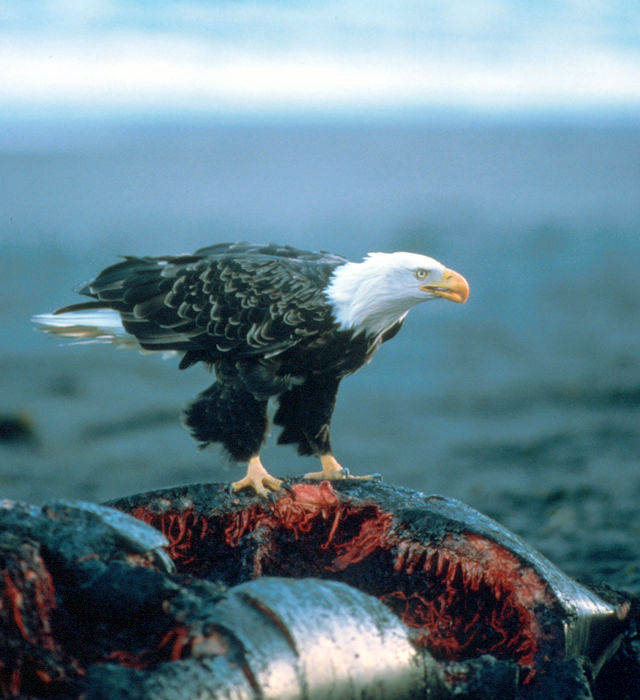
Mammalian preys are generally less frequently taken than fish or avian prey. However, in some regions, such as landlocked areas of North America, wintering bald eagles may become habitual predators of medium-sized mammals that occur in colonies or local concentrations, such as prairie dogs (Cynomys sp.) and jackrabbits (Lepus sp.). Bald eagles in Seedskadee National Wildlife Refuge often hunt in pair to catch cottontails, jackrabbits and prairie dogs. They can attack and prey on rabbits and hares of nearly any size, from marsh rabbits (Sylvilagus palustris) to black and white-tailed jackrabbits (Lepus californicus & L. townsendii), and Arctic hares (Lepus arcticus). In the San Luis Valley, white-tailed jackrabbits can be important prey. Even North American porcupines (Erethizon dorsatum) are reportedly attacked and killed.
Where available, seal colonies can provide a lot of food. On Protection Island, Washington, they commonly feed on harbor seal (Phoca vitulina) afterbirths, still-borns and sickly seal pups. Similarly, bald eagles in Alaska readily prey on sea otter (Enhydra lutris) pups. Small to medium-sized terrestrial mammalian carnivores can be taken infrequently. Mustelid including American martens (Martes pennanti), American minks (Neogale vison), and larger fisher cats (Pekania pennanti) are known to be hunted. Foxes are also taken, including island foxes (* Urocyon littoralis *), Arctic foxes (Vulpes lagopus), and grey foxes (Urocyon cinereoargenteus). Although fox farmers claimed that bald eagle heavily prey on young and adult free-range Arctic fox, the predation events are sporadic. In one instance, two bald eagles fed upon a red fox (Vulpes vulpes) that had tried to cross a frozen Delaware Lake in Ohio. Other medium-sized carnivorans such as striped skunks (Mephitis mephitis), American hog-nosed skunks (Conepatus leuconotus), and common raccoons (Procyon lotor) are taken, as well as domestic cats (Felis catus) and dogs (Canis familiaris).
Other wild mammalian prey include fawns of deer such as white-tailed deer (Odocoileus virginianus) and Sitka deer (Odocoileus hemionus sitkensis), which weigh around 3 kg can be taken alive by bald eagles. In one instance, a bald eagle was observed carrying 6.8 kg mule deer (Odocoileus hemionus) fawn. Additionally, Virginia opossums (Didelphis virginiana) can be preyed upon. Still, predation events are rare due to their nocturnal habits.
Together with the golden eagle, bald eagles are occasionally accused of preying on livestock, especially sheep (Ovis aries). There are a handful of proven cases of lamb predation, some specimens weighing up to 11 kg, by bald eagles. Still, they are much less likely to attack a healthy lamb than a golden eagle. Both species prefer native, wild prey and are unlikely to cause any extensive detriment to human livelihoods. There is one case of a bald eagle killing and feeding on an adult, pregnant ewe (then joined in eating the kill by at least three other eagles), which, weighing on average over 60 kg, is much larger than any other known prey taken by this species.
Reptiles and other prey
Supplemental prey is readily taken given the opportunity. In some areas, reptiles may become regular prey, especially in warm areas such as Florida where reptile diversity is high. Turtles are perhaps the most regularly hunted type of reptile. In coastal New Jersey, 14 of 20 studied eagle nests included remains of turtles. The main species found were common musk turtles (Sternotherus odoratus), diamondback terrapin (Malaclemys terrapin) and juvenile common snapping turtles (Chelydra serpentina). In these New Jersey nests, mainly subadult and small adults were taken, ranging in carapace length from 9.2 to. Similarly, many turtles were recorded in the diet in the Chesapeake Bay. In Texas, softshell turtles are the most frequently taken prey, and a large number of Barbour's map turtles are taken in Torreya State Park. Other reptilian and amphibian prey includes southern alligator lizards (Elgaria multicarinata), snakes such as garter snakes and rattlesnakes, and Greater siren (Siren lacertina).
Invertebrates are occasionally taken. In Alaska, eagles feed on sea urchins (Strongylocentrotus sp.), chitons, mussels, and crabs. Other various mollusks such as land snails, abalones, bivalves, periwinkles, blue mussels, squids, and starfishes are taken as well.
Interspecific predatory relationships
When competing for food, eagles will usually dominate other fish-eaters and scavengers, aggressively displacing mammals such as coyotes (Canis latrans) and foxes, and birds such as corvids, gulls, vultures and other raptors. Occasionally, coyotes, bobcats (Lynx rufus) and domestic dogs (Canis familiaris) can displace eagles from carrion, usually less confident immature birds, as has been recorded in Maine.
Though bald eagles face few natural threats, an unusual attacker comes in the form of the common loon (G. immer), which is also taken by eagles as prey. While common loons normally avoid conflict, they are highly territorial and will attack predators and competitors by stabbing at them with their knife-like bill; as the range of the bald eagle has increased following conservation efforts, these interactions have been observed on several occasions, including a fatality of a bald eagle in Maine that is presumed to have come about as a result of it attacking a nest, then having a fatal puncture wound inflicted by one or both loon parents.
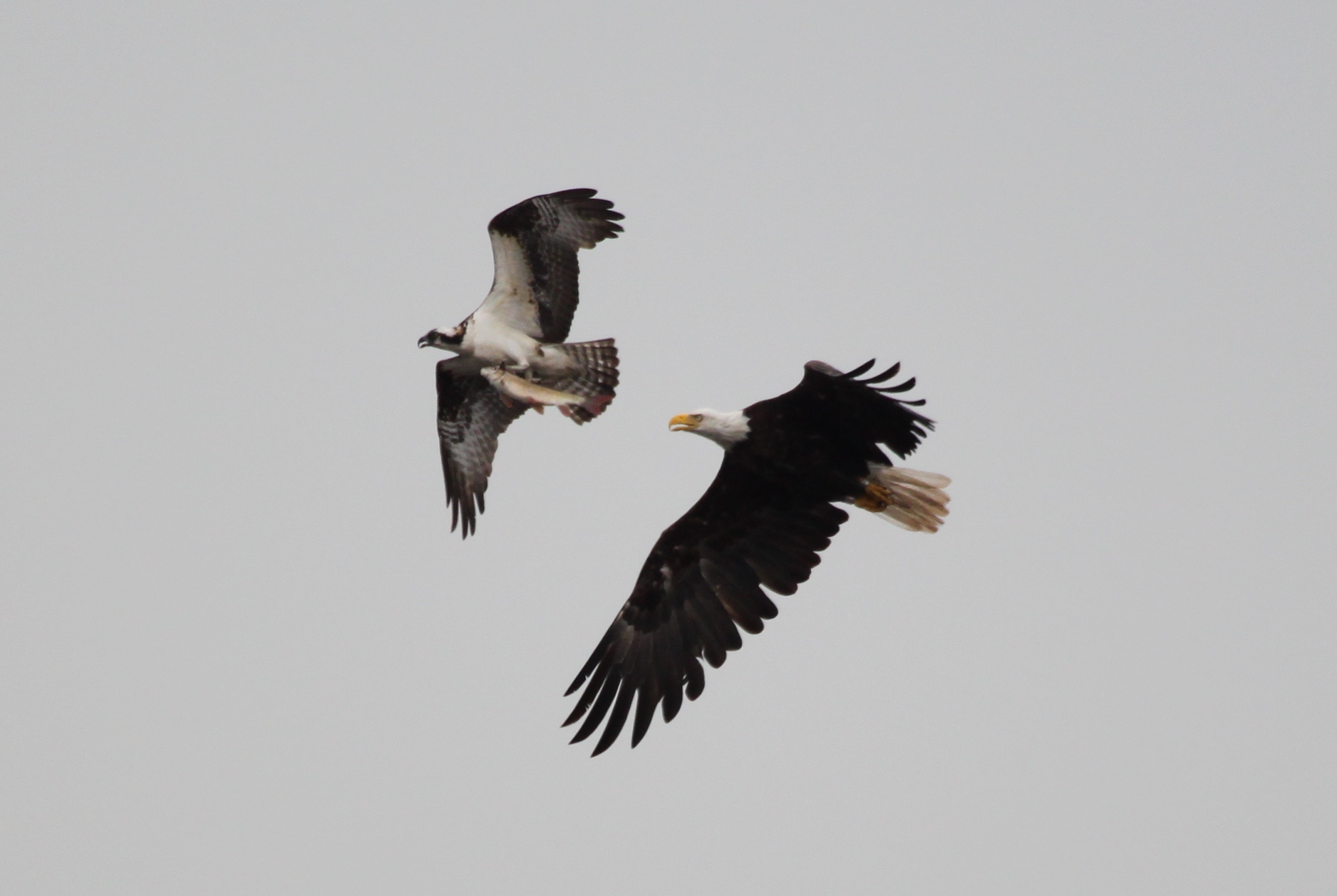
The bald eagle is thought to be much more numerous in North America than the golden eagle, with the bald species estimated to number at least 150,000 individuals, about twice as many as there are golden eagles estimated to live in North America. Due to this, bald eagles often outnumber golden eagles at attractive food sources. Despite the potential for contention between these animals, in New Jersey during winter, a golden eagle and numerous bald eagles were observed to hunt snow geese alongside each other without conflict. Similarly, both eagle species have been recorded, via video-monitoring, to feed on gut piles and carcasses of white-tailed deer (Odocoileus virginianus) in remote forest clearings in the eastern Appalachian Mountains without apparent conflict. Bald eagles are frequently mobbed by smaller raptors, due to their infrequent but unpredictable tendency to hunt other birds of prey. Many bald eagles are habitual kleptoparasites, especially in winters when fish are harder to come by. They have been recorded stealing fish from other predators such as ospreys, herons and even otters. They have also been recorded opportunistically pirating birds from peregrine falcons (Falco peregrinus), prairie dogs from ferruginous hawks (Buteo regalis) and even jackrabbits from golden eagles. When they approach scavengers such as dogs, gulls or vultures at carrion sites, they often attack them in an attempt to force them to disgorge their food. Healthy adult bald eagles are not preyed upon in the wild and are thus considered apex predators.
Reproduction
Bald eagles are sexually mature at four or five years of age. When they are old enough to breed, they often return to the area where they were born. Bald eagles have high mate fidelity and generally mate for life. However, if one pair member dies or disappears, the survivor will choose a new mate. A pair that has repeatedly failed in breeding attempts may split and look for new mates. Bald eagle courtship involves elaborate, spectacular calls and flight displays by the males.


Compared to most other raptors, which mostly nest in April or May, bald eagles are early breeders: nest building or reinforcing is often by mid-February, egg laying is often late February (sometimes during deep snow in the North), and incubation is usually mid-March and early May. Eggs hatch from mid-April to early May, and the young fledge from late June to early July. The nest is the largest of any bird in North America; it is used repeatedly over many years and with new material added each year may eventually be as large as 4 m deep, 2.5 m across and weigh 1 t. One nest in Florida was found to be 6.1 m deep, 2.9 m across, and to weigh 3 ST. This nest is on record as the largest tree nest ever recorded for any animal. Usually nests are used for under five years, as they either collapse in storms or break the branches supporting them by their sheer weight. However, one nest in the Midwest was occupied continuously for at least 34 years. The nest is built of branches, usually in large trees found near water. When breeding where there are no trees, the bald eagle will nest on the ground, as has been recorded largely in areas largely isolated from terrestrial predators, such as Amchitka Island in Alaska.

In Sonora, Mexico, eagles have been observed nesting on top of hecho cactuses (Pachycereus pectin-aboriginum). Nests located on cliffs and rock pinnacles have been reported historically in California, Kansas, Nevada, New Mexico and Utah, but currently are only verified to occur only in Alaska and Arizona. The eggs average about 73 mm long, ranging from 58 to, and have a breadth of 54 mm, ranging from 47 to. Eggs in Alaska averaged 130 g in mass, while in Saskatchewan they averaged 114.4 g. As with their ultimate body size, egg size tends to increase with distance from the equator. Eagles produce between one and three eggs per year, two being typical. Rarely, four eggs have been found in nests, but these may be exceptional cases of polygyny. Eagles in captivity have been capable of producing up to seven eggs. It is rare for all three chicks to successfully reach the fledgling stage. The oldest chick often bears the advantage of a larger size and louder voice, which tends to draw the parents' attention towards it. Occasionally, as is recorded in many large raptorial birds, the oldest sibling sometimes attacks and kills its younger sibling(s), especially early in the nesting period when their sizes are most different. However, nearly half of the known bald eagles produce two fledglings (more rarely three), unlike in some other "eagle" species such as some in the genus Aquila, in which a second fledgling is typically observed in less than 20% of nests, despite two eggs typically being laid. Both the male and female take turns incubating the eggs, but the female does most of the sitting. The parent not incubating will hunt for food or look for nesting material during this stage. For the first two to three weeks of the nestling period, at least one adult is at the nest almost 100% of the time. After five to six weeks, the attendance of parents usually drops off considerably (with the parents often perching in trees nearby).
.jpg)
A young eaglet can gain up to 170 g a day, the fastest growth rate of any North American bird. The young eaglets pick up and manipulate sticks, play tug of war with each other, practice holding things in their talons, and stretch and flap their wings. By eight weeks, the eaglets are strong enough to flap their wings, lift their feet off the nest platform, and rise in the air. The young fledge at anywhere from 8 to 14 weeks of age, though will remain close to the nest and be attended to by their parents for a further six weeks. Juvenile eagles first start dispersing away from their parents about eight weeks after they fledge. Variability in departure date related to effects of sex and hatching order on growth and development. For the next four years, immature eagles wander widely in search of food until they attain adult plumage and are eligible to reproduce.
Male eagles have been observed killing and cannibalizing their chicks. In 2024, at the National Conservation Training Center (NCTC) in West Virginia, the NCTC's Eagle Cam recorded two bald eagle chicks being attacked and devoured by their father as soon as the mother departed from the nest. The NCTC noted in its statement on the incident that such behavior "has been observed in other nests and is not uncommon in birds of prey."
On rare occasions, bald eagles have been recorded to adopt other raptor fledglings into their nests, as seen in 2017 by a pair of eagles in Shoal Harbor Migratory Bird Sanctuary near Sidney, British Columbia. The pair of eagles in question are believed to have carried a juvenile red-tailed hawk back to their nest, presumably as prey, whereupon the chick was accepted into the family by both the parents and the eagles' three nestlings. The hawk, nicknamed "Spunky" by biologists monitoring the nest, fledged successfully.
Longevity and mortality

The average lifespan of bald eagles in the wild is around 20 years, with the oldest confirmed one having been 38 years of age. In captivity, they often live somewhat longer. In one instance, a captive individual in New York lived for nearly 50 years. As with size, the average lifespan of an eagle population appears to be influenced by its location and access to prey. As they are no longer heavily persecuted, adult mortality is quite low. In one study of Florida eagles, adult bald eagles reportedly had 100% annual survival rate.
Most non-human-related mortality involves nestlings or eggs. Around 50% of eagles survive their first year. However, in the Chesapeake Bay area, 100% of 39 radio-tagged nestlings survived to their first year. If food access is low, parental attendance at the nest may be lower because both parents may have to forage, thus resulting in less protection. Nestlings are usually exempt from predation by terrestrial carnivores that are poor tree-climbers, but Arctic foxes (Vulpes lagopus) occasionally snatched nestlings from ground nests on Amchitka Island in Alaska before they were extirpated from the island. The bald eagle will defend its nest fiercely from all comers and has even repelled attacks from bears, having been recorded knocking a black bear out of a tree when the latter tried to climb a tree holding nestlings.
Relationship with humans
Population decline and recovery

Once a common sight in much of the continent, the bald eagle was severely affected in the mid-20th century by a variety of factors, among them the thinning of egg shells attributed to use of the pesticide DDT. Other factors in bald eagle population reductions were a widespread loss of suitable habitat, as well as both legal and illegal shooting. In 1930 a New York City ornithologist wrote that in the territory of Alaska in the previous 12 years, approximately 70,000 bald eagles had been shot. Many of the hunters killed the bald eagles under the long-held beliefs that bald eagles grabbed young lambs and even children with their talons, yet the birds were innocent of most of these alleged acts of predation (lamb predation is rare, human predation is thought to be non-existent). Illegal shooting was described as "the leading cause of direct mortality in both adult and immature bald eagles" by the U.S. Fish and Wildlife Service in 1978. Leading causes of death in bald eagles include lead pollution, poisoning, collision with motor vehicles, and power line electrocution. A study published in 2022 in the Journal Science found that more than half of adult eagles across 38 U.S. states suffered from lead poisoning. The primary cause is when eagles scavenge carcasses of animals shot by hunters. These are often tainted with lead shotgun pellets, rifle rounds, or fishing tackle.
The species was first protected in the U.S. and Canada by the 1918 Migratory Bird Treaty, later extended to all of North America. The Bald and Golden Eagle Protection Act, approved by the U.S. Congress in 1940, protected the bald eagle and the golden eagle, prohibiting commercial trapping and killing of the birds as well as collecting their eggs. The bald eagle was declared an endangered species in the U.S. in 1967, and amendments to the 1940 act between 1962 and 1972 further restricted commercial uses and increased penalties for violators. Perhaps most significant in the species' recovery, in 1972, DDT was banned from usage in the United States due to the fact that it inhibited the reproduction of many birds. DDT was completely banned in Canada in 1989, though its use had been highly restricted since the late 1970s.

With regulations in place and DDT banned, the eagle population rebounded. The bald eagle can be found in growing concentrations throughout the United States and Canada, particularly near large bodies of water. In the early 1980s, the estimated total population was 100,000 individuals, with 110,000–115,000 by 1992; For some time, the stronghold breeding population of bald eagles in the lower 48 states was in Florida, where over a thousand pairs have held on while populations in other states were significantly reduced by DDT use. , the contiguous state with the largest number of breeding pairs of eagles is Minnesota, with an estimated 1,312 pairs, surpassing Florida's most recent count of 1,166 pairs. 23, or nearly half, of the 48 contiguous states had at least 100 breeding pairs of bald eagles. In Washington State, there were only 105 occupied nests in 1980. That number increased by about 30 per year, so that by 2005 there were 840 occupied nests. 2005 was the last year that the Washington Department of Fish and Wildlife counted occupied nests. Further population increases in Washington may be limited by the availability of late winter food, particularly salmon.

The bald eagle was officially removed from the U.S. federal government's list of endangered species on July 12, 1995, by the U.S. Fish & Wildlife Service, when it was reclassified from "endangered" to "threatened". On July 6, 1999, a proposal was initiated "To Remove the Bald Eagle in the Lower 48 States From the List of Endangered and Threatened Wildlife". It was de-listed on June 28, 2007. It has also been assigned a risk level of "least-concern" category on the IUCN Red List. and the eagles may be considered a pest.
Killing permits
In December 2016, the U.S. Fish and Wildlife Service proposed extending the permits issued to wind generation companies to allow them to kill up to 4,200 bald eagles per year without facing a penalty, four times the previous number. The permits would last 30 years, six times the previous five-year term.
In captivity

Permits are required to keep bald eagles in captivity in the United States. Permits are primarily issued to public educational institutions, and the eagles that they show are permanently injured individuals that cannot be released to the wild. The facilities where eagles are kept must be equipped with adequate caging, as well as workers experienced in the handling and care of eagles. The bald eagle can be long-lived in captivity if well cared for, but does not breed well even under the best conditions.
In Canada and England, a license is required to keep bald eagles for falconry.
Cultural significance
The bald eagle is important in various Native American cultures and, as the national symbol of the United States, is prominent in seals and logos, coinage, postage stamps, and other items relating to the U.S. federal government.
Role in Native American culture
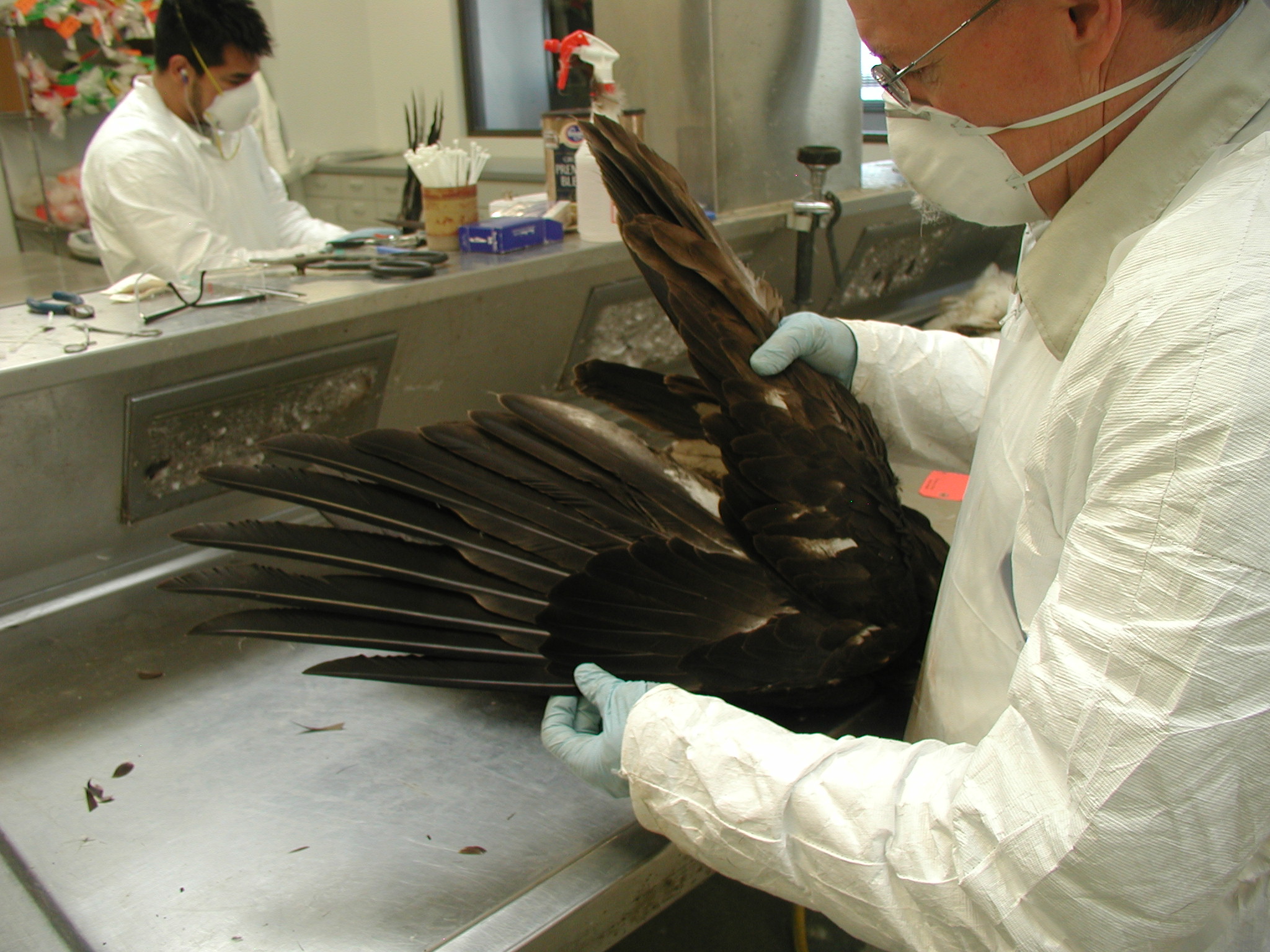
The bald eagle is a sacred bird in some North American cultures, and its feathers, like those of the golden eagle, are central to many religious and spiritual customs among Native Americans. Eagles are considered spiritual messengers between gods and humans by some cultures. Many powwow dancers use the eagle claw as part of their regalia as well. Eagle feathers are often used in traditional ceremonies, particularly in the construction of regalia worn and as a part of fans, bustles and head dresses. In the Navajo tradition an eagle feather is represented to be a protector, along with the feather Navajo medicine men use the leg and wing bones for ceremonial whistles. The Lakota, for instance, give an eagle feather as a symbol of honor to person who achieves a task. In modern times, it may be given on an event such as a graduation from college. The Pawnee consider eagles as symbols of fertility because their nests are built high off the ground and because they fiercely protect their young. The Choctaw consider the bald eagle, who has direct contact with the upper world of the sun, as a symbol of peace.
During the Sun Dance, which is practiced by many Plains Indian tribes, the eagle is represented in several ways. The eagle nest is represented by the fork of the lodge where the dance is held. A whistle made from the wing bone of an eagle is used during the course of the dance. Also during the dance, a medicine man may direct his fan, which is made of eagle feathers, to people who seek to be healed. The medicine man touches the fan to the center pole and then to the patient, in order to transmit power from the pole to the patient. The fan is then held up toward the sky, so that the eagle may carry the prayers for the sick to the Creator.
Eagle feather law stipulates that only individuals of certifiable Native American ancestry enrolled in a federally recognized tribe are legally authorized to obtain or possess bald or golden eagle feathers for religious or spiritual use. The constitutionality of these laws has been questioned by Native American groups on the basis that it violates the First Amendment by affecting ability to practice their religion freely.
The National Eagle Repository, a division of the FWS, exists as a means to receive, process, and store bald and golden eagles which are found dead and to distribute the eagles, their parts and feathers to federally recognized Native American tribes for use in religious ceremonies.
National symbol of the United States

The bald eagle is the national symbol of the United States.
The founders of the United States were fond of comparing their new republic with the Roman Republic, in which eagle imagery (usually involving the golden eagle) was prominent. On June 20, 1782, the Continental Congress adopted the design for the Great Seal of the United States, depicting a bald eagle grasping 13 arrows and an olive branch with 13 leaves with its talons.
The bald eagle appears on most official seals of the U.S. government, including the presidential seal, the presidential flag, and in the logos of many U.S. federal agencies. Between 1916 and 1945, the presidential flag (but not the seal) showed an eagle facing to its left (the viewer's right), which gave rise to the urban legend that the flag is changed to have the eagle face towards the olive branch in peace, and towards the arrows in wartime.
Contrary to popular legend, there is no evidence that Benjamin Franklin ever publicly supported the wild turkey (Meleagris gallopavo), rather than the bald eagle, as a symbol of the United States. However, in a letter written to his daughter in 1784 from Paris, criticizing the Society of the Cincinnati, he stated his personal distaste for the bald eagle's behavior. In the letter Franklin states:
Franklin opposed the creation of the Society because he viewed it, with its hereditary membership, as a noble order unwelcome in the newly independent Republic, contrary to the ideals of Lucius Quinctius Cincinnatus, for whom the Society was named. His reference to the two kinds of birds is interpreted as a satirical comparison between the Society of the Cincinnati and Cincinnatus.
Popular culture
Largely because of its role as a symbol of the United States, but also because it is a large predator, the bald eagle is often represented in popular culture. In film and television, the call of the red-tailed hawk is often substituted for the bald eagle's because the former is much louder and more powerful.
References
References
- "Haliaeetus leucocephalus Linnaeus 1766 (bald eagle)".
- BirdLife International. (2024). "''Haliaeetus leucocephalus''".
- "Appendices {{!}} CITES".
- {{LSJ. a(lia/etos. ἁλιάετος. longref
- {{LSJ. leuko/s2. λευκός. shortref
- {{LSJ. kefalh/. κεφαλή. shortref
- "National Bald Eagle Management Guidelines".
- (2005). "Florida's Birds: A Field Guide and Reference". Pineapple Press Inc.
- (1998). "Size Variation of Migrant Bald Eagles at Glacier National Park, Montana". J. Raptor Res..
- (2012). "Bald eagles (''Haliaeetus leucocephalus'') wintering in northern Arizona select perches based on food availability, visibility and cover". Northern Arizona University.
- (1986). "Eagles, Hawks and Falcons of the World". The Wellfleet Press.
- (1988). "Handbook of North American Birds Volume VI: Diurnal Raptors (Part 1)". Yale University Press.
- (2008). "Bald Eagles in Alaska". University of Alaska Southeast.
- Buehler, David A.. (2022). "Bald Eagle (''Haliaeetus leucocephalus'')". Cornell Lab of Ornithology.
- (1955). "The Bald Eagle and its economic status". US Government Printing Office.
- (1950). "The birds of north and middle America. Part XI. Cathartidae to Falconidae". U.S. Natl. Mus. Bull..
- "BBS Trend Maps – Bald eagle ''Haliaeetus leucocephalus''". Patuxent Wildlife Research Center.
- (August 14, 2006). "Animal Facts: Bald Eagle".
- Cecco, Leyland. (March 10, 2024). "Bald eagles seen nesting in Toronto for first time in city's recorded history". The Guardian.
- "Bald Eagle Viewing Directory".
- (January 22, 2017). "Making their comeback". oswegocountynewsnow.com.
- (December 15, 1987). "Bald Eagle Lands Exhausted in Ireland". Associated Press News.
- (2009). "British Ornithologists' Union Records Committee: 37th Report (October 2008)". Ibis.
- "Largest bird's nest". Guinnessworldrecords.com.
- (February 2, 1900). "Bald Eagle Fact Sheet, Lincoln Park Zoo".
- (1987). "The Bald Eagle". Universe Books.
- (2005). "Analysis of prey remains excavated from an historic bald eagle nest site on San Miguel Island, California". Institute for Wildlife Studies.
- "Gripping Strength of an Eagle – Understanding psi 101". Hawkquest.
- Potts, Steve. (1999). "The Bald Eagle". Capstone.
- (1984). "Bald Eagles of the San Luis valley, Colorado: their winter ecology and spring migration". Montana State University.
- (1982). "Ecology of Bald Eagles wintering near a waterfowl concentration". U.S. Fish and Wildlife Service.
- "Bald Eagle | The Peregrine Fund".
- Audubon, John James. (1840). "White-headed or bald Eagle, ''Haliaetus leucocephalus'', Linn. [Pl. 14]". The Birds of America: From Drawings Made in the United States and Their Territories.
- (1976). "Bald Eagles in Alaska".
- (1964). "The American eagles and their economic status".
- (1982). "Food habits of bald eagles in Maine". The Journal of Wildlife Management.
- "''Haliaeetus leucocephalus'' (Bald eagle)".
- (1975). "Food Habits of Bald Eagles in North-Central Minnesota". The Journal of Wildlife Management.
- Beans, Bruce E.. (1996). "Eagle's Plume: The Struggle to Preserve the Life and Haunts of America's Bald Eagle". Scribner.
- (2016). "Mercury risk to avian piscivores across western United States and Canada". Science of the Total Environment.
- "Bald Eagle Catching Salmon 8598". The Brackendale and Yellowstone page.
- (1975). "Food habits of nesting Bald Eagles in southeast Alaska". The Condor.
- Delong, D. C. Jr.. (1990). "Effects of food on Bald Eagle distribution and abundance on the northern Chesapeake Bay: an experimental approach". Virginia Polytechnic Institute and State University.
- (2007). "Archaeological implications of a bald eagle nesting site at Ferrelo Point, San Miguel Island, California". Journal of Archaeological Science.
- Good, T.P.. "Great Black-backed Gull- Behavior- Birds of North America Online". Cornell Lab of Ornithology.
- Mowbray, Thomas B. "Northern Gannet — Behavior". Birds of North America Online. The Cornell Lab of Ornithology. Retrieved October 17, 2011
- Shields, M. (2020). Brown Pelican (Pelecanus occidentalis), version 1.0. In Birds of the World (A. F. Poole, Editor). Cornell Lab of Ornithology, Ithaca, NY, USA. https://doi.org/10.2173/bow.brnpel.01
- (2020). "Bald Eagle Swims to Shore with Ross's Goose". Journal of Raptor Research.
- (1988). "Bald Eagle kills and carries Giant Canada Goose". Blue Jay.
- Windels, S. K., Beever, E. A., Paruk, J. D., Brinkman, A. R., Fox, J. E., Macnulty, C. C., ... & Osborne, D. C. (2013). Effects of water‐level management on nesting success of common loons. The Journal of wildlife management, 77(8), 1626–1638.
- Forbes, L. Scott. (1987). "Predation on Adult Great Blue Herons: Is It Important?". Colonial Waterbirds.
- (2009). "Postmortem evaluation of reintroduced migratory whooping cranes in eastern North America". Journal of Wildlife Diseases.
- (2019). "First description of a Bald Eagle (''Haliaeetus leucocephalus'') attempting depredation on an adult Whooping Crane (''Grus americana'') of the Aransas-Wood Buffalo population". Monographs of the Western North American Naturalist.
- (2006). "Population growth parameters of a reintroduced trumpeter swan flock, Seney National Wildlife Refuge, Michigan, USA (1991-2004)". Waterbirds.
- "Bald Eagle attacking a Trumpeter Swan".
- (2008). "Bald eagles and sea otters in the Aleutian archipelago: indirect effects of trophic cascades". Ecology.
- (2010). "Raptors of New Mexico". UNM Press.
- (January 24, 2016). "Seedskadee Officials Discuss Bald Eagle Hunting Strategies".
- (1980). "Food habits of the Bald Eagle in north-central Florida.". The Condor.
- Kralovec, Mary L.. (1992). "Nesting productivity, food habits, and nest sites of bald eagles in Colorado and southeastern Wyoming.". The Southwestern Naturalist.
- Wheeler, B. K. (2003). Raptors of eastern north America (p. 439). Princeton, NJ: Princeton University Press.
- (1985). "Fall migration of Bald Eagles produced in northern Saskatchewan". Blue Jay.
- (1976). "Biology of the Bald Eagle on Amchitka Island, Alaska". The Living Bird.
- (May 8, 1981). "''Martes pennanti''". Mammalian Species.
- (2002). "Comparative Home Ranges and Food Habits of Bald Eagles Nesting in Four Aquatic Habitats in Western Washington". Society for Northwestern Vertebrate Biology.
- (2010). "Survival and causes of mortality for fisher and marten in Minnesota". Minn. Dep. Nat. Resour. Summ. Wildl. Res. Findings.
- (June 23, 1995). "''Urocyon littoralis''". Mammalian Species.
- (December 26, 2002). "''Alopex lagopus''". Mammalian Species.
- (1906). "The North American eagles and their economic relations".
- Anthony, R. G., Estes, J. A., Ricca, M. A., Miles, A. K., & Forsman, E. D. (2008). Bald eagles and sea otters in the Aleutian archipelago: indirect effects of trophic cascades. Ecology, 89(10), 2725-2735.
- (February 11, 2021). "A Gathering of Eagles".
- (May 25, 1982). "''Mephitis mephitis''". Mammalian Species.
- (2009). "Conepatus leuconotus (Carnivora: Mephitidae)". Mammalian Species.
- Thompson, Sian. (April 23, 2014). "Two young eagles preying on cats in Campbell River".
- (2011). "Bald eagle predation of a white-tailed deer fawn". Northeastern Naturalist.
- (2016). "Bald Eagle Predation on Sitka Black-Tailed Deer Fawns". Northwestern Naturalist.
- Wood, G.. (1983). "The Guinness Book of Animal Facts and Feats". Guinness Superlatives.
- (October 10, 2021). "Eagle eating live Opossum".
- (1982). "Turtles as a food source of nesting bald eagles in the Chesapeake Bay region". Journal of Field Ornithology.
- (1995). "Prey of nesting bald eagles in Texas". Journal of Raptor Research.
- (1999). "Barbour's map turtle in the diet of nesting bald eagles". Florida Field Naturalist.
- Olson, Storrs L.. (October 1, 2006). "Bald Eagle, Haliaeetus leucocephalus, Preying on Maritime Garter Snake, Thamnophis sirtalis pallidulus, on Cape Breton Island, Nova Scotia". The Canadian Field-Naturalist.
- (1995). "Food habits of bald eagles breeding in the Arizona desert". The Wilson Bulletin.
- (2001). "Shellfish feeders, carrion eaters, and aquatic adaptations". American Antiquity.
- (1987). "Agonistic encounters between Bald Eagles and other raptors wintering in west central Utah". Journal of Raptor Research.
- Bittel, Jason. (May 27, 2020). "Why did a loon stab a bald eagle through the heart?".
- Jenkins, J. M., & Jackman, R. E. (1993). Mate and nest site fidelity in a resident population of Bald Eagles. Condor, 1053-1056.
- (January 29, 2015). "Bald eagles fight, tangle and fall out of the sky". Baltimore Sun.
- Erickson, L.. (2007). "Bald Eagle, About Bald Eagle Nests". Journey North.
- (July 27, 2010). "Amazing Bird Records".
- (2007). "Documentation of Infanticide and Cannibalism in Bald Eagles". Journal of Raptor Research.
- (April 14, 2024). "Second chick at NCTC eagle nest in West Virginia killed by father".
- (June 9, 2017). "Bald eagle adopts 'mortal enemy' baby hawk". BBC News.
- (July 25, 2017). "Why This Young Hawk Thinks It's an Eagle".
- (June 14, 2015). "Bald eagle believed oldest banded of its species found dead". Washington Times (Associated Press).
- [[United States Forest Service]]. (2023). "Final Environmental Impact Statement for the Revised Land and Resource Management Plan for National Forests in Florida". [[University of Florida]].
- "Bald Eagle Fact Sheet". Southern Ontario Bald Eagle Monitoring Project.
- (August 7, 2020). "What kills bald eagles in Michigan? Most comprehensive study ever has the answers". Detroit Free Press.
- (April 2020). "Sources of Mortality in Bald Eagles in Michigan, 1986–2017". The Journal of Wildlife Management.
- (2008). "Status and management of fisher (''Martes pennanti'') in Pennsylvania". Pennsylvania Game Commission.
- {{YouTube. OTr0qkC5sZw. Bald Eagle attacks Black bear again at Redoubt Bay
- (May 26, 2016). "Adopt a Bald Eagle". Smithsonian's National Zoo & Conservation Biology Institute.
- (2015). "South Carolina's Bald Eagles – Past Surveys". South Carolina Department of Natural Resources.
- (March 1930). "American Bald Eagle Is Near Extinction".
- (March 1978). "Bald Eagle's Status Listed for 48 States". Endangered Species Technical Bulletin.
- (December 2014). "Causes of Mortality in Eagles Submitted to The National Wildlife Health Center 1975–2013". Wildlife Society Bulletin.
- Main, Douglas. (February 17, 2022). "Most U.S. eagles suffer from lead poisoning, study suggests".
- (June 8, 1940). "Bald and Golden Eagle Protection Act",%20nests,%20or%20eggs.). [[U.S. Fish & Wildlife Service]].
- "Federal Laws that Protect Bald and Golden Eagles". US Fish and Wildlife Service.
- "Bald Eagle Removed from Endangered Species List". US Fish and Wildlife Service.
- (March 18, 2013). "Bald Eagle Breeding Pairs 1963 to 2006". U.S. Fish & Wildlife Service.
- "Threatened and Endangered Wildlife in Washington, 2012 Annual Report". Washington Department of Fish and Wildlife.
- "History of Bald Eagle Decline, Protection and Recovery".
- (2001). "Direct and Indirect Effects: Interactions Between Bald Eagles and Common Murres". Ecological Applications.
- (January 19, 2017). "When the National Bird Is a Burden". [[The New York Times Magazine]].
- (May 4, 2016). "New Wind Energy Permits Would Raise Kill Limit of Bald Eagles But Still Boost Conservation, Officials Say".
- Daly, Matthew. (April 18, 2013). "New federal rule would permit thousands of eagle deaths".
- (September 21, 2010). "Migratory Bird Permits; Possession and Educational Use". US Fish and Wildlife Service.
- (May 26, 2016). "Birds of prey used for falconry". Ontario Ministry of Natural Resources and Forestry.
- (June 26, 2018). "Courses". Thirsk Bird of Prey Centre.
- (January 12, 2018). "Meet Challenger, a bald eagle whose soaring skills are in high demand". Washington Post.
- (January 12, 2018). "'Wings of America' Birds of Prey Show". American Eagle Foundation.
- Dell'Orto, Giovanna. (2025-07-13). "Bald eagle's new status as the official US bird brings pride and hope to many Native Americans".
- "Eagle Myths and Legends – American Bald Eagle Information".
- "Bald Eagle Population Recovery and the Endangered Species Act". U.S. Fish and Wildlife Service.
- "U.S. Fish & Wildlife Service Office of Law Enforcement / Native Americans and Alaskan Natives – National Eagle Repository".
- Koch, Alexandra. (December 25, 2024). "It's official: Biden signs new law, designates bald eagle as 'national bird'". FOX 13 Seattle.
- Halpert, Madeline. (December 25, 2024). "Bald eagle officially declared US national bird after 250 years".
- (November 5, 2001). "A Turn of the Head". snopes.com.
- "Bald Eagle, Life History, All About Birds – Cornell Lab of Ornithology".
- (May 18, 2007). "American Heraldry Society | MMM / The Arms of the United States: Benjamin Franklin and the Turkey". Americanheraldry.org.
- Jessica Robinson, "[https://www.npr.org/templates/story/story.php?storyId=156187375 Bald Eagle: A Mighty Symbol, With A Not-So-Mighty Voice]"; [[NPR]], July 2, 2012; accessed 2019.08.23.
- Harris. "Bald Eagle ''Haliaeetus leucocephalus''". University of Michigan Museum of Geology.
- Daum, David W.. "Bald Eagle". Alaska Department of Fish & Game.
- Armstrong, R.. "The Importance of Fish to Bald Eagles in Southeast Alaska: A Review". U.S. Forest Service.
- Bird, D.M.. (2004). "The Bird Almanac: A Guide to Essential Facts and Figures of the World's Birds". Firefly Books.
- Dunning, Jr., J.B., ed. (1993). ''CRC Handbook of Avian Body Masses''. CRC Press, Ann Arbor.
- Linnaeus, Carolus. (1766). "Systema naturae per regna tria naturae, secundum classes, ordines, genera, species, cum characteribus, differentiis, synonymis, locis. Tomus I. Editio duodecima, reformata.". Holmiae. (Laurentii Salvii)..
- Evans, R. M. and F. L. Knopf. (1993). "American White Pelican (''Pelecanus erythrorhynchos'')". In: A. Poole and F. Gill, (eds.), ''The Birds of North America'', No. 57. Philadelphia: The Academy of Natural Sciences; Washington D.C.: The American Ornithologists Union.
- Brown, Leslie. (1976). "Birds of Prey: Their biology and ecology". Hamlyn.
- Fraser, J. D. (1985). "The impact of human activities on Bald Eagle populations-a review". pp. 68–84 in ''The Bald Eagle in Canada''. (Gerrard, J. M. and T. M. Ingram, Eds.) White Horse Plains Publishers Headingley, Manitoba.
- Dudley, Karen. (1998). "Bald Eagles". Raintree Steck-Vaughn Publishers.
- "Beaver". Study of Northern Virginia Ecology, Fairfax County Public School.
- Bent, A. C. 1937. ''Life histories of North American birds of prey, Part 1''. U.S. National Museum Bulletin 167.
- (September 21, 2007). "Status of the bald eagle in the lower 48 states and the District of Columbia: 1963–2007". Center for Biological Diversity.
- Bortolotti, G. R.. (1984). "Physical development of nestling Bald Eagles with emphasis on the timing of growth events". Wilson Bulletin.
- (2002). "American Coot (''Fulica americana'')". The Birds of North America Online.
- Wood, P. B., D. A. Buehler, and M. A. Byrd. (1990). "Raptor status report – Bald Eagle". pp. 13–21 in ''Proceedings of the southeast raptor management symposium and workshop''. (Giron Pendleton, B., Ed.) National Wildlife Federation Washington, D.C.
- Bull J. (1987). "Audubon Society Field Guide to North American Birds: Eastern Region". Alfred A. Knopf.
- Coleman, J.. (1986). "Predation on Black and Turkey Vultures". The Wilson Bulletin.
- "Bald Eagle, ''Haliaeetus leucocephalus''". Cornell Lab of Ornithology.
- "''Habits and Habitats of Bald Eagles''". Drexel University.
- Brown, N. L.. "Bald Eagle ''Haliaeetus leucocephalus''". Endangered Species Recovery Program.
- (2001). "Raptors of the World". [[Helm Identification Guides.
- "The Bald Eagle in Florida". Florida Power & Light Company.
- Dietz, Joshua. "What's in a Name". Smithsonian National Zoological Park.
- Gill Jr., R.. (1993). "Are Bald Eagles Important Predators of Emperor Geese?". Journal of Raptor Research.
- "Wildlife Species: ''Haliaeetus leucocephalus''". USDA Forest Service.
- O'Brien, Greg. (2005). "Choctaws in a Revolutionary Age, 1750–1830". University of Nebraska Press.
- Hayward, J.. (2010). "Foraging-Related Activity of Bald Eagles at a Washington Seabird Colony and Seal Rookery". Journal of Raptor Research.
- del Hoyo, J., Elliott, A., & Sargatal, J., eds. (1994). ''[[Handbook of the Birds of the World]]'' Vol. 2. Lynx Edicions, Barcelona {{ISBN. 84-87334-15-6
- Henderson, B.. "Murres and Bald Eagles in a 'Conservation Collision'". Coastwatch- Oregon Shores.
- Hensel, R. J.. (1964). "Nesting studies of the Bald Eagle in Alaska". Condor.
- O'Gara, B.. (August 3, 1994). "Bald and Golden Eagles damage management and predation control". Cooperative Extension Division Institute of Agriculture and Natural Resources University of Nebraska.
- "''Haliaeetus leucocephalus''". Integrated Taxonomic Information System.
- Jenkins, J.. (1994). "Field Experiments in Prey Selection by Resident Bald Eagles in the Breeding and Non-Breeding Season". Journal of Field Ornithology.
- Jones, S.. (January 1989). "Populations and Prey Selection Wintering Raptors in Boulder, Colorado". Proceedings of the North American Prairie Conferences.
- (1991). "Productivity, diet, and environmental contaminants in Bald Eagles nesting near the Wisconsin shoreline of Lake Superior". Archives of Environmental Contamination and Toxicology.
- Watson, J.. (1993). "Bald Eagles rear Red-tailed Hawks". Journal of Raptor Research.
- MacDonald, J.. (1994). "Bald Eagle attacks adult Osprey". Journal of Raptor Research.
- McEneaney, T.. (1983). "Bald Eagle predation on Domestic Sheep". The Wilson Bulletin.
- Melmer, David. (June 11, 2007). "Bald eagles may come off threatened list". Indian Country Today.
- Mersmann, T. J.. (1989). "Foraging ecology of Bald Eagles on the northern Chesapeake Bay with an examination of techniques used in the study of Bald Eagle food habits". Virginia Polytechnic Institute and State University.
- "Bald Eagles in South Carolina". Department of Natural Resources of South Carolina.
- DeGange, Anthony R.. (1982). "Bald Eagle Predation on Nocturnal Seabirds". Journal of Field Ornithology.
- Collier, Julie. "The Sacred Messengers". Mashantucket Pequot Museum.
- (2001). "Raptors of the World". [[Helm Identification Guides.
- "Bald Eagle Facts and Information". Eagles.org.
- "ARKive- Bald Eagle video, photos and facts". ARKive.org- Images of Life on Earth.
- (2009). "Ross Island FAQ". [[Willamette Riverkeeper]].
- (2010). "Bald eagles make nest in Heinz Wildlife Refuge". Delaware Daily Times.
- Carlson, Jen. (February 5, 2010). "Bald Eagle Spotted Near Fairway". Gothamist.
- "San Diego Zoo's Animal Bytes: Bald Eagle". Sandiegozoo.org.
- "Bald Eagle (''Haliaeetus leucocephalus'')". Michigan Department of Natural Resources.
- (April 28, 2009). "Bald Eagle: Life History and Habitat". myfwc.com.
- DeMeo, Antonia M.. (1995). "Access to Eagles and Eagle Parts: Environmental Protection v. Native American Free Exercise of Religion". Hastings Constitutional Law Quarterly.
- Boradiansky, Tina S.. (1990). "Conflicting Values: The Religious Killing of Federally Protected Wildlife". University of New Mexico School of Law.
- Lawrence, Elizabeth Atwood. "The Symbolic Role of Animals in the Plains Indian Sun Dance". University of Washington Press.
- "Fish and Wildlife Conservation Act, 1997". Ministry of Attorney General.
- EPA press release. (December 31, 1972). "DDT Ban Takes Effect". United States Environmental Protection Agency.
- Barrera, Jorge. (July 4, 2005). "Agent Orange has left deadly legacy Fight continues to ban pesticides and herbicides across Canada".
- "Bald Eagle Facts and Information". [[American eagle foundation]].
- (June 28, 2007). "Bald Eagle Facts and Information". Eagles.org.
- "Decline In Alaskan Sea Otters Affects Bald Eagles' Diet".
- "Original Design of the Great Seal of the United States (1782)". National Archives.
- "Official 1782 Description of America's Great Seal".
- "American Eagle on Great Seal of the United States".
- Sherrod, S. K.. (1976). "Biology of the Bald Eagle on Amchitka Island, Alaska". Living Bird.
- [[David Allen Sibley. Sibley, D.]] (2000). ''[[The Sibley Guide to Birds]]''. [[National Audubon Society]] {{ISBN. 0-679-45122-6 p. 127
- (1984). "Ecological energetics and foraging behavior of overwintering Bald Eagles". Ecological Monographs.
- Suring, L.. "Habitat Relationships of Bald Eagles in Alaska". U.S. Forest Service.
- Swenson, J. E.. (1986). "Ecology of Bald Eagles in the greater Yellowstone ecosystem". Wildlife Monographs.
- Terres, John K.. (1980). "The Audubon Society Encyclopedia of North American Birds". Knopf.
- Todd, C. S.. (1982). "Food habits of Bald Eagles in Maine". Journal of Wildlife Management.
- "Species Assessment for Bald Eagle (''Haliaeetus leucocephalus'') in Wyoming". United States Department of the Interior- Bureau of Land Management.
- Watson, Jeff. (2010). "The Golden Eagle". A&C Black.
- Waston, J.. "Foraging Ecology of Bald Eagles in the Columbia River Estuary". Oregon State University.
- "Predation on Northern Diamondback Terrapins (''Malaclemys terrapin terrapin'') by Bald Eagles (''Haliaeetus leucocephalus'') along the Atlantic Ocean and Delaware Bay Coasts of New Jersey". The Wetlands Institute.
- Wood, P.. (1993). "Bald Eagles Prey on Sandhill Cranes in Florida". Journal of Raptor Research.
- Schempf, P. R. (1997). "Bald eagle longevity record from Southeastern Alaska". Journal of Field Ornithology.
- Wink, M. (1996). "A mtDNA phylogeny of sea eagles (genus ''Haliaeetus'') based on nucleotide sequences of the cytochrome ''b'' gene". Biochemical Systematics and Ecology.
- Andrew, J. M.. (1982). "Bald Eagle nest site selection and nesting habitat in Maryland". Journal of Wildlife Management.
- Wood, P. B.. (1989). "Characteristics of Bald Eagle nesting habitat in Florida". Journal of Wildlife Management.
- Broley, C. L.. (1947). "Migration and nesting of Florida bald eagles". Wilson Bulletin.
- Vlietstra, L. S.. (1997). "Predation attempts on incubating Common Loons, ''Gavia immer'', and the significance of shoreline nesting". Canadian Field-Naturalist.
- Jorde, D.G.. (1998). "Kleptoparasitism by Bald Eagles wintering in South-Central Nebraska". Journal of Field Ornithology.
- Dekker, Dick. (2012). "The Effect of Kleptoparasitic Bald Eagles and Gyrfalcons on the Kill Rate of Peregrine Falcons Hunting Dunlins Wintering in British Columbia". Condor.
- Brown, B. T.. (1987). "First Bald Eagle nesting record from Sonora, Mexico". Wilson Bulletin.
- Gilbert, S.. (1981). "History of captive management and breeding of Bald Eagles". International Zoo Yearbook.
- Maestrelli, John R.. (March 1975). "Breeding Bald Eagles in Captivity". The Wilson Bulletin.
- Retfalvi, L.. (1970). "Food of nesting Bald Eagles on San Juan Island, Washington". Condor.
- Watt, J.. (1995). "Bald Eagle kleptoparasitizing sea otters at Amchitka Island, Alaska". Condor.
- McCollough, M. A.. (1994). "Supplemental feeding program for wintering Bald Eagles in Maine". Wildlife Society Bulletin.
- (1992). "Diets and foraging effectiveness of Bald Eagles during extreme winter weather in Nebraska". [[Journal of Wildlife Management]].
- Bowman, T. D.. (1995). "Bald Eagle survival and populations dynamics in Alaska after the Exxon Valdez oil spill". Journal of Wildlife Management.
- Sprunt, A.. (1964). "Excerpts from convention addresses on the 1963 Bald Eagle report". Audubon.
- Mckelvey, R. W.. (1979). "A black bear in a Bald Eagle nest". Murrelet.
- (1980). "Proceedings of Washington Bald Eagle symposium". The Nature Conservancy.
- (1988). "The Bald Eagle: Haunts and Habits of a Wilderness Monarch". Smithsonian Institution Press.
- (1994). "Dispersal of Bald Eagles fledged in Texas". J. Raptor Res..
- Doyle, F. I.. (1995). "Bald Eagle, ''Haliaeetus leucocephalus'', and Northern Goshawk, ''Accipiter gentilis'', nests apparently preyed upon by a wolverine(s), ''Gulo gulo'', in the southwestern Yukon Territory". Canadian Field-Naturalist.
- (1990). "Symbol of a Nation: The Bald Eagle in American Culture". The Journal of American Culture.
- Buehler, D. A.. (1991). "Survival rates and population dynamics of Bald Eagles on Chesapeake Bay". Journal of Wildlife Management.
- Folk, M. J.. (1992). "Cooperative hunting of avian prey by a pair of Bald Eagles". Florida Field Naturalist.
This article was imported from Wikipedia and is available under the Creative Commons Attribution-ShareAlike 4.0 License. Content has been adapted to SurfDoc format. Original contributors can be found on the article history page.
Ask Mako anything about Bald eagle — get instant answers, deeper analysis, and related topics.
Research with MakoFree with your Surf account
Create a free account to save articles, ask Mako questions, and organize your research.
Sign up freeThis content may have been generated or modified by AI. CloudSurf Software LLC is not responsible for the accuracy, completeness, or reliability of AI-generated content. Always verify important information from primary sources.
Report