From Surf Wiki (app.surf) — the open knowledge base
Badaga language
Dravidian language spoken in Southern India
.jpg)
Dravidian language spoken in Southern India
| Field | Value |
|---|---|
| name | Badaga |
| nativename | படக, ಬಡಗ, ബഡഗ |
| state | India |
| region | *Tamil Nadu (The Nilgiris) |
| ethnicity | Badaga |
| speakers | 134,000 |
| date | 2011 census |
| ref | e24 |
| familycolor | Dravidian |
| fam2 | Southern |
| fam3 | Southern I |
| fam4 | Tamil–Kannada |
| fam5 | Kannada–Badaga |
| iso3 | bfq |
| glotto | bada1257 |
| glottorefname | Badaga |
| script | Tamil, Kannada, Badaga |
| notice | IPA |
- Kerala (Palakkad)
Badaga () is a southern Dravidian language spoken by the Badaga people of the Nilgiris district of Tamil Nadu. The language is closely related to the Kannada language with influence from the Tamil language. Of all the tribal languages spoken in Nilgiris (Badaga, Toda language, Kota language (India)), Badaga is the most spoken language.
Origins
Badaga, like modern Kannada, likely originates from Old Kannada. This is suggested by the fact that Badaga shares many common features with modern Kannada. One such feature shared by both Badaga and Kannada is initial where other Dravidian languages, and Old Kannada, have an initial , a process which began around the 13th century.
Phonology
Badaga has five vowel qualities, , where each of them may be long or short, and until the 1930s they were contrastively half and fully retroflexed, for a total of 30 vowel phonemes. Current speakers only distinguish retroflection of a few vowels.
| IPA | Gloss |
|---|---|
| disease | |
| scar | |
| sprout | |
| tiger's den | |
| to spread out | |
| to remove | |
| seven | |
| tamarind | |
| bangle | |
| banana | |
| to strike | |
| chisel |
Note on transcription: rhoticity indicates half-retroflexion; doubled it indicates full retroflexion.
| Bilabial | Alveolar | Retroflex | Palatal | Velar | Glottal | Nasal | Stop | voiceless | voiced | Fricative | Approximant | Trill |
|---|
Writing system
Several attempts have been made at constructing an orthography based on English, Kannada and Tamil. The earliest printed book using Kannada script was a Christian work, "Anga Kartagibba Yesu Kristana Olleya Suddiya Pustaka" by Basel Mission Press of Mangaluru in 1890.
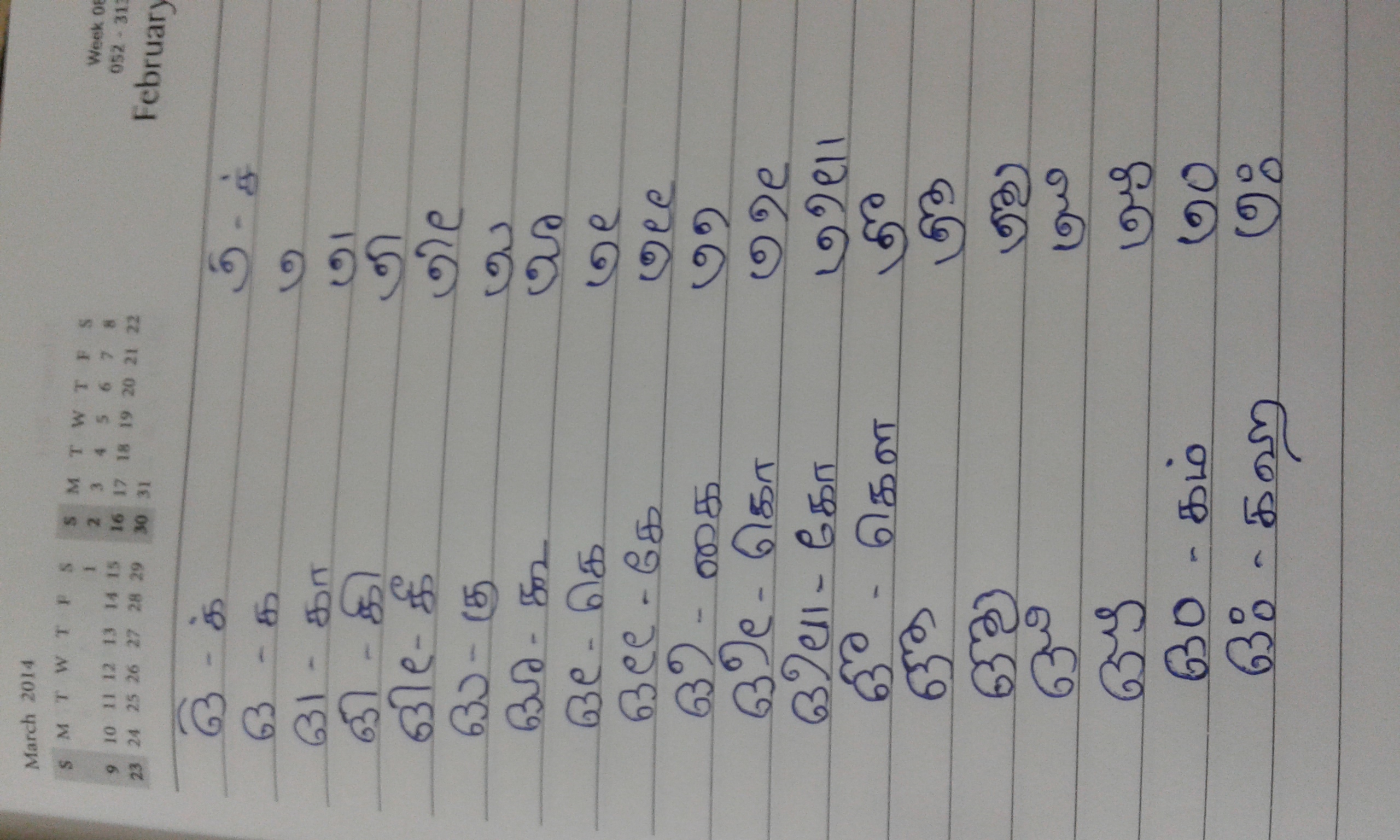
Badaga can also be written in the Kannada script and Tamil script.
Linguistic documentation
Badaga has been studied and documented by linguists. Several Badaga-English Dictionaries have been produced since the latter part of the nineteenth century.
A collection of proverbs and other traditional sayings of the Badaga has been collated and edited by Paul Hockings. It is the result of the work of many people, collecting material over many decades.
References
Relevant literature
- Hockings, Paul. Counsel from the ancients: A study of Badaga proverbs, prayers, omens, and curses. Mouton de Gruyter, 1988. Archive.org
- Hockings, Paul, and Christiane Pilot-Raichoor. A Badaga and English dictionary — glossary and gazetteer. Manohar Publishers & Distributors, 2023. [ISBN 978-93-91928-17-9]
References
- (1939). "The Vowels of the Badaga Language". Language.
- "Badaga". UCLA Phonetics Lab.
- "Word List for Badaga". UCLA Phonetics Lab.
- (1890). "The Gospel of Luke in Badaga". Basel Mission Press.
- (1992). "A Badaga-English Dictionary". Mouton de Gruyter.
- Hockings, Paul. ''"Counsel from the Ancients." A study of Badaga proverbs, prayers, omens and curses''. Berlin, Mouton de Gruyter (1988).
This article was imported from Wikipedia and is available under the Creative Commons Attribution-ShareAlike 4.0 License. Content has been adapted to SurfDoc format. Original contributors can be found on the article history page.
Ask Mako anything about Badaga language — get instant answers, deeper analysis, and related topics.
Research with MakoFree with your Surf account
Create a free account to save articles, ask Mako questions, and organize your research.
Sign up freeThis content may have been generated or modified by AI. CloudSurf Software LLC is not responsible for the accuracy, completeness, or reliability of AI-generated content. Always verify important information from primary sources.
Report