From Surf Wiki (app.surf) — the open knowledge base
Bacteriophage Qbeta
Species of virus

Species of virus
- Enterobacteria phage MX1
- Enterobacteria phage ST
- Enterobacteria phage VK
Bacteriophage Qbeta (Qubevirus durum), commonly referred to as Qbeta or Qβ, is a species consisting of several strains of positive-strand RNA virus which infects bacteria that have F-pili, most commonly Escherichia coli. Its linear genome is packaged into an icosahedral capsid with a diameter of 28 nm. Bacteriophage Qβ enters its host cell after binding to the side of the F-pilus.
Genetics
The genome of Qβ is approximately 4,217 nucleotides, depending on the source which sequenced the virus. Qβ has been isolated all over the world, multiple times, with various subspecies that code for nearly identical proteins but can have very different nucleotide sequences.
The genome has three open reading frames that encode four proteins: the maturation/lysis protein A2; the coat protein; a readthrough of a leaky stop codon in the coat protein, called A1; and the β-subunit of an RNA-dependent RNA-polymerase (RdRp) termed the replicase. The genome is highly structured, regulating gene expression and protecting itself from host RNases.
Coat protein A1
There are approximately 178 copies of the coat protein and/or A1 in the capsid.
Replicase/RdRp
The RNA-dependent RNA polymerase that replicates both the positive and negative RNA strands is a complex of four proteins: the catalytic beta subunit (replicase, ) is encoded by the phage, while the other three subunits are encoded by the bacterial genome: alpha subunit (ribosomal protein S1), gamma subunit (EF-Tu), and delta subunit (EF-Ts).
The structure of the Qbeta RNA replicase has been solved (). The two EF proteins serve as a chaperone for both the replicase and the RNA product. In fact, pure Qbeta polymerase is not soluble enough to be produced in large quantities, and a fusion protein constructed from the replicase and the two EF subunits is usually used instead. The fusion can function independently of ribosomal protein S1.
Maturation/lysis protein A2
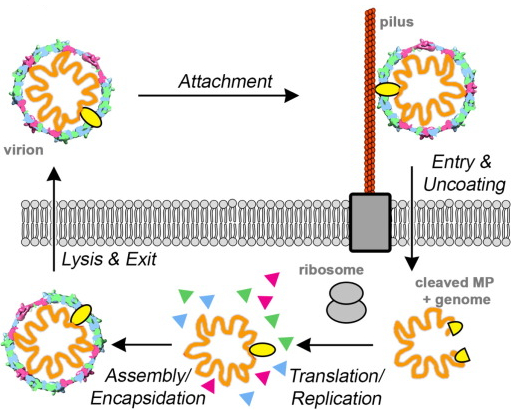
All positive-strand RNA phages encode a maturation protein, whose function is to bind the host pilus and the viral RNA. The maturation protein is named thus, as amber mutants in the maturation protein are unable to infect their host, or are 'immature.' For the related +ssRNA bacteriophage MS2, the maturation protein was shown to be taken up by the host along with the viral RNA and the maturation protein was subsequently cleaved.
In bacteriophage MS2, the maturation protein is called the A protein, as it belongs to the first open reading frame in the viral RNA. In Qβ the A protein was initially thought to be A1, as it is more abundant within the virion and is also required for infection. However, once the sequence of Qβ was determined, A1 was revealed to be a readthrough of the leaky stop codon.
A2 is the maturation protein for Qβ and has an additional role of being the lysis protein.
The mechanism of lysis is similar to that of penicillin; A2 inhibits the formation of peptidoglycan by binding to MurA, which catalyzes the first enzymatically committed step in cell wall biosynthesis.
Experiments
Main article: Spiegelman's monster
RNA from Bacteriophage Qβ was used by Sol Spiegelman in experiments that favored faster replication, and thus shorter strands of RNA. He ended up with Spiegelman's Monster, a minimal RNA chain of only 218 nucleotides that can be replicated by Qβ replicase.
References
References
- (October 2016). "Asymmetric cryo-EM structure of the canonical Allolevivirus Qβ reveals a single maturation protein and the genomic ssRNA in situ". Proceedings of the National Academy of Sciences of the United States of America.
- (August 2011). "Ongoing phenotypic and genomic changes in experimental coevolution of RNA bacteriophage Qβ and Escherichia coli". PLOS Genetics.
- (2006). "The Bacteriophages". Oxford University Press.
- (September 2010). "Assembly of Q{beta} viral RNA polymerase with host translational elongation factors EF-Tu and -Ts". Proceedings of the National Academy of Sciences of the United States of America.
- (May 2006). "Functional Qbeta replicase genetically fusing essential subunits EF-Ts and EF-Tu with beta-subunit". Journal of Bioscience and Bioengineering.
- (2018). "Virus Protein and Nucleoprotein Complexes". Springer Singapore.
- (September 1971). "Stages in phage R17 infection. V. Phage eclipse and the role of F pili". Virology.
- (September 1971). "Possible origin of a minor virus specific protein (A1) in Q-beta particles". Nature.
- (July 1983). "Overproduction of bacteriophage Q beta maturation (A2) protein leads to cell lysis". Cell.
- (October 2017). "Structures of Qβ virions, virus-like particles, and the Qβ-MurA complex reveal internal coat proteins and the mechanism of host lysis". Proceedings of the National Academy of Sciences of the United States of America.
- (2016). "[[The Ancestor's Tale]]". Houghton Mifflin Harcourt.
This article was imported from Wikipedia and is available under the Creative Commons Attribution-ShareAlike 4.0 License. Content has been adapted to SurfDoc format. Original contributors can be found on the article history page.
Ask Mako anything about Bacteriophage Qbeta — get instant answers, deeper analysis, and related topics.
Research with MakoFree with your Surf account
Create a free account to save articles, ask Mako questions, and organize your research.
Sign up freeThis content may have been generated or modified by AI. CloudSurf Software LLC is not responsible for the accuracy, completeness, or reliability of AI-generated content. Always verify important information from primary sources.
Report