From Surf Wiki (app.surf) — the open knowledge base
Baby walker
Device to help infants walk

Device to help infants walk

A baby walker is a device that can be used by infants who cannot walk on their own to move from one place to another. Modern baby walkers are also for toddlers. They have a base made of hard plastic sitting on top of wheels and a suspended fabric seat with two leg holes. In the US, baby walkers are responsible for about 2000 injuries annually to children serious enough to require a trip to the emergency room, prompting calls from pediatricians for their outright ban.
Cause of developmental delays
Many parents believe that such walkers teach a child to walk faster. However, they may actually delay walking by two to three weeks for a typical child. The amount of use matters; for every 24 hours babies spend in a baby walker (for example, one hour per day for 24 days), they learn to walk three days later and to stand four days later than they would have.
Safety issues
Baby walkers have also led to many preventable injuries caused by tripping, toppling over, or skidding on wet floors. These include injuries from falling down stairs while moving around in the baby walker, often with injuries that are worse than typical for falling down the stairs. Walkers allow babies to reach areas they otherwise couldn't, including pools, bathtubs, and kitchens, where they can be at risk for burns from pulling boiling food off stovetops. thus complicating a tally of the number of device-related injuries.
The U.S. Consumer Product Safety Commission, American Academy of Pediatrics, Kids In Danger, and other organizations have issued warnings to discourage parents from using baby walkers. Direct education of parents in a medical setting reduces parents' willingness to use these devices.
In Canada, the sale of baby walkers was banned on April 7, 2004. Canada is the first country in the world to ban the sale, importation and advertisement of baby walkers. This ban extends to modified and second hand baby walkers, including those sold at a yard sales or flea markets. The Canadian Consumers Product Safety Improvement Act of 2008 (CPSIA) changed the items that were allowed to be sold at such sales. Owners of baby walkers may be fined up to CA $100,000 or sentenced to up to six months in jail. /
In the United States, annual baby-walker-related injuries dropped from around 21,000 in 1990 to around 3,200 in 2003, attributed to publicity about the danger of such devices and voluntary safety improvements by manufacturers. Eight babies died from such injuries between 2004 and 2008. Annual injuries dropped a further 23% after mandatory U.S. Consumer Product Safety Commission standards (adopted in 2010) went into effect, including testing requirements and brakes to prevent stair falls.
Alternatives
.jpg)
Parent-assisted baby walkers were developed as an alternative to traditional baby walkers. These types of baby walkers differ greatly from traditional baby walkers as they have no wheels and require full parent assistance while in use. The design of modern parent-assisted baby walkers is similar to leading strings in that the child is suspended upright from straps while learning to walk. Parent-assisted baby walkers offer a safer method for teaching a child to walk over traditional baby walkers that can be unattended while in use.
History
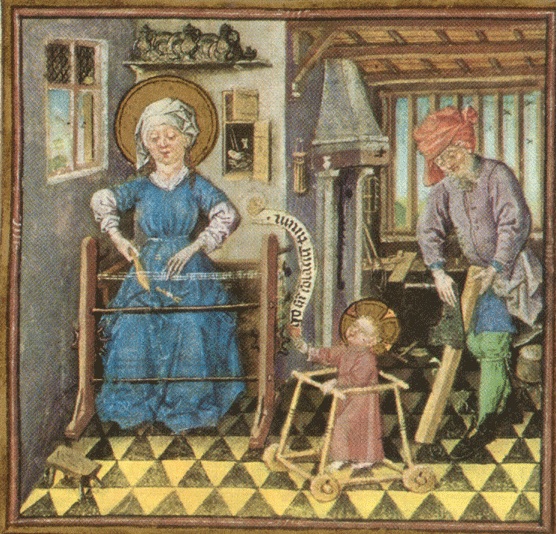


Baby walkers were known as early as the 15th century in Europe. An illumination in the Hours of Catherine of Cleves, a Dutch manuscript from that time, depicts the infant Jesus in a wooden baby walker.
Go-cart was a common historical name for the wheeled version. Other alternatives were also used. A baby-runner was a padded wooden ring, set at the height of the baby's waist, on a pole that was fixed into the floor and ceiling. The baby was placed inside the ring and able to move in a circle around the pole. This prevented the baby from reaching dangerous places, such as hot ovens.
References
References
- (November 2002). "Do baby walkers delay onset of walking in young children?". [[Br J Community Nurs]].
- (2002-06-22). "Locomotor milestones and babywalkers: cross sectional study". BMJ: British Medical Journal.
- "Parachute – Preventing Injuries. Saving Lives.".
- safety, Health. (2020-02-25). "ARCHIVED – Baby Walker bad or good".
- Canada, Health. (2004-09-28). "ARCHIVED - Injury Data Analysis Leads to Baby Walker Ban - Canada.ca".
- (2015-01-01). "Unintentional Home Injuries Across the Life Span: Problems and Solutions". Annual Review of Public Health.
- "SafetyLit Thesaurus Project".
- (2013-11-01). "Preventing childhood falls within the home: overview of systematic reviews and a systematic review of primary studies". Accident Analysis and Prevention.
- "Baby Walker Information from Health Sciences Centre in Winnipeg, Canada".
- (28 September 2004). "Injury Data Analysis Leads to Baby Walker Ban".
- (2004-04-08). "Baby walkers outlawed in Canada".
- (2008). "CPSIA Changes". [[U.S. Consumer Product Safety Commission.
- [https://www.npr.org/sections/health-shots/2018/09/17/646413330/as-injuries-continue-doctors-renew-call-for-ban-on-infant-walkers As Injuries Continue, Doctors Renew Call For Ban On Infant Walkers]
- (2010). "The Juppy Baby Walker". [[Yahoo! News]].
- Lamar, Cyriaque. (23 October 2012). "Behold, the divine baby walker of Jesus Christ". [[io9]].
- Snodgrass, Mary Ellen. (2004-12-29). "Encyclopedia of Kitchen History". Routledge.
This article was imported from Wikipedia and is available under the Creative Commons Attribution-ShareAlike 4.0 License. Content has been adapted to SurfDoc format. Original contributors can be found on the article history page.
Ask Mako anything about Baby walker — get instant answers, deeper analysis, and related topics.
Research with MakoFree with your Surf account
Create a free account to save articles, ask Mako questions, and organize your research.
Sign up freeThis content may have been generated or modified by AI. CloudSurf Software LLC is not responsible for the accuracy, completeness, or reliability of AI-generated content. Always verify important information from primary sources.
Report