From Surf Wiki (app.surf) — the open knowledge base
Baby hamster kidney cell
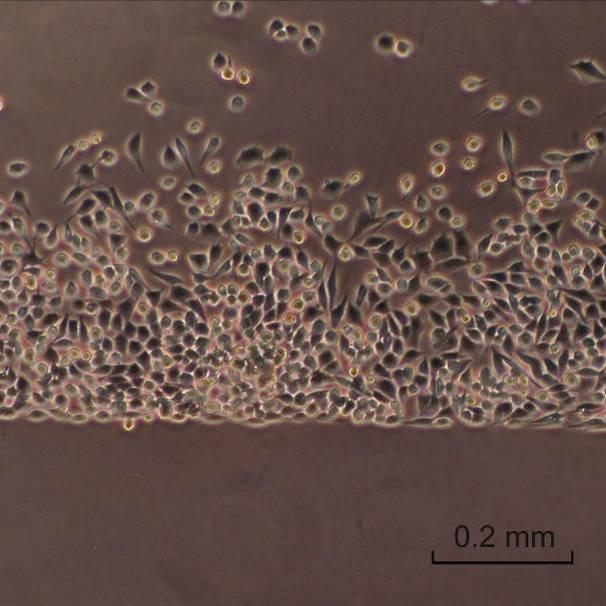
Baby Hamster Kidney fibroblasts (BHK cells) are an adherent cell line used in molecular biology. The cells were derived in 1961 by I. A. Macpherson and M. G. P. Stoker. Nowadays, subclone 13 is occasionally used, which was originally derived by single-cell isolation from the kidneys of five unsexed, 1-day-old hamsters.
BHK and virus infection
BHK-21 cells are susceptible to human adenovirus D, reovirus 3, and vesicular stomatitis virus (Indiana strain). BHK-21 cells are resistant to poliovirus 2 and Rabbit vesivirus (RaV). The cells are negative for reverse transcriptase, which means that they lack integral retrovirus genomes.
Utilization
The BHK-21 cells are useful for transformations and for stable and temporary transfections.
Recommended growth medium
- High-glucose DMEM
- FBS fetal bovine serum: 5% (15% when freeze)
- GLU glutamine: 1%
- PSA regular antibiotics: 1%
- Splitting: 10 by trypsin
References
References
- (August 2015). "Robust kinetics of an RNA virus: Transcription rates are set by genome levels". Biotechnology and Bioengineering.
- "BHK-21 Cells".
- (September 2006). "Model-based design of growth-attenuated viruses". PLOS Computational Biology.
- "Microscopy Resource Center {{!}} Olympus Life Science".
This article was imported from Wikipedia and is available under the Creative Commons Attribution-ShareAlike 4.0 License. Content has been adapted to SurfDoc format. Original contributors can be found on the article history page.
Ask Mako anything about Baby hamster kidney cell — get instant answers, deeper analysis, and related topics.
Research with MakoFree with your Surf account
Create a free account to save articles, ask Mako questions, and organize your research.
Sign up freeThis content may have been generated or modified by AI. CloudSurf Software LLC is not responsible for the accuracy, completeness, or reliability of AI-generated content. Always verify important information from primary sources.
Report