From Surf Wiki (app.surf) — the open knowledge base
Baba Gurditta
Son of Guru Hargobind, father of Guru Har Rai (1613–1638)
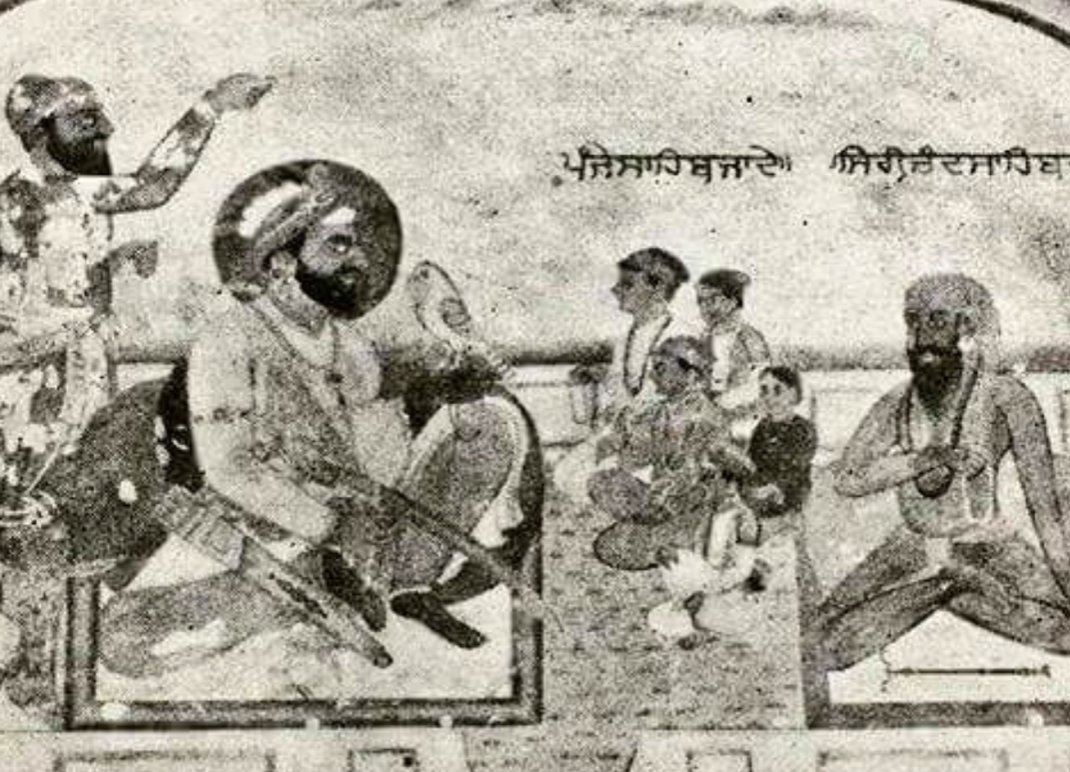
Son of Guru Hargobind, father of Guru Har Rai (1613–1638)
| Field | Value |
|---|---|
| religion | Sikhism |
| name | Gurditta |
| honorific prefix | Baba |
| honorific suffix | Ji |
| native_name_lang | pa |
| native name lang | pa |
| image | Painting of Baba Gurditta, the eldest son of the sixth Sikh guru, Guru Hargobind, and second leader of the Udasi sect succeeding Sri Chand, ca.1685.jpg |
| native_name | ਬਾਬਾ ਗੁਰਦਿੱਤਾ |
| birth_date | 5 November 1613 |
| death_date | 15 March 1638 (24-years-old) |
| birth_place | Daroli Bhai, Firozpur, Punjab, India |
| death_place | Outside Kiratpur, Punjab, India |
| death_cause | Seclusion |
| spouse | Ananti (alias: Natti), also known as Nihalo and Mata Bassi, later given the name of Nihal Kaur |
| father | Guru Hargobind |
| mother | Mata Damodari |
| caption | Painting of Baba Gurditta held by the lineage of Ram Rai at Dehradun, ca.1685. |
| office1 | Head of Udasi Sect |
| predecessor1 | Sri Chand |
| children | Guru Har Rai |
| Dhir Mall (eldest) | |
| birthname | Gurditta Sodhi |
| sect | Udasi |
| successor1 | Almast, Balu Hasne, Phul, and Goinde |
Dhir Mall (eldest) Baba Gurditta (5 November 1613 – 15 March 1638, Gurmukhi: ਗੁਰਦਿੱਤਾ) was the son of Guru Hargobind (sixth Sikh guru), and the father of Guru Har Rai (seventh Sikh guru) of Sikhism. There is a gurudwara in Kiratpur Sahib, Punjab which is in remembrance of Baba Gurditta.
Early life
Baba Gurditta was born on the full moon of the month of Katak in 1613 to Mata Damodari and Guru Hargobind. According to Pashaura Singh, Gurditta was born on the full-moon day (pūrnamā) of the month of Assū in sambat 1665, which corresponds to 13 October 1608 C.E. Gurditta was born in the forests of Daroli located in the Malwa region of Punjab.
Guru Hargobind was organizing Sikh youth in Amritsar when he received the news of the birth of Gurditta, with this event being recorded as follows:
He is said to have resembled Guru Nanak in his youth. According to Bhai Mani Singh Baba Gurditta got name from the fact that he looked like Guru Nanank (Gur) and from the fact that it seemed like Guru Nanak has given himself a physical form (ditta). Gurditta got engaged in 1619 in the month of Katak to Ananti known as Netti. He and his wife were both six years old at the time. They got married on 17 April 1621. A big wedding celebration occurred. Guru Hargobind gifts Gurditta a horse that is worth 100,000 rupees.
Birth year
Some sources record his birth year as being 1608 rather than 1613.
Religious and military career
During the years 1626–1627, he lived in Kartarpur in the Jalandhar district as per directions by his father. He was the founder of Kiratpur near the Shivalik foothills, also according to commands by his father. He took part in the Battle of Kartarpur (1635) against Painde Khan. In the battle he killed a Mughal general named Asman Khan. Asman Khan and Gurditta were previously childhood friends. Gurditta shot Asman Khan with an arrow. Gurditta rushed by him and cried as Asman Khan died. When asked by his father, Guru Hargobind, why he is crying Gurditta remarked that he was just yesterday playing with Asman and now he is dead.
When a Sikh, named Nakhora, offered his daughter to be wed to Baba Gurditta, Mata Ananti protested against this idea and complained to Guru Hargobind. Afterwards, the Guru disapproved of the match and the daughter of Nakhora returned home unwed to Gurditta.
Baba Gurditta died around 1638, while his father was still alive. His brother Guru Tegh Bahadur would later become the ninth Sikh guru when Baba Gurdita's line of succession dried up. After the Battle of Kartarpur, he took rest under a Banyan tree which is still there in Kartarpur near Sukka Talab he tied his horses under the tree. The sacred Banyan tree has great significance for the Sikhs of Kartarpur. The site is maintained by the Toor clan.
Then Baba Gurditta followed the path 5 km north of Kartarpur and conducted the funeral of martyred Nihangs and where now stands a gurdwara called Killi Sahib.
Head of Udasi sect
He was appointed by the aged Sri Chand to succeed him as the head of the Udasi sect that he had established. He is remembered for giving new strength and energy towards the missionary activities of the sect, such as by establishing four Udasi preaching centres known as dhūāṅs.
Death
According to legend, on the earlier part of the day of 15 March 1638 in Kiratpur, Baba Gurditta performed a miracle reluctantly under duress where he revived a cow which he, or another member of his hunting party, had accidentally shot and killed after mistaking it for a deer while he was out hunting. The owners of the cow complained and demanded that Baba Gurditta resurrect the animal, which he did. Guru Hargobind later admonished him for performing a miracle. Baba Gurditta was deeply affected by this reprimand by his father and silently retired himself to a secluded place outside of Kiratpur, near the shrine of Budhan Shah, where he died later the same day. The Guru searched for him and discovered his dead body, which brought upon much sadness to Hargobind and the Sikh congregation. These events may have had a strong impression on the young Tyag Mal (later Guru Tegh Bahadur), teaching him a lesson on the transience and impermanence of life. On the spot of his death now stands a dehrā (mausoleum).** Another account of his death states that he died while wearing bride-groom robes after his requested marriage to the daughter of Nakhora was rejected by his father. He was succeeded as head of the Udasi sect by four of his disciples, them namely being Almast, Balu Hasne, Phul, and Goinde.
Legacy
Gurdwara Baba Gurditta located to the south of Kiratpur was erected in his memory, marking the location of his death and cremation. A sacred neem tree associated with Baba Gurditta can be found at this gurdwara. The neem tree supposedly sprouted from a neem twig that Baba Gurditta was holding when he died at the location.
Gallery
File:A Sikh Shrine at Keeruthpore, Punjaub.jpg|Gurdwara Baba Gurditta at Kiratpur in the 19th century File:Gurdwara Baba Gurditta Ji.JPG|Present-day Gurdwara Baba Gurditta File:Fresco painting of Baba Gurditta, the eldest son of the sixth Sikh guru, Guru Hargobind, and second leader of the Udasi sect succeeding Sri Chand, circa early 18th century.jpg|Early 18th century fresco art depicting Baba Gurditta from Dehradun File:Painting of Baba Gurditta Sodhi (eldest son of Guru Hargobind), circa late 19th century.jpg|Painting of Baba Gurditta Sodhi seated with an attendant, circa late 19th century File:Dhan - Dhan Baba Gurditta Ji 1.jpg|20th century depiction of Gurditta File:Hukamnama issued by Baba Gurditta, son of Guru Tegh Bahadur and father of Guru Har Rai.jpg|Hukamnama issued by Baba Gurditta, circa 17th century
Notes
References
References
- (1992–1998). "The encyclopaedia of Sikhism". Punjabi University.
- Singh, Pashaura. (Aug 9, 2024). "The Routledge Companion to the Life and Legacy of Guru Hargobind: Sovereignty, Militancy, and Empowerment of the Sikh Panth". Taylor & Francis.
- Gurbilas Patashahi 6 Chapter 9
- Gurbilas Patashahi 6 Chapter 15
- (1989). "Punjab History Conference". Department of Punjab Historical Studies, Punjabi University.
- Gurbilas Patashahi 6 Chapter 20
- (2007-09-02). "Baba Gurditta - Gateway To Sikhism".
- (1975). "Guru Tegh Bahadur: A Bibliography". Abhinav Publications.
- "Guide to Sikh Shrines at Sri Anandpur Sahib & Kiratpur Sahib". Takht Kesgarh Sahib.
- Kalhoro, Zulfiqar Ali. (2021-02-18). "Samadhis of Pothohar".
This article was imported from Wikipedia and is available under the Creative Commons Attribution-ShareAlike 4.0 License. Content has been adapted to SurfDoc format. Original contributors can be found on the article history page.
Ask Mako anything about Baba Gurditta — get instant answers, deeper analysis, and related topics.
Research with MakoFree with your Surf account
Create a free account to save articles, ask Mako questions, and organize your research.
Sign up freeThis content may have been generated or modified by AI. CloudSurf Software LLC is not responsible for the accuracy, completeness, or reliability of AI-generated content. Always verify important information from primary sources.
Report