From Surf Wiki (app.surf) — the open knowledge base
B. R. Ambedkar
Indian jurist, economist, politician and social reformer (1891–1956)
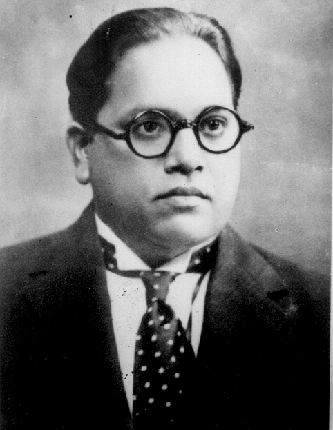
Indian jurist, economist, politician and social reformer (1891–1956)
| Field | Value |
|---|---|
| honorific_prefix | |
| name | Bhimrao Ramji Ambedkar |
| image | Dr. Bhimrao Ambedkar.jpg |
| caption | Ambedkar, |
| office1 | Member of Parliament, Rajya Sabha |
| from Bombay State | |
| term_start1 | 3 April 1952 |
| term_end1 | 6 December 1956 |
| order | 1st |
| office | Minister of Law and Justice |
| term_start | 15 August 1947 |
| term_end | 6 October 1951 |
| primeminister | Jawaharlal Nehru |
| predecessor | Position established |
| successor | Charu Chandra Biswas |
| office2 | Chairman of the Constitution Drafting Committee |
| term_start2 | 29 August 1947 |
| term_end2 | 24 January 1950 |
| office3 | Member of the Constituent Assembly of India |
| term_start3 | 9 December 1946 |
| term_end3 | 24 January 1950 |
| constituency3 | Bengal Province (1946–47) |
| Bombay Province (1947–50) | |
| office4 | Minister of Labour in Viceroy's Executive Council |
| term_start4 | 22 July 1942 |
| term_end4 | 20 October 1946 |
| governor_general4 | The Marquess of Linlithgow |
| The Viscount Wavell | |
| predecessor4 | Feroz Khan Noon |
| last | Yes |
| titlestyle | border:1px dashed lightgrey;}} |
| embed | Yes |
| office5 | Leader of the Opposition in the Bombay Legislative Assembly |
| term_start5 | 1937 |
| term_end5 | 1942 |
| office6 | Member of the Bombay Legislative Assembly |
| term_start6 | 1937 |
| term_end6 | 1942 |
| constituency6 | Bombay City (Byculla and Parel) General Urban |
| office7 | Member of the Bombay Legislative Council |
| term_start7 | 1926 |
| term_end7 | 1937 |
| birth_name | Bhimrao Ramji Sakpal |
| birth_date | |
| birth_place | Mhow, Central India Agency, British India |
| death_date | |
| death_place | New Delhi, India |
| resting_place | Chaitya Bhoomi |
| resting_place_coordinates | |
| party | Independent Labour Party |
| Scheduled Castes Federation | |
| otherparty | Republican Party of India |
| spouse | |
| children | Yashwant |
| relatives | Ambedkar family |
| profession | |
| awards | Bharat Ratna |
| (1990, posthumous) | |
| signature | Dr. Babasaheb Ambedkar Signature.svg |
| website | |
| nickname | Babasaheb |
| education | University of Mumbai (BA, MA) |
| Columbia University (MA, PhD) | |
| London School of Economics (MSc, DSc) |
from Bombay State Bombay Province (1947–50) The Viscount Wavell | Legislative positions Scheduled Castes Federation (1990, posthumous) Columbia University (MA, PhD) London School of Economics (MSc, DSc) Bhimrao Ramji Ambedkar (né Sakpal; 14 April 1891 – 6 December 1956) was an Indian jurist, economist, social reformer and political leader who chaired the committee that drafted the Constitution of India based on the debates of the Constituent Assembly of India and the first draft of Sir Benegal Narsing Rau. Ambedkar served as Law and Justice minister in the first cabinet of Jawaharlal Nehru. He later renounced Hinduism and converted to Buddhism, inspiring the Dalit Buddhist movement.
After graduating from Elphinstone College, University of Bombay, Ambedkar studied economics at Columbia University and the London School of Economics, receiving doctorates in 1927 and 1923, respectively, and was among a handful of Indian students to have done so at either institution in the 1920s. During his time at the Columbia University, Ambedkar came under the influence of John Dewey and his philosophy of pragmatism. He also trained in the law at Gray's Inn, London. In his early career, he was an economist, professor, and lawyer. His later life was marked by his political activities; he became involved in campaigning and negotiations for partition, publishing journals, advocating political rights and social freedom for Dalits, and contributing to the establishment of the state of India. In 1956, he converted to Buddhism, initiating mass conversions of Dalits.
In 1990, the Bharat Ratna, India's highest civilian award, was posthumously conferred on Ambedkar. The salutation Jai Bhim (lit. "Hail Bhim") is used by his followers to honour him. He is also referred to by the honorific Babasaheb, meaning "Respected Father".
Early life and education
Ambedkar was born on 14th April 1891 in the town and military cantonment of Mhow (now officially known as Dr Ambedkar Nagar, Madhya Pradesh). He was the 14th and last child of Ramji Maloji Sakpal, an army officer who held the rank of Subedar, and Bhimabai Sakpal, daughter of Laxman Murbadkar. His family was of Marathi background from the town of Ambadawe (Mandangad taluka) in Ratnagiri district of modern-day Maharashtra. Ambedkar's ancestors had long worked for the army of the British East India Company, and his father served in the British Indian Army at the Mhow cantonment.
Ambedkar was born into a Mahar (Dalit) caste, who were treated as untouchables and subjected to socio-economic discrimination. Although they attended school, Ambedkar and other untouchable children were segregated and given little attention or help by teachers. They were not allowed to sit inside the class. When they needed to drink water, someone from a higher caste had to pour that water from a height as they were not allowed to touch either the water or the vessel that contained it. This task was usually performed for the young Ambedkar by the school peon, and if the peon was not available then he had to go without water; he described the situation later in his writings as "No peon, No Water". He was required to sit on a gunny sack which he had to take home with him.
Ramji Sakpal retired in 1894 and the family moved to Satara two years later. Shortly after their move, Ambedkar's mother died. The children were cared for by their paternal aunt and lived in difficult circumstances. Three sons – Balaram, Anandrao and Bhimrao – and two daughters – Manjula and Tulasa – of the Ambedkars survived them. Of his brothers and sisters, only Ambedkar passed his examinations and went to high school. His original surname was Sakpal but his father registered his name as Ambadawekar in school, meaning he comes from his native village 'Ambadawe' in Ratnagiri district. His Marathi Brahmin teacher, Krishnaji Keshav Ambedkar, changed his surname from 'Ambadawekar' to his own surname 'Ambedkar' in school records.
Education
In 1907, he passed his matriculation examination and in the following year he entered Elphinstone College, which was affiliated to the University of Bombay, becoming, according to him, the first from his Mahar caste to do so. When he passed his English fourth standard examinations, the people of his community wanted to celebrate because they considered that he had reached "great heights" which he says was "hardly an occasion compared to the state of education in other communities". A public ceremony was evoked, to celebrate his success, by the community, and it was at this occasion that he was presented with a biography of the Buddha by Dada Keluskar, the author and a family friend.
By 1912, he obtained his degree in economics and political science from Bombay University, and prepared to take up employment with the Baroda state government. His wife had just moved his young family and started work when he had to quickly return to Mumbai to see his ailing father, who died on 2 February 1913.

In 1916, he completed his second master's thesis, National Dividend of India – A Historic and Analytical Study, for a second M.A. On 9 May, he presented the paper Castes in India: Their Mechanism, Genesis and Development before a seminar conducted by the anthropologist Alexander Goldenweiser. Ambedkar received his Ph.D. degree in economics at Columbia in 1927. In 1923, he completed a D.Sc. in Economics which was awarded from University of London, and the same year he was called to the Bar by Gray's Inn.
Opposition to untouchability
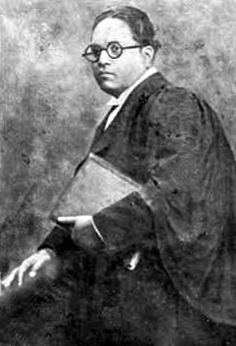
As Ambedkar was educated by the Princely State of Baroda, he was bound to serve it. He was appointed Military Secretary to the Gaikwad but had to quit in a short time. He described the incident in his autobiography, Waiting for a Visa. Thereafter, he tried to find ways to make a living for his growing family. He worked as a private tutor, as an accountant, and established an investment consulting business, but it failed when his clients learned that he was an untouchable. In 1918, he became professor of political economy in the Sydenham College of Commerce and Economics in Mumbai. Although he was successful with the students, other professors objected to his sharing a drinking-water jug with them.
Ambedkar had been invited to testify before the Southborough Committee, which was preparing the Government of India Act 1919. At this hearing, Ambedkar argued for creating separate electorates and reservations for untouchables and other religious communities. In 1920, he began the publication of the weekly Mooknayak (Leader of the Silent) in Mumbai with the help of Shahu of Kolhapur, that is, Shahu IV (1874–1922).
Ambedkar went on to work as a legal professional. In 1926, he successfully defended three non-Brahmin leaders who had accused the Brahmin community of ruining India and were then subsequently sued for libel. Dhananjay Keer notes, "The victory was resounding, both socially and individually, for the clients and the doctor".
While practising law in the Bombay High Court, he tried to promote education to untouchables and uplift them. His first organised attempt was his establishment of the central institution Bahishkrit Hitakarini Sabha, intended to promote education and socio-economic improvement, as well as the welfare of "outcastes", at the time referred to as depressed classes. For the defence of Dalit rights, he started many periodicals like Mook Nayak, Bahishkrit Bharat, and Equality Janta.

He was appointed to the Bombay Presidency Committee to work with the all-European Simon Commission in 1925. This commission had sparked great protests across India, and while its report was ignored by most Indians, Ambedkar himself wrote a separate set of recommendations for the future Constitution of India.
By 1927, Ambedkar had decided to launch active movements against untouchability. He began with public movements and marches to open up public drinking water resources. He also began a struggle for the right to enter Hindu temples. He led a satyagraha in Mahad to fight for the right of the untouchable community to draw water from the main water tank of the town. In a conference in late 1927, Ambedkar publicly condemned the classic Hindu text, the Manusmriti (Laws of Manu), for ideologically justifying caste discrimination and "untouchability", and he ceremonially burned copies of the ancient text. On 25 December 1927, he led thousands of followers to burn copies of Manusmriti. Thus annually 25 December is celebrated as Manusmriti Dahan Din (Manusmriti Burning Day) by Ambedkarites and Dalits.
In 1930, Ambedkar launched the Kalaram Temple movement after three months of preparation. About 15,000 volunteers assembled at Kalaram Temple satygraha making one of the greatest processions of Nashik. The procession was headed by a military band and a batch of scouts; women and men walked with discipline, order and determination to see the god for the first time. When they reached the gates, the gates were closed by Brahmin authorities.
Poona Pact

In 1932, the British colonial government announced the formation of a separate electorate for "Depressed Classes" in the Communal Award. Mahatma Gandhi fiercely opposed a separate electorate for untouchables, saying he feared that such an arrangement would divide the Hindu community. Gandhi protested by fasting while imprisoned in the Yerwada Central Jail of Poona. Following the fast, congressional politicians and activists such as Madan Mohan Malaviya and Palwankar Baloo organised joint meetings with Ambedkar and his supporters at Yerwada. On 25 September 1932, the agreement, known as the Poona Pact was signed between Ambedkar (on behalf of the depressed classes among Hindus) and Madan Mohan Malaviya (on behalf of the other Hindus). The agreement gave reserved seats for the depressed classes in the Provisional legislatures within the general electorate. Due to the pact the depressed class received 148 seats in the legislature instead of the 71, as allocated in the Communal Award proposed earlier by the colonial government under Prime Minister Ramsay MacDonald. The text used the term "Depressed Classes" to denote Untouchables among Hindus who were later called Scheduled Castes and Scheduled Tribes under the India Act 1935, and the later Indian Constitution of 1950. In the Poona Pact, a unified electorate was in principle formed, but primary and secondary elections allowed Untouchables in practice to choose their own candidates.
Political career
_Yashwant,_BR_Ambedkar,_Ramabai,_Laxmibai,_Mukundrao,_and_Tobby.jpg)
In 1935, Ambedkar was appointed principal of the Government Law College, Bombay, a position he held for two years. He also served as the chairman of Governing body of Ramjas College, University of Delhi, after the death of its Founder Shri Rai Kedarnath. Settling in Bombay (today called Mumbai), Ambedkar oversaw the construction of a house, and stocked his personal library with more than 50,000 books. His wife Ramabai died after a long illness the same year. It had been her long-standing wish to go on a pilgrimage to Pandharpur, but Ambedkar had refused to let her go, telling her that he would create a new Pandharpur for her instead of Hinduism's Pandharpur which treated them as untouchables. At the Yeola Conversion Conference on 13 October in Nasik, Ambedkar announced his intention to convert to a different religion and exhorted his followers to leave Hinduism. He would repeat his message at many public meetings across India.

In 1936, Ambedkar founded the Independent Labour Party, which contested the 1937 Bombay election to the Central Legislative Assembly for the 13 reserved and 4 general seats, and secured 11 and 3 seats respectively.
Ambedkar published his book Annihilation of Caste on 15 May 1936. It strongly criticised Hindu orthodox religious leaders and the caste system in general, and included "a rebuke of Gandhi" on the subject. Later, in a 1955 BBC interview, he accused Gandhi of writing in opposition of the caste system in English language papers while writing in support of it in Gujarati language papers. In his writings, Ambedkar also accused Jawaharlal Nehru of being "conscious of the fact that he is a Brahmin".
During this time, Ambedkar also fought against the khoti system prevalent in Konkan, where khots, or government revenue collectors, regularly exploited farmers and tenants. In 1937, Ambedkar tabled a bill in the Bombay Legislative Assembly aimed at abolishing the khoti system by creating a direct relationship between government and farmers.
Ambedkar served on the Defence Advisory Committee and the Viceroy's Executive Council as minister of labour. Before the Day of Deliverance events, Ambedkar stated that he was interested in participating: "I read Mr. Jinnah's statement and I felt ashamed to have allowed him to steal a march over me and rob me of the language and the sentiment which I, more than Mr. Jinnah, was entitled to use." He went on to suggest that the communities he worked with were twenty times more oppressed by Congress policies than were Indian Muslims; he clarified that he was criticizing Congress, and not all Hindus. Jinnah and Ambedkar jointly addressed the heavily attended Day of Deliverance event in Bhindi Bazaar, Bombay, where both expressed "fiery" criticisms of the Congress party, and according to one observer, suggested that Islam and Hinduism were irreconcilable.
After the Lahore resolution (1940) of the Muslim League demanding Pakistan, Ambedkar wrote a 400-page tract titled Thoughts on Pakistan, which analysed the concept of "Pakistan" in all its aspects. Ambedkar argued that the Hindus should concede Pakistan to the Muslims. He proposed that the provincial boundaries of Punjab and Bengal should be redrawn to separate the Muslim and non-Muslim majority parts. He thought the Muslims could have no objection to redrawing provincial boundaries. If they did, they did not quite "understand the nature of their own demand". Scholar Venkat Dhulipala states that Thoughts on Pakistan "rocked Indian politics for a decade". It determined the course of dialogue between the Muslim League and the Indian National Congress, paving the way for the Partition of India.
In his work Who Were the Shudras?, Ambedkar tried to explain the formation of untouchables. He saw Shudras and Ati Shudras who form the lowest caste in the ritual hierarchy of the caste system, as separate from Untouchables. Ambedkar oversaw the transformation of his political party into the Scheduled Castes Federation. It did not fare well in the 1946 provincial elections, but in Bengal, it managed to elect Ambedkar to the Constituent Assembly of India by winning support from Congress legislators.

Jagjivan Ram's wife Indrani Jagjivan Ram wrote in her memoir that Ambedkar persuaded her husband to ask Mahatma Gandhi for his inclusion in Nehru's cabinet in independent India. Initially, Jagjivan Ram consulted Vallabhbhai Patel before asking Gandhi to recommend Ambedkar to Nehru for inclusion in cabinet, adding that Ambedkar had "given up his antagonism to Congress and Gandhiji". Ambedkar was ultimately included as the law minister of India in the First Nehru ministry after Gandhi recommended his name to Nehru.
On 27 September 1951, Ambedkar resigned from Nehru's cabinet ministry after Hindu code bill was defeated in parliament.
Ambedkar contested in the Bombay North first Indian General Election of 1952, but lost to his former assistant and Congress Party candidate Narayan Sadoba Kajrolkar. He tried to enter Lok Sabha again in the by-election of 1954 from Bhandara, but he placed third (the Congress Party won). Ambedkar served as the member of the Rajya Sabha, representing Bombay State for the Scheduled Castes Federation from April 3, 1952, until his death.
Ambedkar also criticised Islamic practice in South Asia. While justifying the Partition of India, he condemned child marriage and the mistreatment of women in Muslim society.
No words can adequately express the great and many evils of polygamy and concubinage, and especially as a source of misery to a Muslim woman. Take the caste system. Everybody infers that Islam must be free from slavery and caste. [...] [While slavery existed], much of its support was derived from Islam and Islamic countries. While the prescriptions by the Prophet regarding the just and humane treatment of slaves contained in the Koran are praiseworthy, there is nothing whatever in Islam that lends support to the abolition of this curse. But if slavery has gone, caste among Musalmans [Muslims] has remained.}}
India's Constitution
Main article: Dominion of India#Framing the new constitution

Upon India's independence on 15 August 1947, the new prime minister Jawaharlal Nehru invited Ambedkar to serve as the Dominion of India's Law Minister; two weeks later, he was appointed Chairman of the Drafting Committee of the Constitution for the future Republic of India.
On 25 November 1949, Ambedkar in his concluding speech in constituent assembly said: |"The credit that is given to me does not really belong to me. It belongs partly to Sir B.N. Rau the Constitutional Advisor to the Constituent Assembly who prepared a rough draft of the Constitution for the consideration of the Drafting Committee."
Indian constitution guarantees and protections for a wide range of civil liberties for individual citizens, including freedom of religion, the abolition of untouchability, and the outlawing of all forms of discrimination. Ambedkar was one of the ministers who argued for extensive economic and social rights for women, and won the Assembly's support for introducing a system of reservations of jobs in the civil services, schools and colleges for members of scheduled castes and scheduled tribes and Other Backward Class, a system akin to affirmative action. India's lawmakers hoped to eradicate the socio-economic inequalities and lack of opportunities for India's depressed classes through these measures. The Constitution was adopted on 26 November 1949 by the Constituent Assembly.
Steven Calabresi has voiced agreement with Martha C. Nussbaum's assessment of the Indian constitution as "Ambedkar's constitution," on account of the Supreme Court of India having evolved away from judicial restraint and legal positivism favored and successfully executed into the Constitution in 1950 by Jawaharlal Nehru and leaders of India's anti-colonial nationalist movement who held sway in the Constituent Assembly of India to an purposive approach by which the court rules today, whereby it is the final arbiter of the Constitution's meaning and its interpretations are binding on the executive and legislative branches of the government. Ambedkar had supported the purposive approach during the drafting of the constitution from 1947 to 1949 but his views were in a minority.
_on_June_5,_1952.jpg)
Ambedkar had openly shared his concern in the Constituent Assembly that country might lose both its Constitution and its democratic freedoms in the future. He believed that the lack of a strong democratic tradition, the widespread presence of ‘bhakti’ or political ‘hero worship’ and the large gap between the republican promises of the Constitution and socio-economic inequality, made this a distinct and ever-present possibility.
Ambedkar expressed his disapproval for the constitution in 1953 during a parliament session and said "People always keep on saying to me "Oh you are the maker of the constitution". My answer is I was a hack. What I was asked to do, I did much against my will." Ambedkar added that, "I am quite prepared to say that I shall be the first person to burn it out. I do not want it. It does not suit anybody."
Economics
.jpg)
Ambedkar was the first Indian to pursue a doctorate in economics abroad. He argued that industrialisation and agricultural growth could enhance the Indian economy. His DSc thesis, The problem of the Rupee: Its Origin and Solution (1923) examines the causes for the Rupee's fall in value. In this dissertation, he argued in favour of a gold standard in modified form, and was opposed to the gold-exchange standard favoured by Keynes in his treatise Indian Currency and Finance (1909), claiming it was less stable. He favoured the stoppage of all further coinage of the rupee and the minting of a gold coin, which he believed would fix currency rates and prices.
He also analysed revenue in his PhD dissertation The Evolution of Provincial Finance in British India. In this work, he analysed the various systems used by the British colonial government to manage finances in India. His views on finance were that governments should ensure their expenditures have "faithfulness, wisdom and economy." "Faithfulness" meaning governments should use money as nearly as possible to the original intentions of spending the money in the first place. "Wisdom" meaning it should be used as well as possible for the public good, and "economy" meaning the funds should be used so that the maximum value can be extracted from them.
Ambedkar opposed income tax for low-income groups. He contributed in Land Revenue Tax and excise duty policies to stabilise the economy. He played an important role in land reform and the state economic development. According to him, the caste system, due to its division of labourers and hierarchical nature, impedes movement of labour (higher castes would not do lower-caste occupations) and movement of capital (assuming investors would invest first in their own caste occupation). His theory of State Socialism had three points: state ownership of agricultural land, the maintenance of resources for production by the state, and a just distribution of these resources to the population. He emphasised a free economy with a stable Rupee which India has adopted recently. He advocated birth control to develop the Indian economy, and this has been adopted by Indian government as national policy for family planning. He emphasised equal rights for women for economic development.
A number of Ambedkar's ideas reflected deep interest in Austrian school of economics. The ideas of Ambedkar were close to those of Carl Menger, Ludwig von Mises, Friedrich Hayek, and William Graham Sumner. Ambedkar's theory of free banking was built on Menger's work and also on Gopal Krishna Gokhale's treatise on finance and money. Ambedkar's view about distinguishing differential quality of money was influenced by Menger's idea of sale-ability of money which is found in Menger's article 'On the Origin of Money'. Ambedkar's recommendations for free banking were ignored by both Royal Commission and Indian government.
In his book, "The Evolution of Provincial Finance in British India", Ambedkar wrote "a Central Government for the whole of India could not be said to possess knowledge and experience of all various conditions prevailing in different Provinces under it. It, therefore, necessarily becomes an authority less competent to deal with matters of provincial administration than the Provisional Governments.'
Ambedkar's views on agricultural land was that too much of it was idle, or that it was not being utilized properly. He believed there was an "ideal proportion" of production factors that would allow agricultural land to be used most productively. To this end, he saw the large portion of people who lived on agriculture at the time as a major problem. Therefore, he advocated industrialization of the economy to allow these agricultural labourers to be of more use elsewhere. Ambedkar was of the view that there is a need to shift surplus labour from agricultural channels to non-agricultural channels.
Ambedkar was trained as an economist, and was a professional economist until 1921, when he became a political leader. He wrote three books on economics:
- Administration and Finance of the East India Company
- The Evolution of Provincial Finance in British India
- The Problem of the Rupee: Its Origin and Its Solution
Marriage

Ambedkar's first wife Ramabai died in 1935 after prolonged illness. After completing the draft of India's constitution in the late 1940s, he suffered from lack of sleep, had neuropathic pain in his legs, and was taking insulin and homoeopathic medicines. He went to Bombay for treatment, and there met Sharada Kabir, MBBS, whom he married on 15 April 1948, at his home in New Delhi. Doctors recommended a companion who was a good cook and was a medical practitioner to care for him. She adopted the name Savita Ambedkar and cared for him the rest of his life. Savita Ambedkar, who was called also 'Mai', died on 29 May 2003, aged 93 in Mumbai.
Conversion to Buddhism
Main article: Dalit Buddhist movement

Ambedkar considered converting to Sikhism, which encouraged opposition to oppression and so appealed to leaders of scheduled castes. But after meeting with Sikh leaders, he concluded that he might get "second-rate" Sikh status.
Instead, around 1950, he began devoting his attention to Buddhism and travelled to Ceylon (now Sri Lanka) to attend a meeting of the World Fellowship of Buddhists. While dedicating a new Buddhist vihara near Pune, Ambedkar announced he was writing a book on Buddhism, and that when it was finished, he would formally convert to Buddhism. He twice visited Burma in 1954; the second time to attend the third conference of the World Fellowship of Buddhists in Rangoon. In 1955, he founded the Bharatiya Bauddha Mahasabha, or the Buddhist Society of India. In 1956, he completed his final work, The Buddha and His Dhamma, which was published posthumously.
After meetings with the Sri Lankan Buddhist monk Hammalawa Saddhatissa, Ambedkar organised a formal public ceremony for himself and his supporters in Nagpur on 14 October 1956. Accepting the Three Refuges and Five Precepts from a Buddhist monk in the traditional manner, Ambedkar completed his own conversion, along with his wife. He then proceeded to convert some 500,000 of his supporters who were gathered around him. He prescribed the 22 Vows for these converts, after the Three Jewels and Five Precepts. He then travelled to Kathmandu, Nepal to attend the Fourth World Buddhist Conference. His work on The Buddha or Karl Marx and "Revolution and counter-revolution in ancient India" remained incomplete.
Death

Since 1948, Ambedkar had diabetes. He remained in bed from June to October in 1954 due to medication side-effects and poor eyesight. His health worsened during 1955. Three days after completing his final manuscript The Buddha and His Dhamma, Ambedkar died in his sleep on 6 December 1956 at his home in Delhi.
Prime Minister Jawaharlal Nehru addressed the parliament saying:
Dr. Ambedkar will be remembered as a symbol of revolt against the oppressive features of the Hindu Society. His virulent oppositions to these oppressive features kept people's mind awake. Although he was highly controversial figure, yet he played a very constructive role in making of the Constitution of India and Hindu Law Reform.
A Buddhist cremation was organised at Dadar Chowpatty beach on 7 December, attended by half a million grieving people. A conversion program was organised on 16 December 1956, so that cremation attendees were also converted to Buddhism at the same place.
Ambedkar was survived by his second wife Savita Ambedkar (known as Maisaheb Ambedkar), who died in 2003, and his son Yashwant Ambedkar (known as Bhaiyasaheb Ambedkar), who died in 1977. Savita and Yashwant carried on the socio-religious movement started by B. R. Ambedkar. Yashwant served as the 2nd President of the Buddhist Society of India (1957–1977) and a member of the Maharashtra Legislative Council (1960–1966). Ambedkar's elder grandson, Prakash Yashwant Ambedkar, is the chief-adviser of the Buddhist Society of India, leads the Vanchit Bahujan Aghadi and has served in both houses of the Indian Parliament. Ambedkar's younger grandson, Anandraj Ambedkar leads the Republican Sena (tran: The "Republican Army").
A number of unfinished typescripts and handwritten drafts were found among Ambedkar's notes and papers and gradually made available. Among these were Waiting for a Visa, which probably dates from 1935 to 1936 and is an autobiographical work, and the Untouchables, or the Children of India's Ghetto, which refers to the census of 1951.
A memorial for Ambedkar was established in his Delhi house at 26 Alipur Road. His birthdate known as Ambedkar Jayanti or Bhim Jayanti is observed as a public holiday in many Indian states. He was posthumously awarded India's highest civilian honour, the Bharat Ratna, in 1990.
On the anniversary of his birth and death, and on Dhamma Chakra Pravartan Din (14 October) at Nagpur, at least half a million people gather to pay homage to him at his memorial in Mumbai. Thousands of bookshops are set up, and books are sold. His message to his followers was "educate, agitate, organise!"
Legacy


Ambedkar's legacy as a socio-political reformer had a deep effect on modern India. In post-Independence India, his socio-political thought is respected across the political spectrum. His initiatives have influenced various spheres of life and transformed the way India today looks at socio-economic policies, education and affirmative action through socio-economic and legal incentives. His reputation as a scholar led to his appointment as free India's first law minister, and chairman of the committee for drafting the constitution. He passionately believed in individual freedom and criticised caste society. His accusations of Hinduism as being the foundation of the caste system made him controversial and unpopular among Hindus. His conversion to Buddhism sparked a revival in interest in Buddhist philosophy in India and abroad.
Many public institutions are named in his honour, and the Dr. Babasaheb Ambedkar International Airport in Nagpur, otherwise known as Sonegaon Airport. Dr. B. R. Ambedkar National Institute of Technology, Jalandhar, Ambedkar University Delhi is also named in his honour.
The Maharashtra government has acquired a house in London where Ambedkar lived during his days as a student in the 1920s. The house is expected to be converted into a museum-cum-memorial to Ambedkar.
Ambedkar was voted "the Greatest Indian" since independence by a poll organised by History TV18 and CNN IBN, ahead of Patel and Nehru, in 2012. Nearly 20 million votes were cast. Due to his role in economics, Narendra Jadhav, a notable Indian economist, has said that Ambedkar was "the highest educated Indian economist of all times." Amartya Sen, said that Ambedkar is "father of my economics", and "he was highly controversial figure in his home country, though it was not the reality. His contribution in the field of economics is marvelous and will be remembered forever."
On 2 April 1967, an 3.66 metre (12 foot) tall bronze statue of Ambedkar was installed in the Parliament of India. The statue, sculpted by B.V. Wagh, was unveiled by the then President of India, Sarvepalli Radhakrishnan. On 12 April 1990, a portrait of B.R. Ambedkar is put in the Central Hall of Parliament House. The portrait of Ambedkar, painted by Zeba Amrohawi, was unveiled by the then Prime Minister of India, V. P. Singh. Another portrait of Ambedkar is put in the Parliamentary Museum and archives of the Parliament House.
Ambedkar's legacy was not without criticism. Ambedkar has been criticised for his one-sided views on the issue of caste at the expense of cooperation with the larger nationalist movement. Ambedkar has been also criticised by some of his biographers over his neglect of organization-building.
Ambedkar's political philosophy has given rise to a large number of political parties, publications and workers' unions that remain active across India, especially in Maharashtra. His promotion of Buddhism has rejuvenated interest in Buddhist philosophy among sections of population in India. Mass conversion ceremonies have been organised by human rights activists in modern times, emulating Ambedkar's Nagpur ceremony of 1956. Some Indian Buddhists regard him as a Bodhisattva, although he never claimed it himself. Outside India, during the late 1990s, some Hungarian Romani people drew parallels between their own situation and that of the downtrodden people in India. Inspired by Ambedkar, they started to convert to Buddhism.
The Ambedkar Statue in Hyderabad is a statue of B. R. Ambedkar located in Hyderabad. The statue was designed by Ram V. Sutar. The foundation stone was laid in 2016, but the construction of the statue began in 2021. The statue was inaugurated on 14 April 2023, by K. Chandrashekhar Rao, the Chief Minister of Telangana, on the 132nd Ambedkar Jayanti. Ambedkar's grandson Prakash Ambedkar was the chief guest of the event. The statue is made up of over 360 tonnes of steel and 100 tonnes of bronze. On 19 January 2024, a 125 feet tall "Statue of Social Justice" of Ambedkar was installed in Vijayawada, Andhra Pradesh, which stands on an 81 feet high platform. The Ambedkar statues in Hyderabad and Vijayawada are the fifth and fourth tallest statues in India respectively. In May 2026, a 450 feet tall "Statue of Equality" of Babasaheb Ambedkar will be ready at Indu Mill in Mumbai, which will be the second tallest statue in India and the third tallest in the world.
File:Bust of Ambedkar at Dr. Bhimrao Ramji Ambedkar Memorial, in London.jpg|Bust of Ambedkar at Primrose Hill, London File:Ambedkar statue, Miskolc.jpg|Bust of Ambedkar in Miskolc, Hungary File:Amdedkar house.jpg|Ambedkar Memorial in London
Views
Religion
.jpg)
Ambedkar said in 1935 that he was born a Hindu but would not die a Hindu. He viewed Hinduism as an "oppressive religion" and started to consider conversion to any other religion. In Annihilation of Caste, Ambedkar claims that the only lasting way a true casteless society could be achieved is through destroying the belief of the sanctity of the Shastras and denying their authority. Ambedkar was critical of Hindu religious texts and epics and wrote a work titled Riddles in Hinduism during 1954–1955. The work was published posthumously by combining individual chapter manuscripts and resulted in mass demonstrations and counter demonstrations.
Ambedkar viewed Christianity to be incapable of fighting injustices. He wrote that "It is an incontrovertible fact that Christianity was not enough to end the slavery of the Negroes in the United States. A civil war was necessary to give the Negro the freedom which was denied to him by the Christians."
Ambedkar criticized distinctions within Islam and described the religion as "a close corporation and the distinction that it makes between Muslims and non-Muslims is a very real, very positive and very alienating distinction".
He opposed conversions of depressed classes to convert to Islam or Christianity added that if they converted to Islam then "the danger of Muslim domination also becomes real" and if they converted to Christianity then it "will help to strengthen the hold of Britain on the country".
Initially, Ambedkar planned to convert to Sikhism but he rejected this idea after he discovered that British government would not guarantee the privileges accorded to the untouchables in reserved parliamentary seats.
On 16 October 1956, he converted to Buddhism just weeks before his death.
Aryan invasion theory
Ambedkar viewed the Shudras as Aryan and adamantly rejected the Aryan invasion theory, describing it as "so absurd that it ought to have been dead long ago" in his 1946 book Who Were the Shudras?. Ambedkar viewed Shudras as originally having been "part of the Kshatriya Varna in the Indo-Aryan society", but became socially degraded after they inflicted many tyrannies on Brahmins.
Ambedkar disputed various hypotheses of the Aryan homeland being outside India, and concluded the Aryan homeland was India itself. According to Ambedkar, the Rig Veda says Aryans, Dāsa and Dasyus were competing religious groups, not different peoples.
Communism
Ambedkar was heavily influenced by John Dewey and his philosophy of pragmatism. Ambedkar's views on Communism were expressed in two 1956 texts, "Buddha or Karl Marx" and "Buddhism and Communism". According to Jaffrelot, Ambedkar "constantly criticised the Communists, whom he accused of exploiting the workers' cause to advance their own career". In a 1938 speech delivered to the Masur conference of depressed classes, Ambedkar said: "It is absolutely impossible for me to keep relations with the communists. I am an implacable enemy of the Communists."
Ambedkar stated that:
He accepted the Marxist theory that the privileged few's exploitation of the masses perpetuated poverty and its issues. However, he did not see this exploitation as purely economic, theorizing that the cultural aspects of exploitation are as bad or worse than economic exploitation. In addition, he did not see economic relationships as the only important aspect of human life. He also saw Communists as willing to resort to any means to achieve proletarian revolution, including violence, while he himself saw democratic and peaceful measures as the best option for change. Ambedkar also opposed the Marxist idea of controlling all the means of production and ending private ownership of property: seeing the latter measure as not able to fix the problems of society. In addition, rather than advocating for the eventual annihilation of the state as Marxism does, Ambedkar believed in a classless society, but also believed the state would exist as long as society and that it should be active in development. But in the 1950s, in an interview he gave to BBC, he accepted that the current liberal democratic system will collapse and the alternative, as he thinks, "is some kind of communism".
Ambedkar's objections to communism were severely criticized by Abhinav Sinha of 'The Anvil magazine'.
"Ambedkar did not have any understanding about Marxism as he had not read a single work by Marx, Engels or Lenin. Therefore the very question whether Ambedkar agreed or disagreed, in real sense of the terms, with Marxism or not is a non-question. The truth is that he did not have any understanding of Marxism."}}
In popular culture
Several films, plays, and other works have been based on the life and thoughts of Ambedkar.
- Indian director Jabbar Patel made a documentary titled Dr. Babasaheb Ambedkar in 1991; he followed this with a full-length feature film Dr. Babasaheb Ambedkar in 2000 with Mammootty in the lead role. This biopic was sponsored by the National Film Development Corporation of India and the government's Ministry of Social Justice and Empowerment. The film was released after a long and controversial gestation.
- Other Indian films on Ambedkar include: Balaka Ambedkar (1991) by Basavaraj Kestur, Dr. Ambedkar (1992) by Bharath Parepalli, and Yugpurush Dr. Babasaheb Ambedkar (1993).
- David Blundell, professor of anthropology at UCLA and historical ethnographer, has established Arising Light – a series of films and events that are intended to stimulate interest and knowledge about the social conditions in India and the life of Ambedkar.
- In Samvidhaan, a TV mini-series on the making of the Constitution of India directed by Shyam Benegal, the pivotal role of B. R. Ambedkar was played by Sachin Khedekar.
- The play Ambedkar Aur Gandhi, directed by Arvind Gaur and written by Rajesh Kumar, tracks the two prominent personalities of its title.
- Bhimayana: Experiences of Untouchability is a graphic biography of Ambedkar created by Pardhan-Gond artists Durgabai Vyam and Subhash Vyam, and writers Srividya Natarajan and S. Anand. The book depicts the experiences of untouchability faced by Ambedkar from childhood to adulthood. CNN named it one of the top 5 political comic books.
- The Ambedkar Memorial at Lucknow is dedicated in his memory. The chaitya consists of monuments showing his biography.
- Jai Bhim slogan was given by the Dalit community in Delhi in his honour in 1946.
- Google commemorated Ambedkar's 124th birthday through a homepage doodle on 14 April 2015. The doodle was featured in India, Argentina, Chile, Ireland, Peru, Poland, Sweden and the United Kingdom.
- An Indian television show named Ek Mahanayak: Dr. B. R. Ambedkar portraying his life aired on &TV in 2019.
- Another show, Dr. Babasaheb Ambedkar - Mahamanvachi Gauravgatha, has aired in Marathi on Star Pravah from 2019.
Works
The Education Department, Government of Maharashtra (Mumbai) published the collection of Ambedkar's writings and speeches in different volumes. The list of Ambedkar's works include the following:
- Castes in India: Their Mechanism, Genesis and Development and 11 Other Essays
- The Annihilation of Caste, (1936)
- Ambedkar in the Bombay Legislature, with the Simon Commission and at the Round Table Conferences, (1927–1939)
- Philosophy of Hinduism; India and the Pre-requisites of Communism; Revolution and Counter-revolution; Buddha or Karl Marx
- Riddles in Hinduism{{cite book |title=Dr. Babasaheb Ambedkar Writings and Speeches, Vol 4 |last=Ambedkar |first=B. R. |author-link=B. R. Ambedkar |year=1987 |publisher=Dr. Ambedkar Foundation, Ministry of Social Justice & Empowerment, Govt. of India
- Essays on Untouchables and Untouchability
- The Evolution of Provincial Finance in British India
- The Untouchables Who Were They And Why They Became Untouchables ?
- Who Were the Shudras? (1946)
- Pakistan or The Partition of India (1945), originally published as Thoughts on Pakistan (1941)
- What Congress and Gandhi have done to the Untouchables; Mr. Gandhi and the Emancipation of the Untouchables
- Ambedkar as member of the Governor General's Executive Council, 1942–46
- The Buddha and his Dhamma
- Unpublished Writings; Ancient Indian Commerce; Notes on laws; Waiting for a Visa; Miscellaneous notes, etc.
- Ambedkar as the principal architect of the Constitution of India
- (2 parts) Dr. Ambedkar and The Hindu Code Bill
- Ambedkar as Free India's First Law Minister and Member of Opposition in Indian Parliament (1947–1956)
- The Pali Dictionary and The Pali Grammar
- Ambedkar and his Egalitarian Revolution – Struggle for Human Rights. Events starting from March 1927 to 17 November 1956 in the chronological order;
- Ambedkar and his Egalitarian Revolution – Socio-political and religious activities. Events starting from November 1929 to 8 May 1956 in the chronological order;
- Ambedkar and his Egalitarian Revolution – Speeches. (Events starting from 1 January to 20 November 1956 in the chronological order.)
Notes
References
References
- Duara, Juliette G.. (2018). "Gender Justice and Proportionality in India: Comparative Perspectives". Routledge.
- Elangovan, Arvind. (2019). "Norms and Politics: Sir Benegal Narsing Rau in the Making of the Indian Constitution, 1935–1950". Oxford University Press.
- Ewing, Cindy. (2020). "Decolonization, Self-Determination, and the rise of Global Human Rights Politics". Cambridge University Press.
- Prasse-Freeman, Elliott. (2023). "Rights Refused: Grassroots Activism and State Violence in Myanmar". Stanford University Press.
- "Sir Benegal Narsing Rau Indian jurist". Encyclopaedia Britannica.
- "B. R. Ambedkar Indian Political Leader". Encyclopaedia Britannica.
- (24 January 2025). "B R Ambedkar and the Evolution of Pragmatism in India".
- Skaria, Ajay. (3 July 2015). "Ambedkar, Marx and the Buddhist Question". South Asia: Journal of South Asian Studies.
- Krishnamurty, J.. (2020). "Ambedkar's Educational Odyssey, 1913–1927". SAGE.
- (2013). "Princeton Dictionary of Buddhism". Princeton University Press.
- Jaffrelot, Christophe. (2005). "Ambedkar and Untouchability: Fighting the Indian Caste System". [[Columbia University Press]].
- Pritchett, Frances. "In the 1890s".
- Ahuja, M. L.. (2007). "Eminent Indians: administrators and political thinkers". Rupa.
- "Mahar". britannica.com.
- Ambedkar, B. R.. "Waiting for a Visa". Columbia.edu.
- Kurian, Sangeeth. (23 February 2007). "Human rights education in schools". [[The Hindu]].
- (14 April 2016). "आंबडवे नाव योग्यच – खासदार अमर साबळे".
- (18 April 2014). "डॉ. बाबासाहेब आंबेडकर यांचे मूळ गाव आंबवडे येथे आंतरराष्ट्रीय दर्जाचे शैक्षणिक संकुल".
- "आंबेडकर गुरुजींचं कुटुंब जपतंय सामाजिक वसा, कुटुंबानं सांभाळल्या 'त्या' आठवणी".
- "Bhim, Eklavya". outlookindia.com.
- (7 November 2017). "आपने देखा आंबेडकर का जर्जर होता स्कूल?". BBC Hindi.
- Adshul, Ashok. (26 December 2016). "आंबेडकर गुरुजींचं कुटुंब जपतंय सामाजिक वसा, कुटुंबानं सांभाळल्या 'त्या' आठवणी". Divya Marathi.
- Prasad, Kamta. (4 July 2020). "डॉ. भीम राव आम्बेडकर को उनके गुरु कृष्ण केशव आम्बेडकर ने दिया था अपना सरनेम". Live Hindustan.
- S. N. Mishra. (2010). "Socio-economic and Political Vision of Dr. B.R. Ambedkar". Concept Publishing Company.
- (14 April 2017). "ऐसे हुआ डॉ आंबेडकर का नाम परिवर्तन... तकनीक से सशक्तीकरण का सपना होगा साकार". NDTV.
- (1971). "Dr. Ambedkar: life and mission.". Popular Prakashan..
- Pritchett, Frances. "In the 1890s".
- Pritchett, Frances. "In the 1910s".
- (31 March 2016). "Ambedkar teacher".
- "Bhimrao Ambedkar".
- (15 April 2015). "Rescuing Ambedkar from pure Dalitism: He would've been India's best Prime Minister".
- Ambedkar, Dr. B.R.. "Waiting for a Visa". Columbia University.
- Keer, Dhananjay. (1971). "Dr. Ambedkar: Life and Mission". Popular Prakashan.
- (2001). "Buddhism and politics in twentieth-century Asia". Continuum International Group.
- Tejani, Shabnum. (2008). "Indian secularism: a social and intellectual history, 1890–1950". Indiana University Press.
- Jaffrelot, Christophe. (2005). "Dr Ambedkar and Untouchability: Analysing and Fighting Caste". C. Hurst & Co. Publishers.
- [[Dhananjay Keer]]. (1995). "Dr. Ambedkar: Life and Mission". Popular Prakashan.
- "Dr. Ambedkar". National Campaign on Dalit Human Rights.
- Benjamin, Joseph. (June 2009). "B. R. Ambedkar: An Indefatigable Defender of Human Rights". Asia-Pacific Human Rights Information Center (HURIGHTS OSAKA).
- (2008). "B. R. Ambedkar:perspectives on social exclusion and inclusive policies". Oxford University Press.
- Ambedkar, B. R.. (1979). "Writings and Speeches". Education Dept., Govt. of Maharashtra.
- "Dr. Babasaheb Ambedkar". Maharashtra Navanirman Sena.
- Kumar, Aishwary. "The Lies Of Manu".
- "Annihilating caste".
- Menon, Nivedita. (25 December 2014). "Meanwhile, for Dalits and Ambedkarites in India, December 25th is Manusmriti Dahan Din, the day on which B R Ambedkar publicly and ceremoniously in 1927".
- "11. Manusmriti Dahan Day celebrated as Indian Women's Liberation Day".
- Keer, Dhananjay. (1990). "Dr. Ambedkar: life and mission". Popular Prakashan Private Limited.
- "Poona Pact – 1932". Encyclopædia Britannica.
- (20 August 2012). "Ambekar vs Gandhi: A Part That Parted". Outlook.
- (25 September 2007). "Museum to showcase Poona Pact". The Times of India.
- Omvedt, Gail. (2012). "A Part That Parted". The Outlook Group.
- "Gandhi's Epic Fast".
- (1985). "Gandhi, Ambedkar and the Poona pact, 1932". South Asia: Journal of South Asian Studies.
- "7 Unknown Historical Facts About Ramjas College, University of Delhi | the Campus Connect".
- Pritchett, Frances. "In the 1930s".
- Jaffrelot, Christophe. (2005). "Dr Ambedkar and Untouchability: Analysing and Fighting Caste". C. Hurst & Co. Publishers.
- (15 May 2015). "May 15: It was 79 years ago today that Ambedkar's 'Annihilation Of Caste' was published".
- Mungekar, Bhalchandra. (16–29 July 2011). "Annihilating caste". Frontline.
- Naresh, Vatsal. (2025). ""Problems of an Other's Making": B. R. Ambedkar, Caste, and Majoritarian Domination". American Political Science Review.
- [[Siddhartha Deb. Deb, Siddhartha]], [https://www.nytimes.com/2014/03/09/magazine/arundhati-roy-the-not-so-reluctant-renegade.html "Arundhati Roy, the Not-So-Reluctant Renegade"] {{webarchive. link. (6 July 2017 , New York Times ''Magazine'', 5 March 2014. Retrieved 5 March 2014.)
- (13 August 2016). "A for Ambedkar: As Gujarat's freedom march nears tryst, an assertive Dalit culture spreads".
- Bhimrao Ramji Ambedkar, Valerian Rodrigues. (2002). "The Essential Writings of B.R. Ambedkar". Oxford University Press.
- Wankhede, Deepak Mahadeo Rao. (2009). "Geographical Thought of Dr. B.R. Ambedkar". Gautam Book Center.
- (2005). "Dr Ambedkar and Untouchability: Analysing and Fighting Caste". C. Hurst & Co. Publishers.
- Keer, Dhananjay. (2005). "Dr. Ambedkar: Life and Mission". Popular Prakashan.
- Zakaria, Rafiq. (2001). "The Man Who Divided India: An Insight Into Jinnah's Leadership and Its Aftermath". Popular Prakashan.
- Sialkoti, Zulfiqar Ali. (2014). "An Analytical Study of the Punjab Boundary Line Issue during the Last Two Decades of the British Raj until the Declaration of 3 June 1947". Pakistan Journal of History and Culture.
- Dhulipala, Venkat. (2015). "Creating a New Medina". Cambridge University Press.
- Indrani Jagjivan Ram. (2010). "Milestones: A Memoir". Penguin Books India.
- Haynes, Jeffrey. (2020). "Peace, Politics, and Religion". [[MDPI]].
- (2009). "Ambedkar & the Making of the Indian Constitution: A Tribute to Babasaheb B.R. Ambedkar". Macmillan Publishers India.
- "Alphabetical List Of Former Members Of Rajya Sabha Since 1952". Rajya Sabha Secretariat, New Delhi.
- Ambedkar, Bhimrao Ramji. (1946). "Pakistan or the Partition of India". Thackers Publishers.
- Guha, R.. (2013). "Makers of Modern India". Harvard University Press.
- "Constituent Assembly Debates on November 25, 1949".
- Sheth, D. L.. (November 1987). "Reservations Policy Revisited". Economic and Political Weekly.
- "Constitution of India". Ministry of Law and Justice of India.
- Calabresi, Steven Gow. (2021). "The History and Growth of Judicial Review, Volume 1: The G-20 Common Law Countries and Israel". Oxford University Press.
- Singh, Tripurdaman. (2020). "[[Sixteen Stormy Days]]: The Story of the First Amendment of the Constitution of India". Penguin Random House India.
- (26 January 2016). "Why BR Ambedkar's three warnings in his last speech to the Constituent Assembly resonate even today".
- Dave, Dushyant. (2023-04-14). "Babasaheb's warning: In politics, bhakti or hero-worship is a sure road to dictatorship".
- Dhamija, Bhanu. (13 April 2018). "Ambedkar Jayanti 2018: Why BR Ambedkar Didn't Like India's Constitution?".
- A.G. Noorani. (2005). "Constitutional Questions and Citizens' Rights: An Omnibus comprising Constitutional Questions in India: The President, Parliament and the States and Citizens' Rights, Judges and State Accountability". [[Oxford University Press]].
- "IEA Newsletter – The Indian Economic Association (IEA)". IEA publications.
- (July 2020}} Ambedkar advocated national economic and social development, stressing education, public hygiene, community health, residential facilities as the basic amenities.{{Cite book). "Socio-economic and political vision of Dr. B.R. Ambedkar". Concept Publishing Company.
- Jadhav, Narendra. (1991). "Neglected Economic Thought of Babasaheb Ambedkar". Economic and Political Weekly.
- Zelliot, Eleanor. (1991). "Dr. Ambedkar and America". A talk at the Columbia University Ambedkar Centenary.
- Ambirajan, S.. (1999). "Ambedkar's Contributions to Indian Economics". Economic and Political Weekly.
- Barnett, V.. (2014). "Routledge Handbook of the History of Global Economic Thought". Taylor & Francis.
- (2011). "Ragnar Nurkse (1907-2007): Classical Development Economics and Its Relevance for Today". Anthem Press.
- "अभिगमन तिथि".
- "Dr. B. R. AMBEDKAR".
- Keer, Dhananjay. (2005). "Dr. Ambedkar: life and mission". Popular Prakashan.
- Pritchett, Frances. "In the 1940s".
- "Ambedkar's wife passes away".
- Cohen, Stephen P.. (May 1969). "The Untouchable Soldier: Caste, Politics, and the Indian Army". The Journal of Asian Studies.
- Sangharakshita. (2006). "Ambedkar and Buddhism". Motilal Banarsidass Publishers.
- Pritchett, Frances. "In the 1950s".
- (2007). "Rethinking Gandhi and Nonviolent Relationality: Global Perspectives". Routledge.
- Quack, Johannes. (2011). "Disenchanting India: Organized Rationalism and Criticism of Religion in India". Oxford University Press.
- [https://archives.sundayobserver.lk/2005/03/20/fea31.html Online edition of Sunday Observer – Features] . Sundayobserver.lk. Retrieved on 12 August 2012.
- Sinha, Arunav. (15 April 2015). "Monk who witnessed Ambedkar's conversion to Buddhism".
- Shashi, S.S.. (1996). "Encyclopaedia Indica: Great political personalities of Post Colonial Era-I". Anmol Publications.
- (6 December 1956). "The Passing of B.R. Ambedkar (6 December 1956)".
- Sangharakshita. (2006). "Ambedkar and Buddhism". Motilal Banarsidass Publishers Pvt. Ltd.
- (1976). "Religion and social conflict in South Asia". Brill.
- Kantowsky, Detlef. (2003). "Buddhists in India today:descriptions, pictures, and documents". Manohar Publishers & Distributors.
- (30 May 2003). "President, PM condole Savita Ambedkar's death". [[The Hindu]].
- Kshīrasāgara, Rāmacandra. (1994). "Dalit movement in India and its leaders, 1857–1956". M D Publications pvt Ltd.
- (2002). "Modernisation of Buddhism: Contributions of Ambedkar and Dalai Lama XIV". Gyan Publishing House.
- Khobragade, Fulchand. (2014). "Suryaputra Yashwantrao Ambedkar". Sanket Prakashan.
- "maharashtrapoliticalparties".
- (9 November 2019). "अखेर भारिप-बमसं 'वंचित'मध्ये विलीन!". Lokmat.
- "Biographical Sketch, Member of Parliament, 13th Lok Sabha". parliamentofindia.nic.in.
- (8 January 2012). "Ambedkar grandson targets Buddhist caves". Express Publications.
- "Baba Saheb".
- "Homage to Dr Ambedkar: When all roads led to Chaityabhoomi".
- Ganguly, Debanji. (2005). "Caste, Colonialism and Counter-Modernity:: notes on a postcolonial hermeneutics of caste". Routledge.
- Joshi, Barbara R.. (1986). "Untouchable!: Voices of the Dalit Liberation Movement". Zed Books.
- Keer, D.. (1990). "Dr. Ambedkar: Life and Mission". Popular Prakashan.
- Bayly, Susan. (2001). "Caste, Society and Politics in India from the Eighteenth Century to the Modern Age". Cambridge University Press.
- Naik, C.D. (2003). "Thoughts and philosophy of Doctor B.R. Ambedkar". Sarup & Sons.
- (23 May 2017). "सामाजिक न्याय विभागाचे पुरस्कार जाहीर".
- (22 January 2018). "PM inaugurates Ambedkar memorial in London".
- "A Measure Of The Man {{!}} Outlook India Magazine".
- "Member's Profile: Dr. Narendra Jadhav". Government of India.
- Pisharoty, Sangeeta Barooah. (26 May 2013). "Words that were". The Hindu.
- (22 July 2013). "Face the People - FTP: Nobel laureate Amartya Sen on economic growth, Indian politics". YouTube.
- "Ambedkar my father in Economics: Dr Amartya Sen". Atrocity News.
- "Rajya Sabha - Dr. B. R. Ambedkar".
- "Rajya Sabha - Photographs Of Parliament House Complex".
- "Photo Gallery: Lok Sabha".
- "Rajya Sabha".
- "Photo Gallery: Lok Sabha".
- "The Office of Speaker Lok Sabha".
- "Rajya Sabha - Portraits In The Parliamentary Museum And Archives".
- "Rajya Sabha - Picture Gallery - Dr B. R. Ambedkar".
- Menski, W. F.. (February 1989). "The role of the judiciary in plural societies". Cambridge University.
- Omvedt, Gail. (1994). "Dalits and the Democratic Revolution: Dr Ambedkar and the Dalit Movement in Colonial India". [[SAGE Publications]].
- (28 May 2007). "One lakh people convert to Buddhism". [[The Hindu]].
- {{harvtxt. Michael. 1999, p. 65, notes that "The concept of Ambedkar as a Bodhisattva or enlightened being who brings liberation to all backward classes is widespread among Buddhists." He also notes how Ambedkar's pictures are enshrined side-to-side in Buddhist Vihars and households in India. Labour Member in Viceroy's Executive Council]]n Buddhist homes.
- (22 November 2009). "Magazine / Land & People: Ambedkar in Hungary". [[The Hindu]].
- Janyala, Sreenivas. (14 April 2023). "KCR unveils 125-ft tall bronze statue of Dr B R Ambedkar on his 132nd birth anniversary".
- (14 April 2023). "125 feet Dr BR Ambedkar: Know trivia of Hyderabad's new monument".
- (13 April 2023). "Stage set for inauguration of 125-ft Dr. B.R. Ambedkar statue today". The Hindu.
- Ali, Roushan. (14 April 2023). "K Chandrasekhar Rao to unveil India's tallest Ambedkar statue in Hyderabad today". The Times of India.
- Jayachandran, Apoorva. (14 April 2023). "Telangana CM KCR unveils 125-ft-tall Ambedkar statue in Hyderabad".
- (17 January 2024). "CM Jagan Mohan Reddy to unveil statue of social justice on January 19". The Hindu.
- (5 December 2023). "Ambedkar memorial project at Mumbai's Indu Mill to be ready by May 2026".
- (5 December 2023). "Ambedkar memorial project at Mumbai's Indu Mill to be ready by May 2026".
- Anupama P. Rao. (1999). "Undoing Untouchability?: Violence, Democracy, and Discourses of State in Maharashtra, 1932–1991". University of Michigan.
- Guru, Gopal. (1991). "Appropriating Ambedkar". Economic and Political Weekly.
- (28 February 2016). "The Mahishasura debate: alternative traditions". The Hindu.
- Stroud, Scott R.. (1 June 2019). "Pragmatist riddles in Ambedkar's 'Riddles in Hinduism'". ForwardPress.in.
- Vaidyanathan, T. G.. (1989). "Authority and Identity in India". Daedalus.
- [[Ranganayakamma]]. "For the Solution of the "Caste" Question, Buddha is Not Enough, Ambedkar is Not Enough Either, Marx is a Must".
- (1 June 2020). "Dimensions of Constitutional Democracy: India and Germany". Springer Nature.
- Dhananjay Keer. (1971). "Dr. Ambedkar: Life and Mission". Popular Prakashan.
- Geoffrey A. Oddie. (1991). "Religion in South Asia: Religious Conversion and Revival Movements in South Asia in Medieval and Modern Times". Manohar.
- Gauri Viswanathan. (2021). "Outside the Fold: Conversion, Modernity, and Belief". Princeton University Press.
- Bryant, Edwin (2001). ''The Quest for the Origins of Vedic Culture'', Oxford: Oxford University Press. pp. 50–51. {{ISBN. 9780195169478
- Bryant, Edwin. ''The Quest for the Origins of Vedic Culture'', Oxford: Oxford University Press, 2001. pp. 50.
- Sharma, Arvind. (2005). "Dr. B. R. Ambedkar on the Aryan Invasion and the Emergence of the Caste System in India". Journal of the American Academy of Religion.
- (24 January 2025). "B R Ambedkar and the Evolution of Pragmatism in India".
- Skaria, Ajay. (3 July 2015). "Ambedkar, Marx and the Buddhist Question". South Asia: Journal of South Asian Studies.
- Kirby, Julian. (2008). "Ambedkar and the Indian Communists: The Absence of Conciliation". University of Manitoba.
- Jaffrelot, Christophe. (2005). "Dr Ambedkar and Untouchability: Analysing and Fighting Caste". C. Hurst & Co. Publishers.
- (8 May 2017). "Can Communism and Democracy Work Together? – Dr Ambedkar's Views".
- Ramabadran, Sudarshan. (5 December 2019). "Buddha, China and Communism: What Ambedkar said".
- Haq, Zia. (26 April 2019). "Review: The Great March of Democracy edited by SY Quraishi".
- (31 May 2018). "The Tragic Regression of Anand Teltumbde".
- Kumar, Vivek. (20 January 2018). "Resurgence of an icon". Kasturi & Sons.
- Viswanathan, S. (24 May 2010). "Ambedkar film: better late than never". The Hindu.
- Blundell, David. (2006). "Arising Light: Making a Documentary Life History Motion Picture on Dr B. R. Ambedkar in India". Hsi Lai Journal of Humanistic Buddhism.
- Ramnara. (5 March 2014). "Samvidhaan: The Making of the Constitution of India (TV Mini-Series 2014)".
- Anima, P.. (17 July 2009). "A spirited adventure". [[The Hindu]].
- Calvi, Nuala. (23 May 2011). "The top five political comic books". CNN.
- "Dr. B.R. Ambedkar Samajik Parivartan Sthal". Department of Tourism, Government of UP, Uttar Pradesh.
- "Ambedkar Memorial, Lucknow/India". Remmers India Pvt. Ltd.
- (18 April 2016). "Chronologically 'Jai Bhim' is older than 'Jai Hind': Experts".
- "
".
- Gibbs, Jonathan. (14 April 2015). "B. R. Ambedkar's 124th Birthday: Indian social reformer and politician honoured with a Google Doodle". The Independent.
- (14 April 2015). "B R Ambedkar 124th birth anniversary: Google doodle changes in 7 countries as tribute".
- (14 April 2015). "Google's BR Ambedkar birth anniversary doodle on 7 other countries apart from India".
- Nelson, Dean. (14 April 2015). "B.R. Ambedkar, a hero of India's independence movement, honoured by Google Doodle". The Telegraph.
- (6 December 2019). "A new TV show on B.R. Ambedkar raises questions of responsible representation". The Print.
- (16 February 2019). "A new show based on the life of Babasaheb Bhimrao Ambedkar to go on-air soon".
- Ambedkar, B. R.. (1979). "Dr. Babasaheb Ambedkar, writings and speeches.". Education Dept., Govt. of Maharashtra.
- Ambedkar, B. R.. (1946). "Pakistan Or The Partition Of India". Thacker & Co. Ltd.
- Ambedkar, B. R.. (1941). "Thoughts on Pakistan". Thacker & Co. Ltd.
- Ambedkar, B. R.. (1998). "Dr. Babasaheb Ambedkar Writings and Speeches, Vol 16". Education Department, Government of Maharashtra.
This article was imported from Wikipedia and is available under the Creative Commons Attribution-ShareAlike 4.0 License. Content has been adapted to SurfDoc format. Original contributors can be found on the article history page.
Ask Mako anything about B. R. Ambedkar — get instant answers, deeper analysis, and related topics.
Research with MakoFree with your Surf account
Create a free account to save articles, ask Mako questions, and organize your research.
Sign up freeThis content may have been generated or modified by AI. CloudSurf Software LLC is not responsible for the accuracy, completeness, or reliability of AI-generated content. Always verify important information from primary sources.
Report