From Surf Wiki (app.surf) — the open knowledge base
Azo compound
1=Organic compounds with a diazenyl group (–N=N–)
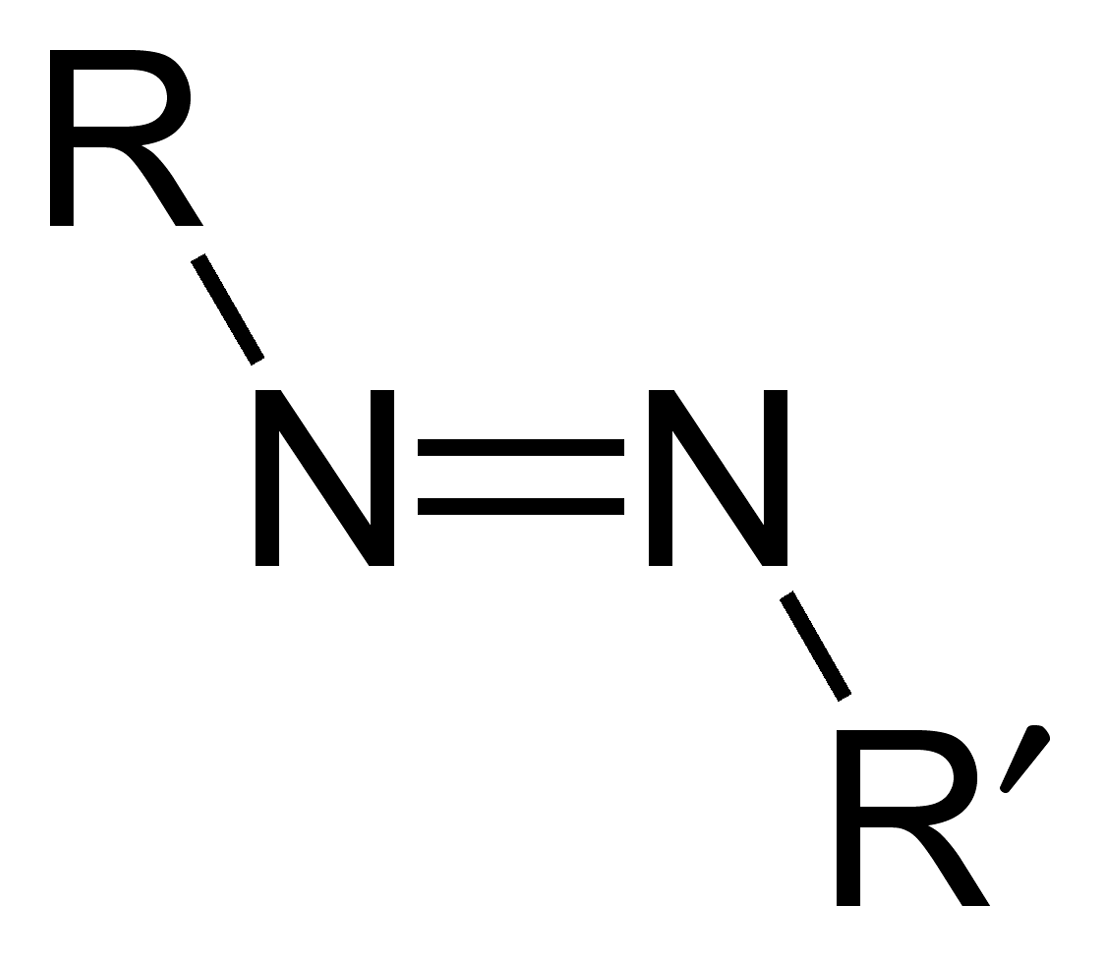
1=Organic compounds with a diazenyl group (–N=N–)
Azo compounds are organic compounds bearing the functional group diazenyl (, in which R and R′ can be either aryl or alkyl groups).
IUPAC defines azo compounds as: "Derivatives of diazene (diimide), , wherein both hydrogens are substituted by hydrocarbyl groups, e.g. azobenzene or diphenyldiazene.", where Ph stands for phenyl group. The more stable derivatives contain two aryl groups. The group is called an azo group (, ).
Many textile and leather articles are dyed with azo dyes and pigments.
Aryl azo compounds
thumb|[[Phenazopyridine]], an aryl azo compound, is used to treat [[urinary tract infections]]
Aryl azo compounds are usually stable, crystalline species. Azobenzene is the prototypical aromatic azo compound. It exists mainly as the trans isomer, but upon illumination, converts to the cis isomer.
Aromatic azo compounds can be synthesized by azo coupling, which entails an electrophilic substitution reaction where an aryl diazonium cation is attacked by another aryl ring, especially those substituted with electron-donating groups: :
Since diazonium salts are often unstable near room temperature, the azo coupling reactions are typically conducted near 0 °C. The oxidation of hydrazines () also gives azo compounds. Azo dyes are also prepared by the condensation of nitroaromatics with anilines followed by reduction of the resulting azoxy intermediate: : : For textile dying, a typical nitro coupling partner would be disodium 4,4′-dinitrostilbene-2,2′-disulfonate. Typical aniline partners are shown below.
phenol_structure.svg)
As a consequence of π-delocalization, aryl azo compounds have vivid colors, especially reds, oranges, and yellows. Therefore, they are used as dyes, and are commonly known as azo dyes, an example of which is Disperse Orange 1. Some azo compounds, e.g., methyl orange, are used as acid-base indicators due to the different colors of their acid and salt forms. Most DVD-R/+R and some CD-R discs use blue azo dye as the recording layer. The commercial success of azo dyes motivated the development of azo compounds in general.
Alkyl azo compounds
Aliphatic azo compounds (R and/or R′ = aliphatic) are less commonly encountered than the aryl azo compounds. A commercially important alkyl azo compound is azobisisobutyronitrile (AIBN), which is widely used as an initiator in free-radical polymerizations and other radical-induced reactions. It achieves this initiation by decomposition, eliminating a molecule of nitrogen gas to form two 2-cyanoprop-2-yl radicals: :[[File:Formation of Radicals from AIBN.png|frameless]] For instance a mixture of styrene and maleic anhydride in toluene will react if heated, forming the copolymer upon addition of AIBN.
A simple dialkyl diazo compound is diethyldiazene, , which can be synthesized through a variant of the Ramberg–Bäcklund reaction. Because of their instability, aliphatic azo compounds pose the risk of explosion.
AIBN is produced by converting acetone cyanohydrin to the hydrazine derivative followed by oxidation: : :
Safety and regulation
Many azo pigments are non-toxic, although some, such as dinitroaniline orange, ortho-nitroaniline orange, or pigment orange 1, 2, and 5 have been found to be mutagenic. Likewise, several case studies have linked azo pigments with basal cell carcinoma.
European regulation
Certain azo dyes can break down under reductive conditions to release any of a group of defined aromatic amines. Consumer goods which contain listed aromatic amines originating from azo dyes were prohibited from manufacture and sale in European Union countries in September 2003. As only a small number of dyes contained an equally small number of amines, relatively few products were affected.
References
References
- "azo compounds".
- (2003). "The Art of Writing Reasonable Organic Reaction Mechanisms". Springer.
- H. T. Clarke. (1941). "Methyl Red".
- March, J.. (1992). "Advanced Organic Chemistry". J. Wiley and Sons.
- Klaus Hunger, Peter Mischke, Wolfgang Rieper, Roderich Raue, Klaus Kunde, Aloys Engel: "Azo Dyes" in ''Ullmann’s Encyclopedia of Industrial Chemistry'', 2005, Wiley-VCH, Weinheim.{{doi. 10.1002/14356007.a03_245.
- Ohme, R.. (1988). "Azoethane".
- Jean-Pierre Schirmann, Paul Bourdauducq: "Hydrazine" in ''Ullmann's Encyclopedia of Industrial Chemistry'', Wiley-VCH, Weinheim, 2002. {{doi. 10.1002/14356007.a13_177.
- Tucson University. "Health & Safety in the Arts, A Searchable Database of Health & Safety Information for Artists". Tucson University Studies.
- (2008). "Azo Pigments and a Basal Cell Carcinoma at the Thumb". Dermatology.
- [http://www.tfl.com/web/files/eubanazodyes.pdf European Ban on Certain Azo Dyes] {{webarchive. link. (2012-08-13, Dr. A. Püntener and Dr. C. Page, Quality and Environment, TFL)
This article was imported from Wikipedia and is available under the Creative Commons Attribution-ShareAlike 4.0 License. Content has been adapted to SurfDoc format. Original contributors can be found on the article history page.
Ask Mako anything about Azo compound — get instant answers, deeper analysis, and related topics.
Research with MakoFree with your Surf account
Create a free account to save articles, ask Mako questions, and organize your research.
Sign up freeThis content may have been generated or modified by AI. CloudSurf Software LLC is not responsible for the accuracy, completeness, or reliability of AI-generated content. Always verify important information from primary sources.
Report