From Surf Wiki (app.surf) — the open knowledge base
Azm Palace (Hama)
18th-century Ottoman palace in Hama, Syria
18th-century Ottoman palace in Hama, Syria
| Field | Value |
|---|---|
| name | Azm Palace |
| native_name | قصر العظم |
| alternate_names | Qasr al-Azm |
| image | AlAzamPalace at Hama1.JPG |
| caption | Upper courtyard of the palace |
| building_type | Palace, museum |
| architectural_style | Syrian |
| location | Hama, Syria |
| address | 400 m south of the Hama Citadel |
| client | As'ad Pasha al-Azm |
| completion_date | 1742 |
| floor_count | 2 |
The Azm Palace (, Bayt al-ʿAẓm) is an 18th-century Ottoman-era palace in Hama, Syria at the center of the city on the banks of the Orontes River, about 400 m south of the Hama Citadel. Ross Burns, author of Monuments of Syria (1999), reportedly considers the Azm Palace to be "one of the loveliest Ottoman residential buildings in Syria." The palace has been used as a regional archaeology museum since 1956.
History
The Azm Palace at Hama was built in 1742 by the Ottoman governor, As'ad Pasha al-Azm, as his residence.
A larger palace with the same basic plan, also known as the Azm Palace, was built in Damascus by As'ad Pasha when he became governor of that city in 1743.
The palace has been used as a museum since 1956. Extensively damaged during the 1982 Hama uprising, the palace has since been largely restored.
Architecture
The other rooms inside are also decorated with both fountains and painted panels of birds and trees. In addition, the rooms that open into the upper courtyard contain "popular tradition" displays, with costumed mannequins depicting everyday scenes of Syrian life. Close to the entrance area is the Azm Palace's private hamaam ("bath"). However, the hamaam seems to have been available for use by the public.
The smaller courtyard at the lower floor served as the haramlek, or family and women's quarters. Burns says that the haramlek is particularly noteworthy. The palace has a single-floor guest wing on the western side, vaulted service quarters on the eastern side, and the second floor was the family residence. There is a direct entrance to the madafa and the southern liwan, which also gives passage to the service wing and the Azm family tomb.
Museum
Since 1956, the palace has been housing a museum
Gallery
File:Al Azam Palace, in Hama, Syria10.JPG|Grand reception room File:Al Azam Palace, Hama, fountain.jpg|Lower courtyard of the palace, leading up to the upper courtyard File:Al Azam Palace, in Hama, Syria.8.JPG|Mannequin display depicting traditional scene
References
Bibliography
References
- "Ḥamāh".
- Beatti (1996), p. 318.
- Carter, Dunston, and Thomas (2008), p. 163.
- Nilsson and Fugmann (2002), p. 62.
- It served the continuing line of Azm governors in Hama until the end of family rule in the 19th century.Ragette (2003), p. 162.
- Mannheim (2001), pp. 216-217.
- [http://www.syriagate.com/Syria/about/cities/Hama/azem.htm ''Beit Al-Azem, The Azem Palace Museum''] at Syria Gate. {{webarchive. link. (6 August 2009)
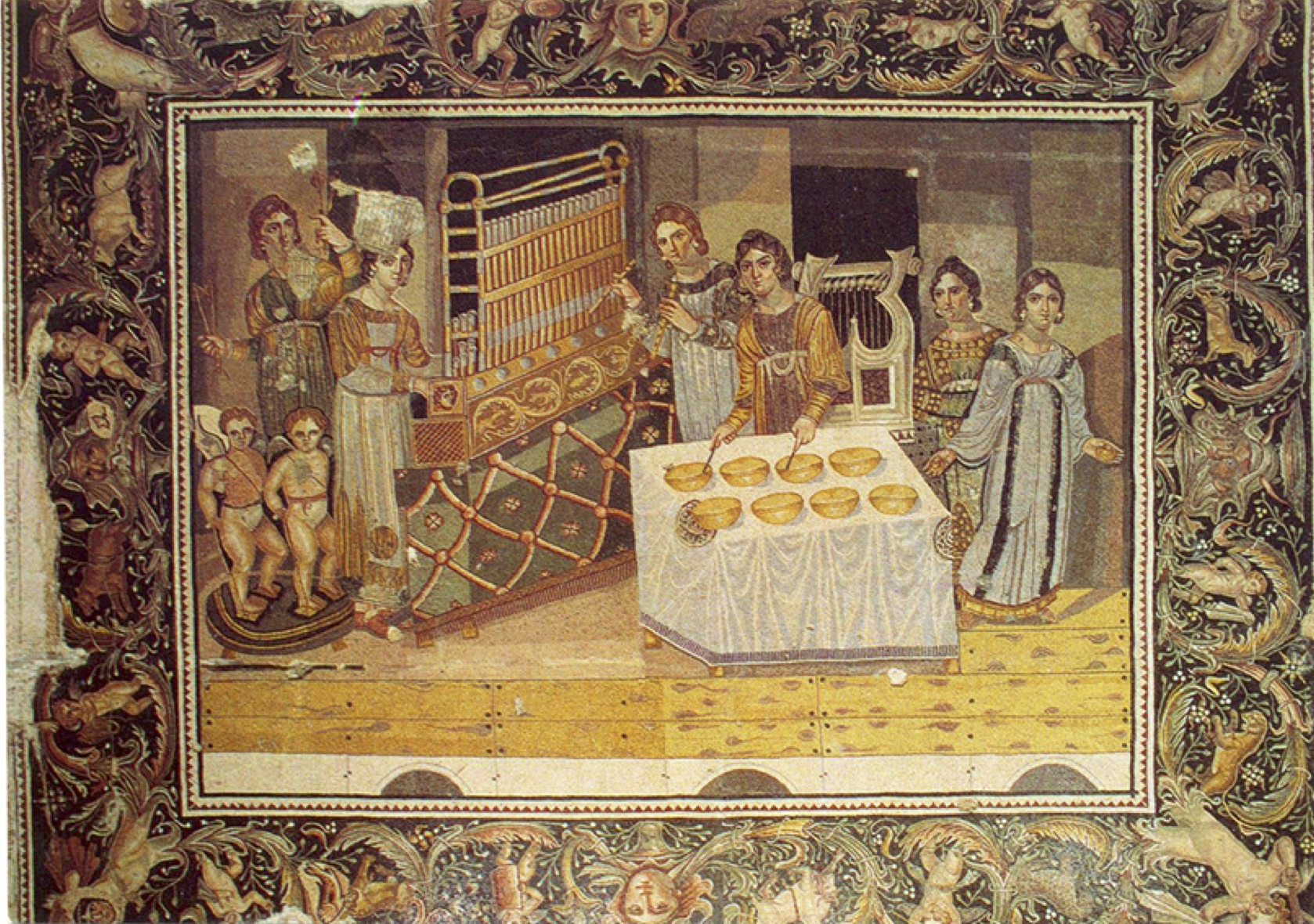
- Gavrili, Paraskevi. (2011). "Musical scenes of Roman daily life: from the Etruscans to the end of late Antiquity". University of Vienna.
This article was imported from Wikipedia and is available under the Creative Commons Attribution-ShareAlike 4.0 License. Content has been adapted to SurfDoc format. Original contributors can be found on the article history page.
Ask Mako anything about Azm Palace (Hama) — get instant answers, deeper analysis, and related topics.
Research with MakoFree with your Surf account
Create a free account to save articles, ask Mako questions, and organize your research.
Sign up freeThis content may have been generated or modified by AI. CloudSurf Software LLC is not responsible for the accuracy, completeness, or reliability of AI-generated content. Always verify important information from primary sources.
Report