From Surf Wiki (app.surf) — the open knowledge base
Azimuth
Horizontal angle from north or other reference cardinal direction
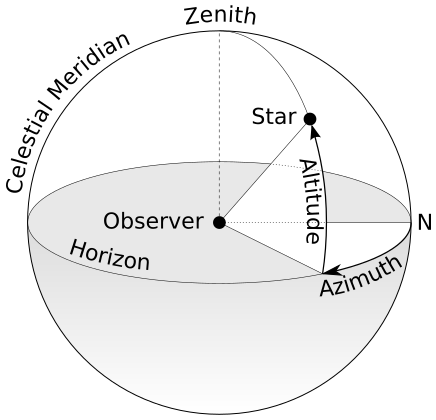
Horizontal angle from north or other reference cardinal direction
An azimuth (; from ) is the horizontal angle from a cardinal direction, most commonly north, in a local or observer-centric spherical coordinate system.
Mathematically, the relative position vector from an observer (origin) to a point of interest is projected perpendicularly onto a reference plane (the horizontal plane); the angle between the projected vector and a reference vector on the reference plane is called the azimuth.
When used as a celestial coordinate, the azimuth is the horizontal direction of a star or other astronomical object in the sky. The star is the point of interest, the reference plane is the local area (e.g. a circular area with a 5 km radius at sea level) around an observer on Earth's surface, and the reference vector points to true north. The azimuth is the angle between the north vector and the star's vector on the horizontal plane.
Azimuth is usually measured in degrees (°), in the positive range 0° to 360° or in the signed range -180° to +180°. The concept is used in navigation, astronomy, engineering, mapping, geodesy, mining, and ballistics.
Etymology
The word azimuth is used in all European languages today. It originates from medieval Arabic السموت (al-sumūt, pronounced as-sumūt), meaning "the directions" (plural of Arabic السمت al-samt = "the direction"). The Arabic word entered late medieval Latin in an astronomy context and in particular in the use of the Arabic version of the astrolabe astronomy instrument. Its first recorded use in English is in the 1390s in Geoffrey Chaucer's A Treatise on the Astrolabe. The first known record in any Western language is in Spanish in the 1270s in an astronomy book that was largely derived from Arabic sources, the Libros del saber de astronomía commissioned by King Alfonso X of Castile.
In astronomy
Main article: Horizontal coordinate system
In the horizontal coordinate system, used in celestial navigation, azimuth is one of the two coordinates. The other is altitude, sometimes called elevation above the horizon. It is also used for satellite dish installation (see also: sat finder). In modern astronomy azimuth is nearly always measured from the north.
In navigation
Main article: Azimuth (navigation)

Today, the reference plane for an azimuth is typically true north, measured as a 0° azimuth, though other angular units (grad, mil) can be used. Moving clockwise on a 360 degree circle, east has azimuth 90°, south 180°, and west 270°. There are exceptions: some navigation systems use south as the reference vector. Any direction can be the reference vector, as long as it is clearly defined.
Quite commonly, azimuths or compass bearings are stated in a system in which either north or south can be the zero, and the angle may be measured clockwise or anticlockwise from the zero. For example, a bearing might be described as "(from) south, (turn) thirty degrees (toward the) east" (the words in brackets are usually omitted), abbreviated "S30°E", which is the bearing 30 degrees in the eastward direction from south, i.e. the bearing 150 degrees clockwise from north. The reference direction, stated first, is always north or south, and the turning direction, stated last, is east or west. The directions are chosen so that the angle, stated between them, is positive, between zero and 90 degrees. If the bearing happens to be exactly in the direction of one of the cardinal points, a different notation, e.g. "due east", is used instead.
True north-based azimuths
| Direction | Azimuth | N | NNE | NE | ENE | E | ESE | SE | SSE |
|---|---|---|---|---|---|---|---|---|---|
| 0° | |||||||||
| 22.5° | |||||||||
| 45° | |||||||||
| 67.5° | |||||||||
| 90° | |||||||||
| 112.5° | |||||||||
| 135° | |||||||||
| 157.5° |
| Direction | Azimuth | S | SSW | SW | WSW | W | WNW | NW | NNW |
|---|---|---|---|---|---|---|---|---|---|
| 180° | |||||||||
| 202.5° | |||||||||
| 225° | |||||||||
| 247.5° | |||||||||
| 270° | |||||||||
| 292.5° | |||||||||
| 315° | |||||||||
| 337.5° |
In geodesy
Main article: Inverse geodetic problem

We are standing at latitude \varphi_1, longitude zero; we want to find the azimuth from our viewpoint to Point 2 at latitude \varphi_2, longitude L (positive eastward). We can get a fair approximation by assuming the Earth is a sphere, in which case the azimuth α is given by
:\tan\alpha = \frac{\sin L}{\cos\varphi_1 \tan\varphi_2 - \sin\varphi_1 \cos L}
A better approximation assumes the Earth is a slightly-squashed sphere (an oblate spheroid); azimuth then has at least two very slightly different meanings. Normal-section azimuth is the angle measured at our viewpoint by a theodolite whose axis is perpendicular to the surface of the spheroid; geodetic azimuth (or geodesic azimuth) is the angle between north and the ellipsoidal geodesic (the shortest path on the surface of the spheroid from our viewpoint to Point 2). The difference is usually negligible: less than 0.03 arc second for distances less than 100 km.
Normal-section azimuth can be calculated as follows: : \begin{align} e^2 &= f(2 - f) \ 1 - e^2 &= (1 - f)^2 \ \Lambda &= \left(1 - e^2\right) \frac{\tan\varphi_2}{\tan\varphi_1} + e^2 \sqrt{\frac{1 + \left(1 - e^2\right)\left(\tan\varphi_2\right)^2} {1 + \left(1 - e^2\right)\left(\tan\varphi_1\right)^2}} \ \tan\alpha &= \frac{\sin L}{(\Lambda - \cos L)\sin\varphi_1} \end{align} where f is the flattening and e the eccentricity for the chosen spheroid (e.g., for WGS84). If φ1 = 0 then : \tan\alpha = \frac{\sin L}{\left(1 - e^2\right)\tan\varphi_2}
To calculate the azimuth of the Sun or a star given its declination and hour angle at a specific location, modify the formula for a spherical Earth. Replace φ2 with declination and longitude difference with hour angle, and change the sign (since the hour angle is positive westward instead of east).
In cartography

The cartographical azimuth or grid azimuth (in decimal degrees) can be calculated when the coordinates of 2 points are known in a flat plane (cartographical coordinates):
:\alpha = \frac{180}{\pi} \operatorname{atan2}(X_2 - X_1, Y_2 - Y_1)
Remark that the reference axes are swapped relative to the (counterclockwise) mathematical polar coordinate system and that the azimuth is clockwise relative to the north. This is the reason why the X and Y axis in the above formula are swapped. If the azimuth becomes negative, one can always add 360°.
The formula in radians would be slightly easier: :\alpha = \operatorname{atan2}(X_2 - X_1, Y_2 - Y_1)
Note the swapped (x, y) in contrast to the normal (y, x) atan2 input order.
The opposite problem occurs when the coordinates (X1, Y1) of one point, the distance D, and the azimuth α to another point (X2, Y2) are known, one can calculate its coordinates: :\begin{align} X_2 &= X_1 + D \sin\alpha \ Y_2 &= Y_1 + D \cos\alpha \end{align} This is typically used in triangulation and azimuth identification (AzID), especially in radar applications.
Map projections
There is a wide variety of azimuthal map projections. They all have the property that directions (the azimuths) from a central point are preserved. Some navigation systems use south as the reference plane. However, any direction can serve as the plane of reference, as long as it is clearly defined for everyone using that system.
Other uses
For magnetic tape drives, azimuth refers to the angle between the tape head(s) and tape.
In sound localization experiments and literature, the azimuth refers to the angle the sound source makes compared to the imaginary straight line that is drawn from within the head through the area between the eyes.
An azimuth thruster in shipbuilding is a propeller that can be rotated horizontally.
References
References
- The singular form of the noun is {{langx. ar. السَّمْت. as-samt. the direction.
- {{cite Dictionary.com. azimuth
- "Azimuth" at [https://archive.org/stream/oed01arch#page/602/mode/1up ''New English Dictionary on Historical Principles'']; "azimut" at [http://www.cnrtl.fr/definition/azimut ''Centre National de Ressources Textuelles et Lexicales'']; "al-Samt" at [http://referenceworks.brillonline.com/entries/encyclopaedia-of-islam-2/al-samt-SIM_6591 ''Brill's Encyclopedia of Islam'']; "azimuth" at [http://englishwordsofarabicancestry.wordpress.com/#cite_note-39 EnglishWordsOfArabicAncestry.wordpress.com] {{webarchive. link. (January 2, 2014 . In Arabic the written ''al-sumūt'' is always pronounced ''as-sumūt'' (see [[Sun and moon letters). pronunciation of "al-" in Arabic]]).
- Rutstrum, Carl, ''The Wilderness Route Finder'', University of Minnesota Press (2000), {{ISBN. 0-8166-3661-3, p. 194
- U.S. Army, ''Map Reading and Land Navigation'', FM 21-26, Headquarters, Dept. of the Army, Washington, D.C. (7 May 1993), ch. 6, p. 2
- U.S. Army, ''Map Reading and Land Navigation'', FM 21-26, Headquarters, Dept. of the Army, Washington, D.C. (28 March 1956), ch. 3, p. 63
- U.S. Army, ch. 6 p. 2
- U.S. Army, ''Advanced Map and Aerial Photograph Reading'', Headquarters, War Department, Washington, D.C. (17 September 1941), pp. 24–25
- U.S. Army, ''Advanced Map and Aerial Photograph Reading'', Headquarters, War Department, Washington, D.C. (23 December 1944), p. 15
- Torge & Müller (2012) Geodesy, De Gruyter, eq.6.70, p.248
This article was imported from Wikipedia and is available under the Creative Commons Attribution-ShareAlike 4.0 License. Content has been adapted to SurfDoc format. Original contributors can be found on the article history page.
Ask Mako anything about Azimuth — get instant answers, deeper analysis, and related topics.
Research with MakoFree with your Surf account
Create a free account to save articles, ask Mako questions, and organize your research.
Sign up freeThis content may have been generated or modified by AI. CloudSurf Software LLC is not responsible for the accuracy, completeness, or reliability of AI-generated content. Always verify important information from primary sources.
Report