From Surf Wiki (app.surf) — the open knowledge base
Aylesbury
County town of Buckinghamshire, England

County town of Buckinghamshire, England
| Field | Value |
|---|---|
| official_name | Aylesbury |
| country | England |
| region | South East England |
| static_image_name | {{multiple image |
| border | infobox |
| total_width | 250 |
| image_style | border:1; |
| perrow | 2/1/2 |
| image1 | St Mary's Church - geograph.org.uk - 3709063.jpg |
| caption1 | St Mary’s |
| image2 | Buckinghamshire County Hall, Aylesbury.jpg |
| caption2 | County Hall |
| image3 | Aylesbury Market Square Bucks.jpg |
| caption3 | Aylesbury Crown Court |
| image4 | End of Aylesbury Arm, Grand Union Canal - geograph.org.uk - 5638650.jpg |
| caption4 | Aylesbury Arm |
| image5 | Aylesbury, Buckinghamshire County Museum - geograph.org.uk - 897270.jpg |
| caption5 | County Museum |
| population | 63,273 |
| population_ref | (2021) |
| Urban area 94,238 | |
| os_grid_reference | SP818138 |
| coordinates | |
| post_town | AYLESBURY |
| postcode_area | HP |
| postcode_district | HP18-HP21 |
| dial_code | 01296 |
| constituency_westminster | Aylesbury |
| civil_parish | Aylesbury |
| london_distance | 36 mi |
| unitary_england | Buckinghamshire Council |
| lieutenancy_england | Buckinghamshire |
| mapframe | yes |
| mapframe-zoom | 11 |
| mapframe-point | none |
the town in England
Urban area 94,238 | mapframe-zoom = 11 | mapframe-point = none Aylesbury ( or ) is the county town of Buckinghamshire, England. It is home to the Roald Dahl Children's Gallery and the Waterside Theatre. There is also one of the largest independent Arts Centre in the UK, the Queens Park Arts Centre which recently received the King's Award for Voluntary Service. It is located in central Buckinghamshire, midway between High Wycombe and Milton Keynes.
In 2011 its urban area had a population of 94,238 The housing target for the town is set to grow with 16,000 homes set to be built by 2033.
Etymology
The town name is of Old English origin. It is first recorded in the form Æglesburg in the Anglo-Saxon Chronicle, a text which took its present form in the later ninth century. The word Ægles is a personal name in the genitive case, meaning "Ægel's" and burg means "fortification". Thus the name once meant "Fort of Ægel" — though who Ægel was is not recorded. Nineteenth-century speculation that the name contained the Welsh word eglwys meaning "a church" (from Latin ecclesia) has been discredited.
History
Excavations in the town centre in 1985 found an Iron Age hill fort dating from the early 4th century BCE.
The Anglo-Saxon Chronicle portrays Aylesbury as being captured from the Britons by one Cuthwulf following the Battle of Bedcanford; the historicity of this event is doubtful, but the portrayal at least indicates that in the early Middle Ages the settlement was thought to be of some strategic importance. During the early medieval period, Aylesbury became a major market town, the burial place of Saint Osgyth, whose shrine attracted pilgrims. Aylesbury was a royal manor with eight attached hundreds in 1086, and some historians have supposed that it was already a royal manor before the Norman conquest. Some lands here were granted by William the Conqueror to citizens upon the tenure that the owners should provide straw for the monarch's bed, sweet herbs for his chamber and two green geese and three eels for his table, whenever he should visit Aylesbury.
The town includes an Early English parish church, St. Mary the Virgin's (which has many later additions).
In 1450, a religious institution called the Guild of St Mary was founded in Aylesbury by John Kemp, Archbishop of York. Known popularly as the Guild of Our Lady it became a meeting place for local dignitaries and a hotbed of political intrigue. The guild was influential in the outcome of the Wars of the Roses. Its premises at the Chantry in Church Street, Aylesbury, are still there, though today the site is used mainly for retail.
Aylesbury was declared the new county town of Buckinghamshire in 1529 by King Henry VIII: Aylesbury Manor was among the many properties belonging to Thomas Boleyn, the father of Anne Boleyn, and it is rumoured that the change was made by the King to curry favour with the family. The plague decimated the population in 1603/4.

The town played a large part in the English Civil War when it became a stronghold for the Parliamentarian forces, like many market towns a nursing-ground of Puritan sentiment and in 1642 the Battle of Aylesbury was fought and won by the Parliamentarians. Its proximity to Great Hampden, home of John Hampden has made of Hampden a local hero: his silhouette was used on the emblem of Aylesbury Vale District Council and his statue stands prominently in the town centre. Aylesbury-born composer, Rutland Boughton (1878–1960), possibly inspired by the statue of John Hampden, created a symphony based on Oliver Cromwell.
On 18 March 1664, Robert Bruce, 2nd Earl of Elgin in the Peerage of Scotland was created 1st Earl of Ailesbury.
The grade II* listed Jacobean mansion of Hartwell adjoining the southwest of the town was the residence of French king Louis XVIII during his exile (1810–1814). Bourbon Street in Aylesbury is named after the king. Louis's wife, Marie Joséphine of Savoy died at Hartwell in 1810 and is the only French queen to have died on English soil. After her death, her body was carried first to Westminster Abbey, and one year later to Sardinia, where the Savoy King of Sardinia had withdrawn during Napoleonic occupation of Turin and Piedmont; she is buried in the Cathedral of Cagliari.
Aylesbury's heraldic crest displays the Aylesbury duck, which has been bred here since the birth of the Industrial Revolution, although only one breeder of true Aylesbury ducks, Richard Waller, remains today.
The town also received international publicity in 1963 when the culprits responsible for the Great Train Robbery (1963) were tried at Aylesbury Rural District Council Offices in Walton Street and sentenced at Aylesbury Crown Court. The robbery took place at Bridego Bridge, a railway bridge at Ledburn, about 6 mi from the town.
A notable institution is Aylesbury Grammar School which was founded in 1598. The original building is now part of the County Museum buildings in Church Street and has grade II* architecture; other grammar schools now include Sir Henry Floyd Grammar School and Aylesbury High School. Other notable buildings are the King's Head Inn, (which, with the Fleece Inn at Bretforton, is one of the few public houses in the country owned by the National Trust and still run as a public house) and the Queens Park Centre.
James Henry Govier, the British painter and etcher, lived at Aylesbury and produced a number of works relating to the town including the church, canal, Walton, Aylesbury Gaol, the King's Head Inn and views of the town during the 1940s and 1950s, examples of which can be seen in the Buckinghamshire County Museum in Aylesbury.
The town is the birthplace of the Paralympic Games. During the 1948 Olympics in London, German-British neurologist Sir Ludwig Guttmann, set up a small sporting event for World War II veterans known as the World Wheelchair and Amputee Games (WWAG) at Stoke Mandeville Hospital Rehabilitation Facility in Aylesbury. This eventually led to the growth of the phenomenon of the modern Paralympic Games that has been held immediately after every Summer Olympic Games since 1988, and the WWAG was held most years at Stoke Mandeville until 1997, when it has been held in other countries and cities ever since. During the 2012 Paralympics, the official mascot was called 'Mandeville' after Stoke Mandeville Hospital.
The Rothschild Family acquired many large country estates and stately homes around and near the town, including Waddesdon Manor in nearby Waddesdon Village, Halton House near Wendover and Tring Park in Tring across the border in Hertfordshire, although today most of these properties belong to the National Trust. They have brought in increased tourism to the town and the surrounding areas.
The Aylesbury duck
In the 18th century, selective breeding of white common ducks led to a white domestic duck, generally known as the English White. Since at least the 1690s ducks had been farmed in Aylesbury, and made Aylesbury known throughout England and beyond. They were bred and brought up by poor people, and sent to London by the weekly carriers. They went on to be known as the Aylesbury duck.

The duck business in Aylesbury went into decline in the 19th century. By the time Beatrix Potter's 1908 The Tale of Jemima Puddle-Duck—about an Aylesbury duck although set in Cumbria—caused renewed interest in the breed, the Aylesbury duck was in steep decline. The duckers of Buckinghamshire had generally failed to introduce technological improvements such as the incubator, and inbreeding had dangerously weakened the breed. Meanwhile, the cost of duck food had risen fourfold over the 19th century, and from 1873 onwards competition from Pekin and Pekin cross ducks was undercutting Aylesbury ducks at the marketplace. The First World War devastated the remaining duckers of Buckinghamshire. By the end of the war small-scale duck rearing in the Aylesbury Vale had vanished, with duck raising dominated by a few large duck farms. Shortages of duck food in the Second World War caused further disruption to the industry, and almost all duck farming in the Aylesbury Vale ended. A 1950 "Aylesbury Duckling Day" campaign to boost the reputation of the Aylesbury duck had little effect; by the end of the 1950s the last significant farms had closed, other than a single flock in Chesham owned by Mr L. T. Waller, and by 1966 there were no duck breeders remaining in Aylesbury. As of 2021 the Waller family's farm in Chesham remains in business, the last surviving flock of pure Aylesbury meat ducks in the country. Although, there are still many hobbyists who keep the breed.

The Aylesbury duck remains a symbol of the town of Aylesbury. Aylesbury United F.C. are nicknamed "The Ducks" and include an Aylesbury duck on their club badge, and the town's coat of arms includes an Aylesbury duck and plaited straw, representing the two historic industries of the town. The Aylesbury Brewery Company, now defunct, featured the Aylesbury duck as its logo, an example of which can still be seen at the Britannia pub. Duck Farm Court is a shopping area of modern Aylesbury located near the historic hamlet of California, close to one of the main breeding grounds for ducks in the town, and there have been two pubs in the town with the name "The Duck" in recent years; one in Bedgrove that has since been demolished and one in Jackson Road that has recently been renamed.[[File:Jemima5.jpg|thumb|An illustration of Jemima Puddle-Duck from [[The Tale of Jemima Puddle-Duck]] by [[Beatrix Potter]].|left]]
Demography
The town's population has grown from 28,000 in the 1960s to almost 72,000 in 2011 due in the main to new housing developments, including many London overspill housing estates, built to ease pressure on the capital. Indeed, Aylesbury, to a greater extent than many English market towns, saw substantial areas of its own heart demolished in the 1950s/1960s as 16th–18th century houses (many in good repair) were demolished to make way for new, particularly retail, development.
Aylesbury's population in the ten-year period since 2001 has grown by two thousand primarily related to the development of new housing estates which will eventually cater for eight thousand people on the north side, between the A41 (Akeman Street) and the A413 and the expansion of Fairford Leys estate.
According to the 2011 Census, the religious groupings in Aylesbury were: Christianity (55.7%), no religion (26.9%), Islam (8.3%), Hinduism (1.4%), other (0.4%). 6.7% of respondents did not state their religion.
Geography

Neighbourhoods
Housing estates in or neighbourhoods of the modern Aylesbury include:
- Bedgrove
- Berryfields
- Broughton
- Buckingham Park
- Coppice
- Crown Leys
- Elm Farm
- Elmhurst
- Fairford Leys
- Haydon Hill
- Hawkslade Farm
- Kingsbrook
- Mandeville Estate
- Mandeville Park
- d'accord
- Prebendal Farm
- Quarrendon
- Queens Park
- Shakespeare Estate
- Southcourt
- Stoke Farm
- Stoke Grange
- Walton Court
- Watermead
- The Willows
Distinct whole areas that have a notably high property price in the town are Bedgrove, the conservation area around St. Mary's Church and Queens Park, particularly facing onto the canal.
Farms and hamlets
Aylesbury has also been extended to completely surround the hamlets and former farms at:
- Bedgrove
- California
- Fairford Leys
- New Zealand
- Prebendal Farm
- Quarrendon
- Turnfurlong
- Walton
Future developments
Anticipated developments are expected to raise the urban population of Aylesbury from its current approximation of 75,000 to over 100,000 between 2018 and 2023.
Elevations, soil and geology
Aylesbury is immediately southeast of the upper River Thame that flows past Thame to Dorchester on Thames and is partly sited on the two northernmost outcrops of Portland stone in England
The town centre's higher terrain is accurately described by Samuel Lewis in 1848 as a "gentle eminence".
Main article: Buckinghamshire#Geology
The county's oldest rocks of Jurassic age cover the whole of the northern half of Buckinghamshire, succeeded continuously by younger rocks to the south of the Chilterns.
Culture and community
.jpg)
The town centre is home to many pubs and bars. The Queens Park Centre, which is the UK's largest independent arts centre is also based in the town centre.
The local newspaper is the Bucks Herald, which started publishing in January 1832.
Local radio stations was named Mix 96, which first broadcast in April 1994, and eventually ceased operations in September 2020, being replaced by Greatest Hits Radio. One of the more prominent buildings in Aylesbury is the "Blue Leanie" office block, home to Lloyds Bank. When first built it was thought to be a potential hazard to passing motorists, due to the sun reflecting off its large mirrored surface. As a result, a line of mature trees was planted alongside the main road to prevent dazzling.
BBC local radio station that broadcast to the town is BBC Three Counties Radio on 94.7 FM.
Local news and television programmes is provided by BBC South and ITV Meridian. Television signals are received from the Oxford transmitting station.
Aylesbury Waterside Theatre, a new £42 million theatre, with 1,200-seat auditorium, opened in October 2010. In addition to this, the surrounding area has been redeveloped a £100 million project known as the 'Waterside project'. When this is completed, there will be 260000 sqft of new retail floor space and 1,100 new jobs created, although when this will be completed now is unclear. Also, a new campus of the [Bucks New University] opened on the Waterside site next to the Waterside Theatre.
The Bourg Walk Bridge (also called the Southcourt Bridge or the Roberts Bridge after a local councillor) opened in March 2009 connecting Southcourt to Aylesbury town centre. The focus of the footbridge is a central concrete pillar with four suspension cables supporting the structure. This bridge forms a central part of the Aylesbury Hub project. Bourg Walk was nominated and won the Engineering Excellence Award 2009 awarded by the Institution of Civil Engineers – South East England branch.
Governance

There are two tiers of local government covering the town, at parish and unitary authority level: Aylesbury Town Council, based at Aylesbury Town Hall at 5 Church Street, and Buckinghamshire Council, which is also based in Aylesbury, having its headquarters at The Gateway on Gatehouse Road.
Aylesbury Town Council is the parish council for the town. As at May 2021 it comprises 25 councillors, 20 of whom are Liberal Democrats and 5 Conservative. The council represents only the constituents of Aylesbury town itself. Surrounding villages and some recent developments on the outskirts of Aylesbury like Fairford Leys & Watermead have their own parish council. In 2010 the district council decided that the new developments of Berryfields and Weedon Hill, both to the north of Aylesbury, should also join to form a new parish as of May 2011.
The town council also elects the town mayor from the serving town councillors every year. The process culminates in a formal "Mayor Making" ceremony where the new mayor takes over from the preceding mayor. The role of mayor is mainly a ceremonial role representing the town at various events and acting as an ambassador for the town.
Administrative history
Aylesbury was made a borough by a charter from Mary I in 1554, which gave the town the right to elect two members of parliament and to establish a council to govern itself. The right to establish a council was opposed by the prominent local landowner Thomas Pakington, and it seems likely that this element of the charter was not put into effect at that time. In 1650, following the English Civil War, the town did establish a degree of self-government under the auspices of the 1554 charter. However, in 1664, in the aftermath of the Restoration, the town's short-lived council was abolished and the rights it had held reverted to the Pakington family which had exercised them prior to the civil war. Thereafter the town was governed by its vestry in the same way as most rural areas, although it remained a parliamentary constituency.
In 1849 a local board of health was established to govern the town. This board was replaced by Aylesbury Urban District Council in 1894, which was subsequently given municipal borough status on 1 January 1917, becoming Aylesbury Borough Council. The borough council was awarded a coat of arms in 1964.
In 1974 Aylesbury Borough Council merged with several neighbouring districts to become Aylesbury Vale. No successor parish was initially created for Aylesbury, and it became an unparished area, directly administered by Aylesbury Vale District Council. The civil parish of Aylesbury was re-established in 2001, with its parish council taking the name Aylesbury Town Council. From 2001 to 2020 there were therefore three tiers of local government covering the town, at parish, district, and county level.
Aylesbury Vale District Council was abolished in 2020, merging with Buckinghamshire County Council and other district councils to become a unitary authority called Buckinghamshire Council. Since 1 April 2020, when Buckinghamshire Council came into being, it has been responsible for almost all statutory local government functions across the county.
Education
Aylesbury is home to one college of general further education (Aylesbury College on Oxford Road), three grammar schools, two community upper schools, an academy, a university technical college and a host of primary schools. The secondary schools are:
- Aylesbury Grammar School (boys only)
- Aylesbury High School (girls only)
- The Aylesbury Vale Academy
- Buckinghamshire University Technical College
- The Grange School
- Sir Henry Floyd Grammar School
- Mandeville School
There are also the following special schools:
- The PACE Centre
- Pebble Brook School
- Stocklake Park Community School, formerly Park School
The Aylesbury Vale Secondary Support Centre is a Pupil referral unit (PRU), which caters for permanently excluded pupils.
Aylesbury Music Centre is a large educational establishment, which has its own premises adjoining Aylesbury High School and rivals the Royal College of Music, having produced members of national orchestras.
Health
Stoke Mandeville Hospital is a large National Health Service hospital to the south of the town centre. Its National Spinal Injuries Centre is one of the largest specialist spinal units in the world, and the pioneering rehabilitation work carried out there by Sir Ludwig Guttmann led to the development of the Paralympic Games. Stoke Mandeville Stadium was developed alongside the hospital and is the National Centre for Disability Sport in the United Kingdom.
Royal Buckinghamshire Hospital is a private hospital specialising in spinal cord injury.
Aylesbury has provisions for mental health therapy and treatments at the Tindal Centre on Bierton Road. The Tindal Centre closed in early 2014 and Mental Health therapy and treatments along with Adult and Older Adult Mental Health Team's moved across the road to the new purpose-built hospital the Whiteleaf Centre. The former site of Tindal Centre has been transformed into a new housing development Bierton Place which has maintained the architecture of the original building and enhanced its beauty
Trade and industry
Traditionally the town was a commercial centre with a market dating back to the Saxon period. This is because it was established on the main Akeman Street which became an established trade route linking London to the southwest. In 1180 a jail was established in the town .
15th century
By 1477 flour was being ground in the town for surrounding parishes. By the modern period this had grown into a huge established industry: the last grist mill in Aylesbury was closed in the 1990s (Hills & Partridge on the canal behind Tesco). By 1560 the manufacture of sewing needles had become a large industry in Long Crendon a village close by which was an important production centre.
17th century – lace making
In 1672 poor children in Buckinghamshire were taught to make lace as a way to make a living. Bucks lace as it became known quickly became very sought after and production boomed as the lace was mainly made by poor women and children. The lace-making industry had died out by Victorian times, however, as new machine-made lace became cheaper.
In 1764 Euclid Neale opened his clockmaking workshop in Aylesbury. In the 18th century, he was one of the best clock makers in the country.
19th century – canals
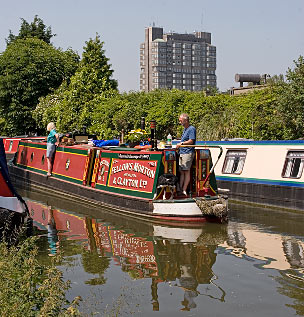
In 1814, the Aylesbury arm of the Grand Union Canal from Marsworth was opened bringing major industry to the town for the first time. At the same time the Wendover arm was built leading to nearby Wendover.
20th century – motor manufacture

From 1919 until 1925 the Cubit Engineering Works on Bicester Road was a volume manufacturer of motor vehicles. Approximately 3,000 cars were built, but a somewhat slow and heavy design could not survive the onslaught from cheap American competition. Their robust design and high ground clearance made them popular in less developed parts of the British Empire which lacked paved roads like Australia and South Africa. The works have been demolished for a domestic housing development. The marque is commemorated by Cubitt Street (and Edge Street) which traverses the old works.
By the late 20th century, the printers and bookbinders, Hazell, Watson and Viney and the Nestlé dairy were the two main employers in the town, employing more than half the total population. These factories have long since been demolished and replaced by a Tesco supermarket which opened in 1994, and a housing development, respectively.
21st century
Today, the town is still a major commercial centre and the market still meets on the cobbles of the old Market Square four days a week. Nestle and Hazell, Watson and Viney and US automotive parts producer TRW have gone – the last left the town in 2006. However three major industrial and commercial centres make sure the town has one of the lowest unemployment rates in the country.
A £150 million Arla Foods 'megadairy' opened just off the A41 road in nearby Aston Clinton in November 2013, roughly 3+1/2 mi from the town centre and is a major employer in the area. Traffic improvement measures were paid for by Arla in order to reduce the impact of congestion and pollution.
Sport and leisure
Aylesbury has two local semi-professional football teams, Aylesbury Vale Dynamos F.C. which plays at Haywood Way and Aylesbury United F.C. which currently shares a ground with Chesham United. There is a strong cricket club in the town, that was formed in 1837 with success in the 1950s and 1980s and is again emerging as one of the strong clubs in mid- to north Buckinghamshire. Since 2013, Aylesbury has been host to a free 5 km run called the Aylesbury Parkrun. Aylesbury is represented in Rugby Union by Aylesbury Rugby Football Club, situated at Ostler's Field in the nearby village of Weston Turville; 'The Ducks' play in the 6th tier of English Rugby.
Aylesbury's recent sporting success comes in Gymnastics with Jessica and Jennifer Gadirova, of Lynx Gymnastics Aylesbury, both winning bronze medals at the Tokyo 2020 Olympic Games for Great Britain.
Transport
Rail
The town is served by Aylesbury railway station and Aylesbury Vale Parkway railway station; the latter is terminus of passenger services of the London to Aylesbury Line from London Marylebone. Stoke Mandeville railway station also lies in the town's urban area.
Railways came to Aylesbury early, in 1839 when the Aylesbury Railway opened from Cheddington on Robert Stephenson's London and Birmingham Railway. The Wycombe Railway (later Great Western Railway) arrived via Princes Risborough on 1 October 1863, and on 23 September 1868 the Aylesbury and Buckingham Railway (later Metropolitan Railway) was opened from to almost connect a loop with the Wycombe Railway. The Metropolitan Railway (MetR) from Baker Street arrived via Amersham in 1892. The Great Central Railway (GCR) connected from Nottingham Victoria to London Marylebone via the MetR in 1899. Between 1899 and 1953, Aylesbury had railway links to four London termini: Marylebone, Baker Street, Paddington and Euston. The Aylesbury Railway closed in 1953, the MetR, which later became the Metropolitan line of the London Underground withdrew north of Aylesbury in 1936 and withdrew from the town in 1961. The GCR was dismantled north of Aylesbury in 1966. As a result, there were no regular passenger services north of Aylesbury until the opening of Aylesbury Vale Parkway railway station in December 2008. Now only the GCR south of Aylesbury Vale Parkway to Marylebone is used for regular London services.
A rail scheme to extend passenger services northwestwards to a new station, Aylesbury Vale Parkway, was completed in December 2008. This is sited on the formerly goods-only line towards Quainton at the point where the line crosses the A41 near Berryfields Farm on the north-west outskirts of the town, some 2.25 mi north of the main Aylesbury station. This area is to be known as Berryfields, a major development area and will include park and ride facilities for Aylesbury.
A further expansion of rail services to a new Winslow railway station, , Bedford and Oxford via the Claydon LNE Junction (see East West Rail) is due to be opened by 2030. Until then connections are available to Oxford and Birmingham by changing at Princes Risborough.
Roads
Aylesbury is served by the A41 road from London to Birkenhead, which becomes the M40 motorway at Bicester 13 mi west (by north) of Aylesbury. The A413 and A418 roads also run through the town. The M40 motorway at junction 9 is 14.7 mi away and the M25 motorway is just over 21 mi's drive.
Buses
Aylesbury is served by Aylesbury bus station. In 2006, work commenced on the public transport hub, a scheme comprising a one-way loop of bus lanes around the town's inner ring road, which includes improvements to the connectivity between bus and rail services. The first two phases of this scheme were completed in 2007, providing new bus lanes on Exchange Street, New Street, Friarage Road and White Hill, and also opened up High Street to buses. The final two phases, including the Bourg Walk Bridge and Station Boulevard were officially opened in April 2009.
The town is served by Buckinghamshire's first 'Rainbow Routes' network of bus services. The colour-coded routes were set up by Buckinghamshire County Council, and bus operators.
Cycling demonstration town
In 2005, the town won £1million funding to be one of six Cycling Demonstration towns in England, which was match-funded by Buckinghamshire County Council. This allows Buckinghamshire County Council to promote the use of cycling amongst the general public, as well as provide facilities for cyclists, such as bike lockers, bike stands, and Tiger and Toucan road crossings.
Cycle Aylesbury, the team created to undertake the Cycling Demonstration town work, recently opened the first of their Gemstone Cycleways, which are a network of routes running from Aylesbury town centre to various locations around the town, including Stone, Bierton, Wendover and Watermead. A second brochure/magazine was published to accompany the routes, along with a redesigned website, CycleAylesbury.co.uk.
Notable people
:See :Category:People from Aylesbury File:John Hampden portrait.jpg|John Hampden MP File:Lynda Bellingham (cropped-J1).gif|Lynda Bellingham File:Nick Blood (cropped).jpg|Nick Blood File:Brendan Cole in 2018.jpg|Brendan Cole File:Official portrait of Rt Hon Andrea Leadsom MP crop 2.jpg|Andrea Leadsom MP File:Nicholas Parsons 2007 (cropped-J1).png|Nicholas Parsons File:Mark Webber 2017 United States GP (cropped).jpg|Mark Webber File:Ellen White England Ladies v Montenegro 5 4 2014 952 (cropped-J1).jpg|Ellen White File:Ludwig Guttmann2.jpg|Ludwig Guttmann Aylesbury is or has been home to a range of notable people. In the latter part of the 20th century, the main maternity unit in the district was located in Aylesbury at the Royal Buckinghamshire Hospital; hence a large number of people were born in Aylesbury who may not have had any other association with the town. For a full list see People from Aylesbury. In alphabetic order of surname, those who live, or have lived in Aylesbury include:
- Michael Apted (1941–2021), film director and producer
- Benjamin Bates (1716–1790), physician, art connoisseur and socialite
- Lynda Bellingham (1948–2014), actress, broadcaster and author
- Nick Blood (born 1982), actor, Agents of S.H.I.E.L.D. (2014–2017), The Day of the Jackal (2024)
- Rutland Boughton (1878–1960), English composer and communist, born in the town
- Ernest Bullock (1890–1979), organist, composer and teacher; died in Aylesbury
- Brendan Cole (born 1976), New Zealand born pro-dancer on Strictly Come Dancing from 2004 to 2017
- Mathilde Carré (1908–2007), a French Resistance agent and double agent detainee at Aylesbury Prison
- Barns Courtney (born 1990), singer and songwriter, born in Aylesbury
- Sir Alexander Croke (1758–1842), British judge and Colonial Administrator in Nova Scotia
- Catherine Anne Davies (born ca.1990), stage name The Anchoress, musician and songwriter
- Greg Day (born 1957), playwright, born in Aylesbury
- Liam Gillick (born 1964) artist, born in Aylesbury
- Martin Grech (born 1982), singer, songwriter and musician
- John Hampden (ca.1595–1643), politician and Parliamentarian during the English Civil War, lived in Hartwell House
- John Junkin (1930–2006), TV performer and scriptwriter, died in Aylesbury
- Andrea Leadsom (born 1963), Conservative MP for South Northamptonshire; Minister of State for Energy at the Department of Energy and Climate Change; candidate for the leadership of the Conservative Party in 2016
- Samantha Lewthwaite (born 1983), terrorist, grew up in Aylesbury
- Constance Markievicz (1868–1927), Irish politician, revolutionary nationalist, suffragette and socialist; inmate Aylesbury prison in 1916
- John Otway (born 1952), singer and songwriter
- Nicholas Parsons (1923-2020), TV presenter and actor, lived in Aylesbury and died at Stoke Mandeville Hospital
- Charles Pearson (1847–1917), a pioneer Anglican missionary in Uganda
- Sir James Clark Ross (1800–1862), Arctic naval explorer, died in Aylesbury
- Vernon Scannell (1922–2007), a poet and author and former boxer
- William of Sherwood (ca.1200 – ca.1272), medieval English scholastic philosopher, logician, teacher and rector of Aylesbury
- Mike Smith (1943–2008), musician, of the Dave Clark Five lived in Aylesbury
- Pete Trewavas (born 1959), musician, member of Marillion
- John Wilkes (1725–1797), a radical journalist and politician; MP for Aylesbury 1757 and 1761, lived at Prebendal House in the town
Sport
- Emmerson Boyce (born 1979), footballer, born in Aylesbury
- Jennifer Gadirova and Jessica Gadirova, (twins, born 2004), Team GB gymnasts, won Bronze at the Tokyo Olympics
- Ludwig Guttmann (1899–1980), neurologist, founded the Stoke Mandeville Games, which became the Paralympic Games.
- Matt Phillips (born 1991), footballer, born in Aylesbury
- Mark Webber (born 1976), former Formula 1 driver who raced for Red Bull Racing, Jaguar Racing and Williams F1, with nine career wins; resides in Aston Clinton
- Ellen White (born 1989), England women's national football team, former Chelsea Ladies, Arsenal Ladies, Notts County Ladies, Birmingham City and Manchester City football player from Aylesbury.
Popular culture
.jpg)
A live music nightclub in Aylesbury was prominent in the 1960s, 1970s and 1980s and renamed the Friars' Club in 1969. The venue hosted many of the top artists of the time, including Jimi Hendrix, the Rolling Stones, Cream, Otis Redding, the Clash, Hawkwind, Queen, Genesis, U2, David Bowie, Talking Heads, Marillion and the Ramones. Friars' Club celebrated its 40th anniversary in 2009 by holding three special concerts that reflected the various phases of the club's musical history. The first concert in June featured the Edgar Broughton Band, the Groundhogs and the Pretty Things.
The rock band Marillion have a close association with Aylesbury. They originally formed there, with the band's first single, 1982's "Market Square Heroes", taking its title inspiration from Aylesbury's Market Square. The band continue to be based in the area, with their Racket Records studio still close to Aylesbury, and in 2007 the band performed together with their original lead singer, Fish, for the first time in 19 years at Aylesbury.
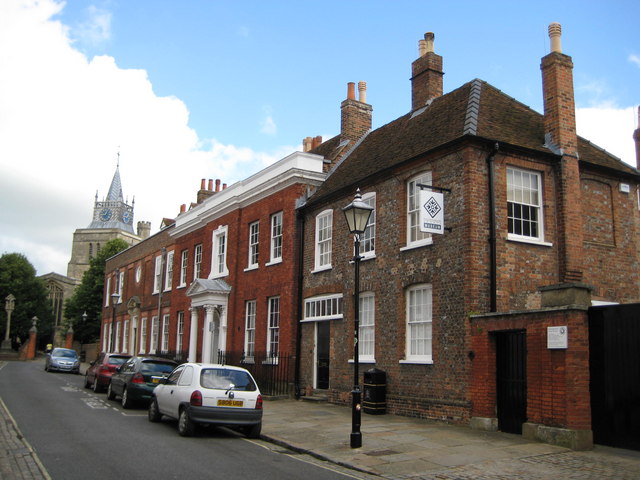
Aylesbury Methodist Church holds an annual organ recital, which attracts prominent national organists. The Roald Dahl Children's Gallery in Church Street, Aylesbury, is a children's museum in honour of novelist Roald Dahl that opened on 23 November 1996. Aylesbury hosts the Roald Dahl Festival, a procession of giant puppets based on his characters, on 2 July.
Comedian and actor Ronnie Barker (1929–2005) began his acting career in the town in the late 1940s and in September 2010, almost five years after his death, a bronze statue of him was unveiled by actor David Jason and Barker's one time co-star Ronnie Corbett (the other half of the Two Ronnies) on a new public place in Exchange Street.
Shown in productions
Scenes from the film A Clockwork Orange were filmed in Friars Square in Aylesbury but did not make it to the final cut. This is the 'Librarian Scene' where outtakes from the shoot and rehearsal can be seen in Alison Castle's The Stanley Kubrick Archives published by Taschen. The opening scene, in which the droogs beat up an elderly Irishman, is mistakenly cited as being filmed in the underpass linking Friars Square Shopping Centre with the railway station. However, Christiane Kubrick's book Stanley Kubrick – A Life in Pictures states that the underpass in the film has a different shape to the one in Aylesbury and these sequences were actually filmed in Wandsworth.
The County Court building and Aylesbury Market Square regularly feature in the BBC Television series Judge John Deed.
Twin town
Aylesbury is twinned with the French town of Bourg-en-Bresse, 267 mi east of Paris.
Closest cities, towns and villages
Gallery
File:Church of St Mary, Aylesbury - geograph.org.uk - 4572.jpg|Church of St Mary, Aylesbury – Grade I listed church File:Aylesbury Church Street.jpg|The Old Grammar School, now museum and other buildings, Church Street, Aylesbury File:Church Street, Aylesbury (2).jpg|Church Street – detail File:Ayles00205A.jpg|Bucks 'New' County offices File:BlueLeany2008.jpg|Blue Leanie, office block of Lloyds Bank. File:Aylesbury KingsHeadInn02.JPG|15th century King's Head Inn File:Aylesbury KingsHeadInn01.JPG|Beer garden of King's Head Inn File:Aylesbury's Hobgoblin - geograph.org.uk - 752699.jpg|Hobgoblin Inn File:Aylesbury railway station.JPG|Aylesbury railway station File:Aylesbury Vale 1.jpg|Part of Aylesbury Vale taken from the top of Coombe Hill, looking towards Aylesbury – the town's shape is visible.
Freedom of the Town
The following people and military units have received the Freedom of the Town of Aylesbury.
Individuals
- Freda Roberts: 25 April 2016.
- Ellen White: 25 April 2016.
References
- "Aylesbury Parish".
- "Aylesbury Built-up area".
- (1997). "Frommer's England from $60 a Day". Wiley.
- "Aylesbury".
- [https://www.aylesburyvaledc.gov.uk/section/vale-aylesbury-local-plan-valp-2013-2033 Vale of Aylesbury Local Plan]
- ''The Cambridge Dictionary of English Place-Names Based on the Collections of the English Place-Name Society'', ed. by Victor Watts (Cambridge: Cambridge University Press, 2004), s.v. ''AYLESBURY''; {{ISBN. 9780521168557.
- (1971). "Origines Celticae (a Fragment) and Other Contributions to the History of Britain, Volume 1". Ardent Media.
- Samuel Lewis. (1848). "Aylesbury". Institute of Historical Research.
- Sims-Williams, Patrick. (1983). "The Settlement of England in Bede and the Chronicle". Anglo-Saxon England.
- (15 January 2013). "The Plague in Amersham".
- http://www.civicheraldry.co.uk/thames_valley_chilterns.html#aylesbury%20tc Civic Heraldry of England and Wales: Aylesbury. CREST: On a Wreath Argent and Gules issuant from a Wreath of plaited Straw a Mount thereon an Aylesbury Duck all proper.
- Richard Waller. "Richard Waller – The Last Remaining Breeder of Aylesbury Ducks".
- {{National Heritage List for England
- [http://www.visionofbritain.org.uk/data_cube_page.jsp?data_theme=T_POP&data_cube=N_TOT_POP&u_id=10213356&c_id=10001043&add=N A Vision of Britain Aylesbury population change]. Retrieved 2 February 2013
- "Map search for property for sale – Mouseprice".
- "Soilscapes soil types viewer – National Soil Resources Institute. Cranfield University".
- "Natural England — Geodiversity".
- (22 April 2017). "All hail Aylesbury's Queen's Park Arts Centre!". The Bucks Herald.
- "Geograph:: The "Blue Leanie" (C) sijon".
- [https://archive.today/20120913074756/http://www.thestage.co.uk/news/newsstory.php/29923/aylesburys-42m-waterside- Aylesbury's £42 Million New Theatre Opens]
- "None".
- Waterside Theatre Opens (BBC) http://news.bbc.co.uk/local/threecounties/hi/people_and_places/newsid_9083000/9083183.stm
- "Aylesbury's Economic Growth".
- (September 2023). "Aylesbury Footbridge achieves top honour at Thames Valley Engineering Excellence Awards}}{{Dead link".
- "Aylesbury Vale District Council recommendations for Weedon parish".
- "Aylesbury Town Council".
- (1925). "A History of the County of Buckingham, Volume 3". Victoria County History.
- (2000). "The Aylesbury Vale (Parishes) Order 2000 (Statutory Instrument 2000 No. 3095)".
- "Aylesbury College – Buckinghamshire Integrated Learning Campus".
- "AVSSC – International Educational Resources for Parents Abroad".
- "Stoke Mandeville Stadium".
- "The Buckinghamshire Hospital – Official Website".
- Permanent display on the Cubit motor manufacturer at Aylesbury town museum. 2021
- (26 November 2013). "Dairy Delivers". [[Bucks Herald]].
- (6 August 2013). "Council responds to traffic fears". [[Bucks Herald]].
- [http://www.parkrun.org.uk/aylesbury/] Aylesbury Parkrun
- "Metropolitan Railway". 20th Century London.
- "Quainton Road to Verney Junction". Underground History.
- "Metropolitan Line". Davros.
- "Bucks County Council Thirty Year Transport Vision". Bucks County Council.
- "Chancellor accepts East West Rail targets and strengthens plans with extra cash".
- [http://www.eastwestrail.org.uk/2017/12/14/transport-secretary-officially-launches-east-west-railway-company-bletchley-park/ Transport Secretary officially launches East West Railway Company at Bletchley Park] East West Rail, 22 November 2017
- "This page does not exist | Buckinghamshire County Council".
- (2017). "Aylesbury Transport Strategy". Buckinghamshire County Council.
- "Aylesbury and Buckingham transport strategies".
- "NTA Bid 2011: Improvements to Bus Services". Buckinghamshire County Council.
- "Aylesbury". Cycling England.
- "Michael Apted Personal Biog". Film Reference.
- "John Hamilton Mortimer and the discovery of Captain Cook". [[National Library of Australia]].
- "Lynda Bellingham Official Biography". [[Lynda Bellingham]].
- [http://www.credoreference.com/entry/orionbritainireland/aylesbury Aylesbury]. ''Brewer's Britain and Ireland''. Retrieved 13 September 2012 {{Subscription required
- (1978). "International Music Guide 1978". Barnes.
- (30 January 2018). "Brendan Cole 'in shock' at being dropped from Strictly Come Dancing". BBC News.
- (28 November 2002). "How a triple agent called 'the Cat' got the cream of Britain's spy network". [[The Independent]].
- (1881). "Sir Alexander Croke". [[Royal Nova Scotia Historical Society]].
- Time Out, 18 February 1983
- (18 May 2005). "Martin Grech". [[The Guardian]].
- {{IMDb name. 0432729. John Junkin
- (26 September 2013). "Profile: Samantha Lewthwaite". BBC News.
- "Constance Markievicz". Irish Volunteers.
- (25 July 2007). "From Shaw Taylor to John Otway". The [[Bucks Herald]].
- (28 January 2020). "BBC radio host Nicholas Parsons dies". BBC News.
- "Pearson, Charles William". Dictionary of African Christian Biography.
- "Sir James Clark Ross".
- (19 November 2007). "Obituary: Vernon Scannell". [[The Guardian]].
- (1988). "The Cambridge History of Later Medieval Philosophy". Cambridge University Press.
- (29 February 2008). "Dave Clark Five singer Smith dies". [[BBC]].
- "John Wilkes 'A Friend to Liberty' 1727–1797". Aylesbury Town Council.
- (25 July 2021). "Aylesbury's amazing Gadirova twins through to Olympic gymnastics finals".
- (25 February 2012). "Aylesbury football star Phillips snubs Three Lions for Tartan Army". The [[Bucks Herald]].
- "Mark Webber | My Story".
- "David Bowie Statue Unveiled in English Town Where Ziggy Stardust Debuted".
- (28 August 2007). "Singer Fish and Marillion reunite". BBC News.
- Sharron L. McElmeel (1999)[https://books.google.com/books?id=5VkjAQAAIAAJ&q=Buckinghamshire+County+Museum+ 100 most popular children's authors: biographical sketches and bibliographies] Libraries Unlimited, 1999
- (30 September 2010). "Ronnie Barker statue unveiled". BBC News.
- [[Malcolm McDowell]]: Camera 2 in the summer of 2002
- "Aylesbury Twinning Association". Aylesbury Town Council.
- {{National Heritage List for England
- (25 April 2016). "HONORARY FREEWOMAN OF THE PARISH OF AYLESBURY".
This article was imported from Wikipedia and is available under the Creative Commons Attribution-ShareAlike 4.0 License. Content has been adapted to SurfDoc format. Original contributors can be found on the article history page.
Ask Mako anything about Aylesbury — get instant answers, deeper analysis, and related topics.
Research with MakoFree with your Surf account
Create a free account to save articles, ask Mako questions, and organize your research.
Sign up freeThis content may have been generated or modified by AI. CloudSurf Software LLC is not responsible for the accuracy, completeness, or reliability of AI-generated content. Always verify important information from primary sources.
Report