From Surf Wiki (app.surf) — the open knowledge base
Axolotl
Species of salamander

Species of salamander
| Gyrinus mexicanus | Shaw and Nodder, 1798 | Siren pisciformis | Shaw, 1802 | Siredon axolotl | Wagler, 1830 | Axolotes guttata | Owen, 1844 | Siredon Humboldtii | Duméril, Bibron, and Duméril, 1854 | Amblystoma weismanni | Wiedersheim, 1879 | Siredon edule | Dugès, 1888 }}
The axolotl (; from ) (Ambystoma mexicanum) is a species of paedomorphic mole salamander. They mature into the terrestrial adult form without undergoing metamorphosis; the adults remain fully aquatic with obvious external gills. This trait, although somewhat unusual among the majority of amphibians, is not unique. Axolotls may be difficult to distinguish from the larval stage of other neotenic adult mole salamanders, such as mudpuppies (Necturus spp.) or the occasionally paedomorphic tiger salamander (A. tigrinum).
Axolotls originally inhabited a system of interconnected wetlands and lakes in the Mexican highlands. They were known to inhabit the smaller lakes of Xochimilco and Chalco, and are also presumed to have inhabited the larger lakes of Texcoco and Zumpango. These waterways were mostly drained by Spanish settlers after the conquest of the Aztec Empire, leading to the destruction of much of the axolotl's natural habitat, which is now largely occupied by Mexico City. Despite this, they remained abundant enough to form part of the staple in the diet of native Mexica during the colonial era. Today, due to continued urbanization in Mexico City, which causes water pollution in the remaining waterways, as well as the introduction of invasive species such as tilapia and carp, the axolotls are now near extinction. This can be seen as the species has been listed as critically endangered in the wild, with a decreasing population of around 50 to 1,000 adult individuals, by the International Union for Conservation of Nature (IUCN), and is listed under Appendix II of the Convention on International Trade in Endangered Species (CITES).
A large captive population of axolotls currently exists, with the specimens being used extensively in scientific research for their remarkable ability to regenerate parts of their body, including limbs, gills and parts of their eyes and brains. In general, they are model organisms that are also used in other research matters, and as aquarium technology has developed, they have become a common exhibit in zoos and aquariums, and as an occasional pet in home aquaria. Axolotls are also a popular subject in contemporary culture, inspiring a number of works and characters in the media.
Nomenclature
The term "axolotl" is a Nahuatl word which has been translated variably; it may be interpreted as "water slave", "water servant", "water sprite", "water player", "water monstrosity", "water twin", or "water dog". The word refers to the Aztec God, Xolotl, who holds dominion over multiple aspects such as fire, lightning, the dead and those resurrected, dogs, games, grotesque or ugly beings, and lastly, twins, as he is the twin of Quetzalcōātl.
Some sources prefer the term "Mexican axolotl" to refer to this species unambiguously, as "axolotl" may be used for unmetamorphosed individuals of other Ambystoma species, although the word is most commonly used to refer to wild A. mexicanum and captive individuals.
Within Ambystomatidae, the closest relative of the axototl is the Eastern tiger salamander, A. tigrinum..
Description
A sexually mature adult axolotl, at age 18–27 months, ranges in length from 15 to; a size close to 23 cm is most common and any greater than 30 cm is rare. Axolotls possess features typical of salamander larvae, including external gills and a caudal fin extending from behind the head to the vent. External gills are usually lost when salamander species mature into adulthood, however, axolotls retain this feature. This is a type of neoteny.
Axolotls have wide heads and lidless eyes. Their limbs are underdeveloped and possess long, thin digits. Three pairs of external gill stalks (rami) originate behind their heads and are used to move oxygenated water. These are lined with filaments (fimbriae) to increase surface area for gas exchange. Four-gill slits lined with gill rakers are hidden underneath the external gills, which prevent food from entering and allow particles to filter through. Males can be identified by their swollen cloacae lined with papillae, while females have noticeably wider bodies when gravid and full of eggs.
Axolotls have barely visible vestigial teeth; other salamanders only develop these during metamorphosis. Their primary method of feeding is by suction, during which their rakers interlock to close the gill slits. Axolotls use their external gills for respiration; buccal pumping (gulping air from the surface) may also be used to provide oxygen to their lungs. Buccal pumping can occur in a two-stroke manner that pumps air from the mouth to the lungs or a four-stroke manner which reverses this pathway using compression forces.
The wild type animal (the "natural" form) is brown or tan with gold speckles and an olive undertone. They also possess the ability to subtly alter their color by changing the relative size and thickness of their melanophores, presumably for camouflage. Axolotls have four pigmentation genes; when mutated, they create different color variants. The five most common mutant colors are listed below:
- Leucistic: pale pink with black eyes.
- Xanthic: grey, with black eyes.
- Albinism: pale pink or white, with red eyes.
- Melanism: all black or dark blue with no gold speckling or olive tone.
In addition, there is wide individual variability in the size, frequency, and intensity of the gold speckling, and at least one variant leads to the development of a black and white piebald appearance upon reaching maturity. Because pet breeders frequently cross the variant colors, double homozygous mutants are common in the pet trade, especially white/pink animals with pink eyes that are double homozygous mutants for both the albino and leucistic genes.
.jpg)
The 32 billion base pair long sequence of the axolotl's genome was published in 2018 and was the largest animal genome completed at the time. It revealed species-specific genetic pathways that may be responsible for limb regeneration. Although the axolotl genome is about 10 times as large as the human genome, it encodes a similar number of proteins, namely 23,251 (the human genome encodes about 20,000 proteins). The size difference is mostly explained by a large fraction of repetitive sequences, but such repeated elements also contribute to increased median intron sizes (22,759 bp) which are 13, 16 and 25 times that observed in human (1,750 bp), mouse (1,469 bp) and Tibetan frog (906 bp), respectively.
Physiology
Regeneration
The feature of the axolotl that attracts most attention is its healing ability: the axolotl does not heal by scarring, but is capable of tissue regeneration; entire lost appendages such as limbs and the tail can regrow over a period of months, and, in certain cases, more vital structures, such as the tissues of the eye and heart can be regrown. They can even restore parts of their central nervous system, such as less vital parts of their brains. Moreover, they can also readily accept transplants from other individuals, including eyes and parts of the brain—restoring these "alien organs" to full functionality. In some special cases, axolotls have been known to repair a damaged limb, as well as regenerating an additional one, ending up with an extra appendage that makes them attractive to pet owners as a novelty. Their ability to regenerate declines with age but does not disappear, though in metamorphosed individuals, the ability to regenerate is greatly diminished. Axolotls experience indeterminate growth, meaning their bodies continue to grow throughout their life, and some consider this trait to be a direct contributor to their regenerative abilities. The axolotl is therefore used as a model for the development of limbs in vertebrates. There are three basic requirements for regeneration of the limb: (1) the wound epithelium, (2) nerve signaling, and (3) the presence of cells from the different limb axes. A wound epidermis is quickly formed by the cells to cover up the site of the wound. In the following days, the cells of the wound epidermis divide and grow, quickly forming a blastema, which means the wound is ready to heal and undergo patterning to form the new limb.
It is believed that during limb generation, axolotls have a different system to regulate their internal macrophage level and suppress inflammation, as scarring prevents proper healing and regeneration. However, this belief has been questioned by other studies. The axolotl's regenerative properties leave the species as the perfect model to study the process of stem cells and its own neoteny feature. Current research can record specific examples of these regenerative properties through tracking cell fates and behaviors, lineage tracing skin triploid cell grafts, pigmentation imaging, electroporation, tissue clearing and lineage tracing from dye labeling. The newer technologies of germline modification and transgenesis are better suited for live imaging the regenerative processes that occur for axolotls. In a 2025 study, scientists found a new way to insert and activate the genes inside the axolotl's brain and nervous system using special, harmless viruses called Adeno-Associated Viruses (AAVs). Before this, it was hard for researchers to make specific genes work inside the axolotl, but this discovery allows them to explore how the axolotl's nervous system helps it regrow body parts like its brain and spinal cord. Additionally, they found that the axolotl's nervous system has a unique two-way communication between the brain and eye.
Neoteny
Main article: Neoteny
In animals with functioning thyroid glands, iodine in the form of iodide is selectively gathered into the colloid of the thyroid. Inside the colloid, iodide is reduced to elemental iodine (I2), which reacts with the tyrosyl residues of thyroglobulin. Two iodinated tyrosyl residues are conjugated together. When they are cleaved from the thyroglobulin chain, thyroid hormone is obtained.
Diiodotyrosine, an analogue of the iodinated thyroglobulin precursor in thyroxine biosynthesis, causes metamorphosis in axolotls that have their thyroids removed. Lugol's solution, which contains both iodide and I2, triggers metamorphosis when injected. This is because diiodotyrosine and thyroxine is produced when I2 reacts with proteins other than thyroglobulin. If given in a bath instead of injected, I2 has no effect on axolotls. Iodide, which does not react with proteins, does not trigger metamorphosis. It does speed up the rate of metamorphosis, once it has been triggered by thyroid hormone extract. Most amphibians begin their lives as aquatic animals which are unable to live on dry land, often being dubbed as tadpoles. To reach adulthood, they go through a process called metamorphosis, in which they lose their gills and start living on land. The axolotl is unusual in that it has a lack of thyroid-stimulating hormone, which is needed for the thyroid to produce thyroxine for the axolotl to go through metamorphosis; it keeps its gills and lives in water all its life, even after it becomes an adult and is able to reproduce. Neoteny is the term for reaching sexual maturity without undergoing metamorphosis.{{Cite magazine |last=Ley
The genes responsible for neoteny in laboratory axolotls may have been identified; they are not linked to the genes of wild populations, suggesting artificial selection is the cause of complete neoteny in laboratory and pet axolotls. The genes responsible have been narrowed down to a small chromosomal region called met1, which contains several candidate genes.
Many other species within the axolotl's genus are also either entirely neotenic or have neotenic populations. Sirens, Necturus mudpuppies, and the troglobitic olm are other examples of neotenic salamanders, although unlike axolotls, they cannot be induced to metamorphose by an injection of iodine or thyroxine hormone.
Neoteny has been observed in all salamander families in which it seems to be a survival mechanism, in aquatic environments only of mountain and hill, with little food and, in particular, with little iodine. In this circumstance, salamanders can reproduce and survive in the form of a smaller larval stage, which is aquatic and requires a lower quality and quantity of food compared to the big adult, which is terrestrial. If the salamander larvae ingest a sufficient amount of iodine, directly or indirectly through cannibalism, they quickly begin metamorphosis and transform into bigger terrestrial adults, with higher dietary requirements, but an ability to disperse across dry land. In fact, in some high mountain lakes, dwarf forms of salmonids can be identified, which are caused by deficiencies in food and, in particular, iodine, which leads to causes cretinism and dwarfism due to hypothyroidism, as it does in humans.
Metamorphosis
Research on this phenomenon has been performed for centuries. The Mexican axolotl (Ambystoma mexicanum) has, over evolutionary time, lost the ability to naturally undergo metamorphosis and instead remains neotenic, retaining its juvenile traits. It still retains the capacity to undergo metamorphosis if provided with the necessary hormones from an external source, such as through artificial administration. Under modern laboratory conditions, metamorphosis is reliably induced by administering thyroid hormones, including thyroxine, triiodo-L-thyronine, or thyroid-stimulating hormones.
Depending on what hormone is used or induction, different outcomes may occur. Some hormones, such as triiodo-l-thyronine, can promote regenerative abilities while in some cases failing to produce complete metamorphosis. In contrast, thyroxine can inhibit regenerative abilities and accelerate metamorphosis.

After an axolotl undergoes hormonally induced metamorphosis and begins living on land, it experiences a number of physiological changes that help it adapt to terrestrial life. These include increased muscle tone in limbs, resorption of gills and fins into the body, the development of eyelids, and a reduction in the skin's permeability to water, allowing the axolotl to remain more effectively hydrated on land. The lungs of an axolotl, though present alongside gills after reaching non-metamorphosed adulthood, develop further during metamorphosis. Axolotls that complete metamorphosis resemble adult plateau tiger salamander, though axolotls differs in having longer toes.
In the absence of induced metamorphosis, larval axolotls begin absorbing iodide into their thyroid glands at around 30 days post-fertilization. Larval axolotls do produce thyroid hormones from iodide, but the amount appears highly variable. In contrast, adult axolotls do not produce detectable levels of thyroid hormone unless metamorphism is triggered.
Wild population
Axolotls are within the same genus as the tiger salamander (Ambystoma tigrinum), being part of its species complex along with all other Mexican species of Ambystoma. Their habitat is like that of most neotenic Ambystoma species; a high-altitude body of water surrounded by a risky terrestrial environment, with these conditions thought to favor the development of neoteny. However, a population of terrestrial Mexican tiger salamanders occupies and breeds in the axolotl's habitat (being sympatric). The axolotl is native to the freshwater Lakes Xochimilco and Chalco in the Valley of Mexico (though the species may have also inhabited the larger Lakes of Texcoco and Zumpango), and is currently native only to the former two; Lake Chalco is an unstable ecosystem, often being drained as a flood control measure, and Lake Xochimilco remains a remnant of its former self, existing mainly as canals. The water temperature in Xochimilco rarely rises above 20 C, although it may fall to 6 - in the winter, and perhaps lower. An additional population of Ambystoma inhabiting the artificial lake at Chapultepec was confirmed to contain axolotls; thus the extent of occurrence as of 23 October 2019 was 467 km2. Overall, the wild axolotl prefers a system of water channels and deep-water lakes with abundant aquatic vegetation.
Biology
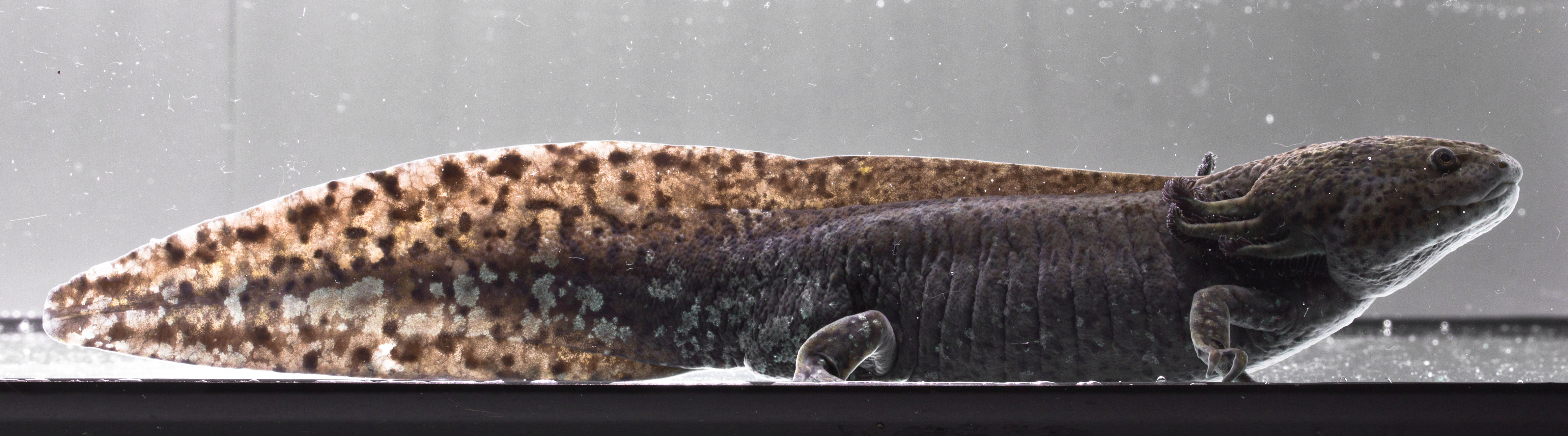
The axolotl is carnivorous, consuming small prey such as mollusks, worms, insects, other arthropods, and small fish in the wild. Axolotls locate food by smell, and will "snap" at any potential meal, sucking the food into their stomachs with vacuum force. The wild axolotl is thought to reach sexual maturity at 1.5 years of age, with a generation length of around 5.5 years. The development of neoteny in mole salamanders is thought to have been an adaptation to conditions that did not favor metamorphosis into the terrestrial form.
Threats
Axolotls are only native to the Mexican Central Valley. Although the population once extended through most lakes and wetlands in this region, its habitat is now limited to Lake Xochimilco as a result of the expansion of Mexico City, and is under pressure from the city's growth. Lake Xochimilco is not a large body of water, but a small series of artificial channels, small lakes, and temporary wetlands. The axolotl is on the International Union for Conservation of Nature's Red List of threatened species.
Surveys in 1998, 2003, and 2008 found 6,000, 1,000, and 100 axolotls, respectively, per square kilometer in Lake Xochimilco.{{cite web | last = Stevenson | first = M.
Lake Xochimilco has poor water quality; tests reveal a low nitrogen-phosphorus ratio and a high concentration of chlorophyll a, which are indicative of an oxygen-poor environment not well-suited to axolotls. This is caused by the demands of industries such as aquaculture and agriculture in the region, which maintain the water levels of the Lake through inputs of partially treated wastewater. Agricultural pesticides from their intensive use eventually enter the lake through runoff; these pesticides contain chemical compounds that sharply increase mortality in axolotl embryos and larvae. Of the surviving embryos and larvae, there is also an increase in morphological, behavioral, and activity abnormalities.
With such a small native or wild population, there is a large loss of genetic diversity. This can be dangerous for the remaining population, causing an increase in inbreeding and a decrease in fitness and adaptive potential. Studies found indicators of a low interpopulation gene flow and higher rates of genetic drift. These are likely the result of multiple "bottleneck" incidents wherein the number of individuals in the population and its genetic diversity are sharply reduced. The offspring produced after bottleneck events have a greater risk of showing decreased fitness and are often less capable of adaptation. In the case of multiple bottleneck events, disastrous effects are likely to arise within the population, potentially leading to extinction. Studies have found high rates of relatedness that are indicative of inbreeding, which can be especially harmful as it can cause an increase in the presence of deleterious, or harmful, genes. The detection of introgressed tiger salamander (A. tigrinum) DNA in the laboratory axolotl population raises concerns about the suitability of the captive population as an "ark" for potential reintroduction purposes.
Another factor that threatens the population is the introduction of invasive fish species such as Nile tilapia and the common carp. These fish eat the axolotls' young, as well as compete for their primary source of food. The presence of these species has changed the behavior of axolotls, causing them to be less active, in the effort to avoid predation. This reduction in activity greatly impacts the axolotl's foraging and mating opportunities.
The fungus Batrachochytrium dendrobatidis has been detected in axolotls; B. dendrobatidis is a fungus that causes chytridiomycosis in amphibians, and is a major concern for amphibian conservation worldwide. However, the axolotl displays resistance to both B. dendrobatidis and B. salamandrivorans, so chytridiomycosis is thought to not be a threat to this species.
Conservation efforts
There has been little improvement in the conditions of the population of native axolotls over the years. Many scientists are focusing their conservation efforts on the translocation of captive-bred individuals into new habitats or reintroduction into Lake Xochimilco. The Laboratorio de Restauracion Ecologica (), of the National Autonomous University of Mexico, has built up a population of 100 captive-bred individuals as of 2021. These axolotls are mostly used for research, but there are plans for a semi-artificial wetland inside the university, to establish a viable population of axolotls within it. Studies have shown that captive-bred axolotls that are raised in a semi-natural environment can catch prey, survive in the wild, and have moderate success in escaping predators. These captive-bred individuals can be introduced into unpolluted bodies of water or back into Lake Xochimilco itself, although, with the current state of pollution, due to urbanization, and predators within Lake Xochimilco, the captive-bred individuals may eventually have the same fate as the wild population.
A 2025 study confirmed the viability of releasing captive-bred axolotls into the wild, with recaptured animals putting on weight compared to their release weight, though this practice risks the loss of the axolotls through predation, as several released axolotls were preyed upon by great egrets.
Relation to humans
Research history
Alexander von Humboldt noted that the Mexicans, having been vanquished by the Spanish Empire, lived "in great want, compelled to feed on roots of aquatic plants, insects and a problematical reptile called axolotl."
Six adult axolotls (including a leucistic specimen) were shipped from Mexico City to the Jardin des Plantes in Paris in 1863. Unaware of their neoteny, Auguste Duméril was surprised when, instead of the axolotl, he found in the vivarium a new species, similar to the salamander. This discovery was the starting point of research about neoteny. It is not certain that Ambystoma velasci specimens were not included in the original shipment. Vilem Laufberger in Prague used thyroid hormone injections to induce an axolotl to grow into a terrestrial adult salamander. The experiment was repeated by Englishman Julian Huxley, who was unaware the experiment had already been done, using ground thyroids. Since then, experiments have often been done with injections of iodine or various thyroid hormones used to induce metamorphosis.
Use as a model organism

Today, the axolotl is still used in research as a model organism, and large numbers are bred in captivity. They are especially easy to breed compared to other salamanders in their family, which are rarely captive-bred due to the husbandry demands of terrestrial life. One attractive feature for research is the large and easily manipulated embryo, which allows viewing of the full development of a vertebrate. Axolotls are used in heart defect studies due to the presence of a mutant gene that causes heart failure in embryos. Since the embryos survive almost to hatching with no heart function, the defect is very observable. Further research has been conducted to examine their heart as a model of a single human ventricle and excessive trabeculation. The axolotl is also considered an ideal animal model for the study of neural tube closure due to the similarities between human and axolotl neural plate and tube formation; the axolotl's neural tube, unlike a frog's, is not hidden under a layer of superficial epithelium. There are also mutations affecting other organ systems some of which are not well characterized, while others are. The genetics of the color variants of the axolotl have also been widely studied. Axolotls have also been a model organism for its regeneration capabilities of entire limbs. The apical-ectodermal ridge(AER) a fundamental growth structure with the apical-ectodermal cap (AEC) are one of the few things given credit for the axolotls ability to regenerate whole limbs in early development. The apical ectodermal ridge is a structure in embryos that start the growth of appendages by signaling how they are shaped and extended. These cells are needed to form limbs in most tetrapod's, amphibians, and humans. Unlike most other animals, the AEC in the axolotl is able to send signals through growth hormones to activate blastema cells which can rebuild whole amputated or damaged limbs or organs. This can be important to look at to find the differences of AER capabilities compared to the AEC. The study of the AEC could reveal why most animals heal with scars instead of regrowing limbs. Axolotls having this gene allows an extraordinarily unique way of regenerating their whole body and being able to understand this could help understand how humans can achieve better ways to heal from serious injuries.
Captive care

The axolotl is a popular exotic pet like its relative, the tiger salamander (Ambystoma tigrinum). As for all poikilothermic organisms, lower temperatures result in slower metabolism and a potentially dangerously reduced appetite. Temperatures at approximately 16 C to 18 C are suggested for captive axolotls to ensure sufficient food intake; stress resulting from more than a day's exposure to lower temperatures may quickly lead to disease and death, and temperatures higher than 24 C may lead to metabolic rate increase, also causing stress and eventually death. Chlorine, commonly added to tapwater, is harmful to axolotls. A single axolotl typically requires a 150 L tank. Axolotls spend the majority of the time at the bottom of the tank.
In captivity, axolotls eat a variety of readily available foods, including trout and salmon pellets, frozen or live bloodworms, earthworms, and waxworms. Axolotls can also eat feeder fish, but care should be taken as fish may contain parasites.
Substrates are another important consideration for captive axolotls, as axolotls (like other amphibians and reptiles) tend to ingest bedding material together with food Some common substrates used for animal enclosures can be harmful for amphibians and reptiles. Gravel (common in aquarium use) should not be used, and is recommended that any sand consists of smooth particles with a grain size of under 1mm. One guide to axolotl care for laboratories notes that bowel obstructions are a common cause of death, and recommends that no items with a diameter below 3 cm (or approximately the size of the animal's head) should be available to the animal.
There is some evidence that axolotls might seek out appropriately-sized gravel for use as gastroliths based on experiments conducted at the University of Manitoba axolotl colony. As there is no conclusive evidence pointing to gastrolith use, gravel should be avoided due to the high risk of impaction.
Salts, such as Holtfreter's solution, are often added to the water to prevent infection. Among hobbyists, the process of artificially inducing metamorphosis can often result in death during or even following a successful attempt, and so casual hobbyists are generally discouraged from attempting to induce metamorphosis in pet axolotls. Morphed pet axolotls should be given solid footholds in their enclosure to satisfy their need for land. They should not be given live animals as food.
File: Ambystoma mexicanum at Vancouver Aquarium.jpg|These axolotls at Vancouver Aquarium are leucistic, with less pigmentation than normal. File:Axolotl in a Pet store in Melbourne.jpg|Axolotl in a pet store in Melbourne, Australia File:Axolotls in Kew Gardens.jpg|Axolotls in a pond with Pistia, Kew Gardens
Cultural significance

The species is named after the Aztec deity Xolotl, the god of fire and lightning, who transformed himself into an axolotl to avoid being sacrificed by fellow gods. They continue to play an outsized cultural role in Mexico. Axólotl also means water monster in the Nahuatl language.
Julio Cortázar wrote a book titled "Axolotl".
They appear in the works of Mexican muralist Diego Rivera. In 2021, Mexico released a new design for its 50-peso banknote featuring an axolotl along with maize and chinampas on its back. It was recognized as "Bank Note of the Year" by the International Bank Note Society. HD 224693, a star in the equatorial constellation of Cetus, was named Axólotl in 2019.

In the 21st century, axolotls became renowned as a cultural icon, with the species' likeness appearing in or inspiring various aspects of contemporary media, such as television shows, movies, or video games. The Pokémon Mudkip and its evolutions, added in Pokémon Ruby and Sapphire (2002), take some visual inspiration from axolotls. Additionally, the Pokémon Wooper, added in Pokémon Gold, Silver and Crystal (1999), is directly based on an axolotl. The dragon Toothless in the How to Train Your Dragon movies was modeled after axolotls as well. Following Mojang Studios' trend of adding endangered species to the game to raise awareness, axolotls were added to the video game Minecraft in 2020 (depicted as troglofauna in-game), and were included in its spin-offs Minecraft: Dungeons and Lego Minecraft.
References
References
- IUCN SSC Amphibian Specialist Group. (2020). "''Ambystoma mexicanum''".
- "Appendices {{!}} CITES".
- Frost, Darrel R.. (2018). "''Ambystoma mexicanum'' (Shaw and Nodder, 1798)". American Museum of Natural History.
- Malacinski, George M.. (Spring 1978). "The Mexican Axolotl, ''Ambystoma mexicanum'': Its Biology and Developmental Genetics, and Its Autonomous Cell-Lethal Genes". American Zoologist.
- (30 October 2012). "Mythic Salamander Faces Crucial Test: Survival in the Wild". The New York Times.
- "Meet the Peter Pan of salamanders, the axolotl". World Wildlife Fund.
- "The axolotl in pre-Hispanic mythology". Axolotitlán.
- "Ambystoma mexicanum Salamandra ajolote". University of Michigan.
- (1975). "Handbook of Genetics Volume 4: Vertebrates of Genetic Interest". Springer.
- {{Cite Merriam-Webster. Axolotl
- Shaffer, H. Bradley. (December 1993). "Phylogenetics of Model Organisms: The Laboratory Axolotl, Ambystoma mexicanum". Systematic Biology.
- San Francisco Examiner (San Francisco, California) 7 August 1887, page 9, authored by [[Yda Addis]]
- (1984). "Functional morphology of gills in larval amphibians". Springer Netherlands.
- Kardong, Kenneth V. (2019). "Vertebrates: comparative anatomy, function, evolution". McGraw-Hill Education.
- (1985). "Vision and the skin camouflage reactions of ''Ambystoma'' larvae: the effects of eye transplants and brain lesions". Brain Research.
- (August 14, 2019). "18 Types of Axolotl Colors You Can Own (Axolotl Color Guide)".
- (1984). "A color atlas of pigment genes in the Mexican axolotl (''Ambystoma mexicanum'')". Differentiation.
- (2018-01-24). "The axolotl genome and the evolution of key tissue formation regulators". [[Nature (journal).
- (2009-11-11). "Weird Creatures with Nick Baker". [[The Science Channel]].
- (January 2018). "Transcriptional landscapes of Axolotl (Ambystoma mexicanum)". [[Developmental Biology]].
- Sandoval-Guzmán, Tatiana. (August 2023). "The axolotl". Nature Methods.
- (November 2008). "Regeneration in axolotls: a model to aim for!". [[Experimental Gerontology]].
- (2020). "Advancements to the Axolotl Model for Regeneration and Aging". Gerontology.
- (June 4, 2013). "Macrophages are required for adult salamander limb regeneration". [[Proceedings of the National Academy of Sciences of the United States of America]].
- (April 17, 2020). "Modulating the immune response and the pericardial environment with LPS or prednisolone in the axolotl does not change the regenerative capacity of cryoinjured hearts". [[The FASEB Journal]].
- Masselink, Wouter, and Elly M. Tanaka. "Toward Whole Tissue Imaging of Axolotl Regeneration." Developmental Dynamics, vol. 250, no. 6, 2020, pp. 800–806., https://doi.org/10.1002/dvdy.282.
- (2025-03-11). "Adeno-associated viruses for efficient gene expression in the axolotl nervous system". Proceedings of the National Academy of Sciences.
- (April 2016). "Medical Physiology". Elsevier/Saunders.
- (November 1923). "Iodine and Amphibian Metamorphosis". The Biological Bulletin.
- (1 December 1928). "Metamorphosis of the Colorado Axolotl by Injection of Inorganic Iodine.". Experimental Biology and Medicine.
- (May 1947). "The Thyroxine-Like Action of Elemental Iodine in the Rat and Chick1". Endocrinology.
- (January 1961). "The role of haloids (bromine and iodine) in the metamorphosis of amphibia". Bulletin of Experimental Biology and Medicine.
- Malacinski, George M.. (1978-05-01). "The Mexican Axolotl, ''Ambystoma mexicanum'': Its Biology and Developmental Genetics, and Its Autonomous Cell-lethal Genes". American Zoologist.
- (12 April 2019). "Rediscovering the Axolotl as a Model for Thyroid Hormone Dependent Development". Frontiers in Endocrinology.
- Venturi, S.. (2004). "Iodine and Evolution. DIMI-Marche".
- (2023-07-10). "Differential effects of 3,5-T2 and T3 on the gill regeneration and metamorphosis of the Ambystoma mexicanum (axolotl)". Frontiers in Endocrinology.
- (2018-07-20). "Experimentally induced metamorphosis in highly regenerative axolotl (''Ambystoma mexicanum'') under constant diet restructures microbiota". Scientific Reports.
- Gale, Jen. (2025-11-05). "What happens if an axolotl larva is placed in water containing sufficient iodine?".
- "Axolotls – Metamorphosed & Tiger Salamanders".
- (25 November 1997). "The role of thyroid hormone in zebrafish and axolotl development". Proceedings of the National Academy of Sciences.
- (2017-01-31). "Identification of Mutant Genes and Introgressed Tiger Salamander DNA in the Laboratory Axolotl, Ambystoma mexicanum". Scientific Reports.
- "Mexican Walking Fish, Axolotls ''Ambystoma mexicanum''".
- "Axolotols (Walking Fish)". Aquarium Online.
- "Lake Xochimilco, Borough of Xochimilco in southern México City, 162 L • Biotope Aquarium".
- "Ambystoma mexicanum (Salamandra ajolote)".
- (1989). "Evolution of motor patterns: aquatic feeding in salamanders and ray-finned fishes". Brain, Behavior and Evolution.
- "Axolotls: Meet the amphibians that never grow up {{!}} Natural History Museum".
- (2014-02-24). "Endangered 'water monster' Axolotl found in Mexico City lake". The Independent.
- (2016). "Water quality in Lake Xochimilco, Mexico: zooplankton indicators and Vibrio cholerae". Journal of Limnology.
- (2009-02-01). "Organophosphorus pesticides effect on early stages of the axolotl Ambystoma mexicanum (Amphibia: Caudata)". Chemosphere.
- (2011). "Conservation genetics of threatened Mexican axolotls (Ambystoma)". Animal Conservation.
- (2017-01-31). "Identification of Mutant Genes and Introgressed Tiger Salamander DNA in the Laboratory Axolotl, Ambystoma mexicanum". Scientific Reports.
- (November 2008). "Mexico City's 'water monster' nears extinction".
- (2015-07-01). "Response of a native endangered axolotl, Ambystoma mexicanum (Amphibia), to exotic fish predator". Hydrobiologia.
- Matt Walker. (2009-08-26). "Axolotl verges on wild extinction". BBC.
- PetAquariums.com. (22 April 2020). "Are Axolotls Endangered? You Need To Be Careful…".
- (2021). "The potential of temporary shelters to increase survival of the endangered Mexican axolotl". Aquatic Conservation: Marine and Freshwater Ecosystems.
- Paúl, María Luisa. (2023-12-01). "Mexico wants you to adopt an axolotl, the amphibian that never grows up". Washington Post.
- (30 April 2025). "Movement ecology of captive-bred axolotls in restored and artificial wetlands: Conservation insights for amphibian reintroductions and translocations". PLOS ONE.
- (6 May 2025). "Good news for the adorable axolotl — ones born in captivity could survive in the wild". NPR.
- (30 April 2025). "Endangered axolotl release raises hopes for rare amphibian". British Broadcasting Corporation.
- Huxley, Julian S.. (January 1920). "Metamorphosis of Axolotl caused by Thyroid-feeding". Nature.
- (2015). "The history of the oldest self-sustaining laboratory animal: 150 years of axolotl research". Journal of Experimental Zoology Part B: Molecular and Developmental Evolution.
- (2004-02-01). "The Axolotl (''Ambystoma mexicanum''), a Neotenic Amphibian, Expresses Functional Thyroid Hormone Receptors". Endocrinology.
- (2022-11-28). "Opportunities and short-comings of the axolotl salamander heart as a model system of human single ventricle and excessive trabeculation". Scientific Reports.
- Gordon, R.. (1985). "A review of the theories of vertebrate neurulation and their relationship to the mechanics of neural tube birth defects". [[Journal of Embryology and Experimental Morphology]].
- Armstrong, John B.. (1985). "The axolotl mutants". [[Developmental Genetics]].
- (June 2022). "The amazing and anomalous axolotls as scientific models". Developmental Dynamics.
- (1999). "The axolotl as an animal model for the comparison of 3-D ultrasound with plain film radiography". Ultrasound in Medicine and Biology.
- "Axolotls – Requirements & Water Conditions in Captivity".
- "Caudata Culture Species Entry – ''Ambystoma mexicanum'' – Axolotl".
- Wiegert, Joshua. "Axolotls: Keeping a Water Monster".
- (2011). "The Aquarium Trade as an Invasion Pathway in the Pacific Northwest". Fisheries.
- (2007). "Amphibian Emergency Medicine". Veterinary Clinics of North America: Exotic Animal Practice.
- Pough, F. H.. (1992). "Recommendations for the Care of Amphibians and Reptiles in Academic Institutions". National Academy Press.
- (2004). "An Introduction to the Mexican Axolotl (''Ambystoma mexicanum'')". Lab Animal.
- Wings, O [http://www.dinosaurhunter.org/files/app-2007-wings-gastrolith_function_classification.pdf A review of gastrolith function with implications for fossil vertebrates and a revised classification] {{Webarchive. link. (2016-03-04 Acta Palaeontologica Polonica 52 (1): 1–16)
- Gordon, N, [https://embryogenesisexplained.org/2015/09/10/gastroliths-how-i-learned-to-stop-worrying-and-love-gravel/ Gastroliths – How I Learned to Stop Worrying and Love Gravel.] {{Webarchive. link. (2020-09-22)
- Björklund, N.K. (1993). Small is beautiful: economical axolotl colony maintenance with natural spawnings as if axolotls mattered. In: Handbook on Practical Methods. Ed.: G.M. Malacinski & S.T. Duhon. Bloomington, Department of Biology, Indiana University: 38–47.
- Loh, Richmond. (2015-05-15). "Common Disease Conditions in Axolotls".
- Clare, John P.. "Health and Diseases".
- "Transition & Feeding".
- Garcia, David Alire. (2018-11-20). "Mexico's axolotl, a cartoon hero and genetic marvel, fights for survival". Reuters.
- "Axolotl: The Real Julio Cortazar". Harvard University.
- "Axolotl, Xolotl, and Religion". Harvard University.
- (2020-02-21). "Mexican axolotl will be the new image of the 50 peso bill".
- "Billete de 50 pesos de la familia G".
- "Banknote of 2021 Nominations".
- "Approved names".
- (December 17, 2019). "100 000s of People from 112 Countries Select Names for Exoplanet Systems In Celebration of IAU's 100th Anniversary".
- Minecraft. (October 3, 2020). ""Minecraft Live: Caves & Cliffs – First Look"".
- "The Guardian Battle 21180".
- "The Axolotl House 21247".
This article was imported from Wikipedia and is available under the Creative Commons Attribution-ShareAlike 4.0 License. Content has been adapted to SurfDoc format. Original contributors can be found on the article history page.
Ask Mako anything about Axolotl — get instant answers, deeper analysis, and related topics.
Research with MakoFree with your Surf account
Create a free account to save articles, ask Mako questions, and organize your research.
Sign up freeThis content may have been generated or modified by AI. CloudSurf Software LLC is not responsible for the accuracy, completeness, or reliability of AI-generated content. Always verify important information from primary sources.
Report