From Surf Wiki (app.surf) — the open knowledge base
Axial tilt
Angle between the rotational axis and orbital axis of a body
Angle between the rotational axis and orbital axis of a body
Earth's orbital plane is known as the ecliptic plane, and Earth's tilt is known to astronomers as the obliquity of the ecliptic, being the angle between the ecliptic and the celestial equator on the celestial sphere.
Earth currently has an axial tilt of about 23.44°. This value remains about the same relative to a stationary orbital plane throughout the cycles of axial precession. | doi-access=free
History
The ancient Greeks had good measurements of the obliquity since about 350 BCE, when Pytheas of Marseilles measured the shadow of a gnomon at the summer solstice.
During the Middle Ages, it was widely believed that both precession and Earth's obliquity oscillated around a mean value, with a period of 672 years, an idea known as trepidation of the equinoxes. Perhaps the first to realize this was incorrect (during historic time) was Ibn al-Shatir in the fourteenth century{{cite book
Seasons
Main article: Season
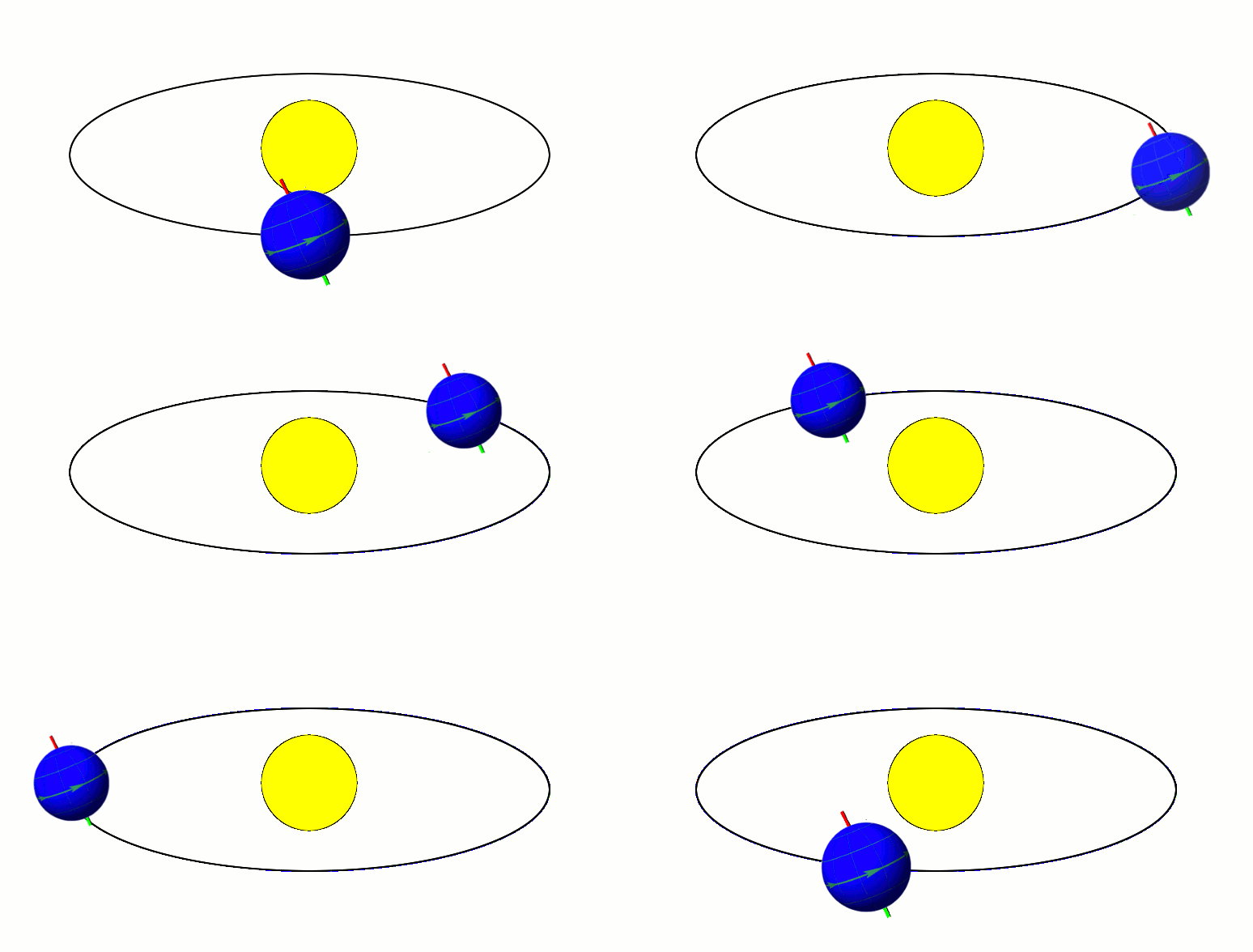
Earth's axis remains tilted in the same direction with reference to the background stars throughout a year (regardless of where it is in its orbit) – this is known as axial parallelism. This means that one pole (and the associated hemisphere of Earth) will be directed away from the Sun at one side of the orbit, and half an orbit later (half a year later) this pole will be directed towards the Sun. This is the cause of Earth's seasons. Summer occurs in the Northern Hemisphere when the North Pole is directed toward and the South Pole away from the Sun. Variations in Earth's axial tilt can influence the seasons and is likely a factor in long-term climatic change (also see Milankovitch cycles).

Oscillation
Short term

The exact angular value of the obliquity is found by observation of the motions of Earth and planets over many years. Astronomers produce new fundamental ephemerides as the accuracy of observation improves and as the understanding of the dynamics increases, and from these ephemerides various astronomical values, including the obliquity, are derived.
Annual almanacs are published listing the derived values and methods of use. Until 1983, the Astronomical Almanac's angular value of the mean obliquity for any date was calculated based on the work of Newcomb, who analyzed positions of the planets until about 1895:
:
where ε is the obliquity and T is tropical centuries from B1900.0 to the date in question.
From 1984, the Jet Propulsion Laboratory's DE series of computer-generated ephemerides took over as the fundamental ephemeris of the Astronomical Almanac. Obliquity based on DE200, which analyzed observations from 1911 to 1979, was calculated:
:
where hereafter T is Julian centuries from J2000.0.
JPL's fundamental ephemerides have been continually updated. For instance, according to IAU resolution in 2006 in favor of the P03 astronomical model, the Astronomical Almanac for 2010 specifies:
:
These expressions for the obliquity are intended for high precision over a relatively short time span, perhaps ± several centuries.
:
where here t is multiples of 10,000 Julian years from J2000.0.See table 8 and eq. 35 in {{cite journal
These expressions are for the so-called mean obliquity, that is, the obliquity free from short-term variations. Periodic motions of the Moon and of Earth in its orbit cause much smaller (9.2 arcseconds) short-period (about 18.6 years) oscillations of the rotation axis of Earth, known as nutation, which add a periodic component to Earth's obliquity. |access-date=26 March 2015
Long term
Main article: Formation and evolution of the Solar System
Main article: Milankovitch cycles
Using numerical methods to simulate Solar System behavior over a period of several million years, long-term changes in Earth's orbit, and hence its obliquity, have been investigated. For the past 5 million years, Earth's obliquity has varied between 22°2′33″ and 24°30′16″, with a mean period of 41,040 years. This cycle is a combination of precession and the largest term in the motion of the ecliptic. For the next 1 million years, the cycle will carry the obliquity between 22°13′44″ and 24°20′50″.
The Moon has a stabilizing effect on Earth's obliquity. Frequency map analysis conducted in 1993 suggested that, in the absence of the Moon, the obliquity could change rapidly due to orbital resonances and chaotic behavior of the Solar System, reaching as high as 90° in as little as a few million years (also see Orbit of the Moon). |url-status=dead |archive-url=https://web.archive.org/web/20121123093109/http://bugle.imcce.fr/fr/presentation/equipes/ASD/person/Laskar/misc_files/Laskar_Robutel_1993.pdf |archive-date=23 November 2012
Solar System bodies
All four of the innermost, rocky planets of the Solar System may have had large variations of their obliquity in the past. Since obliquity is the angle between the axis of rotation and the direction perpendicular to the orbital plane, it changes as the orbital plane changes due to the influence of other planets. But the axis of rotation can also move (axial precession), due to torque exerted by the Sun on a planet's equatorial bulge. Like Earth, all of the rocky planets show axial precession. If the precession rate were very fast the obliquity would actually remain fairly constant even as the orbital plane changes. The rate varies due to tidal dissipation and core-mantle interaction, among other things. When a planet's precession rate approaches certain values, orbital resonances may cause large changes in obliquity. The amplitude of the contribution having one of the resonant rates is divided by the difference between the resonant rate and the precession rate, so it becomes large when the two are similar.
Mercury and Venus have most likely been stabilized by the tidal dissipation of the Sun. Earth was stabilized by the Moon, as mentioned above, but before its formation, Earth, too, could have passed through times of instability. Mars's obliquity is quite variable over millions of years and may be in a chaotic state; it varies as much as 0° to 60° over some millions of years, depending on perturbations of the planets.
The occasional shifts in the axial tilt of Mars have been suggested as an explanation for the appearance and disappearance of rivers and lakes over the course of the existence of Mars. A shift could cause a burst of methane into the atmosphere, causing warming, but then the methane would be destroyed and the climate would become arid again.
The obliquities of the outer planets are considered relatively stable.
| Body | NASA, J2000.0 epoch | IAU, 0h 0 January 2010 TT epoch | Axial tilt | |||||||||
|---|---|---|---|---|---|---|---|---|---|---|---|---|
| (degrees) | North Pole | Rotational | ||||||||||
| period | ||||||||||||
| (hours) | Axial tilt | |||||||||||
| (degrees) | North Pole | Rotation | ||||||||||
| (deg./day) | R.A. (degrees) | Dec. (degrees) | R.A. (degrees) | Dec. (degrees) | ||||||||
| Sun | 7.25 | 286.13 | 63.87 | 609.12 | 7.25 | 286.15 | 63.89 | 14.18 | ||||
| Mercury | 0.03 | 281.01 | 61.41 | 1407.6 | 0.01 | 281.01 | 61.45 | 6.14 | ||||
| Venus | 2.64 | 272.76 | 67.16 | −5832.6 | 2.64 | 272.76 | 67.16 | −1.48 | ||||
| Earth | 23.44 | 0.00 | 90.00 | 23.93 | 23.44 | 90.00 | 360.99 | |||||
| Moon | 6.68 | – | – | 655.73 | 1.54 | 270.00 | 66.54 | 13.18 | ||||
| Mars | 25.19 | 317.68 | 52.89 | 24.62 | 25.19 | 317.67 | 52.88 | 350.89 | ||||
| Jupiter | 3.13 | 268.06 | 64.50 | 9.93 | 3.12 | 268.06 | 64.50 | 870.54 | ||||
| Saturn | 26.73 | 40.59 | 83.54 | 10.66 | 26.73 | 40.59 | 83.54 | 810.79 | ||||
| Uranus | 82.23 | 257.31 | −15.18 | −17.24 | 82.23 | 257.31 | −15.18 | −501.16 | ||||
| Neptune | 28.32 | 299.33 | 42.95 | 16.11 | 28.33 | 299.40 | 42.95 | 536.31 | ||||
| Pluto | 57.47 | 312.99 | 6.16 | −153.29 | 60.41 | 312.99 | 6.16 | −56.36 |
Extrasolar planets
The stellar obliquity ψs, i.e. the axial tilt of a star with respect to the orbital plane of one of its planets, has been determined for only a few systems.
By 2012, the sky-projected spin-orbit misalignment λ had been measured for 49 stars, |access-date=24 February 2012
As of 2024 the axial tilt of 4 exoplanets have been measured with one of them (VHS 1256 b) having a Uranus like tilt of 90 degrees ± 25 degrees.
Astrophysicists have applied tidal theories to predict the obliquity of extrasolar planets. It has been shown that the obliquities of exoplanets in the habitable zone around low-mass stars tend to be eroded in less than a billion years,
References
References
- ''Explanatory Supplement 1992'', p. 384
- (2007). "Report of the IAU/IAG Working Group on cartographic coordinates and rotational elements: 2006". Celestial Mechanics and Dynamical Astronomy.
- [https://aa.usno.navy.mil/faq/asa_glossary "Glossary"] in ''Astronomical Almanac Online''. (2023). Washington DC: United States Naval Observatory. s.v. obliquity.
- Sédillot, L.P.E.A.. (1853). "Prolégomènes des tables astronomiques d'OlougBeg: Traduction et commentaire". Firmin Didot Frères.
- Dreyer (1890), p. 123
- ''Astronomical Almanac 2010'', p. B52
- ''Explanatory Supplement'' (1961), sec. 2C
- (20 July 2014). "On the Spin-axis Dynamics of a Moonless Earth". Astrophysical Journal.
- Berger, 1976.
- (20 July 1973). "Large-Scale Variations in the Obliquity of Mars". Science.
- (7 October 2017). "Methane burps on young Mars helped it keep its liquid water". New Scientist.
- (2 October 2017). "Methane bursts as a trigger for intermittent lake-forming climates on post-Noachian Mars". Nature Geoscience.
- [http://nssdc.gsfc.nasa.gov/planetary/planetfact.html Planetary Fact Sheets], at http://nssdc.gsfc.nasa.gov
- ''Astronomical Almanac 2010'', pp. B52, C3, D2, E3, E55
- (December 2024). "Leaning Sideways: VHS 1256‑1257 b is a Super-Jupiter with a Uranus-like Obliquity". [[The Astronomical Journal]].
This article was imported from Wikipedia and is available under the Creative Commons Attribution-ShareAlike 4.0 License. Content has been adapted to SurfDoc format. Original contributors can be found on the article history page.
Ask Mako anything about Axial tilt — get instant answers, deeper analysis, and related topics.
Research with MakoFree with your Surf account
Create a free account to save articles, ask Mako questions, and organize your research.
Sign up freeThis content may have been generated or modified by AI. CloudSurf Software LLC is not responsible for the accuracy, completeness, or reliability of AI-generated content. Always verify important information from primary sources.
Report