From Surf Wiki (app.surf) — the open knowledge base
Axel jump
Jump in figure skating
Jump in figure skating
| Field | Value |
|---|---|
| image | Axel Paulsen jump without text.svg |
| alt | Refer to caption |
| caption | Illustration of a single Axel jump |
| element name | Axel jump |
| alt name | Axel Paulsen jump |
| scoring abbrev | A |
| element type | Jump |
| take off edge | Forward outside |
| landing edge | Backward outside |
| inventor | Axel Paulsen |
| disciplines | Singles, pairs |
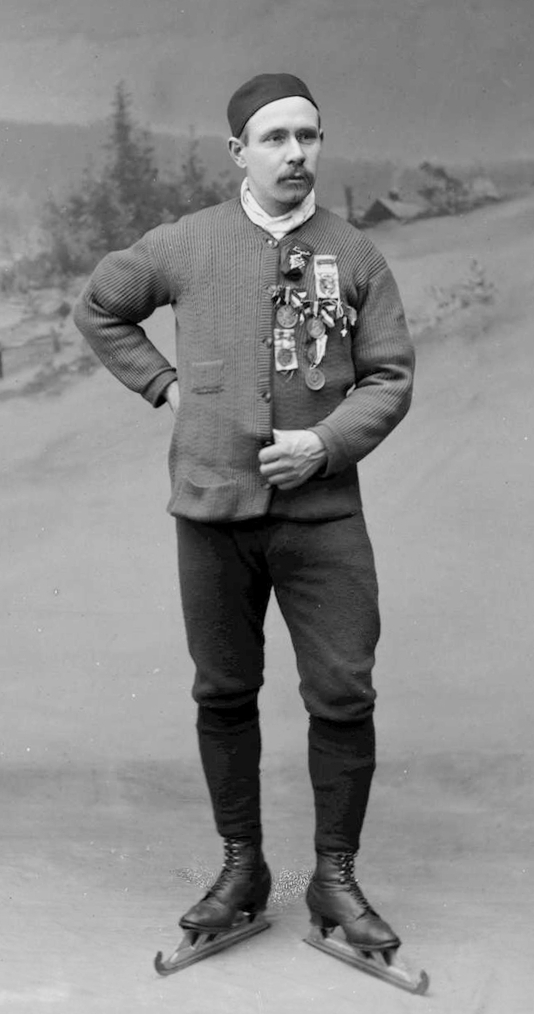
The Axel jump or Axel Paulsen jump, named after its inventor, Norwegian figure skater Axel Paulsen, is an edge jump performed in figure skating. It is the sport's oldest and most difficult jump, and the only basic jump in competition with a forward take-off, which makes it the easiest to identify. A double or triple Axel is required in both the short program and the free skating segment for junior and senior single skaters in all events sanctioned by the International Skating Union (ISU).
Compared with other basic figure skating jumps, the Axel requires an extra half revolution, which makes a triple Axel "more a quadruple jump than a triple", according to figure skating expert Hannah Robbins.
The triple Axel has become a common technical element in the men's singles discipline. As of March 2025, 27 women have successfully completed the triple Axel in international competition. The quadruple Axel was successfully executed in competition for the first time in 2022 by Ilia Malinin, who remains the only person to have landed it in international competition.
History
The Axel jump, also called the Axel Paulsen jump for its creator the Norwegian figure skater Axel Paulsen, is an edge jump in the sport of figure skating. According to figure skating historian James Hines, the Axel is "figure skating's most difficult jump". It is the only basic jump in competition that takes off forward, which makes it the easiest jump to identify. Skaters commonly perform a double or triple Axel, followed by a jump of lower difficulty in combination. It is the most studied jump in figure skating.
A double or triple Axel is required in the short program for junior and senior single skaters in all ISU competitions. For the free skating program for junior and senior single skaters, one of the seven required jump elements must be an Axel-type jump. In the 2025-2026 season, junior pair skating teams have to include either a double loop solo jump or a double Axel solo jump in their short programs; in 2026-2027, they will have to include either a double Lutz solo jump or a double Axel solo jump in their short programs. In competition, the base value of an Axel is determined by the number of revolutions completed during the jump. The base value of a single Axel is 1.10, a double Axel 3.30, a triple Axel 8.00, a quadruple Axel 12.50 and a quintuple Axel is 14.
Paulsen was the first skater to accomplish an Axel, at the first international figure skating competition, which was held in Vienna in 1882, while wearing speed skates. Hines, who called Paulsen "progressive" for inventing it, stated that he did it "as a special figure". By the mid-1920s, the Axel was the only jump that was not being doubled. Dorothy Greenhough-Smith was the first woman to complete an Axel in competition, which she did at the 1908 Olympic Games; fellow skater TD Richardson said that she performed the jump with "complete nonchalance" while wearing an ankle-length skirt. The ISU, however, states that Sonja Henie from Norway was the first woman to complete an Axel in competition, in the 1920s.
Professional German skater Charlotte Oelschlägel was also one of the first women to include an Axel in her programs; Hines reported that she would terminate the Axel with her "famous fade-away ending", the Charlotte spiral, a move she invented. It was also reported by Hines that in the 1930s, Austrian skater Felix Kaspar, who was known for his athleticism, performed Axels with a trajectory of four feet height and 20 feet distance from take-off to landing (1.20m height and 6m distance); Hines stated that "there is little doubt in the minds of those who saw him that had the technique then been known, he probably could have easily performed triple or even quadruple jumps".
At the 1948 Winter Olympics, American Dick Button was the first skater to complete a double Axel in competition. American Carol Heiss was the first woman to perform a double Axel, in 1953. The first successful triple Axel in competition was performed by Canadian Vern Taylor at the 1978 World Championships. Six years later, at the 1984 Winter Games in Sarajevo, Canadian skater Brian Orser became the first skater to complete a triple Axel at the Olympics. The first female skater to successfully execute a triple Axel in competition was Japanese skater Midori Ito, at a regional competition in the Aichi Prefecture of Japan in 1988. She was also the first woman to land it at an international competition, at the 1988 NHK Trophy, as well as the first woman to land it at the Olympics, in 1992.
The first throw triple Axel was performed by American pair skaters Rena Inoue and John Baldwin, at the 2006 U.S. National Championships. They were also the first couple to perform a throw triple Axel at the Olympics and international competition in 2006.
In 2022, at the CS U.S. Classic, American skater Ilia Malinin was the first skater to successfully complete a quadruple Axel in competition.
| Abbr. | Jump element | Skater | Nation | Event | Ref. | 1A | 2A | 3A | 4A |
|---|---|---|---|---|---|---|---|---|---|
| Single Axel (men's) | NOR | 1882 international skating competition in Vienna | |||||||
| Single Axel (women's) | NOR | 1920s skating competition | |||||||
| Double Axel (men's) | USA | 1948 Winter Olympic Games | |||||||
| Double Axel (women's) | USA | 1953 skating competition | |||||||
| Triple Axel (men's) | CAN | 1978 World Championships | |||||||
| Triple Axel (women's) | JPN | 1988 NHK Trophy | |||||||
| Quadruple Axel (men's) | USA | 2022 CS U.S. Classic | |||||||
| Quadruple Axel (women's) | None ratified |
Execution
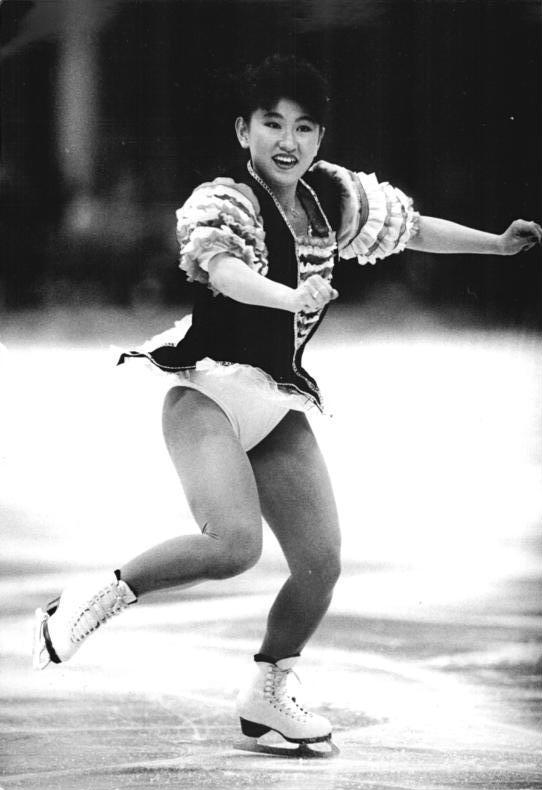
The Axel is an edge jump, which means that the skater must spring into the air from bent knees. It is the oldest figure skating jump; it is also the most difficult because unlike all other jumps, which is initiated with a backwards take off, the Axel has a facing forward take off and a backwards landing. A "lead-up" to the Axel is the waltz jump, a half-revolution jump and the first jump that skaters learn.
The Axel has three phases: the entrance phase (which ends with the takeoff), the flight phase, when the skater rotates into the air, and the landing phase, which begins when the skater's blade hits the ice and ends when they are "safely skating backwards on the full outside edge with one leg behind in the air". According to researcher Anna Mazurkiewicz and her colleagues, the most important parts of the entrance phase are the transition phase (also called the pre-takeoff phase) and the takeoff itself.
The jump has a forward takeoff, typically from a step forward onto the outside edge of the takeoff foot. The skater then kicks through with their free leg, helping them to jump into the air. The skater must land on the back outside edge of the opposite foot. The change in foot required to complete the Axel means that their center of gravity must be transferred from the left side to the right, while rotating in the air, to reach the correct position for landing. As a result, the Axel has an extra half-rotation, which, as figure skating expert Hannah Robbins states, "makes a triple Axel more a quadruple jump than a triple": the single Axel consists of one-and-a-half revolutions, the double Axel consists of two-and-a-half revolutions, the triple Axel consists of three-and-a-half revolutions, and the quad Axel consists of four-and-a-half revolutions. No skater, as of 2025, has landed a quintuple Axel in competition.
Sports reporter Nora Princiotti states, about the triple Axel, "It takes incredible strength and body control for a skater to get enough height and to get into the jump fast enough to complete all the rotations before landing with a strong enough base to absorb the force generated". According to American skater Mirai Nagasu, "falling on the triple Axel is really brutal". On a successful quadruple Axel, the skater lands with five to ten times the force of their body weight. According to Mexican skater Donovan Carrillo, accomplishing the quad Axel is "an incredible feat" because a skater must start the jump from one foot, complete four-and-a-half rotations in less than one second, and then land on the opposite foot.
More skilled skaters have greater takeoff velocities and jump lengths, so when skaters perform double Axels, they exhibit greater rotations during the flight phase, take off in more closed positions, and attain greater rotational velocities than when performing single Axels. They also increase their turns not by increasing the time in the air, but by increasing their rotational velocity when performing single, double, and triple Axels. According to researcher D.L. King, the key to executing a successful triple Axel is "achieving a high rotational velocity by generating angular momentum at take-off and minimizing the moment of inertia about the spin axis".
Gallery
File:Yuzuru Hanyu - 2018 Autumn Classic - 3.jpg|Yuzuru Hanyu sets up for an Axel jump File:2012 Rostelecom Cup 01d 144 Adelina Sotnikova.JPG|Adelina Sotnikova sets up for an Axel jump File:Bradie Tennell - 2018 Autumn Classic - 13.jpg|Bradie Tennell rotates in the air File:Mone Chiba 2024 Worlds Free Skate 6.jpg|Mone Chiba landing File:Amber Glenn 2025 Worlds Free Skate 3A 02.webm|Video of Amber Glenn performing a triple Axel jump
Notes
References
Works cited
- "Special Regulations & Technical Rules Single & Pair Skating and Ice Dance 2024" (S&P/ID 2024). Lausanne, Switzerland: International Skating Union. Retrieved 28 September 2025.
References
- Robbins, Hannah. (11 February 2018). "Triple Axel new ladies' figure skating staple". [[University of Tulsa]].
- Abad-Santos, Alexander. (5 February 2014). "A GIF Guide to Figure Skaters' Jumps at the Olympics".
- S&P/ID 2024, p. 106
- S&P/ID 2024, pp. 110—111
- S&P/ID 2024, pp. 111-112
- S&P/ID 2024, pp. 119—120
- "Communication No. 2707: Single & Pair Skating Scale of Values (ISU No. 2707)".
- (10 February 2022). "How Yuzuru Hanyu Nearly Landed a Quadruple Axel". Washington Post.
- Richardson, T.D.. (1956). "Ice Skating". Charles T. Branford Company.
- Staveley-Wadham, Rose. (2021-07-26). "Celebrating Britain's Early Women Olympians".
- Media Guide, pp. 19—20
- Pucin, Diane. (7 January 2002). "Button Has Never Been Known to Zip His Lip". Los Angeles Times.
- Judd, Ron C.. (2009). "The Winter Olympics: An Insider's Guide to the Legends, the Lore, and the Games". Mountaineers Books.
- Media Guide, p. 20
- Victor, Daniel. (12 February 2018). "Mirai Nagasu Lands Triple Axel, a First by an American Woman at an Olympics". The New York Times.
- Lubarsky, Jared. (10 March 1991). "Power Skating". The New York Times.
- Flade, Tatjana. (20 September 2011). "Midori Ito Returns to Competition".
- (19 February 2018). "US Female Figure Skater 1 of Only 3 in Olympic History to Land the High-Risk Triple Axel".
- Media guide, p. 22
- "Pairs – Rena Inoue and John Baldwin". International Skating Union.
- Carpenter, Les. (14 September 2022). "U.S. Figure Skater Ilia Malinin Lands First Quad Axel in Competition". The Washington Post.
- Media guide, p. 19
- Princiotti, Nora. (12 February 2018). "What is a Triple Axel? And Why is it So Hard for Figure Skaters to Pull Off?".
- Schad, Tom. (29 March 2025). "What is a Quad Axel? Explaining Ilia Malinin's Famed Figure Skating Jump".
- Robbins, Hannah. (11 February 2018). "Triple Axel new ladies' figure skating staple". University of Tulsa.
This article was imported from Wikipedia and is available under the Creative Commons Attribution-ShareAlike 4.0 License. Content has been adapted to SurfDoc format. Original contributors can be found on the article history page.
Ask Mako anything about Axel jump — get instant answers, deeper analysis, and related topics.
Research with MakoFree with your Surf account
Create a free account to save articles, ask Mako questions, and organize your research.
Sign up freeThis content may have been generated or modified by AI. CloudSurf Software LLC is not responsible for the accuracy, completeness, or reliability of AI-generated content. Always verify important information from primary sources.
Report