From Surf Wiki (app.surf) — the open knowledge base
Awabakal language
Australian Aboriginal language
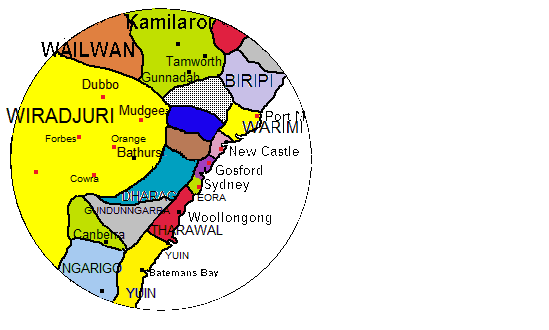
Australian Aboriginal language
| Field | Value |
|---|---|
| name | Awabakal |
| altname | Hunter River – Lake Macquarie |
| states | Eastern New South Wales, Australia |
| region | Lake Macquarie, Newcastle |
| ethnicity | Awabakal, Geawegal, Wonnarua |
| extinct | late 19th century |
| familycolor | Australian |
| fam1 | Pama–Nyungan |
| fam2 | Yuin–Kuric |
| fam3 | Kuri |
| fam4 | Worimi |
| dia1 | Awabagal |
| dia2 | Geawegal |
| dia3 | Wonarua |
| iso3 | awk |
| linglist | awk.html |
| glotto | awab1243 |
| glottorefname | Awabakal |
| aiatsis | S66 |
| revived | early stages of revival |
| imagecaption | An Australian Aboriginal language, as spoken by the Awabakal |
| image | An Australian language as spoken by the Awabakal.djvu |
Awabakal (also Awabagal or the Hunter River – Lake Macquarie, often abbreviated HRLM language) is an Australian Aboriginal language that was spoken around Lake Macquarie and Newcastle in New South Wales. The name is derived from Awaba, which was the native name of the lake. It was spoken by Awabakal and Wonnarua peoples.
It was studied by missionary Lancelot Threlkeld in the 19th century, who wrote a grammar of the language, but the spoken language had died out before 21st-century revival efforts.
Classification
Awabakal is a Pama–Nyungan language, most closely related to the Worimi language, within the Yuin–Kuric group of Pama–Nyungan.
History
Awabakal was studied by the Reverend Lancelot Threlkeld from 1825 until his death in 1859, producing a grammar and dictionary in An Australian Grammar in 1834. The speaker of Awabakal who taught him about the language was Biraban, the tribal leader. Threlkeld and Biraban's Specimens of a Dialect of the Aborigines of New South Wales in 1827 was the earliest attempt at exhibiting the structure of an Australian language.
Threlkeld's work was greatly expanded by John Fraser and republished in 1892 as * An Australian language as spoken by the Awabakal, the people of Awaba or Lake Macquarie (near Newcastle, New South Wales) being an account of their language, traditions and customs / by L.E. Threlkeld; re-arranged, condensed and edited with an appendix by John Fraser*. It contained a grammar and vocabulary as well as much new material by Fraser, and helped to popularise the name "Awabakal" for the language grouping more broadly referred to as the Hunter River-Lake Macquarie language.
Modern revival
The language is currently being revived. A new orthography and reconstruction of the phonology has been undertaken. To date, several publications have been produced including "A grammar for the Awabakal language", "An introduction to the Awabakal language : its orthography, recommended orthoepy and its grammar and stylistics " and "Nupaleyalaan palii Awabakalkoba = Teach yourself Awabakal".
Phonology
Consonants
| Labial | Alveolar | Palatal | Velar | Plosive | Nasal | Trill | Lateral | Approximant |
|---|
- Stop sounds may also be heard as voiced in free variation among speakers.
- Palatal sounds may also have dental allophones as .
Vowels
| Front | Central | Back | Close | Open |
|---|
- Vowel length may or may not be distinctive.
Grammar
Nouns
There exist three noun classes. The first has 4 declension patterns. A noun can exist in any of 13 cases.
- 1st class – Common nouns, descriptors, demonstratives and minaring
- 2nd class – Place names, words of spatial relations and wonta
- 3rd class – Personal names, kinship terms, and ngaan
The default, unmarked case of nouns is the absolutive. Unlike English and many European languages, in which an unmarked noun is the nominative case, and is (in the active voice) the subject of the sentence, Awabakal merely references a particular noun with this case.
Descriptors
There is a category of words in Awabakal called descriptors. They can stand as referring terms and are in these cases similar to nouns, like adjectives or intransitive verbs/predicative verb-adjective phrases. They can be declined into nominal cases.
Numbers
There are four number words.
- wakool
- bulowara
- ngoro
- wara (also , a metaphorical extension of )
Pronominal enclitics
Pronominal enclitics are suffixes which have several functions and can be attached to verbs, descriptors, appositions, interrogatives, negatives and nouns. The numbers are: singular, dual and plural with a feminine/masculine distinction in the first person. They mark verbs for person, number, case and voice. The "ergative" enclitcs imply an active transitive situation and the "accusative" implies a passive intransitive situation. There are three true pronouns which could be called a nominative or topic case. There are only found at the beginning of an independent clause. These pronominals are found in ergative, accusative, dative and possessive cases.
Demonstratives
There are 3 degrees. They are declined for 10 cases.
- 'this' near the speaker
- 'that' near the addressee(s)
- 'that' there (but at hand)
Appositive demonstratives
Here too, there are 3 degrees. These terms indicate place. They decline for 13 cases.
Verbs
The default verbative voice of Awabakal verbs is neutral, i.e., they do not give a sense of active or passive. The pronominal enclitics indicate which voice the verb should be analysed as being in. There are 3 present tenses, 8 future and 7 past, with various voice, aspect and mood modifications.
|kariwang+ku minaring ta+taan? |magpie+ERG what(ABS) eat+PRES |'What does the magpie eat?'}}
|minaring+ku kariwang ta+taan |what+ERG magpie(ABS) eat+PRES |'What eats the magpie?'}}
Negatives
There are 10 forms of negatives which work with different types of words or phrases.
Conjunctions
Conjunctions are not commonly used in comparison to many languages. Sentences can often be connected without their use. These also have various combinations and case declinations.
Interrogatives
- ngaan
- minaring
- wonta
- yakowai
- yakowanta
- iorakowa
- wiya
Sample texts
:Wonto ba kauwȧllo mankulla unnoa tara túġunbilliko ġurránto ġéen kinba, : 2. Yanti bo ġearun kin bara ġukulla, unnoa tara nakillikan kurri-kurri kabiruġ ġatun mankillikan wiyellikanne koba. : 3. Murrȧrȧġ tia kȧtan yantibo, koito baġ ba tuiġ ko ġirouġ Teopolo murrȧrȧġ ta, : 4. Gurra-uwil koa bi tuloa, unnoa tara wiyatoara banuġ ba. ::—Introduction of the Gospel of Luke
The Lord's Prayer
Below is the Lord's Prayer in Awabakal, according to the Gospel of Luke. Part of the Gospel of Luke was translated into Awabakal in 1892 and below the text reflects the orthography of the prayer in 1892.
Ġatun noa wiya barun, wiyånůn ba, ġiakai wiyånůn nura, Biyuġbai ġearúmba wokka ka ba moroko ka ba kåtan, Kåmůnbilla yitirra ġiroúmba. Ġurrabunbilla wiyellikanne ġiroúmba, yanti moroko ka ba, yanti ta purrai ta ba. Ġuwoa ġearún purreåġ ka takilliko. Ġatun warekilla ġearúnba yarakai umatoara, kulla ġéen yanti ta wareka yanti ta wiyapaiyeůn ġearúnba. Ġatun yuti yikpra ġearún yarakai umullikan kolaġ; mitomulla ġearún yarakai tabiruġ.
Influence on English
The word Koori, a self-referential term used by some Aboriginal people, comes from Awabakal.
Bibliography
19th century
21st century
References
References
- Dixon, R. M. W.. (2002). "Australian Languages: Their Nature and Development". Cambridge University Press.
- (1834). "An Australian grammar: comprehending the principles and natural rules of the language, as spoken by the Aborigines in the vicinity of Hunter's River, Lake Macquarie, &c. New South Wales". Printed by Stephens and Stokes.
- Threlkeld, Lancelot Edward. (1892). "An Australian language as spoken by the Awabakal, the people of Awaba, or lake Macquarie (near Newcastle, New South Wales): being an account of their language, traditions, and customs". C. Potter, Govt. Printer.
- (1892). "An Australian language as spoken by the Awabakal, the people of Awaba or Lake Macquarie (near Newcastle, New South Wales): being an account of their language, traditions and customs". Charles Potter, Govt. Printer.
- (2008). "A grammar for the Awabakal language". Arwarbukarl Cultural Resource Association.
- (2009). "An introduction to the Awabakal language : its orthography, recommended orthoepy and its grammar and stylistics". Arwarbukarl Cultural Resource Association.
- (2010). "Nupaleyalaan palii Awabakalkoba = Teach yourself Awabakal". Arwarbukarl Cultural Resource Association Inc.
- Lissarrague, Amanda. (2006). "A salvage grammar and wordlist of the language from the Hunter River and Lake Macquarie". Nambucca Heads, NSW: Muurrbay Language and Culture Centre.
- This map is indicative only.
- This orthography is from the original works of Threlkeld. A new orthography was created in 2004.
- "Awabakal Rosary Prayers".
- ''[[Oxford Dictionary of English]]'', 3rd ed., p 977.
This article was imported from Wikipedia and is available under the Creative Commons Attribution-ShareAlike 4.0 License. Content has been adapted to SurfDoc format. Original contributors can be found on the article history page.
Ask Mako anything about Awabakal language — get instant answers, deeper analysis, and related topics.
Research with MakoFree with your Surf account
Create a free account to save articles, ask Mako questions, and organize your research.
Sign up freeThis content may have been generated or modified by AI. CloudSurf Software LLC is not responsible for the accuracy, completeness, or reliability of AI-generated content. Always verify important information from primary sources.
Report