From Surf Wiki (app.surf) — the open knowledge base
Autoimmune polyendocrine syndrome type 2

| Field | Value |
|---|---|
| name | Autoimmune polyendocrine syndrome type 2 |
| image | File:HLA-DQ2.5 gliadin.PNG |
| caption | HLA-DQ2 one of the human leukocyte antigens genotypes responsible for this condition |
| synonyms | Schmidt's syndrome |
| symptoms | Asplenia |
| risks | Human leukocyte antigen (HLA-DQ2, HLA-DQ8 and HLA-DR4) |
| diagnosis | Ultrasound, MRI |
| treatment | Thyroid-stimulating hormone |
Autoimmune polyendocrine syndrome type 2, a form of autoimmune polyendocrine syndrome also known as APS-II, or PAS II, is the most common form of the polyglandular failure syndromes. PAS II is defined as the association between autoimmune Addison's disease and either autoimmune thyroid disease, type 1 diabetes, or both. It is heterogeneous and has not been linked to one gene. Rather, individuals are at a higher risk when they carry a particular human leukocyte antigen (HLA-DQ2, HLA-DQ8 and HLA-DR4). APS-II affects women to a greater degree than men.
Signs and symptoms
Signs and symptoms that are consistent in an individual affected with autoimmune polyendocrine syndrome type 2 are the following:
- Nausea
- Frequent urination
- Palpitations
- Weight loss
- Anorexia
- Low blood pressure
- Hypoparathyroidism
- Myalgias
- Hashimoto thyroiditis
- Graves' disease
- Anaemia
- Hypogonadism
- Diabetes mellitus
Genetics

In terms of genetics one finds that autoimmune polyendocrine syndrome type 2 has an autosomal dominant pattern of inheritance, with an incomplete penetrance. Furthermore, the human leukocyte antigen involved in this condition are HLA-DQ2(DR3 (DQB0201)) and HLA-DQ8(DR4 (DQB10302)), genetically speaking, which indicates this is a multifactorial disorder, as well.
Should any affected organs show chronic inflammatory infiltrate (lymphocytes), this would be an indication. Moreover, autoantibodies reacting to specific antigens is common, in the immune system of an affected individual.
Diagnosis
In terms of genetic testing, while it is done for type 1 of this condition, type 2 will only render (or identify) those genes which place the individual at higher risk. Other methods/exam to ascertain if an individual has autoimmune polyendocrine syndrome type 2 are:
- CT scan
- MRI
- Ultrasound
Treatment
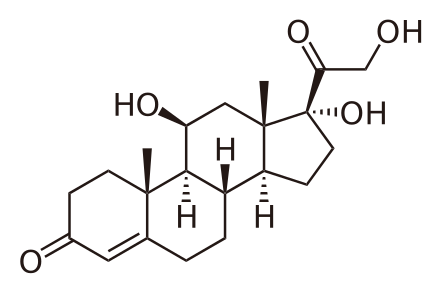
Management of autoimmune polyendocrine syndrome type 2 consists of the following:
- Cyclosporin A
- Isohormonal therapy
- Glucocorticoids
- Thyroid-stimulating hormone
- Dietary guidelines(depending if diabetic/Addison d.)
History
The condition was recognized by Martin Benno Schmidt (1863 – 1949), a German pathologist, first described in 1926. A third subtype, PAS III, has been described in adults, but apart from the absence of adrenal failure, no clinical differences between types II and III have been described. Because of this, both of these subtypes are generally referred to as PAS II.
Society and culture
- U.S. President John F. Kennedy is presumed to have suffered from Autoimmune Polyendocrine Syndrome, Type II.
References
References
- "Autoimmune polyglandular syndrome type 2 {{!}} Genetic and Rare Diseases Information Center (GARD) – an NCATS Program".
- Greenspan, Francis S.. (2004). "Basic clinical endocrinology". McGraw-Hill.
- Kahaly, George J.. (2012-12-01). "Polyglandular Autoimmune Syndrome Type II". La Presse Médicale.
- "Type II Polyglandular Autoimmune Syndrome Clinical Presentation: History, Physical, Causes".
- (April 2003). "Update on autoimmune polyendocrine syndromes (APS)". Acta Biomed.
- Betterle, Corrado. (2002-06-01). "Autoimmune Adrenal Insufficiency and Autoimmune Polyendocrine Syndromes: Autoantibodies, Autoantigens, and Their Applicability in Diagnosis and Disease Prediction". Endocrine Reviews.
- "OMIM Entry - % 269200 - AUTOIMMUNE POLYENDOCRINE SYNDROME, TYPE II; APS2".
- Majeroni, BA. (1 March 2007). "Autoimmune polyglandular syndrome, type II.". American Family Physician.
- Weiss, Roy E.. (2016). "Genetic Diagnosis of Endocrine Disorders". Academic Press.
- Betterle, C. (19 April 2017). "Autoimmune polyglandular syndrome Type 2: the tip of an iceberg?". Clinical and Experimental Immunology.
- Eisenbarth, George S.. (2011). "Immunoendocrinology: Scientific and Clinical Aspects". Springer Science & Business Media.
- Kahaly, George J.. (2003-07-01). "Polyglandular Autoimmune Syndromes: Immunogenetics and Long-Term Follow-Up". The Journal of Clinical Endocrinology & Metabolism.
- Kahaly, George J.. (2009-07-01). "Polyglandular autoimmune syndromes". European Journal of Endocrinology.
- Macchia, Donatella et al. "President John F Kennedy's medical history: coeliac disease and autoimmune polyglandular syndrome type 2." Postgraduate medical journal vol. 96,1139 (2020): 543-549. doi:10.1136/postgradmedj-2020-137722
- Mandel, Lee R.. (2009). "Endocrine and Autoimmune Aspects of the Health History of John F. Kennedy". Annals of Internal Medicine.
This article was imported from Wikipedia and is available under the Creative Commons Attribution-ShareAlike 4.0 License. Content has been adapted to SurfDoc format. Original contributors can be found on the article history page.
Ask Mako anything about Autoimmune polyendocrine syndrome type 2 — get instant answers, deeper analysis, and related topics.
Research with MakoFree with your Surf account
Create a free account to save articles, ask Mako questions, and organize your research.
Sign up freeThis content may have been generated or modified by AI. CloudSurf Software LLC is not responsible for the accuracy, completeness, or reliability of AI-generated content. Always verify important information from primary sources.
Report