From Surf Wiki (app.surf) — the open knowledge base
Australian Kelpie
Dog breed
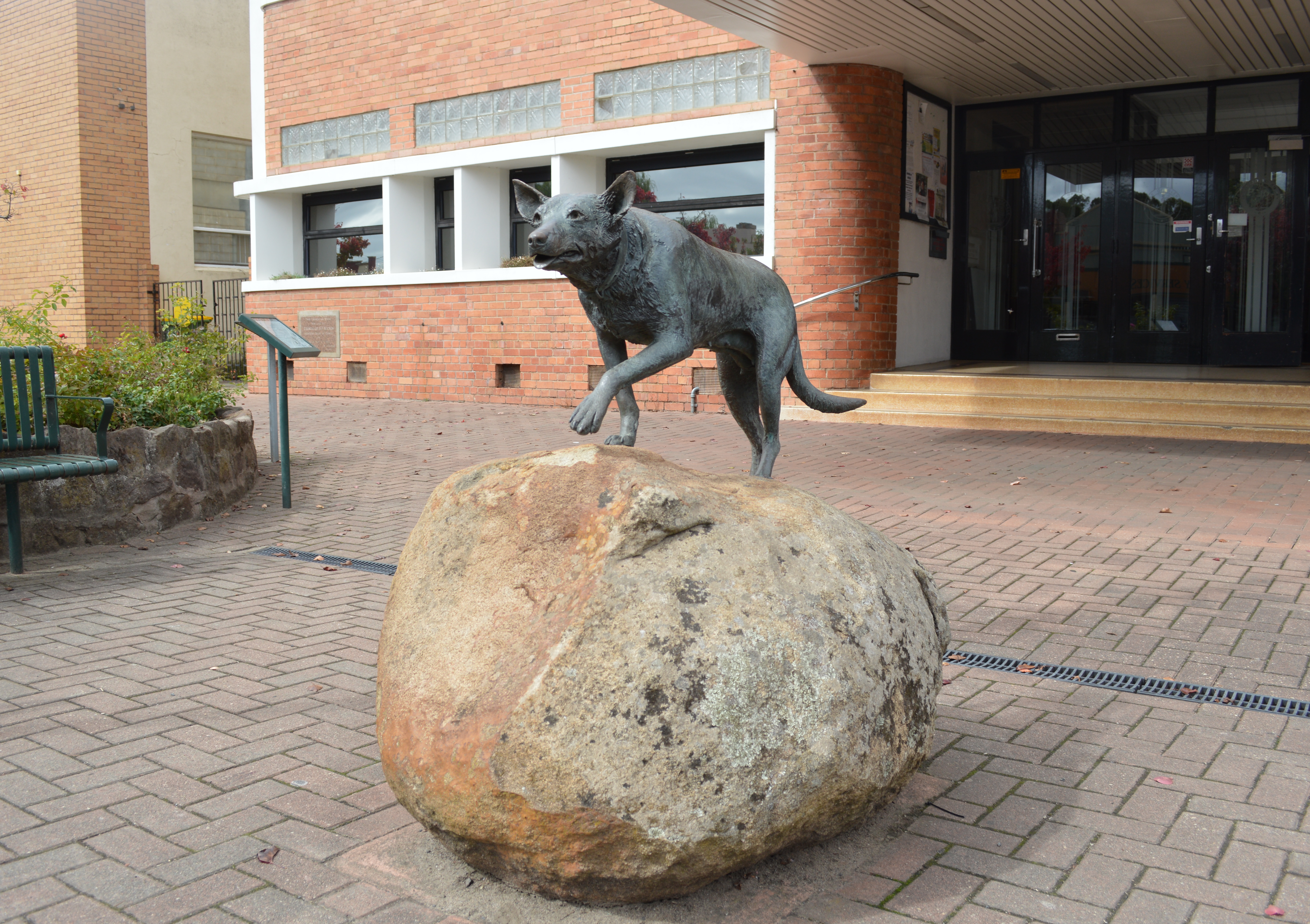
Dog breed
| Field | Value |
|---|---|
| name | Australian Kelpie |
| image | Hilu the Australian Kelpie dog.jpg |
| image_caption | An Australian Kelpie |
| altname | Kelpie, Barb |
| nickname | Farmer Dog |
| country | Australia |
| weight | 13 - |
| height | 39 - |
| coat | short double coat |
| colour | black, black and tan, red, red and tan, chocolate, chocolate and tan, blue, blue and tan, fawn, fawn and tan, cream, black and white |
| kc_name | ANKC |
| kc_std | http://ankc.org.au/Breed/Detail/149 |
| kc2_name | |
| fcistd | http://www.fci.be/Nomenclature/Standards/293g01-en.pdf |
The Australian Kelpie, or simply Kelpie, is an Australian sheepdog capable of mustering and droving with little or no guidance. It is a medium-sized dog and comes in a variety of colours. The Kelpie has been exported throughout the world and is used to muster livestock, primarily sheep, cattle and goats.
The breed has been separated into two distinct varieties: the Show (or Bench) Kelpie and the Working Kelpie. The Show Kelpie is seen at conformation dog shows in some countries and is selected for appearance rather than working instinct, while the Working Kelpie is bred for its working ability.
History

The ancestors of most Kelpies were British dogs known loosely as collies (sometimes spelled colleys). These were mostly black, or very dark brown, dogs – hence the name collie, which has the same root as coal. (The official collie breeds were not formed until about 10 or 15 years after the Kelpie was established as a breed, and the first recognised Border Collie was not brought to Australia until after the Federation in 1901). Some collies were imported to Australia for stock work in the early 19th century, and were bred with other types of dogs – usually with an eye to working sheep without direct supervision.
A 1950 article in the Dungog Chronicle as an example, amongst a number of them that can be found in public archives, reports a then-popular account claiming that the first Kelpies descended from a deliberate cross between a smooth-haired Scottish Collie and a dingo around 1870. The story reflected a widespread belief of the time that Australian working dogs owed some of their hardiness to native dingo blood.{{cite news |title=Origin of the Kelpie |newspaper=Dungog Chronicle |date=18 March 1950 |url=https://trove.nla.gov.au/newspaper/article/140859520 |access-date=25 October 2025}}
In May 2019, several media outlets reported that a University of Sydney genomic study had found “no dingo ancestry” in the Kelpie.{{cite web |title=Strewth! Turns out your Kelpie is not a dingo |url=https://www.sydney.edu.au/news-opinion/news/2019/05/27/strewth--turns-out-your-kelpie-is-not-a-dingo.html
The first dog known as a Kelpie was a black and tan female pup with floppy ears bought by Jack Gleeson about 1872 from a litter born on Warrock Station near Casterton, owned by George Robertson, a Scot. This dog was named after the kelpie, a mythological shapeshifting water spirit of Celtic folklore. In later years she was referred to as "(Gleeson's) Kelpie", to differentiate her from "(King's) Kelpie", her daughter.
The second "Kelpie" was "(King's) Kelpie", another black and tan bitch out of "Kelpie" by "Caesar", a pup from two sheepdogs imported from Scotland. "(King's) Kelpie" tied for the prestigious Forbes Trial in 1879, and the strain was soon popularly referred to as "Kelpie's pups", or just Kelpies. The King brothers joined another breeder, McLeod, to form a dog breeding partnership whose dogs dominated trials during 1900 to 1920.
An early Kelpie, Sally, was mated to Moss, a Smooth Collie, and she produced a black pup that was named Barb after The Barb, a black horse which had won the Melbourne Cup in 1866. Consequently, black Kelpies became known as Barb Kelpies or Barbs.
There were a number of Kelpies named Red Cloud. The first and most famous was John Quinn's Red Cloud in the early 20th century. In the 1960s, another Red Cloud became well known in Western Australia. This started the tradition in Western Australia of calling all Red or Red and Tan Kelpies, especially those with white chests, Red Cloud Kelpies. Other notable specimens include Gunner and Red Dog (c. 1971 – 21 November 1979), a Kelpie mix which was the subject of a movie, Red Dog, released in 2011.
Kelpies have been exported to many countries including Argentina, Canada, Italy, Korea, New Caledonia, New Zealand, Sweden, the United Kingdom and the United States for various pursuits.
By 1990, Kelpies had been trained as scent dogs with good success rates. In Sweden they have been widely used for tracking and rescue work.
Appearance
The Kelpie is a soft-coated, medium-sized dog, usually with prick ears and an athletic appearance. Their coat colours include black, black and tan, red, red and tan, blue, blue and tan, fawn, fawn and tan, cream, black and blue, and white and gold. The Kelpie generally weighs 14 - and measures 41 - at the withers. They can reach a maximum weight of 25 -.
Breed standards
Robert Kaleski published the first standard for the Kelpie in 1904. The standard was accepted by leading breeders of the time and adopted by the Kennel Club of New South Wales. Contemporary breed standards vary depending on whether the registry is for working or show Kelpies. It is possible for a dog to both work and show, but options for competition in conformation shows might be limited depending on ancestry and the opinions of the kennel clubs or breed clubs involved.
In Australia, there are two separate registries for Kelpies. Working Kelpies are registered with the Working Kelpie Council (WKC) and/or the Australian Sheepdog Workers Association. The WKC encourages breeding for working ability, and allows a wide variety of coat colours. Show Kelpies are registered with the Australian National Kennel Council, which encourages breeding for a certain appearance and limits acceptable colours. The wide standards allowed by the WKC mean that many Working Kelpies do not meet the standard for showing.
In the US, the Kelpie is not recognised as a breed by the American Kennel Club (AKC). However, the United Kennel Club and the Canadian Kennel Club recognise the Kelpie and allow them to compete in official events. As of 2015, Australian Kelpies have been accepted by the AKC as Herding Dogs allowed to compete in AKC sanctioned Sheep Herding Trials.
Working Kelpie
The Working Kelpie comes in three coat types: short, smooth and rough. The coat can be almost any colour from black to light tan or cream. Some Kelpies have a white blaze on the chest, and a few have white points. Kelpies sometimes have a double coat, which sheds out in spring in temperate climates. Agouti is not unusual, and can look like a double coat.
Working Kelpies vary in size, ranging from about 19 – and 28 –.


A Working Kelpie can be a cheap and efficient worker that can save farmers and graziers the cost of several hands when mustering livestock. The good Working Kelpies are herding dogs that will prevent stock from moving away from the stockman. Kelpies have natural instincts for managing livestock. They will work sheep, cattle, goats, pigs, poultry, and other domestic livestock. The Kelpie's signature move is to jump on the backs of sheep and walk across the tops of the sheep to reach the other side and break up the jam. Kelpies compete and are exhibited in livestock working trials, ranging from yards or arenas to large open fields working sheep, goats, cattle, or ducks.
Show Kelpie
Kelpies that are bred under the ANKC registrations are registered for show (Main Register) only in the following colours: Black, Chocolate, Red, Smoky Blue, Fawn, Black and Tan, and Red and Tan. They have a double coat and pricked ears. The other colours can be registered as pets and sporting dogs (Limited Register): Blue and Tan, Fawn and Tan and Yellow/Cream. Kelpies were first exhibited in the early 20th century, at the Sydney Royal Easter Show. ANKC "Show" Kelpies are now becoming very popular both nationally and internationally as family pets, companion dogs, running mates and sport dogs due to their trainability, good nature and low maintenance of care and can be found all over the world.
Temperament

Show Kelpies generally excel in agility trials and may be shown in conformation in Australia.
Kelpies are intelligent and easy to train dogs making them good-tempered and good pets, especially with children. However they require a lot of physical exercise and mental stimulation, otherwise they can become bored and hence be disruptive by constantly barking or digging, or by chewing on objects. Working Kelpies are often described as "workaholics", with a strong drive to herd.
Health
Kelpies are a hardy breed with few health problems, but they are susceptible to disorders common to all breeds, such as cryptorchidism, hip dysplasia, cerebellar abiotrophy and luxating patella. Research is underway to find the genetic marker for cerebellar abiotrophy in the breed.
A 2024 UK study found a life expectancy of 12 years based on a sample of 49 deaths for the breed compared to an average of 12.7 for purebreeds and 12 for crossbreeds.
Notable Kelpies
A 30-year-old Kelpie owned by a Victorian dairy farmer, Maggie, was thought to be the world's oldest dog at her time of death.
In popular culture
A Black and Tan Kelpie, named Roy, is featured in the Australian drama series McLeod's Daughters, while another Black and Tan Kelpie, named Turbo (offspring of Roy), appears in the series several years later.
A Red Kelpie boy and one of Bluey's best friends, Rusty, is featured in the show Bluey. Rusty is joined by older brother Digger and younger sister Dusty.
The film The Fall Guy features a Kelpie.
A Kelpie named Dart portrays the dog, Frankie (Francesca Camilla Kelpington III), in the Australian-British crime drama television series, Return to Paradise.
Show coat colours
File:Svart kelpie.png|Black Kelpie File:Chokladbrun kelpie.png| Chocolate Kelpie File:Röd kelpie.png|Red Kelpie File:Black & Tan kelpie.png|Black and Tan Kelpie File:Red & Tan kelpie.png|Red and Tan Kelpie File:Rökblå kepie.png|Smoky Blue Kelpie File:Fawn kelpie.png|Fawn Kelpie
Explanatory notes
References
References
- "Australian Working Kelpie". Burke's Backyard.
- "coal". Online Etymology Dictionary.
- "collie". Online Etymology Dictionary.
- (13 April 2008). "beginnings". Petsburgh.
- (9 December 2007). "early". Petsburgh.
- Parsons, Anthony D.. (1986). "The Working Kelpie". Nelson.
- (1 July 2011). "The Victor Trumpers of sheep dog trials".
- [http://www.wkc.org.au/Foundation.html#GLEESON The Kelpie Foundation & John D Jack Gleeson] {{webarchive. link. (30 December 2006)
- [http://www.wkc.org.au/HisDtrialsHTML.htm#ForbesSheepdogTrial Historical Sheepdog Trials] {{webarchive. link. (29 September 2006)
- "Australian Kelpie".
- Sloane, Steve. (1990). "Australian Kelpie". TFH Publications, Inc..
- (2002). "Kelpie". World Almanac Education Group.
- Walsh, G. P.. (1983). "Australian Dictionary of Biography". National Centre of Biography, Australian National University.
- [http://www.wkc.org.au/ The Working Kelpie Council of Australia] {{webarchive. link. (22 March 2004)
- "ASDWA – Australian Sheep Dog Workers' Association -". asdwa.org.au.
- "Dog Breeds – Types Of Dogs". [[American Kennel Club]].
- "Australian Kelpie". [[United Kennel Club]].
- "CKC Breed Standards".
- Club, American Kennel. "Working Kelpie". akc.org.
- Parmer, Ida. "Basic Coat Color Genetics". hnrworkingkelpies.com.
- (February 1997). "Learning to train your four-legged workers". [[Farming Ahead]].
- Sim, Terry. (16 June 2021). "Hoover's $35,200 price sets world record at Casterton auction". Nascon Media.
- Messner, Andrew. (2006). "Green Gully Historical Report". [[Department of Environment, Climate Change and Water (New South Wales).
- Wilcox, Bonnie. (1989). "Atlas of dog breeds of the world". Neptune City, N.J. : T.F.H. Publications.
- (2024-02-01). "Longevity of companion dog breeds: those at risk from early death". Springer Science and Business Media LLC.
- (20 April 2016). "The 'world's oldest dog' has died aged 30". The Journal.
- "Who remembers Claire with her dog Roy! 😍 - Leah".
- (2 April 2012). "Wild dogs kill TV star".
- "[[Cricket (Bluey)".
- Tiwari, Sakcham. (14 March 2024). "Ryan Gosling's French-Speaking Dog in 'The Fall Guy' Honors Wife's Pet".
This article was imported from Wikipedia and is available under the Creative Commons Attribution-ShareAlike 4.0 License. Content has been adapted to SurfDoc format. Original contributors can be found on the article history page.
Ask Mako anything about Australian Kelpie — get instant answers, deeper analysis, and related topics.
Research with MakoFree with your Surf account
Create a free account to save articles, ask Mako questions, and organize your research.
Sign up freeThis content may have been generated or modified by AI. CloudSurf Software LLC is not responsible for the accuracy, completeness, or reliability of AI-generated content. Always verify important information from primary sources.
Report