From Surf Wiki (app.surf) — the open knowledge base
Australian Capital Territory Legislative Assembly
Unicameral legislature of the Australian Capital Territory
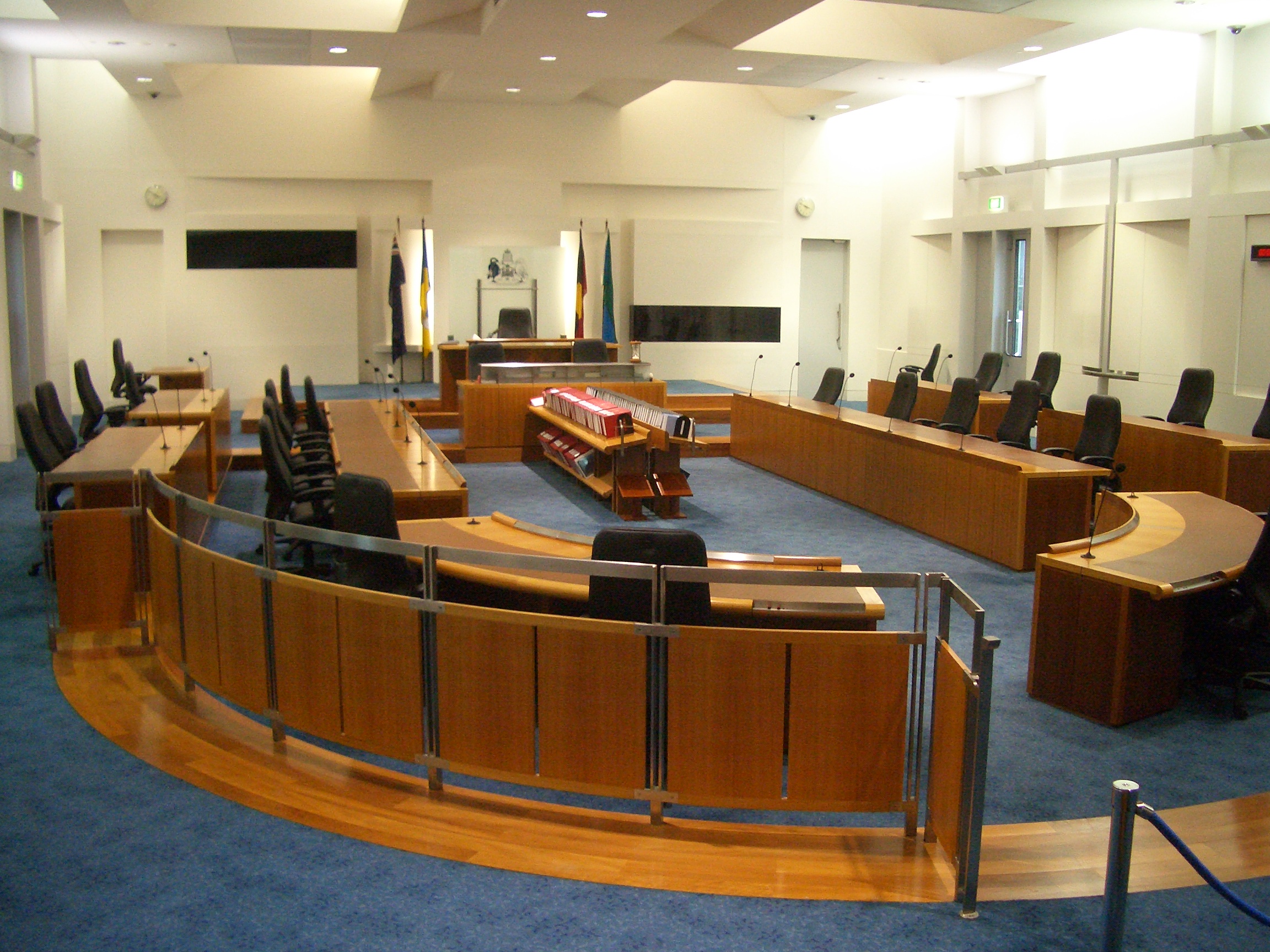
Unicameral legislature of the Australian Capital Territory
| Field | Value | |
|---|---|---|
| background_color | #224C98 | |
| name | Legislative Assembly | |
| legislature | 11th Assembly | |
| coa_pic | Coat of Arms of the Australian Capital Territory.svg | |
| coa_caption | Coat of Arms of Canberra | logo_pic = ACT Legislative Assembly logo.png |
| logo_caption | Legislative Assembly logo | house_type = Unicameral |
| foundation | ||
| preceded_by | House of Assembly | |
| leader1_type | Speaker | |
| leader1 | Jeremy Hanson | |
| party1 | Liberal | |
| election1 | 2 December 2025 | |
| leader2_type | Deputy Speaker | |
| leader2 | Andrew Braddock | |
| party2 | Greens | |
| election2 | 6 November 2024 | |
| leader3_type | Manager of Government | |
| Business | ||
| leader3 | Tara Cheyne | |
| party3 | Labor | |
| election3 | 7 November 2024 | |
| leader4_type | Government whip | |
| leader4 | Caitlin Tough | |
| party4 | Labor | |
| leader5_type | Chief Minister | |
| leader5 | Andrew Barr | |
| party5 | Labor | |
| election5 | 11 December 2014 | |
| leader6_type | Leader of the Opposition | |
| leader6 | Mark Parton | |
| party6 | Liberal | |
| election6 | 10 November 2025 | |
| seats | 25 | |
| structure1 | 11th ACT Legislative Assembly.svg | |
| structure1_res | 200px | |
| political_groups1 | Government (10) | |
| * | border | darkgray}} Labor (10) |
| * | border | darkgray}} Liberal (9) |
| * | border | darkgray}} Greens (4)}} |
| * | border | darkgray}} Carricks (1) |
| * | border | darkgray}} Independents (1) |
| term_length | 4 years | |
| voting_system1 | Hare–Clark electoral system | |
| first_election1 | 4 March 1989 | |
| last_election1 | 19 October 2024 | |
| next_election1 | 21 October 2028 | |
| session_room | Australian Capital Territory Legislative Assembly.jpg | |
| meeting_place | Legislative Assembly Building, Canberra, Australian Capital Territory, Australia | |
| website |
Business
-
Labor (10) Opposition (9)
-
Liberal (9) Crossbench (6)
-
Carricks (1)
-
Independents (1)
The Legislative Assembly for the Australian Capital Territory, known in short as the ACT Legislative Assembly, is the unicameral legislature of the Australian Capital Territory (ACT). It sits in the Legislative Assembly Building on Civic Square, close to the centre of the city of Canberra.
Unlike the legislatures of the states and the Northern Territory, the Assembly also has the functions of a local council; the city of Canberra has no other local government. It replaced the House of Assembly when the ACT was granted self-government in 1986. Voters had previously rejected self government in a 1978 plebiscite.
Structure and Membership
The Legislative Assembly has 25 members, elected from five electorates ― Brindabella, Ginninderra, Kurrajong, Murrumbidgee and Yerrabi ― each having five members. Members are elected for four-year terms by the Hare-Clark system, a variation of the Single Transferable Vote form of proportional representation.
Members of the Legislative Assembly vote to elect a Chief Minister. In practice, Chief Minister is the leader of whichever party is able to form government. The Chief Minister, in turn, selects ministers to form a cabinet. The leader of the second-largest party in the Assembly usually becomes the Leader of the Opposition.
Election dates for the Assembly are fixed in legislation, with elections held on the third Saturday in October every four years (until 1997, elections were held in February). The term of the Assembly was increased in 2004 from three to four years. The last election was held on Saturday the 19th of October, 2024, with the next election expected to be held on 21 October 2028.
Current electorates
Brindabella
Main article: Brindabella electorate
Electing five members to the Assembly, Brindabella contains the town centre and all of the suburbs of Tuggeranong. It also includes all of the ACT which is south of the Murrumbidgee River, thus making it the largest electorate by area. It used to exclude the whole of the suburb of Kambah.
Ginninderra
Main article: Ginninderra electorate
Electing five members to the Assembly, Ginninderra contains the town centre and all of the suburbs of Belconnen excluding Giralang and Kaleen. Its southern boundary was the Molonglo River prior to the 2016 election. It used to exclude the suburbs of Evatt, Lawson and McKellar.
Kurrajong
Main article: Kurrajong electorate
Electing five members to the Assembly, Kurrajong contains all the suburbs of Inner North Canberra, Inner South Canberra and Oaks Estate. It used to include the suburbs of Deakin, Yarralumla, Forrest and Red Hill.
Murrumbidgee
Main article: Murrumbidgee electorate
Electing five members to the Assembly, Murrumbidgee contains all the suburbs of the Molonglo Valley, Weston Creek, Woden Valley and also includes the suburbs of Deakin, Yarralumla, Forrest and Red Hill. It used to also include the whole of the suburb of Kambah.
Yerrabi
Main article: Yerrabi electorate
Electing five members to the Assembly, Yerrabi contains all the suburbs of Gungahlin as well as the Belconnen suburbs of Giralang and Kaleen and the village of Hall. It used to also include the suburbs of Evatt, Lawson and McKellar.
Former electorates
Molonglo
Main article: Molonglo electorate
Molonglo was an electorate of the Australian Capital Territory Legislative Assembly that was contested from the 1995 election to the 2012 election, it covered Inner North Canberra, Inner South Canberra, Weston Creek and most of the suburbs of Woden and Gungahlin. It was a 7-seat electorate.
Current Government

The current Chief Minister is Andrew Barr, who is also the Minister for Economic Development and Minister for Tourism and Trade. The position of Chief Minister is analogous to the Premier in the Australian states. Barr is the longest serving Chief Minister in ACT history, as well as the longest serving current Premier or Chief Minister in Australia, having taken the post in December 2014.
The ACT Labor Party has been in power since 2001, although with the exception of 2004-2008, have served in minority or coalition governments with the support of the ACT Greens.
At the 2020 Australian Capital Territory election, 10 Labor members, 9 Liberal members and 6 Greens members were elected.
Following the expulsion of Elizabeth Kikkert from the Canberra Liberals party room on 10 September 2024, the Liberals were left with 8 members, with Kikkert becoming an independent.
At the 2024 Australian Capital Territory election, 10 Labor members, 9 Liberal members, 4 Green members, 1 Independent for Canberra member, and 1 Fiona Carrick Independent member were elected, with Labor to hold power in a minority government.
| Party | Seats held | Percentage | Seat distribution | |
|---|---|---|---|---|
| Labor Party | 10 | 34.2% | ||
| Liberal Party | 9 | 33.5% | ||
| ACT Greens | 4 | 12.1% | ||
| Independents for Canberra | 1 | 8.5% | ||
| Fiona Carrick Independent | 1 | 2.7% |
| Electorate | Seats held | ||
|---|---|---|---|
| Brindabella | Labor}} | ||
| Ginninderra | Labor}} | ||
| Kurrajong | Labor}} | ||
| Murrumbidgee | Labor}} | ||
| Yerrabi | Labor}} |
| FCI |
|---|
|}
Salary
, Members of the Legislative Assembly are paid a base salary of $188,798, while additional remuneration is provided depending on the additional office or role the member holds.
| Office | Additional Remuneration | Total Remuneration |
|---|---|---|
| Chief Minister | $207,678 | $396,476 |
| Deputy Chief Minister | $151,038 | $339,836 |
| Leader of the Opposition | $132,158 | $320,956 |
| Minister | $132,158 | $320,956 |
| Speaker/Presiding Officer | $103,839 | $292,636 |
| Deputy Leader of the Opposition | $37,760 | $226,558 |
| Deputy Speaker/Presiding Officer | $28,320 | $217,118 |
| Government/Opposition Whips | $18,880 | $207,678 |
| Presiding member of a committee concerned with public affairs rather than affairs of the Legislative Assembly | $18,880 | $207,678 |
History

]]
.png)
The current Legislative Assembly was created by four acts of the Commonwealth Parliament in 1988, including the Australian Capital Territory (Self-Government) Act 1988. The first election was held on 4 March 1989 and the assembly first sat on 11 May that year. Until this point, the ACT had been directly administered by the Commonwealth Government. It replaced the House of Assembly (also known for a period as the Legislative Assembly), which existed from 1976 to 1986, but had no executive power, with a principal function of advising the Commonwealth on matters relating to the Territory.
Historical Composition

At its inception, the Assembly was elected by a modified d'Hondt system, the ACT comprised one electorate, electing seventeen members to the Assembly. A 1992 referendum supported the Hare-Clark method, which was introduced for the 1995 election. As of this change, the Legislative Assembly had 17 members, elected from three electorates. Brindabella and Ginninderra elected five members, and the now-defunct electorate of Molonglo elected seven.
On 30 April 2002, the ACT Electoral Commission made a submission to the ACT Legislative Assembly's Standing Committee on Legal Affairs, which inquired into the appropriateness of the size of the Legislative Assembly for the ACT, and options for changing the number of members and electorates. The Electoral Commission recommended increasing "the size of the Legislative Assembly to three electorates each returning seven members, giving a total of 21 members".
In 2014, the Assembly voted to expand the number of members to the present 25, with the change taking effect at the 2016 election.
There has only been one majority government in the history of the Legislative Assembly, with Labor winning 9 of 17 seats at the 2004 election.
Historical Results
| Primary vote | Seats | ALP | Lib | GRN | Oth. | ALP | Lib | GRN | Oth. | Total | 4 March 1989 election | 17 | 15 February 1992 election | 18 February 1995 election | 21 February 1998 election | 20 October 2001 election | 16 October 2004 election | 18 October 2008 election | 20 October 2012 election | 15 October 2016 election | 25 | 17 October 2020 election | 19 October 2024 election |
|---|---|---|---|---|---|---|---|---|---|---|---|---|---|---|---|---|---|---|---|---|---|---|---|
| 22.8% | 14.9% | - | 62.3% | 5 | 4 | - | 8 | ||||||||||||||||
| 39.9% | 29.0% | - | 31.1% | 8 | 6 | - | 3 | ||||||||||||||||
| 31.6% | 40.5% | 9.1% | 18.8% | 7 | 8 | 2 | 0 | ||||||||||||||||
| 27.7% | 37.8% | 9.1% | 25.4% | 6 | 7 | 1 | 3 | ||||||||||||||||
| 41.7% | 31.6% | 9.1% | 17.6% | 8 | 7 | 1 | 1 | ||||||||||||||||
| 46.8% | 34.8% | 9.3% | 9.1% | 9 | 7 | 1 | 0 | ||||||||||||||||
| 37.4% | 31.6% | 15.6% | 15.4% | 7 | 6 | 4 | 0 | ||||||||||||||||
| 38.88% | 38.9% | 10.8% | 11.4% | 8 | 8 | 1 | 0 | ||||||||||||||||
| 38.4% | 36.7% | 10.3% | 14.6% | 12 | 11 | 2 | 0 | ||||||||||||||||
| 37.8% | 33.8% | 13.5% | 14.9% | 10 | 9 | 6 | 0 | ||||||||||||||||
| 34.1% | 33.4% | 12.2% | 20.3% | 10 | 9 | 4 | 2 |
Powers
As with the Northern Territory Legislative Assembly, the ACT Legislative Assembly lacks the full powers of a state legislature. Section 122 of the Constitution of Australia provides that the Commonwealth Parliament "may make laws for the government of any territory" surrendered by any State to the Commonwealth. The Governor-General, on the advice of the Executive, previously had the power to override laws passed by the Assembly. Although this was rare in practice, the Civil Unions Act 2006, which allowed same-sex couples to enter into "civil unions" was overruled following concerns that the civil unions mimicked marriage. In July 2006, the Federal Government again threatened to overrule the ACT Stanhope Government's anti-terror legislation, which was not consistent with other state laws. In 2011 the Federal Parliament passed a private senator's bill which removed this power in respect to both the Australian Capital Territory and the Northern Territory.
The ACT is unique among Australian states and self-governing territories, as it has no vice-regal post exercising authority as the representative of the monarch, such as a governor or an Administrator. The functions vested in a state Governor or territorial Administrator as nominal head of the Executivecommissioning government, proroguing parliament and enacting legislationare exercised by the Assembly itself and by the Chief Minister. Instead of vice-regal or regal assent, a Bill passed by the ACT Legislative Assembly is enacted on "notification"publication in the Government Gazette of a notice authorised by the Chief Minister. However, the Governor-General of Australia does have the power to dissolve the Assembly if it is "incapable of effectively performing its functions or is conducting its affairs in a grossly improper manner".
Notes
References
References
- (25 April 2020). "The road to self-government".
- "A Bill for An Act to amend the Electoral Act 1992".
- (27 April 2016). "Electorates 2016 election".
- (25 April 2020). "Electing Members of the ACT Legislative Assembly". Legislative Assembly for the ACT.
- {{Cite Legislation AU. Cth. num_act. acta1988482. Australian Capital Territory (Self-Government) Act 1988. 40
- {{Cite Legislation AU. ACT. act. actaa2014519. Electoral Act 1992. 100
- (28 April 2020). "Barr-Andrew".
- "Andrew Barr MLA".
- Glenday, James. (2024-09-14). "Is ACT Labor becoming Canberra's 'forever government'?". [[Australian Broadcasting Corporation]].
- (2024-09-10). "'No tolerance': Kikkert dumped from Liberal party room after being disendorsed".
- (2024-10-25). "Greens MLA Laura Nuttall wins fifth and final seat in Tuggeranong-based electorate of Brindabella".
- (2024-11-06). "ACT Greens say 'business as usual won't cut it' as the party confirms it won't form another coalition with Labor".
- "Determination 5 of 2024 Members of the ACT Legislative Assembly". Australian Capital Territory Remuneration Tribunal.
- [http://www.elections.act.gov.au/elections/1989/timetable_89.html ACT government elections] {{webarchive. link. (28 March 2011)
- (2017-03-20). "Establishing self-government in the ACT". Legislative Assembly for the ACT.
- (2002-04-30). "Inquiry into the appropriateness of the size of the ACT Legislative Assembly". [[Australian Capital Territory Electoral Commission.
- {{Cite Legislation AU. ACT. act. actaa2014519. Australian Capital Territory (Legislative Assembly) Act 2014
- {{Cite Legislation AU. Cth. num_act. acta1988482. Australian Capital Territory (Self-Government) Act 1988. 35
- "Territories Self-Government Legislation Amendment (Disallowance and Amendment of Laws) Act 2011".
- "National Archives: Documenting a Democracy".
- {{Cite Legislation AU. Cth. num_act. acta1988482. Australian Capital Territory (Self-Government) Act 1988. 16
This article was imported from Wikipedia and is available under the Creative Commons Attribution-ShareAlike 4.0 License. Content has been adapted to SurfDoc format. Original contributors can be found on the article history page.
Ask Mako anything about Australian Capital Territory Legislative Assembly — get instant answers, deeper analysis, and related topics.
Research with MakoFree with your Surf account
Create a free account to save articles, ask Mako questions, and organize your research.
Sign up freeThis content may have been generated or modified by AI. CloudSurf Software LLC is not responsible for the accuracy, completeness, or reliability of AI-generated content. Always verify important information from primary sources.
Report