From Surf Wiki (app.surf) — the open knowledge base
Australia men's national basketball team
Men's national basketball team representing Australia
Men's national basketball team representing Australia
| Field | Value |
|---|---|
| country | Australia |
| logo | Australian boomers logo.png |
| logo_width | 195px |
| nickname | Boomers |
| coach | Adam Caporn |
| fiba_ranking | |
| joined_fiba | 1947 |
| fiba_zone | FIBA Asia |
| national_fed | Basketball Australia |
| oly_appearances | 16 |
| oly_medals | Bronze: (2020) |
| wc_appearances | 13 |
| zone_championship | FIBA Asia Cup |
| zone_appearances | 3 |
| zone_medals | Gold: (2017, 2022, 2025) |
| zone_championship2 | FIBA Oceania Championship |
| zone_appearances2 | 21 |
| zone_medals2 | Gold: (1971, 1975, 1978, 1979, 1981, 1983, 1985, 1987, 1989, 1991, 1993, 1995, 1997, 2003, 2005, 2007, 2011, 2013, 2015) |
| Silver: (2001, 2009) | |
| h_title | Home |
| h_pattern_b | _greenshoulders |
| h_pattern_s | _greensides |
| h_body | FFD200 |
| h_shorts | FFD200 |
| a_title | Away |
| a_pattern_b | _yellowshoulders |
| a_pattern_s | _goldsides |
| a_body | 1D3F29 |
| a_shorts | 1D3F29 |
| first_game | 89–66 |
| (Melbourne, Australia; 24 November 1956) | |
| largest_win | 136–31 |
| (Timaru, New Zealand; 31 August 1987) | |
| largest_loss | 113–73 |
| (Saitama, Japan; 27 August 2006) |
the men's team
Silver: (2001, 2009) (Melbourne, Australia; 24 November 1956) (Timaru, New Zealand; 31 August 1987) (Saitama, Japan; 27 August 2006) The Australia men's national basketball team, nicknamed the Boomers after the slang term for a male kangaroo, represents Australia in international basketball competition.
Since the late 1980s, Australia has placed among the world elite teams, as the Boomers have reached the semi-finals at both Summer Olympic Games and FIBA World Cup on many occasions. Originally a member of the FIBA Oceania region, Australia nowadays competes at the FIBA Asia Cup where the Boomers were the dominant team at their first appearance. The FIBA Oceania Championship mostly consisted of a three-match competition against the other regional power, the New Zealand Tall Blacks. Before the formation of the National Basketball League (NBL) in 1979, Boomers players were selected from state leagues around the country, with Victoria, South Australia, and to a lesser extent New South Wales the dominant states. After the formation of the NBL, players began to be selected almost exclusively from that competition during the 1980s and 1990s.
Occasionally players were selected from outside the NBL. Mark Bradtke made his Boomers debut in 1987 while attending the Australian Institute of Sport (AIS) before he entered the NBL. Luc Longley made his debut in 1988 while playing college basketball in the United States. Other Australian players enter the Euroleague and the National Basketball Association (NBA) in the U.S. The Boomers's roster for the 2014 World Cup included five NBA players: Cameron Bairstow with the Chicago Bulls, Aron Baynes with the San Antonio Spurs, Matthew Dellavedova with the Cleveland Cavaliers, and Dante Exum and Joe Ingles with the Utah Jazz. Three other players who were ruled out of the World Cup due to injury also played or would later play in the NBA, namely Andrew Bogut, Ben Simmons and Patty Mills.
Several players on youth national teams are student athletes at the AIS or in the US college basketball system. Some players (e.g. Longley) made the senior national team while at US schools. By the early 21st century, almost half of the squad played outside Australia. For the 2012 London Olympic Games, only two members of the Australian squad were based in the country – Peter Crawford and Adam Gibson, with the latter being the only Australia-based member of the 2014 World Cup squad.
Australia has participated in the Olympic men's basketball tournaments 15 times. The Boomers won a bronze medal against Slovenia in the 2020 Olympic Games, making Australia the first team from outside the Americas and European regions to ever win a medal at the event. Australia has also participated in 13 FIBA World Cups without winning a medal, making Australia the nation with the second-most appearances at the tournament without winning a medal, behind Puerto Rico (15).
History
Pre-1970s
Australia debuted on the international stage at the 1956 Summer Olympic Games held in Melbourne. Australia did not fare well in the competition, as they defeated only two sides (Singapore and Thailand), finishing 12th, but the event helped to popularise the game in Australia.
After not qualifying for the 1960 Summer Olympic Games in Rome, Italy, Australia returned to compete at the 1964 Tokyo Summer Olympic Games. The Australians improved on their position in Melbourne, to be ranked ninth at the completion of the games. They failed in their bid to qualify for the 1968 Summer Olympics in Mexico City.
1970–80s
They did not play again in a major international tournament until 1970, when the team qualified for the FIBA World Championship for the first time. The team finished in 12th place, with their sole victory coming over the United Arab Republic.
At the 1972 Munich Olympic Games Australia changed its guards. Lindsay Gaze made his coaching debut, after he had played at the 1964 Summer Olympics. Australia again finished ninth, but close defeats to Czechoslovakia and Spain left the team just a few baskets away from advancing to the second round. Eddie Palubinskas was the holder of the second highest scoring average of the tournament.
At the 1976 Montreal Olympic Games, Eddie Palubinskas finished as the top overall scorer, and set three Olympic scoring records, including the most points scored in a single Olympics to that time, with 269 points. The Boomers defeated Mexico, 120–117, in an overtime game, and defeated Japan, 117–79, as they moved to the second round of the tournament for the first time, on their way to an eighth-place finish.
In 1978, the Boomers headed to the Philippines for the 1978 FIBA World Championship. Australia played their most successful tournament to that time, defeating Czechoslovakia, the Dominican Republic, the Philippines (twice), and playing eventual gold medallist Yugoslavia, losing 105–101. The Boomers advanced to the semi-final round, and placed seventh.
In the 1980 Moscow Olympic Games, the Boomers played their best Olympic tournament to that date, equalling their 1976 finish of eighth place. The Boomers defeated eventual silver medallist Italy, 84–77, in the preliminary round, but due to a three-way tie with Italy and Cuba, the team failed to advance to the final round, despite 5 wins and 2 losses.
Two years later, the 1982 FIBA World Championship was held in Colombia. The Australians finished in fifth place.
The Boomers were captained at the 1984 Los Angeles Olympic Games by Phil Smyth, and introduced coach Lindsay Gaze's 19-year-old son, Andrew Gaze, to the world stage. Australia advanced to the second round, following victories over Brazil and West Germany. A loss to Italy, and a 16-point win over Egypt, left the Boomers in a must-win situation against Spain, to advance to the medal round. Spain went up big early in the first half, but the Boomers fought back, ultimately losing by a score of 101–93, ending their medal hopes with an Olympic best seventh-place finish.
Following the 1984 Olympics, Adrian Hurley took over as team coach from Lindsay Gaze.
The 1986 FIBA World Championship was a bit disappointing for Australia. Losses to Uruguay, Angola, and the Soviet Union during group play kept the Boomers from advancing, and the team finished 17th. Due to a FIBA rule allowing one naturalised player per squad at the World Championship, American born point guard Cal Bruton made his Boomers debut at the age of 32.
In 1987, the Boomers faced a home series against the Soviet Union (known as the Wang Superchallenge) and although they lost all 6 games, the team, with all players drawn from the NBL other than Australian Institute of Sport attendee, 6 ft centre / power forward Mark Bradtke who was making his debut for the Boomers as a 17 year old (Bradtke would make his NBL debut in 1988 with the Adelaide 36ers).
Motivated by the 1986 FIBA World Championship, Australia showed up to the 1988 Seoul Olympic Games with quite possibly its most talented roster to that date. Captained by Phil Smyth, the team included Andrew Gaze, Damian Keogh, Darryl Pearce, Ray Borner, and future Chicago Bulls triple NBA Championship winning centre, 7 ft Luc Longley who was attending the University of New Mexico. The Boomers breezed through the first round, losing only to gold medallist Soviet Union and silver medallist Yugoslavia. Finishing third place in their group, Australia advanced to the quarter-finals, where they defeated Spain in a closely fought game, by a score of 77–74, sending the Boomers to their first ever semi-finals. They were beaten by Yugoslavia in the semi-final, and then lost to the United States (including future Hall of Fame player David Robinson), who ended Australia's dream run with a 78–49 victory in the bronze-medal playoff. Despite the disappointing loss, the Boomers’ fourth-place finish was their best ever result at an Olympic Games (or World Championship) and solidified their status as a rising team.
1990s: Gaze, Heal and Longley
Australia flew off to Buenos Aires for the 1990 FIBA World Championship. Led by Andrew Gaze's 24.3 points per game, fourth most in the tournament, the team defeated China, Brazil and Argentina (twice) on their way to a respectable seventh-place finish.
At the 1992 Barcelona Olympic Games, the Boomers looked to prove their fourth-place run at Seoul was no fluke. In the first Summer Olympic Games since the Soviet Union's dissolution, and the first that FIBA allowed professional basketball players to play in, Australia played to a respectable 4–4 record and sixth place. The 1992 Olympics saw the return of NBA center Luc Longley for the Boomers.
Prior to the 1992 Olympics, the Boomers played in a 3-game home series against a visiting "All-Star" team headlined by NBA and NCAA college basketball legend Kareem Abdul-Jabbar. The Boomers won the series 2–1, including attracting a then Australian basketball record 15,000 fans to the National Tennis Centre in Melbourne. The Boomers also played in the 1992 NBL All-Star Game at the AIS Arena in Canberra against the "USA Stars" (made up of import players in the NBL) which was played on 4 July and was promoted as the "Independence Day Challenge". The Boomers won the game 149–132 with Andrew Gaze scoring 43 points.
At the 1994 FIBA World Championship at Toronto, Andrew Gaze starred for the Boomers, leading the tournament with an average of 23.9 points per game. In victories over Puerto Rico, South Korea, and Cuba, Gaze scored 34, 31, and 30 points, respectively. Australia finished with a 5–3 record, and finished the tournament in fifth place. This was Phil Smyth's last World Championship appearance as a player
Smyth, the teams long-time captain and point guard would play one last time for the Boomers in March 1995 in Game 4 of a 5-game series against the touring Magic Johnson All-Stars in front of a packed house (12,000) at the Sydney Entertainment Centre. The Boomers lost in both Adelaide and Brisbane and were ultimately swept 5–0 by the All-Stars (who included former NBA stars Magic Johnson and Mark Aguirre), they pushed the visitors all the way in Game 3 at the National Tennis Centre, while Games 4 (Sydney) and 5 (Perth Entertainment Centre) went into overtime. The series however saw the Boomers without 4 of their usual starting 5 with only Andrew Vlahov who captained the side playing all 5 games. Missing for the Boomers were Andrew Gaze (playing in Greece), Shane Heal, Mark Bradtke and Luc Longley who was playing for the Chicago Bulls.
The 1996 Atlanta Olympic Games were another solid showing for Australia. Led by Andrew Gaze, and featuring Shane Heal, the team rolled through the early competition, losing only to eventual silver medallist Yugoslavia, and scoring over 100 points in every other preliminary game. In the quarterfinals, the Boomers played a hard-fought game against Croatia. The game came down to the wire, as forward Tony Ronaldson hit a 3-pointer to win the game, and advance Australia to the semi-finals. There they met the United States, who were powered by a roster of professional NBA players, and the Boomers were defeated 101–73. Lithuania would defeat Australia in the bronze medal game, and the Boomers equalled their 1988 fourth-place finish.
Just prior to the 1996 Olympics, the Boomers played the US in a warm up game. The game, played at the Delta Center in Salt Lake City, was won 118–77 by the US, though Heal topped all scorers with 28 points including hitting 8 of 12 three pointers. Heal had a running battle with NBA superstar Charles Barkley during the game with the two almost coming to blows at one point, though they hugged in mutual respect on-court after the game.
Following their exciting run at Atlanta, the Boomers showed up in Greece, for the 1998 FIBA World Championship with high hopes. Shane Heal and Andrew Gaze both finished among the top five scorers, with averages of 17.0 and 16.9 points per game, respectively; but a loss to the United States knocked Australia out of medal contention. The Boomers finished the tournament respectably with wins over Canada and Brazil, and walked away with ninth place.
2000s: Sydney Olympics, Commonwealth Games and Bogut
The 2000 Summer Olympic Games projected to be an extremely exciting affair for the Boomers, as they played as host in Sydney. Despite losses in both of their first two games, Australia recovered nicely, and won their next four games over Russia, Angola, and Spain, to propel them into the quarter-finals, where they defeated Italy. But Australia's first basketball medal was not to be, as France won the semi-final match, and Lithuania captured the bronze medal game. Although their goal of medalling was not achieved, the Boomers gave the home crowd plenty to cheer about, on their way to a fourth-place finish.
After failing to qualify for the 2002 FIBA World Championship, the Boomers came into the 2004 Athens Olympic Games hungry for victory. Captained by Shane Heal, and featuring future NBA Draft first pick Andrew Bogut in his international debut, Australia fought hard on their way to a ninth-place finish.
In early 2006, Australia entered the first ever Commonwealth Games basketball competition in their home city of Melbourne and went through the tournament undefeated to claim the gold medal. Later in 2006 at the FIBA World Championship in Japan, Australia was led in scoring by Andrew Bogut, C.J. Bruton, and Jason Smith. Despite their efforts, the Boomers failed to qualify for the playoff rounds, and finished tied for ninth place.
The Boomers entered the 2008 Beijing Olympic Games with one of their more talented rosters to date, which included Andrew Bogut, C.J. Bruton, Captain Matthew Nielsen, and Patty Mills, in his international debut. Despite his youth, Mills had a hot hand, scoring over 20 points on several occasions, and leading the team with an average of 14.2 points per game. Australia made the quarter-finals, but gold medallists United States put the Boomers away late in the game, ending their run with a seventh-place finish.
2010s: Additional NBA players
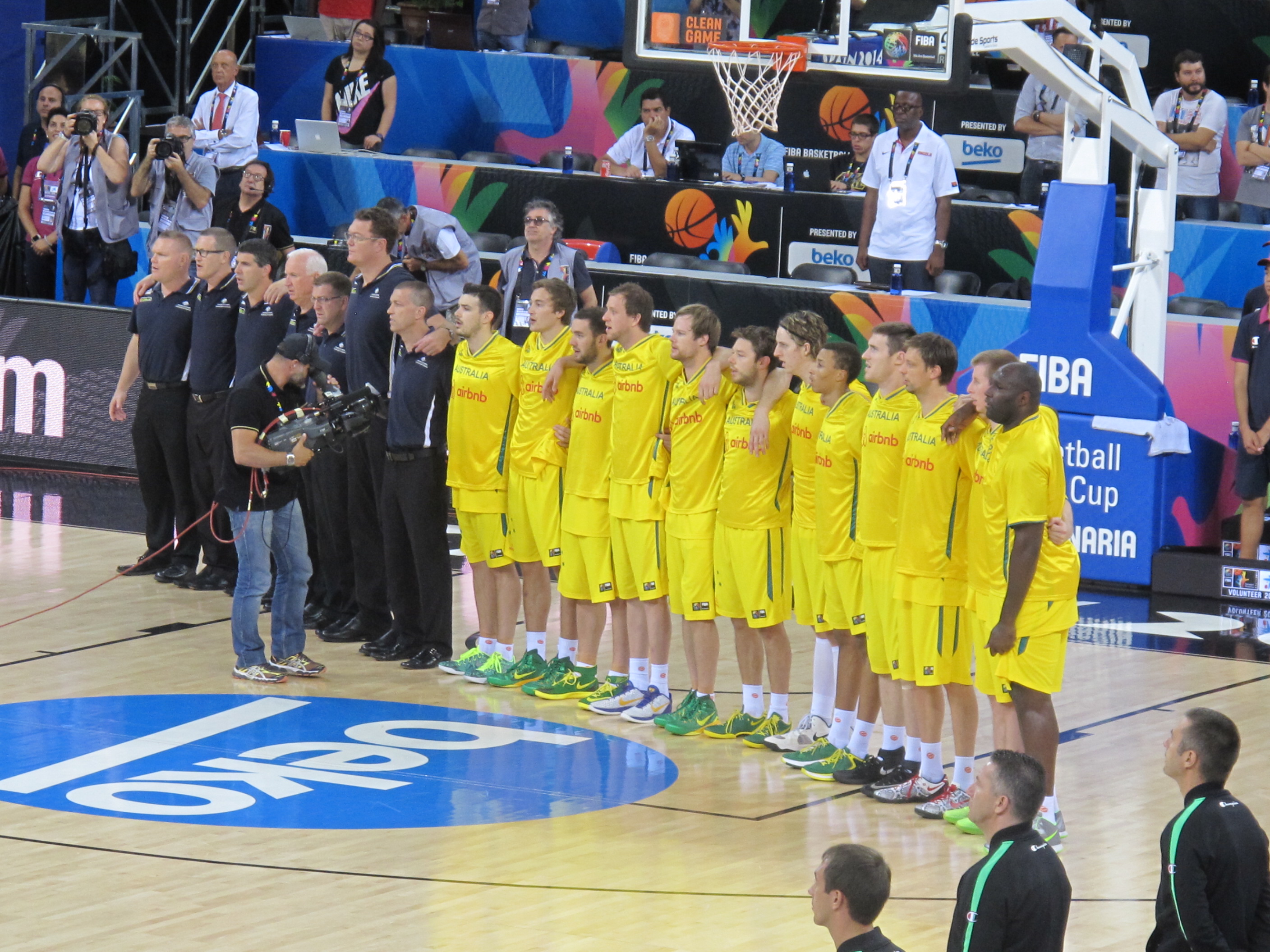
The Boomers qualified for the 2010 FIBA World Championship in Turkey and placed 10th overall. In 2011, Melbourne-born number one NBA draft pick Kyrie Irving considered declaring his international allegiance to Australia in order to compete in the 2012 Olympics, but eventually opted to wait for international selection for the United States.
Despite Irving declining the offer to represent his country of birth, the Boomers entered the 2012 London Olympic Games with arguably their most talented roster since 2000, though they were missing their star centre Andrew Bogut, who was out with a broken ankle. Australia made the quarter-finals with a 3–2 win–loss record, but gold medallists United States put the Boomers away late in the game, ending their run with a seventh-place finish again.
Following the London Olympics, Brett Brown announced his decision to step down as Boomers head coach, citing his desire to spend more time with his family in the United States. As of December 2012, Basketball Australia was yet to announce his replacement, although one of his assistants, dual National Basketball League championship winning coach with the New Zealand Breakers, Andrej Lemanis, was one of the favourites to win the job.
On 24 April 2013, Lemanis was announced as the new head coach of the Boomers.
By winning the 2013 FIBA Oceania Championship, Australia qualified for the 2014 FIBA Basketball World Cup in Spain. Australia was drawn into Group D, alongside Lithuania, Slovenia, Angola, Mexico, and South Korea. After suffering an opening round 90–80 loss to Slovenia, Australia bounced back, stringing together three consecutive wins over South Korea, Lithuania and Mexico, the first time in 16 years that Australia had won 3 consecutive matches at the FIBA World Cup. However, in their next match Australia suffered a 91–83 loss to Angola, which came despite leading by 15 points in the middle of the third quarter. This result, combined with Lithuania's 67–64 win over Slovenia, meant that Australia finished third in their group, qualifying for the knockout stage of the tournament.
Because Australia would finish third by losing, and that finishing third would benefit Australia more than finishing second, combined with the absences of fit key players Aron Baynes and Joe Ingles led to allegations that Australia deliberately lost their game against Angola in order to finish third in their group, and as a result, avoid the United States until the semi-finals, with Slovenian basketballer Goran Dragić posting "Basketball is a beautiful sport, there is no room for fixing the game like today Australia vs Angola!! @FIBA should do something about that!" on Twitter. However, these claims were denied by Boomers coach Andrej Lemanis. On 26 November 2014, Australia was cleared of tanking by FIBA.
Australia met World No. 7 Turkey in the knockout stage of the tournament. Australia suffered a 65–64 loss to Turkey, ending their World Cup campaign, meaning that for the 11th World Cup, Australia would return home empty handed.
Leading into the 2016 Rio Olympics, Australia saw a surge in locals being drafted into the NBA. Along with former number 1 NBA draft pick Andrew Bogut, Dante Exum was taken with the fifth pick in the 2014 NBA draft and Ben Simmons was selected with the first pick in the 2016 NBA draft, adding to already established Australian NBA players in Patty Mills, Matthew Dellavedova, Joe Ingles and Aron Baynes. Forward Thon Maker was also drafted with the 10th pick in the 2016 NBA draft. Despite Exum, Maker and Simmons electing not to compete in the 2016 Olympics, the Australians equaled their best ever performance by reaching the semifinals and losing their bronze medal playoff with Spain by one point.
2017: Move into Asian basketball
In August 2015, FIBA announced Australia would be joining the Asian basketball zone for future tournaments, starting with the 2017 FIBA Asia Cup. The Boomers were victorious in their inaugural Asia Cup appearance and turned their attention to 2019 FIBA World Cup qualifiers against Asian opposition. In July 2018, during the 3rd quarter of their game against the Philippines for the 2019 FIBA Basketball World Cup qualification (Asia), After physical unsportsmanlike hits by Australian player Goulding, Filipino player Roger Pogoy hit Chris Goulding with a hard foul causing teammate Daniel Kickert to retaliate with an elbow strike which sparked a full-scale brawl between the Australians and the Filipinos. Suspensions and fines were handed off to those involved including players from both teams, Filipino coaches and the referees for failing to control the game. After qualifying for the 2019 FIBA World Cup, Australia reached the semi-finals for the first time and finished the tournament in fourth place.
2020s: Olympic breakthrough and more NBA players
At the Tokyo 2020 Olympics, led by veterans Patty Mills and Joe Ingles, the Boomers managed to claim their first ever international medal, defeating a Luka Dončić led Slovenia, 107–93. Mills would score 42 points in the decisive match. The Boomers went through the group stage undefeated, and Mills would be named to the tournament All-Star 5. Additional Australian players were drafted into the NBA with first round draft picks including 2019 #20 pick Matisse Thybulle, 2020 #18 pick Josh Green, 2021 #6 pick Josh Giddey and 2022 #8 pick Dyson Daniels.
Competitive record
A red box around the year indicates tournaments played within Australia
Olympic Games
| Summer Olympic Games record | Year | Round | Position | Pld | W | L | Total | 0 Titles | 16/21 | 115 | 58 | 57 |
|---|---|---|---|---|---|---|---|---|---|---|---|---|
| GER 1936 | Did not participate | |||||||||||
| UK 1948 | ||||||||||||
| FIN 1952 | ||||||||||||
| AUS 1956 | Playoff | 12th | 7 | 2 | 5 | |||||||
| ITA 1960 | Did not participate | |||||||||||
| JPN 1964 | Playoff | 9th | 9 | 4 | 5 | |||||||
| MEX 1968 | Did not participate | |||||||||||
| GER 1972 | Playoff | 9th | 9 | 5 | 4 | |||||||
| CAN 1976 | Quarter-finals | 8th | 7 | 2 | 5 | |||||||
| URS 1980 | Quarter-finals | 8th | 7 | 5 | 2 | |||||||
| USA 1984 | Quarter-finals | 7th | 8 | 4 | 4 | |||||||
| KOR 1988 | Semi-finals | 4th | 8 | 4 | 4 | |||||||
| ESP 1992 | Quarter-finals | 6th | 8 | 4 | 4 | |||||||
| USA 1996 | Semi-finals | 4th | 8 | 5 | 3 | |||||||
| AUS 2000 | Semi-finals | 4th | 8 | 4 | 4 | |||||||
| GRE 2004 | Playoff | 9th | 6 | 2 | 4 | |||||||
| CHN 2008 | Quarter-finals | 7th | 6 | 3 | 3 | |||||||
| UK 2012 | Quarter-finals | 7th | 6 | 3 | 3 | |||||||
| BRA 2016 | Semi-finals | 4th | 8 | 5 | 3 | |||||||
| JPN 2020 | Semi-finals | 3rd | 6 | 5 | 1 | |||||||
| FRA 2024 | Quarter-finals | 6th | 4 | 1 | 3 |
FIBA World Cup
NB: This competition was known as the FIBA World Championship through the 2010 edition.
| FIBA World Cup record | Year | Round | Position | Pld | W | L | Total | 0 Titles | 13/19 | 93 | 44 | 49 |
|---|---|---|---|---|---|---|---|---|---|---|---|---|
| ARG 1950 | Did not participate | |||||||||||
| BRA 1954 | ||||||||||||
| CHI 1959 | ||||||||||||
| BRA 1963 | ||||||||||||
| URU 1967 | ||||||||||||
| YUG 1970 | Playoff | 12th | 8 | 1 | 7 | |||||||
| PUR 1974 | Playoff | 12th | 7 | 2 | 5 | |||||||
| PHI 1978 | Quarter-finals | 7th | 10 | 4 | 6 | |||||||
| COL 1982 | Quarter-finals | 5th | 8 | 4 | 4 | |||||||
| ESP 1986 | Playoff | 17th | 5 | 2 | 3 | |||||||
| ARG 1990 | Quarter-finals | 7th | 8 | 4 | 4 | |||||||
| CAN 1994 | Quarter-finals | 5th | 8 | 5 | 3 | |||||||
| GRE 1998 | Playoff | 9th | 8 | 5 | 3 | |||||||
| USA 2002 | Did not qualify | |||||||||||
| JPN 2006 | Playoff | 13th | 6 | 2 | 4 | |||||||
| TUR 2010 | Playoff | 10th | 6 | 3 | 3 | |||||||
| ESP 2014 | Round of 16 | 12th | 6 | 3 | 3 | |||||||
| CHN 2019 | Semi-finals | 4th | 8 | 6 | 2 | |||||||
| PHIJPNIDN 2023 | Second round | 10th | 5 | 3 | 2 | |||||||
| QAT 2027 | To be determined |
FIBA Asia Cup
| Year | Round | Position | Pld | W | L | Total | 3 Titles | 3/3 | 18 | 18 | 0 | |
|---|---|---|---|---|---|---|---|---|---|---|---|---|
| 1960–2015 | Not a FIBA Asia member | |||||||||||
| LBN 2017 | Champions | 1st | 6 | 6 | 0 | |||||||
| IDN 2022 | 6 | 6 | 0 | |||||||||
| KSA 2025 | 6 | 6 | 0 |
FIBA Oceania Championship
| FIBA Oceania Championship record | Year | Round | Position | Pld | W | L | Total | 19 Titles | 21/22 | 56 | 51 | 5 |
|---|---|---|---|---|---|---|---|---|---|---|---|---|
| NZL 1971 | Champions | 1st | 3 | 3 | 0 | |||||||
| AUS 1975 | Champions | 1st | 3 | 3 | 0 | |||||||
| NZL 1978 | Champions | 1st | 3 | 2 | 1 | |||||||
| AUS 1979 | Champions | 1st | 3 | 3 | 0 | |||||||
| NZL 1981 | Champions | 1st | 2 | 2 | 0 | |||||||
| NZL 1983 | Champions | 1st | 2 | 2 | 0 | |||||||
| AUS 1985 | Champions | 1st | 3 | 3 | 0 | |||||||
| NZL 1987 | Champions | 1st | 3 | 3 | 0 | |||||||
| AUS 1989 | Champions | 1st | 2 | 2 | 0 | |||||||
| NZL 1991 | Champions | 1st | 2 | 2 | 0 | |||||||
| NZL 1993 | Champions | 1st | 3 | 3 | 0 | |||||||
| AUS 1995 | Champions | 1st | 3 | 3 | 0 | |||||||
| NZL 1997 | Champions | 1st | 3 | 3 | 0 | |||||||
| NZL 1999 | Did not participate | |||||||||||
| NZL 2001 | Runner-up | 2nd | 3 | 1 | 2 | |||||||
| AUS 2003 | Champions | 1st | 3 | 3 | 0 | |||||||
| NZL 2005 | Champions | 1st | 3 | 3 | 0 | |||||||
| AUS 2007 | Champions | 1st | 3 | 2 | 1 | |||||||
| AUS NZL 2009 | Runner-up | 2nd | 2 | 1 | 1 | |||||||
| AUS 2011 | Champions | 1st | 3 | 3 | 0 | |||||||
| NZL AUS 2013 | Champions | 1st | 2 | 2 | 0 | |||||||
| AUS NZL 2015 | Champions | 1st | 2 | 2 | 0 |
FIBA Diamond Ball
| FIBA Diamond Ball record | Year | Round | Position | Pld | W | L | Total | 1 Title | 3/3 | 9 | 6 | 3 |
|---|---|---|---|---|---|---|---|---|---|---|---|---|
| Hong Kong 2000 | Champions | 1st | 3 | 3 | 0 | |||||||
| Serbia and Montenegro 2004 | Playoff | 5th | 3 | 1 | 2 | |||||||
| China 2008 | Runner-up | 2nd | 3 | 2 | 1 |
FIBA Stanković Cup
| FIBA Stanković Cup record | Year | Round | Position | Pld | W | L | Total | 1 Title | 5/7 | 20 | 12 | 8 |
|---|---|---|---|---|---|---|---|---|---|---|---|---|
| China 2005 | Third place | 3rd | 5 | 3 | 2 | |||||||
| China 2006 | Playoff | 6th | 3 | 0 | 3 | |||||||
| China 2007 | Did not participate | |||||||||||
| China 2008 | ||||||||||||
| China 2009 | Champions | 1st | 4 | 4 | 0 | |||||||
| China 2010 | Runner-up | 2nd | 4 | 3 | 1 | |||||||
| China 2011 | Runner-up | 2nd | 4 | 2 | 2 | |||||||
| China 2012 | Runner-up | 2nd | 4 | 1 | 3 |
Commonwealth Games
| Commonwealth Games record | Year | Round | Position | Pld | W | L | Total | 2 Titles | 2/2 | 10 | 10 | 0 |
|---|---|---|---|---|---|---|---|---|---|---|---|---|
| AUS 2006 | Champions | 1st | 5 | 5 | 0 | |||||||
| AUS 2018 | Champions | 1st | 5 | 5 | 0 |
General results
- Australia men's national basketball team 2011–12 results
- Australia men's national basketball team 2012–13 results
- Australia men's national basketball team 2013–14 results
- Australia men's national basketball team 2014–15 results
Team
Current roster
Roster for the 2025 FIBA Asia Cup.
- AUS Adam Caporn
- USA Garrett Jackson
- AUS David Patrick
- AUS Dean Vickerman
- (C) Team captain
- Club – describes last club before the tournament
- Age – describes age on 5 August 2025
Notable players
- David Andersen
- Chris Anstey
- Daniel Kickert
- Aron Baynes
- David Barlow
- Andris Blicavs
- Andrew Bogut
- Jonah Bolden
- Ray Borner
- Mark Bradtke
- Ryan Broekhoff
- C.J. Bruton
- Martin Cattalini
- Matthew Dellavedova
- Mark Dalton
- Brad Dalton
- Ian Davies
- John Dorge
- Frank Drmic
- Dante Exum
- Andrew Gaze
- Lindsay Gaze
- Adam Gibson
- Brian Goorjian
- Ricky Grace
- Josh Green
- Scott Fisher
- Shane Heal
- Adrian Hurley
- Joe Ingles
- Damian Keogh
- Leroy Loggins
- Luc Longley
- Brett Maher
- Thon Maker
- Aleks Marić
- Damian Martin
- Mangok Mathiang
- Mike McKay
- Sam Mackinnon
- Patrick Mills
- Danny Morseu
- Brad Newley
- Matthew Nielsen
- Eddie Palubinskas
- Darryl Pearce
- John Rillie
- Paul Rogers
- Tony Ronaldson
- Glen Saville
- Luke Schenscher
- Larry Sengstock
- Ben Simmons
- Jason Smith
- Phil Smyth
- Matisse Thybulle
- Andrew Vlahov
- Bill Wyatt
Head coach position
- AUS Lindsay Gaze – 1972–1984
- AUS Adrian Hurley – 1985–1993
- AUS Lindsay Gaze – 1994
- AUS Barry Barnes – 1995–2000
- AUS Phil Smyth – 2001
- USA Brian Goorjian – 2001–2008
- USA Brett Brown – 2009–2012
- AUS Andrej Lemanis – 2013–2019
- USA Brett Brown – 2019–2020 (did not lead the team in a game or a camp during second stint due to COVID-19 pandemic)
- USA Brian Goorjian – 2020–2024
- AUS Adam Caporn – 2025–present
References
References
- "Basketball Australia – Basketball Australia".
- "Lindsay Gaze Bio, Stats, and Results".
- (29 April 2016). "1987 Australian Boomers vs USSR basketball – part 1 of 7".
- (10 November 2016). "1992 NBL All star game – Boomers vs USA All Stars".
- Mac Fryz. (18 January 2016). "1996 Australian Boomers vs USA Dream Team III".
- (10 August 2016). "How close Australia really got to luring NBA superstar Kyrie Irving, as Boomers prepare for Team USA".
- "Brett Brown has quit as coach of the Australian men's bastketball team".
- "The Official Website of the SKYCITY Breakers – Together.Stronger".
- (24 April 2013). "Andrej Lemanis confirmed as Boomers coach". Stuff.
- "NBL – The National Basketball League –".
- "Boomers dispatch Mexico at World Cup". Herald Sun.
- (3 September 2014). "Australia claim third straight win at Basketball World Cup against Mexico". The Guardian.
- "Did the Australian Boomers 'tank' against Angola?". Aussie Hoopla.
- Media, Australian Community Media – Fairfax. (5 September 2014). "Boomers deny 'tank' accusation".
- Ward, Roy. (5 September 2014). "Boomers' World Cup loss to minnow Angola enables them to miss USA side of draw".
- Barton, Joe. (4 September 2014). "Boomers deny tanking after loss to Angola at world championships".
- (4 September 2014). "Australia's Boomers deny 'tanking' at Basketball World Cup". The Guardian.
- (5 September 2014). "Boomers accused of World Cup tank". The Australian.
- (4 September 2014). "Boomers' loss to Angola: 'Tournament strategy' or 'un-Australian'?".
- (26 November 2014). "Boomers cleared of tanking by FIBA". [[Australian Broadcasting Corporation]].
- "Australia cleared of tanking Angola match – Yahoo!7 Sport".
- "Basketball | SPORTAL".
- (26 November 2014). "FIBA clears Aussies of tanking at World Cup".
- Ward, Roy. (14 August 2015). "Boomers to move into Asia, play regular games as part of FIBA changes". The Sydney Morning Herald.
- (20 August 2017). "Australian Boomers claim first FIBA Asia Cup but no player makes all-star five".
- (3 July 2018). "Philippines v Australia basketball: Mass brawl at World Cup qualifier". BBC.
- (19 July 2018). "Players, coaches and referees banned after mass brawl in FIBA World Cup qualifier".
- (12 September 2019). "Patty Mills fires again as Australia reach maiden Basketball World Cup semi-final".
- "Slovenia v Australia boxscore – Tokyo 2020 Men's Olympic Basketball Tournament – 7 August – FIBA.basketball".
- "Five nations represented in the All-Star Five of the Men's Olympic Basketball Tournament – Tokyo 2020 Men's Olympic Basketball Tournament – FIBA.basketball".
- "Boomers confirm team for FIBA Asia Cup title defense".
- "Team roster: Australia".
- (13 October 2020). "Brett Brown quits Boomers before coaching a game". ABC News.
- (13 March 2025). "Adam Caporn to spearhead the next era of Boomers basketball". www.australia.basketball.
This article was imported from Wikipedia and is available under the Creative Commons Attribution-ShareAlike 4.0 License. Content has been adapted to SurfDoc format. Original contributors can be found on the article history page.
Ask Mako anything about Australia men's national basketball team — get instant answers, deeper analysis, and related topics.
Research with MakoFree with your Surf account
Create a free account to save articles, ask Mako questions, and organize your research.
Sign up freeThis content may have been generated or modified by AI. CloudSurf Software LLC is not responsible for the accuracy, completeness, or reliability of AI-generated content. Always verify important information from primary sources.
Report