From Surf Wiki (app.surf) — the open knowledge base
Aussurucq
_eglise_trinitaire,_façade.JPG)
| Field | Value |
|---|---|
| name | Aussurucq |
| commune status | Commune |
| image | Dolmen Ithe.jpg |
| caption | Dolmen in the Arbailles Forest |
| arrondissement | Oloron-Sainte-Marie |
| canton | Montagne Basque |
| INSEE | 64081 |
| postal code | 64130 |
| mayor | Jean-Marie Queheille |
| term | 2020–2026 |
| intercommunality | CA Pays Basque |
| coordinates | |
| elevation m | 209 |
| elevation min m | 191 |
| elevation max m | 1284 |
| area km2 | 47.12 |
| population | |
| population date | |
| population footnotes |
Aussurucq (; ) is a commune in the Pyrénées-Atlantiques department in the Nouvelle-Aquitaine region of south-western France.
The inhabitants are known as Altzürükütar.
_vieux_stèles_discoïdales.JPG)
Geography
Aussurucq is located in the former province of Soule in the Massif des Arbailles some 30 km west by south-west of Oloron-Sainte-Marie and 25 km east of Saint-Jean-Pied-de-Port. Access to the commune is by road D147 from Idaux-Mendy in the north which passes through the village and continues south through the commune to join the D117 on the southern border of the commune. A pastoral road from Béhorléguy to Alçay and Aussurucq passes through the Col d'Aphanize (without crossing it) and generally follows the line of the watershed along the Col de Burdin Olatzé. The commune is mostly rugged and heavily forested however there is some farmland in the north.
The Ruisseau de Guessalia rises in the south of the commune and flows north-east gathering some tributaries to join the Apouhoura north of the commune. The Arangorena forms the north-western border as it flows north-east to join the Saison near Gotein-Libarrenx. The Bidouze rises in the south of the commune and flows north to eventually join the Adour north of Bardos.
Places and Hamlets
- Abeheaborda
- Ahancetaborda
- Ahanzolha
- Ahusquy: known for its spring of the same name
- Althabéa (ruins)
- Althabegoïty
- Ambukoborda
- Ardiaénéa
- Ascune (rocks)
- Athekaketa
- Bagadoy
- Barnexborda
- Baskinabe
- Behegayborda
- Beherégaray (barns)
- Burdin-Clatze (col)
- Capara (barn)
- Carriquiborda
- Chalunia
- Cumba
- Elsareko Ordokia
- Erbinia (cayolar)
- Etchakokoua
- Etchaltia (rocks)
- Etchebidea
- Etchecopar
- Etchekolaz
- Exaltia (cayolar)
- Gettaborda
- Goyheneix
- Guessalia
- Harribiribile
- Hasgagnia
- Haspia (rocks)
- Héguilloré (cayolar)
- Hidogaratia (col)
- Hidondo
- Ibarrondoa
- Ihatia
- Inharpu (col)
- Istaurdy (cayolar)
- Jaguiborda
- Jaragoyhen
- Karkatz
- Lagay
- Lapistoy
- Lapitz (field)
- Larraguy
- Larramendy
- Latchéra
- Lecharegaratia (cayolar)
- Lecharéguibela (cayolar)
- Leycharzepia (fountain)
- Lhastéria
- Lohiolha
- Lucugnébehety (cayolar)
- Miadore (cayolar)
- Mouchako
- Naboleguy (cayolar)
- Nébélé (fountain)
- Nékolha
- Olhatzezarre (cayolar)
- Otxolatzé (fontaine)
- Potcho (cayolars)
- Sallaberria
- Sorzauqui (col)
- Souhourtia (cayolar)
- Thartassu
- Udoya (cayolar)
- Uhalberryborda
- Uhaldéa
- Uhaltéberria
- Uhartéa
- Urrutchoya
- Urrutia (château)
- Uthurbietta (fountain)
- Uthurieta (cayolar)
- Zouhourtia
Toponymy
The commune name in basque is Altzürükü.
Jean-Baptiste Orpustan indicated that the name comes from the basque altzu ("alder tree") which is explained by the position of the valley covered in alder trees. The second part of the name is more enigmatic. According to Orpustan it could be from Urru ("the other side") or iri giving alzu-(i) ri-ku meaning "place in the Alder field".
The following table details the origins of the commune name and other names in the commune.
| Name | Spelling | Date | Source | Page | Origin | Description |
|---|---|---|---|---|---|---|
| Aussurucq | Auçuruc | 1189 | Orpustan | Village | ||
| Auzuruc | 1337 | Orpustan | ||||
| Aussuruc | 1385 | Raymond | Duchesne | |||
| Aussuruc | 1412 | Raymond | Notaries | |||
| Ausuruc | 1454 | Raymond | Not stated | |||
| Sent-Martin d'Auçuruc, Auserucus | 1471 | Raymond | Chapter | |||
| Ausuruc | 1520 | Orpustan | ||||
| Dassurucq | 1690 | Orpustan | ||||
| Ausuruc | 1690 | Orpustan | ||||
| Aussurucq | 1690 | Orpustan | ||||
| La fontaine d'Ahusquy | La fontaine d'Ahusquy | 1863 | Raymond | Fountain | ||
| Arabéhère | Arabéhère | 1520 | Raymond | Soule | Farm | |
| Aran | Aran | 1520 | Raymond | Soule | Farm | |
| Arhanset | Arhanset | 1520 | Raymond | Soule | Farm | |
| Ariadar | Ariadar | 1520 | Raymond | Soule | Farm | |
| Arsusqui | Arsusqui | 1520 | Raymond | Soule | Farm | |
| Béherégaray | Béherégaray | 1520 | Raymond | Soule | Farm | |
| Carrica | Carrica | 1520 | Raymond | Soule | Farm | |
| Carricart | Carricart | 1520 | Raymond | Soule | Farm | |
| Carriquiri | Carriquiri | 1520 | Raymond | Soule | Farm (possibly the current Carriquiborda Farm) | |
| Goyen | Goyen | 1520 | Raymond | Soule | Farm | |
| Goyti | Goyti | 1520 | Raymond | Soule | Farm | |
| Iribarne | Iribarne | 1520 | Raymond | Soule | Farm | |
| Lapistoy | Lapitztoy | 1520 | Raymond | Soule | Farm | |
| Mendiburu | Mendiburu | 1520 | Raymond | Soule | Farm | |
| Nécol | Nécol | 1520 | Raymond | Soule | Farm (possibly the current Nékolha Farm) | |
| Sagarspe | Sagarspe | 1520 | Raymond | Soule | Farm | |
| Urruchoro | Urruchoro | 1520 | Raymond | Soule | Farm | |
| Burunolatxé | Burunolatxé | 1863 | Raymond | A Col between Alçay-Alçabéhéty-Sunharette and Aussurucq | ||
| Escuné | Escuné | 1863 | Raymond | Forest |
Sources:
- Orpustan: Jean-Baptiste Orpustan, New Basque Toponymy
- Raymond: Topographic Dictionary of the Department of Basses-Pyrenees, 1863, on the page numbers indicated in the table.
Origins:
- Duchesne: Duchesne collection volume CXIV
- Notaries: Notaries of Navarrenx
- Chapter: Titles of the Chapter of Bayonne
- Soule: Customs of Soule
History
In the Middle Palaeolithic era Soule was already populated as remains of Neanderthal prehistoric man have been found in the Xaxixiloaga caves in Aussurucq. A tumulus was also reported at shepherd's cabins in Potxo along the D147 road.
The central part of Soule is also called the Messagerie des Arbailles between Basabürü and Pettarra (in the Sauguis-Saint-Étienne, Aussurucq, and Barcus regions).
Administration
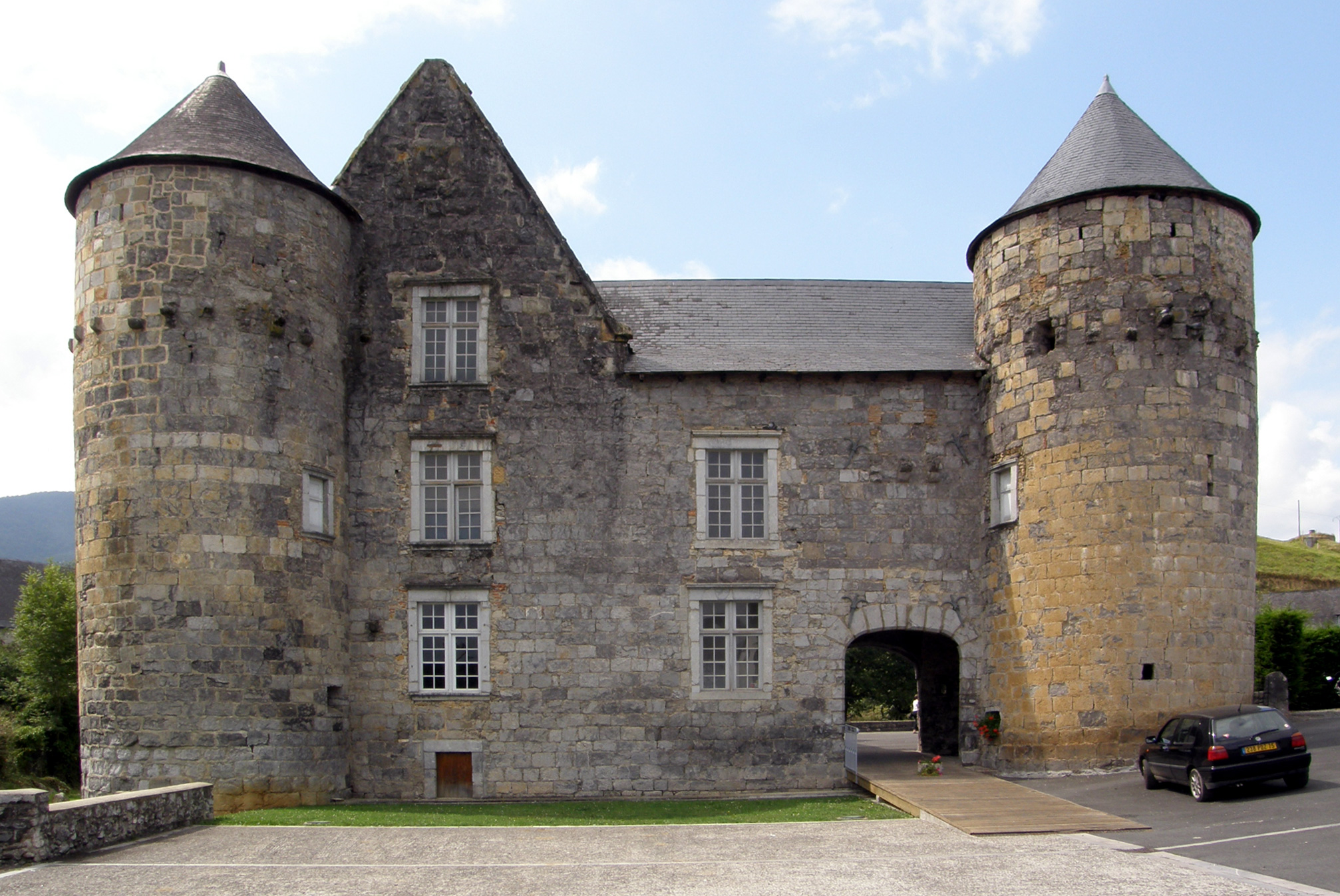
_La_mairie_dans_le_château,_coté_cour.JPG)

List of Successive Mayors
| From | To | Name |
|---|---|---|
| 1983 | 1989 | Jean Etchebarne |
| 1989 | 2008 | Jean-Baptiste Queheille |
| 2008 | 2020 | Jean Carricaburu |
| 2020 | 2026 | Jean-Marie Queheille |
Inter-communality
The commune is part of six inter-communal structures:
- the Communauté d'agglomération du Pays Basque;
- the sanitation association for Pays du Soule;
- the Energy association of Pyrénées-Atlantiques;
- the inter-communal association of Arbailla;
- the inter-communal association for transport from Musculdy to Ordiap;
- the inter-communal association to support Basque culture.
Demography
In 2017 the commune had 245 inhabitants.
| graph-pos = bottom |1793 |596 |1800 |574 |1806 |637 |1821 |700 |1831 |711 |1836 |632 |1841 |701 |1846 |740 |1851 |716 |1856 |662 |1861 |660 |1866 |640 |1872 |643 |1876 |640 |1881 |604 |1886 |570 |1891 |564 |1896 |570 |1901 |523 |1906 |512 |1911 |518 |1921 |472 |1926 |502 |1931 |459 |1936 |437 |1946 |432 |1954 |401 |1962 |379 |1968 |347 |1975 |289 |1982 |293 |1990 |274 |1999 |254 |2007 |254 |2012 |249 |2017 |245
Economy
Economic activity is based on agriculture (livestock and pasture). The commune is part of the Appellation d'origine contrôlée (AOC) zone of Ossau-iraty.
Culture and Heritage
The village features a dynamic scene related especially to Basque culture. The inhabitants of the village performed the pastoral Ürrüti Jauregiko Peirot in 2002, a play written by the son of the village Niko Etxart, an acclaimed Basque musician.
Civil heritage
- The Chateau of Ruthie (11th century) is registered as an historical monument.
- A Gaztelu Zahar (Castellum) is at a place called gaztelu at an altitude of 582 metres.
Religious heritage

The town has a church with a Trinitarian steeple or a tower surmounted by three points of nearly equal height. The church contains a processional cross (17th century) which is registered as an historical object.
Environmental heritage
At the end of the 19th century, the Arbailles Forest covered parts of the communes of Aussurucq, Béhorléguy, Camou-Cihigue, Musculdy, Ordiarp, and Saint-Just-Ibarre.
A wealth of heritage in Aussurucq commune is contained in its sub-soil. Most of the territory of the commune is karstic. The environment is characterized by the presence of natural cavities in complex shapes that have not all yet been discovered or much less explored to date. Departmental cavers have undertaken the exploration, description, and publication of this heritage respecting the environment and the local population. One of the most beautiful caves in the commune is the Nébélé which has been the subject of works and regular explorations since 1972.
The peak of Ascune stands at 860 m, Echagorry is 935 m, Elsarré is 1,153 m, Sihigue is 1,193 m, and Etchecortia is 1,204 m. In the south-west of the commune, Bohorcortia is 1,214 metres high.
Amenities
The town has a primary school (Garaibie).
Notable people linked to the commune
- Pierre V de Charritte de Ruthie, born in Aussurucq, was chaplain to François I.
- Gilen Epherre, born at Aussurucq in 1911 and died in Bayonne in 1974, was a writer, priest, scholar and important cultural player in the post-war period
References
References
- (2 December 2020). "Répertoire national des élus: les maires".
- eu
- [https://www.google.com/maps/place/Aussurucq/@43.1256245,-0.9691932,13279m/data=!3m1!1e3!4m2!3m1!1s0xd5720431cf5c2d5:0x15594f755c88d3a3?hl=en Google Maps]
- IGN]] {{in lang. fr
- Jean-Baptiste Orpustan, ''New Basque Toponymy'', Presses universitaires de Bordeaux, 2006, {{ISBN. 2 86781 396 4 {{in lang. fr
- Paul Raymond]], Imprimerie nationale, 1863, Digitised from Lyon Public Library 15 June 2011 {{in lang. fr
- Duchesne Collection, volumes 99 to 114, containing the papers of Oihenart, former Imperial Librarian - [[Bibliothèque nationale de France]]
- Departmental Archives of Pyrénées-Atlantiques {{in lang. fr
- Chapter of Bayonne in the Departmental Archives of Pyrénées-Atlantiques {{in lang. fr
- Customs of [[Soule (province). Soule]] in 1520, printed at [[Pau, Pyrénées-Atlantiques. Pau]] in 1760 {{in lang. fr
- The duty of the ''messenger'' of the royal procurer was the surveillance of a defined geographic zone - [[Paul Raymond (archivist). Paul Raymond]], ''Topographic Dictionary of Béarn-basque country'' {{in lang. fr
- fr
- {{Cassini-Ehess. 1943. Aussurucq
- [https://www.insee.fr/fr/statistiques/4515315?geo=COM-64081#ancre-POP_T1 Population en historique depuis 1968], INSEE
- Ministry of Culture, Mérimée {{Mérimée. PA00084327. PA00084327 Chateau of Ruthie {{in lang. fr
- Philippe Veyrin, ''The Basques'', p. 241, Arthaud, 20 December 1975 {{in lang. fr
- Ministry of Culture, Palissy {{Palissy. PM64000061. PM64000061 Processional Cross {{in lang. fr
- Claude de Vic, [[Joseph Vaissète]], and Alexandre Du Mège, ''General History of Languedoc: with notes and justification pieces'', J.B. Paya, 1841 {{in lang. fr
This article was imported from Wikipedia and is available under the Creative Commons Attribution-ShareAlike 4.0 License. Content has been adapted to SurfDoc format. Original contributors can be found on the article history page.
Ask Mako anything about Aussurucq — get instant answers, deeper analysis, and related topics.
Research with MakoFree with your Surf account
Create a free account to save articles, ask Mako questions, and organize your research.
Sign up freeThis content may have been generated or modified by AI. CloudSurf Software LLC is not responsible for the accuracy, completeness, or reliability of AI-generated content. Always verify important information from primary sources.
Report