From Surf Wiki (app.surf) — the open knowledge base
Aunt Jemima
Former brand of breakfast foods

Former brand of breakfast foods
| Field | Value | |
|---|---|---|
| name | Aunt Jemima | |
| logo | Aunt Jemima logo (red).png | |
| logo_size | 200 | |
| image | Aunt Jemima Flour.jpg | |
| image_size | 200 | |
| caption | Aunt Jemima flour pack | |
| producttype | Pancake mix | |
| Table syrup | ||
| country | United States | |
| introduced | 1888 | |
| discontinued | ||
| previousowners | {{plainlist | |
| module | ||
| module1 |
the food products brand formerly known as Aunt Jemima
Table syrup
- Pearl Milling Company (1888–1926)
- Quaker Oats Company (1926–2001)
- PepsiCo (2001–21)
Aunt Jemima is a discontinued American breakfast brand for pancake mix, table syrup, and other breakfast food products. The brand was retired in 2021 and is now sold under the name Pearl Milling Company. The original version of the pancake mix was developed in 1888–1889 by the Pearl Milling Company and was advertised as the first "ready-mix" cooking product.
Aunt Jemima was modeled after, and has been a famous example of, the "Mammy" archetype in the Southern United States. Due to the "Mammy" stereotype's historical ties to the Jim Crow era, Quaker Oats announced in June 2020 that the Aunt Jemima brand would be discontinued "to make progress toward racial equality", leading to the Aunt Jemima image being removed by the fourth quarter of 2020.
In June 2021, amidst heightened racial unrest in the United States, the Aunt Jemima brand name was discontinued by its current owner, PepsiCo, with all products rebranded to Pearl Milling Company, the name of the company that produced the original pancake mix product. The Aunt Jemima name remains in use in the brand's tagline, "Same great taste as Aunt Jemima."
Nancy Green portrayed the Aunt Jemima character at the 1893 World's Columbian Exposition in Chicago and was one of the first Black corporate models in the United States.
History
Main article: Pearl Milling Company
In 1888, St. Joseph Gazette editor Chris L. Rutt and his friend Charles G. Underwood bought a small flour mill at 214 North 2nd St. in St. Joseph, Missouri. Rutt and Underwood's "Pearl Milling Company" produced a range of milled products (such as wheat flour and cornmeal) using a pearl milling process. Facing a glutted flour market, after a year of experimentation they began selling their excess flour in paper bags with the generic label "Self-Rising Pancake Flour" (later dubbed "the first ready-mix").
Branding and trademark
To distinguish their pancake mix, in late 1889 Rutt appropriated the Aunt Jemima name and image from lithographed posters seen at a vaudeville house in St. Joseph, Missouri. At the 1893 World's Columbian Exposition in Chicago, the company set up a pancake-cooking display next to the "world's largest flour barrel" (twenty-four feet high). Nancy Green, a former slave from Montgomery County, Kentucky, portrayed the character and cooked pancakes, sang songs, and promoted the product.
In 1915, the well-known Aunt Jemima brand was the basis for a trademark law ruling that set a new precedent. Previously, United States trademark law had protected against infringement by other sellers of the same product, but under the "Aunt Jemima Doctrine", the seller of pancake mix was also protected against infringement by an unrelated seller of a different but related product—pancake syrup. Aunt Jemima became one of the longest continually running logos and trademarks in the history of American advertising.
Logo
The earliest advertising was based upon a vaudeville parody, and it remained a caricature for many years.
Quaker Oats commissioned Haddon Sundblom, a nationally known commercial artist, to paint a portrait of an obese actress named Anna Robinson, and the Aunt Jemima package was redesigned around the new likeness.
James J. Jaffee, a freelance artist from the Bronx, New York, also designed one of the images of Aunt Jemima used by Quaker Oats to market the product into the mid-20th century.
Just as the formula for the mix changed several times over the years, so did the Aunt Jemima image. In 1968, the face of Aunt Jemima became a composited creation. She was slimmed down from her previous appearance, depicting a more "svelte" look, wearing a white collar and a geometric print "headband" still resembling her previous kerchief.
In 1989, marking the 100th anniversary of the brand, her image was again updated, with all head-covering removed, revealing wavy, gray-streaked hair, gold-trimmed pearl earrings, and replacing her plain white collar with lace. At the time, the revised image was described as a move towards a more "sophisticated" depiction, with Quaker marketing the change as giving her "a more contemporary look" which remained on the products until early 2021.
Rebranding of 2020–2021
On June 17, 2020, Quaker Oats announced that the Aunt Jemima brand would be discontinued and replaced with a new name and image "to make progress toward racial equality". The image was removed from packaging in fall 2020, while the name change was said to be planned for a later date.
Within one day of the June 2020 announcement, other similarly motivated rebrandings and reviews of brand marketing were also announced, including for Uncle Ben's rice (which was renamed Ben's Original), the Mrs. Butterworth's pancake syrup brand and bottle shape, and the "Rastus" Black chef logo used by Cream of Wheat.
Descendants of Aunt Jemima models Lillian Richard and Anna Short Harrington objected to the change. Vera Harris, a family historian for Richard's family, said "I wish we would take a breath and not just get rid of everything. Because good or bad, it is our history." Harris further stated "Erasing my Aunt Lillian Richard would erase a part of history." Harrington's great-grandson Larnell Evans said "This is an injustice for me and my family. This is part of my history." Evans had previously lost a lawsuit against Quaker Oats (and others) for billions of dollars in 2015.
On February 9, 2021, PepsiCo announced that the replacement brand name would be Pearl Milling Company. PepsiCo purchased that brand name for that purpose on February 1, 2021. The new branding was launched that June, one year after the company announced they would drop Aunt Jemima branding. PepsiCo referenced the Aunt Jemima brand by logotype on the front of the packaging for at least six months after the rebrand. Following that period, PepsiCo said it wouldn't be able to completely and permanently abandon the Aunt Jemima brand due to trademark law; if it did, a third party could obtain and use the brand.
Character of Aunt Jemima
Aunt Jemima is based on the common enslaved "Mammy" archetype, a plump black woman wearing a headscarf who is a devoted and submissive servant.
The terms "aunt" and "uncle" in this context were a Southern form of address used with older enslaved peoples. They were denied use of English honorifics, such as "mistress" and "mister" respectively.
A British image in the Library of Congress, which may have been created as early as 1847, shows a smiling black woman named "Miss Jim-Ima Crow", with a framed image of "James Crow" on the wall behind her. A character named "Aunt Jemima" appeared on the stage in Washington, D.C., as early as 1864. Rutt's inspiration for Aunt Jemima was Billy Kersands' American-style minstrelsy/vaudeville song "Old Aunt Jemima", written in 1875. Rutt reportedly saw a minstrel show featuring the "Old Aunt Jemima" song in the fall of 1889, presented by blackface performers identified by Arthur F. Marquette as "Baker & Farrell". Marquette recounts that the actor playing Aunt Jemima wore an apron and kerchief.
However, Doris Witt at University of Iowa was unable to confirm Marquette's account. Witt suggests that Rutt might have witnessed a performance by the vaudeville performer Pete F. Baker, who played characters described in newspapers of that era as "Ludwig" and "Aunt Jemima". His portrayal of the Aunt Jemima character may have been a white male in blackface, pretending to be a German immigrant, imitating a black minstrel parodying an imaginary black female enslaved cook.
Advertising
Marketing materials for the line of products centered around the "Mammy" archetype, including the slogan first used at the 1893 World's Columbian Exposition in Chicago, Illinois: "I's in Town, Honey".
At that World's Fair, and for decades afterward, Jemima was said to use a secret recipe "from the South before the Civil War", with their "matchless plantation flavor", to make the best pancakes in Dixie. Another story described her as diverting Union soldiers during the Civil War with her pancakes long enough for Colonel Higbee to escape. She was said to have revived a group of shipwrecked survivors with her flapjacks.
Beginning in 1894, the company added an Aunt Jemima paper doll family that could be cut out from the pancake box. Aunt Jemima is joined by her husband, Uncle Rastus (later renamed Uncle Mose to avoid confusion with the Cream of Wheat character, while Uncle Mose was first introduced as the plantation butler). Their children, described as "comical pickaninnies": Abraham Lincoln, Dilsie, Zeb, and Dinah. The paper doll family was posed dancing barefoot, dressed in tattered clothing, and the box was labeled "Before the Receipt was sold". (Receipt is an archaic rural form of recipe.) Buying another box with elegant clothing cut-outs to fit over the dolls, the customer could transform them "After the Receipt was sold". This placed them in the Horatio Alger rags-to-riches American cultural mythos.
Rag doll versions were offered as a premium in 1909: "Aunt Jemima Pancake Flour / Pica ninny Doll / The Davis Milling Company". Early versions were portrayed as poor people with patches on their trousers, large mouths, and missing teeth. The children's names were changed to Diana and Wade. Over time, there were improvements in appearance. Oil-cloth versions were available circa the 1950s, with cartoonish features, round eyes, and watermelon mouths.
A typical magazine ad from the turn of the century created by advertising executive James Webb Young, and the illustrator N.C. Wyeth, shows a heavyset black cook talking happily while a white man takes notes. The ad copy says, "After the Civil War, after her master's death, Aunt Jemima was finally persuaded to sell her famous pancake recipe to the representative of a northern milling company."
However, the Davis Milling Company was not located in a northern state. Missouri in the American Civil War was a hotly contested border state. In reality, she never existed, created by marketers to better sell products.
Controversy
_(14598409868).jpg)
Although the Aunt Jemima character was not created until nearly 25 years after the American Civil War, the clothing, dancing, enslaved dialect, and singing old plantation songs as she worked, all harkened back to a glorified view of antebellum Southern plantation life as a "happy slave" narrative. The marketing legend surrounding Aunt Jemima's successful commercialization of her "secret recipe" contributed to the post-Civil War nostalgia and romanticism of Southern life in service of America's developing consumer culture—especially in the context of selling kitchen items.
African American women formed the Women's Columbian Association and the Women's Columbian Auxiliary Association to address the exclusion of African Americans from the 1893 World's Fair exhibitions, asking that the fair reflect the success of post-Emancipation African Americans. Instead, the Fair included a miniature West African village whose natives were portrayed as primitive savages. Ida B. Wells was incensed by the exclusion of African Americans from mainstream fair activities; the so-called "Negro Day" was a picnic held off-site from the fairgrounds.
Black scholars Hallie Quinn Brown, Anna Julia Cooper, and Fannie Barrier Williams used the World's Fair as an opportunity to address how African American women were being exploited by white men. In her book A Voice from the South (1892), Cooper had noted the fascination with "Southern influence, Southern ideas, and Southern ideals" had "dictated to and domineered over the brain and sinew of this nation".
These educated progressive women saw "a mammy for the national household" represented at the World's Fair by Aunt Jemima. This directly relates to the belief that slavery cultivated innate qualities in African Americans. The notion that African Americans were natural servants reinforced a racist ideology renouncing the reality of African American intellect.
Aunt Jemima embodied a post-Reconstruction fantasy of idealized domesticity, inspired by "happy slave" hospitality, and revealed a deep need to redeem the antebellum South. There were others that capitalized on this theme, such as Uncle Ben's Rice and Cream of Wheat's Rastus.
Slang
The term "Aunt Jemima" is sometimes used colloquially as a female version of the derogatory epithet "Uncle Tom" or "Rastus". In this context, the slang term "Aunt Jemima" falls within the "mammy archetype" and refers to a friendly black woman who is perceived as obsequiously servile or acting in, or protective of, the interests of whites. Cassell's Dictionary of Slang, Jonathon Green, Cassell, March 1999, , p. 36.
John Sylvester of WTDY-AM drew criticism after calling Condoleezza Rice an "Aunt Jemima" and Colin Powell an "Uncle Tom", referring to remarks by singer and civil rights activist Harry Belafonte about their alleged subservience in the George W. Bush administration. He apologized by giving away Aunt Jemima's pancake mix and syrup.
Barry Presgraves, then 77-year-old Mayor of Luray, Virginia, was censured 5-to-1 by the town council because he referred to Kamala Harris as "Aunt Jemima" after she was selected by Joe Biden to be the Democratic Party vice presidential candidate.
Performers of Aunt Jemima
The African American Registry of the United States suggests Nancy Green and others who played the caricature of Aunt Jemima
Following Green's work as Aunt Jemima, very few were well known. Advertising agencies (such as J. Walter Thompson, Lord and Thomas, and others) hired dozens of actors to portray the role, often assigned regionally, as the first organized sales promotion campaign.
Quaker Oats ended local appearances for Aunt Jemima in 1965.
Nancy Green
Main article: Nancy Green
Nancy Green was the first spokesperson hired by the R. T. Davis Milling Company for the Aunt Jemima pancake mix. Dressed as Aunt Jemima, Green appeared at the 1893 World's Columbian Exposition in Chicago, beside the "world's largest flour barrel" (24 feet high), where she operated a pancake-cooking display, sang songs, and told romanticized stories about the Old South (a happy place for blacks and whites alike). She appeared at fairs, festivals, flea markets, food shows, and local grocery stores, her arrival heralded by large billboards featuring the caption, "I'se in town, honey."
Green refused to cross the Atlantic Ocean for the 1900 Paris exhibition. She was replaced by Agnes Moody. Green died in 1923 and was buried in an unmarked pauper's grave in Chicago's Oak Woods Cemetery. A headstone was placed on September 5, 2020.
Agnes Moody
60-year-old Agnes Moody first performed as Aunt Jemima at the 1900 Paris exhibition, and was erroneously reported as the original Aunt Jemima. She had become well known in the Chicago area for her cornmeal bread and cakes. She died April 9, 1903.
Lillian Richard
Main article: Lillian Richard

Lillian Richard was hired to portray Aunt Jemima in 1925, and remained in the role for 23 years. Richard was born in 1891, and grew up in the tiny community of Fouke 7 miles west of Hawkins in Wood County, Texas. In 1910, she moved to Dallas, working initially as a cook. Her job "pitching pancakes" was based in Paris, Texas.
Hawkins, Texas, east of Mineola, is known as the "Pancake Capital of Texas" because of longtime resident Lillian Richard. The local chamber of commerce decided to use Hawkins' connection to Aunt Jemima to boost tourism. In 1995, State Senator David Cain introduced Senate Resolution No. 73 designating Hawkins as the "Pancake Capital of Texas", which was passed into law; the measure was spearheaded by Lillian's niece, Jewell Richard-McCalla.
Artie Belle McGinty
Main article: Artie Belle McGinty
In 1927, Artie Belle McGinty debuted as the original radio advertisement voice for Aunt Jemima.
Anna Robinson
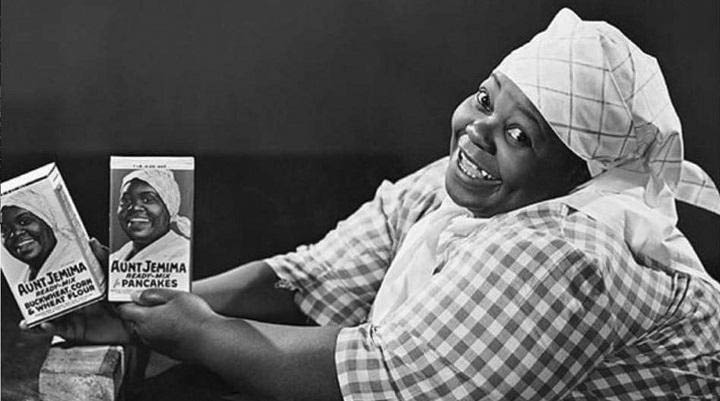
Anna Robinson was hired to play Aunt Jemima at the 1933 Century of Progress Chicago World's Fair. She was sent to New York City by Lord and Thomas to have her picture taken. A 1967 company history commemorated this journey as "the day they loaded 350 pounds of Anna Robinson on the Twentieth Century Limited."
She appeared at prestigious establishments frequented by the rich and famous, such as El Morocco, the Stork Club, "21", and the Waldorf-Astoria. Photos show Robinson making pancakes for celebrities and stars of Broadway, radio, and motion pictures. They were used in advertising "ranked among the highest read of their time". The Aunt Jemima packaging was redesigned in her likeness.
Robinson reportedly worked for the company until her death in 1951; however, The same claim was made for Anna Short Harrington, yet according to the 1940 census, she rented an apartment in a four-flat in Washington Park with her daughter, son-in-law, and two grandchildren.
Rosa Washington Riles
Rosa Washington Riles became the third face on Aunt Jemima packaging in the 1930s, and continued until 1948. Rosa Washington was born in 1901 near Red Oak in Brown County, Ohio, one of several children of Robert and Julie (Holliday) Washington and a granddaughter of George and Phoeba Washington. She was employed as a cook in the home of a Quaker Oats executive and began pancake demonstrations at her employer's request. She died in 1969, and is buried near her parents and grandparents in the historic Red Oak Presbyterian Church cemetery of Ripley, Ohio.
Anna Short Harrington
Main article: Anna Short Harrington
Anna Short Harrington began her career as Aunt Jemima in 1935 and continued to play the role until 1954. She was born in 1897 in Marlboro County, South Carolina. The Short family lived on the Pegues Place plantation as sharecroppers. In 1927, she moved to Syracuse, New York. Quaker Oats discovered her cooking pancakes at the 1935 New York State Fair. Harrington died in Syracuse in 1955.
Edith Wilson
Main article: Edith Wilson (singer)
Edith Wilson was the face and voice of Aunt Jemima on radio, television, and in personal appearances, from 1948 to 1966. She was the first Aunt Jemima to appear in television commercials. Born in 1896 in Louisville, Kentucky, Wilson was a classic blues singer and actress in Chicago, New York, and London. She appeared on radio in The Great Gildersleeve, on radio and television in Amos 'n' Andy, and on film in To Have and Have Not (1944). Wilson died in Chicago on March 31, 1981.
Ethel Ernestine Harper
Main article: Ethel Ernestine Harper
Ethel Ernestine Harper portrayed Aunt Jemima during the 1950s. After graduating from college at the age of 17, she taught elementary school for 2 years and high school mathematics for 10 years. She then moved to New York City, where she performed in The Hot Mikado in 1939. She also appeared in Harlem Cavalcade in 1942 and toured Europe during and after World War II as one of the Ginger Snaps. Harper, who was the last individual model for the character's logo,
Rosie Lee Moore Hall
Rosie Lee Moore Hall, the last "living" Aunt Jemima, was born in Robertson County, Texas on June 22, 1899. She was working in the Quaker Oats' advertising department in Oklahoma when she answered their search for a new Aunt Jemima. Hall portrayed Aunt Jemima from 1950 until her death (on her way to church) from a heart attack on February 12, 1967. She was buried in the family plot in the Colony Cemetery near Wheelock, Texas. On May 7, 1988, her grave was declared a historical landmark.
Aylene Lewis
Aylene Lewis portrayed Aunt Jemima at the Disneyland Aunt Jemima's Pancake House, a popular eating place at the park on New Orleans Street in Frontierland, from 1957 until her death in 1964. Lewis became well known posing for pictures with visitors and serving pancakes to dignitaries, such as Indian prime minister Jawaharlal Nehru. She also developed a close relationship with Walt Disney.
In popular culture
Aunt Jemima has been featured in various formats and settings throughout popular culture. Aunt Jemima has been a present image identifiable by popular culture for well over a century, dating back to Nancy Green's appearance at the 1893 World Fair in Chicago, Illinois.
Aunt Jemima, a minstrel-type variety radio program, was broadcast January 17, 1929 – June 5, 1953, at times on CBS and at other times on the Blue Network. The program had several hiatuses during its time on the air.
The 1933 novel Imitation of Life by Fannie Hurst features an Aunt Jemima-type character, Delilah, a maid struggling in life with her widowed employer, Bea. Their fortunes change dramatically when Bea capitalizes on Delilah's family pancake recipe by opening a restaurant that attracts tourists at the Jersey Shore. It becomes a great success and is eventually packaged and sold as “Aunt Delilah's Pancake Mix”, packaged with an image of Delilah on the box dressed as an Aunt Jemima. The 1934 film version, Imitation of Life, retains this part of the plot, but it was excised from the 1959 remake, Imitation of Life.
In the 1960s, Betye Saar began collecting images of Aunt Jemima, Uncle Tom, Little Black Sambo, and other stereotyped African-American figures from folk culture and advertising of the Jim Crow era. She incorporated them into collages and assemblages, transforming them into statements of political and social protest. The Liberation of Aunt Jemima is one of her most notable works from this era. In this mixed-media assemblage, Saar utilized the stereotypical mammy figure of Aunt Jemima to subvert traditional notions of race and gender.
"Aunt Jemima's Kitchen"—named Aunt Jemima's Pancake House when it first started operating in 1955—was a restaurant opened in 1962 during the Civil Rights Movement as the official Aunt Jemima restaurant at Disneyland. In addition to the restaurant, a woman portraying Aunt Jemima was poised at the restaurant to take pictures with its patrons. Aunt Jemima's Kitchen also had additional locations across the United States. However, the Disneyland location closed in July 1970 after Quaker Oats withdrew its sponsorship following a dispute with The Walt Disney Company over control of the restaurant.
The Aunt Jemima character, portrayed at the time by Edith Wilson, received the Key to the City of Albion, Michigan, on January 25, 1964. Actresses portraying Aunt Jemima visited Albion, Battle Creek ("Cereal City"), and other Michigan cities many times over three decades. Grand Rapids had an Aunt Jemima's Kitchen, one of 21 locations, until it was changed to Colonial Kitchen in 1968.
Frank Zappa includes a song titled "Electric Aunt Jemima" on his 1969 album Uncle Meat. Electric Aunt Jemima was the nickname for Zappa's Standel guitar amplifier.
Faith Ringgold's first quilt story Who's Afraid of Aunt Jemima? (1983) depicts the story of Aunt Jemima as a matriarch restaurateur: through mediums of text and imagery used to characterize Aunt Jemima in the public sphere, Ringgold represented the oppressed mammy caricature as an entrepreneur.
"Burn Hollywood Burn" on Public Enemy's 1990 album Fear of a Black Planet features Big Daddy Kane commenting on the updating of racial tropes with the lyrics, "And black women in this profession / As for playin' a lawyer, out of the question / For what they play Aunt Jemima is the perfect term / Even if now she got a perm." Spike Lee's 2000 film Bamboozled features Aunt Jemima (played by Tyheesha Collins) as one of the dancing "pickaninnies" in the film's deliberately racist TV show Mantan: The New Millennium Minstrel Show, alongside other stereotypical black antebellum South characters like Rastus.
In the 2003 Touchstone Pictures film Bringing Down the House, Ashley, played by Missi Pyle, disrespectfully refers to Queen Latifah's character Charlene Morton as "Jemima". Charlene also parodies Jemima's look while serving dinner to Peter Sanderson's racist client Virginia Arness.
In the South Park episode "Gluten Free Ebola" (2014), Aunt Jemima appears in Eric Cartman's delirious dream to tell him that the food pyramid is upside down.
On November 7, 2020, the comedy sketch TV series Saturday Night Live featured a skit in which Aunt Jemima was fired, in addition to Uncle Ben, with roles played by "Count Chocula" and the "Allstate Guy".
In the 2021 film, Judas and the Black Messiah, a police officer disparagingly compares a passing Black woman to Aunt Jemima, in a scene where Chicago Police are surrounding the Black Panther Party Headquarters.
References
References
- Kern-Foxworth, Marilyn. (1994). "Aunt Jemima, Uncle Ben, and Rastus: Blacks in advertising, Yesterday, Today and Tomorrow". Connecticut and London: Greenwood Press.
- "Aunt Jemima—Our History". Quaker Oats.
- (November 25, 2012). "Caricatures of African Americans: Mammy". [[Regnery Publishing]].
- Kesslen, Ben. (June 17, 2020). "Aunt Jemima brand to change name, remove image that Quaker says is 'based on a racial stereotype'".
- Kowitt, Beth. (February 11, 2021). "The inside story behind Aunt Jemima's new name".
- Boyce, Travis. (Summer 2020). "Cruel Summer1 {{!}} Dialogue: The Interdisciplinary Journal of Popular Culture and Pedagogy".
- Alcorn, Chauncey. (February 9, 2021). "Aunt Jemima finally has a new name".
- Kubota, Samantha. (9 Feb 2021). "Brand formerly known as Aunt Jemima reveals new name".
- Crocker, Ronnie. (June 17, 2020). "Homage to Aunt Jemima remains a tricky business". Beaumont Enterprise.
- "The untold story of the real 'Aunt Jemima' and the fight to preserve her legacy".
- (2021). "What is the history of the brand?".
- (2021-02-10). "What Does Aunt Jemima's New Name, Pearl Milling Company, Mean?".
- Wallace-Sanders, Kimberly. (2008). "Mammy: A Century of Race, Gender, and Southern Memory". University of Michigan Press.
- "Nancy Green, The Original 'Aunt Jemima' born". African American Registry.
- Soniak, Matt. (June 15, 2012). "How Aunt Jemima Changed U.S. Trademark Law".
- Richardson, Riché. (2015-06-24). "Can We Please, Finally, Get Rid of 'Aunt Jemima'?". [[The New York Times]].
- Anderson, Peggy. (1989-05-02). "Aunt Jemima's Ready for the '90s". The Burlington Free Press.
- Ingrano, Terrance. (February 4, 2019). "Strange But True: 'I'se in town, honey!'". [[Worcester Telegram]].
- Valinsky, Jordan. (June 17, 2020). "The Aunt Jemima brand, acknowledging its racist past, will be retired".
- Kubota, Samantha. (June 17, 2020). "Aunt Jemima to remove image from packaging and rename brand". NBC Universal.
- Voytko, Lisette. (June 17, 2020). "Aunt Jemima—Long Denounced As A Racist Caricature—Removed By Quaker Oats".
- Hallmark, Bob. (June 22, 2020). "Family of woman who portrayed Aunt Jemima opposes move to change brand". KLTV.
- (29 June 2020). "Family Of Woman Who Portrayed Aunt Jemima Speaks Out About Quaker Oats's Rebranding Decision". WBUR.
- Konkol, Mark. (June 18, 2020). "Aunt Jemima's Great-Grandson Enraged Her Legacy Will Be Erased".
- Manring, M. M.. (1998). "[[Slave in a Box: The Strange Career of Aunt Jemima]]". University of Virginia Press.
- Wallace-Sanders, Kimberly. (June 15, 2009). "Southern Memory, Southern Monuments, and the Subversive Black Mammy". Southern Spaces.
- Gritz, Jennie Rothenberg. (2012-04-23). "New Racism Museum Reveals the Ugly Truth Behind Aunt Jemima".
- Zillman, Claire. (2014-08-12). "Why it's so hard for Aunt Jemima to ditch her unsavory past".
- Patrick, Jeanette. (May 11, 2017). "Aunt Jemima and Betty Crocker: American Cultural Icons that Never Existed". National Women's History Museum.
- Berry, Karin D.. (June 18, 2020). "It was past time for Aunt Jemima's image to go". ESPN.
- "The Advertiser's Holy Trinity: Aunt Jemima, Rastus, and Uncle Ben". The Museum of Public Relations.
- (January 1847). "Miss Jim-Ima Crow".
- (August 11, 1864). "Daily national Republican. [volume] (Washington, D.C.) 1862–1866, August 11, 1864, Second Edition, Image 3". National Endowment for the Humanities.
- (1920). "The Poor Little Bride of 1860". C.W. Bryan & Company.
- Wallace-Sanders, Kimberly. (1962). "Mammy: A Century of Race, Gender, and Southern Memory". University of Michigan Press – Ann Arbor.
- (1996). "What a Character! 20th Century American Advertising Icons". Chronicle Books.
- Lamphier, Mary Jane. (Jan 13, 2020). "Aunt Jemima and family!".
- Cooper, Anna Julia. (January 28, 2007). "Women's Cause is One and Universal".
- (November 19, 2004). "Radio host Calls Rice 'Aunt Jemima'". [[NBC News]].
- Jasper, Simone. (August 5, 2020). "Virginia mayor who said Joe Biden picked Aunt Jemima as VP faces calls to resign". [[McClatchy.
- Hood, John. (August 11, 2020). "Luray mayor apologizes for Facebook post at town council meeting". [[WHSV-TV]].
- Armstrong, Rebecca. (August 11, 2020). "Luray Town Council Censures Mayor Over 'Aunt Jemima' Post". [[Daily News-Record]].
- Griffith, Janelle. (August 13, 2020). "Virginia mayor urged to resign after saying Biden picked 'Aunt Jemima as his VP'". NBC News.
- "Nancy Green, the original "Aunt Jemima"".
- Buckley, Nick. (June 24, 2020). "'Aunt Jemima' was given the key to Albion in 1964. The character, based on a stereotype, is being retired". [[Battle Creek Enquirer]].
- Aulbach, Lucas. (June 17, 2020). "Aunt Jemima's image pulled from boxes, putting an end to a story that began in Kentucky". [[Louisville Courier Journal]].
- Nagasawa, Katherine. (June 19, 2020). "The Fight To Preserve The Legacy Of Nancy Green, The Chicago Woman Who Played The Original 'Aunt Jemima'". [[WBEZ]].
- Crowther, Linnea. (June 19, 2020). "Finally, a proper headstone for the original Aunt Jemima spokeswoman, Nancy Green".
- Gibson, Tammy. (August 31, 2020). "Nancy Green, the Original face of Aunt Jemima, Receives a Headstone". [[The Chicago Defender]].
- Johnson, Erick. (September 15, 2020). "Nearly 100 years later, original Aunt Jemima gets a headstone". [[The Chicago Crusader]].
- (December 3, 1900). "'Aunt Jemima' Back: Famous Baker of Hoe Cakes Returns from Her Service in Corn Kitchen of Paris Exposition". Independence Daily Reporter.
- (April 10, 1903). "Agnes Moody, 'Aunt Jemima' actress, dies in Chicago". The Pittsburgh Gazette.
- Hollister, Stacy. (October 2002). "Texas History 101: The northeast town of Hawkins remembers one of its small-town girls".
- Popik, Barry. (December 8, 2006). "Pancake Capital of Texas".
- . (June 29, 2012). ["State Planning to Honor 'Aunt Jemima,' Hawkins with Historical Marker"](https://www.news-journal.com/news/local/state-planning-to-honor-aunt-jemima-hawkins-with-historical-marker/article_2e915088-e724-5c6d-8b78-0c3336705cc3.html). *[[Longview News-Journal]]*.
- "Details – Lillian Richard – Atlas Number 5507016717 – Atlas: Texas Historical Commission".
- . (May 14, 1933). ["Mandy Lou Takes Spot From Stars"](https://www.newspapers.com/clip/104793582/mandy-lou-takes-spot-from-stars/). *[[The Pittsburgh Press]]*.
- Tucker, T. J.. (January 16, 2001). "Rosa Washington Riles – Aunt Jemima born in Brown County". Ledger Independent.
- Berry, Karin D.. (September 2, 1991). "Aunt Jemima Tribute Falls Flat as Pancake". [[The Plain Dealer]].
- Albrecht, Brian E.. (May 4, 2001). "Ohioans proud to honor one of own, 'Aunt Jemima'". The Plain Dealer.
- Sloan, Bob. (May 7, 2009). "Book details history of Wallace's own 'Aunt Jemima'". The Cheraw Chronicle.
- Case, Dick. (November 3, 2002). "Book serves up the life of Syracuse's 'Aunt Jemima'". [[The Post-Standard]].
- Wight, Conor. (June 17, 2020). "The Syracuse resident that portrayed Aunt Jemima, and the racist history of the character". [[Sinclair Broadcast Group]].
- Croyle, Johnathan. (June 18, 2020). "Exploring Syracuse's tie to the controversial 'Aunt Jemima' brand". syracuse.com.
- (April 19, 1979). "Ethel 'Aunt Jemima' Harper Dies at 75".
- Waligora-Davis, Nicole A.. (2007). "Dunbar and the Science of Lynching". African American Review.
- Dunning, John. (1998). "On the Air: The Encyclopedia of Old-Time Radio". Oxford University Press.
- "Betye Saar {{!}} American artist and educator". Encyclopedia Britannica.
- "Life Is a Collage for Artist Betye Saar". NPR.org.
- McElya, Micki. (2007). "Clinging to Mammy: The Faithful Slave in Twentieth-Century America". Harvard University Press.
- Rosen and Hughes. (2019). "Aunt Jemima's Kitchen - 2019 - Question of the Month - Jim Crow Museum - Ferris State University".
- (May 17, 2017). "Aunt Jemima Pancake House".
- Passic, Frank. (January 7, 2007). "The Key To The City". Historic Albion Michigan, Albion History/Genealogy Resources.
- Lowe, Kelly. (2007). "The words and music of Frank Zappa". Bison Books.
- Morris, Bob. (2020-06-11). "Faith Ringgold Will Keep Fighting Back". The New York Times.
- "Burn Hollywood Burn".
- King, Tom. (March 28, 2003). "'Bringing Down the House' Succeeds by Offending". The Wall Street Journal.
- (July 2003). "The Contradiction of Comedy:Steve Martin, Queen Latifah, and Race In Bringing Down the House". American Popular Culture.com.
- Parker, Trey. "[[South Park (season 18)".
- Henderson, Cydney. (2020-11-08). "'SNL:' Dave Chappelle, Pete Davidson break character during Aunt Jemima, Uncle Ben's firing".
- (February 2021). "Judas and the Black Messiah". Warner Bros. Pictures.
This article was imported from Wikipedia and is available under the Creative Commons Attribution-ShareAlike 4.0 License. Content has been adapted to SurfDoc format. Original contributors can be found on the article history page.
Ask Mako anything about Aunt Jemima — get instant answers, deeper analysis, and related topics.
Research with MakoFree with your Surf account
Create a free account to save articles, ask Mako questions, and organize your research.
Sign up freeThis content may have been generated or modified by AI. CloudSurf Software LLC is not responsible for the accuracy, completeness, or reliability of AI-generated content. Always verify important information from primary sources.
Report