From Surf Wiki (app.surf) — the open knowledge base
Atlas V
Expendable launch system
.png)
Expendable launch system
| Field | Value | |
|---|---|---|
| name | Atlas V | |
| logo | Atlas V logo.svg | |
| logo_upright | 0.3 | |
| image | {{Photomontage | |
| photo1a | NASA’s Boeing Crew Flight Test Launch (NHQ202406050040).jpg | |
| photo2a | NHQ202110160002 - Lucy Spacecraft Launch.jpg | |
| photo2b | Mars 2020 Perseverance Launch (NHQ202007300012).jpg | |
| size | 255 | |
| spacing | 3 | |
| color | transparent | |
| color_border | transparent | |
| caption | On the top is an Atlas V N22 with Boe-CFT carrying Barry Wilmore and Sunita Williams, while on one side is an Atlas V 401 carrying the Lucy spacecraft to an exploration of Trojan asteroid around Jupiter and on the other side is an Atlas V 541 carrying the Perseverance rover to Mars | |
| function | Medium-lift launch vehicle | |
| manufacturer | United Launch Alliance | |
| country-origin | United States | |
| cpl | (2016) | |
| height | Up to 58.3 m | |
| diameter | 3.81 m | |
| mass | 590000 kg | |
| stages | 2 | |
| capacities | {{Infobox rocket/payload | |
| location | LEO | |
| inclination | 28.70° | |
| kilos | 8210–18850 kg | |
| location | GTO | |
| kilos | 4750–8900 kg | |
| family | Atlas | |
| derived_from | Atlas III | |
| comparable | {{flatlist | |
| status | Active, retiring | |
| sites | {{plainlist | |
| launches | ||
| success | ||
| partial | ||
| first | August 21, 2002 (Hot Bird 6) | |
| last | December 16, 2025 (LeoSat LA-04, most recent) | |
| stagedata | {{Infobox rocket/stage | |
| type | booster | |
| name | AJ-60A | |
| number | 0 to 5 | |
| length | 17 m | |
| diameter | 1.6 m | |
| gross | 46697 kg | |
| propmass | 42630 kg | |
| solid | yes | |
| thrust | 1688.4 kN | |
| SI | 279.3 isp | |
| burntime | 94 seconds | |
| fuel | AP / HTPB / Al | |
| type | booster | |
| name | GEM 63 | |
| number | 0 to 5 | |
| length | 20.1 m | |
| diameter | 1.6 m | |
| gross | 49300 kg | |
| propmass | 44200 kg | |
| solid | yes | |
| thrust | 1663 kN | |
| burntime | 94 seconds | |
| fuel | AP / HTPB / Al | |
| type | stage | |
| stageno | First | |
| name | Atlas CCB | |
| length | 32.46 m | |
| diameter | 3.81 m | |
| empty | 21054 kg | |
| propmass | 284089 kg | |
| engines | 1 × RD-180 | |
| thrust | {{ubl | |
| SI | {{ubl | |
| burntime | 253 seconds | |
| fuel | RP-1 / LOX | |
| type | stage | |
| stageno | Second | |
| name | Centaur III | |
| length | 12.68 m | |
| diameter | 3.05 m | |
| empty | 2316 kg | |
| propmass | 20830 kg | |
| engines | 1 × RL10A, 2 × RL10A or 1 × RL10C | |
| thrust | 99.2 kN (RL10A) | |
| SI | 450.5 isp (RL10A) | |
| burntime | 842 seconds (RL10A) | |
| fuel | LH2 / LOX |
the rocket
| country-origin = United States
-
Delta IV
-
Falcon 9
-
Long March 3B
-
LVM3
-
Proton-M
-
Saturn IB
-
Cape Canaveral, SLC-41
-
Vandenberg, SLC-3 (until 2022)
| SL: 3827 kN | vac: 4152 kN | SL: 311.3 isp | vac: 337.8 isp
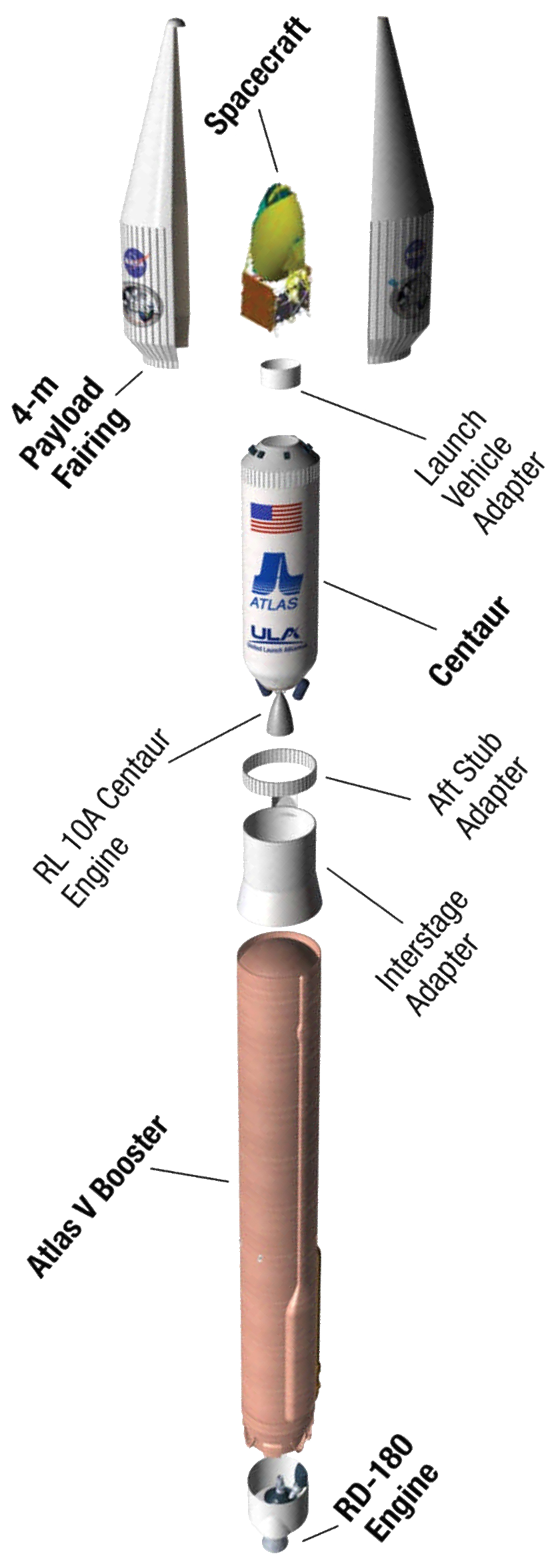
Each Atlas V vehicle consists of two main stages. The first stage is powered by a single Russian-made RD-180 engine that burns kerosene and liquid oxygen. The Centaur upper stage uses one or two American-made Aerojet Rocketdyne RL10 engines that burn liquid hydrogen and liquid oxygen. Strap-on solid rocket boosters (SRBs) are used in several configurations. Originally equipped with AJ-60A SRBs, the vehicle switched to Graphite-Epoxy Motor (GEM 63) boosters beginning in November 2020, except for flights in the Boeing Starliner program. Standard payload fairings measure either 4.2 m or 5.4 m in diameter, with multiple available lengths.
In August 2021, ULA announced that Atlas V would be retired and all remaining launches had been sold. , 10 launches remain. Production of the rocket ended in 2024. Future ULA missions will use the Vulcan Centaur launch vehicle, which was designed in part to comply with a Congressional mandate to phase out use of the Russian-made RD-180 engine.
Vehicle description
The Atlas V was developed by Lockheed Martin Commercial Launch Services (LMCLS) as part of the U.S. Air Force Evolved Expendable Launch Vehicle (EELV) program and made its inaugural flight on August 21, 2002. The vehicle operates from SLC-41 at Cape Canaveral Space Force Station (CCSFS). It also operated from SLC-3E at Vandenberg Space Force Base until 2022. LMCLS continued to market the Atlas V to commercial customers worldwide until January 2018, when United Launch Alliance (ULA) assumed control of commercial marketing and sales.
Atlas V first stage
Main article: Common Core Booster
The Atlas V first stage, the Common Core Booster (not to be confused with the Delta IV's Common Booster Core), is 3.8 m in diameter and 32.5 m in length. It is powered by one Russian NPO Energomash RD-180 main engine burning 284450 kg of liquid oxygen and RP-1. The booster operates for about four minutes, providing about 4 MN of thrust. Thrust can be augmented with up to five Aerojet AJ-60A or Northrop Grumman GEM 63 strap-on solid rocket boosters, each providing an additional 1.27 MN of thrust for 94 seconds.
The main differences between the Atlas V and earlier Atlas I and II family launch vehicles are:
- The first stage tanks no longer use stainless steel monocoque pressure stabilized "balloon" construction. The tanks are isogrid aluminum and are structurally stable when unpressurized.
- Accommodation points for parallel stages, both smaller solids and identical liquids, are built into first-stage structures.
- The "1.5 staging" technique is no longer used, having been discontinued on the Atlas III with the introduction of the Russian RD-180 engine.
- The main-stage diameter increased from 3.0 to.
Centaur III upper stage
Main article: Centaur (rocket stage)
The Centaur III upper stage uses a pressure-stabilized propellant-tank design and cryogenic propellants. The Centaur III was first introduced for use on the Atlas III and was stretched 1.7 m relative to the Centaur II used on the Atlas II. It is powered by either one or two Aerojet Rocketdyne RL10 engines, each developing a thrust of up to 101.8 kN. The inertial navigation unit (INU) located on the Centaur provides guidance and navigation for both the Atlas and Centaur and controls both Atlas and Centaur tank pressures and propellant use. The Centaur engines are capable of multiple in-space starts, making possible insertion into low Earth parking orbit, followed by a coast period and then insertion into GTO. A subsequent third burn following a multi-hour coast can permit direct injection of payloads into geostationary orbit.
When the Atlas V was introduced, the Centaur III was alternatively called the Common Centaur, reflecting its use on both the Atlas III and V. , the Centaur III had the highest proportion of burnable propellant relative to total mass of any modern hydrogen upper stage and hence can deliver substantial payloads to a high-energy state.
Payload fairing
Atlas V payload fairings are available in two diameters, depending on satellite requirements. The 4.2 m diameter fairing, originally designed for the Atlas II booster, comes in three different lengths: the original 9 m version and extended 10 and versions, first flown respectively on the AV-008/Astra 1KR and AV-004/Inmarsat-4 F1 missions. Fairings of up to 7.2 m diameter and 32.3 m length have been considered but were never implemented.
A 5.4 m diameter fairing, with an internally usable diameter of 4.57 m, was developed and built by RUAG Space in Switzerland. The RUAG fairing uses carbon fiber composite construction and is based on a similar flight-proven fairing for the Ariane 5. Three configurations are manufactured to support the Atlas V: 20.7 m, 23.4 m, and 26.5 m long.
Upgrades
Many systems on the Atlas V have been the subject of upgrade and enhancement both prior to the first Atlas V flight and since that time. Work on a Fault Tolerant Inertial Navigation Unit (FTINU) started in 2001 to enhance mission reliability for Atlas vehicles by replacing the earlier non-redundant navigation and computing equipment with a fault-tolerant unit. The upgraded FTINU first flew in 2006, and in 2010 a follow-on order for more FTINU units was awarded.
In 2015, ULA announced that the Aerojet Rocketdyne-produced AJ-60A solid rocket boosters (SRBs) then in use on Atlas V would be superseded by new GEM 63 boosters produced by Northrop Grumman Innovation Systems. The extended GEM 63XL boosters will also be used on the Vulcan Centaur launch vehicle that will replace the Atlas V. The first Atlas V launch with GEM 63 boosters happened on November 13, 2020.
Human-rating certification
Proposals and design work to human-rate the Atlas V began as early as 2006, with ULA's parent company Lockheed Martin reporting an agreement with Bigelow Aerospace that was intended to lead to commercial private trips to low Earth orbit (LEO).
Human-rating design and simulation work began in earnest in 2010, with the award of US$6.7 million in the first phase of the NASA Commercial Crew Program (CCP) to develop an Emergency Detection System (EDS).
As of February 2011, ULA had received an extension to April 2011 from NASA and was finishing up work on the EDS.
NASA solicited proposals for CCP phase 2 in October 2010, and ULA proposed to complete design work on the EDS. At the time, NASA's goal was to get astronauts to orbit by 2015. Then-ULA President and CEO Michael Gass stated that a schedule acceleration to 2014 was possible if funded. Other than the addition of the Emergency Detection System, no major changes were expected to the Atlas V rocket, but ground infrastructure modifications were planned. The most likely candidate for the human-rating was the N02 configuration, with no fairing, no solid rocket boosters, and dual RL10 engines on the Centaur upper stage.
On July 18, 2011, NASA and ULA announced an agreement on the possibility of certifying the Atlas V to NASA's standards for human spaceflight. ULA agreed to provide NASA with data on the Atlas V, while NASA would provide ULA with draft human certification requirements.
In 2011, Sierra Nevada Corporation (SNC) picked the Atlas V to be the booster for its still-under-development Dream Chaser crewed spaceplane. The Dream Chaser was intended to launch on an Atlas V, fly a crew to the ISS, and land horizontally following a lifting-body reentry. However, in late 2014 NASA did not select the Dream Chaser to be one of the two vehicles selected under the Commercial Crew competition.
On August 4, 2011, Boeing announced that it would use the Atlas V as the initial launch vehicle for its CST-100 crew capsule. CST-100 will take NASA astronauts to the International Space Station (ISS) and was also intended to service the proposed Bigelow Commercial Space Station. A three-flight test program was projected to be completed by 2015, certifying the Atlas V/CST-100 combination for human spaceflight operations. The first flight was expected to include an Atlas V rocket integrated with an uncrewed CST-100 capsule, the second flight an in-flight launch abort system demonstration in the middle of that year, and the third flight a crewed mission carrying two Boeing test-pilot astronauts into LEO and returning them safely at the end of 2015. These plans were delayed by many years and morphed along the way so that in the end, the first orbital test flight with no crew materialized in 2019, but it was a failure and needed to be reflown in 2022, the in-flight launch abort system test flight did not materialize, and the third flight, a crewed orbital test flight with two astronauts (in the end NASA's, not Boeing's astronauts) materialized in June 2024 as Boeing Crewed Flight Test. The launch abort system was tested in 2019 in the Boeing Pad Abort Test. The spacecraft launched from a test stand, not from an Atlas V.
In 2014, NASA selected the Boeing Starliner CST-100 spacecraft as part of the Commercial Crew Program. Atlas V is the launch vehicle for Starliner. The first launch of an uncrewed Starliner, the Boeing OFT mission, occurred atop a human-rated Atlas V on the morning of December 20, 2019; the mission failed to meet goals due to a spacecraft failure, though the Atlas V launcher performed well. In 2022, an Atlas V launched an uncrewed Starliner capsule for the second time on Boe-OFT 2 mission; the mission was a success.
In June 2024, on Boe-CFT mission, Atlas V carried humans into space for the first time, launching two NASA astronauts to the ISS.
Amazon Leo
Amazon selected the Atlas V to launch some of the satellites for Amazon Leo, formerly known as Project Kuiper. Amazon Leo will offer a high-speed satellite internet constellation service. The contract signed with Amazon is for all nine remaining available Atlas V rockets. Amazon Leo aims to put thousands of satellites into orbit. ULA is Amazon's first launch provider. Two test satellites were launched on Atlas V in 2023 because their originally-contracted launch vehicles were not available on time. The remaining eight Atlas V Amazon Leo launches will each carry a full payload of Leo satellites. Most of the Amazon Leo constellation will use other launch vehicles. The first launch of an Atlas V carrying the first batch of 27 Leo satellites launched on April 28, 2025.
Versions
Each Atlas V booster configuration has a three-digit designation.
The first digit shows the diameter (in meters) of the payload fairing and has a value of "4" or "5" for fairing launches and "N" for crew capsule launches (as no payload fairing is used).
The second digit indicates the number of solid rocket boosters (SRBs) attached to the core of the launch vehicle and can range from "0" through "3" with the 4 m fairing, and "0" through "5" with the 5 m fairing. As seen in the first image, all SRB layouts are asymmetrical.
The third digit represents the number of engines on the Centaur stage, either "1" or "2". All of the configurations use the Single Engine Centaur, except for the "N22" which is only used on Starliner crew capsule missions, and uses Dual Engine Centaur.
Atlas V has flown in eleven configurations: ;
| Version | Fairing | SRBs | Centaur | |||||
|---|---|---|---|---|---|---|---|---|
| engines | Payload, kg | Launches | ||||||
| to date | Base | |||||||
| price | to LEO | to GTO | ||||||
| 401 | 4 m | – | 1 | 9,797 | 4,750 | 41 | US$109 million | |
| 411 | 4 m | 1 | 1 | 12,150 | 5,950 | 6 | US$115 million | |
| 421 | 4 m | 2 | 1 | 14,067 | 6,890 | 9 | US$123 million | |
| 431 | 4 m | 3 | 1 | 15,718 | 7,700 | 3 | US$130 million | |
| 501 | 5.4 m | – | 1 | 8,123 | 3,775 | 8 | US$120 million | |
| 511 | 5.4 m | 1 | 1 | 10,986 | 5,250 | 1 | US$130 million | |
| 521 | 5.4 m | 2 | 1 | 13,490 | 6,475 | 2 | US$135 million | |
| 531 | 5.4 m | 3 | 1 | 15,575 | 7,475 | 5 | US$140 million | |
| 541 | 5.4 m | 4 | 1 | 17,443 | 8,290 | 9 | US$145 million | |
| 551 | 5.4 m | 5 | 1 | 18,814 | 8,900 | 19 | US$153 million | |
| N22 | None | 2 | 2 | 13,250 (to ISS) | 3 | – |
Launch cost
Before 2016, pricing information for Atlas V launches was limited. In 2010, NASA contracted with ULA to launch the MAVEN mission on an Atlas V 401 for approximately US$187 million. The 2013 cost of this configuration for the U.S. Air Force under their block buy of 36 launch vehicles was US$164 million. In 2015, the TDRS-M launch on an Atlas 401 cost NASA US$132.4 million.
Starting in 2016, ULA provided pricing for the Atlas V through its RocketBuilder website, advertising a base price for each launch vehicle configuration, which ranges from US$109 million for the 401 up to US$153 million for the 551. Each additional SRB adds an average of US$6.8 million to the cost of the launch vehicle. Customers can also choose to purchase larger payload fairings or additional launch service options. NASA and Air Force launch costs are often higher than equivalent commercial missions due to additional government accounting, analysis, processing, and mission assurance requirements, which can add US$30–80 million to the cost of a launch.
In 2013, launch costs for commercial satellites to GTO averaged about US$100 million, significantly lower than historic Atlas V pricing. However, after the rise of reusable rockets, the price of an Atlas V [401] has dropped from approximately US$180 million to US$109 million, in large part due to competitive pressure that emerged in the launch services marketplace during the early 2010s. ULA CEO Tory Bruno stated in 2016 that ULA needs at least two commercial missions each year in order to stay profitable going forward. ULA is not attempting to win these missions on purely lowest purchase price, stating that it "would rather be the best value provider". In 2016, ULA suggested that customers would have much lower insurance and delay costs because of the high Atlas V reliability and schedule certainty, making overall customer costs close to that of using competitors like the SpaceX Falcon 9.
Historically proposed versions
In 2006, ULA offered an Atlas V Heavy option that would use three Common Core Booster (CCB) stages strapped together to lift a 29400 kg payload to low Earth orbit. ULA stated at the time that 95% of the hardware required for the Atlas V Heavy has already been flown on the Atlas V single-core vehicles. The lifting capability of the proposed launch vehicle was to be roughly equivalent to the Delta IV Heavy, which used RS-68 engines developed and produced domestically by Aerojet Rocketdyne.
A 2006 report, prepared by the RAND Corporation for the Office of the Secretary of Defense, stated that Lockheed Martin had decided not to develop an Atlas V heavy-lift vehicle (HLV).{{cite book |archive-url=https://web.archive.org/web/20121023080432/https://www.rand.org/pubs/monographs/2006/RAND_MG503.pdf|archive-date=October 23, 2012}} The report recommended for the U.S. Air Force and the National Reconnaissance Office (NRO) to "determine the necessity of an EELV heavy-lift variant, including development of an Atlas V Heavy", and to "resolve the RD-180 issue, including coproduction, stockpile, or United States development of an RD-180 replacement".
In 2010, ULA stated that the Atlas V Heavy variant could be available to customers 30 months from the date of order.
;Atlas V PH2 In late 2006, the Atlas V program gained access to the tooling and processes for 5-meter-diameter stages used on Delta IV when Boeing and Lockheed Martin space operations were merged into the United Launch Alliance. This led to a proposal to combine the 5-meter-diameter Delta IV tankage production processes with dual RD-180 engines, resulting in the Atlas Phase 2.
An Atlas V PH2-Heavy consisting of three 5-meter stages in parallel with six RD-180s was considered in the Augustine Report as a possible heavy lifter for use in future space missions, as well as the Shuttle-derived Ares V and Ares V Lite. If built, the Atlas PH2-Heavy was projected to be able to launch a payload mass of approximately 70 MT into an orbit of 28.5° inclination.
;Booster for GX rocket The Atlas V Common Core Booster was to have been used as the first stage of the joint US-Japanese GX rocket, which was scheduled to make its first flight in 2012. GX launches would have been from the Atlas V launch complex at Vandenberg Air Force Base, SLC-3E. However, the Japanese government decided to cancel the GX project in December 2009.
;Out-licensing rejected by ULA In May 2015, a consortium of companies, including Aerojet and Dynetics, sought to license the production or manufacturing rights to the Atlas V using the Aerojet Rocketdyne AR1 engine in place of the RD-180. The proposal was rejected by ULA.
Atlas V launches
| Flight No. | Date and time (UTC) | Type | Serial no. | Launch site | Payload | Type of payload | Orbit | Outcome | Remarks | ||||||||
|---|---|---|---|---|---|---|---|---|---|---|---|---|---|---|---|---|---|
| 1 | August 21, 2002 | ||||||||||||||||
| 22:05 | 401 | AV-001 | Cape Canaveral, SLC-41 | Hot Bird 6 | Commercial communications satellite (comsat) | GTO | First Atlas V launch | ||||||||||
| 2 | May 13, 2003 | ||||||||||||||||
| 22:10 | 401 | AV-002 | Cape Canaveral, SLC-41 | Hellas Sat 2 | Commercial comsat | GTO | First satellite for Greece and Cyprus | ||||||||||
| 3 | July 17, 2003 | ||||||||||||||||
| 23:45 | 521 | AV-003 | Cape Canaveral, SLC-41 | Rainbow-1 | Commercial comsat | GTO | First Atlas V 500 launch | ||||||||||
| First Atlas V launch with SRBs | |||||||||||||||||
| 4 | December 17, 2004 | ||||||||||||||||
| 12:07 | 521 | AV-005 | Cape Canaveral, SLC-41 | AMC-16 | Commercial comsat | GTO | Last flight of the 521 configuration | ||||||||||
| 5 | March 11, 2005 | ||||||||||||||||
| 21:42 | 431 | AV-004 | Cape Canaveral, SLC-41 | Inmarsat-4 F1 | Commercial comsat | GTO | First Atlas V 400 launch with SRBs | ||||||||||
| 6 | August 12, 2005 | ||||||||||||||||
| 11:43 | 401 | AV-007 | Cape Canaveral, SLC-41 | Mars Reconnaissance Orbiter (MRO) | Mars orbiter | Heliocentric to | |||||||||||
| Areocentric | url=http://mars.jpl.nasa.gov/mro/newsroom/pressreleases/20050812a.html | title=NASA's Multipurpose Mars Mission Successfully Launched | date=August 12, 2005 | publisher=NASA | access-date=December 4, 2011 | archive-url=https://web.archive.org/web/20130510140909/http://mars.jpl.nasa.gov/mro/newsroom/pressreleases/20050812a.html | archive-date=May 10, 2013}} | First Atlas V launch for NASA | |||||||||
| 7 | January 19, 2006 | ||||||||||||||||
| 19:00 | 551 | AV-010 | Cape Canaveral, SLC-41 | New Horizons | Pluto and Kuiper Belt probe | Hyperbolic | Star 48B third stage used, only Atlas V launch with a third stage. | ||||||||||
| 8 | April 20, 2006 | ||||||||||||||||
| 20:27 | 411 | AV-008 | Cape Canaveral, SLC-41 | Astra 1KR | Commercial comsat | GTO | |||||||||||
| 9 | March 9, 2007 | ||||||||||||||||
| 03:10 | 401 | AV-013 | Cape Canaveral, SLC-41 | Space Test Program-1 | 6 military research satellites | LEO | |||||||||||
| 10 | June 15, 2007 | ||||||||||||||||
| 15:12 | 401 | AV-009 | Cape Canaveral, SLC-41 | USA-194 (NROL-30/NOSS-4-3A and -4-3B) | Two NRO Reconnaissance satellites | LEO | First Atlas V flight for the National Reconnaissance Office Atlas did not achieve the intended orbit, but payload compensated for shortfall. NRO declared the mission a success. | ||||||||||
| 11 | October 11, 2007 | ||||||||||||||||
| 00:22 | 421 | AV-011 | Cape Canaveral, SLC-41 | USA-195 (WGS-1) | Military comsat | GTO | Valve replacement delayed launch. | ||||||||||
| 12 | December 10, 2007 | ||||||||||||||||
| 22:05 | 401 | AV-015 | Cape Canaveral, SLC-41 | USA-198 (NROL-24) | NRO reconnaissance satellite | Molniya | |||||||||||
| 13 | March 13, 2008 | ||||||||||||||||
| 10:02 | 411 | AV-006 | Vandenberg, | ||||||||||||||
| SLC-3E | USA-200 (NROL-28) | NRO reconnaissance satellite | Molniya | url=https://www.ulalaunch.com/about/news-detail/2008/03/13/ula-inaugural-atlas-v-west-coast-launch-a-success | title=United Launch Alliance Inaugural Atlas V West Coast Launch a Success | date=March 13, 2008 | publisher=United Launch Alliance | access-date=June 12, 2018 | archive-url=https://web.archive.org/web/20180612141813/https://www.ulalaunch.com/about/news-detail/2008/03/13/ula-inaugural-atlas-v-west-coast-launch-a-success | archive-date=June 12, 2018 | url-status=live}} | First Atlas V launch from Vandenberg. | |||||
| 14 | April 14, 2008 | ||||||||||||||||
| 20:12 | 421 | AV-014 | Cape Canaveral, SLC-41 | ICO G1 | Commercial comsat | GTO | |||||||||||
| 15 | April 4, 2009 | ||||||||||||||||
| 00:31 | 421 | AV-016 | Cape Canaveral, SLC-41 | USA-204 (WGS-2) | Military comsat | GTO | |||||||||||
| 16 | June 18, 2009 | ||||||||||||||||
| 21:32 | 401 | AV-020 | Cape Canaveral, SLC-41 | LRO/LCROSS | Lunar exploration | HEO to Lunar | First Centaur stage to impact on the Moon. | ||||||||||
| 17 | September 8, 2009 | ||||||||||||||||
| 21:35 | 401 | AV-018 | Cape Canaveral, SLC-41 | USA-207 (Palladium At Night - PAN) | url=http://www.spaceflightnow.com/atlas/av018/ | title=Clues about mystery payload emerge soon after launch | date=September 8, 2009 | publisher=Spaceflight Now | archive-url=https://web.archive.org/web/20140427025125/http://www.spaceflightnow.com/atlas/av018/ | archive-date=April 27, 2014}} | GTO | ||||||
| 18 | October 18, 2009 | ||||||||||||||||
| 16:12 | 401 | AV-017 | Vandenberg, | ||||||||||||||
| SLC-3E | USA-210 (DMSP 5D3-F18) | Military weather satellite | LEO | ||||||||||||||
| 19 | November 23, 2009 | ||||||||||||||||
| 06:55 | 431 | AV-024 | Cape Canaveral, SLC-41 | Intelsat 14 | Commercial comsat | GTO | LMCLS launch | ||||||||||
| 20 | February 11, 2010 | ||||||||||||||||
| 15:23 | 401 | AV-021 | Cape Canaveral, SLC-41 | SDO | Solar telescope | GTO | |||||||||||
| 21 | April 22, 2010 | ||||||||||||||||
| 23:52 | 501 | AV-012 | Cape Canaveral, SLC-41 | USA-212 (X-37B OTV-1) | Military orbital test vehicle | LEO | url=https://web.archive.org/web/20120318131637/http://www.wistv.com/global/story.asp?s=12541816 | date=March 18, 2012}} | |||||||||
| 22 | August 14, 2010 | ||||||||||||||||
| 11:07 | 531 | AV-019 | Cape Canaveral, SLC-41 | USA-214 (AEHF-1) | Military comsat | GTO | |||||||||||
| 23 | September 21, 2010 | ||||||||||||||||
| 04:03 | 501 | AV-025 | Vandenberg, SLC-3E | USA-215 (NROL-41) | NRO reconnaissance satellite | LEO | |||||||||||
| 24 | March 5, 2011 | ||||||||||||||||
| 22:46 | 501 | AV-026 | Cape Canaveral, SLC-41 | USA-226 (X-37B OTV-2) | Military orbital test vehicle | LEO | |||||||||||
| 25 | April 15, 2011 | ||||||||||||||||
| 04:24 | 411 | AV-027 | Vandenberg, SLC-3E | USA-229 (NROL-34) | NRO reconnaissance satellite | LEO | url=http://www.ulalaunch.com/site/pages/News.shtml#/69 | title=ULA Successfully Launches Fifth NRO Mission in Seven Months | date=April 14, 2011 | publisher=United Launch Alliance | archive-url=https://web.archive.org/web/20131207160150/http://www.ulalaunch.com/site/pages/News.shtml | archive-date=December 7, 2013}} | |||||
| 26 | May 7, 2011 | ||||||||||||||||
| 18:10 | 401 | AV-022 | Cape Canaveral, SLC-41 | USA-230 (SBIRS GEO-1) | Missile Warning satellite | GTO | url=http://www.ulalaunch.com/site/pages/News.shtml#/70/ | title=United Launch Alliance Marks 50th Successful Launch by delivering the Space-Based Infrared System (SBIRS) Satellite to orbit for the U.S. Air Force | date=May 7, 2011 | publisher=United Launch Alliance | archive-url=https://web.archive.org/web/20131207160150/http://www.ulalaunch.com/site/pages/News.shtml | archive-date=December 7, 2013}} | |||||
| 27 | August 5, 2011 | ||||||||||||||||
| 16:25 | 551 | AV-029 | Cape Canaveral, SLC-41 | Juno | Jupiter orbiter | Hyperbolic to | |||||||||||
| Jovicentric | url=http://www.ulalaunch.com/site/pages/News.shtml#/78/ | title=United Launch Alliance Successfully Launches Juno Spacecraft on Five-Year Journey to study Jupiter | date=August 5, 2011 | publisher=United Launch Alliance | archive-url=https://web.archive.org/web/20131207160150/http://www.ulalaunch.com/site/pages/News.shtml | archive-date=December 7, 2013}} | |||||||||||
| 28 | November 26, 2011 | ||||||||||||||||
| 15:02 | 541 | AV-028 | Cape Canaveral, SLC-41 | Mars Science Laboratory (MSL) | Mars rover | Hyperbolic | |||||||||||
| (Mars landing) | First launch of the 541 configuration | ||||||||||||||||
| Centaur entered orbit around the Sun. | |||||||||||||||||
| 29 | February 24, 2012 | ||||||||||||||||
| 22:15 | 551 | AV-030 | Cape Canaveral, SLC-41 | MUOS-1 | Military comsat | GTO | url=http://www.ulalaunch.com/site/pages/News.shtml#/97/ | title=United Launch Alliance Atlas V Rocket, with 200th Centaur, Successfully Launches Mobile User Objective System-1 Mission | date=February 24, 2012 | publisher=United Launch Alliance | archive-url=https://web.archive.org/web/20131207160150/http://www.ulalaunch.com/site/pages/News.shtml | archive-date=December 7, 2013}} | |||||
| 30 | May 4, 2012 | ||||||||||||||||
| 18:42 | 531 | AV-031 | Cape Canaveral, SLC-41 | USA-235 (AEHF-2) | Military comsat | GTO | {{cite news | title=AEHF-2 handed over to the USAF after completing on-orbit testing | last1=Graham | first2=Chris | last2=Bergin | date=November 16, 2012 | url=https://www.nasaspaceflight.com/2012/11/aehf-2-handed-usaf-after-completing-on-orbit-testing/ | access-date=November 12, 2022 | publisher=NASASpaceflight.com}} | ||
| 31 | June 20, 2012 | ||||||||||||||||
| 12:28 | 401 | AV-023 | Cape Canaveral, SLC-41 | USA-236 (NROL-38) | NRO reconnaissance satellite | GTO | 50th EELV launch | ||||||||||
| 32 | August 30, 2012 | ||||||||||||||||
| 08:05 | 401 | AV-032 | Cape Canaveral, SLC-41 | Van Allen Probes (RBSP) | Van Allen Belts exploration | HEO | |||||||||||
| 33 | September 13, 2012 | ||||||||||||||||
| 21:39 | 401 | AV-033 | Vandenberg, SLC-3E | USA-238 (NROL-36) | NRO reconnaissance satellites | LEO | |||||||||||
| 34 | December 11, 2012 | ||||||||||||||||
| 18:03 | 501 | AV-034 | Cape Canaveral, SLC-41 | USA-240 (X-37B OTV-3) | Military orbital test vehicle | LEO | url=http://www.ulalaunch.com/site/pages/News.shtml#/127/ | title=United Launch Alliance Successfully Launches Third X-37B Orbital Test Vehicle for the Air Force | date=December 11, 2012 | publisher=United Launch Alliance | archive-url=https://web.archive.org/web/20131207160150/http://www.ulalaunch.com/site/pages/News.shtml | archive-date=December 7, 2013}} | |||||
| 35 | January 31, 2013 | ||||||||||||||||
| 01:48 | 401 | AV-036 | Cape Canaveral, SLC-41 | TDRS-K (TDRS-11) | Data relay satellite | GTO | url=http://www.ulalaunch.com/site/pages/News.shtml#/128/ | title=United Launch Alliance Successfully Launches NASA's Tracking and Data Relay Satellite | date=January 31, 2013 | publisher=United Launch Alliance | archive-url=https://web.archive.org/web/20131207160150/http://www.ulalaunch.com/site/pages/News.shtml | archive-date=December 7, 2013}} | |||||
| 36 | February 11, 2013 | ||||||||||||||||
| 18:02 | 401 | AV-035 | Vandenberg, SLC-3E | Landsat 8 | Earth Observation satellite | LEO | url=http://spaceflightnow.com/atlas/av035/ | title=Atlas 5 rocket launch continues legacy of Landsat | author=Justin Ray | url-status=live | access-date=February 11, 2013 | publisher=Spaceflight Now | archive-url=https://web.archive.org/web/20140421051311/http://spaceflightnow.com/atlas/av035/ | archive-date=April 21, 2014}} | First West Coast Atlas V Launch for NASA | ||
| 37 | March 19, 2013 | ||||||||||||||||
| 21:21 | 401 | AV-037 | Cape Canaveral, SLC-41 | USA-241 (SBIRS GEO 2) | Missile Warning satellite | GTO | url=http://www.ulalaunch.com/site/pages/News.shtml#/131/ | title=United Launch Alliance Successfully Launches Second Space-Based Infrared System SBIRS Satellite to Orbit for the U.S. Air Force | url-status=dead | access-date=March 20, 2013 | publisher=United Launch Alliance | archive-url=https://web.archive.org/web/20131207160150/http://www.ulalaunch.com/site/pages/News.shtml#/131/ | archive-date=December 7, 2013}} | ||||
| 38 | May 15, 2013 | ||||||||||||||||
| 21:38 | 401 | AV-039 | Cape Canaveral, SLC-41 | USA-242 (GPS IIF-4) | Navigation satellite | MEO | url=http://www.ulalaunch.com/site/pages/News.shtml#/139/ | title=ULA Launches 70th Successful Mission in 77 Months with the Launch of the GPS IIF-4 Satellite for the Air Force | url-status=dead | access-date=May 15, 2013 | publisher=United Launch Alliance | archive-url=https://web.archive.org/web/20131207160150/http://www.ulalaunch.com/site/pages/News.shtml#/139/ | archive-date=December 7, 2013 }} | First GPS satellite launched by an Atlas V | |||
| 39 | July 19, 2013 | ||||||||||||||||
| 13:00 | 551 | AV-040 | Cape Canaveral, SLC-41 | MUOS-2 | Military comsat | GTO | url=http://www.ulalaunch.com/site/pages/News.shtml#/146/ | title=United Launch Alliance Atlas V Rocket Successfully Launches Mobile User Objective System-2 Mission for U.S. Navy | url-status=dead | access-date=July 19, 2013 | publisher=United Launch Alliance | archive-url=https://web.archive.org/web/20131207160150/http://www.ulalaunch.com/site/pages/News.shtml#/146/ | archive-date=December 7, 2013}} | ||||
| 40 | September 18, 2013 | ||||||||||||||||
| 08:10 | 531 | AV-041 | Cape Canaveral, SLC-41 | USA-246 (AEHF-3) | Military comsat | GTO | url=http://www.ulalaunch.com/site/pages/News.shtml#/154/ | title=United Launch Alliance Marks 75th Successful Launch by Delivering the Advanced Extremely High Frequency-3 Satellite to Orbit for the U.S. Air Force | url-status=dead | access-date=September 18, 2013 | publisher=United Launch Alliance | archive-url=https://web.archive.org/web/20131207160150/http://www.ulalaunch.com/site/pages/News.shtml#/154/ | archive-date=December 7, 2013}} | ||||
| 41 | November 18, 2013 | ||||||||||||||||
| 18:28 | 401 | AV-038 | Cape Canaveral, SLC-41 | MAVEN | Mars orbiter | Hyperbolic to | |||||||||||
| Areocentric | url=http://www.ulalaunch.com/site/pages/News.shtml#/158/ | title=United Launch Alliance Atlas V Rocket Successfully Launches MAVEN mission on Journey to the Red Planet | url-status=dead | access-date=November 19, 2013 | publisher=United Launch Alliance | archive-url=https://web.archive.org/web/20131207160150/http://www.ulalaunch.com/site/pages/News.shtml#/158/ | archive-date=December 7, 2013}} | ||||||||||
| 42 | December 6, 2013 | ||||||||||||||||
| 07:14:30 | 501 | AV-042 | Vandenberg, SLC-3E | USA-247 (NROL-39) | NRO reconnaissance satellite | Low Earth orbit | url=http://www.ulalaunch.com/site/pages/News.shtml#/163/ | title=United Launch Alliance Atlas V Rocket Successfully Launches Payload for the National Reconnaissance Office | url-status=dead | access-date=December 6, 2013 | publisher=ULA | archive-url=https://web.archive.org/web/20131207160150/http://www.ulalaunch.com/site/pages/News.shtml#/163/ | archive-date=December 7, 2013}} | ||||
| 43 | January 24, 2014 | ||||||||||||||||
| 02:33 | 401 | AV-043 | Cape Canaveral, SLC-41 | TDRS-L (TDRS-12) | Data relay satellite | GTO | |||||||||||
| 44 | April 3, 2014 | ||||||||||||||||
| 14:46 | 401 | AV-044 | Vandenberg, SLC-3E | USA-249 (DMSP-5D3 F19) | Military weather satellite | Low Earth orbit | 50th RD-180 launch | ||||||||||
| 45 | April 10, 2014 | ||||||||||||||||
| 17:45 | 541 | AV-045 | Cape Canaveral, SLC-41 | USA-250 (NROL-67) | NRO reconnaissance satellite | GTO | url=http://www.ulalaunch.com/site/pages/News.shtml#/171/ | title=United Launch Alliance Successfully Launches Second Mission in Just Seven Days | url-status=dead | access-date=April 11, 2014 | publisher=United Launch Alliance | archive-url=https://web.archive.org/web/20131207160150/http://www.ulalaunch.com/site/pages/News.shtml#/171/ | archive-date=December 7, 2013}} | ||||
| 46 | May 22, 2014 | ||||||||||||||||
| 13:09 | 401 | AV-046 | Cape Canaveral, SLC-41 | USA-252 (NROL-33) | NRO reconnaissance satellite | GTO | |||||||||||
| 47 | August 2, 2014 | ||||||||||||||||
| 03:23 | 401 | AV-048 | Cape Canaveral, SLC-41 | USA-256 (GPS IIF-7) | Navigation satellite | MEO | url=http://www.ulalaunch.com/ula-successfully-launches-gps-iif-7.aspx | title=United Launch Alliance Successfully Launches Two Rockets in Just Four Days | access-date=August 3, 2014 | publisher=United Launch Alliance | archive-url=https://web.archive.org/web/20140819085101/http://www.ulalaunch.com/ula-successfully-launches-gps-iif-7.aspx | archive-date=August 19, 2014 | url-status=dead}} | ||||
| 48 | August 13, 2014 | ||||||||||||||||
| 18:30 | 401 | AV-047 | Vandenberg, SLC-3E | WorldView-3 | Earth imaging satellite | Low Earth orbit | url=http://www.ulalaunch.com/ula-atlas-v-launches-worldview3-satellite.aspx?title=United+Launch+Alliance+Atlas+V+Launches+WorldView-3+Satellite+for+DigitalGlobe | title=United Launch Alliance Atlas V Launches WorldView-3 Satellite for DigitalGlobe | access-date=August 13, 2014 | publisher=United Launch Alliance | archive-url=https://web.archive.org/web/20140814025937/http://www.ulalaunch.com/ula-atlas-v-launches-worldview3-satellite.aspx?title=United+Launch+Alliance+Atlas+V+Launches+WorldView-3+Satellite+for+DigitalGlobe | archive-date=August 14, 2014 | url-status=dead}} | ||||
| 49 | September 17, 2014 | ||||||||||||||||
| 00:10 | 401 | AV-049 | Cape Canaveral, SLC-41 | USA-257 (CLIO) | url=http://www.nasaspaceflight.com/2014/09/ula-atlas-v-secretive-clio-mission/ | title=ULA Atlas V successfully launches secretive CLIO mission | date=September 17, 2014 | publisher=NASASpaceFlight.com | access-date=September 17, 2014 | archive-url=https://web.archive.org/web/20140919005030/http://www.nasaspaceflight.com/2014/09/ula-atlas-v-secretive-clio-mission/ | archive-date=September 19, 2014 | url-status=live}} | GTO | ||||
| 50 | October 29, 2014 | ||||||||||||||||
| 17:21 | 401 | AV-050 | Cape Canaveral, SLC-41 | USA-258 (GPS IIF-8) | Navigation satellite | MEO | 50th Atlas V launch | ||||||||||
| 51 | December 13, 2014 | ||||||||||||||||
| 03:19 | 541 | AV-051 | Vandenberg, SLC-3E | USA-259 (NROL-35) | NRO reconnaissance satellite | Molniya | url=http://www.ulalaunch.com/ula-atlas-v-successfully-launches-nrol-35.aspx | title=United Launch Alliance Atlas V Successfully Launches Payload for the National Reconnaissance Office | access-date=December 13, 2014 | publisher=United Launch Alliance | archive-url=https://web.archive.org/web/20141213152335/http://www.ulalaunch.com/ula-atlas-v-successfully-launches-nrol-35.aspx | archive-date=December 13, 2014 | url-status=dead}} | First use of the RL-10C engine on the Centaur stage | |||
| 52 | January 21, 2015 | ||||||||||||||||
| 01:04 | 551 | AV-052 | Cape Canaveral, SLC-41 | MUOS-3 | Military comsat | GTO | url=http://www.ulalaunch.com/ula-successfully-launches-navys-muos3.aspx | title=United Launch Alliance Successfully Launches the U.S. Navy's Mobile User Objective System-3 | access-date=January 21, 2015 | publisher=United Launch Alliance | archive-url=https://web.archive.org/web/20150121063714/http://www.ulalaunch.com/ula-successfully-launches-navys-muos3.aspx | archive-date=January 21, 2015 | url-status=dead }} | ||||
| 53 | March 13, 2015 | ||||||||||||||||
| 02:44 | 421 | AV-053 | Cape Canaveral, SLC-41 | MMS | Magnetosphere research satellites | HEO | url=http://www.ulalaunch.com/ula-successfully-launches-nasa-mms.aspx?title=United+Launch+Alliance+Successfully+Launches+Solar+Probes+to+Study+Space+Weather+for+NASA | title=United Launch Alliance Successfully Launches Solar Probes to Study Space Weather for NASA | access-date=March 15, 2015 | publisher=United Launch Alliance | archive-url=https://web.archive.org/web/20150315035930/http://www.ulalaunch.com/ula-successfully-launches-nasa-mms.aspx?title=United+Launch+Alliance+Successfully+Launches+Solar+Probes+to+Study+Space+Weather+for+NASA | archive-date=March 15, 2015 | url-status=dead}} | ||||
| 54 | May 20, 2015 | ||||||||||||||||
| 15:05 | 501 | AV-054 | Cape Canaveral, SLC-41 | USA-261 (X-37B OTV-4/AFSPC-5) | Military orbital test vehicle | LEO | url=http://www.ulalaunch.com/ula-successfully-launches-afspc5.aspx?title=United+Launch+Alliance+Successfully+Launches+X-37B+Orbital+Test+Vehicle+for+the+U.S.+Air+Force | title=United Launch Alliance Successfully Launches X-37B Orbital Test Vehicle for the U.S. Air Force | access-date=May 21, 2015 | publisher=United Launch Alliance | archive-url=https://web.archive.org/web/20150521175411/http://www.ulalaunch.com/ula-successfully-launches-afspc5.aspx?title=United+Launch+Alliance+Successfully+Launches+X-37B+Orbital+Test+Vehicle+for+the+U.S.+Air+Force | archive-date=May 21, 2015 | url-status=dead}} | ||||
| 55 | July 15, 2015 | ||||||||||||||||
| 15:36 | 401 | AV-055 | Cape Canaveral, SLC-41 | USA-262 (GPS IIF-10) | Navigation satellite | MEO | |||||||||||
| 56 | September 2, 2015 | ||||||||||||||||
| 10:18 | 551 | AV-056 | Cape Canaveral, SLC-41 | MUOS-4 | Military comsat | GTO | |||||||||||
| 57 | October 2, 2015 | ||||||||||||||||
| 10:28 | 421 | AV-059 | Cape Canaveral, SLC-41 | Morelos-3 | Comsat | GTO | |||||||||||
| 58 | October 8, 2015 | ||||||||||||||||
| 12:49 | 401 | AV-058 | Vandenberg, SLC-3E | USA-264 (NROL-55) | NRO reconnaissance satellites | LEO | |||||||||||
| 59 | October 31, 2015 | ||||||||||||||||
| 16:13 | 401 | AV-060 | Cape Canaveral, SLC-41 | USA-265 (GPS IIF-11) | Navigation satellite | MEO | |||||||||||
| 60 | December 6, 2015 | ||||||||||||||||
| 21:44 | 401 | AV-061 | Cape Canaveral, SLC-41 | Cygnus CRS OA-4 | ISS logistics spacecraft | LEO | First Atlas rocket used to directly support the ISS program | ||||||||||
| 61 | February 5, 2016 | ||||||||||||||||
| 13:38 | 401 | AV-057 | Cape Canaveral, SLC-41 | USA-266 (GPS IIF-12) | Navigation satellite | MEO | |||||||||||
| 62 | March 23, 2016 | ||||||||||||||||
| 03:05 | 401 | AV-064 | Cape Canaveral, SLC-41 | Cygnus CRS OA-6 | ISS logistics spacecraft | LEO | First stage shut down early but did not affect mission outcome | ||||||||||
| 63 | June 24, 2016 | ||||||||||||||||
| 14:30 | 551 | AV-063 | Cape Canaveral, SLC-41 | MUOS-5 | Military comsat | GTO | |||||||||||
| 64 | July 28, 2016 | ||||||||||||||||
| 12:37 | 421 | AV-065 | Cape Canaveral, SLC-41 | USA-267 (NROL-61) | NRO reconnaissance satellite | GTO | |||||||||||
| 65 | September 8, 2016 | ||||||||||||||||
| 23:05 | 411 | AV-067 | Cape Canaveral, SLC-41 | OSIRIS-REx | Asteroid sample return | Heliocentric | |||||||||||
| 66 | November 11, 2016 | ||||||||||||||||
| 18:30 | 401 | AV-062 | Vandenberg, SLC-3E | WorldView-4 (GeoEye-2) + 7 NRO cubesats | Earth Imaging, cubesats | SSO | LMCLS launch | ||||||||||
| 67 | November 19, 2016 | ||||||||||||||||
| 23:42 | 541 | AV-069 | Cape Canaveral, SLC-41 | GOES-R (GOES-16) | Meteorology | GTO | 100th EELV launch | ||||||||||
| 68 | December 18, 2016 | ||||||||||||||||
| 19:13 | 431 | AV-071 | Cape Canaveral, SLC-41 | EchoStar 19 (Jupiter 2) | Commercial comsat | GTO | LMCLS launch | ||||||||||
| 69 | January 21, 2017 | ||||||||||||||||
| 00:42 | 401 | AV-066 | Cape Canaveral, SLC-41 | USA-273 (SBIRS GEO-3) | Missile Warning satellite | GTO | |||||||||||
| 70 | March 1, 2017 | ||||||||||||||||
| 17:49 | 401 | AV-068 | Vandenberg, SLC-3E | USA-274 (NROL-79) | NRO Reconnaissance Satellite | LEO | |||||||||||
| 71 | April 18, 2017 | ||||||||||||||||
| 15:11 | 401 | AV-070 | Cape Canaveral, SLC-41 | Cygnus CRS OA-7 | ISS logistics spacecraft | LEO | |||||||||||
| 72 | August 18, 2017 | ||||||||||||||||
| 12:29 | 401 | AV-074 | Cape Canaveral, SLC-41 | TDRS-M (TDRS-13) | Data relay satellite | GTO | |||||||||||
| 73 | September 24, 2017 | ||||||||||||||||
| 05:49 | 541 | AV-072 | Vandenberg, SLC-3E | USA-278 (NROL-42) | NRO Reconnaissance Satellite | Molniya | |||||||||||
| 74 | October 15, 2017 | ||||||||||||||||
| 07:28 | 421 | AV-075 | Cape Canaveral, SLC-41 | USA-279 (NROL-52) | NRO Reconnaissance satellite | GTO | |||||||||||
| 75 | January 20, 2018 | ||||||||||||||||
| 00:48 | 411 | AV-076 | Cape Canaveral, SLC-41 | USA-282 (SBIRS GEO-4) | Missile Warning satellite | GTO | |||||||||||
| 76 | March 1, 2018 | ||||||||||||||||
| 22:02 | 541 | AV-077 | Cape Canaveral, SLC-41 | GOES-S (GOES-17) | Meteorology | GTO | |||||||||||
| 77 | April 14, 2018 | ||||||||||||||||
| 23:13 | 551 | AV-079 | Cape Canaveral, SLC-41 | AFSPC-11 | Military comsat | GEO | |||||||||||
| 78 | May 5, 2018 | ||||||||||||||||
| 11:05 | 401 | AV-078 | Vandenberg, SLC-3E | InSight MarCO | Mars lander; 2 CubeSats | Hyperbolic | |||||||||||
| (Mars landing) | First interplanetary mission from Vandenberg; first interplanetary CubeSats. | ||||||||||||||||
| 79 | October 17, 2018, | ||||||||||||||||
| 04:15 | 551 | AV-073 | Cape Canaveral, SLC-41 | USA-288 (AEHF-4) | Military comsat | GTO | |||||||||||
| 80 | August 8, 2019, | ||||||||||||||||
| 10:13 | 551 | AV-083 | Cape Canaveral, SLC-41 | USA-292 (AEHF-5) | Military comsat | GTO | |||||||||||
| 81 | December 20, 2019, | ||||||||||||||||
| 11:36 | N22 | AV-080 | Cape Canaveral, SLC-41 | Starliner Boeing OFT | Uncrewed orbital test flight | LEO (ISS) | url=https://www.nasaspaceflight.com/2019/12/starliner-mission-shortening-failure-successful-launch/ | title=Starliner suffers mission-shortening failure after successful launch | date=December 20, 2019}} | ||||||||
| 82 | February 10, 2020, | ||||||||||||||||
| 04:03 | 411 | AV-087 | Cape Canaveral, SLC-41 | Solar Orbiter | Solar heliophysics orbiter | Heliocentric | Last Flight of the 411 configuration | ||||||||||
| 83 | March 26, 2020, | ||||||||||||||||
| 20:18 | 551 | AV-086 | Cape Canaveral, SLC-41 | USA-298 (AEHF-6) | Military comsat | GTO | First ever flight for the U.S. Space Force. 500th flight of the RL10 engine | ||||||||||
| 84 | May 17, 2020, | ||||||||||||||||
| 13:14 | 501 | AV-081 | Cape Canaveral, SLC-41 | USA-299 (USSF-7 (X-37B OTV-6, Falcon-Sat-8)) | X-37 military spaceplane; USAFA sat. | LEO | url=https://ula.bsshost.me/missions/missions-details/2020/05/17/united-launch-alliance-successfully-launches-the-sixth-orbital-test-vehicle-for-the-u.s.-space-force | title=United Launch Alliance Successfully Launches the Sixth Orbital Test Vehicle for the U.S. Space Force | publisher=United Launch Alliance | date=May 17, 2020 | access-date=May 18, 2020}} | Sixth flight of X-37B; FalconSat-8 | |||||
| 85 | July 30, 2020, | ||||||||||||||||
| 11:50 | 541 | AV-088 | Cape Canaveral, SLC-41 | Mars 2020 | Mars rover | Heliocentric | last1=Strickland | first1=Ashley | title=Mars launch: NASA sends Perseverance rover to space | url=https://www.cnn.com/2020/07/30/world/mars-perseverance-rover-launch-scn/index.html | access-date=July 30, 2020 | work=CNN | date=July 30, 2020 | archive-url=https://web.archive.org/web/20200730170129/https://www.cnn.com/2020/07/30/world/mars-perseverance-rover-launch-scn/index.html | archive-date=July 30, 2020 | url-status=live}} | Launch of the Perseverance rover |
| 86 | November 13, 2020, | ||||||||||||||||
| 22:32 | 531 | AV-090 | Cape Canaveral, SLC-41 | USA 310 | |||||||||||||
| (NROL-101) | NRO Reconnaissance Satellite | LEO | url=https://www.ulalaunch.com/about/news/2020/11/14/united-launch-alliance-successfully-launches-nrol-101-mission-in-support-of-national-security | title=United Launch Alliance Successfully Launches NROL-101 Mission in Support of National Security | publisher=United Launch Alliance | date=November 14, 2020 | access-date=November 14, 2020}} | First usage of new GEM 63 solid rocket boosters. | |||||||||
| 87 | May 18, 2021, | ||||||||||||||||
| 17:37 | 421 | AV-091 | Cape Canaveral, SLC-41 | USA 315 | |||||||||||||
| (SBIRS-GEO 5) | Missile warning satellite | GTO | url=https://www.ulalaunch.com/about/news/2021/05/18/united-launch-alliance-successfully-launches-sbirs-geo-flight-5-mission-in-support-of-national-security | title=United Launch Alliance Successfully Launches SBIRS GEO Flight 5 Mission in Support of National Security | publisher=United Launch Alliance | date=May 18, 2021 | access-date=May 18, 2021}} | First usage of RL-10C-1-1 upper stage engine. Mission was successful, but unexpected vibration was observed in the new engine. Further use of this engine variant is on hold pending better understanding. | |||||||||
| 88 | September 27, 2021 | ||||||||||||||||
| 18:12 | 401 | AV-092 | Vandenberg, SLC-3E | Landsat 9 | Earth Observation satellite | LEO | url=https://www.nasaspaceflight.com/2021/09/nasa-landsat-9-launch/ | title=NASA's Landsat 9 successfully launched aboard Atlas V from Vandenberg | author=Mihir Neal and Lee Kanayama | date=September 27, 2021 | url-status=live | access-date=September 27, 2021 | publisher=NASASpaceFlight.com | archive-url=https://web.archive.org/web/20210927152701/https://www.nasaspaceflight.com/2021/09/nasa-landsat-9-launch/ | archive-date=September 27, 2021 }} | ||
| 89 | October 16, 2021 | ||||||||||||||||
| 09:34 | 401 | AV-096 | Cape Canaveral, SLC-41 | Lucy | Space probe | Heliocentric | |||||||||||
| 90 | December 7, 2021 | ||||||||||||||||
| 10:19 | 551 | AV-093 | Cape Canaveral, SLC-41 | STP-3 | Technology demonstration | GEO | Longest flight ever by an Atlas V Rocket | ||||||||||
| 91 | January 21, 2022 | ||||||||||||||||
| 19:00 | 511 | AV-084 | Cape Canaveral, SLC-41 | USSF-8 | |||||||||||||
| (GSSAP 5 & 6) | Space Surveillance | GEO | First and only planned flight of the 511 configuration | ||||||||||||||
| 92 | March 1, 2022 | ||||||||||||||||
| 21:38 | 541 | AV-095 | Cape Canaveral, SLC-41 | GOES-T | Meteorology | GEO | |||||||||||
| 93 | May 19, 2022 | ||||||||||||||||
| 22:54 | N22 | AV-082 | Cape Canaveral, SLC-41 | Boe OFT-2 | Uncrewed orbital test flight | LEO (ISS) | |||||||||||
| 94 | July 1, 2022 | ||||||||||||||||
| 23:15 | 541 | AV-094 | Cape Canaveral, SLC-41 | USSF-12 (WFOV) | Early warning | GEO | Last flight of the 541 configuration | ||||||||||
| 95 | August 4, 2022 | ||||||||||||||||
| 10:29 | 421 | AV-097 | Cape Canaveral, SLC-41 | USA-336 (SBIRS GEO-6) | Missile warning satellite | GEO | Last flight of the 421 configuration | ||||||||||
| 96 | 4 October 2022 21:36 | 531 | AV-099 | Cape Canaveral, SLC-41 | SES-20 & SES-21 | Communication Satellites | GEO | Last flight of the 531 configuration | |||||||||
| 97 | 10 November 2022 09:49 | 401 | AV-098 | Vandenberg, SLC-3E | JPSS-2 / LOFTID | Environmental Satellites | SSO | Last flight of the 401 configuration and last Atlas V launch from VSFB. Final flight of an Atlas V with a 4-meter fairing. 100th use of Single Engine Centaur. | |||||||||
| 98 | 10 September 2023 12:47 | 551 | AV-102 | Cape Canaveral, SLC-41 | USA-346 | ||||||||||||
| USA-347 | |||||||||||||||||
| USA-348 | |||||||||||||||||
| (NROL-107) | NRO domain awareness satellites | GEO | Final NRO launch on an Atlas V. | ||||||||||||||
| 99 | 6 October 2023 18:06 | 501 | AV-104 | Cape Canaveral, SLC-41 | KuiperSat-1 & KuiperSat-2 | Experimental Internet Satellites | LEO | Project Kuiper Protoflight mission carrying two demonstrator satellites. Last flight of the 501 configuration. | |||||||||
| 100 | 5 June 2024 14:52 | N22 | AV-085 | Cape Canaveral, SLC-41 | Boe-CFT | Crewed orbital test flight | LEO (ISS) | The first crewed launch of an Atlas V rocket with Sunita Williams and Barry E. Wilmore onboard. | |||||||||
| 101 | July 30, 2024, 10:45 | 551 | AV-101 | Cape Canaveral, SLC-41 | USA-396 | ||||||||||||
| USA-397 | |||||||||||||||||
| USA-398 | |||||||||||||||||
| (USSF-51) | Unknown | GEO | url=https://www.nasaspaceflight.com/2024/07/ussf-51/ | title=Atlas V has launched on its last ever national security mission | first=Justin | last=Davenport | date=July 29, 2024 | access-date=July 29, 2024 | website=NasaSpaceFlight}} | First launch for ULA under National Security Space Launch program. Launch vehicle transferred from Vulcan Centaur to Atlas V. | |||||||
| 102 | April 28, 2025, 23:01 | 551 | AV-107 | Cape Canaveral, SLC-41 | KuiperSat × 27 (KA01) | Internet Satellites | LEO | Launch of 27 satellites for internet constellation. | |||||||||
| 103 | June 23, 2025, 10:54 | 551 | AV-105 | Cape Canaveral, SLC-41 | KuiperSat × 27 (KA02) | Internet Satellites | LEO | Launch of 27 satellites for internet constellation. | |||||||||
| 104 | September 25, 2025, 12:09 | 551 | AV-108 | Cape Canaveral, SLC-41 | KuiperSat × 27 (KA03) | Internet Satellites | LEO | Launch of 27 satellites for internet constellation. | |||||||||
| 105 | November 14, 2025, 03:04 | 551 | AV-100 | Cape Canaveral, SLC-41 | ViaSat-3 Flight 2 | Communications Satellite | GTO | Last launch of geostationary communication satellite on Atlas V. | |||||||||
| 106 | December 16, 2025, 08:28 | 551 | AV-111 | Cape Canaveral, SLC-41 | LeoSat × 27 (LA04) | Internet Satellites | LEO | Launch of 27 satellites for internet constellation. |
ULA has stopped selling the Atlas V. It will fly ten more launches.
For planned launches, see List of Atlas launches (2020–2029).
Notable missions
The first payload, the Hot Bird 6 communications satellite, was launched to geostationary transfer orbit (GTO) on August 21, 2002, by an Atlas V 401.
On August 12, 2005, the Mars Reconnaissance Orbiter was launched aboard an Atlas V 401 launch vehicle from Space Launch Complex 41 at Cape Canaveral Air Force Station (CCAFS). The Centaur upper stage of the launch vehicle completed its burns over a 56-minute period and placed MRO into an interplanetary transfer orbit towards Mars.
On January 19, 2006, New Horizons was launched by a Lockheed Martin Atlas V 551 rocket. A third stage was added to increase the heliocentric (escape) speed. This was the first launch of the Atlas V 551 configuration with five solid rocket boosters, and the first Atlas V with a third stage.
On December 6, 2015, Atlas V lifted its heaviest payload to date into orbit – a 16517 lb Cygnus resupply craft.
On September 8, 2016, the OSIRIS-REx Asteroid Sample Return Mission was launched on an Atlas V 411 launch vehicle. It arrived at the asteroid Bennu in December 2018 and departed back to Earth in May 2021 to arrive September 2022 at with a sample ranging from 60 grams to 2 kilograms in 2023.
Five Boeing X-37B spaceplane missions were successfully launched with the Atlas V. The flights are launched on Atlas V 501s from Cape Canaveral Space Force Station in Florida. The X-37B, also known as the Orbital Test Vehicle (OTV), is a reusable robotic spacecraft operated by USAF that can autonomously conduct landings from orbit to a runway. Landings occur at both Vandenberg and Cape Canaveral depending on mission requirements.
On December 20, 2019, the first Starliner crew capsule was launched in Boe-OFT un-crewed test flight. The Atlas V launch vehicle performed flawlessly but an anomaly with the spacecraft left it in a wrong orbit. The orbit was too low to reach the flight's destination of ISS, and the mission was subsequently cut short.
Mission success record
In its 100 launches (as of June 2024), starting with its first launch in August 2002, Atlas V has achieved a 100% mission success rate and a 99% vehicle success rate.
The first anomalous event in the use of the Atlas V launch system occurred on June 15, 2007, when the engine in the Centaur upper stage of an Atlas V shut down early, leaving its payload – a pair of NROL-30 ocean surveillance satellites – in a lower than intended orbit. The cause of the anomaly was traced to a leaky valve, which allowed fuel to leak during the coast between the first and second burns. The resulting lack of fuel caused the second burn to terminate 4 seconds early. Replacing the valve led to a delay in the next Atlas V launch. However, the customer (the National Reconnaissance Office) categorized the mission as a success.
A flight on March 23, 2016, suffered an underperformance anomaly on the first-stage burn and shut down 5 seconds early. The Centaur proceeded to boost the Orbital Cygnus payload, the heaviest on an Atlas to date, into the intended orbit by using its fuel reserves to make up for the shortfall from the first stage. This longer burn cut short a later Centaur disposal burn. An investigation of the incident revealed that this anomaly was due to a fault in the main engine mixture-ratio supply valve, which restricted the flow of fuel to the engine. The investigation and subsequent examination of the valves on upcoming missions led to a delay of the next several launches.
Orbital debris creation
The mission success criteria used by ULA includes only delivering the payload to a correct, or at least acceptable, orbit. A more expansive definition, subscribed to internationally, and by both NASA and the DOD, includes not generating any un-necessary orbital debris, even after the primary mission is complete. By this more expansive standard, Atlas V has had 4 failures, each where an derelict Centaur stage fragmented in orbit long after the primary mission was completed.{{cite web |url=https://payloadspace.com/slingshot-tracks-centaur-break-up-in-heo/#:~:text=Imagery:%20Slingshot%20Aerospace.,GOES%2D18%20satellite%20in%202018. |title=Slingshot Tracks Centaur Break-Up in HEO
Notable payloads
- Boeing Starliner
- Boeing X-37
- ELaNa
- Geostationary Operational Environmental Satellite
- GPS
- Inmarsat
- InSight
- Juno
- Lucy
- Lunar Reconnaissance Orbiter
- Lunar Crater Observation and Sensing Satellite
- Mars Reconnaissance Orbiter
- Curiosity
- Perseverance and Ingenuity
- MAVEN
- MUOS-1 (200th Centaur upper stage launch)
- New Horizons
- NROL launches
- OSIRIS-REx
- Solar Dynamics Observatory
- Solar Orbiter
- Space Test Program
- USA-212
Replacement with Vulcan
Main article: Vulcan Centaur
In 2014, geopolitical and U.S. political considerations because of the Russian annexation of Crimea led to an effort to replace the Russian-supplied NPO Energomash RD-180 engine used on the first-stage booster of the Atlas V. Formal study contracts were issued in June 2014 to a number of U.S. rocket-engine suppliers.
Although ULA intended to complete development of Vulcan by 2019, development took longer than expected and the first Vulcan launch was on January 8, 2024.
In September 2014, ULA announced a partnership with Blue Origin to develop the BE-4 LOX/methane engine to replace the RD-180 on a new first-stage booster. As the Atlas V core is designed around RP-1 fuel and cannot be retrofitted to use a methane-fueled engine, a new first stage was developed. This booster has the same first-stage tankage diameter as the Delta IV and is powered by two 2400 kN thrust BE-4 engines.
Vulcan uses the Centaur V developed for it instead of the Centaur III used on Atlas V. It also uses two, four, or six optional solid rocket boosters, called the GEM 63XL, derived from the GEN 63 solid boosters used on Atlas V.
Retirement
In August 2021, ULA announced that they are no longer selling launches on the Atlas V and they would fulfill their 29 existing launch contracts. They made a final purchase of the RD-180 motors they needed and the last of those motors were delivered in April 2021. The last launch will occur "some time in the mid-2020s". , eighteen missions have flown since the announcement, and eleven launches remain.
Photo gallery
File:Atlas V(401) launches with LRO and LCROSS cropped.jpg|Launch of an Atlas V 401 carrying the Lunar Reconnaissance Orbiter and LCROSS space probes on June 18, 2009. File:Atlas V rocket raised.jpg|Core stage of an Atlas V being raised to a vertical position. File:Boeing X-37B inside payload fairing before launch.jpg|X-37B OTV-1 (Orbital Test Vehicle) being encased in its payload fairing for its 22 April 2010, launch. File:Mars Science Laboratory Atlas V rocket AV-028 rollout to SLC-41.jpg|An Atlas V 541 is moved to the launch pad. File:TDRS-L on launch pad.jpg|Atlas V 401 on launch pad File:Atlas V Ignition for TDRS-L Launch.jpg|Atlas V ignition File:New Horizons launch.jpg|An Atlas V 551 with the New Horizons probe launches from Launch Pad 41 in Cape Canaveral.
Notes
References
References
- (March 10, 2017). "RocketBuilder". United Launch Alliance.
- "Atlas V". United Launch Alliance.
- Frankle, Jared. (July 28, 2019). "ULA delays focused on protecting its 100 percent mission success rate". NASASpaceflight.com.
- (June 15, 2007). "NRO satellite successfully launched aboard Atlas V". National Reconnaissance Office.
- (February 27, 2017). "ULA Readies Atlas V for Launch of NROL-79 Reconnaissance Satellite".
- "Atlas V Solid Rocket Motor". Aerojet Rocketdyne.
- (October 15, 2017). "Space Launch Report: Atlas 5 Data Sheet". Space Launch Report.
- (April 5, 2016). "GEM 63/GEM 63XL Fact Sheet".
- (April 8, 2019). "Developing Vulcan Centaur".
- (March 2010). "Atlas V Launch Services User's Guide". United Launch Alliance.
- Bruno, Tory. "Bitter sweet. The final Atlas V is making its way through the factory. There are 16 AV missions to go. They will all be built this year, making more room for #Vulcan rate production".
- (August 26, 2021). "ULA stops selling its centerpiece Atlas V, setting path for the rocket's retirement". The Verge.
- (November 11, 2009). "Lockheed Martin Ready For Launch Of Intelsat 14 Spacecraft". Lockheed Martin.
- (January 22, 2018). "United Launch Alliance Assumes Marketing and Sales for Atlas V from Lockheed Martin". Parabolic Arc.
- (March 2010). "Atlas V Launch Services User's Guide". United Launch Alliance.
- "Atlas V Starliner OFT: By the Numbers".
- (March 2009). "Evolved Expendable Launch Vehicle".
- (2006). "Centaur Application to Robotic and Crewed Lunar Lander Evolution". American Institute of Physics.
- "Atlas V 401 – Rockets".
- (March 2010). "Atlas V Launch Services User's Guide". United Launch Alliance.
- "Launcher Fairings and Structures". RUAG Space.
- "Atlas-5 (Atlas-V)". Gunter's Space Page.
- (April 30, 2001). "Honeywell awarded US$52 million Atlas V contract". Military & Aerospace Electronics.
- (March 6, 2012). "Atlas V Launch Services User's Guide". United Launch Alliance.
- (August 2, 2010). "Honeywell Provides Guidance System For Atlas V Rocket". Space-Travel.com.
- Rhian. (September 23, 2015). "ULA selects Orbital ATK's GEM 63/63 XL SRBs for Atlas V and Vulcan boosters". Spaceflight Insider.
- (November 13, 2020). "Northrop Grumman Rocket Boosters Help Successfully Launch United Launch Alliance's Atlas V". Northrop Grumman Newsroom.
- Gaskill, Braddock. (January 31, 2007). "Human Rated Atlas V for Bigelow Space Station details emerge". NASASpaceFlight.com.
- (February 2, 2010). "NASA Selects United Launch Alliance for Commercial Crew Development Program".
- (February 13, 2011). "CCDev awardees one year later: where are they now?". NewSpace Journal.
- Clark, Stephen. (February 13, 2011). "Safety system tested for Atlas and Delta rockets". Spaceflight Now.
- (July 18, 2011). "NASA Begins Commercial Partnership With United Launch Alliance". NASA.
- Boyle, Alan. (July 18, 2011). "Rocket venture to work with NASA". MSNBC Cosmic Log.
- Kelly, John. (August 6, 2011). "Atlas V rising to the occasion". Florida Today.
- (August 4, 2011). "Boeing selects Atlas V Rocket for Initial Commercial Crew Launches". Boeing.
- Malik, Tariq. (August 4, 2011). "Boeing Needs Space Pilots for Spaceship & Rocket Test Flights". SPACE.com.
- "Boeing's Starliner Falls Short in Big Blow to NASA's Crewed Program". Popular Mechanics.
- Sheetz, Michael. (December 20, 2019). "Boeing Starliner fails key NASA mission as autonomous flight system malfunctions".
- "Boeing Starliner capsule lifts off to space station on second orbital flight test".
- (May 25, 2022). "Starliner concludes OFT-2 test flight with landing in New Mexico".
- (June 5, 2024). "Starliner lifts off on crewed test flight".
- Rosenstein, Sawyer. (June 5, 2024). "Boeing's Starliner CFT launches on third attempt".
- (April 19, 2021). "Amazon signs with ULA for rockets to launch Jeff Bezos' Kuiper internet satellites". CNBC.
- McDowell, Jonathan. (October 28, 2010). "Jonathan's Space Report Launch Vehicle Database".
- "Atlas V Mission Planner's Guide – March 2010".
- Egan, Barbara. (October 15, 2016). "We are calling the config N22. No payload fairing with the Starliner on board".
- Clark, Stephen. (May 15, 2021). "Billion-dollar missile defense satellite ready for launch Monday in Florida". Spaceflight Now.
- "Atlas V Starliner". United Launch Alliance.
- (October 21, 2010). "NASA Awards Launch Services Contract for Maven Mission".
- "ULA Frequently Asked Questions – Launch Costs".
- (October 30, 2015). "NASA Awards Launch Services Contract for TDRS Satellite".
- Grush, Loren. (November 30, 2016). "United Launch Alliance unveils website that lets you price out a rocket "like building a car"". The Verge.
- Clark. (November 24, 2013). "Sizing up America's place in the global launch industry". Spaceflight Now.
- Roulette, Joey. (August 26, 2021). "ULA stops selling its centerpiece Atlas V, setting path for the rocket's retirement".
- Thompson, Loren. "CEO Tory Bruno Explains How United Launch Alliance Will Stay Ahead Of Competitors". Forbes.
- "The Great Rocket Race". Fortune.
- Harwood. (November 30, 2016). "ULA unveils 'RocketBuilder' website". Spaceflight Now.
- "Atlas V Product Card". United Launch Alliance.
- (2006). "National Security Space Launch Report". RAND Corporation.
- [http://www.nasa.gov/pdf/396093main_HSF_Cmte_FinalReport.pdf HSF Final Report: Seeking a Human Spaceflight Program Worthy of a Great Nation] {{Webarchive. link. (November 22, 2009 October 2009 ''Review of U.S. Human Spaceflight Plans Committee'' graphic on p. 64, retrieved February 7, 2011. {{PD-notice)
- "Development of the GX Launch Vehicle, New Medium Class Launch Vehicle of Japan". IHI Engineering Review.
- (December 16, 2009). "Japan scraps GX rocket development project". iStockAnalyst.
- Gruss. (May 12, 2015). "Aerojet on Team Seeking Atlas 5 Production Rights". SpaceNews.
- (August 21, 2002). "Inaugural Atlas V Scores Success for ILS, Lockheed Martin". International Launch Services.
- (May 13, 2003). "ILS Launches Hellas-Sat on Atlas V". International Launch Services.
- (July 17, 2003). "ILS Launches Rainbow 1 Satellite". International Launch Services.
- (December 17, 2004). "ILS Launches AMC-16; Wraps Up Year With 10 Mission Successes". International Launch Services.
- (March 11, 2005). "ILS Atlas V Vehicle Lifts Massive Satellite For Inmarsat". International Launch Services.
- (August 12, 2005). "NASA's Multipurpose Mars Mission Successfully Launched". NASA.
- (January 19, 2006). "NASA's Pluto Mission Launched Toward New Horizons". NASA.
- (April 20, 2006). "ILS Launches ASTRA 1KR Satellite". International Launch Services.
- (March 8, 2007). "United Launch Alliance Successfully Launches First USAF Atlas V". United Launch Alliance.
- (June 15, 2007). "NRO satellite successfully launched aboard Atlas V". NRO.
- (August 16, 2007). "Mission Status Center". Spaceflight Now.
- (June 15, 2007). "NRO satellite successfully launched aboard Atlas V".
- (February 27, 2017). "ULA readies Atlas V for launch of NROL-79 reconnaissance satellite".
- (October 10, 2007). "United Launch Alliance Atlas V Successfully Launches AF WGS Satellite". United Launch Alliance.
- (December 10, 2007). "United Launch Alliance Atlas V Successfully Launches NRO Satellite". United Launch Alliance.
- (March 13, 2008). "United Launch Alliance Inaugural Atlas V West Coast Launch a Success". United Launch Alliance.
- (April 14, 2008). "United Launch Alliance Launches Heaviest Commercial Satellite for Atlas V". United Launch Alliance.
- (April 3, 2009). "United Launch Alliance Atlas V Successfully Launches AF WGS-2 Satellite". United Launch Alliance.
- (June 18, 2009). "United Launch Alliance Successfully Launches Moon Mission for NASA". United Launch Alliance.
- (September 8, 2009). "Clues about mystery payload emerge soon after launch". Spaceflight Now.
- (September 8, 2009). "United Launch Alliance Successfully Launches PAN Satellite". United Launch Alliance.
- (April 17, 2019). "Rocket Stage Launched 10 Years Ago Disintegrates into Trail of Space Junk (Video)". SPACE.com.
- (October 18, 2009). "United Launch Alliance 600th Atlas Mission Successfully Launches DMSP F18". United Launch Alliance.
- (November 23, 2009). "United Launch Alliance Launches 4th 2009 Commercial Mission: Intelsat 14". United Launch Alliance.
- (February 11, 2010). "United Launch Alliance Launches Solar Observatory Mission for NASA". United Launch Alliance.
- (April 22, 2010). "United Launch Alliance Successfully Launches OTV Mission". United Launch Alliance.
- link. (March 18, 2012)
- (August 14, 2010). "United Launch Alliance Successfully Launches First AEHF Mission". United Launch Alliance.
- (September 20, 2010). "United Launch Alliance Successfully Launches National Defense Mission". United Launch Alliance.
- (March 5, 2011). "United Launch Alliance Successfully Launches Second OTV Mission". United Launch Alliance.
- (April 14, 2011). "ULA Successfully Launches Fifth NRO Mission in Seven Months". United Launch Alliance.
- (May 7, 2011). "United Launch Alliance Marks 50th Successful Launch by delivering the Space-Based Infrared System (SBIRS) Satellite to orbit for the U.S. Air Force". United Launch Alliance.
- (August 5, 2011). "United Launch Alliance Successfully Launches Juno Spacecraft on Five-Year Journey to study Jupiter". United Launch Alliance.
- Harwood, William. (November 26, 2011). "Mars Science Laboratory begins cruise to red planet". Spaceflight Now.
- "Challenge of Getting to Mars". NASA JPL.
- Myslewski. (November 26, 2011). "US Martian nuke-truck launches without a hitch, but...".
- (February 24, 2012). "United Launch Alliance Atlas V Rocket, with 200th Centaur, Successfully Launches Mobile User Objective System-1 Mission". United Launch Alliance.
- Ray. (February 9, 2012). "Landmark launch in rocketry: Centaur set for Flight 200". Spaceflight Now.
- [http://www.spaceflightnow.com/atlas/av023/status.html] {{webarchive. link. Spaceflight Now. (December 20, 2013)
- [http://www.ulalaunch.com/site/pages/News.shtml#/117/ United Launch Alliance] {{webarchive. link. (December 7, 2013)
- Graham, William. (September 13, 2012). "ULA Atlas V finally launches with NROL-36". NASASpaceFlight.com.
- (December 11, 2012). "United Launch Alliance Successfully Launches Third X-37B Orbital Test Vehicle for the Air Force". United Launch Alliance.
- (January 31, 2013). "United Launch Alliance Successfully Launches NASA's Tracking and Data Relay Satellite". United Launch Alliance.
- Justin Ray. "Atlas 5 rocket launch continues legacy of Landsat". Spaceflight Now.
- "United Launch Alliance Successfully Launches Second Space-Based Infrared System SBIRS Satellite to Orbit for the U.S. Air Force". United Launch Alliance.
- "ULA Launches 70th Successful Mission in 77 Months with the Launch of the GPS IIF-4 Satellite for the Air Force". United Launch Alliance.
- "United Launch Alliance Atlas V Rocket Successfully Launches Mobile User Objective System-2 Mission for U.S. Navy". United Launch Alliance.
- "United Launch Alliance Marks 75th Successful Launch by Delivering the Advanced Extremely High Frequency-3 Satellite to Orbit for the U.S. Air Force". United Launch Alliance.
- "United Launch Alliance Atlas V Rocket Successfully Launches MAVEN mission on Journey to the Red Planet". United Launch Alliance.
- "United Launch Alliance Atlas V Rocket Successfully Launches Payload for the National Reconnaissance Office". ULA.
- (January 23, 2014). "United Launch Alliance successfully launches NASA's Tracking and Data Relay Satellite payload". United Launch Alliance.
- (April 3, 2014). "United Launch Alliance Marks 80th Successful Launch by Delivering Air Force's Weather Satellite to Orbit". United Launch Alliance.
- "United Launch Alliance Successfully Launches Second Mission in Just Seven Days". United Launch Alliance.
- "United Launch Alliance Successfully Launches Four Missions in Just Seven Weeks". United Launch Alliance.
- "United Launch Alliance Successfully Launches Two Rockets in Just Four Days". United Launch Alliance.
- "United Launch Alliance Atlas V Launches WorldView-3 Satellite for DigitalGlobe". United Launch Alliance.
- (September 17, 2014). "ULA Atlas V successfully launches secretive CLIO mission". NASASpaceFlight.com.
- (September 17, 2014). "United Launch Alliance Launches Its 60th Mission from Cape Canaveral". United Launch Alliance.
- "Orbital Debris Quarterly News". NASA.
- (October 29, 2014). "United Launch Alliance Successfully Launches 50th Atlas V Rocket". United Launch Alliance.
- "United Launch Alliance Atlas V Successfully Launches Payload for the National Reconnaissance Office". United Launch Alliance.
- "United Launch Alliance Successfully Launches the U.S. Navy's Mobile User Objective System-3". United Launch Alliance.
- "United Launch Alliance Successfully Launches Solar Probes to Study Space Weather for NASA". United Launch Alliance.
- "United Launch Alliance Successfully Launches X-37B Orbital Test Vehicle for the U.S. Air Force". United Launch Alliance.
- (July 15, 2015). "United Launch Alliance Successfully Launches Global Positioning Satellite for the U.S. Air Force". United Launch Alliance.
- (September 2, 2015). "United Launch Alliance Successfully Launches the U.S. Navy's Mobile User Objective System-4". United Launch Alliance.
- (October 2, 2015). "United Launch Alliance Reaches 100 Successful Missions with Morelos-3 Satellite". United Launch Alliance.
- (October 8, 2015). "United Launch Alliance Successfully Launches Payload for the National Reconnaissance Office". [[United Launch Alliance]].
- (October 31, 2015). "United Launch Alliance Successfully Launches GPS IIF-11 Satellite for U.S. Air Force". [[United Launch Alliance]].
- (December 6, 2015). "United Launch Alliance Successfully Launches OA-4 Cygnus to International Space Station". [[United Launch Alliance]].
- (February 5, 2016). "United Launch Alliance Successfully Launches GPS IIF-12 Satellite for U.S. Air Force". [[United Launch Alliance]].
- (March 22, 2016). "United Launch Alliance Successfully Launches 7,745 Pounds of Cargo to International Space Station". [[United Launch Alliance]].
- (June 24, 2016). "United Launch Alliance Successfully Launches MUOS-5 Satellite for the U.S Air Force and U.S. Navy". [[United Launch Alliance]].
- (July 28, 2016). "United Launch Alliance Successfully Launches NROL-61 Payload for the National Reconnaissance Office". United Launch Alliance.
- (September 8, 2016). "United Launch Alliance Successfully Launches OSIRIS-REx Spacecraft for NASA". [[United Launch Alliance]].
- (November 11, 2016). "United Launch Alliance Successfully Launches WorldView-4 for DigitalGlobe". [[United Launch Alliance]].
- (November 19, 2016). "United Launch Alliance Successfully Launches GOES-R Satellite for NASA and NOAA". [[United Launch Alliance]].
- (December 18, 2016). "United Launch Alliance Successfully Launches EchoStar XIX Satellite". [[United Launch Alliance]].
- (January 20, 2017). "United Launch Alliance Successfully Launches SBIRS GEO Flight 3 Satellite to Orbit for U.S. Air Force". [[United Launch Alliance]].
- "United Launch Alliance Successfully Launches NROL-79 Payload for the National Reconnaissance Office".
- (April 18, 2017). "Atlas V Rocket Launches Private Cygnus Cargo Ship to Space Station". SPACE.com.
- "United Launch Alliance Successfully Launches NASA's TDRS-M Satellite".
- (September 24, 2017). "United+Launch+Alliance+Successfully+Launches+NROL-42+Mission+for+the+National+Reconnaissance+Office". [[United Launch Alliance]].
- Graham, William. (October 15, 2017). "Atlas V finally launches with NROL-52". [[NASASpaceFlight.com]].
- (January 20, 2018). "United Launch Alliance Successfully Launches SBIRS GEO Flight 4 Mission for the U.S. Air Force". United Launch Alliance.
- (March 1, 2018). "United Launch Alliance Successfully Launches GOES-S Weather Satellite for NASA and NOAA". United Launch Alliance.
- "Slingshot Orbital Alert". X (formerly Twitter).
- (April 15, 2018). "United Launch Alliance Successfully Launches AFSPC-11 Mission for the U.S. Air Force". [[United Launch Alliance]].
- (May 5, 2018). "United Launch Alliance Successfully Launches West Coast's First Interplanetary Mission for NASA". [[United Launch Alliance]].
- (October 17, 2018). "United Launch Alliance Successfully Launches AEHF-4 Mission". [[United Launch Alliance]].
- (September 16, 2020). "The Maple Leaf".
- (August 2019). "Orbital Debris Quarterly News". NASA.
- "Breakup of Atlas 5 Centaur".
- (August 8, 2019). "United Launch Alliance Successfully Launches Communications Satellite for the U.S. Air Force Space and Missile Systems Center". [[United Launch Alliance]].
- (December 20, 2019). "Starliner suffers mission-shortening failure after successful launch".
- (February 9, 2020). "United Launch Alliance Successfully Launches Solar Orbiter to Study the Sun". [[United Launch Alliance]].
- (March 26, 2020). "United Launch Alliance Successfully Launches First National Security Space Mission for the U.S. Space Force". [[United Launch Alliance]].
- (May 17, 2020). "United Launch Alliance Successfully Launches the Sixth Orbital Test Vehicle for the U.S. Space Force". [[United Launch Alliance]].
- (July 30, 2020). "Mars launch: NASA sends Perseverance rover to space". [[CNN]].
- (November 14, 2020). "United Launch Alliance Successfully Launches NROL-101 Mission in Support of National Security". United Launch Alliance.
- (May 18, 2021). "United Launch Alliance Successfully Launches SBIRS GEO Flight 5 Mission in Support of National Security". United Launch Alliance.
- (June 23, 2021). "ULA delays further use of enhanced upper-stage engine pending studies". SpaceNews.
- Mihir Neal and Lee Kanayama. (September 27, 2021). "NASA's Landsat 9 successfully launched aboard Atlas V from Vandenberg". NASASpaceFlight.com.
- Warren, Haygen. (October 15, 2021). "NASA, ULA launch historic Lucy mission". NASASpaceFlight.com.
- Fletcher, Colin. (December 7, 2021). "ULA launches Atlas V on long duration mission for Space Force". [[NASASpaceFlight]].
- Graham, William. (January 21, 2022). "ULA's Atlas V launches satellite-inspection mission for Space Force". [[NASASpaceFlight]].
- Kanayama, Lee. (March 1, 2022). "NOAA, NASA's GOES-T weather satellite launches on ULA Atlas V". [[NASASpaceFlight]].
- Graham, William. (May 19, 2022). "Starliner OFT-2 launch makes it to orbit, heading to ISS". [[NASASpaceFlight]].
- Graham, William. (July 1, 2022). "Atlas V launches two experimental military satellites on USSF-12 mission". [[NASASpaceFlight]].
- Graham, William. (August 4, 2022). "ULA's Atlas V launches final SBIRS GEO missile detection satellite". [[NASASpaceFlight]].
- Kanayama, Lee. (October 4, 2022). "Final Atlas V 531 launches dual SES-20 and SES-21 satellites". [[NASASpaceFlight]].
- Gebhardt, Chris. (November 9, 2022). "Atlas rocket bids farewell to California as ULA readies for Vulcan". [[NASASpaceFlight]].
- Atkinson, Ian. (September 10, 2023). "ULA conducts NROL-107 launch, last Atlas NRO mission". [[NASASpaceFlight]].
- Mike, Wall. (October 6, 2023). "Atlas V rocket launches Amazon's 1st 2 internet satellites to orbit (video)". Space.com.
- Elizabeth, Howell. (June 5, 2024). "Boeing's Starliner launches astronauts for 1st time in historic liftoff (photos, video)". Space.com.
- Davenport, Justin. (July 29, 2024). "Atlas V has launched on its last ever national security mission".
- (April 2, 2025). "Here's what to expect from Project Kuiper's first full-scale satellite launch".
- (August 26, 2021). "ULA Atlas V to Retire After 29 Missions, Boeing-Lockheed's Venture Now Stops Sale of Rocket".
- "Status: Hotbird 6". NextSpaceFlight.com.
- "New Horizons Pluto Kuiper Belt Flyby". solarviews.com.
- Ray, Justin. "Atlas 5 rocket sends Cygnus in hot pursuit of space station".
- (February 20, 2015). "OSIRIS-REx".
- (December 3, 2010). "X-37B Orbital Test Vehicle lands at Vandenberg AFB". U.S. Air Force.
- "X-37B Orbital Test Vehicle". U.S. Air Force.
- (July 28, 2019). "ULA delays focused on protecting its 100 percent mission success rate".
- (July 2, 2007). "Air Force Issues Second Update Regarding Atlas V Centaur Upper Stage Anomaly Review". U.S. Air Force.
- Peterson, Patrick. (September 2, 2007). "Faulty valve pushes back Atlas 5 launch". Florida Today.
- (June 15, 2007). "NRO satellite successfully launched aboard Atlas V". NRO.
- (June 18, 2007). "NROL-30 launch update". NRO.
- (March 24, 2016). "Atlas 5 forced to improvise during Tuesday's climb to orbit". Spaceflight Now.
- Ray, Justin. "New lineup spelled out for upcoming Atlas 5 rocket launches from the Cape". Spaceflight Now.
- United Nations OFFICE FOR OUTER SPACE AFFAIRS. (2010). "Space Debris Mitigation Guidelines of the Committee on the Peaceful Uses of Outer Space".
- J.-C. Liou. (2019). "The 2019 U.S. Government Orbital Debris Mitigation Standard Practices".
- (2022). "DOD DIRECTIVE 3100.10SPACE POLICY".
- (2025). "Investigation of Atlas V Centaur Upper Stage Fragmentation Events with Uncertainty Analysis". Springer.
- "Another high-orbit Centaur, AV-077, has undergone a breakup.".
- Gruss. (April 13, 2015). "ULA's Next Rocket To Be Named Vulcan". SpaceNews.
- Belam, Martin. (January 8, 2024). "Nasa Peregrine 1 launch: Vulcan Centaur rocket carrying Nasa moon lander lifts off in Florida – live updates". the Guardian.
- "Explosive test pushes 1st ULA Vulcan rocket launch to at least June, CEO says".
- (September 17, 2014). "ULA To Invest in Blue Origin Engine as RD-180 Replacement". SpaceNews.
- Gruss. (April 13, 2015). "ULA's Vulcan Rocket To be Rolled out in Stages". SpaceNews.
- Butler, Amy. (May 11, 2015). "Industry Team Hopes To Resurrect Atlas V Post RD-180". Aviation Week & Space Technology.
- Foust, Jeff. (September 11, 2020). "ULA studying long-term upgrades to Vulcan".
- (August 26, 2021). "ULA stops selling its centerpiece Atlas V, setting path for the rocket's retirement". The Verge.
This article was imported from Wikipedia and is available under the Creative Commons Attribution-ShareAlike 4.0 License. Content has been adapted to SurfDoc format. Original contributors can be found on the article history page.
Ask Mako anything about Atlas V — get instant answers, deeper analysis, and related topics.
Research with MakoFree with your Surf account
Create a free account to save articles, ask Mako questions, and organize your research.
Sign up freeThis content may have been generated or modified by AI. CloudSurf Software LLC is not responsible for the accuracy, completeness, or reliability of AI-generated content. Always verify important information from primary sources.
Report