From Surf Wiki (app.surf) — the open knowledge base
Asyut

| Field | Value | |
|---|---|---|
| <!-- Basic info ----------------> | name | Asyut |
| native_name | أسيوط | |
| settlement_type | City | |
| image_skyline | {{Multiple image | |
| perrow | 1/3/2/2 | |
| total_width | 300 | |
| caption_align | center | |
| image1 | Panorama of Mahatta Square بانوراما لميدان المحطة - panoramio.jpg | |
| caption1 | Downtown Asyut Panoramio | |
| image2 | AsyutMotherOfChampionDetail.jpg | |
| caption2 | Omm El-Batal | |
| image3 | Assiut university new.jpg | |
| caption3 | Assiut University | |
| image4 | AsyutMotherOfChampionOld.jpg | |
| caption4 | South Asyut Entrance | |
| image5 | AsyutSalamTaggatLibrary.jpg | |
| caption5 | Taggart Library | |
| image6 | قصر ألكسان باشا.jpg | |
| caption6 | Alexan Pasha Palace | |
| image7 | المعهد الديني - أسيوط - مصر - The Religious Institute - Assiut - Egypt.JPG | |
| caption7 | Asyut Religious Institute | |
| image8 | خزان أسيوط - مصر - Assiut Dam - Egypt.jpg | |
| caption8 | Assiut Barrage | |
| border | infobox | |
| motto | ||
| pushpin_map | Egypt | |
| pushpin_label_position | left | |
| pushpin_relief | yes | |
| pushpin_map_caption | Location of Asyut within Egypt | |
| <!-- Location ------------------> | coordinates | |
| subdivision_type | Country | |
| subdivision_name | Egypt | |
| subdivision_type1 | Governorate | |
| subdivision_name1 | Asyut | |
| established_title | Founded | |
| established_date | 3100 BC | |
| leader_title1 | ||
| area_footnotes | ||
| area_total_km2 | 26.6 | |
| area_land_km2 | ||
| <!-- Population -----------------------> | elevation_footnotes | |
| elevation_m | 56 | |
| elevation_ft | ||
| population_total | 528,669 | |
| population_as_of | 2021 | |
| population_footnotes | ||
| population_density_km2 | 19870 | |
| population_density_sq_mi | 7665 | |
| population_blank1_title | Ethnicities | |
| population_density_blank1_sq_mi | ||
| postal_code_type | ||
| area_code | (+20) 88 | |
| footnotes | ||
| timezone | EET | |
| utc_offset | +2 | |
| timezone_DST | EEST | |
| utc_offset_DST | +3 |
Lycopolis and Lykopolis redirect here: for the ancient city bearing those names located in the delta of the Nile, see Lycopolis (Delta).
AsyutAlso spelled Assiout or Assiut. (ar ) is a city in Upper Egypt and the capital of the modern Asyut Governorate in Egypt. It was built close to the ancient city of the same name, which is situated nearby. The modern city is located at , while the ancient city is located at . The city is home to one of the largest Coptic Christian communities in the country.
Name and etymology
The name of the city is derived from early Egyptian zꜣwtj (late Egyptian, Səyáwt) which became Coptic , meaning "Guardian" of the northern approach of Upper Egypt. In Graeco-Roman Egypt, it was called Lycopolis or Lykopolis (, "ἡ Λύκων πόλις"), ('wolf city') Lycon, or Lyco.
With the Islamic conquest, the Arabs retained the name "Syout," which appears in works such as Al-Masalik by Ibn Khordadbeh and Al-Mukhtar by Al-Qudā‘ī. Later, the name was modified to "Asyut," which is found in Kitāb al-Buldān by Al-Ya‘qūbī, who described it as “one of the principal cities of Upper Egypt, where crimson carpets resembling Armenian ones are produced,” and in Nuzhat al-Mushtāq as well as Mu‘jam al-Buldān by Yāqūt al-Hamawī, who wrote: “A city in western Egypt on the Nile, it is a large and noble city,” and cited Al-Hasan ibn Ibrahim al-Miṣrī: “It produces Armenian and triangular Debequi fabrics and all kinds of sugar, found in every Islamic and pre-Islamic town; its quince orchards surpass every other place in quantity, and opium is also produced there.” Ibn ‘Abd al-Haqq mentioned it as Asyut, while noting its district (kūra) under the name Syout, and it is also referred to as Asyut in Subh al-A‘shā and in Qawānīn Ibn Mammātī. ‘Alī Pasha Mubārak recorded both names, Syout and Asyut, noting that according to the French, the city in their time was mostly built of mudbrick with some fired brick, had solid mosques, grand baths, and six olive oil presses. Its market contained numerous shops, and along the Nile-side gardens there were sycamores and palm trees. Most of its trade at that time consisted of linen garments, natron, pottery vessels, and opium. Similarly, Muḥammad Amīn al-Khānjī mentioned some of the city’s commercial buildings.
History
Bronze Age
Old Kingdom period
Ancient Asyut was the capital of the Thirteenth Nome of Upper Egypt around 3100 BC. It was located on the western bank of the Nile. The two most prominent gods of ancient Egyptian Asyut were Anubis and Wepwawet, both funerary deities.
First Intermediate period
During the First Intermediate Period, the rulers of "Zawty" (Khety I, Tefibi, and Khety II) were supporters of the Herakleopolitan kings, of whose domain the Nome formed the southern limits. The conflict between this Nome and the southern Nomes under the rule of the Eleventh Dynasty ended with the victory of Thebes and the decline of Asyut's importance.
New Kingdom period

In the 19th Dynasty, a statue of the chief royal scribe Yuny of Asyut is known. Other ancient Egyptian monuments discovered in Asyut include; the Asyut necropolis (west of the modern city), tombs which date to dynasties Nine, Ten and Twelve, and the Ramessid tombs of Siese and Amenhotep.
Classical Age
Lycopolis (Lycopolites Nome) has no remarkable ruins, but in the excavated chambers of the adjacent rocks mummies of wolves have been found, confirming the origin of its name, as well as a tradition preserved by Diodorus Siculus, to the effect that an Ethiopian army, invading Egypt, was repelled beyond the city of Elephantine by packs of wolves. Osiris was worshipped under the symbol of a wolf at Lycopolis. According to a myth, he had come "from the shades" as a wolf to aid Isis and Horus in their combat with Typhon.
In Graeco-Roman times, there was a distinct dialect of Coptic spoken in Asyut, known as "Lycopolitan", after the Greek name for the city. Lesser-used names for this dialect are "Sub-Akhmimic" and "Assiutic".
Middle Ages
In the Christian era, Asyut became the site of various monasteries and churches. On Gebel Asyut, for example, the ruins of two monasteries are partially preserved. A large Byzantine Treasure was discovered near the city in the early twentieth century and is now dispersed amongst a number of museums in the West. The hoard is composed of some of the most elaborate jewellery to survive from late antiquity.
Asyut was at the end of the 40 Day Road that connected the city to Darfur through the Selima and Kharga Oases. The history of the road, known by local herders as Darb al-Arba'in, goes back over 700 years. It was used as a pathway for great caravans of up to 12,000 camels at its peak in the 14th century.
Modern Asyut
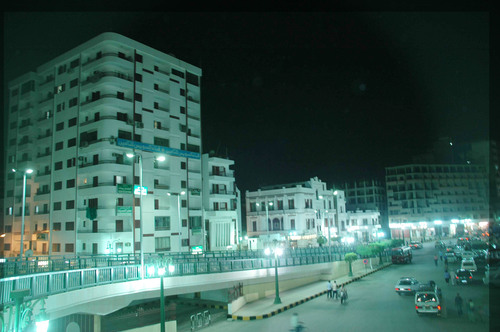
Today, the city of Asyut has around 528,000 inhabitants. It is the Egyptian city with one of the highest Coptic Christian concentrations of approximately 50%. It is also home to the Assiut University, one of the largest universities in Egypt, to the Assiut Barrage, and to the Lillian Trasher Orphanage.
The city is one of the only cities in the world that still makes silver appliqué-work shawls and is home to a large textile industry. The city also produces fine pottery, inlaid woodwork, and rugs.
Asyut is the terminus of the Ras Shukheir-Asyut oil pipeline, the terminus of the Cairo-Asyut gas pipeline and the beginning of the proposed Asyut-Qena gas pipeline, the last two being part of the Nile Valley Gas Company Pipeline Project. Aysut is next to the Aysut Dam across the Nile river in the neighboring port of Al-Hamra. The dam was built in 1902 and a hydroelectric plant was added in the 1980s.
Coptic Catholic Eparchy
On 10 August 1947, a Coptic Catholic eparchy (Eastern Catholic Diocese) of Assiut (or Lycopolis) was established on southern Egyptian territory split off from the Coptic Catholic Eparchy of Luqsor, each suffragan of Coptic Catholic Patriarch of Alexandria. Its episcopal see is the cathedral of the Mother of Divine Love, in Assyut.
;Suffragan Eparchs (Bishops) of Assiut (all Coptic Rite)
- Alexandros Scandar (9 August 1947 – death 29 December 1964)
- Youhanna Nueir, Friars Minor (O.F.M.) (26 March 1965 – retired 20 March 1990); previously Auxiliary Eparch of Luqsor of the Copts (Egypt) (8 December 1955 – 26 March 1965) & Titular Bishop of Phatanus (8 December 1955 – 26 March 1965)
- Kyrillos Kamal William Samaan, O.F.M. (16 May 1990 – 2022)
- Daniel Lotfy (2022–present)
Geography
Climate
Köppen-Geiger climate classification system classifies its climate as hot desert (BWh). It is the driest city of Egypt.{{cite web |access-date=20 June 2013 |archive-date=23 June 2012 |archive-url=https://web.archive.org/web/20120623100510/http://www.climate-charts.com/Countries/Egypt.html |url-status=dead
The highest record temperature was 51 C, recorded on July 23, 1994, while the lowest record temperature was -2 C, recorded on January 16, 2008.{{cite web
| Jan record high C = 32.2 | Feb record high C = 39.8 | Mar record high C = 44.2 | Apr record high C = 44.6 | May record high C = 47.8 | Jun record high C = 48.4 | Jul record high C = 44.3 | Aug record high C = 45.2 | Sep record high C = 43.5 | Oct record high C = 41.5 | Nov record high C = 37.6 | Dec record high C = 32.2 | year record high C = 48.4 | Jan record low C = 0.0 | Feb record low C = 1.2 | Mar record low C = 0.7 | Apr record low C = 6.2 | May record low C = 11.3 | Jun record low C = 15.4 | Jul record low C = 17.9 | Aug record low C = 18.0 | Sep record low C = 13.8 | Oct record low C = 10.7 | Nov record low C = 3.0 | Dec record low C = 0.9 | year record low C = 0.0 | archive-url = https://web.archive.org/web/20240703003426/ftp://ftp.atdd.noaa.gov/pub/GCOS/WMO-Normals/TABLES/REG__I/UB/62393.TXT | archive-date = 2024-07-03 | url-status = dead | access-date = October 25, 2015}} |access-date=12 December 2013 |archive-date=5 January 2014 |archive-url=https://web.archive.org/web/20140105192051/http://www.weather2travel.com/climate-guides/egypt/asyut.php |url-status=dead
Culture

The Alexan Pasha Palace was constructed in 1910 as a riverside residence of a local aristocratic family. It remained in possession of the family until 1995 when it was sold to the state. There are plans to restore the mansion and turn it into a museum.
Transport
Main article: Assiut Airport
Asyut is linked to Giza and northern cities by the road of Asyut western desert, eastern desert road and rural road, which also connects it to the railways. Also the railway station is linked to Alexandria in the north and Aswan in the south. In 1974, Assiut Airport was opened, renewed and expanded with a new terminal in 2011.
Notable people
- Plotinus, Neoplatonic philosopher 204 or 205 – 270 CE
- Coluthus, 5th century Greek poet
- Pope Shenouda III, Pope and Patriarch of the Egyptian Orthodox Church in Egypt and All Middle East
- Thutmose Kamel Gabrial, an Egyptian military pilot who was killed in action during the 1948 Palestine War.
- Gamal Abdel Nasser, second Egyptian president
- Samir Ghanem, comedian, singer, and entertainer
- Ahmed Lutfi el-Sayed, Egyptian nationalist
- Melitius of Lycopolis, founder of the Melitians.
- al-Suyuti, Sunni Muslim theologian who died in 1505
- Ali El-Araby, footballer
- Umar Makram, revolutionary and noble
- Regina Khayatt, feminist, educator, philanthropist, suffragist, and temperance worker
Twinnings
- Romania Iaşi, Romania
Notes
References
Bibliography
- Loprieno, Antonio: Ancient Egyptian: A Linguistic Introduction, Oxford University Press 1996.
- Baines & Malek Cultural Atlas of Ancient Egypt, 2000.
- Kahl, Jochem: "Ancient Asyut: The first Synthesis after Three Hundred Years of Research", The Asyut Project vol. I. Wiesbaden 2008.
References
- "Egypt: Governorates, Major Cities & Towns - Population Statistics, Maps, Charts, Weather and Web Information".
- (October 1, 2016). "Hiếu-ức quốc ???".
- Wilkinson, Toby. (2013). "The Rise and Fall of Ancient Egypt". Bloomsbury Publishing.
- [[Ptolemy. Ptol.]] iv. 5. § 63; [[Stephanus of Byzantium. Steph. B.]] ''s. v.''; [[Strabo]] xvii. p. 813)
- ([[Pliny the Elder. Plin.]] v. 9. s. 11)
- ([[Antonine Itinerary. Itin. Anton.]] p. 157)
- Macmillan & Co. (1905). "Guide to Egypt and the Sudan: Including a Description of the Route Through Uganda to Mombasa". Macmillan.
- {{Wikidata citation. Q114966099
- {{Wikidata citation. Q114913343
- {{Wikidata citation. Q121008728
- {{Wikidata citation. Q127175828
- {{Wikidata citation. Q124980359
- (ii. 88; comp. Aelian. ''Hist. An.'' x. 28)
- (Champollion, ''Descript. de l'Egypte'', vol. i. p. 276; Jollois, ''Egypte'', vol. ii. ch. 13.)
- (1928). "Dictionnaire des Noms Géographiques Contenus dans les Textes Hiéroglyphiques Vol. 5".
- Eichner, Ina (2020). ''Der Survey der spätantiken und mittelalterlichen christlichen Denkmäler in der Nekropole von Assiut/Lykopolis (Mittelägypten)'' [The survey of the late antique and medieval Christian monuments in the necropolis of Assiut/Lykopolis (Middle Egypt)]. The Asyut Project, vol. 14. Wiesbaden: Harrassowitz, {{ISBN. 978-3-447-11457-8.
- "Riding the Forty Days' Road".
- "Egypt". Citypopulation.de.
- "The Coptic Orthodox Church in action - Al-Ahram Weekly".
- "Asyūṭ Egypt".
- "North Africa Pipelines map - Crude Oil (petroleum) pipelines - Natural Gas pipelines - Products pipelines". Theodora.com/pipelines.
- "Alexan Palace".
- Vivian, Cassandra. (2008-01-01). "Western Desert of The Egypt". The Western Desert of Egypt.
- مبتدا. (2022-01-26). "عيد الطيران المدنى الـ 92.. مطارات مصر قصص الكفاح والتحدى".
- {{Cite CE1913
This article was imported from Wikipedia and is available under the Creative Commons Attribution-ShareAlike 4.0 License. Content has been adapted to SurfDoc format. Original contributors can be found on the article history page.
Ask Mako anything about Asyut — get instant answers, deeper analysis, and related topics.
Research with MakoFree with your Surf account
Create a free account to save articles, ask Mako questions, and organize your research.
Sign up freeThis content may have been generated or modified by AI. CloudSurf Software LLC is not responsible for the accuracy, completeness, or reliability of AI-generated content. Always verify important information from primary sources.
Report