From Surf Wiki (app.surf) — the open knowledge base
Asymptotic giant branch
Grouping of evolved cool luminous stars
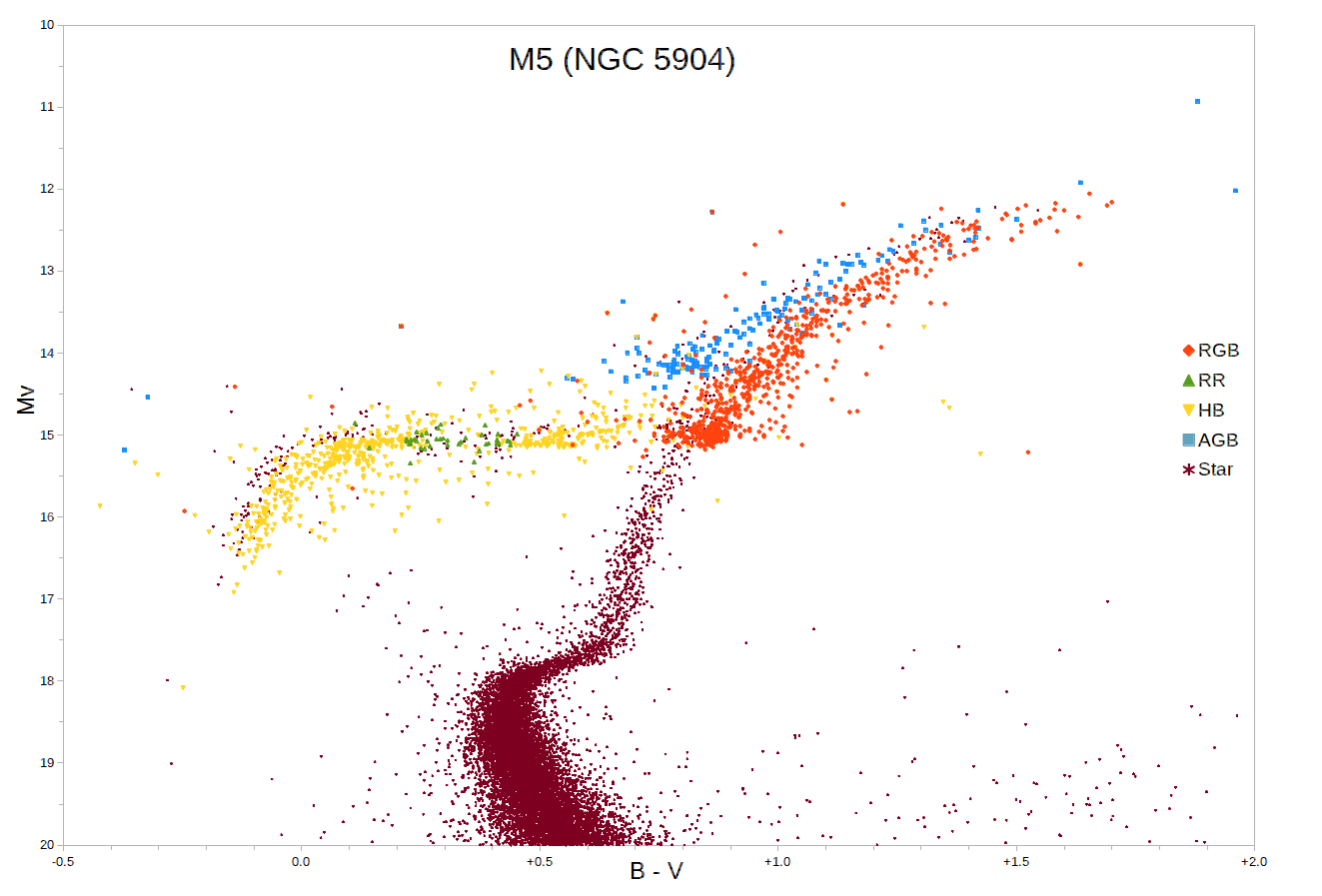
Grouping of evolved cool luminous stars
]] The asymptotic giant branch (AGB) is a region of the Hertzsprung–Russell diagram populated by evolved cool luminous stars. This is a period of stellar evolution undertaken by all low- to intermediate-mass stars (about 0.5 to 8 solar masses) late in their lives.
Observationally, an asymptotic-giant-branch star will appear as a bright red giant with a luminosity ranging up to thousands of times greater than the Sun. Its interior structure is characterized by a central and largely inert core of carbon and oxygen, a shell where helium is undergoing fusion to form carbon (known as helium burning), another shell where hydrogen is undergoing fusion forming helium (known as hydrogen burning), and a very large envelope of material of composition similar to main-sequence stars (except in the case of carbon stars). |editor1-last=Le Bertre |editor1-first=T. |editor2-last=Lebre |editor2-first=A. |editor3-last=Waelkens |editor3-first=C. |book-title=Asymptotic Giant Branch Stars
Stellar evolution


When a star exhausts the supply of hydrogen by nuclear fusion processes in its core, the core contracts and its temperature increases, causing the outer layers of the star to expand and cool. The star becomes a red giant, following a track towards the upper-right hand corner of the HR diagram.
After the completion of helium burning in the core, the star again moves to the right and upwards on the diagram, cooling and expanding as its luminosity increases. Its path is almost aligned with its previous red-giant track, hence the name asymptotic giant branch, although the star will become more luminous on the AGB than it did at the tip of the red-giant branch. Stars at this stage of stellar evolution are known as AGB stars. |doi-access=free
AGB stage
The AGB phase is divided into two parts, the early AGB (E-AGB) and the thermally pulsing AGB (TP-AGB). During the E-AGB phase, the main source of energy is helium fusion in a shell around a core consisting mostly of carbon and oxygen. During this phase, the star swells up to giant proportions to become a red giant again. The star's radius may become as large as one astronomical unit ().
After the helium shell runs out of fuel, the TP-AGB starts. Now the star derives its energy from fusion of hydrogen in a thin shell, which restricts the inner helium shell to a very thin layer and prevents it fusing stably. However, over periods of 10,000 to 100,000 years, helium from the hydrogen shell burning builds up and eventually the helium shell ignites explosively, a process known as a helium shell flash. The power of the shell flash peaks at thousands of times the observed luminosity of the star, but decreases exponentially over just a few years. The shell flash causes the star to expand and cool which shuts off the hydrogen shell burning and causes strong convection in the zone between the two shells. When the helium shell burning nears the base of the hydrogen shell, the increased temperature reignites hydrogen fusion and the cycle begins again. The large but brief increase in luminosity from the helium shell flash produces an increase in the visible brightness of the star of a few tenths of a magnitude for several hundred years. These changes are unrelated to the brightness variations on periods of tens to hundreds of days that are common in this type of star. |display-authors=etal

During the thermal pulses, which last only a few hundred years, material from the core region may be mixed into the outer layers, changing the surface composition, in a process referred to as dredge-up. Because of this dredge-up, AGB stars may show S-process elements in their spectra and strong dredge-ups can lead to the formation of carbon stars. All dredge-ups following thermal pulses are referred to as third dredge-ups, after the first dredge-up, which occurs on the red-giant branch, and the second dredge up, which occurs during the E-AGB. In some cases there may not be a second dredge-up but dredge-ups following thermal pulses will still be called a third dredge-up. Thermal pulses increase rapidly in strength after the first few, so third dredge-ups are generally the deepest and most likely to circulate core material to the surface. |display-authors=etal |doi-access=free
AGB stars are typically long-period variables, and suffer mass loss in the form of a stellar wind. For M-type AGB stars, the stellar winds are most efficiently driven by micron-sized grains. Thermal pulses produce periods of even higher mass loss and may result in detached shells of circumstellar material. A star may lose 50 to 70% of its mass during the AGB phase. |doi-access=free
Circumstellar envelopes of AGB stars

The extensive mass loss of AGB stars means that they are surrounded by an extended circumstellar envelope (CSE). Given a mean AGB lifetime of one Myr and an outer velocity of , its maximum radius can be estimated to be roughly (30 light years). This is a maximum value since the wind material will start to mix with the interstellar medium at very large radii, and it also assumes that there is no velocity difference between the star and the interstellar gas.
These envelopes have a dynamic and interesting chemistry, much of which is difficult to reproduce in a laboratory environment because of the low densities involved. The nature of the chemical reactions in the envelope changes as the material moves away from the star, expands and cools. Near the star the envelope density is high enough that reactions approach thermodynamic equilibrium. As the material passes beyond about the density falls to the point where kinetics, rather than thermodynamics, becomes the dominant feature. Some energetically favorable reactions can no longer take place in the gas, because the reaction mechanism requires a third body to remove the energy released when a chemical bond is formed. In this region many of the reactions that do take place involve radicals such as OH (in oxygen rich envelopes) or CN (in the envelopes surrounding carbon stars). In the outermost region of the envelope, beyond about , the density drops to the point where the dust no longer completely shields the envelope from interstellar UV radiation and the gas becomes partially ionized. These ions then participate in reactions with neutral atoms and molecules. Finally as the envelope merges with the interstellar medium, most of the molecules are destroyed by UV radiation.
The temperature of the CSE is determined by heating and cooling properties of the gas and dust, but drops with radial distance from the photosphere of the stars which are –. Chemical peculiarities of an AGB CSE outwards include:
- Photosphere: Local thermodynamic equilibrium chemistry
- Pulsating stellar envelope: Shock chemistry
- Dust formation zone
- Chemically quiet
- Interstellar ultraviolet radiation and photodissociation of molecules – complex chemistry
The dichotomy between oxygen-rich and carbon-rich stars has an initial role in determining whether the first condensates are oxides or carbides, since the least abundant of these two elements will likely remain in the gas phase as COx.
In the dust formation zone, refractory elements and compounds (Fe, Si, MgO, etc.) are removed from the gas phase and end up in dust grains. The newly formed dust will immediately assist in surface catalyzed reactions. The stellar winds from AGB stars are sites of cosmic dust formation, and are believed to be the main production sites of dust in the universe.
The stellar winds of AGB stars (Mira variables and OH/IR stars) are also often the site of maser emission. The molecules that account for this are SiO, H2O, OH, HCN, and SiS.{{cite journal |doi-access=free
After these stars have lost nearly all of their envelopes, and only the core regions remain, they evolve further into short-lived protoplanetary nebula. The final fate of the AGB envelopes are represented by planetary nebulae (PNe).
Physical samples
Main article: Presolar grains
Physical samples, known as presolar grains, of mineral grains from AGB stars are available for laboratory analysis in the form of individual refractory presolar grains. These formed in the circumstellar dust envelopes and were transported to the early Solar System by stellar wind. A majority of presolar silicon carbide grains have their origin in 1–3 M☉carbon stars in the late thermally-pulsing AGB phase of their stellar evolution.
Late thermal pulse
As many as a quarter of all post-AGB stars undergo what is dubbed a "born-again" episode. The carbon–oxygen core is now surrounded by helium with an outer shell of hydrogen. If the helium is re-ignited a thermal pulse occurs and the star quickly returns to the AGB, becoming a helium-burning, hydrogen-deficient stellar object. If the star still has a hydrogen-burning shell when this thermal pulse occurs, it is termed a "late thermal pulse". Otherwise it is called a "very late thermal pulse". |editor1-last=Sterken |editor1-first=C. |editor2-last=Kurtz |editor2-first=D. W. |book-title=Observational aspects of pulsating B and A stars
The outer atmosphere of the born-again star develops a stellar wind and the star once more follows an evolutionary track across the Hertzsprung–Russell diagram. However, this phase is very brief, lasting only about 200 years before the star again heads toward the white dwarf stage. Observationally, this late thermal pulse phase appears almost identical to a Wolf–Rayet star in the midst of its own planetary nebula.
Stars such as Sakurai's Object and FG Sagittae are being observed as they rapidly evolve through this phase.
Mapping the circumstellar magnetic fields of thermal-pulsating (TP-) AGB stars has recently been reported using the so-called Goldreich-Kylafis effect.
Super-AGB stars
Main article: Super-AGB star
Stars close to the upper mass limit to still qualify as AGB stars show some peculiar properties and have been dubbed super-AGB stars. They have masses above and up to 9 or (or more |doi-access=free
References
References
- Höfner, Susanne. (2018-01-09). "Mass loss of stars on the asymptotic giant branch". The Astronomy and Astrophysics Review.
- Höfner, S.. (2008-11-01). "Winds of M-type AGB stars driven by micron-sized grains". Astronomy & Astrophysics.
- (2018-01-09). "Mass loss of stars on the asymptotic giant branch". The Astronomy and Astrophysics Review.
- (November 2020). "Explaining the winds of AGB stars: Recent progress". Proceedings of the International Astronomical Union.
- (1984). "Mass Loss from Red Giants (Morris & Zuckerman Eds)". Springer.
- (2006). "Massive-Star Supernovae as Major Dust Factories". Science.
- (1979). "Catalogue of late-type stars with OH, H2O or SiO maser emission". Astronomy and Astrophysics Supplement Series.
- (1 January 2014). "1.4 – Presolar Grains". Treatise on Geochemistry (Second Edition).
- (September 1983). "Asymptotic Giant Branch Evolution and Beyond". Annual Review of Astronomy and Astrophysics.
- (July 2020). "Mapping circumstellar magnetic fields of late-type evolved stars with the Goldreich-Kylafis effect: CARMA observations at $\lambda 1.3$ mm of R Crt and R Leo". The Astrophysical Journal.
This article was imported from Wikipedia and is available under the Creative Commons Attribution-ShareAlike 4.0 License. Content has been adapted to SurfDoc format. Original contributors can be found on the article history page.
Ask Mako anything about Asymptotic giant branch — get instant answers, deeper analysis, and related topics.
Research with MakoFree with your Surf account
Create a free account to save articles, ask Mako questions, and organize your research.
Sign up freeThis content may have been generated or modified by AI. CloudSurf Software LLC is not responsible for the accuracy, completeness, or reliability of AI-generated content. Always verify important information from primary sources.
Report