From Surf Wiki (app.surf) — the open knowledge base
Asura
Mythical beings in Indian religions
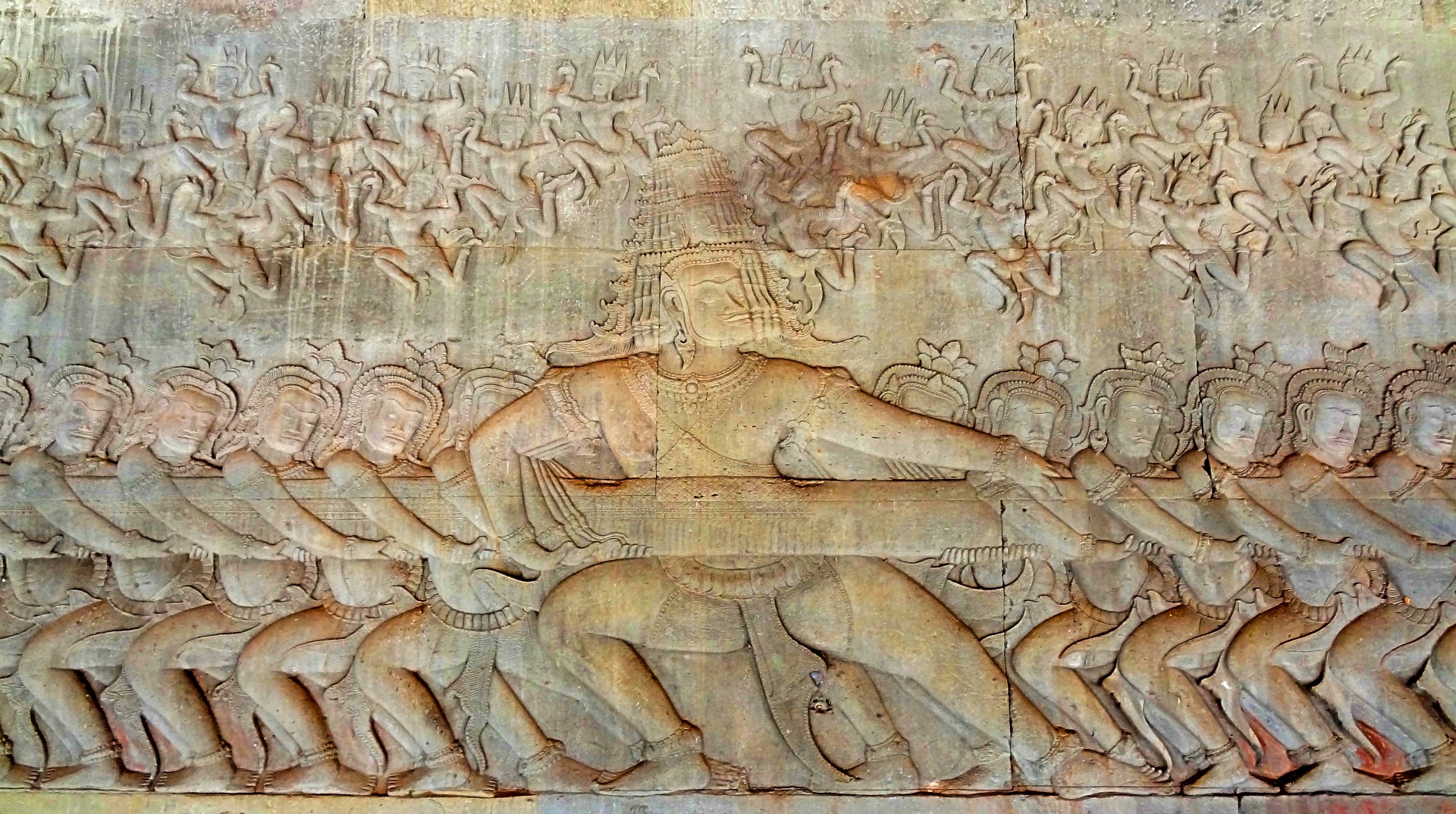
Mythical beings in Indian religions
Asura in Indian religions
Asuras () are a class of beings in Indian religions. They are described as power-seeking beings related to the more benevolent Devas (also known as Suras) in Hinduism. In its Buddhist context, the word is translated as "titan," "demigod," or "antigod".
According to Hindu texts, the asuras are in constant fear of the devas. Asuras are described in Indian texts as powerful superhuman demigods with good or bad qualities. In early Vedic literature, the good Asuras are called Adityas and are led by Varuna, while the malevolent ones are called Danavas and are led by Vritra. In the earliest layer of Vedic texts, Agni, Indra and other gods are also called Asuras, in the sense of their being "lords" of their respective domains, knowledge and abilities. In later Vedic and post-Vedic texts, the benevolent gods are called Devas, while malevolent Asuras compete against these Devas and are considered "enemy of the gods".
Asuras are part of Hinduism along with Yakshas (nature spirits), Rakshasas (fierce man-eating beings or demons), Bhutas (ghosts) and many more. Asuras have been featured in many cosmological theories and legends in Hinduism and Buddhism.
Etymology
Traditional etymologies
Asura is a given name by Devas to other races collectively where Asura means* not-sura* (with sura being another name for Devas).
The 5th century Buddhist philosopher, Buddhaghosa explains that their name derives from the myth of their defeat at the hands of the god Śakra. According to the story, the asura were dispossessed of their state in Trāyastriṃśa because they became drunk and were thrown down Mount Sumeru. After this incident, they vowed never to drink sura again. In some Buddhist literature, they are sometimes referred to as pūrvadeva (Pāli: pubbadeva), meaning "ancient gods."
Modern scholarship
There is a wide consensus in modern scholarship that the Old Indic term Asura is cognate with Old Iranian Ahura, a term desginating a group of benevolent supernatural beings which are in conflict with the malevolent Daevas. Both Sanskrit असुर (asura) and Avestan 𐬀𐬵𐬎𐬭𐬀 (ahura) derive from the common Proto-Indo-Iranian hásuras, with the meaning lord. According to Finnish Indologist Asko Parpola, the word *hásuras was also borrowed from the Proto-Indo-Iranian language into Proto-Uralic during an early period of contact, in the form *asera-, likewise with the meaning lord or prince. The term is also etymologically related to Old Norse Æsir, indicating that the Indo-Iranian *hásuras has an even earlier Proto-Indo-European root.
Monier-Williams traces the etymological roots of asura () to asu (), which means 'life of the spiritual world' or 'departed spirits'.
finds that the oldest verses of Vedic texts (the earliest Samhita layer), the word Asuras is used to refer to any spiritual, divine being, including both those with good or with bad intentions, and with constructive or with destructive inclinations or dispositions. Whereas the late verses of the Samhita texts instead describe the Asuras as "evil spirits, demons, and opponents of the gods" . In this use of asura it connotes chaos-creating, malevolent, evil faction, in the parts of Indo-Iranian mythology centered on the battle between good and evil.
In Hindu literature
''Rig Veda''
Bhargava states the word, asura, including its variants, asurya and asura, occurs "88 times in the Rig Veda, 71 times in the singular number, 4 times in the dual, 10 times in the plural, and 3 times as the first member of a compound. In this, the feminine form, asuryaa, is included twice. The word, asurya, has been used 19 times as an abstract noun, while the abstract form asuratva occurs 24 times, 22 times in one hymn and twice each in two other hymns".
Bhargava gives a count of the word use for every Vedic deity: Asura is used as an adjective meaning "powerful" or "mighty". In the Rig Veda, two generous kings – as well as some priests – have been described as asuras. One hymn requests a son who is an asura. In nine hymns, Indra is described as asura. He is said to possess asurya 5 times, and once he is said to possess asuratva. Agni has total of 12 asura descriptions, Varuna has 10, Mitra has 8, and Rudra has 6. Book 1 of the Rig Veda describes Savitr (Vedic solar deity) as an asura who is a "kind leader".
हिरण्यहस्तो असुरः सुनीथः सुमृळीकः स्ववाँ यात्वर्वाङ् । अपसेधन्रक्षसो यातुधानानस्थाद्देवः प्रतिदोषं गृणानः ॥१०॥
May he, gold-handed Asura, kind leader, come hither to us with his help and favour. Driving off Raksasas and Yatudhanas, [he] the god is present, praised in hymns at evening. – Translated by Ralph Griffith
The golden-handed lord of good guidance, of good grace, of good help—let him drive in our direction. Repelling demons and sorcerers, the god has taken his place facing evening, while being hymned. – Translated by Stephanie W. Jamison, Joel P. Brereton |Rig Veda 1.35.10}}
Samaveda
In the Jaiminya (3.35.3) – one of three recensions of the SamaVeda – the term 'Asura' is stated to be derived from 'rests' (√ram) in the vital airs (asu), i.e. 'Asu' + 'ram' = 'Asuram' (Asura); this is in reference to the mind being 'asura[-like]'.
Mahabharata
According to the Bhagavad Gita (16.6-16.7), all beings in the universe have both the divine qualities (daivi sampad) and the demonic qualities (asuri sampad) within each. The sixteenth chapter of the Bhagavad Gita states that pure god-like saints are rare and pure demon-like evil are rare among human beings, and the bulk of humanity is multi-charactered with a few or many faults. According to Jeaneane Fowler, the Gita states that desires, aversions, greed, needs, emotions in various forms "are facets of ordinary lives", and it is only when they turn to lust, hate, cravings, arrogance, conceit, anger, harshness, hypocrisy, cruelty and such negativity- and destruction-inclined that natural human inclinations metamorphose into something demonic (Asura).
Brahmanda Purana

In the Brahmanda Purana, it is stated the term 'Asura' was used for the Daityas due to their rejection of Varuni (Goddess of Wine) after she emerged from the Ocean of Milk (i.e. 'a-sura', meaning 'those who do not have ''Sura''', that is, 'wine' or more generally 'liquor'). However, in other legends, the Asuras accept Varuni (see Kurma).
Vishnu Purana
According to the Vishnu Purana, during the Samudra Manthana or the "churning of the ocean", the daityas came to be known as asuras because they rejected Varuni, the goddess of sura "wine", while the devas accepted her and came to be known as suras.

Shiva Purana
Alain Daniélou states that Asuras were initially good, virtuous and powerful in Indian mythology. However, their nature gradually changed and they came to represent evil, vice and abuse of power. In Shiva Purana, they evolved into anti-gods and had to be destroyed because they threatened the gods.
The asuras (anti-gods) were depicted to have become proud, vain, to have stopped performing sacrifices, to violate sacred laws, not visit holy places, not cleanse themselves from sin, to be envious of devas, torturous of living beings, creating confusion in everything and challenging the devas.
Alain Daniélou states that the concept of asuras evolved with changing socio-political dynamics in ancient India. Asuras gradually assimilated the demons, spirits, and ghosts worshipped by the enemies of Vedic people, and this created the myths of the malevolent asuras and the rakshasa. The allusions to the disastrous wars between the asuras and the suras, found in the Puranas and the epics, may be the conflict faced by people and migrants into ancient India.
Context
Scholars have disagreed on the nature and evolution of the asura concept in ancient Indian literature. The most widely studied scholarly views on Asura concept are those of F.B.J. Kuiper, W. Norman Brown, Haug, von Bradke, Otto, Benveniste, Konow, Rajwade, Dandekar, Darmesteter, Bhandarkar, and Raja, Banerji-Sastri, Padmanabhayya, Skoeld, S.C. Roy, Kumaraswamy, Shamasastry, Przyluski, Schroeder, Burrows, Hillebrandt, Taraporewala, Lommel, Fausboll, Segerstedt, Thieme, Gerschevitch, Boyce, Macdonnell, Hermann Oldenberg, Geldner, Venkatesvaran, and Jan Gonda.
Kuiper calls Asuras a special group of gods in one of major Vedic theories of creation of the universe. Their role changes only during and after the earth, sky, and living beings have been created. The sky world becomes that of Devas, the underworld becomes that of Asuras. The god Indra is the embodiment of good and represents the Devas, while the dragon Vrtra is the embodiment of evil and an Asura. During this battle between good and evil, creation and destruction, some powerful Asuras side with the good and are called Devas, other powerful Asuras side with the evil and thereafter continue to be called Asuras. This is the first major dualism to emerge in the nature of everything in the Universe. , in his review, states that Kuiper's theory on Asura is plausible, but weak, because the Vedas never call Vrtra (the central character) an Asura, as the text does describe many other powerful beings. Secondly, Rig Veda never explicitly classifies Asura as a "group of gods" states Hale, and this is a presumption of Kuiper.
Many scholars describe Asuras to be "lords" with different specialized knowledge, magical powers and special abilities, which only later choose to deploy these for good, constructive reasons or for evil, destructive reasons. The former become known as Asura in the sense of Devas, the later as Asura in the sense of demons. Kuiper, Brown, Otto and others are in this school; however, none of them provide an explanation and how, when and why Asura came ultimately to mean demon.
Ananda Coomaraswamy suggested that Devas and Asuras can be best understood as being similar in concept to the Twelve Olympians and the titans of Greek mythology: Both are powerful, but have different orientations and inclinations – in Hindu mythology the Devas represent the powers of light and the Asuras represent the powers of darkness.
Indo-Aryan context
In the 19th century, Haug pioneered the idea that the term Asura is linguistically related to the Ahuras of Indo-Aryan people and pre-Zoroastrianism era. In both religions, Ahura of pre-Zoroastrianism (Asura of Indian religions), Vouruna (Varuna) and Daeva (Deva) are found, but their roles are on opposite sides.
The relationship between ahuras / asuras and daevas / devas in Indo-Aryan times, was discussed at length by F.B.J. Kuiper. This theory and other Avesta-related hypotheses developed over the 20th century, are all now in question, particularly for lack of archaeological evidence.
Relation to Germanic deities
Main article: Æsir
Some scholars such as Asko Parpola suggest that the word Asura may be related to proto-Uralic and proto-Germanic history. The Aesir-Asura correspondence is the relation between Vedic Sanskrit Asura and Old Norse Æsir and Proto-Uralic *asera, all of which mean 'lord, powerful spirit, god'. Parpola states that the correspondence extends beyond Asera / Asura, and extends to a host of parallels such as Inmar-Indra, Sampas-Stambha and many other elements of respective mythologies.
Characteristics
In the earliest Vedic literature, all supernatural beings are called Devas and Asuras. A much-studied hymn of the Rig Veda states Devav asura (Asuras who have become Devas), and contrasts it with Asura adevah (Asuras who are not Devas).}} Each Asura and Deva emerges from the same father (Prajapati), share the same residence (Loka), eat together the same food and drinks (Soma), and have innate potential, knowledge and special powers in Hindu mythology; the only thing that distinguishes "Asura who become Deva" from "Asura who remain Asura" is intent, action and choices they make in their mythic lives.
"Asuras who remain Asura" share the character of powerful beings obsessed with their craving for ill-gotten Soma, and for wealth, ego, anger, unprincipled nature, force, and violence.
The hostility between the two groups is the source of extensive legends, tales, and literature in Hinduism; however, many texts discuss their hostility in neutral terms – without explicit moral connotations or condemnation.
In Buddhist mythology, while all the gods of the Kāmadhātu are subject to passions to some degree, the asuras above all are addicted to them, especially wrath, pride, envy, insincerity, falseness, boasting, and bellicosity. The asuras are said to experience a much more pleasurable life than humans, but they are plagued by envy for the devas, whom they can see just as animals perceive humans.
Symbolism
Edelmann and other scholars state that the dualistic concept of Asura and Deva in Hinduism is a form of symbolism found throughout its ancient and medieval literature. In the Upanishads, for example, Devas and Asuras go to Prajāpati to understand what is Self (Atman, soul) and how to realize it. The first answer that Prajāpati gives is simplistic, which the Asuras accept and leave with, but the Devas led by Indra do not accept and question because Indra finds that he hasn't grasped its full significance and the given answer has inconsistencies.
The god (Deva) and antigod (Asura), states Edelmann, are also symbolically the contradictory forces that motivate each individual and people, and thus Deva-Asura dichotomy is a spiritual concept rather than mere genealogical category or species of being.
Asuri
Asuri is the feminine of an adjective from asura and in later texts means 'belonging to or having to do with demons and spirits'. Asuri parallels Asura in being "powerful beings", and in early Vedic texts includes all goddesses. The term Asuri also means a Rakshasi in Indian texts.
The powers of an Asuri are projected into plants offering a remedy against leprosy.
First, before all, the strong-winged Bird was born, thou wast the gall thereof. Conquered in fight, the Asuri took then the shape and form of plants. The Asuri made, first of all, this medicine for leprosy, this banisher of leprosy. She banished leprosy, and gave one general colour to the skin. |A charm against leprosy, Atharva Veda, Hymn 1.24|}}
In Book 7, Asuri is a powerful female with the special knowledge of herbs, who uses that knowledge to seduce Deva Indra in Atharva Veda. A hymn invokes this special power in Asuri, and this hymn is stipulated for a woman as a charm to win over the lover she wants.
I dig this Healing Herb that makes my lover look on me and weep, That bids the parting friend return and kindly greets him as he comes. This Herb wherewith the Asuri drew Indra downward from the Gods, With this same Herb I draw thee close that I may be most dear to thee.
Thou art the peer of Soma, yea, thou art the equal of the Sun, The peer of all the Gods art thou: therefore we call thee hitherward. I am the speaker here, not thou: speak thou where the assembly meets. Thou shalt be mine and only mine, and never mention other dames.
If thou art far away beyond the rivers, far away from men, This Herb shall seem to bind thee fast and bring thee back my prisoner. |A maiden's love-charm, Atharva Veda, Hymn 7.38|}}
Similarly, in the Atharva Veda, all sorts of medical remedies and charms are projected as Asuri manifested in plants and animals.
Buddhism

Main article: Asura (Buddhism)
Asuras (; ; ) are a type of supernatural beings (antigods, demigods, or titans) in traditional Buddhist cosmology and a realm of rebirth based on one's karma in current or past lives. They are described in Buddhist texts as creatures who live in lower levels of mount Sumeru, obsessed with sensuous aspects of existence, living with jealousy, and endlessly engaged in wars against the creatures who are Devas (gods).
Asura realm
The asura realm is one of the realms in which one can be reborn as a result of experiencing the fruits of wholesome karma, while engaging in unwholesome karma. Generally, the desire realm is recognized as consisting of five realms and the realm of the asuras tends to be included among the deva realms, but the addition of the asuras in the six-world bhavacakra was created in Tibet at the authority of Je Tsongkhapa.
Deva-Asura War
The asuras were dispossessed of their state in Trāyastriṃśa because they became drunk and were thrown down Mount Sumeru by the bodhisatta, as mentioned in Jatakas. This led to ever lasting war between the Devas of Tavatimsa and Asuras.
Asurendra
In Buddhism, the leaders of the asuras are called asurendra (Pāli: Asurinda, 阿修羅王; lit. "Asura-lord"). There are several of these, as the asuras are broken into different tribes or factions. In Pali texts, names that are found include Vepacitti, Rāhu (Verocana), Pahārāda, Sambara, Bali, Sucitti, and Namucī. According to the Lotus Sutra, the four leaders of the asuras took refuge in the Buddha after hearing his sermon.
References
References
- A. Sanducci Ancient Scholars about the Turks and the Turkic Nations. World Scholarly Press 01.05.2022 p. 440
- Robert Beer. The ''Handbook of Tibetan Buddhist Symbols'' Serindia Publications 2003 {{ISBN. 978-1-932-47603-3 page 246
- "Britannica Academic".
- Singoji, Umamaheshwar. (2017). "Who were Asuras? India and Iran's ancient links".
- Don Handelman (2013), ''One God, Two Goddesses, Three Studies of South Indian Cosmology'', Brill Academic, {{ISBN. 978-90-04-25615-6, pages 23–29
- Wendy Doniger (1988), ''Textual Sources for the Study of Hinduism'', Manchester University Press, {{ISBN. 978-0-7190-1866-4, p. 67
- Robert E. Buswell Jr. (2013). "The Princeton Dictionary of Buddhism". Princeton University Press.
- (2007). "Dictionary of Pali Proper Names". Motilal Banarsidass Publishers.
- (1986). "Ásura- in Early Vedic Religion". Motilal Banarsidass Publishers.
- (2000). "A Comparative Study of Religions". Motilal Banarsidass Publ..
- (1989). "A History of Zoroastrianism: The Early Period". BRILL.
- (2024). "Old Avestan Dictionary". Research Institute for Languages and Cultures of Asia and Africa; Tokyo Language of Foreign Studies.
- Parpola, Asko. (2015). "The Roots of Hinduism: The early Aryans and the Indus civilization". Oxford University Press.
- Kroonen, Guus. (2013). "Etymological Dictionary of Proto-Germanic.". Brill.
- Monier-Williams, Monier. (1899). "A Sanskrit-English Dictionary". Motilal Banarsidass.
- P.L. Bhargava, ''Vedic Religion and Culture'', South Asia Books, {{ISBN. 978-81-246-0006-1
- [https://sa.wikisource.org/wiki/ऋग्वेद:_सूक्तं_१०.२२ ''Rig Veda''] Sanskrit text, Wikisource
- [[Wikisource:The Rig Veda/Mandala 1/Hymn 35. Mandala 1, Hymn 35]] Ralph T Griffith, Wikisource
- Stephanie Jamison. (2015). "The Rigveda – Earliest religious poetry of India". Oxford University Press.
- Oertel, Hanns. (1896). "The Jāiminīya or Talavakāra Upaniṣad Brāhmaṇa". Journal of the American Oriental Society; JSTOR.
- Jeaneane D Fowler (2012), The Bhagavad Gita, Sussex Academic Press, {{ISBN. 978-1-84519-346-1, pages 253-262
- Christopher K Chapple (2010), The Bhagavad Gita: Twenty-fifth–Anniversary Edition, State University of New York Press, {{ISBN. 978-1-4384-2842-0, pages 610-629
- G.V.Tagare. "Brahmanda Purana - English Translation - Part 4 of 5".
- "Sanskrit Dictionary for Spoken Sanskrit: 'Sura'".
- Roshen Dalal (2011). Hinduism: An Alphabetical Guide, p.46. Penguin Books India. {{ISBN
- Alain Daniélou (1991). ''The Myths and Gods of India: The Classic Work on Hindu Polytheism from the Princeton Bollingen Series'', [https://archive.org/details/mythsgodsofindia00dani/page/141 pp. 141–142]. Inner Traditions / Bear & Co. {{ISBN. 0-89281-354-7.
- Kuiper, F.B.J.. (1975). "The Basic Concept of Vedic Religion".
- Bahadur, Om Lata. (1996). "The Book of Hindu Festivals and Ceremonies". UBS Publishers Distributors.
- Coomaraswamy, Ananda. (1935). "Angel and titan: An essay in Vedic ontology". [[Journal of the American Oriental Society]].
- Kuiper, F.B.J.. (1983). "Ancient Indian Cosmogony".
- (1993). "*Daiva". Mazda.
- Adams, Douglas. (1997). "King". Routledge.
- "Deva".
- (4 July 2013). "Encyclopedia of Ancient Deities". Routledge.
- Williams, George. (2008). "A Handbook of Hindu Mythology". Oxford University Press.
- Hale, Wash Edward. (1999). "Ásura in Early Vedic Religion". Motilal Barnarsidass.
- "ऋग्वेदः मण्डल ८".
- (1993). "Asian Mythologies". University of Chicago Press.
- Gier, Nicholas. (1995). "Hindu titanism". Philosophy East and West.
- (1986). "The Hindu Temple". Motilal Banarsidass.
- (2000). "Merriam-Webster's Encyclopedia of World Religions". Merriam-Webster.
- Jonathan Edelmann (2013), Hindu Theology as Churning the Latent, Journal of the American Academy of Religion, Volume 81, Issue 2, pages 427-466
- Doris Srinivasan (1997), Many Heads, Arms and Eyes: Origin, Meaning, and Form of Multiplicity in Indian Art, Brill Academic, {{ISBN. 978-90-04-10758-8, pages 130-131
- Edelmann states that this symbolism embedded in the Upanishads is a reminder that one must struggle with presented ideas, learning is a process, and Deva nature emerges with effort. Similar dichotomies are present in the [[Purana]]s literature of Hinduism, where god Indra (a Deva) and the antigod Virocana (an Asura) question a sage for insights into the knowledge of the self. Virocana leaves with the first given answer, believing now he can use the knowledge as a weapon. In contrast, Indra keeps pressing the sage, churning the ideas, and learning about means to inner happiness and power. Edelmann suggests that the Deva-Asura dichotomies in Hindu mythology may be seen as "narrative depictions of tendencies within our selves".Jonathan Edelmann (2013), Hindu Theology as Churning the Latent, Journal of the American Academy of Religion, Volume 81, Issue 2, pages 439-441
- In the Bhāgavata Purana, saints and gods are born in families of Asuras, such as [[Mahabali]] and [[Prahlada]], conveying the symbolism that motivations, beliefs and actions rather than one's birth and family circumstances define whether one is Deva-like or Asura-like.Jonathan Edelmann (2013), Hindu Theology as Churning the Latent, Journal of the American Academy of Religion, Volume 81, Issue 2, pages 440-442
- American Oriental Society (1852). Proceedings (American Oriental Society) 1874-1893, p.xv
- Coburn, Thomas B. (1988). Devī-Māhātmya, p.200. Motilal Banarsidass Publications. {{ISBN. 81-208-0557-7
- [[Henk Bodewitz. Bodewitz, H. W.]] (1990). The Jyotiṣṭoma Ritual: Jaiminīya Brāhmaṇa I, 66-364, p.265. Volume 34 of Orientalia Rheno-traiectina. {{ISBN. 90-04-09120-3
- Shende, N.J. (1967). Kavi and kāvya in the Atharvaveda, p. 22. Issue 1 of Publications of the Centre of Advanced Study in Sanskrit, Centre of Advanced Study in Sanskrit, University of Poona
- Garg, Gaṅgā Rām (1992). Encyclopaedia of the Hindu World: Ar-Az, p.751. Volume 3 of Encyclopaedia of the Hindu World. Concept Publishing Company. {{ISBN. 81-7022-373-3
- [https://archive.org/stream/hymnsatharvaved00unkngoog#page/n52/mode/2up Hymns of the Atharva Veda], [[Ralph T. H. Griffith]] (Translator), Luzac and Co., London, pages 28-29
- [https://archive.org/stream/hymnsatharvaved00unkngoog#page/n368/mode/2up Hymns of the Atharva Veda], Ralph T.H. Griffith (Translator), Luzac and Co., London, page 344
- Goudriaan, Teun & Gupta, Sanjukta (1981). Hindu Tantric and Śākta Literature, p.114. Otto Harrassowitz Verlag. {{ISBN. 3-447-02091-1
- Norman C. McClelland. (2010). "Encyclopedia of Reincarnation and Karma". McFarland.
- (2013). "The Princeton Dictionary of Buddhism". Princeton University Press.
This article was imported from Wikipedia and is available under the Creative Commons Attribution-ShareAlike 4.0 License. Content has been adapted to SurfDoc format. Original contributors can be found on the article history page.
Ask Mako anything about Asura — get instant answers, deeper analysis, and related topics.
Research with MakoFree with your Surf account
Create a free account to save articles, ask Mako questions, and organize your research.
Sign up freeThis content may have been generated or modified by AI. CloudSurf Software LLC is not responsible for the accuracy, completeness, or reliability of AI-generated content. Always verify important information from primary sources.
Report