From Surf Wiki (app.surf) — the open knowledge base
Astrological sign
Twelve 30° sectors of the ecliptic, as defined by Western astrology

Twelve 30° sectors of the ecliptic, as defined by Western astrology
In Western astrology, astrological signs are the zodiac, twelve 30-degree sectors that are crossed by the Sun's 360-degree orbital path as viewed from Earth in its sky. The signs enumerate from the first day of spring, known as the First Point of Aries, which is the vernal equinox. The astrological signs are Aries, Taurus, Gemini, Cancer, Leo, Virgo, Libra, Scorpio, Sagittarius, Capricorn, Aquarius, and Pisces. The Western zodiac originated in Babylonian astrology, and was later influenced by the Hellenistic culture. Each sign was named after a constellation the sun annually moved through while crossing the sky. This observation is emphasized in the simplified and popular sun sign astrology. Over the centuries, Western astrology's zodiacal divisions have shifted out of alignment with the constellations they were named after by axial precession of the Earth while Hindu astrology measurements correct for this shifting. Astrology (i.e. a system of omina based on celestial appearances) was developed in Chinese and Tibetan cultures as well but these astrologies are not based upon the zodiac but deal with the whole sky.
Astrology is a pseudoscience. Scientific investigations of the theoretical basis and experimental verification of claims have shown it to have no scientific validity or explanatory power. More plausible explanations for the apparent correlation between personality traits and birth months exist, such as the influence of seasonal birth in humans.
According to astrology, celestial phenomena relate to human activity on the principle of "as above, so below", so that the signs are held to represent characteristic modes of expression. Scientific astronomy used the same sectors of the ecliptic as Western astrology until the 19th century.
Various approaches to measuring and dividing the sky are currently used by differing systems of astrology, although the tradition of the Zodiac's names and symbols remain mostly consistent. Western astrology measures from Equinox and Solstice points (points relating to equal, longest, and shortest days of the tropical year), while Hindu astrology measures along the equatorial plane (sidereal year).
Western zodiac signs
History
Main article: Zodiac, History of astrology

Western astrology is a direct continuation of Hellenistic astrology as recorded in Ptolemy's Tetrabiblos in the 2nd century. Hellenistic astrology in turn was partly based on concepts from Babylonian tradition. Specifically, the division of the ecliptic in twelve equal sectors is a Babylonian conceptual construction.Sachs (1948), p. 289. Isolated references to celestial "signs" in Sumerian sources are insufficient to speak of a Sumerian zodiac, see Rochberg (1998), p. ix. This division of the ecliptic originated in the Babylonian "ideal calendar" found in the old compendium MUL.APIN and its combination with the Babylonian lunar calendar, represented as the "path of the moon" in MUL.APIN. In a way, the zodiac is the idealisation of an ideal lunar calendar.
By the 4th century BC, Babylonian astronomy and its system of celestial omens influenced the culture of ancient Greece, as did the astronomy of Egypt by late 2nd century BC. This resulted, unlike the Mesopotamian tradition, in a strong focus on the birth chart of the individual and the creation of Horoscopic astrology, employing the use of the Ascendant (the rising degree of the ecliptic, at the time of birth), and of the twelve houses. Association of the astrological signs with Empedocles' four classical elements was another important development in the characterization of the twelve signs.
The body of the Hellenistic astrological tradition as it stood by the 2nd century is described in Ptolemy's Tetrabiblos. This is the seminal work for later astronomical tradition not only in the West but also in India and the Islamic sphere and has remained a reference for almost seventeen centuries as later traditions made few substantial changes to its core teachings.
Western astrological correspondence chart
The following table shows the approximate dates of the twelve astrological signs, along with the classical and modern rulerships of each sign. By definition, Aries starts at the First Point of Aries which is the location of the Sun at the March equinox. The precise date of the Equinox varies from year to year but is always between 19 March and 21 March. The consequence is the start date of Aries and therefore the start date of all the other signs can change slightly from year to year. The following Western astrology table enumerates the twelve divisions of celestial longitude with the Latin names. The longitude intervals, are treated as closed for the first endpoint (a) and open for the second (b) – for instance, 30° of longitude is the first point of Taurus, not part of Aries. The signs are occasionally numbered 0 through 11 in place of symbols in astronomical works. Please Note. The start date-time for ALL signs changes each year. Consequently the dates differ from one reference text to another. Please don't correct the dates one year and then put them back the year after. It is not helpful and in one case this harmless date nudging hid a deliberate malicious edit. See Talk:Astrological sign#Sun Dates.
| Sign | Gloss | Symbol | Unicode Character | Approximate Sun Sign Start Dates | Approximate Sun Sign End Dates | Ecliptic Longitude | ||||||||||||||||||||||
|---|---|---|---|---|---|---|---|---|---|---|---|---|---|---|---|---|---|---|---|---|---|---|---|---|---|---|---|---|
| (a ≤ λ | [House | Polarity | Triplicity | Modality | Northern Hemisphere Season | Southern Hemisphere Season | Modern Ruler | Classic Ruler | Aries | Taurus | Gemini | Cancer | Leo | Virgo | Libra | Scorpio | Sagittarius | Capricorn | Aquarius | Pisces | ||||||||
| The Ram | [[File:Aries symbol (fixed width).svg | 20px]] | ♈︎ | 0° to 30° | 1 | Positive | Fire | Cardinal | Spring | Autumn | Mars | |||||||||||||||||
| The Bull | [[Image:Taurus symbol (fixed width).svg | 20px]] | ♉︎ | 30° to 60° | 2 | Negative | Earth | Fixed | Spring | Autumn | Venus | |||||||||||||||||
| The Twins | [[Image:Gemini symbol (fixed width).svg | 20px]] | ♊︎ | 60° to 90° | 3 | Positive | Air | Mutable | Spring | Autumn | Mercury | |||||||||||||||||
| The Crab | [[File:Cancer symbol (fixed width).svg | 20px]] [[File:Cancer symbol (straight, fixed width).svg | 20px]] | ♋︎ | 90° to 120° | 4 | Negative | Water | Cardinal | Summer | Winter | Moon | ||||||||||||||||
| The Lion | [[Image:Leo symbol (fixed width).svg | 20px]] | ♌︎ | 120° to 150° | 5 | Positive | Fire | Fixed | Summer | Winter | Sun | |||||||||||||||||
| The Maiden, Virgin | [[Image:Virgo symbol (fixed width).svg | 20px]] | ♍︎ | 150° to 180° | 6 | Negative | Earth | Mutable | Summer | Winter | Mercury | |||||||||||||||||
| The Scales | [[Image:Libra symbol (fixed width).svg | 20px]] | ♎︎ | 180° to 210° | 7 | Positive | Air | Cardinal | Autumn | Spring | Venus | |||||||||||||||||
| The Scorpion | [[Image:Scorpius symbol (fixed width).svg | 20px]] | ♏︎ | 210° to 240° | 8 | Negative | Water | Fixed | Autumn | Spring | Pluto (or) | Mars | ||||||||||||||||
| The Archer (Centaur) | [[Image:Sagittarius symbol (fixed width).svg | 20px]] | ♐︎ | 240° to 270° | 9 | Positive | Fire | Mutable | Autumn | Spring | Jupiter | |||||||||||||||||
| The Goat | [[Image:Capricornus symbol (fixed width).svg | 20px]] [[File:Capricornus symbol (European, fixed width).svg | 20px]] | ♑︎ | 270° to 300° | 10 | Negative | Earth | Cardinal | Winter | Summer | Saturn | ||||||||||||||||
| The Water-bearer | [[Image:Aquarius symbol (fixed width).svg | 20px]] | ♒︎ | 300° to 330° | 11 | Positive | Air | Fixed | Winter | Summer | Uranus | Saturn | ||||||||||||||||
| The Fish | [[Image:Pisces symbol (fixed width).svg | 20px]] | ♓︎ | 330° to 360° | 12 | Negative | Water | Mutable | Winter | Summer | Neptune | Jupiter |
The twelve signs are positioned in a circular pattern, creating a pattern of oppositions related to different philosophically polarized attributes. Fire and air elements are generally 180 degrees opposed in Western astrology, as well as earth and water elements. Not all systems of astrology have four elements, notably the Sepher Yetzirah describes only three elements emanating from a central divine source. Spring signs are opposite to autumn ones, winter signs are opposite to summer ones and vice versa.
- Aries is opposite to Libra
- Taurus is opposite to Scorpio
- Gemini is opposite to Sagittarius
- Cancer is opposite to Capricorn
- Leo is opposite to Aquarius
- Virgo is opposite to Pisces
Polarity
In Western astrology, the polarity divides the zodiac in half and refers to the alignment of a sign's energy as either positive or negative, with various attributes associated to them as a result. Positive polarity signs, also called active, yang, expressive, or masculine signs, are the six odd-numbered signs of the zodiac: Aries, Gemini, Leo, Libra, Sagittarius, and Aquarius. Positive signs make up the fire and air triplicities. Negative polarity signs, also called passive, yin, receptive, or feminine signs, are the six even-numbered signs of the zodiac: Taurus, Cancer, Virgo, Scorpio, Capricorn, and Pisces. Negative signs make up the earth and water triplicities.
The three modalities
The modality or mode of a given sign refers to its position in the season it is found in. Each of the four elements manifests in three modalities: ‘’’cardinal’’’, ‘’’fixed’’’, and ‘’’mutable’’’. Each modality comprehends four signs, also known as Quadruplicities.
| Modality | 3 primes | Alt. symbols | Keywords | Fire signs | Water signs | Air signs | Earth signs | Cardinal | Fixed | Mutable | |||
|---|---|---|---|---|---|---|---|---|---|---|---|---|---|
| 20px | 🜍 | [[File:Cardinal symbol.svg | 20px]] | Action, dynamic, initiative, great force | Aries | Cancer | Libra | Capricorn | |||||
| 20px | 🜔 | [[File:Fixed symbol.svg | 20px | ⊟]] | Resistance to change, great willpower, inflexible | Leo | Scorpio | Aquarius | Taurus | ||||
| 20px | ☿ | [[File:Mutable symbol.svg | 20px | 🜳]] | Adaptability, flexibility, resourcefulness | Sagittarius | Pisces | Gemini | Virgo |
Triplicities of the four elements
Main article: Triplicity

The Greek philosopher Empedocles identified fire, earth, air, and water as elements in the fifth-century BC. He explained the nature of the universe as an interaction of two opposing principles, love and strife, which manipulate the elements into different mixtures that produce the different natures of things. He stated all the elements are equal, the same age, rule their own provinces, and possess their own individual character. Empedocles said that those born with nearly equal proportions of the elements are more intelligent and have the most exact perceptions.
The elemental categories are called triplicities because each classical element is associated with three signs The four astrological elements are also considered as a direct equivalent to Hippocrates' personality types (sanguine = air; choleric = fire; melancholic = earth; phlegmatic = water). A modern approach looks at elements as "the energy substance of experience" and the next table tries to summarize their description through keywords. The elements have grown in importance and some astrologers begin natal chart interpretations by studying the balance of elements in the location of planets (especially the Sun and Moon) and the position of angles in the chart.
| Polarity | Element | Symbol | Keywords | Sign triplicity | Fire | Air | Earth | Water | |
|---|---|---|---|---|---|---|---|---|---|
| Positive | [[File:fire symbol (alchemical).svg | 20px]] | Assertion, drive, willpower | Aries, Leo, Sagittarius | |||||
| [[File:air symbol (alchemical).svg | 20px]] | Communication, socialization, conceptualization | Gemini, Libra, Aquarius | ||||||
| Negative | [[File:earth symbol (alchemical).svg | 20px]] | Practicality, caution, material world | Taurus, Virgo, Capricorn | |||||
| [[File:water symbol (alchemical).svg | 20px]] | Emotion, empathy, sensitivity | Cancer, Scorpio, Pisces |
Celestial body rulerships

Indian astrology
In Indian astrology (Jyotiṣa), the cosmological framework is based on the Pancha Mahābhūta, the five great elements: Fire (Agni), Earth (Pṛthvī), Air (Vāyu), Water (Jala), and Ether (Ākāśa). The master of fire is Mars, while Mercury is of land, Saturn of air, Venus of water, and Jupiter of ether.
Each of the five visible planets (excluding Sun and Moon) is associated with one of these elements as its ruling principle:
- Mars (Maṅgala) is the ruler of Fire (Agni)
- Mercury (Budha) rules Earth (Pṛthvī)
- Saturn (Śani) governs Air (Vāyu)
- Venus (Śukra) rules Water (Jala)
- Jupiter (Bṛhaspati) governs Ether (Ākāśa)
Jyotisha recognises twelve zodiac signs (Rāśi), that correspond to those in Western astrology. The relation of the signs to the elements is the same in the two systems.
Nakshatras
Main article: Nakshatra
Chinese zodiac signs
Main article: Chinese zodiac
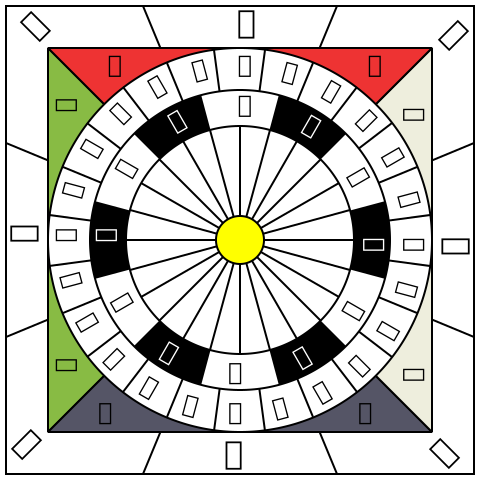
Chinese astrological signs operate on cycles of years, lunar months, and two-hour periods of the day (also known as shichen). A particular feature of the Chinese zodiac is its operation in a 60-year cycle in combination with the Five Phases of Chinese astrology (Wood, Fire, Metal, Water and Earth). Nevertheless, some researches say that there is an obvious relationship between the Chinese 12-year cycle and zodiac constellations: each year of the cycle corresponds to a certain disposal of Jupiter. For example, in the year of Snake Jupiter is in the Sign of Gemini, in the year of Horse Jupiter is in the Sign of Cancer and so on. So the Chinese 12-year calendar is a solar-lunar-jovian calendar.
Zodiac symbolism
The following table shows the twelve signs and their attributes.
| Sign | Yin/Yang | Direction | Season | Fixed Element | Trine | Rat | Ox | Tiger | Rabbit | Dragon | Snake | Horse | Sheep | Monkey | Rooster | Dog | Pig |
|---|---|---|---|---|---|---|---|---|---|---|---|---|---|---|---|---|---|
| Yang | North | Mid-Winter | Water | 1st | |||||||||||||
| Yin | North | Late Winter | Earth | 2nd | |||||||||||||
| Yang | East | Early Spring | Wood | 3rd | |||||||||||||
| Yin | East | Mid-Spring | Wood | 4th | |||||||||||||
| Yang | East | Late Spring | Earth | 1st | |||||||||||||
| Yin | South | Early Summer | Fire | 2nd | |||||||||||||
| Yang | South | Mid-Summer | Fire | 3rd | |||||||||||||
| Yin | South | Late Summer | Earth | 4th | |||||||||||||
| Yang | West | Early Autumn | Metal | 1st | |||||||||||||
| Yin | West | Mid-Autumn | Metal | 2nd | |||||||||||||
| Yang | West | Late Autumn | Earth | 3rd | |||||||||||||
| Yin | North | Early Winter | Water | 4th |
The twelve signs
Notes
References
- Arroyo, Stephen (1975). Astrology, Psychology and The Four Elements. California: CCRS Publications
- Arroyo, Stephen (1989). Chart Interpretation Handbook. California: CCRS Publications.
- Bobrick, Benson (2005). The Fated Sky: Astrology in History. Simon & Schuster. 369 pp.
- Caiozzo, Anna (2003). Images of the Sky. Paris-Sorbonne. Signs and Constellations.
- Eric Francis (2016). "Why Your Zodiac Sign is Not Wrong"
- Hone, Margaret (1978). The Modern Text-Book of Astrology. Revised edition. England: L. N. Fowler & Co. Ltd.
- Johnsen, Linda (2004 March). A Thousand Suns: Designing Your Future with Vedic Astrology. Yes International Publishers.
- Mayo, Jeff (1979). Teach Yourself Astrology. London: Hodder and Stoughton.
- Rochberg, Francesca (1998), "Babylonian Horoscopes", American Philosophical Society, New Series, Vol. 88, No. 1, pp. i–164. . .
- Rudhyar, Dane (1943). Astrological Signs – The Pulse of Life.
- Sachs, Abraham (1948), "A Classification of the Babylonian Astronomical Tablets of the Seleucid Period", Journal of Cuneiform Studies, Vol. 2, No. 4, pp. 271–290. . .
- Sutton, Komilla (1999). The Essentials of Vedic Astrology. England: The Wessex Astrologer Ltd.
References
- Bobrick (2005), pp. 10, 23.
- Johnsen (2004).
- "Science and Pseudo-Science".
- Vishveshwara. (1989). "Cosmic Perspectives: Essays Dedicated to the Memory of M.K.V. Bappu". Cambridge University Press.
- Carlson, Shawn. (1985). "A double-blind test of astrology". Nature.
- Mayo (1979), p. 35.
- Hoffmann, Susanne M.. (2017). "Hipparchs Himmelsglobus: ein Bindeglied in der babylonisch-griechischen Astrometrie?". Springer Spektrum.
- Carol Wills. (2007). "Rulerships".
- Hone (1978), p. 21.
- Jeremy B. Tatum, "[https://ui.adsabs.harvard.edu/abs/2010JRASC.104..103T/abstract The Signs and Constellations of the Zodiac] {{Webarchive. link. (2023-06-01 ", ''Journal of the Royal Society of Canada'', '''104''' (2010), 103--104.)
- "Opposition".
- "WoC :: Sefer Yetzirah".
- "The element of Air".
- "The element of Fire".
- "The element of Water".
- "The element of Earth".
- Hall, Judy. (2005). "The Astrology Bible: The Definitive Guide to the Zodiac". Sterling Publishing Company, Inc..
- Standen, Anthony. (1975). "Is There An Astrological Effect On Personality". The Journal of Psychology.
- van Rooij, Jan J. F.. (1993). "Introversion-Extraversion: astrology versus psychology". Department of Psychology, University of Leiden, the Netherlands.
- Arroyo (1989), p. 29.
- For example, the sign [[Aries (astrology). Aries]] is found in the first month of spring in the [[Northern Hemisphere]], so practitioners of astrology describe it as having a cardinal modality.{{Sfn. Woodwell. 2019
- Tierney, Bil. (2001). "All Around the Zodiac: Exploring Astrology's Twelve Signs". Llewellyn Worldwide.
- Woodwell, Donna. (2019-11-19). "The Astrology Dictionary: Cosmic Knowledge from A to Z". Simon and Schuster.
- As used in Sepharial’s “The Manual of Astrology”-Brazilian edition (1988) by Editora Nova Fronteira S/A, Rio de Janeiro
- Hone (1978), p. 40
- Arroyo (1989), p. 30
- Charlie Higgins. (1997). "Astrology and The Four Elements".
- Ajay Mohan. (2002). "Astrology and The Four Elements".
- Pelletier, Robert, and Leonard Cataldo (1984). ''Be Your Own Astrologer''. London: Pan Books. pp. 43–44
- Pottenger, Maritha (1991). ''Astro Essentials''. San Diego: ACS Publications. pp. 31–36.
- Arroyo (1989), p. 27.
- Arroyo (1989), pp. 30–34
- Hone (1978), p. 42
- Arroyo (1975) pp. 131–140.
- Glyphs from the [[alchemical symbol]]ogy.
- Hone (1978), p. 22
- (2013). "Astrology as a Social Framework: The 'Children of Planets', 1400–1600". [[Journal for the Study of Religion, Nature and Culture]].
- "Logos Professional Astrology - Glossary of astrological terms".
- Hone (1978), p. 144
- (26 November 2007). "Accidental Dignity". Astrological Dictionary 1998–2007.
- Hone (1978), p. 87
- Hone (1978), p. 88
- "Astrology Horoscope Chart".
- Rudhyar (1943)
- Armstrong, Robin. (2009). "The Signs and the Houses". RASA School of Astrology.
- Armstrong, Robin. (2009). "I Ching: The Sequence of Change". RA Publications.
- "What are energy and the elements associated with it as per astrology?".
- Sutton (1999) pp. 74–92.
- Sutton (1999), p. 168.
- (16 February 2009). "'Almanac' 'lunar' zodiac beginning of spring as the boundary dislocation? – China Network".
- "The Chinese Zodiac". Faces.
- Theodora Lau, ''Ibid'', pp. 2–8, 30–5, 60–4, 88–94, 118–24, 148–53, 178–84, 208–13, 238–44, 270–78, 306–12, 338–44, 2005
- Chinese Astrology: Exploring the Eastern Zodiac by Shelly Wu
This article was imported from Wikipedia and is available under the Creative Commons Attribution-ShareAlike 4.0 License. Content has been adapted to SurfDoc format. Original contributors can be found on the article history page.
Ask Mako anything about Astrological sign — get instant answers, deeper analysis, and related topics.
Research with MakoFree with your Surf account
Create a free account to save articles, ask Mako questions, and organize your research.
Sign up freeThis content may have been generated or modified by AI. CloudSurf Software LLC is not responsible for the accuracy, completeness, or reliability of AI-generated content. Always verify important information from primary sources.
Report