From Surf Wiki (app.surf) — the open knowledge base
Astroid
Curve generated by rolling a circle inside another circle with 4x or (4/3)x the radius

Curve generated by rolling a circle inside another circle with 4x or (4/3)x the radius
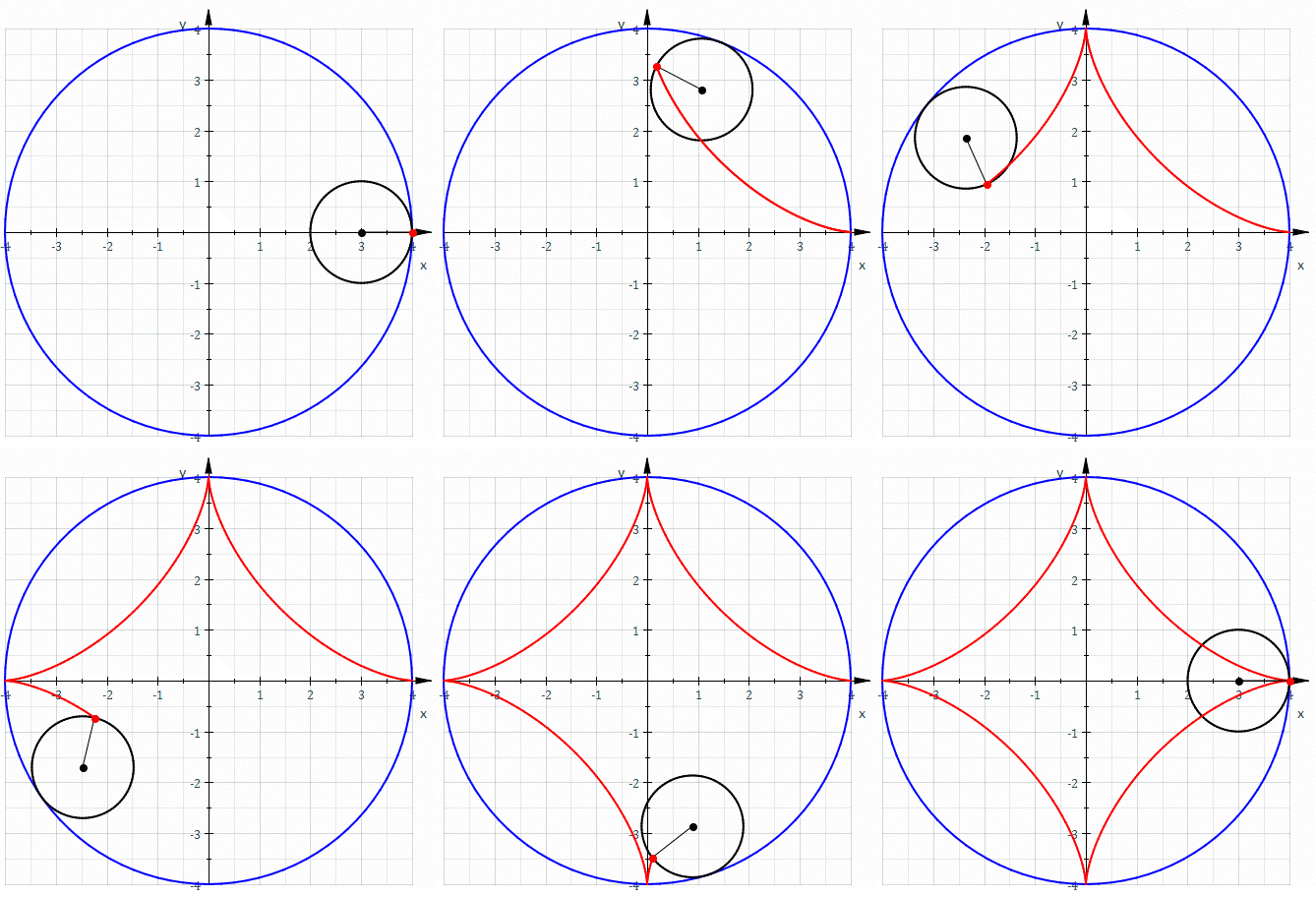


In mathematics, an astroid is a particular type of roulette curve: a hypocycloid with four cusps. Specifically, it is the locus of a point on a circle as it rolls inside a fixed circle with four times the radius. By double generation, it is also the locus of a point on a circle as it rolls inside a fixed circle with 4/3 times the radius. It can also be defined as the envelope of a line segment of fixed length that moves while keeping an end point on each of the axes. It is therefore the envelope of the moving bar in the Trammel of Archimedes.
Its modern name comes from the Greek word for "star". It was proposed, originally in the form of "Astrois", by Joseph Johann von Littrow in 1838. The curve had a variety of names, including tetracuspid (still used), cubocycloid, and paracycle. It is nearly identical in form to the evolute of an ellipse.
Equations
If the radius of the fixed circle is a then the equation is given by x^{2/3} + y^{2/3} = a^{2/3}. This means that an astroid is also a superellipse.
Parametric equations are \begin{align} x = a\cos^3 t &= \frac{a}{4} \left( 3\cos \left(t\right) + \cos \left(3t\right)\right), \[2ex] y = a\sin^3 t &= \frac{a}{4} \left( 3\sin \left(t\right) - \sin \left(3t\right) \right). \end{align}
The pedal equation with respect to the origin is r^2 = a^2 - 3p^2,
the Whewell equation is s = {3a \over 4} \cos 2\varphi, and the Cesàro equation is R^2 + 4s^2 = \frac{9a^2}{4}.
The polar equation is r = \frac{a}{\left(\cos^{2/3}\theta + \sin^{2/3}\theta\right)^{3/2}}.
The astroid is a real locus of a plane algebraic curve of genus zero. It has the equation \left(x^2 + y^2 - a^2\right)^3 + 27 a^2 x^2 y^2 = 0.
The astroid is, therefore, a real algebraic curve of degree six.
Derivation of the polynomial equation
The polynomial equation may be derived from Leibniz's equation by elementary algebra: x^{2/3} + y^{2/3} = a^{2/3}.
Cube both sides: \begin{align} x^{6/3} + 3x^{4/3}y^{2/3} + 3x^{2/3}y^{4/3} + y^{6/3} &= a^{6/3} \[1.5ex] x^2 + 3x^{2/3}y^{2/3} \left(x^{2/3} + y^{2/3}\right) + y^2 &= a^2 \[1ex] x^2 + y^2 - a^2 &= -3x^{2/3}y^{2/3} \left(x^{2/3} + y^{2/3}\right) \end{align}
Cube both sides again: \left(x^2 + y^2 - a^2\right)^3 = -27 x^2 y^2 \left(x^{2/3} + y^{2/3}\right)^3
But since: x^{2/3} + y^{2/3} = a^{2/3} ,
It follows that \left(x^{2/3} + y^{2/3}\right)^3 = a^2.
Therefore: \left(x^2 + y^2 - a^2\right)^3 = -27 x^2 y^2 a^2 or \left(x^2 + y^2 - a^2\right)^3 + 27 x^2 y^2 a^2 = 0.
Metric properties
;Area enclosed :\frac{3}{8} \pi a^2 ;Length of curve :6a ;Volume of the surface of revolution of the enclose area about the x-axis. :\frac{32}{105}\pi a^3 ;Area of surface of revolution about the x-axis :\frac{12}{5}\pi a^2 ;Radius of the outscribed circle: a ;Radius of the inscribed circle: a/2
Properties
The astroid has four cusp singularities in the real plane, the points on the star. It has two more complex cusp singularities at infinity, and four complex double points, for a total of ten singularities.
The dual curve to the astroid is the cruciform curve with equation x^2 y^2 = x^2 + y^2. The evolute of an astroid is an astroid twice as large.
The astroid has only one tangent line in each oriented direction, making it an example of a hedgehog.{{cite journal
References
References
- Yates
- J. J. v. Littrow. (1838). "Kurze Anleitung zur gesammten Mathematik".
- Loria, Gino. (1902). "Spezielle algebraische und transscendente ebene kurven. Theorie und Geschichte".
- Yates, for section
- "Astroid".
- A derivation of this equation is given on p. 3 of http://xahlee.info/SpecialPlaneCurves_dir/Astroid_dir/astroid.pdf
- Yates, for section
This article was imported from Wikipedia and is available under the Creative Commons Attribution-ShareAlike 4.0 License. Content has been adapted to SurfDoc format. Original contributors can be found on the article history page.
Ask Mako anything about Astroid — get instant answers, deeper analysis, and related topics.
Research with MakoFree with your Surf account
Create a free account to save articles, ask Mako questions, and organize your research.
Sign up freeThis content may have been generated or modified by AI. CloudSurf Software LLC is not responsible for the accuracy, completeness, or reliability of AI-generated content. Always verify important information from primary sources.
Report