From Surf Wiki (app.surf) — the open knowledge base
Aston Martin DBS
Grand tourer produced by Aston Martin (1967–1972)
Grand tourer produced by Aston Martin (1967–1972)
| Field | Value |
|---|---|
| name | Aston Martin DBS |
| body_style | 2-door coupe |
| image | AstonMartinDB-S-1969-avant.jpg |
| manufacturer | Aston Martin Ltd. |
| production | 1967–1972 |
| 787 produced | |
| assembly | United Kingdom: Newport Pagnell, Buckinghamshire, England |
| class | Grand tourer |
| layout | FR layout |
| wheelbase | 2610 mm |
| length | 4580 mm |
| width | 1830 mm |
| height | 1330 mm |
| weight | 1588 kg (DBS) |
| 1727 kg (DBS V8) | |
| transmission | Borg-Warner automatic |
| or ZF 5-speed manual | |
| or Chrysler 3-speed automatic transmission | |
| engine | 4.0 L DOHC I6 |
| 5.3 L V8 (DBS V8) | |
| successor | Aston Martin Vantage (DBS) / Aston Martin V8 (DBS V8) |
| related | Aston Martin V8 |
| designer | William Towns |
| sp | uk |
787 produced 1727 kg (DBS V8) or ZF 5-speed manual or Chrysler 3-speed automatic transmission 5.3 L V8 (DBS V8)
The Aston Martin DBS is a grand tourer produced by the British manufacturer Aston Martin Lagonda Limited from 1967 to 1972.
From 2007 to 2012 the DBS name was resurrected for a new model, also called the Aston Martin DBS.
DBS (1967–1972)

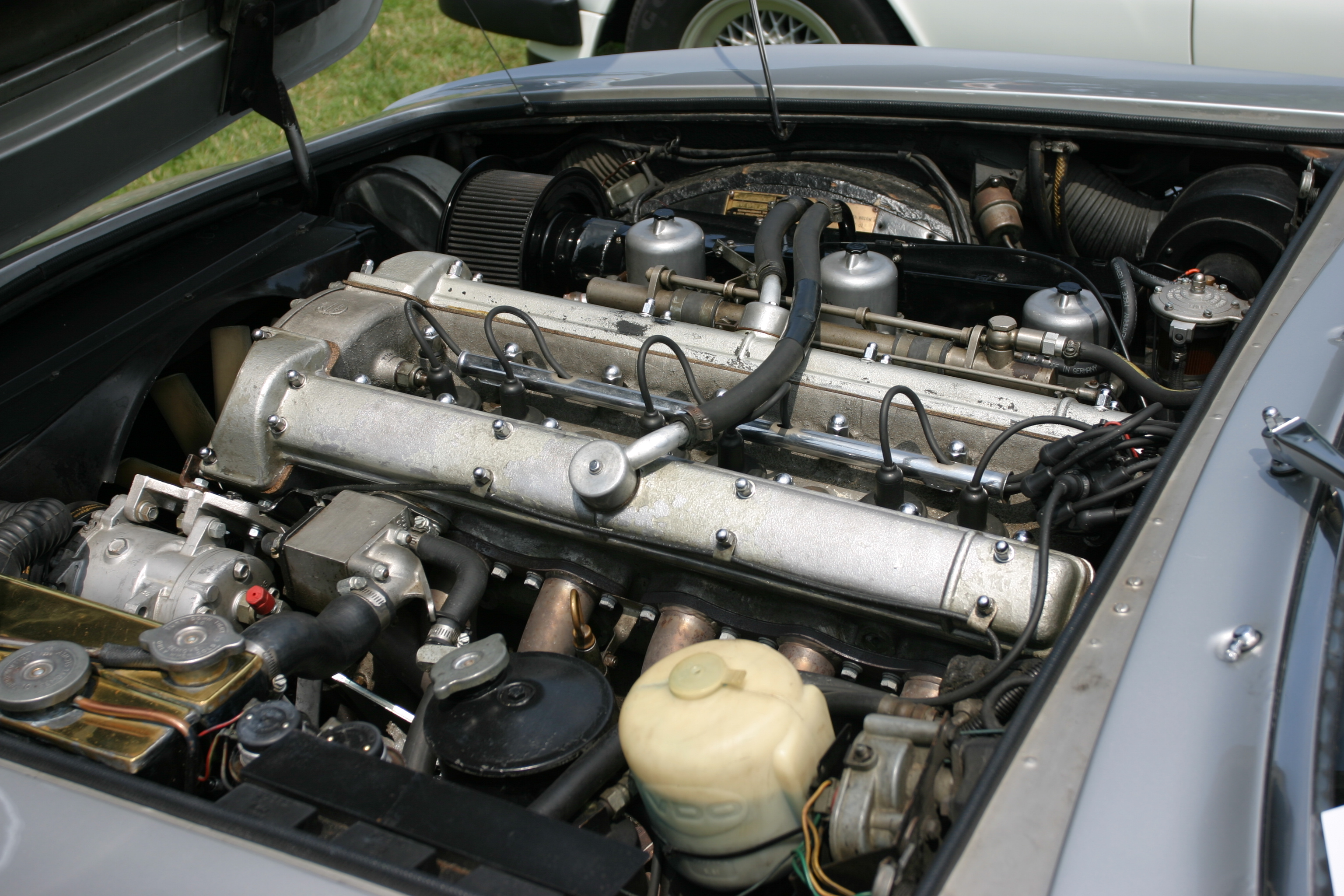
The DBS was intended as the successor to the Aston Martin DB6, although the two ran concurrently for three years. Powered by a straight-six engine, it was produced from 1967 until 1972, eventually being phased out in favour of the Aston Martin V8.
It was a larger coupé than the DB6, with four full sized seats, but was powered by the same 4.0 L engine as the previous car. Claimed engine output was 280 bhp, but a Vantage engine option used Italian made Weber carburettors, increasing output to an advertised 325 bhp.
In 1966, Touring of Milan was commissioned to design the DB6 replacement and produced two prototypes before the design house went out of business. The DB6 was incapable of accommodating the planned V8-engine and had to be replaced. William Towns was then hastily brought in to design the new car. The DBS was intended to have a more "modern" look than the previous series of Aston models (the DB4 through DB6), and it incorporated a fastback style rear end and squared off front grille, atypical of Astons at the time but very much then in vogue in automotive design circles of the late sixties. Trademark Aston design features, such as a bonnet scoop, knock-off wire wheels with 815X15 Crossplys or 205VR15 Pirelli Cinturato CN72 Radial Tyres, and side air vents with stainless steel brightwork were however retained. The DBS was the last Aston Martin to be developed under David Brown's control.
Specifications
- Weight: 1588 kg
- Engine: 3995 cc DOHC straight-6
- Power: 280 bhp at 4500 rpm
- Torque: 390.5 Nm at 3850 rpm
DBS V8 (1969–1972)
Main article: Aston Martin V8


In September 1969 the DBS was made available with the 5340 cc V8 engine for which it was always intended, this variant being known as the DBS V8. At the time, it was the fastest four-seater production car in the world. The new model was fitted with light alloy wheels (as opposed to wire wheels on the DBS) fitted with Pirelli 225/70VR15 Cinturato CN12 and ventilated brake discs. Automatic transmission was offered as an alternative to the ZF 5-speed manual gearbox. The DBS V8 was produced until May 1972, after which it was given a single headlamp front end and was renamed simply the Aston Martin V8.
Specifications
- Weight: 1727 kg
- Engine: 5340cc V8
- Power: 320 bhp at 5000 rpm
- Torque: 330 lbft at 5000 rpm
Lagonda
In 1969 the Lagonda name was briefly resurrected, appearing on a four-door prototype of the DBS model. The prototype was allocated chassis MP230/1 and was retained by the factory until 1972 and used by Sir David Brown as his personal car, registered JPP 5G. The car originally ran a prototype 5-litre V8 engine but this was quickly replaced by an early 5.3-litre production quad carb version (VS4008EE).
Between 1974 and 1976, seven Lagonda four-door saloons were produced based on the 1969 prototype. The production models adopted a single-headlight treatment with a Lagonda "horseshoe" grille in place of the twin-headlamp treatment of the prototype.
Popular culture
The DBS was used by George Lazenby's James Bond in the 1969 film On Her Majesty's Secret Service. Unlike Bond's previous car, the Aston Martin DB5, no gadgets were seen in this car, other than a mounting for a telescopic-sight rifle in the glove compartment. In the final scenes of the film, Bond's wife, Tracy, is shot and killed whilst sitting in the car.
A second DBS also appears in a brief single scene in the next Bond film, Diamonds are Forever. It can be seen in the background being fitted with small missiles at Q Branch whilst Bond is talking to Q on the telephone.
Another DBS was later used in the TV series The Persuaders! (1971–1972), in which Roger Moore's character Lord Brett Sinclair drove a distinctive "Bahama Yellow" 6-cylinder DBS (chassis number DBS/5636/R) that, through the use of alloy wheels and different badges, had been made to look like the DBS V8 model. Supplied by Aston Martin to the show's producers, the car used the personalised number plate "BS 1" (except for one scene in the episode "The Gold Napoleon," where the car has its original UK registration number PPP 6H instead), courtesy of the plate's real owner Billy Smart, Jr. After filming ended it was sold by the factory, via HR Owen in London, to its first private owner. It was later restored by the Aston Martin factory, and is currently owned by divorce lawyer and noted art collector Jeremy Levison. Moore and co-star Tony Curtis both signed the underside of the car's boot lid (rear luggage compartment): Moore at Pinewood Studios in May 2003; Curtis at Cheltenham Racecourse in October 2008. In 2013 the Aston Martin DBS was an invited participant at two of Europe's most exclusive motoring concours, the Concorso d'Eleganza Villa d'Este at Lake Como, and the Salon Privé Concours in London.
Kenneth Haigh as Joe Lampton drove a DBS in the television series Man at the Top.
The restoration of an original DBS, registration JRA615H was featured in the first episode of series 2 of the Channel 4 series For the Love of Cars, screened in April 2015. The process took over 6,000 man-hours. During restoration, it was upgraded to Vantage specification which included conversion from an automatic to manual gearbox. It sold at auction with Coys of Kensington for £169,800 .
References
References
- Records of The Aston Martin Owner's Club
- (October 1967). "Exhibition Stand 144 Aston Martin". [[Autocar (magazine).
- "DBS – DBS V8 – Aston Martin".
- "MARKS' SITE- Aston Martin DBS (1967-1972)".
- Grayson, Stan. (1980). "Volante – a look at the latest Aston Martin". [[Automobile Quarterly]].
- Sass, Rob. (June 2010). "Aston Martin DBS, Unloved No More". [[Sports Car Market]].
- [http://www.astonmartin.com/heritage/past-models/dbs DBS & DBS V8, www.astonmartin.com]. Retrieved 31 March 2013
- "Levison • Meltzer • Pigott ~ Jeremy Levison".
- (20 April 2015). "Aston Martin DBS".
This article was imported from Wikipedia and is available under the Creative Commons Attribution-ShareAlike 4.0 License. Content has been adapted to SurfDoc format. Original contributors can be found on the article history page.
Ask Mako anything about Aston Martin DBS — get instant answers, deeper analysis, and related topics.
Research with MakoFree with your Surf account
Create a free account to save articles, ask Mako questions, and organize your research.
Sign up freeThis content may have been generated or modified by AI. CloudSurf Software LLC is not responsible for the accuracy, completeness, or reliability of AI-generated content. Always verify important information from primary sources.
Report