From Surf Wiki (app.surf) — the open knowledge base
Assembly of the International Space Station
Process of assembling the International Space Station

Process of assembling the International Space Station
The process of assembling the International Space Station (ISS) has been under way since the 1990s. Zarya, the first ISS module, was launched by a Proton rocket on 20 November 1998. The STS-88 Space Shuttle mission followed two weeks after Zarya was launched, bringing Unity, the first of three node modules, and connecting it to Zarya. This bare 2-module core of the ISS remained uncrewed for the next one and a half years, until in July 2000 the Russian module Zvezda was launched by a Proton rocket, allowing a maximum crew of three astronauts or cosmonauts to be on the ISS permanently.
The ISS has a pressurized volume of approximately 1000 m3, a mass of approximately 410000 kg, approximately 100 kilowatts of power output, a truss 108.4 m long, modules 74 m long, and a crew of seven. Building the complete station required more than 40 assembly flights. As of 2020, 36 Space Shuttle flights delivered ISS elements. Other assembly flights consisted of modules lifted by the Falcon 9, Russian Proton rocket or, in the case of Pirs and Poisk, the Soyuz-U rocket.
Some of the larger modules include:
- Zarya (launched 20 November 1998)
- Unity Module (launched 4 December 1998, also known as Node 1)
- Zvezda (launched 12 July 2000)
- Destiny Laboratory Module (launched 7 February 2001)
- Harmony Module (launched 23 October 2007, also known as Node 2)
- Columbus orbital facility (launched 7 February 2008)
- Japanese Experiment Module, also known as Kibō (launched in multiple flights between 2008 and 2009)
- The truss, original and iROSA solar panels (unpressurized, truss and original panels launched in multiple flights between 2000 and 2009, iROSAs launched between 2021 and 2023, a final set of iROSAs are planned to be sent in 2025)
- Nauka (MLM-U) (launched 21 July 2021)
Logistics
The space station is located in orbit around the Earth at an altitude of approximately 410 km, a type of orbit usually termed low Earth orbit (the actual height varies over time by several kilometers due to atmospheric drag and reboosts). It orbits Earth in a period of about 90 minutes; by August 2007 it had completed more than 50,000 orbits since launch of Zarya on 20 November 1998.
A total of 14 main pressurized modules were scheduled to be part of the ISS by its completion date in 2010. A number of smaller pressurized sections will be adjunct to them (Soyuz spacecraft (permanently 2 as lifeboats – 6 months rotations), Progress transporters (2 or more), the Quest and Pirs airlocks, as well as periodically the H-II Transfer Vehicle).
The US Orbital Segment was completed in 2011 after the installation of the Alpha Magnetic Spectrometer during the STS-134 mission. The Russian Orbital Segment assembly has been on an indefinite hiatus since the installation of the Rassvet module in 2010 during the STS-132 mission. The Rassvet module on the ISS right now was originally supposed to be the on-ground dynamic testing mock-up of the now-cancelled Science Power Platform. The Nauka science laboratory module contains new crew quarters, life support equipment that can produce oxygen and water, and a new galley. The Nauka was originally supposed to be delivered to the ISS in 2007 but cost overruns and quality control problems delayed it for over a decade. The Nauka module finally launched in July 2021 and docked to the nadir port of Zvezda module after several days of free flight followed by the Prichal which launched on 24 November 2021.
There are plans to add 2 or 3 more modules that would attach to Prichal during the mid-2020s. Adding more Russian modules will help the Zvezda module greatly because Zvezda's originally installed central command computers no longer work (three ThinkPad laptops are now the Zvezda's central command computers) and its Elektron oxygen generators are not replaceable and failed again for a short time in 2020 after multiple malfunctions throughout their history. In Russian modules all the hardware is launched with the equipment permanently installed. It is impossible to replace hardware like in the US Orbital Segment with its very wide 51 inch (105 cm) hatch openings between modules. This potential problem with the Zvezda was made apparent when in October 2020 the toilet, oven, and Elektron all malfunctioned at the same time and the cosmonauts onboard had to make emergency repairs.
Destiny was the first science module delivered to the ISS, whereas Zarya provides electrical power, storage, propulsion, and guidance functions and Zvezda provides living quarters, a life support system, a communication system, electrical power distribution, a data processing system, a flight control system, and a propulsion system. Node 1's primary function is to link different modules together; however, fluids, environmental control and life support systems, and electrical and data systems are also routed through Node 1 to supply work and living areas of the station.
The ISS, when completed, will consist of a set of communicating pressurized modules connected to a truss, on which four large pairs of photovoltaic modules (solar panels) are attached. The pressurized modules and the truss are perpendicular: the truss spanning from starboard to port and the habitable zone extending on the aft-forward axis. Although during the construction the station attitude may vary, when all four photovoltaic modules are in their definitive position the aft-forward axis will be parallel to the velocity vector.
In addition to the assembly and utilization flights, approximately 30 Progress spacecraft flights are required to provide logistics until 2010. Experimental equipment, fuel and consumables are and will be delivered by all vehicles visiting the ISS: the SpaceX Dragon, the Russian Progress, the European ATV and the Japanese HTV, and space station downmass will be carried back to Earth facilities on the Dragon.
''Columbia'' disaster and changes in construction plans
Disaster and consequences
After the Space Shuttle Columbia disaster on 1 February 2003, there was some uncertainty over the future of the ISS. The subsequent two and a half-year suspension of the U.S. Space Shuttle program, followed by problems with resuming flight operations in 2005, were major obstacles.
The Space Shuttle program resumed flight on 26 July 2005, with the STS-114 mission of Discovery. This mission to the ISS was intended both to test new safety measures implemented since the Columbia disaster and deliver supplies to the station. Although the mission succeeded safely, it was not without risk; foam was shed by the external tank, leading NASA to announce future missions would be grounded until this issue was resolved.
Between the Columbia disaster and the resumption of Shuttle launches, crew exchanges were carried out solely using the Russian Soyuz spacecraft. Starting with Expedition 7, two-astronaut caretaker crews were launched in contrast to the previously launched crews of three. Because the ISS had not been visited by a shuttle for an extended period, a larger than planned amount of waste accumulated, temporarily hindering station operations in 2004. However Progress transports and the STS-114 shuttle flight took care of this problem.
Changes in construction plans

Many changes were made to the originally planned ISS, even before the Columbia disaster. Modules and other structures were cancelled or replaced, and the number of Shuttle flights to the ISS was reduced from previously planned numbers. However, more than 80% of the hardware intended to be part of the ISS in the late 1990s was orbited and is now part of the ISS's configuration.
During the shuttle stand-down, construction of the ISS was halted and the science conducted aboard was limited due to the crew size of two, adding to earlier delays due to Shuttle problems and the Russian space agency's budget constraints.
In March 2006, a meeting of the heads of the five participating space agencies accepted the new ISS construction schedule that planned to complete the ISS by 2010.
As of May 2009, a crew of six has been established following 12 Shuttle construction flights after the second "Return to Flight" mission STS-121. Requirements for stepping up the crew size included enhanced environmental support on the ISS, a second Soyuz permanently docked on the station to function as a second 'lifeboat', more frequent Progress flights to provide double the amount of consumables, more fuel for orbit raising maneuvers, and a sufficient supply line of experimental equipment. As of November 2020, the crew capacity has increased to seven due to the launch of Crew Dragon by SpaceX, which can carry 4 astronauts to the ISS.
Later additions included the Bigelow Expandable Activity Module (BEAM) in 2016, and numerous Russian components are planned as part of the in-orbit construction of OPSEK.
Assembly sequence
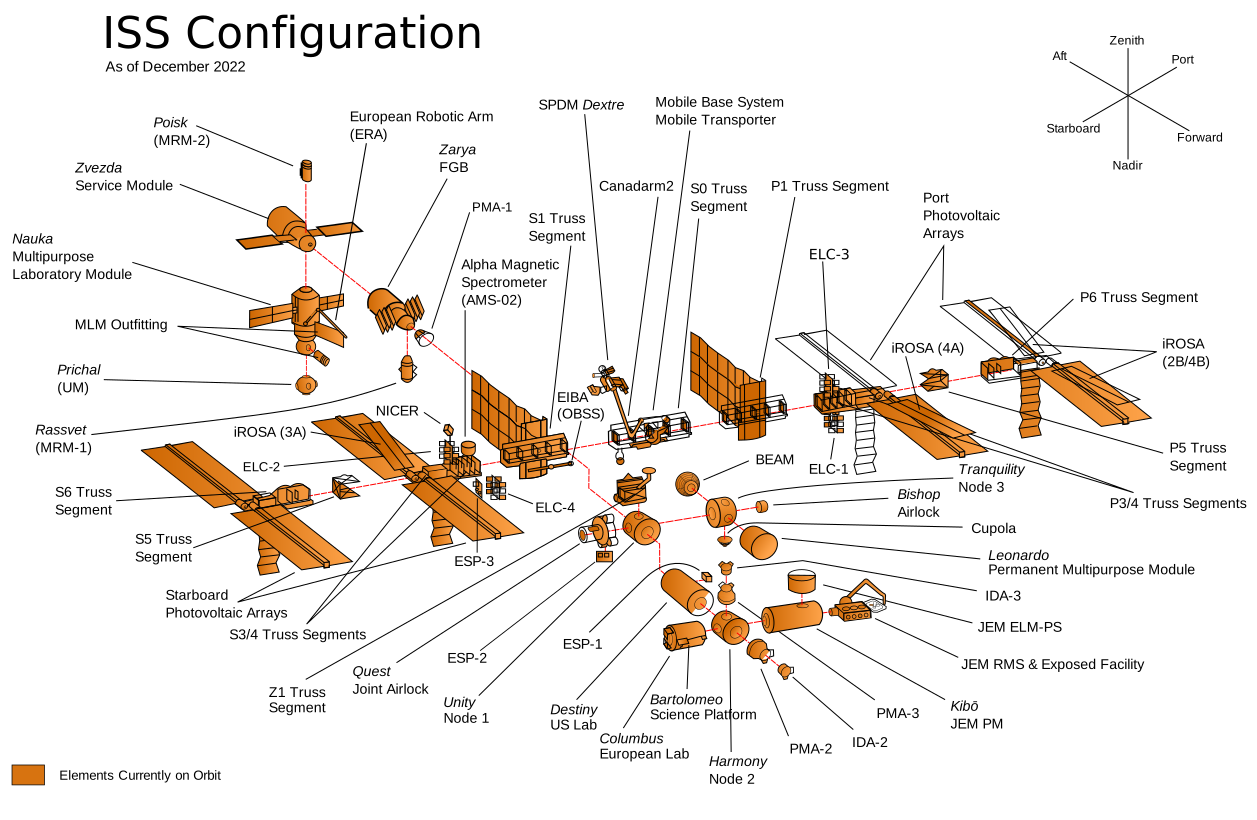
The ISS is made up of 16 pressurized modules: six Russian modules (Zarya, Zvezda, Poisk, Rassvet, Nauka, and Prichal), eight US modules (BEAM, Leonardo, Harmony, Quest, Tranquility, Unity, Cupola, and Destiny), one Japanese module (Kibō) and one European module (Columbus).
At least one Russian pressurized module (Pirs) is deorbited till now.
Although not permanently docked with the ISS, Multi-Purpose Logistics Modules (MPLMs) formed part of the ISS during some Shuttle missions. An MPLM was attached to Harmony (initially to Unity) and was used for resupply and logistics flights.
Spacecraft attached to the ISS also extend the pressurized volume. At least one Soyuz spacecraft is always docked as a 'lifeboat' and is replaced every six months by a new Soyuz as part of crew rotation. Table below shows the sequence in which these components were added to the ISS. Decommissioned and deorbited Modules are shown in gray.
| Element | Assembly | |||||||||
|---|---|---|---|---|---|---|---|---|---|---|
| flight | Launch | |||||||||
| date | Launch | |||||||||
| vehicle | Length | Diameter | Mass | Isolated View | Station View | |||||
| Zarya (FGB) | 1A/R | 1998-11-20 | Proton-K | 12.56 m | 4.1 m | 24,968 kg | [[File:Zarya from STS-88.jpg | 80px]] | [[File:Zarya from STS-88.jpg | 80px]] |
| Unity (Node 1) | 2A | 1998-12-04 | (STS-88) | 5.5 m | 4.3 m | 11,895 kg | [[File:ISS Unity module.jpg | 80px]] | [[File:Sts088-703-019e.jpg | 80px]] |
| PMA-1 | 1.86 m | 1.9 m | 1,589 kg | [[File:PMA-3 arrives in SSPF.jpg | 80px]] | |||||
| PMA-2 | 1.86 m | 1.9 m | 1,376 kg | [[File:PMA-3 arrives in SSPF.jpg | 80px]] | |||||
| Zvezda (Service Module) | 1R | 2000-07-12 | Proton-K | 13.1 m | 4.2 m | 24,604 kg | [[File:View of the bottom of Zvezda.jpg | 80px]] | [[File:Unity-Zarya-Zvezda STS-106.jpg | 80px]] |
| Z1 Truss | 3A | 2000-10-11 | (STS-92) | 4.6 m | 4.2 m | 8,755 kg | [[File:ISS Unity and Z1 truss structure from STS-92.jpg | 80px]] | [[File:S97e5009.jpg | 80px]] |
| PMA-3 | 1.86 m | 1.9 m | 1,183 kg | [[File:PMA-3 arrives in SSPF.jpg | 80px]] | |||||
| P6 Truss & Solar Arrays | 4A | 2000-11-30 | (STS-97) | 18.3 m | 10.7 m deployed | 15,824 kg | [[File:STS-97 ISS.jpg | 80px]] | [[File:STS-97 ISS.jpg | 80px]] |
| Destiny (US Laboratory) | 5A | 2001-02-07 | (STS-98) | 9.2 m | 4.3 m | 14,515 kg | [[File:ISS Destiny Lab.jpg | 80px]] | [[File:Sts098-312-0020.jpg | 80px]] |
| ESP-1 | 5A.1 | 2001-03-08 | (STS-102) | 2.4 m | 0.46 m | [[File:STS-102 External Storage Platform 1 crop.jpg | 80px]] | [[File:S102e5350.jpg | 80px]] | |
| Canadarm2 (SSRMS) | 6A | 2001-04-19 | (STS-100) | 17.6 m | 35 cm | 1,800 kg | [[File:STS-114 Steve Robinson on Canadarm2.jpg | 80px]] | [[File:S100e5958 cropped.jpg | 80px]] |
| Quest (Joint Airlock) | 7A | 2001-07-12 | (STS-104) | 5.5 m | 4.0 m | 9,923 kg | [[File:ISS Quest airlock.jpg | 80px]] | [[File:ISS on 20 August 2001.jpg | 80px]] |
| Pirs (Docking Compartment) | 4R | 2001-09-14 | Soyuz-U (Progress M-SO1) | 4.9 m | 2.55 m | 3,838 kg | [[File:Pirs docking module taken by STS-108.jpg | 80px]] | [[File:S108e5628.jpg | 80px]] |
| S0 Truss | 8A | 2002-04-08 | (STS-110) | 13.4 m | 4.6 m | 13,971 kg | [[File:S0 Truss lifted from Shuttles cargo bay.jpg | 80px]] | [[File:International Space Station.jpg | 80px]] |
| Mobile Base System | UF2 | 2002-06-05 | (STS-111) | 1,438 kg | [[File:STS-111 Installation of Mobile Base System.jpg | 80px]] | [[File:Sts111-711-005.jpg | 80px]] | ||
| S1 Truss | 9A | 2002-10-07 | (STS-112) | 13.7 m | 4.6 m | 14,124 kg | [[File:ISS S1 Truss.jpg | 80px]] | [[File:S112e05823.jpg | 80px]] |
| P1 Truss | 11A | 2002-11-23 | (STS-113) | 13.7 m | 4.6 m | 14,003 kg | [[File:ISS Truss structure.jpg | 80px]] | [[File:ISS Mission STS-113.jpg | 80px]] |
| ESP-2 | LF1 | 2005-07-26 | (STS-114) | 2.6 m | 4.3 m | [[File:STS-114 External Storage Platform 2 crop.jpg | 80px]] | [[File:ISS Aug2005.jpg | 80px]] | |
| P3/P4 Truss & Solar Arrays | 12A | 2006-09-09 | (STS-115) | 13.7 m | 4.6 m | 15,824 kg | [[File:STS-115 EVA 2 on Day 5.jpg | 80px]] | [[File:STS-115 ISS after undocking.jpg | 80px]] |
| P5 Truss | 12A.1 | 2006-12-09 | (STS-116) | 3.37 m | 4.55 m | 1,864 kg | [[File:STS-116 - ISS P5 Truss awaits installation (NASA ISS014-E-09479).jpg | 80px]] | [[File:ISS after STS-116 in December 2006.jpg | 80px]] |
| S3/S4 Truss & Solar Arrays | 13A | 2007-06-08 | (STS-117) | 13.7 m | 10.7 m | 15,824 kg | [[File:S3-S4 Truss Installed 2.jpg | 80px]] | [[File:ISS after STS-117 in June 2007.jpg | 80px]] |
| S5 Truss | 13A.1 | 2007-08-08 | (STS-118) | 3.37 m | 4.55 m | 1,864 kg | [[File:STS-116 - P5 Truss hand-off to ISS (NASA S116-E-05765).jpg | 80px]] | [[File:ISS after STS-118 in August 2007.jpg | 80px]] |
| ESP-3 | 2.6 m | 4.3 m | [[File:STS-118 ESP-3 on RMS.jpg | 80px]] | ||||||
| Harmony (Node 2) | 10A | 2007-10-23 | (STS-120) | 7.2 m | 4.4 m | 14,300 kg (31,500 lb) | [[File:Harmony Relocation.jpg | 80px]] | [[File:ISS after STS-120 in November 2007.jpg | 80px]] |
| Relocation of | ||||||||||
| P6 Truss | 18.3 m | 10.7 m deployed | 15,824 kg | [[File:S6 Truss Transfer (STS-119).jpg | 80px]] | |||||
| Columbus (European Laboratory) | 1E | 2008-02-07 | (STS-122) | 7 m | 4.5 m | 12,800 kg (28,219 lb) | [[File:Columbus module - cropped.jpg | 80px]] | [[File:STS-122 ISS Flyaround.jpg | 80px]] |
| Dextre (SPDM) | 1J/A | 2008-03-11 | (STS-123) | 3.5 m | 7 m outstretched | 1,662 kg | [[File:S123 Dextre01.jpg | 80px]] | [[File:STS-123 ISS Flyaround cropped.jpg | 80px]] |
| Experiment Logistics Module (ELM) | 4.21 m (13.8 ft) | 4.39 m (14.4 ft) | 8,386 kg (18,488 lb) | [[File:Kibo ELM-PS on ISS.jpg | 80px]] | |||||
| JEM Pressurized Module (JEM-PM) | 1J | 2008-05-31 | (STS-124) | 11.19 m (36.7 ft) | 4.39 m (14.4 ft) | 15,900 kg (35,100 lb) | [[File:STS-124 Kibo.jpg | 80px]] | [[File:ISS after STS-124 06 2008.jpg | 80px]] |
| JEM Remote Manipulator System (JEMRMS) | 10 m | |||||||||
| S6 Truss & Solar Arrays | 15A | 2009-03-15 | (STS-119) | 18.3 m | 10.7 m deployed | 15,824 kg | [[File:S6 Truss Transfer (STS-119).jpg | 80px]] | [[File:ISS March 2009.jpg | 80px]] |
| Kibo Exposed Facility (JEM-EF) | 2J/A | 2009-07-15 | (STS-127) | [[File:STS-127 JEM-EF.jpg | 80px]] | [[File:ISS & Endeavour Shadow STS-127 2.jpg | 80px]] | |||
| Poisk (MRM-2) | 5R | 2009-11-10 | Soyuz-U (Progress M-MIM2) | 4.049 m | 2.55 m | 3670 kg | [[File:Poisk.Jpeg | 80px]] | [[File:STS-129 Atlantis approaches below the ISS.jpg | 80px]] |
| ELC-1 | ULF3 | 2009-11-16 | (STS-129) | 6,280 kg | [[File:ELC2 STS 129.JPG | 80px]] | [[File:ISS ULF3 STS-129.jpg | 80px]] | ||
| ELC-2 | 6,100 kg | [[File:ELC2 STS 129.JPG | 80px]] | |||||||
| Tranquility (Node 3) | 20A | 2010-02-08 | (STS-130) | 6.706 m (22.00 ft) | 4.48 m (14.7 ft) | 19,000 kg (42,000 lb) | [[File:Tranquility-node3.JPG | 80px]] | [[File:ISSpoststs130.jpg | 80px]] |
| Cupola | 1.5 m | 2.95 m | 1,880 kg | [[File:Exterior of Cupola - Exp28.jpg | 80px]] | |||||
| Rassvet (MRM-1) | ULF4 | 2010-05-14 | (STS-132) | 6 m | 2.35 m | 8,015 kg | [[File:STS-132 ISS-23 Rassvet Pirs and Progress M-05M.jpg | 80px]] | [[File:International Space Station after undocking of STS-132.jpg | 80px]] |
| Nauka Science Airlock | 1,050 kg | |||||||||
| Nauka RTOd Radiator | ||||||||||
| ERA portable workpost | ||||||||||
| Leonardo (PMM) | ULF5 | 2011-02-24 | (STS-133) | 6.6 m | 4.57 m (15.0 ft) | 4,082 kg (8,999 lb) | [[File:STS-133 ISS-26 Permanent Multipurpose Module.jpg | 80px]] | [[File:STS-133 International Space Station after undocking.jpg | 80px]] |
| ELC-4 | 3,735 kg | [[File:ELC2 STS 129.JPG | 80px]] | |||||||
| AMS-02 | ULF6 | 2011-05-16 | (STS-134) | 7,500 kg | [[File:Alpha Magnetic Spectrometer - 02.jpg | 80px]] | [[File:STS-134 International Space Station after undocking.jpg | 80px]] | ||
| OBSS | 15.24 m | 35 cm | [[File:STS-120 OBSS repair.jpg | 80px]] | ||||||
| ELC-3 | 6,361 kg | [[File:ELC2 STS 129.JPG | 80px]] | |||||||
| HRSGF | CRS SpX-2 | 2013-03-13 | Falcon 9 (SpaceX CRS-2) | |||||||
| BEAM | CRS SpX-8 | 2016-04-08 | Falcon 9 (SpaceX CRS-8) | 4.01 m | 3.23 m | 1,413 kg | [[File:Beam-instalation-space-station.jpg | 80px]] | [[File:ISS-56 International Space Station fly-around (04).jpg | 80px]] |
| IDA-2 | CRS SpX-9 | 2016-07-18 | Falcon 9 (SpaceX CRS-9) | 110 cm | 160 cm | 526 kg | [[File:IDA-2 upright.jpg | 80px]] | ||
| IDA-3 | CRS SpX-18 | 2019-07-25 | Falcon 9 (SpaceX CRS-18) | 110 cm | 160 cm | 526 kg | ||||
| Bartolomeo | CRS SpX-20 | 2020-03-06 | Falcon 9 (SpaceX CRS-20). | |||||||
| Nanoracks Bishop Airlock | CRS SpX-21 | 2020-12-06 | Falcon 9 (SpaceX CRS-21) | 1.80 m | 2.014 m | 1,059 kg | [[File:Bishop Airlock Module.jpg | frameless | 120x120px]] | |
| iROSA 1 and 2 | CRS SpX-22 | 2021-06-03 | Falcon 9 (SpaceX CRS-22) | 325 kg | [[File:ISS-52 Roll Out Solar Array (ROSA) (4).jpg | 80px]] | [[File:View of the ISS taken during Crew-2 flyaround (ISS066-E-080651).jpg | 80px]] | ||
| Nauka (MLM-U) | 3R | 2021-07-21 | Proton-M | 13 m | 4.25 m | 20,300 kg | [[File:Nauka Module as seen from Cupola during VKD-51 spacewalk.jpg | 80px]] | [[File:View of the ISS taken during Crew-2 flyaround (ISS066-E-080300).jpg | 80px]] |
| European Robotic Arm | 11.3 m | 630 kg | ||||||||
| Nauka SSPA-GM temporary docking adapter | ||||||||||
| MLM Means of Attachment of Large payloads | ||||||||||
| (LCCS Part) | 79P | 2021-10-28 | Soyuz 2.1a (Progress MS-18) | |||||||
| Prichal | 6R | 2021-11-24 | Soyuz 2.1b (Progress M-UM) | 4.91 m | 3.3 m | 3890 kg | [[File:Russian Spacewalkers dwarfed by the Prichal module (cropped).jpg | 80px]] | ||
| MLM Means of Attachment of Large payloads | ||||||||||
| (SCCS Part) | 82P | 2022-10-26 | Soyuz 2.1a (Progress MS-21) | |||||||
| iROSA 3 and 4 | CRS SpX-26 | 2022-11-26 | Falcon 9 (SpaceX CRS-26) | 325 kg | [[File:ISS-52 Roll Out Solar Array (ROSA) (4).jpg | 80px]] | ||||
| iROSA 5 and 6 | CRS SpX-28 | 2023-06-05 | Falcon 9 (SpaceX CRS-28) | 325 kg | [[File:ISS-52 Roll Out Solar Array (ROSA) (4).jpg | 80px]] |
Future elements
- In January 2021, NASA announced plans to upgrade the station's solar arrays by installing new arrays on top of all the station's eight existing arrays. Six were delivered in three pairs, each pair aboard SpaceX CRS-22 in June 2021, SpaceX CRS-26 in November 2022 and SpaceX CRS-28 in June 2023. Two more will be delivered in one pair aboard a future mission in 2025.
- Axiom Space plans to launch one module, the Payload Power Thermal Module (PPTM), to the ISS to inaugurate its commercial Axiom Station project.
Cancelled modules

- Interim Control Module – not needed once Zvezda was launched
- ISS Propulsion Module – not needed once Zvezda was launched
- Habitation Module (HAB) – With the cancellation of the Habitation Module, sleeping places are now spread throughout the station. There are two in the Russian segment and four in the US segment. It is not necessary to have a separate 'bunk' in space – many visitors just strap their sleeping bag to the wall of a module, get into it and sleep.
- Crew Return Vehicle (CRV) – replaced by crewed spacecraft docked to the station at all times (Soyuz, SpaceX Dragon 2)
- Centrifuge Accommodations Module (CAM) – would have been attached to Harmony (Node 2)
- Nautilus-X Centrifuge Demonstration – If produced, this centrifuge would have been the first in-space demonstration of sufficient scale centrifuge for artificial partial-g effects. It was designed to become a sleep module for the ISS crew.
- Science Power Platform (SPP) – power will be provided to the Russian segments partly by the US solar cell platforms
- Russian Research Modules (RM1 and RM2) – replaced by single Multipurpose Laboratory Module (Nauka)
- Universal Docking Module (UDM) – cancelled along with the Research Modules which were to connect to it
- Science Power Module (NEM) – cancelled in April 2021 and used as the core module of the proposed Russian Orbital Service Station (ROSS).
Unused modules
The following module was built, but has not been used in future plans for the ISS as of January 2021.
- American Node 4 – Also known as the Docking Hub System (DHS), would allow the station to have more docking ports for visiting vehicles and would allow inflatable habitats and technology demonstrations to be tested as part of the station.
Cost
The ISS is credited as the most expensive item ever built, costing around $150 billion (USD), making it more expensive than Skylab (costing US$2.2 billion) and Mir (US$4.2 billion).
References
References
- (November 17, 2020). "4 Astronauts Aboard SpaceX Crew Dragon Successfully Dock With Space Station".
- "Consolidated Launch Manifest". NASA.
- "Новости. Подготовка "Науки" – идет четвёртый стартовый день".
- "Oxygen supply system deactivated in Russian ISS section due to malfunction".
- [https://www.themoscowtimes.com/2020/10/20/crew-in-no-danger-after-iss-issues-resolved-russia-a71799 Retrieved 15 December 2020]
- "What are the ISS attitudes?". NASA.
- Coppinger, Rob. (3 March 2006). "NASA commits to Shuttle missions to International Space Station". FlightGlobal.
- [https://arstechnica.com/science/2017/10/nasa-tries-an-inflatable-room-on-the-space-station-likes-it/ Retrieved 27 November 2017.]
- Gebhardt, Chris. (25 July 2021). "Farewell, Pirs; ISS module decommissioned, destructively reentered". NASASpaceFlight.com.
- (September 2015). "Reference Guide to the International Space Station".
- "Space Station Assembly: Integrated Truss Structure". NASA.
- (July 2006). "P3 and P4 to expand station capabilities, providing a third and fourth solar array". Boeing.
- (July 2007). "STS-118 Mission Overview: Build the Station … Build the Future". NASA PAO.
- (10 January 2009). "Columbus laboratory". ESA.
- (25 September 2008). "About Kibo". JAXA.
- (23 November 2007). "Kibo Japanese Experiment Module". NASA.
- Zak, Anatoly. "Docking Compartment-1 and 2". RussianSpaceWeb.com.
- Bergin, Chris. (9 November 2009). "Russian module launches via Soyuz for Thursday ISS docking". NASASpaceflight.com.
- (9 April 2007). "NASA Extends Contract With Russia's Federal Space Agency". NASA.
- (16 January 2013). "NASA to Test Bigelow Expandable Module on Space Station". NASA.
- Jason Rhian. (18 July 2016). "SpaceX Conducts Second Ground Landing After Launch Of CRS-9 Dragon To ISS". Spaceflight Insider.
- (19 August 2016). "Spacewalkers attach docking adapter to space station for commercial vehicles".
- "Spacewalkers Complete Installation of Second Commercial Docking Port – Space Station".
- (9 March 2020). "Successful launch for Airbus' Bartolomeo". [[Airbus]].
- "FGB-based Multipurpose Lab Module (MLM-U)". Khrunichev State Research and Production Space Centre.
- (12 January 2021). "NASA to upgrade space station solar arrays".
- (2 June 2021). "New solar arrays ready to upgrade International Space Station's power grid". Spaceflight Now.
- Davenport, Justin. (June 15, 2023). "ISS finishes initial iROSA upgrade with two EVAs this month".
- Foust, Jeff. (18 December 2024). "Axiom Space revises space station assembly plans". [[SpaceNews]].
- "Nautilus X Holderman – 1 26 11 | PDF | Flight Controller | International Space Station".
- (24 April 2021). "Научно-энергетический модуль запустят на "Ангаре" с Восточного". [[Roscosmos]].
- Zak, Anatoly. (16 April 2021). "Russian Orbital Service Station, ROSS". RussianSpaceWeb.
- Harding, Pete. (20 December 2010). "ISS Managers review long-term configuration of International Space Station".
- "Spaceflight Now | Breaking News | Test article could facilitate space station applications".
- (2014-08-27). "Is The International Space Station The Most Expensive Single Item Ever Built?".
- "The Space Review: Costs of US piloted programs".
- Tyler, Patrick E.. (2001-03-24). "Russians Find Pride, and Regret, in Mir's Splashdown". The New York Times.
This article was imported from Wikipedia and is available under the Creative Commons Attribution-ShareAlike 4.0 License. Content has been adapted to SurfDoc format. Original contributors can be found on the article history page.
Ask Mako anything about Assembly of the International Space Station — get instant answers, deeper analysis, and related topics.
Research with MakoFree with your Surf account
Create a free account to save articles, ask Mako questions, and organize your research.
Sign up freeThis content may have been generated or modified by AI. CloudSurf Software LLC is not responsible for the accuracy, completeness, or reliability of AI-generated content. Always verify important information from primary sources.
Report