From Surf Wiki (app.surf) — the open knowledge base
Assault weapon
Controversial term used in U.S. firearm legislation
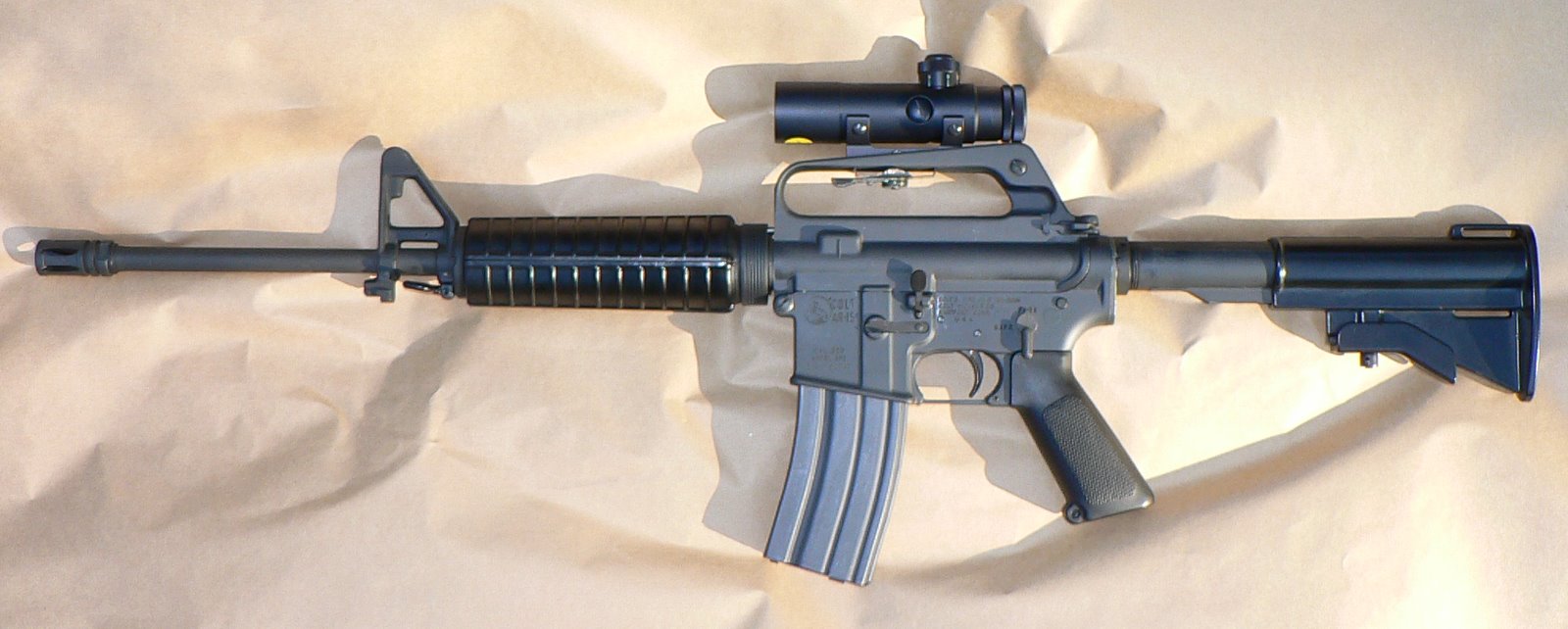
Controversial term used in U.S. firearm legislation
firearms restricted by some United States laws
In the United States, assault weapon is a controversial term applied to different kinds of firearms. There is no clear, consistent definition. It can include semi-automatic firearms with a detachable magazine, a pistol grip, and sometimes other features, such as a vertical forward grip, flash suppressor, or barrel shroud. Certain firearms are specified by name in some laws that restrict assault weapons. When the now-defunct Federal Assault Weapons Ban was passed in 1994, the U.S. Department of Justice said, "In general, assault weapons are semiautomatic firearms with a large magazine of ammunition that were designed and configured for rapid fire and combat use." The commonly used definitions of assault weapons are under frequent debate, and have changed over time.
The origin of the term has been attributed to legislators, the firearms industry, gun control groups, and the media. It is sometimes used interchangeably with the term assault rifle, which refers to selective fire rifles that use intermediate cartridges. This use has been described as incorrect and a misapplication of the term. After the December 2012 Sandy Hook Elementary School shooting, many news organizations ran stories about assault weapons, explaining their varying definitions and presenting varying opinions about whether they should be banned again at the federal level.
Definitions and usage
Main article: Assault weapons legislation in the United States
Drawing from federal and state law definitions, the term assault weapon refers primarily to semi-automatic rifles, pistols, and shotguns that are able to accept detachable magazines and possess one or more other features. Legislative definitions do not include fully automatic weapons, which are regulated separately as Title II weapons under federal law.}} A key defining law was the now-defunct Federal Assault Weapons Ban of 1994. At that time, the United States Department of Justice said, "In general, assault weapons are semiautomatic firearms with a large magazine of ammunition that were designed and configured for rapid fire and combat use."
Common attributes used in legislative definitions of assault weapons include:
- Semi-automatic firearm capable of accepting a detachable magazine;
- Folding or telescoping (collapsible) stock,
- A pistol grip that protrudes beneath the action of the weapon;
- Bayonet lug, which allows the mounting of a bayonet;
- Threaded barrel, which can accept muzzle devices such as a flash hider, suppressor, compensator or muzzle brake;
- Grenade launcher;
- Barrel shroud.
Dictionary definitions vary from legal definitions. Dictionary.com defines "assault weapon" as "any of various automatic and semiautomatic military firearms utilizing an intermediate-power cartridge, designed for individual use". The Merriam-Webster Online Dictionarys definition is "any of various automatic or semiautomatic firearms; especially: assault rifle".
History of terminology
The origin of the term is not clearly known and is the subject of much debate. In the past, the names of certain military weapons used the phrase, such as the Rifleman's Assault Weapon, a grenade launcher developed in 1977 for use with the M16 assault rifle, or the Shoulder-launched Multipurpose Assault Weapon, a rocket launcher introduced in 1984.
One of the earliest uses of the term, or a similar term, in its current meaning was as part of an advertisement in The Hutchinson News (Kansas) in 1978 for the Valmets-7.62×39, the Colt AR-15, and the Wilkinson Terry carbine. Another was in a bill introduced by Art Agnos in the California State Assembly in April 1985 to ban semi-automatic "assault firearms" capable of using detachable magazines of 20 rounds or more. Speaking to the Assembly Public Safety Committee, Agnos said, "The only use for assault weapons is to shoot people." The measure did not pass when it came up for a vote.
In 2013, The Washington Post, looking into the history of the term, wrote of the term: "Many attribute its popularization to a 1988 paper written by gun-control activist and Violence Policy Center founder Josh Sugarmann and the later reaction to the Cleveland School massacre in Stockton, California, in January 1989." Sugarmann had written:
Other researchers have found evidence to suggest that the firearms industry itself may have introduced the term "assault weapon" to build interest in new product lines. Phillip Peterson, the author of Gun Digest Buyer's Guide to Assault Weapons (2008) wrote:
Meanwhile, many gun rights activists have put forward that the term was popularized by the media or gun control activists. Conservative writer Rich Lowry said that assault weapon is a "manufactured term". Joseph P. Tartaro of the Second Amendment Foundation (SAF) wrote in 1994: "One of the key elements of the anti-gun strategy to gull the public into supporting bans on the so-called 'assault weapons' is to foster confusion. As stated previously, the public does not know the difference between a full automatic and a semi-automatic firearm." Robert Crook, executive director of the Coalition of Connecticut Sportsmen, said "the term 'assault weapon,' as used by the media, is a media invention." Gun control supporters use the term while gun rights supporters generally do not use the term.
Differing state law definitions
Main article: Assault weapons legislation in the United States
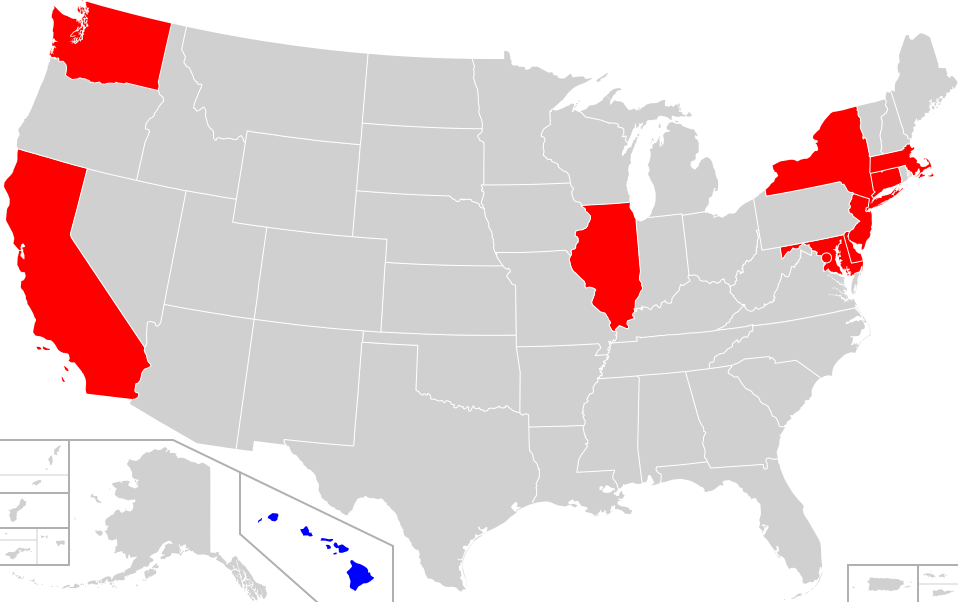
Seven states have assault weapon bans with different definitions and characteristics.
- California defines assault weapons by name, by "series" (AK-47 or AR-15), and by characteristic. A shotgun with a revolving cylinder is also defined as an assault weapon.
- Connecticut defines assault weapons as selective-fire firearms (including assault rifles capable of fully automatic or burst fire); semi-automatic firearms specified by name; and semi-automatic firearms with specific characteristics.
- Hawaii defines and bans assault pistols.
- Maryland defines and bans assault pistols. It regulates 45 other assault weapons listed by make or model including copies, regardless of manufacturer.
- Massachusetts defines assault weapons as semi-automatic firearms with the same definition provisions from the expired federal ban of 1994.
- New York had an assault weapons ban prior to 2013, but on January 16 of that year it passed the SAFE Act, which created a stricter definition of assault weapons and banned them immediately. The NY SAFE Act defines assault weapons as semi-automatic pistols and rifles with detachable magazines and one military-style feature, and semi-automatic shotguns with one military-style feature.
In Illinois, proposed legislation in 2013 would have defined the term "semi-automatic assault weapon" as any semi-automatic firearm able to accept a detachable magazine, but it was never brought to a vote. The Illinois State Rifle Association said most of the state's firearms owners owned one or more guns that would have been banned under the proposal. The NRA said the proposal would have restricted about 75 percent of handguns and 50 percent of long guns in circulation. Minnesota also defines certain firearms as assault weapons and regulates their sales.
Distinction from assault rifles
The term "assault rifle" is frequently used interchangeably with the term "assault weapon" but this use has been described as incorrect and a misapplication of the term. The AP Stylebook suggests that newsrooms avoid the terms "assault weapon" and "assault rifle" instead using the term "semi-automatic rifle". Part of the definition of "assault rifle", according to the Encyclopædia Britannica, is that it is selective-fire, which means that it is capable of both semiautomatic and fully automatic fire. Civilian ownership of machine guns, including selective-fire rifles, has been tightly regulated since 1934 under the National Firearms Act and since 1986 under the Firearm Owners Protection Act.
Cosmetic features
Gun control advocates and gun rights advocates have referred to at least some of the features outlined in assault weapons bans as "cosmetic". The NRA Institute for Legislative Action and the Violence Policy Center both used the term in 2004 when the federal ban expired. In May 2012, the Law Center to Prevent Gun Violence said, "the inclusion in the list of features that were purely cosmetic in nature created a loophole that allowed manufacturers to successfully circumvent the law by making minor modifications to the weapons they already produced." Some reporters used the term in stories after the 2012 shootings in Aurora, Colorado, and Newtown, Connecticut.More cosmetic sources:
Assault weapons, also sometimes called "black guns" or "black rifles", are no more powerful than many other semi-automatic rifles legally used for hunting throughout the United States; they do not shoot faster or have greater range.
Two scholars have written: "One problem inherent in the study of [assault weapons (AW)] is that the classifications of AW are based on cosmetic features of firearms... For instance, the Colt AR-15 series of semi-automatic rifles—the civilian version of the fully automatic M-16 rifle issued to U.S. soldiers—was subject to the 1994 AW restrictions, but the Ruger Mini-14 rifle was not banned. Yet, the Mini-14 is the same caliber, has a similar barrel length, the same semi-automatic action, and can use magazines that hold 30 rounds of ammunition. The only real meaningful difference between the two firearms is cosmetic: The AR-15 rifle looks more dangerous."
The National Shooting Sports Foundation, a firearms industry trade group, states that the term assault weapon has been misapplied to many semi-automatic firearms because of their appearance and not their use in crime.
Political and legislative issues
Main article: Assault weapons legislation in the United States
As of 2021, there are an estimated 16–44 million rifles from just the AR-15 family of rifles in civilian use in the United States.
Defunct U.S. Federal Assault Weapons Ban
Main article: Federal Assault Weapons Ban
The Public Safety and Recreational Firearms Use Protection Act of 1994, more commonly known as the Federal Assault Weapons Ban, expired in 2004. It banned the manufacture or importation of certain semi-automatic firearms that it defined as "semiautomatic assault weapons", commonly known as assault weapons. Any firearms so defined that were already possessed at the time the law took effect were grandfathered in, and could be legally owned or transferred. Another aspect of the law banned the manufacture or importation of magazines that could hold more than ten rounds of ammunition, with existing magazines grandfathered in as legal.
The Federal Assault Weapons Ban of 1994 defined certain firearms as assault weapons based on the features they possessed. This included semi-automatic rifles with a detachable magazine and at least two of these features: a pistol grip, a folding or telescoping stock, a flash suppressor or threaded barrel, a bayonet mount, or a muzzle-mounted grenade launcher. It included semi-automatic pistols with a detachable magazine and at least two of these features: a magazine that attaches outside the pistol grip, a threaded barrel, a barrel shroud, or an unloaded weight of 50 ounces or more. Additionally defined as assault weapons were semi-automatic shotguns with a rotating cylinder, or with at least two of these features: a pistol grip, a folding or telescoping stock, a detachable magazine, or a fixed magazine that can hold more than five rounds.
The ban also prohibited 19 specifically named models of firearms, as well as copies of those guns. These included the AK-47, Uzi, Galil, AR-15, FN FAL, MAC-10, Steyr AUG, TEC-9, and Armsel Striker.
File:Ruger 10-22 (2).JPG|This Ruger 10/22 rifle with a pistol grip and a folding stock was classified as an assault weapon under the Federal Assault Weapons Ban. File:kg99.jpg|An Intratec TEC-DC9 with a 32-round magazine. This semi-automatic pistol has a threaded barrel and a magazine that attaches outside the pistol grip, two of the features listed in the Federal Assault Weapons Ban.
Assault Weapons Ban of 2013 bill
Main article: Assault Weapons Ban of 2013
On December 16, 2012, two days after the Sandy Hook Elementary School shooting, Senator Dianne Feinstein said she would introduce a new assault weapons ban on the first day of Congress. Five days later, on December 21, Wayne LaPierre, chief executive of the National Rifle Association, held a news conference repeating the NRA's opposition to additional gun laws. Feinstein and Senator Richard Blumenthal held a separate news conference in response. There, Feinstein said that it seemed to her "prudent" to register grandfathered assault weapons under the National Firearms Act (NFA). A two-page bill summary on the senator's web site also mentioned registering grandfathered assault weapons under the NFA, but the text of the bill introduced to the Senate did not include that provision.
On January 24, 2013, Feinstein introduced S. 150, the "Assault Weapons Ban of 2013". The bill was similar to the 1994 ban, but differed in that it used a one-feature test for a firearm to qualify as an assault weapon rather than the two-feature test of the 1994 ban. On April 17, 2013, it failed on a Senate vote of 60 to 40.
Explanatory notes
References
References
- Poole, Helen. (2021). "Firearms: Global Perspectives on Consequences, Crime and Control". Routledge.
- Lord, Debbie. (May 26, 2022). "Assault Weapon vs. Assault Rifle: What Is the Difference?".
- Goode, Erica. (January 16, 2013). "Even Defining 'Assault Rifles' Is Complicated". The New York Times.
- Blake, Aaron. (January 17, 2013). "Is It Fair to Call Them 'Assault Weapons'?". The Washington Post.
- Lallanilla, Marc. (January 17, 2013). "What Is an Assault Weapon?". Fox News Channel.
- Babay, Emily. (December 22, 2012). "Confusion abounds: Just what is an 'assault weapon'?". Philadelphia Media Network.
- . (April 2004). ["Banning Assault Weapons: A Legal Primer for State and Local Action"](http://smartgunlaws.org/wp-content/uploads/2012/05/Banning_Assault_Weapons_A_Legal_Primer_8.05_entire.pdf). *[[Law Center to Prevent Gun Violence*.
- . (2000). ["Senate Bill 23 Assault Weapon Characteristics"](http://oag.ca.gov/firearms/regs/genchar2). *California DOJ*.
- (11 September 2018). "Assault weapon". Connecticut General Statutes.
- Ballou, James L.. (2000). "''Rock in a Hard Place: The Browning Automatic Rifle''". Collector Grade Publications Inc..
- 103rd Congress. (1994). "Public Safety and Recreational Firearms Use Protection Act, H.R.3355". Government Printing Office.
- Levs, Josh. (January 31, 2013). "Loaded language poisons gun debate". CNN.
- Definition of [http://dictionary.reference.com/browse/assault+weapon?s=t "assault weapon"], Dictionary.com. Retrieved December 29, 2012.
- Definition of [http://www.merriam-webster.com/dictionary/assault%20weapon "assault weapon"]. ''Merriam-Webster Online Dictionary''. Retrieved December 29, 2012.
- ''Jane's Infantry Weapons 1995–96'', p. 219.
- . ["Marine Corps Fact File: Shoulder-Launched Multipurpose Assault Weapon (SMAW)"](http://usmilitary.about.com/library/milinfo/marinefacts/blsmaw.htm). *About.com*.
- {{Cite OED. Assault weapon
- Ingram, Carl. (April 9, 1985). "Restricting of Assault-Type Guns Okd by Assembly Unit". Los Angeles Times.
- Kavey, Fred. (November 1, 1985). "California: gun control's primary target".
- Sugarmann, Josh. (1988). "Assault Weapons and Accessories in America". [[Violence Policy Center]].
- Richman, Josh. (January 18, 2013). "Assault Weapons: What Are They, and Should They Be Banned?". San Jose Mercury News.
- Peterson, Phillip. (October 2020). "Gun Digest Buyer's Guide to Assault Weapons". Gun Digest Books.
- Lowry, Richard. (2003). "Legacy: Paying the Price for the Clinton Years". Regnery Publishing.
- Tartaro, Joseph P.. (1995). "The Great Assault Weapon Hoax". University of Dayton Law Review.
- Kauffman, Matthew. (December 18, 2012). "In State with 'Assault Weapons' Ban, Lanza's Rifle Still Legal". Hartford Courant.
- "Is it fair to call them 'assault weapons'?". The Washington Post.
- (February 22, 2018). "Definition of what's actually an 'assault weapon' is a highly contentious issue". CNBC.
- Nahmias, Laura. (December 22, 2012). "Cuomo for Gun Laws". The Wall Street Journal.
- (2011-12-16). "Frequently Asked Questions: What is considered an assault weapon under California law?". California Department of Justice.
- Walker, Robert E.. (2013). "Cartridges and Firearm Identification". CRC Press.
- Mantel, Barbara. (March 8, 2013). "Gun Control". CQ Researcher.
- (January 2011). "State Laws and Published Ordinances – Firearms". ATF.gov.
- "General Laws: Title XX, Chapter 140, Section 121". The 188th General Court of the Commonwealth of Massachusetts.
- "N.Y. ADC. LAW § 10-301 : NY Code – Section 10-301: Control and regulation of the disposition, purchase and possession of firearms, rifles, shotguns and assault weapons".
- Cuomo, Andrew M.. (January 16, 2013). "Governor Cuomo Signs NY Safe Act in Rochester". Governor's Press Office.
- Berger, Judson. (January 18, 2013). "NY Guv Looks to Clarify Gun Law After Concern About Exemption for Police". Fox News Channel.
- Acevedo, Edward J. (January 4, 2013). [http://www.ilga.gov/legislation/97/SB/PDF/09700SB2899ham001.pdf Amendment to Senate Bill 2899], Illinois General Assembly web site. Retrieved January 18, 2013. "In this Section: "Semi-automatic assault weapon" means: ... (C-2) a semi-automatic rifle or a pistol with the capacity to accept a detachable magazine, a muzzle brake, or muzzle compensator..."
- (January 7, 2013). "Illinois Assault Weapons Ban Fails Again, Votes Not There For Passage In Lame-Duck Session". The Huffington Post.
- Chakraborty, Barnini. (January 3, 2013). "Firearms Groups Fight Sweeping Illinois Gun Ban, Dems Weigh Options". Fox News Channel.
- "Municipal Code of Chicago – Title 8, Chapter 8-20, Article III., Section 170 – Unregisterable firearms". American Legal Publishing Corporation.
- "Cook County, Illinois, Code of Ordinances – Part I, Chapter 54, Article III, Division 4 – Blair Holt Assault Weapons Ban". Library.municode.com.
- "What's new in the AP Stylebook, 55th Edition?".
- "assault rifle {{!}} Definition, Examples, Facts, & History {{!}} Britannica".
- . (September 13, 2004). ["Finally, the End of a Sad Era—Clinton Gun Ban Stricken from Books!"](http://www.nraila.org/legislation/federal-legislation/2004/finally,-the-end-of-a-sad-era-clinton.aspx). *National Rifle Association, Institute for Legislative Action*.
- . (September 13, 2004). ["Violence Policy Center Issues Statement on Expiration of Federal Assault Weapons Ban"](http://www.vpc.org/press/0409aw.htm). *Violence Policy Center*.
- . (May 21, 2012). ["Assault Weapons Policy Summary"](http://smartgunlaws.org/assault-weapons-policy-summary/). *Law Center to Prevent Gun Violence*.
- Seitz-Wald, Alex. (February 6, 2013). "Don't mourn the assault weapons ban's impending demise". Salon.
- (March 13, 2009). "New Calls for Assault-Gun Ban". The Wall Street Journal.
- Harrison, Laird. (December 20, 2012). "4 Myths About Assault Weapons". KQED.
- (May 1, 2005). "Kids and Assault Weapons: Social Problem or Social Construction?". Criminal Justice Review.
- (December 2011). "Background Information on So-Called 'Assault Weapons'". National Shooting Sports Foundation.
- Sullum, Jacob. (2022-09-09). "The largest-ever survey of American gun owners finds that defensive use of firearms is common".
- "How the AR-15 became a powerful political, cultural symbol in America". Washington Post.
- Koerner, Brendan. (September 16, 2004). "What Is an Assault Weapon? At last, you can get a semiautomatic rifle with a bayonet". Slate.
- Jamieson, Dave. (December 16, 2012). "Dianne Feinstein To Introduce Assault Weapons Ban On First Day Of Congress". The Huffington Post.
- Gold, Matea. (December 21, 2012). "A defiant NRA calls for armed guards in every school". Los Angeles Times.
- Ekins, Emily. (January 30, 2013). "Just 27 Percent of Americans Say the 1994 Federal Assault Weapons Ban Would Have Helped Avoid the Sandy Hook Shooting". Reason.
- (December 21, 2012). "Senators Feinstein and Blumenthal React to NRA". C-SPAN.
- (December 21, 2012). "Senators Feinstein and Blumenthal React to NRA". C-SPAN.
- . (December 26, 2012). ["Summary of 2013 Feinstein Assault Weapons Legislation"](http://www.feinstein.senate.gov/public/index.cfm/files/serve/?File_id=10993387-5d4d-4680-a872-ac8ca4359119).
- {{USBill. 113. S.. 150
- Simon, Richard. (April 17, 2013). "Senate votes down Feinstein's assault weapons ban". Los Angeles Times.
This article was imported from Wikipedia and is available under the Creative Commons Attribution-ShareAlike 4.0 License. Content has been adapted to SurfDoc format. Original contributors can be found on the article history page.
Ask Mako anything about Assault weapon — get instant answers, deeper analysis, and related topics.
Research with MakoFree with your Surf account
Create a free account to save articles, ask Mako questions, and organize your research.
Sign up freeThis content may have been generated or modified by AI. CloudSurf Software LLC is not responsible for the accuracy, completeness, or reliability of AI-generated content. Always verify important information from primary sources.
Report