From Surf Wiki (app.surf) — the open knowledge base
Assault Amphibious Vehicle
American tracked amphibious landing vehicle

American tracked amphibious landing vehicle
| Field | Value | ||||
|---|---|---|---|---|---|
| name | AAVP7A1 RAM/RS | ||||
| image | [[File:170606-N-PF515-398 (34973155842).jpg | 300px | border]] | ||
| caption | An Assault Amphibious Vehicle of the U.S. Marines, assigned to the 1st Battalion, 23rd Infantry Convoy, conduct a simulated amphibious assault during exercise BALTOPS 2017 in Latvia. | ||||
| origin | United States | ||||
| type | Amphibious armored personnel carrier | ||||
| designer | FMC Corporation | ||||
| manufacturer | {{plainlist | ||||
| design_date | 1964–1969 | ||||
| production_date | 1972–present | ||||
| is_vehicle | yes | ||||
| service | 1972–2025 (United States Marine Corps) | ||||
| used_by | See Operators | ||||
| wars | {{plainlist | ||||
| *2025 Cambodia–Thailand conflict<ref>{{cite web | title | Royal Thai Marines Deploy AAVP-7A1 Amphibious Assault Vehicles! | url=https://www.youtube.com/shorts/PTl8Zt-_44U | access-date=26 December 2025 | language=en}} |
| length | 7.94 m (26 ft 1 in) | ||||
| width | 3.27 m (10 ft 9 in) | ||||
| height | 3.26 m (10 ft 8 in) | ||||
| weight | 29.1 t | ||||
| suspension | torsion-bar-in-tube (AAV-7A1); torsion bar (AAV-7RAM-RS) | ||||
| speed | 24 – off-road, 72 km/h surfaced road, 13.2 km/h water | ||||
| vehicle_range | 480 km; 20 NM in water, including survival in Sea State 5 | ||||
| primary_armament | Mk 19 40 mm automatic grenade launcher (rounds: 96 ready; 768 stowed) and 12.7 mm M2HB heavy machine gun(rounds: 200 ready; 1,000 stowed) | ||||
| armour | 45 mm | ||||
| engine | Detroit Diesel 8V-53T (P-7), 400 hp; Cummins VTA-903T (P-7A1), 525 hp | ||||
| crew | 3+21 |
-
United Defense (until 2005)
-
[[BAE Systems Platforms & Services#US Combat Systems| BAE Systems Platforms & Services]] (from 2005)
-
Falklands War
-
Lebanese Civil War
-
Invasion of Grenada
-
Persian Gulf War
-
Somali Civil War
-
Iraq War
The Assault Amphibious Vehicle (AAV)—official designation AAVP-7A1 (formerly known as Landing Vehicle, Tracked, Personnel-7 abbr. LVTP-7)—is a fully tracked amphibious landing vehicle manufactured by BAE Systems Platforms & Services (previously by United Defense, a former division of FMC Corporation).
The AAV-P7/A1 is the current amphibious troop transport of the United States Marine Corps. It is used by U.S. Marine Corps Amphibious Assault Battalions to land the surface assault elements of the landing force and their equipment in a single lift from assault shipping during amphibious operations to inland objectives and to conduct mechanized operations and related combat support in subsequent mechanized operations ashore. It is also operated by other forces. Marines call them "amtracs", a shortening of their original designation, "amphibious tractor".
In June 2018, the Marine Corps announced they had selected the BAE Systems/Iveco wheeled SuperAV for the Amphibious Combat Vehicle (ACV) program to supplement and ultimately replace the AAV.
History
Development
The U.S. Marine Corps became interested in replacing the LVTP-5 due to its limited range, slow water speed and the difficulty of maintaining the aging platform. In 1964, the Marine Corps solicited proposals to replace meet its requirement. The Marine Corps selected a proposal by FMC. FMC delivered the first of 15 prototypes, designated LVTPX12, in October 1967. Marine Corps testing concluded in September 1969. In June 1970, the Marine Corps awarded FMC a $78.5 million contract for the production of 942 vehicles.
The first production models were delivered in August 1971 and the first units became operational in March 1972. In 1977, FMC was contracted to convert 14 LVTP-7 vehicles to prototype LVTP-7A1 configuration. This became the AAV7A1, and from 1982 to 1984 all LVTP-7s were converted to AAV7A1 standard. Improvements were made to the engine, transmission and the overall maintainability of the vehicle. The Cummins VT400 diesel engine replaced the GM 8V53T.
Enhanced Applique Armor Kits (EAAK) were produced for the AAV-7A1 beginning in 1991 and ending in 1993, providing protection against penetration from small arms fire up to 14.5 mm caliber as well as 155 mm artillery fragments.
In 1997 BAE Systems was awarded a contract encompassing all AAV systems and components to return the AAV to the original vehicle's performance specifications and ensure acceptable readiness. Assault Amphibious Vehicle Reliability, Availability, Maintainability/Rebuild to Standard (AAV RAM/RS) program replaced both the AAV engine and suspension with US Army M2 Bradley Fighting Vehicle (BFV) components modified for the AAV.
Another improvement was added starting in 1987 in the form of a Cadillac Gage weapon station or Up-Gunned Weapon Station (UGWS).
In March 2015, SAIC was awarded a contract to perform an AAV Survivability Upgrade (SU). Marine Corps and SAIC officials unveiled the AAV SU prototype in January 2016, with survivability enhancements including replacing the angled EAAK with 49 advanced buoyant ceramic armor panels, a bonded spall liner, armor-protected external fuel tanks, an aluminum armor underbelly providing Mine Resistant Ambush Protected (MRAP)-equivalent blast protection, and blast mitigating seats as well as a more powerful engine, new suspension system, and increased reserve buoyancy. The AAV SU program was intended to upgrade 392 vehicles to keep them operational through 2035 as the ACV gradually entered service. In August 2017, the Marine Corps awarded SAIC a low-rate initial production for 21 vehicle upgrades. However, in August 2018 the Marine Corps terminated the AAV upgrade program, citing other budgetary priorities.
In 2021, the United States Marine Corps started to install the M153 Common Remotely Operated Weapon Station (CROWS) on their AAVP-7A1s. The M153 CROWS is a stabilized mount that contains a sensor suite and fire control software. It allows on-the-move target acquisition and first-burst target engagement. Capable of target engagement under day and night conditions, the CROWS sensor suite includes a daytime video camera, thermal camera and laser rangefinder. It can be fitted with the Mk-19 grenade launcher, M2 .50 Caliber Machine Gun, or M240B Medium Machine Gun. File:AAV Survivability Upgrade (SU).jpg|AAV Survivability Upgrade (SU) File:The Future of Amphibious Warfare - AAV SUP.webm|A USMC officer in 2016 explaining the features of the since-cancelled AAV Survivability Upgrade File:AAVP-7A1 equipped with CROWS.jpg|AAVP-7A1 with a CROWS
Service history

Twenty U.S.-built LVTP-7s were used by Argentina during the 1982 invasion of the Falkland Islands with most returning to the Argentine mainland before the war ended.
From 1982 to 1984, LVTP-7s were deployed with U.S. Marines as part of the multi-national peacekeeping force in Beirut, Lebanon. As Marines became increasingly involved in hostilities, several vehicles sustained minor damage from shrapnel and small arms fire.
On October 25, 1983 U.S. Marine LVTP-7s conducted a highly successful amphibious landing on the island of Grenada as part of Operation Urgent Fury.
It was heavily used in the 1991 Gulf War and Operation Restore Hope.
After the 2003 invasion of Iraq, AAV-7A1s were criticized for providing poor protection for the crew and passengers compared with other vehicles, such as the M2 Bradley. Eight were disabled or destroyed during the Battle of Nasiriyah, where they faced RPG, mortar, tank and artillery fire. At least one vehicle was hit by fire from friendly A-10 Warthog aircraft.
On 3 August 2005, 14 U.S. Marines and their Iraqi interpreter were killed when their AAV struck a roadside bomb in the city of Haditha in the Euphrates river valley in western Iraq.
During the 2010 Rio de Janeiro security crisis, the Brazilian Naval Fusiliers used AAV-7A1s in support of their operations to occupy the Complexo da Penha and Complexo do Alemão favelas, where the vehicles were used to clear barricades left by the Red Command.
Eight U.S. Marines and one U.S. Navy sailor died on 30 July 2020, when their AAV sank in the Pacific Ocean off the coast of San Clemente Island, California, during a training exercise, ahead of an upcoming deployment. As a result of the incident, on 15 December 2021 the U.S. Marine Corps announced that it has banned its fleet of amphibious armored personnel carriers from maritime operations except in emergencies.
In May 2025, the U.S. Marine Corps retired the AAV-P7/A1 from active service.
Replacement attempts
Cancelled: Expeditionary Fighting Vehicle
Renamed from the Advanced Assault Amphibious Vehicle in late 2003, the Expeditionary Fighting Vehicle (EFV) was designed to replace the aging AAV. Able to transport a full Marine rifle squad to shore from an amphibious assault ship beyond the horizon with three times the speed in water and about twice the armor of the AAV, and superior firepower as well it was the Marine Corps' number one priority ground weapon system acquisition. The EFV was intended for deployment in 2015. However, in 2011, United States Defense Secretary Robert Gates cancelled the Expeditionary Fighting Vehicle.
Replacement: Amphibious Combat Vehicle
In June 2018, the Marine Corps announced they had selected the BAE Systems/Iveco wheeled SuperAV for the Amphibious Combat Vehicle (ACV) program to supplement and ultimately replace the AAV.
Variants

- LVTP-7: Original series introduced from 1972. Originally armed with a M85 12.7 mm (.50cal) machine gun.
- LVTP-7A1: 1982 upgraded. Renamed to AAVP-7A1 from 1984.
- AAVP-7A1 (Personnel): This is the most common AAV, as it carries a turret equipped with an M2HB 12.7 mm (.50 caliber) heavy machine gun, and a Mk19 40 mm automatic grenade launcher. It carries four crew radios as well as the AN/VIC-2 intercom system. It is capable of carrying 21 combat equipped Marines in addition to the crew of 4: driver, crew chief/vehicle commander, gunner, and rear crewman.
- AAVC-7A1 (Command): This vehicle does not have a turret, and much of the cargo space of the vehicle is occupied by communications equipment. This version only has two crew radios, and in addition to the VIC-2, it also carries two VRC-92s, a VRC-89, a PRC-103 UHF radio, a MRC-83 HF radio and the MSQ internetworking system used to control the various radios. This AAV has a crew of 3, and additionally carries 5 radio operators, 3 staff members, and 2 commanding officers. Recently, the C7 has been upgraded to use Harris Falcon II class radios, specifically the PRC-117 for VHF/UHF/SATCOM, and the PRC-150 for HF.
- AAVR-7A1 (Recovery): This vehicle also does not have a turret. The R7 is considered the "wrecker", as it has a crane as well as most tools and equipment needed for field repairs. It is by far the heaviest of the three, and sits considerably lower in the water. Crew of three, plus the repairmen.
Many P7s have been modified to carry the Mk 154 MCLC, or Mine Clearance Line Charge. The MCLC kit can fire three linear demolition charges to breach a lane through a minefield. MCLCs were used in the 1991 Persian Gulf War and again in Operation Iraqi Freedom in 2003.
In the 1970s, the U.S. Army used an LVTP-7 as the basis for their Mobile Test Unit (MTU), a ground-based high-energy anti-aircraft laser. After several successful test firings at Redstone Army Arsenal, the laser was reportedly transferred to NASA.
Foreign Variants
- KAAV7A1: KAAV7A1 amphibious vehicle series based on AAV-7A1 by Samsung Techwin (now Hanwha Defense) and BAE systems developed and manufactured in South Korea by Samsung Techwin.
Training systems
The Office of Naval Research (ONR) under the Virtual Training and Environments (VIRTE) program, led by then LCDR Dylan Schmorrow, developed a prototype training system called the AAV Turret Trainer. The system consists of an actual surplus turret mounted with ISMT (Indoor Simulated Marksmanship Trainer) weapons firing on a projected screen displaying the VIRTE Virtual Environment. A total of 15 systems were produced for the USMC and one system for Taiwan.
File:Early prototype of the AAV Turret Trainer.jpg|Early pre-production prototype of the AAV TT File:AAVs preparing to debark USS Gunston Hall (LSD 44).jpg|Well deck with AAVs File:AAV-Nsry.jpg|A USMC AAV destroyed near Nasiriyah in 2003 File:US Navy 090425-N-4879G-393 A group of multinational amphibious assault vehicles from the amphibious dock landing ship USS Ashland (LSD 48) deploy smoke to cover their landing during a simulated amphibious landing demonstration.jpg|Landing force demonstration File:Amphibious Assault Vehicles fire smoke grenades.jpg|USMC AAVs firing smoke grenades during a training exercise
Operators
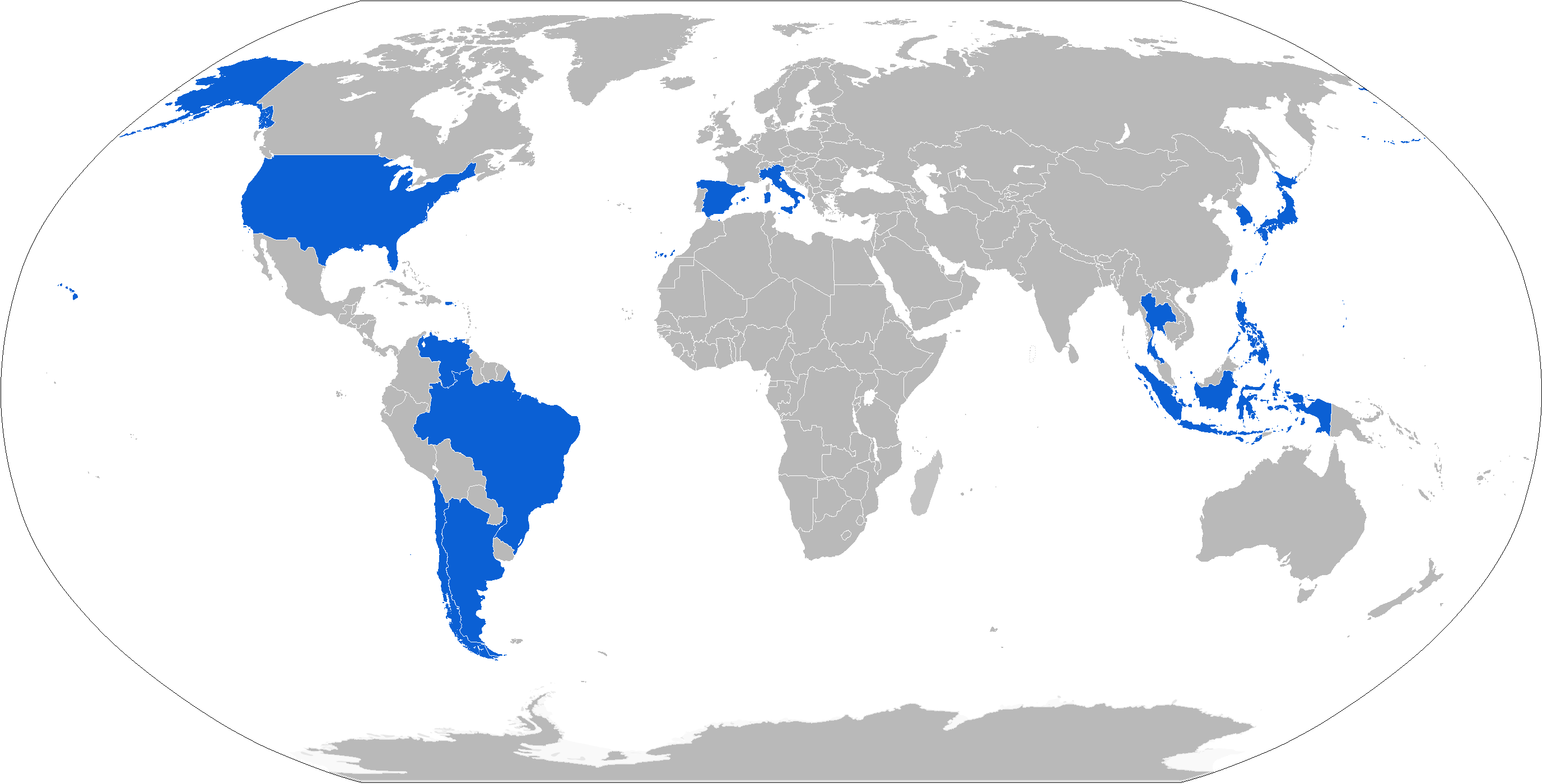
.jpg)
Current
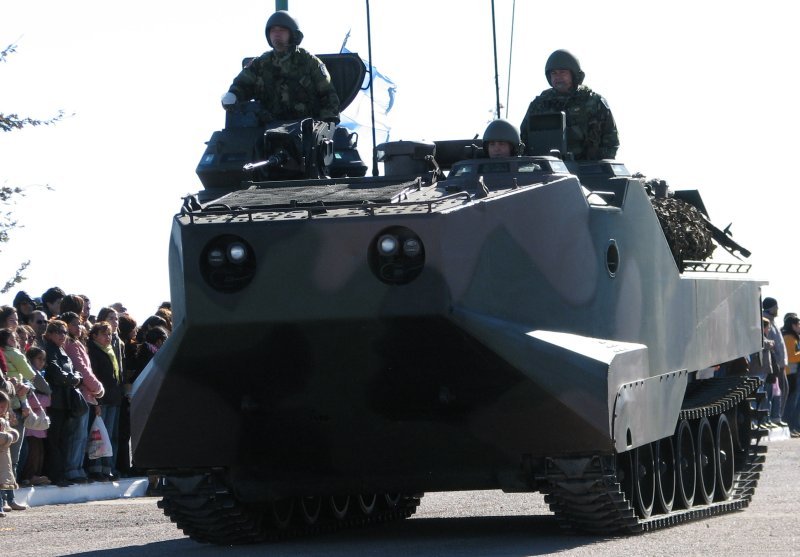
- Argentina: Naval Infantry Command originally received 21 vehicles (19 LVTP-7, 1 LVTC-7 and 1 LVTR-7), 11 of them (9 LVTP-7, 1 LVTC-7 and 1 LVTR-7) were upgraded locally by MECATROL with Caterpillar C7 diesel engines and minor changes to running gear and other components
- Brazil: Brazilian Marine Corps has 49
- Greece: 76 will be procured for use with the Hellenic Marine Corps of the Hellenic Navy
- Indonesia: 15 in service with the Indonesian Marine Corps; donated by South Korea.
- Italy: Due to be replaced by the Italian Marines.
- Japan: Amphibious Rapid Deployment Brigade has 58 (46 personnel, 6 command and 6 recovery) After a period of testing 6 AAVP-7A1s, Japan on 7 April 2016 announced it would purchase 30 systems. Vehicles are AAV7A1 Reliability, Availability, and Maintainability/Rebuild to Standard (RAM/RS) versions, with a more powerful engine and drive train and an upgraded suspension system, providing improved mobility, command, control and repair capabilities. Deliveries to take place in mid to late 2017.
- Philippines: Philippine Marine Corps All 8 AAV vehicles that have arrived in the Philippines are part of a PHP2.42 billion (USD46 million) contract that was signed between the Philippine government and South Korean defence firm Hanwha Techwin in April 2016.
- Romania: 307th Marine Infantry Regiment Romania purchased 21 AAV-7A1 in three configurations: AAVP-7A1, AAVC-7A1, AAVR-7A1. The vehicles will enter service with the naval infantry.
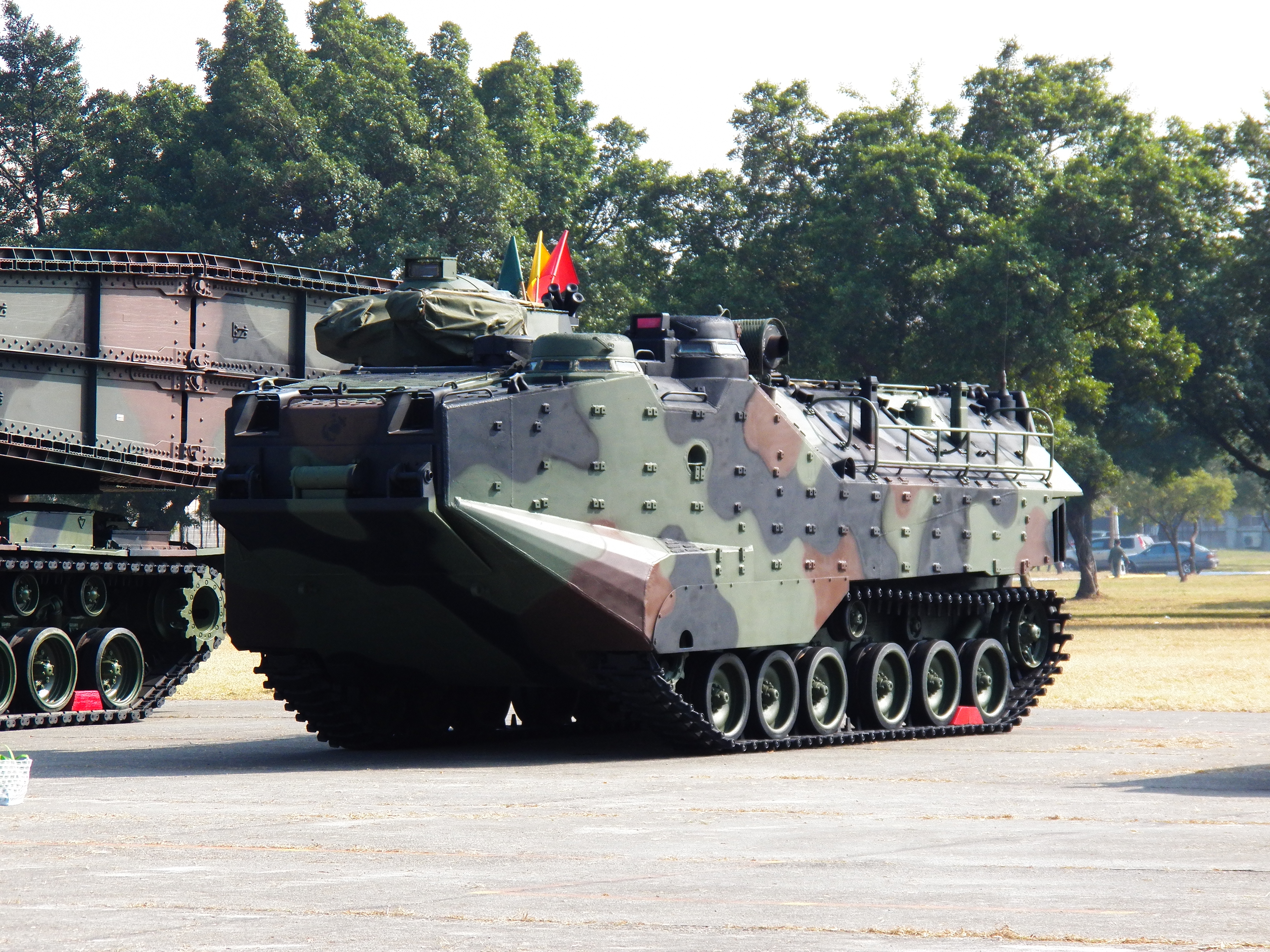
- Taiwan: Republic of China Marine Corps has 90 (78 personnel, 8 command and 4 recovery) and 1 AAV Turret Trainer.
- Spain: 19 (16 personnel, 2 command and 1 recovery)
- South Korea: Republic of Korea Marine Corps 61 as of 2011 (personnel, command and recovery).
- Thailand: 12 as of 2011.
- Venezuela: Venezuelan Marine Corps
Former Operators
- United States: United States Marine Corps retired 26 September 2025
Notes
References
- "Royal Thai Marines Deploy AAVP-7A1 Amphibious Assault Vehicles!".
- Eland, Ivan, ''Putting "Defense" Back Into U.S. Defense Policy'', Greenwood Publishing Group, 2001, p.150
- "LVTP-7 AAVP-7A1 AAV-7 amphibious assault armored vehicle data | United States American Army light armoured vehicle | United States US Army Military equipment UK".
- (2009-03-19). "Assault Amphibious Vehicle Systems (AAVS)". [[Marine Corps Systems Command]].
- "Archived copy".
- "FNSS".
- (15 September 2015). "Bradley: A History of American Fighting and Support Vehicles". Echo Point Books & Media.
- (1979). "Jane's Armour and Artillery 1979–80". Jane's Publishing Company.
- (2011). "Jane's Armour and Artillery 2011–2012". Janes Information Group.
- [http://www.prnewswire.com/news-releases/saic-continues-into-next-phase-of-assault-amphibious-vehicle-survivability-upgrade-300045970.html SAIC Continues into Next Phase of Assault Amphibious Vehicle Survivability Upgrade] {{Webarchive. link. (2015-03-28 - PRNewswire.com, 5 March 2015)
- [http://www.marinecorpstimes.com/story/military/2016/01/29/marines-aging-amphibious-vehicle-fleet-get-better-armor-more-power/79487266/ Marines' aging amphibious vehicle fleet to get better armor, more power] {{Webarchive. link. (2017-06-20 - MarineCorpstimes.com, 29 January 2016)
- [http://www.marinecorpstimes.com/story/defense/2016/03/16/marines-aav-amphibious-assault-vehicle-survivability-upgrade-saic-quantico/81869442/ US Marine Corps Shows Off Upgraded Amphib Vehicle]{{Dead link. (October 2018)
- [https://news.usni.org/2016/03/23/marines-upgraded-aavs-begin-delivering-will-comprise-one-third-of-lift-need-in-2020s Marines’ Upgraded AAVs Begin Delivering, Will Comprise One-Third of Lift Need In 2020s] {{Webarchive. link. (2016-03-28 - News.USNI.org, 23 March 2016)
- (24 September 2018). "US Marine Corps kills amphibious assault vehicle upgrade program". Defense News.
- (25 September 2018). "Marine Corps Cancels AAV Survivability Upgrade". USNI News.
- "Tobyhanna contractors install CROWS systems on Marine AAVs".
- "PEO Soldier".
- Smith, Gordon. (1989). "Battles of the Falklands War". I. Allan.
- [https://news.google.com/newspapers?id=IPEeAAAAIBAJ&sjid=G4QEAAAAIBAJ&pg=6764,5938612&dq Deadliest battle of war so far] Sarasota Herald-Tribune, from [[The New York Times]] News Service, March 24, 2003
- Zeigler, Martin (2006). ''Three Block War II: Snipers in the Sky''. iUniverse, pp. 34 and 36.{{ISBN. 0-595-38816-7
- [http://www.thefinalrollcall.us/stories/charlie.htm#prof Final Roll Call] {{webarchive. link. (May 8, 2005)
- (3 August 2005). "14 U.S. Marines Killed in Iraq when Vehicle Hits a Huge Bomb". The New York Times.
- (28 November 2010). "After escape, BOPE occupies top of favela in Rio de Janeiro". Gazeta do Povo.
- (24 November 2010). "Photo Gallery, Violence in Rio de Janeiro". Veja.
- (8 August 2020). "Sailor, Marines' Remains and Sunken AAV Recovered off San Clemente Island".
- (16 December 2021). "US Marines Ban Amphibious Armored Personnel Carriers from Maritime Operations".
- Burgess, Richard R.. (16 December 2021). "Marine Corps to Cease Deployments, Water Ops of AAV7 Vehicles".
- (19 May 2025). "End of an Era – 2d AA Battalion Bids Farewell to the AAV-P7A1". U.S. Army Europe and Africa.
- (August 2021)
- Garamone, Jim. (6 January 2011). "Gates Reveals Budget Efficiencies, Reinvestment Possibilities". [[American Forces Press Service]].
- [https://www.defensenews.com/land/2018/06/19/bae-wins-marine-corps-contract-to-build-new-amphibious-combat-vehicle/ BAE wins Marine Corps contract to build new amphibious combat vehicle]. ''Defense News''. 19 June 2018.
- [https://news.usni.org/2018/06/19/marines-pick-bae-to-build-amphibious-combat-vehicle-total-contract-worth-up-to-1-2b Marines Pick BAE to Build Amphibious Combat Vehicle; Contract Worth Up to $1.2B] {{Webarchive. link. (2018-06-21 . ''USNI News''. 19 June 2018.)
- Ridzwan Rahmat. "First batch of assault vehicles for Philippine Marine Corps arrives home".
- "Virtual reality, real ingenuity". physorg.com.
- "TJ, Inc". Tjinc-eng.com.
- "Mecatrol". Mecatrol.
- "BAE Systems to Provide Assault Amphibious Vehicles to Brazilian Marine Corps".
- (6 July 2022). "Five new armament programs were approved by the Greek Parliament".
- "Greece – Assault Amphibious Vehicles (AAVs) | Defense Security Cooperation Agency".
- Data Ranratfib Korps Marinir, 2020
- (14 November 2009). "Korsel Hibahkan 10 Tank Amfibi Buatan AS untuk RI".
- Freedberg, Sydney J. Jr.. (27 September 2016). "BAE Unveils 1st Amphibious Combat Vehicle For Marines".
- (13 April 2014). "Big-Ticket Buys Could Hurt Japan". Gannett Government Media.
- (21 August 2013). "Defense Ministry preparing Japanese version of U.S. Marines". The Asahi Shimbun Company.
- (7 April 2016). "Japan buys new BAE Systems AAV7A1 amphibious assault vehicles". Jane's IHS.
- {{usurped
- https://web.archive.org/web/20241206004935/https://www.janes.com/osint-insights/defence-news/philippines-flexes-amphibious-capabilities-at-countrys-first-joint-military-exercise
- (27 July 2023). "Romania – assault amphibious vehicles". [[Defense Security Cooperation Agency]].
- (31 July 2023). "Infanteria marina romana primeste AAV – Assault Amphibious Vehicles". rumaniamilitary.ro.
- (16 December 2015). "Obama's Plan to Arm Taiwan".
- (10 October 2014). "[단독] 기관총에도 뚫리는 해병대 장갑차".
- (7 July 2023). "AAV LVTP7 AAVP7A1 AAV-7 amphibious assault armored vehicle data | United States American Army light armoured vehicle | United States US Army Military equipment UK".
- "Marines bid farewell to the Assault Amphibious Vehicle". U.S. Marine Corps Training and Education Command.
- "USMC’s Amphibious Assault Vehicle Retired After Over 50 Years Of Service". The War Zone.
This article was imported from Wikipedia and is available under the Creative Commons Attribution-ShareAlike 4.0 License. Content has been adapted to SurfDoc format. Original contributors can be found on the article history page.
Ask Mako anything about Assault Amphibious Vehicle — get instant answers, deeper analysis, and related topics.
Research with MakoFree with your Surf account
Create a free account to save articles, ask Mako questions, and organize your research.
Sign up freeThis content may have been generated or modified by AI. CloudSurf Software LLC is not responsible for the accuracy, completeness, or reliability of AI-generated content. Always verify important information from primary sources.
Report