From Surf Wiki (app.surf) — the open knowledge base
Assassination of Indira Gandhi
1984 assassination in New Delhi, India
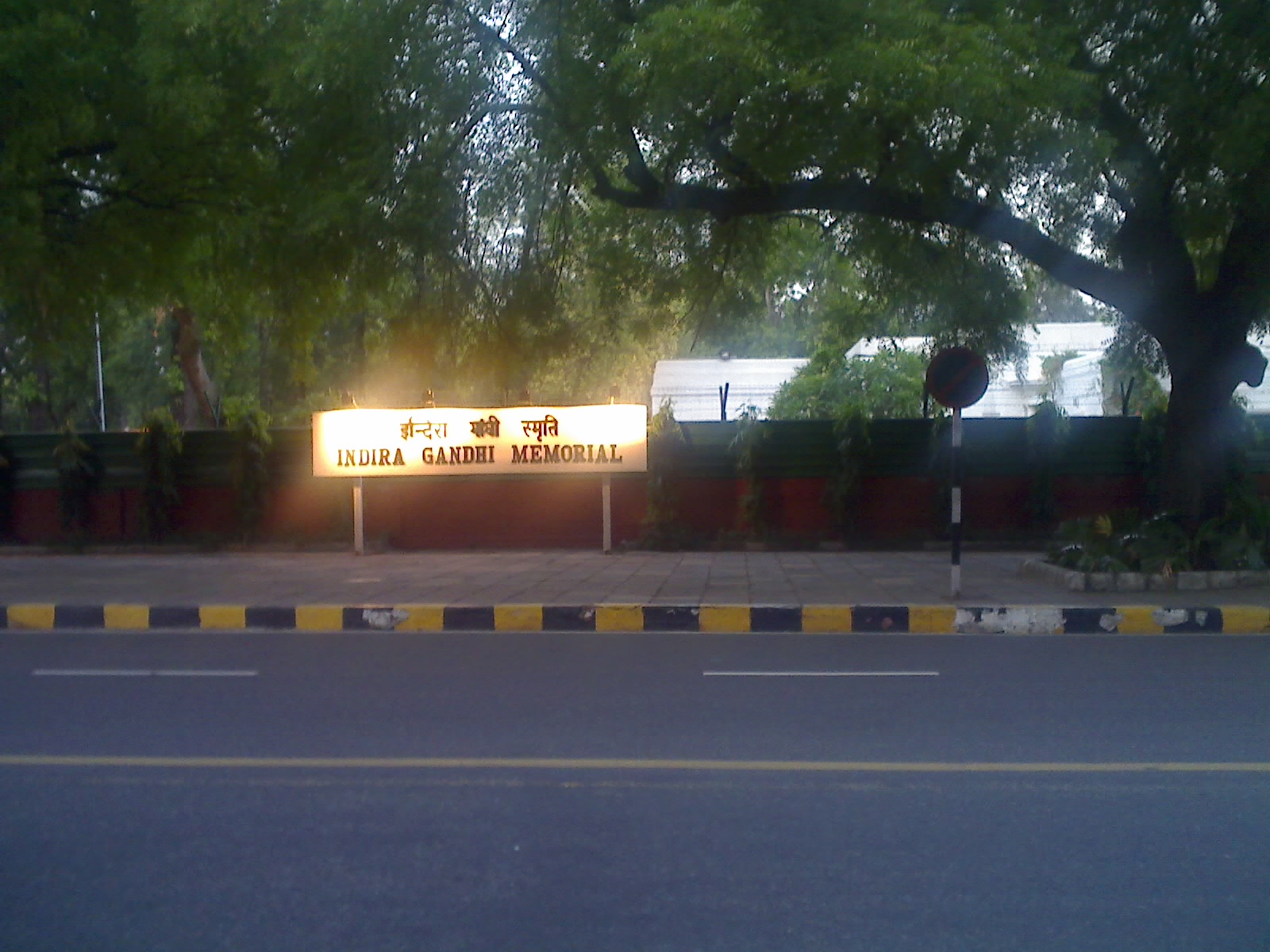
1984 assassination in New Delhi, India
| Field | Value |
|---|---|
| title | Assassination of Indira Gandhi |
| partof | the Insurgency in Punjab, India |
| location | Prime Minister residence, Safdarjung Road, New Delhi |
| date | 31 October 1984 |
| image | PathOfMartyrdom.JPG |
| caption | The spot where Indira Gandhi was shot down is marked by a glass opening in the crystal pathway at the Indira Gandhi Memorial |
| time | 9:30 a.m. |
| type | Assassination |
| weapons | .38 (9.1 mm) revolver and Sterling submachine gun |
| assailants | Satwant Singh and Beant Singh |
| victim | Indira Gandhi |
Indian prime minister Indira Gandhi was assassinated at 9:30 AM on 31 October 1984 at her residence in Safdarjung Road, New Delhi. She was killed by her bodyguards, Satwant Singh and Beant Singh, after the Indian Armed Forces carried out Operation Blue Star between 1 and 8 June 1984 on Gandhi's orders. The military operation was to remove Sikh militant Jarnail Singh Bhindranwale and other Sikh separatists from the Golden Temple in Amritsar, Punjab, the holiest site of Sikhism. The operation resulted in the death of many pilgrims as well as damage to the Akal Takht and the destruction of the Sikh Reference Library.
Gandhi's assassination led to the 1984 Sikh genocide which was instigated by nationalist mobs and political figures from the Indian National Congress (INC), Indira Gandhi's party, who orchestrated pogroms against Sikh populations throughout India. Four days of mob violence resulted in the destruction of 40 historic gurdwaras and other important Sikh holy sites. Official Indian government figures put the death toll at 3,350, while other sources have claimed that between 8,000 to over 25,000 Sikhs were killed.
Operation Blue Star
Operation Blue Star was a large Indian military operation carried out between 1 and 8 June 1984, ordered by Indira Gandhi to remove leader Jarnail Singh Bhindranwale and his militant Sikh followers from the buildings of the Harmandir Sahib complex in Amritsar, Punjab. This attack killed around 5,000 innocent pilgrims, men, women and children, many of whom were Sikhs, and the Indian Army suffered around 700 deaths with most of 80-200 militants dying as well. The Operation also caused serious damage to two of the holiest Sikh shrines, the Golden Temple and Akal Takht, as well as the destruction of the Sikh Reference Library.
The perceived threat to Gandhi's life increased after the operation. Accordingly, Sikhs were removed from her personal bodyguard detail by the Intelligence Bureau for fear of assassination. Gandhi feared that this would reinforce her anti-Sikh image among the public, however, she ordered the Delhi Police to reinstate her Sikh bodyguards, including Beant Singh, reportedly her personal favourite.
Assassination
At about 9:20 a.m. Indian Standard Time on 31 October 1984, Gandhi was on her way to be interviewed by British actor Peter Ustinov, who was filming a documentary for Irish television. She was accompanied by her personal secretary R. K. Dhawan, personal security officer Rameshwar Dayal, and Constable Narayan Singh. She was walking through the garden of the Prime Minister's Residence at No. 1 Safdarjung Road in New Delhi towards the neighbouring 1 Akbar Road office. Gandhi was not wearing her bulletproof vest that day, which she had been advised to wear at all times after Operation Blue Star.
Gandhi passed a wicket gate guarded by Constable Satwant and Sub-Inspector Beant Singh, and the two men opened fire. Beant fired three rounds into her abdomen from his .38 (0.38 inch) revolver; Satwant Singh was tried, convicted, and sentenced to death for killing Gandhi. He was hanged in 1989, along with accomplice Kehar Singh.
Salma Sultan gave the first news of the assassination of Gandhi on Doordarshan's evening news on 31 October 1984, more than ten hours after she was killed. It is alleged by the Indian government that Gandhi's secretary R. K. Dhawan overruled intelligence and security officials who had ordered the removal of policemen as a security threat, including her assassins.
Beant was one of Gandhi's favourite guards, whom she had known for ten years. Satwant was 22 years old at the time of the assassination, and had been assigned to Gandhi's guard just five months earlier.

Gandhi was taken to the All India Institute of Medical Sciences, New Delhi (AIIMS) at 9:30 a.m. AIIMS director-designate Sneh Bhargava wrote that though Gandhi was clinically dead upon arrival, doctors had to keep up appearances and continue to operate on her until her son Rajiv Gandhi could be sworn in as prime minister. She was declared dead at 2:20 p.m. The postmortem examination was conducted by a team of doctors headed by Tirath Das Dogra, who stated that 30 bullets had struck Gandhi from a Sterling sub-machine gun and a revolver. The assailants had fired 33 bullets at her, of which 30 had hit; 23 had passed through her body, while seven remained inside. Dogra extracted bullets to establish the identity of the weapons and to correlate each weapon with the bullets recovered by ballistic examination. The bullets were matched to the weapons at CFSL Delhi.
State Mourning
The Indian government ordered a national mourning from November 1 to November 12 with flags half-masted and cancelled entertainment and cultural events and closed offices for several days. Tanzania declared seven days of mourning, Uganda five, and Cuba four. Pakistan, Vietnam, Brazil, Nicaragua and Gabon each declared three days of mourning. Portugal declared two days of mourning, Yugoslavia, Bulgaria, Cyprus, Mongolian People's Republic and Mauritius declared a day of national mourning.
Funeral
Gandhi's body was taken in a gun carriage through Delhi roads on the morning of 1 November to Teen Murti Bhavan, where her father stayed and where she lay in state. She was cremated with full state honours on 3 November near Raj Ghat, a memorial to Mahatma Gandhi, at an area named Shakti Sthal. Her elder son and successor, Rajiv Gandhi, lit the pyre.
Among the foreign dignitaries who attended the state funeral were:
| Country | Dignitaries |
|---|---|
| Democratic Republic of Afghanistan | Chairman of the Council of Ministers Sultan Ali Keshtmand |
| Algeria | Prime Minister Abdelhamid Brahimi |
| Argentina | Vice President Víctor Hipólito Martínez |
| Australia | Governor-General Ninian Stephen |
| Prime Minister Bob Hawke | |
| Bangladesh | President Hussain Muhammad Ershad |
| Belgium | Deputy Prime Minister Charles-Ferdinand Nothomb |
| Bhutan | King Jigme Singye Wangchuck |
| People's Republic of Bulgaria | General Secretary of the Central Committee of the Bulgarian Communist Party Todor Zhivkov |
| SRUB | Chairman of the Burma Socialist Programme Party Ne Win |
| Canada | Chief Justice Brian Dickson |
| Secretary of State for External Affairs Joe Clark | |
| China | Vice Premier Yao Yilin |
| Cyprus | President Spyros Kyprianou |
| Czechoslovak Socialist Republic | Prime Minister Lubomír Štrougal |
| Fiji | Governor-General Penaia Ganilau |
| Prime Minister Kamisese Mara | |
| Finland | Prime Minister Kalevi Sorsa |
| France | Prime Minister Laurent Fabius |
| East Germany | President of the People's Chamber Horst Sindermann |
| West Germany | Vice Chancellor and Minister of Foreign Affairs Hans-Dietrich Genscher |
| Greece | Prime Minister Andreas Papandreou |
| Guyana | Prime Minister Desmond Hoyte |
| Indonesia | Vice President Umar Wirahadikusumah |
| Ireland | Taoiseach Garret FitzGerald |
| Italy | Minister of Foreign Affairs Giulio Andreotti |
| Japan | Prime Minister Yasuhiro Nakasone |
| Jordan | Crown Prince Hassan bin Talal |
| People's Republic of Kampuchea | President of the Council of State Heng Samrin |
| Prime Minister Chan Sy | |
| Kenya | Vice President Mwai Kibaki |
| North Korea | Vice President Pak Song-chol |
| South Korea | Speaker of the National Assembly Chae Mun-shik |
| Laos | President Souphanouvong |
| Prime Minister Kaysone Phomvihane | |
| Liberia | Vice President Harry Moniba |
| Great Socialist People's Libyan Arab Jamahiriya | Secretary-General of the General People's Congress Mifta al-Usta Umar |
| Madagascar | President Didier Ratsiraka |
| Malaysia | Deputy Prime Minister Musa Hitam |
| Maldives | Minister of Foreign Affairs Fathulla Jameel |
| Mauritius (1968–1992) | Prime Minister Anerood Jugnauth |
| Mongolian People's Republic | First Deputy Chairman of the Council of Ministers Tumenbayaryn Ragchaa |
| People's Republic of Mozambique | President Samora Machel |
| Nauru | President Hammer DeRoburt |
| Kingdom of Nepal | Prime Minister Lokendra Bahadur Chand |
| Netherlands | Prince Claus |
| New Zealand | Governor-General David Beattie |
| Prime Minister David Lange | |
| Norway | Minister of Foreign Affairs Svenn Stray |
| Pakistan | President Zia-ul-Haq |
| Philippines | First Lady Imelda Marcos |
| Polish People's Republic | Chairman of the Council of State Henryk Jabłoński |
| Prime Minister Wojciech Jaruzelski | |
| Portugal | Prime Minister Mário Soares |
| Soviet Union | Chairman of the Council of Ministers Nikolai Tikhonov |
| Spain | Prime Minister Felipe González |
| Sri Lanka | President J. R. Jayewardene |
| Sweden | Minister for Foreign Affairs Lennart Bodström |
| Ba'athist Syria | Vice President Zuhair Masharqa |
| Minister of Foreign Affairs Farouk al-Sharaa | |
| Tanzania | President Julius Nyerere |
| Turkey | Deputy Prime Minister Kaya Erdem |
| Uganda | President Milton Obote |
| United Arab Emirates | Deputy Prime Minister Hamdan bin Mohammed Al Nahyan |
| United Kingdom | Prime Minister Margaret Thatcher |
| Princess Anne (representing Queen Elizabeth II) | |
| United States | Secretary of State George Shultz |
| Vanuatu | President Ati George Sokomanu |
| Prime Minister Walter Lini | |
| Vietnam | President Trường Chinh |
| Prime Minister Phạm Văn Đồng | |
| Yemen Arab Republic | Prime Minister Abdul Aziz Abdul Ghani |
| SFR Yugoslavia | President Veselin Đuranović |
| Prime Minister Milka Planinc | |
| Zambia | President Kenneth Kaunda |
| Zimbabwe | Prime Minister Robert Mugabe |
Aftermath
Over the next four days, 8,000 Sikhs were killed in retaliatory violence. Other sources record well over 25,000 deaths of Sikhs.
The Justice Thakkar Commission of Inquiry, headed by Justice Manharlal Pranlal Thakkar, set up to probe Gandhi's assassination, recommended a separate probe for the conspiracy angle behind the assassination. The Thakkar Report stated that the "needle of suspicion" pointed at R. K. Dhawan for complicity in the conspiracy.
Satwant Singh and co-conspirator Kehar Singh were sentenced to death. Both were executed on 6 January 1989.
A Punjabi movie titled Kaum De Heere (Gems of the Community) highlighting the roles/lives of the two guards that assassinated Indira Gandhi was set to be released on 22 August 2014, but was banned by the Indian government for five years.
References
References
- Swami, Praveen. (16 January 2014). "RAW chief consulted MI6 in the build-up to Operation Bluestar". [[The Hindu]].
- Chima. (2008). "The Sikh Separatist Insurgency in India: Political Leadership and Ethnonationalist Movements". Sage Publishing India.
- (1991). "Counter Terrorism, the Pakistan Factor". Lancer Publishers.
- (2003). "Reduced to Ashes: The Insurgency and Human Rights in Punjab : Final Report". South Asia Forum for Human RIghts.
- (1985). "Oppression in Punjab: A Citizens for Democracy Report to the Nation". Citizens for Human Rights and Civil Liberties.
- (1999). "Politics of Genocide: Punjab, 1984–1998". Ajanta Publications.
- (1998). "The Sikhs of the Punjab (The New Cambridge History of India II.3)". Cambridge University Press.
- (6 June 2018). "What happened during 1984 Operation Blue Star?".
- (2014). "Winning Wars amongst the People: Case Studies in Asymmetric Conflict". Potomac Books.
- (5 November 2016). "Operation Blue Star: India's first tryst with militant extremism".
- Ghose, Sagarika. (December 28, 2018). "She Handpicked Him, He Shot Her Dead". Reader's Digest.
- Smith, William E.. (12 November 1984). "Indira Gandhi's assassination sparks a fearful round of sectarian violence". Time.
- (31 October 2018). "The last day of Indira Gandhi".
- (30 October 2009). "25 years after Indira Gandhi's assassination". [[CNN-IBN]].
- (2 February 2014). "The last walk: Indira Gandhi's last morning as the PM".
- (31 October 1984). "1984: Assassination and revenge". BBC News.
- (24 November 1984). "Questions still surround Gandhi assassination". Times Daily.
- Dr. Sangat Kr. Singh, ''The Sikhs in History'', p. 393
- (3 November 2009). "The riots that could not be televised". Indianexpress.com.
- (24 September 2007). "We the eyeballs : Cover Story – India Today". Indiatoday.intoday.in.
- Hazarika, Sanjoy. (28 March 1989). "India Releases Stinging Report on Gandhi's Death". The New York Times.
- Mollan, Cherylann. (28 June 2025). "A pioneering doctor remembers India leader Indira Gandhi's final moments". [[BBC News]].
- (31 October 2021). "HT THIS DAY: November 1, 1984 — Prime Minister Indira Gandhi shot dead; 12-day mourning announced".
- (6 January 1989). "India Hangs Two Sikhs Convicted in Assassination of Indira Gandhi". The New York Times.
- (1984). "Africa".
- (1984). "Africa".
- [https://sbc.org.pl/Content/88480/PDF/88480.pdf]
- (1982). "Indochina Chronology". Institute of East Asian Studies, University of California.
- "Indira Gandhi assassinated".
- (2 November 1984). "Assassination Aftermath: Olive Branches from Neighbours; Pakistan Offers to Improve India Ties". The New York Times.
- "Decreto nº 90.394 de 31/10/1984".
- [https://sbc.org.pl/Content/88480/PDF/88480.pdf]
- (1964). "Asian Recorder".
- [https://sbc.org.pl/Content/88480/PDF/88480.pdf]
- Указ No. 3904 от 1 ноември 1984 г. Обн. ДВ. бр. 88 от 6 ноември 1984 г.
- "BNL viewer".
- (1984). "Cyprus Bulletin: Review of Cyprus Developments". Press and Information Office, Republic of Cyprus.
- (November 1984). "Daily Report: Asia & Pacific". The Service.
- (1984). "Africa Research Bulletin".
- (1985). "MEA Annual Report 1984-85".
- (4 November 1984). "The World Leaders At the Gandhi Funeral". [[The New York Times]].
- (November 1, 1984). "Reagan, Others Express Shock, Grief". The Boston Globe.
- Reagan, Ronald. (October 31, 1984). "Statement on the Assassination of Prime Minister Indira Gandhi of India".
- Nelson, Dean. (2014-01-30). "Delhi to reopen inquiry in to massacre of Sikhs in 1984 riots". [[The Daily Telegraph.
- (2018). "Political Violence in South Asia". Taylor & Francis.
- Brass, Paul R.. (2008). "The Politics of India Since Independence". Cambridge University Press.
- Chawla, Prabhu. (April 15, 1989). "Thakkar Commission report leak: Govt try to accuse Arun Nehru of being the main culprit".
- (7 January 1989). "Protests Follow Hanging of 2 Sikhs". The New York Times.
- (August 21, 2014). "Centre blocks release of controversial film on Indira Gandhi's assassins 'Kaum de Heere'". [[The Times of India]].
- (August 21, 2014). "Film on Indira Gandhi's assassins barred from release". [[The Tribune (Chandigarh).
- (29 August 2019). "Delhi HC clears release of Punjabi movie 'Kaum De Heere'". The Tribune.
This article was imported from Wikipedia and is available under the Creative Commons Attribution-ShareAlike 4.0 License. Content has been adapted to SurfDoc format. Original contributors can be found on the article history page.
Ask Mako anything about Assassination of Indira Gandhi — get instant answers, deeper analysis, and related topics.
Research with MakoFree with your Surf account
Create a free account to save articles, ask Mako questions, and organize your research.
Sign up freeThis content may have been generated or modified by AI. CloudSurf Software LLC is not responsible for the accuracy, completeness, or reliability of AI-generated content. Always verify important information from primary sources.
Report