From Surf Wiki (app.surf) — the open knowledge base
Asparagus setaceus
Species of plant
Species of plant
| Asparagopsis setacea |Kunth | Asparagus asiaticus var. amharicus |Pic.Serm. | Asparagus lujae |De Wild. | Asparagus plumosus |Baker | Asparagus plumosus nanus |Van Geert | Asparagus plumosus var. tenuissimus |(Van Geert) L.H.Bailey | Asparagus tenuissimus |Van Geert | Asparagus zanzibaricus |Baker | Protasparagus plumosus |(Baker) Oberm. | Protasparagus setaceus |(Kunth) Oberm.
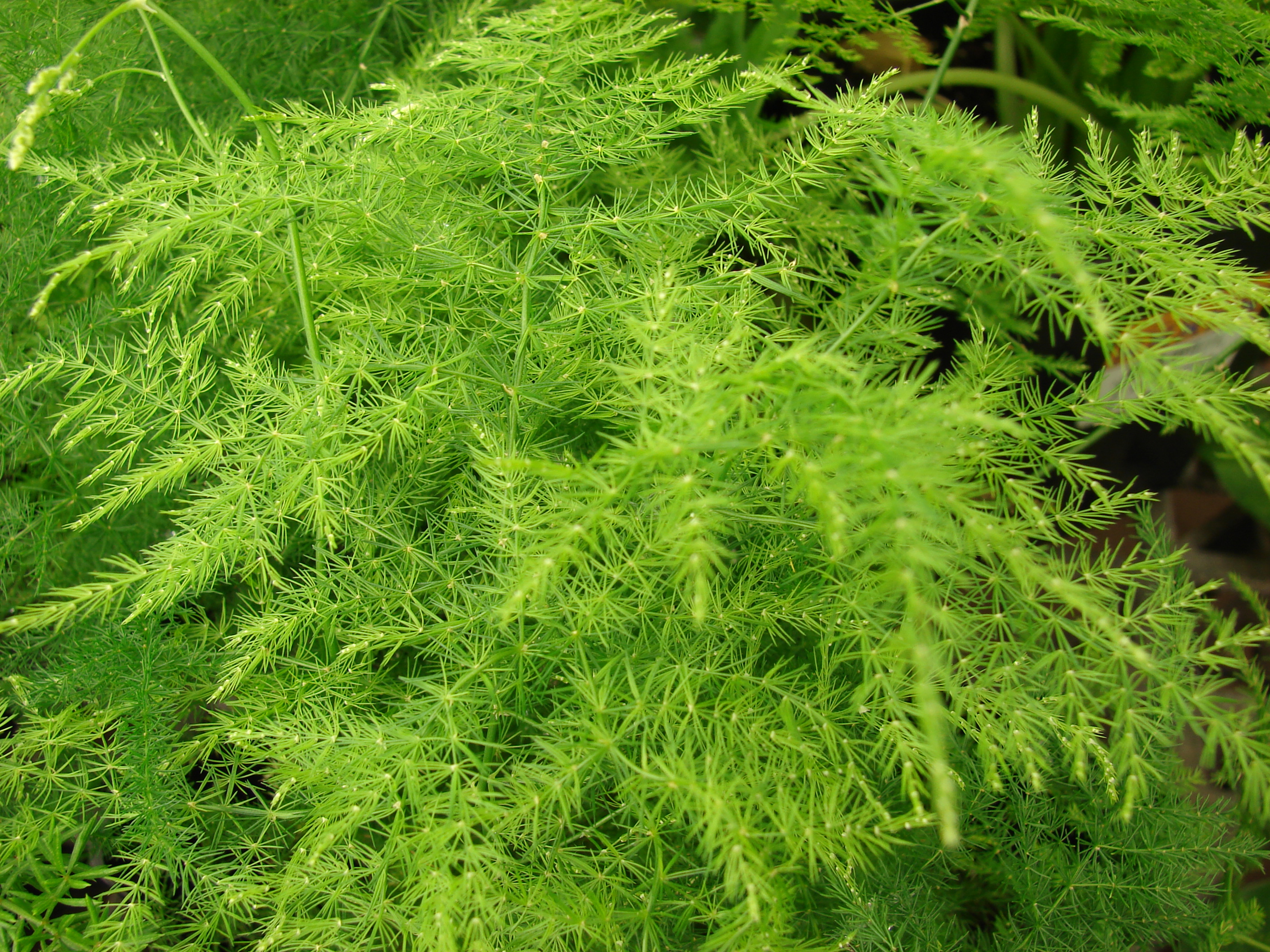
Asparagus setaceus, with the common names of common asparagus fern, asparagus grass, lace fern, climbing asparagus, or ferny asparagus, is a plant in the family Asparagaceae native to southern Africa. Despite its common name, the plant is not a true fern, but has leaves that resemble one.
Naming
Originally described by the German botanist Carl Sigismund Kunth, its Latin specific epithet setaceus means "hairy".
Description
Asparagus setaceus is a scrambling evergreen perennial with tough green stems and leaves, which may reach several metres in length. The leaves are actually leaf-like cladodes up to 7 mm long by 0.1 mm in diameter, which arise in clumps of up to 15 from the stem, making a fine, soft green fern-like foliage. Sharp barbed thorns occur on the stem. Occurring from spring to autumn, the small greenish-white bell-shaped flowers are 0.4 cm long, and are followed by small green berries, which blacken with maturity. They are reportedly toxic upon consumption. If eaten, they can lead to diarrhea and abdominal pain.
Distribution
Asparagus setaceus is native to Southern Africa, extending south west as far as Calitzdorp in the Karoo.
It is grown elsewhere as an ornamental plant and has become an invasive species in several locations where it has been introduced.
Cultivation
Asparagus setaceus is cultivated as an ornamental plant, for planting in garden and containers, and as a house plant. The attractive foliage is also used in floral arrangements. It is hardy to 1 C, but does not tolerate being frozen. Therefore in temperate zones it is normally cultivated indoors in bright, indirect light.
This plant has gained the Royal Horticultural Society's Award of Garden Merit.
Invasive species
In Australia it is considered an invasive species and this hardiness has helped it become a weed in Lord Howe and Norfolk Islands. Other areas that regard it as an invasive species and noxious weed include the North Coast of New South Wales, and Queensland.
Toxicity
Asparagus setaceus is toxic to many domestic animals, including dogs and cats, and if they ingest the berries, vomiting, diarrhea, abdominal pain and allergic dermatitis may result. The toxic agent within the plant is sapogenin, a naturally occurring steroid.
References
References
- "''Asparagus setaceus'' (Kunth) Jessop".
- Asparagus Grass, Adrian Deans, (2023, Hague Publishing) Science fiction novel where a noxious weed becomes a metaphor for a secret alien invasion.
- {{cite PLANTS. (2006-10-01)
- Zachos, Ellen. (2005). "Tempting Tropicals: 175 Irresistible Indoor Plants". Timber Press.
- Simpson DP. (1979). "Cassell's Latin Dictionary". Cassell Ltd..
- "Climbing Asparagus".
- Walliser, Jessica. (2021-11-30). "Plumosa Fern: How to Grow and Care for This Unique Houseplant".
- (2005-12-03). "''Asparagus setaceus''". Institute of Pacific Islands Forestry.
- "RHS Plantfinder - ''Asparagus setaceus''". Royal Horticultural Society.
- (1994). "''Asparagus plumosus''". ABRS, Commonwealth of Australia.
- NSW North Coast Weeds Advisory Committee. (2004). "Asparagus (Climbing) (''Asparagus plumosus'')". Bushland Friendly Nursery Scheme.
- Sonia Jordan. (2007). "Feathered asparagus fern". State of Queensland (Primary Industries and Fisheries within the Department of Employment, Economic Development and Innovation).
- ["Ten Household Plants Dangerous to Dogs and Cats {{!}} Neighborhood Pet Clinic"](https://npcvet.com/10-household-plants-that-are-dangerous-to-dogs-and-cats/#:~:text=Asparagus%20fern%20(also%20called%20emerald,or%20abdominal%20pain%20can%20occur.).
- "Asparagus Fern Poisoning in Dogs - Symptoms, Causes, Diagnosis, Treatment, Recovery, Management, Cost".
- "Asparagus Fern {{!}} ASPCA".
This article was imported from Wikipedia and is available under the Creative Commons Attribution-ShareAlike 4.0 License. Content has been adapted to SurfDoc format. Original contributors can be found on the article history page.
Ask Mako anything about Asparagus setaceus — get instant answers, deeper analysis, and related topics.
Research with MakoFree with your Surf account
Create a free account to save articles, ask Mako questions, and organize your research.
Sign up freeThis content may have been generated or modified by AI. CloudSurf Software LLC is not responsible for the accuracy, completeness, or reliability of AI-generated content. Always verify important information from primary sources.
Report